The American Civil War (1861–1865) was the first conflict extensively documented through photography. Long before combat footage or live news broadcasts, photographers captured haunting images of ruined fields, silent corpses, and solemn soldiers. These images, often printed and distributed in newspapers or displayed in exhibitions, brought the bloody cost of war home to a public unaccustomed to visual proof of battlefield death. The work of Civil War photographers not only changed how people viewed war at the time but also laid the foundation for modern war photography and photojournalism.
Photography was still a relatively young invention in the mid-19th century. Yet within just two decades of its invention, it was being used to chronicle one of the most devastating wars in American history. The result was a rich but sobering visual archive that continues to influence how the Civil War is studied and remembered.
Origins of Civil War Photography
The State of Photography Before the War
By the 1850s, photography had already become a popular tool for portraiture, particularly among the middle class. The most widely used photographic technique was the daguerreotype, introduced to the United States in 1839. Though sharp in detail, daguerreotypes were time-consuming to produce and did not allow for multiple copies. They were soon replaced by more efficient methods like the ambrotype and tintype, which used glass and metal plates, respectively.
However, the most significant advancement came with the wet plate collodion process, developed in 1851 by Frederick Scott Archer. This method involved coating a glass plate with a light-sensitive solution and developing it while still wet. Though cumbersome—it required a portable darkroom and precise timing—it allowed photographers to produce detailed negatives that could be reproduced multiple times. By the late 1850s, this process had become standard in American studios and would be used extensively during the war.
Why the Civil War Became the First Photographed War
While photography had been used in a limited way during earlier conflicts such as the Crimean War (1853–1856), the American Civil War was the first war with broad photographic coverage. Technological advancements made it feasible to transport equipment into the field. Photographers traveled with wagons converted into mobile darkrooms, enabling them to develop images on-site. Though these setups were unwieldy and required extensive supplies, they allowed photographers to remain close to the action.
Another factor was public demand. Americans were hungry for news of the war, and images provided something text could not: a visual connection to the events and people involved. In the North especially, exhibitions and illustrated newspapers used photographs to stir public sentiment. The war also presented a unique commercial opportunity. Enterprising photographers recognized that images of generals, soldiers, and battlefields could be sold as prints, cartes de visite, or included in popular photographic sketchbooks.
Key Figures Who Pioneered the Practice
Mathew Brady is the most recognized name in Civil War photography. Born in 1822 in Warren County, New York, Brady had established a well-regarded portrait studio in New York City by the 1840s. He was already famous for photographing politicians and celebrities when war broke out. Brady saw an opportunity to document the conflict comprehensively and invested his own money to equip a team of field photographers. While he took few battlefield photos himself, he supervised the work of others and published it under his name.
One of Brady’s most talented assistants was Alexander Gardner. A Scottish immigrant born in 1821, Gardner joined Brady’s studio in the late 1850s. By 1862, after a falling out with Brady, Gardner struck out on his own. He went on to produce some of the war’s most iconic images, including scenes from the Battle of Antietam and Gettysburg. Gardner also published the two-volume Photographic Sketch Book of the War in 1866, featuring 100 images with detailed captions.
Another key figure was Timothy H. O’Sullivan, who had worked with both Brady and Gardner. Born around 1840, possibly in Ireland or Staten Island, O’Sullivan gained a reputation for raw and technically advanced images. His photographs of Petersburg’s trenches and the shattered landscape of Gettysburg remain among the most powerful records of the war. After the war, O’Sullivan would continue photographing the American West, helping define documentary photography in the United States.
Notable Early War Photographers:
- Mathew Brady – Studio owner and financier; coordinated a network of field photographers.
- Alexander Gardner – Published Photographic Sketch Book of the War; known for haunting battlefield images.
- Timothy H. O’Sullivan – Captured scenes of combat aftermath and later helped document the American West.
- George Barnard – Focused on the Western Theater and produced striking architectural views.
- Andrew J. Russell – Commissioned by the U.S. Military Railroad; later photographed the building of the Transcontinental Railroad.
Photographing the Battlefield: Process & Challenges
The Technical Side of Battlefield Photography
Photographing during the Civil War was an arduous process. Photographers relied on the wet plate collodion method, which required them to prepare, expose, and develop the plate within 10 to 15 minutes. This meant carrying chemicals like silver nitrate, collodion, ether, and cyanide—hazardous substances that made field work dangerous and difficult. The developing process had to be done in a mobile darkroom, often a horse-drawn wagon equipped with red glass windows and storage for chemicals and fragile plates.
Cameras were large box-like devices mounted on wooden tripods. Exposure times ranged from several seconds to more than a minute, depending on lighting conditions. As a result, moving subjects like live battle scenes were impossible to capture. Most photographs depict still moments—camp life, posed portraits, and the grim aftermath of combat. Even setting up a single shot could take an hour or more, as conditions had to be just right.
What Could (and Couldn’t) Be Captured
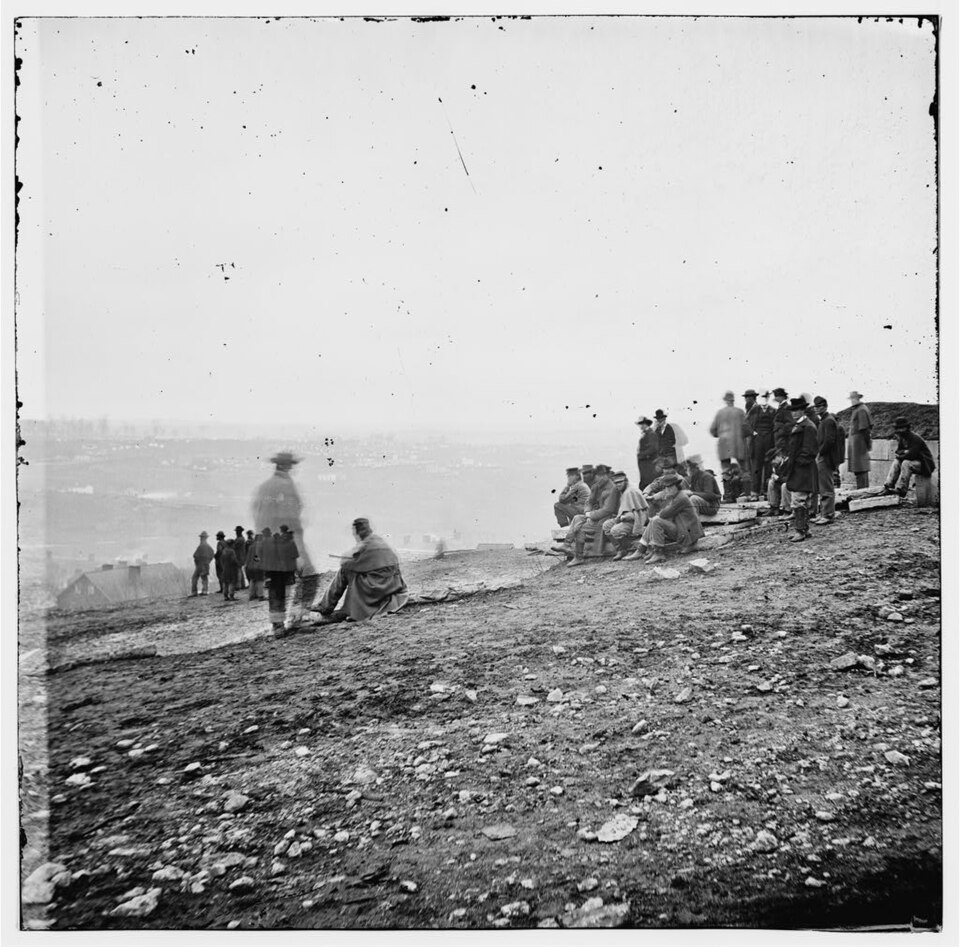
Contrary to popular belief, no Civil War photographs show actual combat. The cameras simply weren’t fast enough. What we have instead are carefully framed scenes taken before or after the fighting. Soldiers were often photographed in camp, standing in formation, or posed with weapons. More chilling were the images of dead soldiers lying across fields and trenches, their bodies untouched and faces visible. These photos showed Americans—for the first time—what death in war really looked like.
Some battlefield scenes were manipulated. In several of Gardner’s photos from Antietam and Gettysburg, historians have noted suspicious placement of bodies and weapons, suggesting the scenes may have been rearranged for dramatic effect. While these practices were not uncommon at the time, they have led to ongoing debates about the ethics of Civil War photography. Despite these concerns, the resulting images remain some of the most powerful visual records in American history.
Ethics and Public Reactions at the Time
The public was not prepared for the brutal reality of battlefield death. When Gardner exhibited his Dead of Antietam series in New York in October 1862, viewers were stunned. For the first time, civilians saw clear images of young American men killed in battle. The New York Times wrote that Brady, who published the work, had “brought home to us the terrible reality and earnestness of war.” The images changed how people perceived the cost of the conflict.
Brady’s business strategy was controversial. Though his name appeared on many photographs, the actual work was often done by others, including Gardner and O’Sullivan. After the war, Gardner and others criticized Brady for failing to credit them properly. In later years, Brady’s legacy became a matter of debate, with some praising his vision and others accusing him of exploiting the labor of his photographers.
Impact on Public Opinion and War Perception
Bringing the War Home to Civilians
Civil War photography brought the conflict directly into the parlors and sitting rooms of American families. Brady and Gardner opened public galleries in major cities like New York and Washington, D.C., where citizens could view enlargements of battlefield scenes. These exhibitions were immensely popular, especially in the North. People came to see portraits of their sons and neighbors, as well as images of battle sites they had read about in the newspapers.
The reach of these images was amplified by illustrated periodicals like Harper’s Weekly and Frank Leslie’s Illustrated Newspaper. While photographic printing technology did not yet allow for direct image reproduction in mass media, engravings based on photographs were widely circulated. These engravings, combined with photo exhibitions and album sales, created a vivid visual culture around the war. Americans were not only reading about the war—they were seeing it.
Reactions from Soldiers and Generals
Soldiers were sometimes wary of photographers in the field. Union generals occasionally cooperated with photographers, especially when images could serve as propaganda or historical documentation. Some commanders allowed photographers to take pictures of camp life, engineering works, or destroyed railroads to demonstrate military effectiveness. In contrast, Confederate officers were generally more suspicious, and far fewer Southern images exist today due to resource constraints and Union capture of photographic materials.
There were also logistical issues. Photographers needed access to the front and protection from both enemy forces and suspicious sentries. Many soldiers saw photographers as intruders or unnecessary distractions. Despite these challenges, many soldiers were eager to sit for portraits, often sending them home as keepsakes. Tintypes and cartes de visite became cherished items for families who feared never seeing their loved ones again.
Influence on Public Sentiment and Morale
The stark imagery of Civil War photography influenced how Americans felt about the war. In the North, especially after 1862, images of battlefield carnage contributed to growing war-weariness. Public opinion began to shift as the reality of high casualties became undeniable. While initial enthusiasm had been strong, by 1863, the photographs helped drive home the enormous human cost of the conflict.
Recruitment patterns were also affected. In some cities, enlistment numbers declined as more images of maimed or dead soldiers appeared in public exhibitions. Meanwhile, abolitionist and pro-Union advocates used photos of escaped slaves and black Union soldiers to support their political causes. Photography, while not always impartial, had become a key tool in shaping the emotional and political narrative of the war.
Key Civil War Photo Exhibitions and Public Reactions:
- Gardner’s “Dead of Antietam” (1862): First exhibition to show American war dead.
- Brady’s Gallery, New York: Regularly displayed battlefield scenes to packed audiences.
- Harper’s Weekly Engravings: Disseminated image-based interpretations to a wide readership.
Legacy and Historical Significance
How Civil War Photography Shaped Modern Photojournalism
The Civil War established photography as an essential tool of wartime documentation. Though limited by its technology, the war demonstrated that the camera could be used to chronicle history with unparalleled clarity and emotional weight. These early photographers laid the groundwork for later wartime photojournalists, from the Spanish-American War to World War I and beyond.
The work of Brady, Gardner, and O’Sullivan became a model for embedded journalism—where photographers accompany soldiers and document events from the front lines. Many of the questions that arose during the Civil War—about truth, staging, and ethics—still echo in photojournalism today. The tension between realism and representation continues to define how war is shown to the public.
Preservation, Archiving, and Public Access
Thousands of Civil War photographs have survived thanks to the efforts of institutions like the Library of Congress, which holds the vast Brady-Gardner-O’Sullivan collection. Many glass plate negatives were preserved, restored, and digitized in the late 20th and early 21st centuries. Today, these images are accessible online through archives such as the National Archives and the American Memory Project.
Some efforts have been made to identify anonymous soldiers depicted in the photographs. In rare cases, modern historians and genealogists have succeeded in connecting faces to names using regimental records, uniform details, or written inscriptions on photo backs. Most identities remain unknown, adding to the haunting quality of these century-and-a-half-old images.
Assessing the Photographers’ Historical Role
Today, historians continue to debate the contributions of Civil War photographers. While Mathew Brady was once hailed as the “father of photojournalism,” modern scholarship gives more credit to his field operators, especially Alexander Gardner and Timothy O’Sullivan. Gardner’s insistence on crediting individual photographers in his 1866 Sketch Book marked an important shift toward artistic recognition in documentary work.
O’Sullivan, long overlooked, is now considered one of the most original visual chroniclers of the war. His unsentimental, almost clinical views of death and destruction helped establish a more modern, less romanticized form of visual storytelling. The legacy of these men endures not just in Civil War memory, but in how wars have been seen and recorded ever since.
Key Takeaways:
- The Civil War was the first war extensively documented through photography.
- Technological advances like the wet plate collodion process made battlefield images possible.
- Key figures included Mathew Brady, Alexander Gardner, and Timothy O’Sullivan.
- Civil War photography shaped public opinion and introduced ethical debates in journalism.
- The photographs remain valuable records and are preserved in national archives.
Frequently Asked Questions:
- Did Civil War photographers capture live combat?
No. The technology required long exposures, so only still scenes could be photographed. - Who took the most famous Civil War battlefield photos?
Alexander Gardner and Timothy O’Sullivan are responsible for many iconic images. - Are the identities of photographed soldiers known?
In most cases, no. A few have been identified through regimental records or annotations. - Were battlefield scenes ever staged?
Yes. Some photos show evidence of rearranged bodies or props for dramatic effect. - Where can I view Civil War photographs today?
The Library of Congress and National Archives offer extensive online collections.