Granada’s artistic prehistory is a murmur beneath the monumental—subtle, scattered, and largely silent. Yet beneath the grandeur of the Alhambra and the weight of Christian cathedrals lies a stratum of visual culture shaped by Iberians, colonizing Romans, and the twilight presence of the Visigoths. Their work survives not as dominant monuments but as traces: pottery shards, mosaics underfoot, disassembled capitals reused in later structures. These fragments are less known but no less essential in understanding how the city learned, layer by layer, to speak in stone, color, and ritual form.
Fragmented Origins and Artistic Echoes
The region of present-day Granada was once home to small, fortified Iberian settlements—oppida—perched on hills for defensive advantage. The local Iberians were not a monolithic group but a mosaic of tribal societies, each with its own customs, burial rites, and visual symbols. In the necropolis of Galera, about 150 kilometers northeast of Granada, archaeologists unearthed polychrome pottery and stylized anthropomorphic sculptures that speak to the symbolic richness of Iberian belief systems. While no major urban Iberian site survives in Granada proper, similar motifs—geometric abstraction, schematic representations of animals, and ritual figurines—likely informed the early visual vocabulary of the region.
With the Carthaginians came trade, and with the Romans, conquest. Roman art introduced not just new forms but new purposes. Art was no longer only symbolic—it became administrative, decorative, didactic. Granada, known to the Romans as Iliberis, became a municipium under the rule of Augustus, and Romanization brought forums, baths, and villas. While the precise location of Iliberis remains debated, enough archaeological evidence has surfaced in the surrounding Vega de Granada region to trace the contours of a classical civic life.
Roman artistic remains in the Granada region tend toward the domestic and the infrastructural. Mosaic fragments, such as those preserved in the Archaeological Museum of Granada, show a Mediterranean elegance: floral scrolls, black-and-white geometric tiles, and occasionally figurative scenes drawn from myth or daily life. One remarkable discovery near Almuñécar—a Roman villa with a fish-salting factory—revealed both utilitarian and ornamental aspects of Roman occupation. Amphorae, statuary bases, and frescoed wall fragments depict a society that balanced commerce and culture, asserting its place through both economic output and aesthetic control.
Roman Mosaic and Utility
It is in these mosaics and architectural traces that Roman Granada reveals its hybrid soul. Unlike the great urban centers of Italica or Tarraco, Roman Iliberis was not a place of imperial propaganda or monumental spectacle. Its art was local, integrated into daily life, and often executed by regional artisans trained in Roman conventions. Floor mosaics used the tesserae not for imperial portraits but for durable beauty in the homes of landowners and officials. Their elegance was subtle: knotwork borders, marine motifs, and Dionysian masks decorating atriums that now lie buried beneath later centuries.
A small, richly detailed mosaic fragment from the Vega Baja shows three birds in symmetrical alignment, framed by stylized ivy leaves. Though not grand in scale, the craftsmanship is meticulous, suggesting an artisan class adept in both technical skill and visual rhythm. Such images also reflect the continuity of natural symbolism—a theme that would reemerge, transfigured, in Islamic stucco and tile.
The Roman road system further shaped artistic transfer. Roads meant movement: of goods, of people, of images. Craftsmen traveled; motifs migrated. A Corinthian capital found reused in a later Visigothic chapel may have originated from a Roman temple dismantled centuries earlier. The Granada basin became a quiet conduit through which visual motifs—scrolls, acanthus leaves, Vitruvian geometries—were carried forward, not as relics but as vocabulary awaiting reinterpretation.
Visigothic Crossroads of Decline
The fall of Rome did not erase its influence. The Visigoths inherited a fractured world, inheriting more ruins than resources. Between the 5th and 8th centuries AD, Granada was not a political center but a peripheral zone—important enough to be claimed, not important enough to be fortified. This ambiguous status fostered a period of stylistic drift. Visigothic art, largely ecclesiastical, drew on both Roman and Christian models while adding its own ornamental lexicon: horseshoe arches, incised vegetal motifs, and crude but expressive figural sculpture.
Granada’s Visigothic past is most visible in portable objects—fibulae, reliquaries, carved liturgical furniture—rather than in standing architecture. One of the few surviving examples of Visigothic religious art in Andalusia is the small basilica of Cuervo, whose altar fragments echo the lace-like carving of earlier Roman stonework but with a rougher, almost anxious touch. This is art made under pressure—politically insecure, aesthetically hesitant.
Granada’s marginality during this era may explain the paucity of monumental Visigothic remains, but it also enabled a quiet receptivity to what came next. As the Islamic conquest swept across Iberia in the early 8th century, Granada offered little in the way of resistance—but much in the way of potential. The layers were thin enough to be built upon, yet thick enough to carry forward echoes of Iberian abstraction, Roman proportion, and Visigothic devotion.
In this quiet before the crescendo, Granada’s artistic foundations were not grand but plural. Its history was one of borrowings and reinventions. And in that ambiguity lay its future brilliance.
Al-Andalus Begins: The Umayyad Arrival and Early Islamic Granada
When the Umayyad armies crossed the Strait of Gibraltar in 711 AD, they brought not only military ambition but an entirely new cosmology of form—abstract, rhythmic, and deeply spiritual. In the centuries that followed, Granada became a fragment of Al-Andalus, absorbing the early momentum of Islamic expansion and eventually transforming into one of its most brilliant outposts. Yet the city’s early Islamic period was not a story of instant splendor. It began in modest settlements, evolving slowly into a seat of power. What emerged during this transitional era was a subtle but decisive shift in artistic sensibility—from the narrative and figural to the ornamental and symbolic, from stone realism to the metaphysics of pattern.
From Garnata al-Yahud to Garnata al-Muslimin
Granada’s name itself reflects the city’s layered transformation. Some historians suggest that “Garnata” (or “Karnata”) was initially a district or suburb of the nearby Roman and Visigothic town of Elvira (Iliberis), located at the foot of the Sierra Elvira mountains. After the Islamic conquest, much of the population of Elvira relocated to Garnata, which lay on more defensible terrain. Over time, this newer settlement eclipsed the older one, and the name “Granada” took on the weight of identity.
Jewish communities also played a crucial role in the city’s early life under Islam. The name Garnata al-Yahud—Granada of the Jews—appears in some early sources, attesting to the city’s early pluralism. Jews, Christians, and Muslims lived in relative proximity under Umayyad rule, a coexistence that allowed for complex aesthetic exchange, especially in manuscript illumination, textiles, and urban ornament. It was not yet a city of palaces or global renown, but even in its early years, Granada became a crucible of visual integration.
Architecturally, the early Islamic Granada was humble. The monumental mosques of Córdoba or the palatial complexes of Madinat al-Zahra overshadowed it. Yet archaeological fragments from the Albaicín—the city’s oldest Islamic quarter—indicate a flourishing domestic culture. Excavations have revealed courtyard homes with geometric stucco reliefs, small cisterns framed by decorative ceramics, and fragments of wall painting bearing vegetal motifs that anticipate later Nasrid styles.
Granada’s position at the edge of the Caliphate of Córdoba offered both opportunity and risk. It was close enough to absorb central Andalusi styles but peripheral enough to develop idiosyncrasies. While Córdoba developed monumental forms in direct dialogue with the Islamic East, Granada’s early artists relied on craft traditions—plasterwork, tiling, wood carving—adapted to local materials and the mountain light.
Kufic Scripts and Geometric Ornament
One of the first great artistic imports of Islamic Granada was calligraphy—not as text alone, but as form. Early Andalusi mosques, coins, and decorative inscriptions bear the influence of Kufic script: a rectilinear, angular style that communicated authority through visual rhythm. Though none of Granada’s earliest mosques have survived intact, fragments of inscribed stone and stucco panels attest to the prominence of calligraphic ornament in architectural programs.
Kufic’s abstraction harmonized perfectly with Islamic Granada’s emerging visual philosophy. In a culture that largely avoided figural imagery in sacred contexts, the script itself became an emblem of divine presence. To write the word was to sculpt it. To read was to trace beauty. Kufic inscriptions, often quoting Qur’anic verses or pious aphorisms, appeared along doorframes, on fountains, and across mihrabs. The architecture of early Islamic Granada was thus written as much as it was built.
Alongside calligraphy, geometric ornament rose in prominence—not merely as decoration, but as worldview. Islamic art’s geometry is not an afterthought but a metaphysical assertion: that unity lies beneath multiplicity, that repetition refines the eye toward contemplation. In Granada, early examples appear in carved stucco, tiled dadoes, and even in the layout of homes, where symmetry and centrality—epitomized in the courtyard—reflected both functional and spiritual order.
The domestic architecture of the Albaicín offers small but telling examples. Homes oriented around square or rectangular patios used water and tile to guide the gaze inward. Zellij—the small, hand-cut ceramic tiles that would later define Nasrid style—began to appear in simple, repeating units. A wall fountain might combine green-glazed ceramics with Kufic inscriptions, uniting utility with devotion.
The Quiet Rise of Architectural Ambition
By the 11th century, Granada had entered a new phase of architectural assertion under the Zirid dynasty. After the fragmentation of the Caliphate of Córdoba in 1031, Granada became the capital of one of several taifas, or independent Muslim principalities. The Zirids, originally Berbers from North Africa, ruled from 1013 to 1090 and made Granada their stronghold. Though the Alhambra had not yet been conceived, the Zirids initiated the first phase of royal construction that foreshadowed its grandeur.
Their seat was the Alcazaba Cadima, or Old Citadel, located in the upper Albaicín. Few remains are visible today, but contemporary accounts describe fortified towers, mosques with carved minbars, and lushly planted courtyards. Here, the themes that would define later Nasrid art—water, light, ornament, and inscription—began their long gestation.
It was during the Zirid period that Granada first developed a reputation for intellectual and artistic cultivation. Poets such as Ibn Hazm and scholars like Samuel ibn Naghrillah found patronage here, contributing to a rich courtly milieu in which the visual and verbal arts coexisted. Miniature painting, textile design, and even sword-making flourished. Granada was no longer a peripheral outpost. It was becoming, quietly and insistently, a world.
A telling anecdote from this era concerns a Zirid emir who commissioned a poem to be carved above the entrance to his palace—a lyric of longing and sovereignty that equated rule with the mastery of words. It was an early instance of a uniquely Granadan impulse: to make art that speaks, and buildings that read like poetry.
Granada in the early Islamic period did not yet possess the visual bravura of later centuries. But its aesthetic DNA—calligraphic, geometric, and contemplative—was already forming. What began as a peripheral city with modest structures became a crucible of styles and strategies that would culminate, generations later, in one of the most dazzling visual cultures in European history.
The Nasrid Dynasty and the Making of the Alhambra
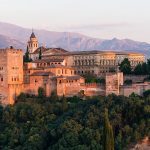
The Alhambra was not built all at once. It unfolded across decades, shaped by dynastic ambition, architectural experimentation, and a worldview that sought to harmonize power with beauty. In the 13th century, the Nasrid dynasty turned Granada into the last great Islamic capital on the Iberian Peninsula, and the Alhambra became its crown—part fortress, part palace, part symbolic universe. It was more than a structure; it was a manifesto of governance, aesthetics, and spiritual geometry. And it remains, even in ruin and restoration, one of the most complete expressions of Islamic art in the West.
Court of the Lions: A Palace Like a Poem
Founded by Muhammad I in 1238 after aligning his Emirate with the expanding Christian kingdoms of Castile, the Nasrid dynasty set about creating a new royal center above the older Alcazaba of the Albaicín. They chose the Sabika hill for its strategic advantage—but also for its theatrical potential. The site offered not just visibility but vistas, allowing the Alhambra’s builders to orchestrate views of sky, city, and mountain with painterly precision.
The Alhambra developed as an ensemble of palaces rather than a single unified structure. Its most iconic space, the Court of the Lions, was not completed until the reign of Muhammad V in the later 14th century. This courtyard is the heart of Nasrid Granada, and it expresses the full maturity of the Alhambra’s aesthetic logic: slender columns encircle a central fountain borne by twelve marble lions, while delicate stucco filigree turns walls into pages of ornament.
Everything in the Court of the Lions is calibrated to evoke otherworldliness. The proportions are improbably delicate, almost weightless. Columns resemble palm stems more than architectural supports, while the carved vaults above—muqarnas domes that seem to drip downward like stalactites—fracture light into infinite variation. The inscriptional program further deepens the experience. Inscriptions drawn from poets of the Nasrid court, often composed specifically for the space in which they appear, transform the palace into a spatial anthology. One couplet engraved in the Hall of the Two Sisters reads: “I am a garden adorned by beauty: my being will know whether you look at my beauty or my architecture.”
It is no accident that so many visitors—poets, painters, and philosophers—have compared the Alhambra to literature. The palace is not only filled with poetry, but structured like a narrative. Visitors pass through thresholds, experience episodes, encounter themes of paradise, justice, transience, and divine harmony. Like a well-composed poem, its complexity never announces itself. It reveals itself slowly, through movement, rhythm, and repetition.
Water as Architecture
If light is the Alhambra’s script, water is its voice. No single element contributes more to the palace’s aesthetic than the constant presence of water—channeled, mirrored, stilled, and set in motion with meticulous intent. Unlike in Roman or Christian architecture, where fountains were often celebratory or symbolic, water in the Alhambra performs multiple roles at once: it cools, it reflects, it orchestrates space.
In the Court of the Myrtles, a long rectangular pool stretches between colonnades, dividing the space while doubling it. Reflections of arches, tiles, and sky collapse the boundary between material and immaterial. The sound of trickling water becomes part of the sensory architecture—an acoustic buffer that stills the mind.
Even the hydraulic system beneath the surface reveals an artistry of engineering. Fed by the Acequia Real, or Royal Canal, the Alhambra’s network of aqueducts and cisterns ensures not just abundance but constancy. Water appears where it is needed—not as surplus but as punctuation. Narrow rills carved into the marble floors guide the eye and the feet. In private rooms, small basins provide privacy and purity; in audience chambers, large pools establish grandeur without excess.
Perhaps the most striking example of water’s architectural function is found in the Hall of the Abencerrajes, where a small star-shaped basin lies directly beneath a muqarnas dome. The spatial alignment is deliberate. As sunlight filters through the perforations above and water shimmers below, the entire room becomes a metaphor for the heavens reflected on earth. The dome, like the cosmos, is both fixed and flowing. Water makes it visible, audible, and real.
Muqarnas and Material Poetry
Among the most technically complex and visually arresting features of the Alhambra are its muqarnas ceilings—honeycomb vaults made from thousands of intricately carved cells that appear to float in space. These forms, derived from earlier Persian and Maghrebi traditions, found their most refined Western expression in Nasrid Granada.
Muqarnas vaults do not merely ornament ceilings; they dismantle the very idea of a ceiling. In rooms like the Hall of the Two Sisters and the Hall of the Abencerrajes, muqarnas structures dissolve the architectural boundary between interior and sky. They fragment light into micro-experiences, transforming each shift in perspective into a new visual event.
To build them required not only aesthetic vision but mathematical mastery. The interlocking plaster or wood cells—each uniquely shaped—had to be measured, cut, and assembled with unerring precision. Though structurally lightweight, muqarnas vaults give the illusion of endless depth, as if space itself were multiplied and refracted. Their beauty lies in their refusal to settle into a single shape.
This abstraction, far from being cold or decorative, is deeply expressive. In a culture that avoided figural representation in sacred or royal spaces, abstraction became a form of metaphysical storytelling. Geometry, light, water, and word worked together to articulate a worldview in which transience and permanence were not opposites but cohabitants. Everything in the Alhambra—stone, tile, poem, and plant—reminds the visitor of beauty’s ephemerality and the soul’s enduring quest.
A micro-narrative survives in the writing of Ibn Zamrak, court poet to Muhammad V, who described how he was tasked with composing verses to adorn the walls of the new palace. He walked alone through unfinished courtyards, listening to the echo of his footsteps and the rustle of cedar scaffolding. The walls were still blank, awaiting script. As he later wrote, “I saw the palace not as a structure but as a silence waiting to be filled.”
The Alhambra is that silence, filled—not loudly, but completely.
A City of Scholars and Scribes: Calligraphy, Illumination, and Science as Art
Granada under the Nasrids was more than a city of palaces—it was a city of thought. Behind the intricate stucco of the Alhambra and the marble basins of its courtyards lay an intellectual infrastructure equally refined, equally intentional. The written word, especially in Arabic, held an exalted position in Nasrid Granada, not only as a medium of record but as an art in itself. The production of manuscripts, the patronage of scholars, and the philosophical spirit of inquiry that pervaded the city were all part of a broader cultural matrix in which science, religion, aesthetics, and politics were deeply interwoven.
Manuscript Aesthetics in Nasrid Granada
Although few illuminated manuscripts survive directly from Nasrid Granada, the city’s reputation as a literary and artistic center was formidable in its time. Granada produced not only copies of classical works but also original compositions in fields as varied as astronomy, medicine, botany, and theology—each rendered in calligraphic scripts that often blurred the line between reading and seeing.
The primary script in use was maghribi, a round, flowing style that originated in North Africa but was refined in Andalusi contexts. Its generous curves and exaggerated ligatures made it well suited for visual emphasis, particularly in religious or poetic works. In Qur’anic manuscripts, the letters themselves were often colored or outlined in gold, and marginalia bloomed like small gardens around the central text. The layout of these pages mirrored architectural ideals: balance, symmetry, and quiet density.
While Granada never became a book-producing powerhouse on the scale of Córdoba or Baghdad, its scribes were among the most respected in the Islamic West. Manuscripts from this region were prized for their elegance of proportion and the delicacy of their ornamentation. Gold leaf, indigo, and vermilion pigments were sparingly but precisely used, often forming vegetal motifs in the margins or framing key phrases in geometric medallions. These books were not mass-produced; they were intellectual luxury goods, carried between courts, gifted to scholars, or commissioned by rulers as declarations of taste and legitimacy.
A remarkable example of this synthesis between text and ornament is a 14th-century Qur’an attributed to a scriptorium in Granada, now preserved in the Bibliothèque nationale de France. Though damaged and partially incomplete, it displays a meticulous interplay between script and embellishment, with illuminated suras bracketed by gold cartouches that mirror the arabesque motifs of Nasrid stucco. Each page is a field of visual rhythm—an architecture of ink.
The Role of the Madrasas
The Madrasa Yusufiyya, founded by Sultan Yusuf I in 1349, was the intellectual counterpart to the Alhambra. Located just off the Plaza Nueva in the heart of Granada, it was the first major institution of higher learning in the city. Unlike the more cloistered royal palaces, the madrasa was a semi-public space—a crossroads of jurisprudence, theology, grammar, and logic. The building itself, modest in scale compared to religious schools in Cairo or Fez, reflected the same principles of Nasrid architecture: intimate courtyards, water features, and finely carved ornament emphasizing the fusion of intellect and devotion.
The madrasa curriculum included the qira’at (readings of the Qur’an), Islamic jurisprudence (fiqh), Arabic grammar, and often mathematics and astronomy. But what distinguished Nasrid scholarly culture was the stylistic polish expected in all forms of discourse. Eloquence was not a flourish; it was a form of discipline. In Granada, learning was not merely the acquisition of knowledge—it was its aesthetic refinement.
Students and scholars were trained not only to interpret texts but to produce them. The act of writing was performative, almost sacred. Even marginal annotations in surviving manuscripts show care for penmanship and layout. These annotations—often in a slightly different hand and ink—form a secondary layer of meaning, sometimes challenging, sometimes supplementing the main text. They are the visual residue of live intellectual engagement.
Yusuf I’s vision of a city steeped in learning was further supported by an informal network of scholars, poets, copyists, and theologians. Many held courtly titles and advised on matters of law or science. Others remained more peripheral but exerted significant cultural influence through their written works. The coexistence of institutional and informal modes of learning allowed Granada to foster a wide spectrum of intellectual life, from theological orthodoxy to philosophical speculation.
Science Rendered Beautiful
Granada’s scientific culture did not separate accuracy from elegance. Astronomical tables were drawn with calligraphic care; medical treatises were bound in leather and incised with interlacing patterns; botanical illustrations combined precise identification with floral embellishment. This synthesis of form and function speaks to a different conception of knowledge—one that values harmony between utility and grace.
One notable figure was Abu Ishaq Ibrahim al-Zarqali, a Toledo-born astronomer whose influence extended to Granada through the preservation and commentary of his works. Granadan scholars not only copied his Zij (astronomical tables) but reformatted them for use in the city’s own observatories. Some tables included small illustrative flourishes—stylized suns, star patterns, and colored coordinate grids—that made them both readable and visually engaging.
Scientific manuscripts from Nasrid Granada often used colored inks to distinguish categories of information: black for main text, red for rubrics or definitions, and blue for commentary. These chromatic hierarchies did more than organize information—they trained the eye to navigate knowledge spatially, much like one would navigate a building or a garden. This cartographic logic is part of what makes Nasrid visual culture so immersive: it draws the viewer—or reader—into a choreography of comprehension.
An especially poignant artifact is a mid-14th-century treatise on medicinal plants, copied in Granada and now held in Istanbul. The illustrations are small and tightly framed, each plant rendered with stylized yet recognizable accuracy. The text surrounds the image like a garden wall, integrating botanical science with poetic structure. The book is not just a reference—it is an object of contemplation.
In this environment, knowledge was not compartmentalized but cultivated as a single garden with many species. Poetry grew beside logic; theology branched into astronomy; beauty pollinated every field.
As the Nasrid state matured and its political fortunes shifted, the city’s artistic and intellectual energies became ever more intertwined. Granada was no longer simply a capital—it was a script being written in real time, line by luminous line.
The Fall of Granada and the Christian Reconquista
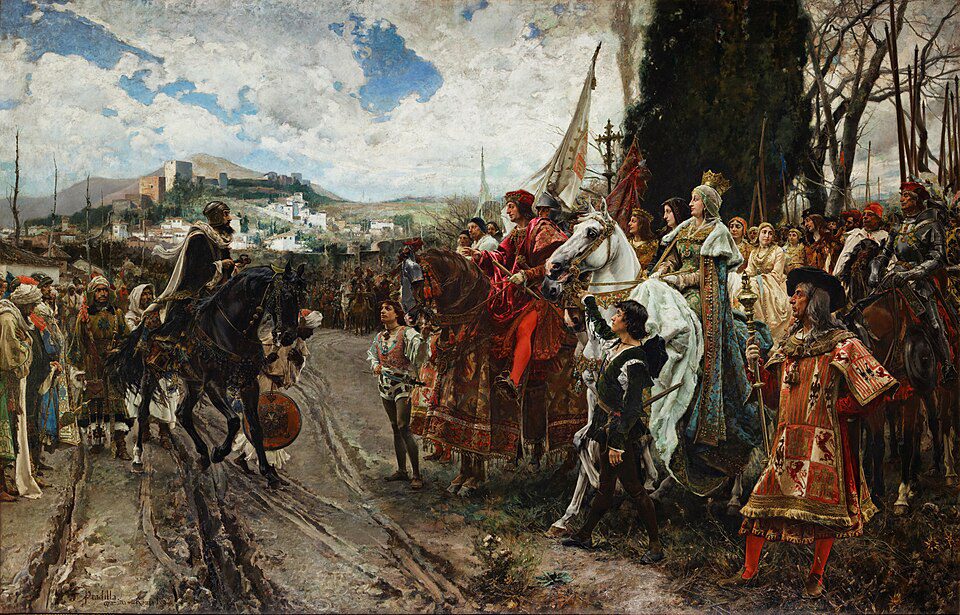
In January of 1492, the banners of Ferdinand and Isabella were raised over the Alhambra, signaling the end of nearly eight centuries of Islamic rule in Iberia. The fall of Granada was not merely a military or political event—it marked a seismic shift in cultural identity, artistic patronage, and the symbolic meaning of space. The last Nasrid ruler, Muhammad XII—known to the Castilians as Boabdil—surrendered the city with a ceremonial gesture, handing over the keys of the Alhambra. What followed was a carefully orchestrated transformation: the appropriation of Islamic art, the Christianization of public space, and the deliberate reprogramming of Granada’s aesthetic memory.
1492: Between Worlds
The conquest of Granada was both the final chapter of the Reconquista and the prologue to Spain’s imperial expansion. That same year saw the expulsion of the Jews from Spain, the first voyage of Columbus, and the formal unification of Castile and Aragon under a single crown. Granada, once a polyglot refuge of Muslims, Jews, and Christians, became the ceremonial keystone of this new Catholic monarchy. Its art and architecture were among the most visible casualties—and instruments—of this transformation.
Initially, the terms of surrender were relatively generous. The Capitulations of Granada, signed in late 1491, guaranteed the city’s Muslim population the right to practice Islam, retain their property, and preserve their cultural traditions. But these guarantees were rapidly eroded. By the early 1500s, forced conversions were underway, Arabic books were burned in public squares, and Islamic schools were shuttered. Granada’s visual and intellectual life, once outward-looking and cosmopolitan, was rapidly forced into conformity with the Catholic monarchy’s vision of sacred order.
This rupture is visible in the sudden cessation of Nasrid patronage. The delicate balance of poetry, ornament, and public space that had defined the Alhambra was suspended in time. Its walls, once inscribed with verses praising ephemeral beauty and divine justice, were now interpreted through a lens of conquest. Rooms that had echoed with the murmur of prayer and poetry now housed the courts of the Catholic Monarchs. Isabella herself is said to have fallen in love with the Alhambra’s beauty, commissioning restorations even as she removed its cultural meaning.
A micro-narrative survives in the lament of Boabdil’s mother, who, upon seeing her son weep as he rode away from the city, is said to have rebuked him: “Do not weep like a woman for what you could not defend like a man.” Whether apocryphal or not, the story encapsulates the intense personal and symbolic charge of Granada’s fall. It was not only a political defeat—it was the loss of a worldview rendered in stucco, water, and verse.
Artistic Hybridity and Cultural Displacement
What followed in Granada was not a clean sweep but a complex entanglement. Islamic forms did not disappear overnight. In fact, many were deliberately preserved, appropriated, or reinterpreted within a Christian framework. This hybridity—at once aesthetic and ideological—defines the early decades of post-Reconquista Granada.
The Catholic Monarchs themselves made strategic use of Islamic visual language. Rather than raze the Alhambra, they converted parts of it into royal quarters. They retained its ornamental vocabulary while stripping it of theological context. In doing so, they signaled both continuity and dominion: the splendor of the conquered was now the property of the conquerors. The architecture of Granada became an object lesson in political theatre.
Elsewhere in the city, Islamic buildings were converted for Christian use. Mosques became churches, often with minimal alteration at first. The Great Mosque of Granada, once a center of learning and worship, was transformed into the site of the newly founded Granada Cathedral. This practice of architectural conversion was not unique to Granada, but it carried particular poignancy here, where Islamic art had reached such a refined pitch of expression.
The process of displacement was not always destructive. In some cases, it gave rise to new artistic idioms. Mudéjar art—created by Muslim artisans under Christian patronage—flourished in the decades following the conquest. These artists brought their technical mastery and aesthetic vocabulary to bear on Christian commissions, producing ceilings, altarpieces, and decorative elements that blended Gothic structure with Islamic ornament. In this way, Islamic Granada continued to shape Spanish art long after its political power had been extinguished.
Yet the cultural loss was profound. Libraries were emptied. Manuscripts were destroyed. Arabic, once the language of administration, science, and poetry, was banned from public use. Artisans who had shaped the visual identity of the city were either driven out, forced to convert, or absorbed into Christian guilds. What remained was a ghost of an artistic tradition, preserved in form but severed from its roots.
Churches from Mosques, Altarpieces from Ashes
One of the most striking features of post-conquest Granada is the speed with which Christian religious art was imposed on the cityscape. Churches rose where mosques had stood, not always replacing them entirely but reconfiguring them. The new architectural language was Gothic—pointed arches, ribbed vaults, and soaring verticals—but it often retained Islamic features such as horseshoe arches, intricate woodwork, and geometric tiling.
The Church of San Salvador, built over the site of the old Albaicín mosque, offers a vivid example. Its entrance incorporates Islamic decorative stonework; its courtyard retains the proportions of the original sahn. The resulting structure is neither entirely mosque nor entirely church—it is a spatial palimpsest in which theological conquest and aesthetic admiration coexist uneasily.
Inside these churches, Christian iconography took hold quickly. Altarpieces became the dominant form of religious art, filling the void left by the absence of Islamic figural representation. These retablos were complex, multi-paneled constructions that combined narrative painting with architectural sculpture. They served a didactic function, visually narrating biblical stories to a largely illiterate population. In Granada, these altarpieces often adopted local materials and occasionally even local techniques, resulting in works that—though unmistakably Christian—bore the fingerprints of Islamic craftsmanship.
The altarpiece of the Monastery of San Jerónimo, for instance, displays a stylistic density that echoes Nasrid ornament. Its tiers of painted saints and gilded frames are set within a carved wooden structure that recalls the coffered ceilings of earlier Mudéjar halls. In this and other examples, Granada’s post-Islamic art reveals a complex inheritance—an aesthetic language caught between rupture and continuity.
Granada’s artistic transition after the Reconquista was not simply the triumph of one style over another. It was a moment of collision, translation, and uneasy coexistence. The city’s architecture and visual culture became a battleground of memory, in which each stone could carry multiple histories, each arch multiple meanings.
And beneath the gilding and saints, the ghosts of verses still lingered in the walls.
Mudejar Art and the Persistence of Islamic Aesthetics
In the wake of the Christian conquest of Granada, the visible language of Islamic art did not vanish. It persisted—subtly transformed and redeployed under a new regime. The term Mudejar refers to Muslims who remained in Christian-controlled territories after the Reconquista, and by extension to the art and architecture they continued to produce, often for Christian patrons. In Granada, where the Islamic visual tradition had reached extraordinary refinement, this persistence was neither marginal nor accidental. Mudejar aesthetics became one of the defining features of post-conquest Spanish art, a paradoxical survival of Islamic forms within an ideologically Christian framework.
Wood, Stucco, and the Language of Survival
The Mudejar artisans of Granada—many of whom had worked on Nasrid palaces or urban homes—found themselves in a radically altered landscape after 1492. Their patrons were now Christian nobles, bishops, or municipal authorities. Yet these new clients often wanted the very things Islamic artisans excelled at: carved wood ceilings, decorative plaster, polychrome tile. What had once been courtly Islamic luxury became, under Christian rule, a fashion—adapted, abstracted, but unmistakably derived.
Among the most enduring forms of Mudejar artistry in Granada was the coffered wooden ceiling. These ceilings, often assembled from interlocking geometric panels (artesonados), became a hallmark of both ecclesiastical and civic buildings. They were not simply structural solutions—they were ornamental programs that revealed the hand of masters trained in Islamic geometry and timber craft. One surviving example, in the Royal Chapel of Granada, floats above the space like a shadow of the Alhambra, its eight-pointed stars and interlace patterns recasting Nasrid aesthetics in service of Christian devotion.
Stucco, too, remained a favored medium. Though the iconography shifted—heraldic shields replacing Qur’anic inscriptions, for example—the techniques remained deeply rooted in Islamic practice. Plaster was poured, carved, and painted with the same meticulous care, producing surfaces that glittered with the texture of memory. In private homes, particularly those of converted Muslims or wealthy Christian officials emulating Nasrid luxury, stucco ornament reappeared in courtyards, doorways, and fireplaces.
And then there was tile. Azulejos, the glazed ceramic tiles that had adorned Nasrid walls and fountains, now covered sacristies, stairwells, and municipal chambers. Christian commissions often introduced new motifs—Christian symbols, Latin texts—but the geometry and color palettes retained Islamic sensibilities. Granada’s artisans continued to fire tiles in the same kilns, using inherited formulas for glazes and cuts. The materials endured even as the message changed.
Three common features in post-conquest Mudejar work show this transformation vividly:
- Eight-pointed stars and interlace motifs, now surrounding Christian coats of arms.
- Arabic script fragments repurposed as abstract ornament, their semantic content forgotten or ignored.
- Water channels and patios in domestic architecture, maintaining the Islamic emphasis on inward-focused, contemplative space.
This continuity was not merely stylistic—it was a form of cultural negotiation. Mudejar art enabled a visual transition that softened the rupture of conquest without erasing the conquered.
Craftsmen Without a Court
One of the quiet tragedies of Mudejar Granada is the dislocation of its craftsmen. The Nasrid court had provided not just patronage but a coherent cultural identity. After 1492, these artisans became freelancers in a world that no longer spoke their language—literally and figuratively. Many were moriscos, Muslims who had converted to Christianity (voluntarily or under duress) but retained Islamic customs and knowledge. Their position was precarious: tolerated for their skills, distrusted for their background.
Records from the early 16th century document numerous contracts between Christian institutions and morisco artisans in Granada. These documents often specify details down to the type of wood to be used, the motifs to be carved, and the timeline of delivery. They reveal both the enduring demand for Islamic-style craftsmanship and the social unease that accompanied it. Artisans were paid, praised, and policed in equal measure.
One compelling figure is the anonymous master of the Casa de los Tiros, a fortified noble house in central Granada that showcases some of the most elaborate Mudejar ceilings and decorative schemes in the city. His name is lost, but his work survives: geometric woodwork of dazzling complexity, cornices bearing alternating Arabic and Latin phrases, and a spatial logic that echoes the Alhambra in miniature. His anonymity is typical. Many of the most skilled artisans of the period remain nameless, their identities absorbed into guilds or erased by the politics of suspicion.
These craftsmen often had to walk a narrow path: working with Christian iconography using Islamic techniques. The result was not dilution but fusion. In churches like Santa María de la Alhambra or the Monastery of San Jerónimo, one finds chapels where Marian imagery is framed by muqarnas vaulting, or altars flanked by tile panels in blue and white arabesques. The boundary between conquered and conqueror became increasingly difficult to locate—at least on the surface of things.
The Paradox of Integration
Mudejar art thrived in part because it offered Christians a means of visually absorbing Islamic culture without endorsing its theology. The paradox was profound: Islamic aesthetics were preserved precisely because they could be de-Islamized. Granada became, in effect, a workshop of Christian exoticism—a place where the decorative genius of the vanquished could be enjoyed without acknowledging its origins.
This was not always cynical. For many Christian patrons, Nasrid and Mudejar aesthetics represented a kind of idealized civility—an art of order, refinement, and complexity. The fact that it came from a defeated rival only heightened its allure. To commission a Mudejar ceiling or a tiled chapel was to participate in a visual language of victory made gracious by inheritance.
Yet this integration also masked deeper dislocations. The morisco population, including many artisans, faced growing suspicion throughout the 16th century. By 1567, the imposition of strict assimilation policies—banning Arabic language, Islamic dress, and public rituals—eroded the cultural base that had sustained Mudejar practice. The final blow came with the expulsion of the moriscos in 1609–1614, a state-sponsored removal that aimed to “purify” Spain’s Christian identity.
After that, Mudejar became a style without a people. It was preserved by memory and imitation, by Catholic craftsmen who had learned the forms but not the philosophy behind them. It became part of Spain’s architectural DNA—but as a ghost of itself.
The story of Mudejar Granada is thus both triumphant and tragic. It is the story of artists who continued to build in the language they knew, long after the meanings had been erased. It is also the story of a visual tradition that survived not by resisting conquest, but by adapting to it so subtly that it could not be completely extinguished.
The Counter-Reformation and the Baroque Surge
By the late 16th century, Granada had shifted once again—not through conquest, but through internal pressure. The Counter-Reformation transformed the city’s artistic language from one of integration and inheritance to one of proclamation and orthodoxy. Art was no longer a repository of hybrid traditions or subtle negotiations; it became an instrument of faith, authority, and ideological clarity. Granada’s churches grew bolder, taller, and more theatrical. Sculpture took center stage. Painting found new emotional registers. The city, once known for its lyrical ornament and quiet geometries, began to speak in thunderous visual declarations of Catholic power.
Granada Cathedral: Ambition and Allegory
At the center of this transformation stood the Cathedral of Granada, a monumental project that sought to overwrite—not merely replace—the Islamic past. Its site was deliberately chosen: the old mosque, once the spiritual heart of Nasrid Granada, was razed to make way for a new Christian epicenter. Construction began in 1523, but the cathedral’s final form would not emerge until well into the 18th century. Its long gestation mirrored the evolving theology and aesthetics of Spanish Catholicism, moving from late Gothic to Renaissance and finally to Baroque expression.
The cathedral’s architecture is itself an argument: its massive Corinthian columns, white stone vaults, and soaring nave speak of divine order rendered on an earthly scale. Designed initially by Enrique Egas and later reimagined by Diego de Siloé, the building reflects the tension between architectural logic and spiritual spectacle. Siloé’s interventions introduced Renaissance spatial clarity, but later additions—particularly in the 17th century—embraced the emotional exuberance of the Baroque.
Inside, art was deployed not for contemplation, but for persuasion. Altarpieces became elaborate narratives in wood and gold. Chapels multiplied, each devoted to a different saint or Marian devotion, often competing with one another in ornamental excess. The Royal Chapel, adjacent to the cathedral, housed the tombs of Ferdinand and Isabella, their carved effigies resting atop alabaster slabs beneath a gilded dome. This space, more intimate than the cathedral but equally charged, served as both a mausoleum and a statement of dynastic triumph.
The iconography throughout the cathedral complex was unambiguous. Where Nasrid Granada had favored abstraction and suggestion, the Counter-Reformation demanded specificity. Angels pointed, saints gestured, martyrs bled. The sacred was no longer veiled in symbol—it was incarnate, visceral, and visibly victorious.
Sculpture in the Age of Faith
Nowhere did this new visual order manifest more powerfully than in sculpture. Granada became a major center for wood sculpture in the 17th century, producing altarpiece figures and devotional images that combined anatomical precision with theatrical pathos. This was art meant to be felt before it was understood—art that could strike awe, induce guilt, and move even the indifferent toward belief.
The leading figure of this movement was Alonso Cano (1601–1667), a prodigious talent who excelled in sculpture, painting, and architecture. Born in Granada and trained in Seville and Madrid, Cano returned to his native city later in life to serve as chief architect of the cathedral. His work fuses Andalusian sensuality with Castilian rigor. As a sculptor, he was unmatched in his ability to render flesh from wood, pain from grain.
One of his most iconic works, the Immaculate Conception in the sacristy of Granada Cathedral, presents the Virgin as both ethereal and grounded—her drapery caught in motion, her face serene but alert. The carving is so delicate that the folds of her robe seem to breathe. Cano’s figures do not merely represent—they embody. They make the theological immediate, tactile, and emotional.
Cano’s influence extended through a school of local sculptors who adopted his expressive style and technical brilliance. José de Mora, Pedro de Mena, and others pushed the emotional intensity further, producing pasos—life-sized processional figures for Holy Week—that could evoke collective weeping in public processions. These figures often featured glass eyes, real hair, and polychromed tears. They blurred the boundary between representation and presence.
Three common traits defined this Granadan sculptural baroque:
- Hyper-realism: Painstaking detail in hair, skin, and wound to enhance the illusion of life.
- Spiritual dramaturgy: Figures caught in suspended gestures—praying, recoiling, swooning—to create narrative tension.
- Liturgical function: Many sculptures were designed for processions, not static display, reinforcing their role as moving icons.
These sculptures were not art objects in a modern sense—they were instruments of devotion. They mediated between heaven and earth, doctrine and emotion. And in a city still haunted by its Islamic past, they served to re-anchor the sacred in a new visual order.
The Zurbáran Circle and Its Echoes
Painting in Baroque Granada mirrored the sculptural trends but added its own registers of intimacy and stillness. Francisco de Zurbarán, though based primarily in Seville, exerted significant influence through pupils and commissions in Granada. His austere, contemplative style—figures set against black backgrounds, luminous fabrics, moments of stillness before revelation—offered a visual counterpoint to the drama of sculpture.
Granadan painters adopted this style but localized it. Juan de Sevilla Romero and Pedro Atanasio Bocanegra, among others, infused their canvases with warmer palettes and more emotional immediacy. Their religious paintings often focused on Marian themes, Eucharistic devotion, and the lives of local saints, rendered with soft light and tactile intimacy.
One recurring subject was the Virgin of Sorrows, often shown with seven daggers piercing her heart—a theme echoed in sculpture but deepened in painting through the use of color and atmosphere. These images were not just visual aids to prayer; they were emotional technologies designed to anchor Catholic devotion in the sensorium.
Bocanegra’s Vision of St. Francis—housed in the Church of San Juan de Dios—is a masterpiece of Granadan Baroque painting. St. Francis kneels in a rocky landscape, gazing upward as divine light streams down upon him. The composition is spare, but the effect is overwhelming. The light is not metaphorical—it is rendered, textured, weighty. This is revelation you can almost touch.
Granada’s painters in this period understood what was at stake: art had become a vehicle for doctrine. In the wake of the Council of Trent, ambiguity was no longer acceptable. The image had to clarify, instruct, move, and confirm. Yet within those constraints, Granadan artists found new avenues for originality and spiritual depth. Their works spoke not just to authority, but to longing.
The Baroque surge in Granada did not erase the past—it overlaid it. Beneath the carved saints and bleeding martyrs still lay the proportions of Nasrid geometry, the shadow of muqarnas, the echo of water flowing through tiled courtyards. But those echoes had been muffled—intentionally—by the thunder of a new visual theology.
Local Saints, Local Painters: The Rise of the Granadan School
By the mid-17th century, Granada had developed not just a style, but a school—an identifiable lineage of painters shaped by shared influences, patronage networks, and devotional priorities. The Granadan School emerged from the city’s unique artistic circumstances: steeped in Baroque Catholicism, shaped by the lingering aesthetics of Islamic craftsmanship, and increasingly focused on the sanctification of local identity. Its painters were less interested in grandeur than in intimacy; their works often evoked stillness, absorption, and private ecstasy rather than imperial spectacle. Granada’s saints were painted as if they were neighbors. Its martyrs bled quietly. Its Virgins wept alone in the dark.
Alonso Cano’s Fusion of Brush and Chisel
The nucleus of the Granadan School was Alonso Cano. Born in 1601 in Granada, he was trained in Seville alongside Velázquez and later moved to Madrid, where he gained royal favor and served as court painter under Philip IV. Yet it was his return to Granada, in 1652, that marked the turning point—not only in his own life, but in the city’s visual culture. Named maestro mayor of the cathedral, Cano brought with him a fusion of painting, sculpture, and architecture that redefined the terms of religious art in Granada.
Cano’s art is marked by a profound internalization of religious experience. His Madonnas do not command; they absorb. One of his most acclaimed paintings, the Immaculate Conception in the sacristy of Granada Cathedral, avoids the triumphal gestures of earlier representations. The Virgin is rendered with downcast eyes, swathed in undulating folds of blue and white. The entire composition is an essay in weightlessness. She is not above the viewer, but beside them—unreachable, yet close.
What distinguished Cano from his contemporaries was his ability to move seamlessly between media. He carved wooden sculptures with the same emotional precision he brought to canvas. In fact, his training as a sculptor informed his sense of three-dimensional form in painting. Figures occupy space with quiet authority; their garments obey gravity. Light caresses surfaces as if modeled by hand.
Cano’s temper was notoriously volatile—he was even arrested on suspicion of murder—but his works radiate calm. They offer a visual theology of restraint, intimacy, and inner stillness. As chief architect of the cathedral, he also influenced spatial experience, directing how worshippers moved, looked, and lingered within the church. His integrated vision of space and image became the blueprint for the next generation.
Juan de Sevilla and Devotional Drama
Among Cano’s followers, Juan de Sevilla Romero (1643–1695) stands out as a transitional figure who both absorbed and extended his mentor’s style. Sevilla trained under Pedro Atanasio Bocanegra, another Granadan master, but he developed a more dramatic, color-driven sensibility that made him one of the most sought-after painters in the region during the late 17th century.
Sevilla’s compositions often centered on single devotional figures—saints, martyrs, the Virgin—but introduced a sense of narrative tension absent from Cano’s serene figures. His St. Jerome in the Desert, for example, portrays the aging saint not in quiet contemplation but in spiritual turmoil. Muscles strain, eyes blaze, the rock he beats his chest with seems ready to fracture. The background is stormy, the palette brooding. This is sanctity as agony—a baroque intensification of spiritual discipline.
Yet even in his most intense works, Sevilla retained the Granadan preference for tactile intimacy. Flesh is rendered with a tenderness that invites empathy rather than awe. His angels are human-scaled. His saints are neither idealized nor grotesque. They are people—elevated, yes, but still tethered to the physical and emotional registers of ordinary life.
Sevilla also worked extensively in ecclesiastical commissions, producing altarpieces, devotional canvases, and small panel paintings for sacristies and side chapels. His work was instrumental in defining the visual identity of Granada’s churches in the late 17th century. His palette—earthy reds, luminous ochres, and deep ultramarine—echoed the mineral tones of the surrounding Sierra Nevada, grounding his religious visions in local color.
Painting the Invisible
The Granadan School was marked by an unusual focus: it aimed not merely to depict holy figures but to render spiritual states. Painters turned inward, exploring how paint could communicate mystical experience, interior transformation, and invisible grace. This was not the ecstatic spectacle of Italian Baroque or the courtly elegance of Madrid. It was quieter, more psychological.
Pedro Atanasio Bocanegra (c. 1638–1689) exemplified this tendency. His Ecstasy of St. Teresa, now housed in the Monastery of Santa Isabel la Real, does not show the famous saint levitating or surrounded by angels, but seated, eyes closed, hands slightly raised in an attitude of quiet surrender. The brushwork is soft, the lighting crepuscular. The viewer is drawn not to action, but to the moment just before or just after—when the divine enters and leaves unnoticed.
Granadan painters were not afraid of silence. In fact, many of their works seem constructed to generate it. Figures look away rather than out. Light enters from obscure sources. Compositions draw the viewer toward a center that remains emotionally indeterminate. These were paintings made for chapels, not galleries—for the murmur of prayer, not the buzz of commentary.
This emphasis on the inward is perhaps most evident in the numerous Mater Dolorosa images—Our Lady of Sorrows—produced in Granada during the 17th century. These portraits, usually close-up, frontal depictions of the Virgin in mourning, were designed for private devotion. One of the finest examples, attributed to Sebastián Martínez Domedel, shows Mary with glassy eyes brimming with tears, her hands folded but tense. The background is void. The effect is immediate and disarming. There is no allegory, no narrative—only presence and grief.
Three characteristics of Granadan devotional painting in this period crystallize this sensibility:
- Emotional containment: Feelings are intense but interior, conveyed through gesture, light, and subtle expression.
- Spatial minimalism: Settings are stripped down, directing focus toward the figure and the psychological moment.
- Color as atmosphere: Muted, luminous palettes evoke moods more than material reality.
The Granadan School did not produce revolutionaries. It produced craftsmen of stillness. Their works are quiet only in volume; in substance, they are thunderous. They remind the viewer that sanctity is not always loud—that the soul may be most visible when the world falls silent around it.
Romanticism, Orientalism, and the Rediscovery of the Alhambra
For centuries after the fall of the Nasrids, the Alhambra stood in partial silence—part palace, part ruin, admired but largely unstudied. By the 18th century, it had become a curiosity, a relic of a vanquished world, more picturesque than powerful. But in the 19th century, as Romanticism swept through Europe, the Alhambra was reborn in the Western imagination—not as a historical footnote, but as a symbol. Painters, writers, and architects from abroad arrived in Granada seeking the exotic, the sublime, the melancholic trace of a lost civilization. Their rediscovery of the Alhambra marked a new chapter in its artistic history—one shaped less by continuity than by fantasy, desire, and invention.
Washington Irving and the Re-Enchanted East
No figure played a greater role in reshaping global perceptions of the Alhambra than the American writer Washington Irving. His Tales of the Alhambra, first published in 1832, did not merely describe the palace—they reimagined it. Irving, who had lived in the Alhambra during his time as U.S. ambassador to Spain, filled his narratives with legends, ghost stories, and semi-fictionalized histories that cast the palace as a dreamscape of lost kingdoms and poetic sorrows.
Irving’s vision was not archaeological; it was atmospheric. He wrote of moonlit courtyards, abandoned fountains, and the rustle of ghosts in tiled hallways. He repopulated the empty halls with Nasrid princes, bewitched princesses, and melancholy warriors. The effect was profound. His book became a cultural sensation across Europe and America, igniting a wave of tourism to Granada and establishing the Alhambra as a staple of Romantic Orientalism.
What Irving began with words, others continued with images. British and French artists—many of whom never traveled to Spain—began to depict the Alhambra as a portal to an exotic elsewhere. Painters like David Roberts and John Frederick Lewis rendered its courtyards with meticulous detail and idealized light, while simultaneously inserting figures in vaguely Middle Eastern attire to heighten the Orientalist aura. These representations told viewers less about the actual Alhambra than about European fantasies of Islamic culture: opulent, sensual, mysterious, and decaying.
Three recurring tropes defined these romanticized visions:
- Ruins as reverie: Crumbling stucco and vine-covered walls symbolized the fragility of beauty and empire.
- Harem-like interiors: Even when historically inaccurate, female figures were depicted lounging in imagined seraglios amid latticework and cushions.
- The gaze of loss: Artists and writers portrayed the Alhambra not only as a marvel, but as a monument to absence—the grandeur of what had been, and would never be again.
This aestheticized mourning reshaped the Alhambra’s identity in Western art: not as a living historical site, but as a poetic ruin—timeless, detached, and ripe for projection.
Painters of Ruin and Memory
While foreign artists often approached the Alhambra as an exotic artifact, Spanish painters brought a more complex sensibility. For them, the palace was not only a site of wonder, but of national ambiguity—a reminder of Spain’s Islamic past, Catholic conquest, and modern struggle for identity. Romantic painters like Genaro Pérez Villaamil and Mariano Fortuny approached the Alhambra with a hybrid gaze: reverent, but also technically exacting.
Villaamil, a Galician by birth, became one of the first Spanish artists to document the Alhambra with rigorous architectural fidelity. His engravings and watercolor studies captured not just the elegance of Nasrid ornament, but also the scars of neglect—the collapsed walls, the cracked columns, the shadows that pooled in deserted chambers. His works were simultaneously nostalgic and documentary: efforts to preserve what Spain seemed poised to forget.
Fortuny, working later in the century, took a more painterly approach. His lush watercolors often featured scenes of daily life in Granada, staged against the backdrop of the Alhambra. He combined Orientalist color palettes with Spanish genre painting, producing works that glimmer with sensual detail while remaining grounded in lived experience. Fortuny’s Arab Fantasia series, though stylized, reflects a more nuanced engagement with Islamic heritage—not just as décor, but as cultural legacy.
Granada’s own painters were influenced by these shifts, though often in quieter registers. Many trained at the Escuela de Bellas Artes in Granada, established in the 19th century, where they studied the Alhambra not just as a monument, but as a living archive of forms. Their sketchbooks are filled with tracings of stucco panels, tile patterns, and column capitals. The palace became, once again, a workshop.
And yet, this revival was shadowed by contradiction. The very artists who celebrated the Alhambra often lamented its neglect. In the mid-19th century, parts of the palace were used as military barracks; fireplaces were carved into centuries-old walls. Tourists scratched their names into plaster. Restoration efforts were inconsistent, sometimes destructive. The line between preservation and exploitation blurred.
The Alhambra as Myth and Muse
By the late 19th century, the Alhambra had transcended geography. It had become a myth—a symbol used to project broader ideas about art, empire, and the East. Architects across Europe and the Americas borrowed from its forms, incorporating horseshoe arches, muqarnas vaults, and tilework into buildings ranging from opera houses to synagogues to train stations. The so-called “Neo-Mudejar” style became fashionable in Madrid and Barcelona, blending nostalgia for Islamic Spain with the theatricality of the Belle Époque.
In literature, the Alhambra appeared as a metaphor for lost utopias and fallen paradises. Poets such as Gustavo Adolfo Bécquer and José Zorrilla invoked it as a place where love, mystery, and tragedy converged. In the broader cultural consciousness, it became a shorthand for the sublime and the irrecoverable—for beauty that could be approached, admired, and recorded, but never fully grasped.
And yet, amidst all this symbolic elaboration, the Alhambra remained a physical place—walked by tourists, studied by architects, drawn by art students. It was not merely a backdrop for fantasy. It was a reality that could resist, and occasionally correct, the excesses of Romantic projection.
A telling moment came in 1870, when the Spanish government declared the Alhambra a national monument and placed it under official protection. Restoration campaigns began in earnest, led by architects like Rafael Contreras, who sought to return the palace to its perceived original state. But what did “original” mean in a place shaped by centuries of alteration, erasure, and fantasy?
Contreras himself leaned heavily into Romantic aesthetics, sometimes “restoring” sections based on imaginative reconstructions. His work included repainting faded ceilings in brighter tones than the originals and re-carving stucco where it had worn away. In trying to preserve the Alhambra, he helped invent it anew.
The Romantic rediscovery of the Alhambra thus reveals a layered irony: the palace that symbolized the lost splendor of Islamic Spain was reshaped—visually and ideologically—by those least connected to its original context. And yet, through their love, misreadings, and embellishments, they ensured its survival.
The Alhambra, for better or worse, became eternal not by staying the same—but by becoming many things to many people.
Modern Granada: Art Under Franco and the Post-War Years
Granada in the 20th century was a city suspended between reverence and repression. While it continued to attract romantic pilgrims and historical tourists drawn by the Alhambra’s mythos, its own living artistic culture endured profound transformations—many of them shaped, constrained, or distorted by the long shadow of the Franco regime. In the decades following the Spanish Civil War (1936–1939), art in Granada was no longer only a vehicle of personal or spiritual expression. It became a terrain of coded dissent, quiet resistance, state control, and fragile continuity.
Suppression, Survival, and Subversion
The Spanish Civil War hit Granada early and hard. On July 20, 1936, just days after the military uprising began, Nationalist forces seized control of the city. Granada would remain in Francoist hands for the entire war, serving as a model city for the regime’s ideology of Catholic nationalism. This had immediate and devastating effects on its artistic and intellectual life. Poets, professors, and painters associated with liberal or leftist circles were arrested, exiled, or executed. The most famous victim was Federico García Lorca, Granada’s native son, who was murdered by Nationalist forces in August 1936 and buried in an unmarked grave near the city’s edge.
Lorca’s death marked the symbolic end of a vibrant pre-war cultural moment. In the 1920s and ’30s, Granada had fostered an avant-garde movement of poets, musicians, and painters who mingled Moorish influence with surrealist experimentation. The Escuela de Artes y Oficios, long a pillar of artistic education in the city, had begun to embrace modernist tendencies—abstract form, psychological depth, the breaking of classical proportion. But the Francoist takeover froze that momentum. The city’s institutions were purged; its curricula sanitized.
Yet artistic energy did not vanish. It adapted. Painters who stayed in Granada after the war often turned inward, developing private idioms that could express emotion or irony without triggering censorship. This was a visual culture of subtext. Religious iconography was permitted—encouraged even—but artists found ways to load traditional subjects with ambivalence. A crucifixion could become a metaphor for state violence. A solitary saint might reflect spiritual exile rather than ecstasy.
Three strategies defined art under Franco in Granada:
- Allegorical substitution: Sacred themes repurposed to hint at social or political suffering.
- Neo-Mudejar nostalgia: A state-approved aesthetic that embraced Spain’s “regional” Islamic past while draining it of complexity or challenge.
- Private modernism: Abstract or experimental works created in domestic settings, often unexhibited until decades later.
This tension between visible orthodoxy and invisible critique defined much of Granada’s mid-century visual production. Artists learned to navigate the regime’s cultural institutions without fully succumbing to them.
José Guerrero and Abstraction’s Exile
One of the most compelling figures of post-war Granadan art was José Guerrero (1914–1991), a painter who left Spain in the late 1940s and found his artistic voice in the United States. Guerrero studied in Madrid but fled the suffocating climate of Francoist Spain, eventually settling in New York, where he became associated with the Abstract Expressionist movement. His early works retained echoes of Spanish landscape and religious imagery—heavy, earth-toned, gestural—but gradually evolved into luminous compositions of color, rhythm, and light.
Guerrero’s paintings do not depict Granada, but they pulse with its memory. In works like Red Echo (1959) or Granada (1966), color fields evoke the palette of Andalusia: ochre for the Sierra’s dust, blue for the Alhambra’s shadows, red for the blood of history. His abstraction was not a denial of place—it was a distillation of it. Guerrero once described painting as “a form of rescue”—a way to recover what history had sought to erase.
His return to Spain in the 1960s and eventual reestablishment in Granada in the 1980s marked a quiet triumph. Guerrero brought with him an aesthetic modernism that had been all but absent in the city for decades. Through exhibitions, collaborations, and public commissions, he helped reintroduce Granada to a language of abstraction and internationalism. His legacy was institutionalized in the creation of the Centro José Guerrero, a museum dedicated to contemporary art, which opened in the city center in 2000.
Guerrero’s life embodies the arc of Granadan art in the 20th century: exile, transformation, return.
Sacromonte’s Silent Resistance
While high art struggled within or beyond institutional boundaries, a parallel cultural current persisted in the Sacromonte, the hillside neighborhood long associated with Granada’s Roma (Gypsy) community. Famous for its cave dwellings and flamenco heritage, Sacromonte remained culturally vibrant even as it suffered from poverty, marginalization, and occasional state persecution.
Here, visual art merged with performance. Flamenco was not just music or dance—it was a living ritual, an aesthetic of survival. The costumes, gestures, and painted backdrops of Sacromonte performances offered an expressive outlet that bypassed the codes of official art. Painters such as Enrique Morente and Antonio Carmona, though better known for their music, developed a visual aesthetic rooted in flamenco’s tension between exuberance and grief.
Sacromonte also became a subject for visual artists—both local and foreign—drawn to its rawness, its theatricality, its resistant beauty. But unlike the Orientalist gaze of earlier centuries, this attention was often collaborative. Painters worked with dancers; photographers documented rituals rather than staging them. The cave chapels and flamenco tablaos became sites of counter-history: unpolished, unapproved, and alive.
Even here, repression loomed. State campaigns in the 1950s sought to “normalize” Sacromonte by relocating residents to standardized housing. Many of the caves were demolished or abandoned. But the culture endured—in song, in gesture, in murals painted on crumbling plaster. The neighborhood became a palimpsest of resistance: spiritual, musical, visual.
Granada in the Franco years was a city under control—but not a city without expression. Its artists adapted, concealed, remembered. Some fled, some stayed. Some found refuge in abstraction, others in allegory. And in the corners where official culture could not reach, traditions older than the regime carried on in silence and song.
Contemporary Granada: Memory, Identity, and Innovation
In today’s Granada, art is no longer the preserve of palaces or cathedrals—it spills into the streets, reclaims old spaces, and rewrites familiar symbols. The city’s artistic culture, once rigidly defined by religion or repression, has entered a new phase of experimentation, self-examination, and dialogue. Contemporary artists in Granada work under the weight—and inspiration—of its past: a city layered with Islamic, Christian, and modernist heritage; a site of national trauma and renewal; a magnet for global tourism and local introspection. The result is an art scene that is both fiercely regional and cosmopolitan, engaged not in nostalgia, but in the active negotiation of memory and identity.
Public Art and the Persistence of the Past
Granada’s urban fabric has become an evolving canvas. Public art—from large-scale murals to ephemeral installations—reflects the city’s ongoing effort to engage with its complex history in visible, participatory ways. Nowhere is this more evident than in the Realejo and Albaicín neighborhoods, where street art has flourished over the past two decades, blending political commentary, poetic fragments, and visual references to the city’s Islamic and Catholic pasts.
One of the most prominent figures in this movement is Raúl Ruiz, better known as “El Niño de las Pinturas.” His murals, often depicting wide-eyed children, musicians, and historical figures, appear on weathered walls, abandoned buildings, and stairways, forming a kind of visual fugue that runs parallel to the city’s formal heritage. His work doesn’t vandalize Granada’s past—it converses with it. In one mural, a boy stares into the distance while a phrase in Andalusi-style lettering reads: “La memoria no es pasado, es raíz.” Memory is not the past—it is root.
This rootedness is key. Unlike Romantic or Orientalist visions that treat Granada’s Islamic legacy as a vanished mirage, contemporary artists often reclaim it as an enduring presence. Geometric motifs from the Alhambra reappear in digital installations and graffiti. Arabic calligraphy, long banned or marginalized, is repurposed as a symbol of plural identity rather than a political threat. Andalusi patterns are not simply decorative—they’re defiant.
Three tendencies dominate Granada’s public art scene today:
- Intertextual layering: Combining fragments of historical text, architectural motifs, and modern typography to create temporal collisions.
- Localized protest: Using imagery and slogans to comment on housing, tourism, and gentrification—especially in historical neighborhoods.
- Iconic inversion: Repurposing sacred or official symbols in ways that challenge their authority or reframe their meanings.
The city’s walls have become sites of negotiation between official history and lived memory, between the permanence of monuments and the fleeting truth of paint.
The New Alhambra: Artists and Architects Reimagine
Beyond street-level intervention, Granada’s contemporary artists and architects have also begun to reimagine the city’s most iconic monument—the Alhambra—not just as a preserved relic, but as an active field of inquiry. Exhibitions, reinterpretations, and site-specific works challenge the fixity of heritage and ask: what does it mean to inherit a masterpiece?
The Fundación Rodríguez-Acosta, housed in a striking white modernist building on the Darro hill near the Alhambra, has emerged as a key space for such exploration. Its exhibitions frequently juxtapose Andalusi motifs with modernist forms, inviting viewers to see continuity not as a chain, but as a dialogue. Recent installations have used projected light, soundscapes, and spatial distortion to evoke the metaphysical quality of Nasrid architecture without reproducing it.
Granadan architects, too, have embraced this ethos. Rather than mimicking the Alhambra’s forms, contemporary projects often abstract its principles—light modulation, spatial rhythm, fluid circulation—and apply them to new contexts. The Parque de las Ciencias (Science Park), opened in the 1990s and expanded over two decades, incorporates filtered light, latticed surfaces, and interior courtyards in ways that subtly echo Islamic design while remaining unapologetically contemporary.
A striking example is the Carmen de la Victoria, a historic villa converted into a residence and cultural center affiliated with the University of Granada. Its architecture marries traditional Andalusian garden layouts with minimalist interventions—stone paths, reflecting pools, and shaded arcades—creating a contemplative space that bridges time rather than freezing it.
In many ways, the “new Alhambra” is not a building, but a conceptual approach: a way of thinking about form, environment, and perception that transcends time and style.
Galleries, Graffiti, and the Postmodern Palimpsest
Granada’s contemporary art institutions operate in a delicate balance between local tradition and global discourse. The Centro José Guerrero, named for the city’s great abstract painter, has become a hub for contemporary exhibitions that range from international conceptual art to regional retrospectives. Located near the cathedral, the center symbolizes a crucial shift in Granada’s artistic geography—from royal and religious patronage to public, secular engagement.
The Guerrero Center’s programming often pairs historical memory with contemporary media. One exhibition juxtaposed Guerrero’s Abstract Expressionist canvases with digital works by younger Andalusian artists exploring identity through algorithm and glitch. Another invited North African artists to reflect on shared Andalusi heritage from the southern side of the Mediterranean. In both cases, Granada was not merely a backdrop—it was the subject.
Yet many artists in Granada choose not to work within galleries at all. The city’s alternative spaces—artist-run studios, converted warehouses, impromptu performances—form a shadow network of creativity that resists institutional packaging. In the outskirts of the Albaicín and Zaidín neighborhoods, collectives like La Empírica and El Rapto have staged multimedia performances, experimental installations, and collaborative projects addressing topics from gender and migration to urban memory and sound ecology.
Granada’s creative energy is often centrifugal: it emerges at the edges, in ruins, in squatted spaces, in hybrid formats that refuse easy classification. The city’s most resonant art in recent years has come not from monumental commissions but from fragile, provisional gestures—video projected onto a crumbling wall, poetry inscribed in ash, a performance staged in an abandoned courtyard at dusk.
This postmodern sensibility reflects a broader truth: Granada today is not one story, but a palimpsest. Its identity cannot be reduced to the Alhambra, the Reconquista, or flamenco. It is all of these—and none—layered, rewritten, erased, and rewritten again.
And that, perhaps, is its deepest inheritance: not a style, but a structure of memory—a way of making meaning through layering, contrast, and return.
Echoes in Stone and Light: Granada’s Art Legacy Today
Granada’s art history does not live in a museum case or a textbook chapter. It lives in motion—in fountains that still whisper in courtyards, in the angled shadow beneath a horseshoe arch, in a painter’s trembling brushstroke that remembers more than it records. This is a city where form never quite rests, where meaning lingers just below the surface. As Granada moves deeper into the 21st century, its artistic legacy reveals itself not through preservation alone, but through its capacity to endure, mutate, and provoke. What remains is not merely beauty—but a way of seeing.
Teaching the Alhambra
Nowhere is Granada’s artistic legacy more actively transmitted than in its educational institutions. The city’s schools of architecture, fine arts, and restoration—particularly those affiliated with the University of Granada—have become laboratories for studying, reinterpreting, and sustaining the city’s visual culture. The Alhambra itself is a subject not only of reverence, but of constant reevaluation.
The Escuela Técnica Superior de Arquitectura has pioneered studies on Nasrid spatial logic, historical materials, and environmental design. Its students learn to draw not just what they see, but how to understand what was meant. Why a wall bends. Why a tile repeats. Why a fountain reflects the stars. These are not rhetorical questions—they are design principles rooted in centuries of experimentation.
Conservation work in the Alhambra and other historic sites has also shifted away from a static ideal of “originality” toward a more dynamic model that accepts the inevitability—and even the necessity—of intervention. Architects and artisans now collaborate across disciplines: chemists testing pigments, computer scientists reconstructing collapsed muqarnas vaults in virtual space, calligraphers re-inking lost verses one diacritic at a time.
Granada’s art schools teach with scalpels and sensors, brushes and code. They do not treat the past as a monument to be embalmed, but as a score to be reinterpreted with each generation. A ceiling is not simply carved—it is read, decoded, rephrased in a new grammar of line and light.
Cultural Tourism and the Ethics of Preservation
Granada’s global fame brings with it a different challenge: how to remain a living city when so much of its energy is spent displaying itself. The Alhambra receives over two million visitors a year. The Albaicín’s narrow alleys fill daily with tour groups. Flamenco, once an organic form of communal expression, is often reduced to scripted performance for foreign audiences. The danger is not just commercialization—it is the erosion of context.
Artistic production in contemporary Granada must now operate within this complex web of visibility, authenticity, and expectation. Artists and curators often find themselves in tension with state-sponsored narratives that favor spectacle over substance. A newly painted mural may be welcomed as “vibrant urban art,” only to be scrubbed clean the following week for violating a zoning code. A performance piece in a historic square may attract both critical acclaim and police intervention.
The ethics of preservation are no longer confined to the treatment of ancient stone. They extend to the social and cultural ecologies that make that stone meaningful. Whose memory is being preserved? Who gets to narrate the history of this place? And what happens when the art that emerges from within the city contradicts the image sold to the outside?
There are no easy answers. But there are gestures of resistance. Artists who refuse easy exoticism. Curators who reject tokenism in favor of deep, uncomfortable storytelling. Performers who bring untrained voices into sacred spaces and let them echo.
In this contested space, Granada’s most honest art often appears in fleeting form:
- A stencil in the Albaicín quoting a Nasrid poem in Arabic and Spanish.
- A contemporary dance piece set in the ruins of a Mudejar cistern.
- An improvised flamenco verse referencing police raids, gentrification, or Lorca’s grave.
These are not products. They are acts of care—toward history, toward place, toward the possibility of telling the truth with beauty.
A Living Archive
To walk through Granada is to feel that history is not behind you, but around you—sometimes dazzling, sometimes oppressive, always unfinished. It is a city that resists synthesis. Its artistic legacy stretches from Iberian ritual figures to Roman mosaics, from Nasrid arabesques to Baroque altarpieces, from Franco-era allegories to postmodern deconstructions. And it is still being written—by a young artist sketching in the shadow of a palace, by a restorer cleaning dust from a lion’s mane, by a child tracing their fingers along a cracked tile pattern that rhymes, unknowingly, with something made seven centuries ago.
Granada’s greatness lies not in its monuments alone, but in its ability to remain a place of making. Its art does not rest on the past—it grows from it, sometimes in agreement, sometimes in refusal, always in motion.
Even now, the city speaks in many tongues: stone, water, flame, pigment, wire. Its voice is fractured, echoing, incomplete. But if you listen long enough—in galleries, in alleys, in the quiet hush beneath a muqarnas dome—you may hear what connects them.
Not a style. Not a school. But a way of thinking in form. A way of feeling in light.
A way of living with what cannot be fully named.