Long before the first bricks of Gothenburg were laid in the 17th century, the granite bedrock of western Sweden had already been transformed into a kind of open-air museum—not with paint or canvas, but with carvings, stones, and spatial arrangements that spoke to a worldview radically different from our own. The earliest art in the Gothenburg region is not decorative, not narrative in any familiar sense, and not even located within a city. It is instead embedded in the land itself: carved into rock faces, buried under mounds, and scattered across the coastline like cryptic monuments to a forgotten metaphysics.
Granite Canvases: The Bronze Age Rock Carvings of Bohuslän
Although the city of Gothenburg did not exist in the Bronze Age, the surrounding region—particularly the Bohuslän coast to the north—holds one of the densest concentrations of prehistoric rock art in Europe. These carvings, dating from roughly 1700 to 500 BC, are often found on glacially smoothed rock surfaces and depict stylized human figures, ships, wheels, animals, and complex geometric motifs. Their placement suggests a relationship not only to topography but to ritual movement, water, and celestial cycles.
At first glance, the figures can appear rudimentary. A ship is represented as a curved line with vertical strokes; a man as a stick figure with exaggerated genitalia or raised arms. But this simplicity is deceptive. What these images encode is not individual identity or personal expression, but shared symbolic functions—gestures of power, fertility, worship, or commemoration, played out repeatedly across the landscape. Some carvings show lines of ships, seemingly in procession; others depict warriors, axes, and sun wheels. Many scholars interpret them as mythograms—visual shorthand for religious beliefs, seasonal rites, or elite status.
One unexpected feature is their visibility: many of the sites would have been more prominent in the Bronze Age, when sea levels were higher and rock faces stood nearer the shoreline. These images were not hidden away in remote sanctuaries; they were part of a living, maritime environment, likely painted originally to increase their visibility. The red pigment often used to infill the grooves has long since faded, but it is sometimes reapplied today to help modern viewers perceive the carvings—raising its own questions of interpretation, authenticity, and interference.
The Visual Vocabulary of Burial and Ritual
Art in prehistoric Scandinavia was rarely ornamental in the modern sense. Its primary function was spiritual, performative, or symbolic—especially in relation to the dead. In the Gothenburg region and its hinterlands, burial mounds and cairns remain scattered across hilltops and coastal ridges. These were not only tombs but highly visible territorial markers. The arrangement of stones, the orientation of the mound, and the inclusion of decorated artifacts all served as forms of visual communication between the living and the dead, and between different groups competing for prestige.
Grave goods—especially from the late Bronze Age and early Iron Age—often include small-scale decorative items that blend functionality with symbolic abstraction. Fibulae (brooches), razors with engraved handles, miniature boats, and amber beads were objects of everyday use elevated by their placement in the grave. Patterns on these items, though often worn, reveal geometric repetition, spiral motifs, and animal-like forms, speaking to a visual culture concerned with cycles, metamorphosis, and transformation.
One of the region’s most evocative motifs is the ship—both in rock art and in burial practice. The “stone ship” graves, formed by placing standing stones in the outline of a vessel, suggest a worldview in which death was not an end but a passage. This maritime symbology remained dominant for centuries and continued well into the Viking Age. The ship, in all its iterations, was both a tool of migration and a vessel of myth.
Folk Memory, Archaeology, and the Modern Eye
The rediscovery of these prehistoric works has been a slow, fragmentary process—one shaped as much by modern biases as by scientific insight. Early antiquarians in the 17th and 18th centuries often dismissed the rock carvings as idle scratches or recent graffiti. It was only in the 19th century, as archaeology developed into a discipline, that scholars began to recognize their antiquity and cultural weight.
Swedish nationalism played a peculiar role in this revaluation. In the late 19th and early 20th centuries, as the young nation sought historical anchors for its identity, Bronze Age and Iron Age artifacts gained symbolic potency. The carvings of Bohuslän, once neglected, were now seen as evidence of a long and distinct cultural lineage—Nordic rather than classical, native rather than foreign.
Today, these carvings serve multiple, sometimes conflicting functions. They are protected heritage sites, tourist attractions, subjects of scientific analysis, and objects of contemporary artistic response. Local artists and researchers have used them as springboards for performance, photography, and public art, probing their meaning and visual language. Some modern environmental art in Gothenburg—especially that situated along the archipelago—takes direct inspiration from these prehistoric marks, reactivating ancient relationships between surface, site, and symbol.
In this way, the prehistoric art of the Gothenburg region remains active not only in the historical imagination but in the aesthetic life of the present. The granite still speaks, even if its language is only partially understood.
Iron Age to Viking Legacy: From Objects to Aesthetic Systems
Between the collapse of the Bronze Age world and the first Christian churches, a thousand years passed in which the Gothenburg region underwent profound cultural shifts—though without ever becoming a political or artistic center in the way that Uppsala or Birka did. Yet even in its peripheral position, the west coast maintained a distinctive visual vocabulary. From hilltop graves and ornamental bracteates to rune stones and ship settings, the area’s Iron Age and Viking-era expressions reveal an evolving relationship between image, object, and the sacred.
Gold Bracteates, Animal Styles, and Local Variants
The early centuries AD saw the proliferation of a new kind of visual logic—more fluid, compact, and enigmatic than the structured scenes of the Bronze Age. This was the world of “animal style” art: interlacing serpents, hybrid beasts, and intricate knotwork that adorned weapons, brooches, and personal ornaments across Scandinavia. In western Sweden, finds of this kind—especially in burials—suggest a visual culture both connected to and independent from larger northern European trends.
Bracteates are among the most fascinating of these objects. These thin, stamped gold medallions, modeled after Roman imperial coins but reimagined with Scandinavian cosmology, were worn as pendants and often buried with high-status individuals. Though relatively rare, examples found in southwestern Sweden feature stylized depictions of mythic scenes: a rider with a spear (likely Odin), abstracted horses, or creatures biting their own limbs. The images are not linear narratives but symbolic condensations—portable cosmologies whose meanings were likely legible only to the initiated.
The animal motifs that evolved during the Vendel period (ca. 550–790 AD) intensified this complexity. Decorated sword hilts, shield bosses, and harness fittings found in the wider region—including inland from Gothenburg—reveal a fascination with abstraction, pattern, and transformation. The creatures depicted do not behave like animals in nature; they coil, grip, and morph into patterns that suggest a worldview in which identity, nature, and the supernatural were fluid categories.
Burial Mounds as Sculptural Landscapes
While Sweden’s most famous Iron Age burial mounds lie farther east, the Gothenburg area contains a surprising number of lesser-known but evocative tumuli—often sited on hills or ridges with commanding views of the sea. These were not neutral tombs but deliberate interventions in the landscape, constructed to be seen from far away. Their shape, scale, and orientation mattered. They declared ownership, spiritual presence, and genealogical memory.
Objects found within these graves—beads, weapons, pottery, and tools—carry both functional and symbolic freight. The grave itself acted as a kind of stage, where the body was laid out amid signs of its role in life and imagined passage into death. In some cases, ship settings—stones arranged in the outline of a vessel—augmented this symbolism, turning the burial site into a visual poem about travel, transition, and fate.
A particularly rich burial site outside Gothenburg revealed a cache of amber beads, glassware imported from the Roman Empire, and iron weapons. The mixture of local and foreign materials points to the area’s entanglement with wider trade routes even in the so-called “Dark Ages.” It also underscores the hybrid aesthetic world of Iron Age Gothenburg—rooted in coastal life, martial values, and long-distance exchange.
Christian Symbols on the Edge of Conversion
By the late 900s, Christianity was beginning to take hold in western Sweden—but not in a uniform or uncontested way. The visual markers of this transition are subtle. Rune stones, which had long served as public memorials, began to incorporate crosses and prayers. These were not wholesale rejections of paganism but gradual accommodations: hybrid monuments that blended ancestral honor with new liturgical codes.
One rune stone fragment discovered near Kållered bears both an older runic inscription and a carved cross—a quiet but potent visual expression of religious ambiguity. Another stone, now housed in a museum in Gothenburg, preserves a prayer invoking both Thor and Christ. These stones were public art in the most literal sense: placed along roads, near bridges, and in open fields, they functioned as tools of memory, authority, and spiritual signaling.
Christian motifs also began to influence portable art. Small crosses, sometimes hidden beneath cloaks or tucked inside belt pouches, suggest that early converts may have concealed their faith—either out of fear, political caution, or the unresolved syncretism of belief systems. These micro-objects—barely larger than coins—are often finely made, with delicate filigree work and hints of Byzantine influence.
By the early 11th century, the Gothenburg region was no longer simply a frontier. It had become a zone of overlap: between old gods and new, between warrior aesthetics and Christian humility, between oral culture and written word. The art of the period reflects this tension—not as a flaw but as a field of invention. These were not static symbols but active sites of negotiation, where the shape of belief and identity was still fluid.
Medieval Imprints: Churches, Carvings, and Sacred Ornament
By the time the medieval period took hold, the region that would become Gothenburg had moved decisively into the Christian orbit, but its artistic language retained a blend of pagan memory, regional materialism, and ecclesiastical ambition. The west coast, long a liminal space between kingdoms and dioceses, became a modest yet active theater of religious art and architectural expression—shaped as much by wood, stone, and seafaring routes as by theological doctrine.
Runestones and Transitional Iconographies
Though the Christianization of Sweden is usually associated with the eastern and central regions, the Gothenburg area also participated in this slow and uneven process. Runestones continued to be raised well into the 11th century, and some of the most revealing examples of transitional iconography come from these hybrid monuments. Inscriptions that begin with invocations to Thor often end with prayers to Christ; crosses are carved alongside serpent motifs and ancestral names.
One notable example from the region is the Säve rune stone, now housed in the Göteborgs stadsmuseum. It combines a stylized Christian cross with a runic inscription commemorating a local chieftain, suggesting that conversion was less a rupture than a layering. The visual culture of this period embraced redundancy, allowing multiple belief systems to coexist within a single form. This aesthetic doubleness—symbols repurposed, beliefs hybridized—characterizes much of the early medieval art in the area.
Stone was still a relatively novel medium in a culture long dominated by wood. Where runestones had previously stood alone in fields or along roads, they were now often positioned at church entrances or incorporated into masonry. Their function shifted from freestanding declarations of kinship to embedded signs of piety and communal memory, anchoring the sacred in visible genealogies.
Wooden Chapels and Painted Vaults
The first churches in the Gothenburg region were wooden, simple, and small—often built on older sacred sites, including hilltops and burial grounds. These structures were humble by continental standards but deeply embedded in the local landscape. Few of them survive intact, but archaeological remains and written records hint at a modest but persistent program of decoration.
Wall paintings from the later medieval period, preserved in parts of Bohuslän and Halland, include saints, Judgment scenes, and vegetal motifs. These murals were typically executed in tempera directly onto plaster and followed standard iconographic models, but always with regional idiosyncrasies: St. Olaf is often more prominent than Peter or Paul; maritime motifs occasionally appear where continental churches would feature vineyards or lions.
The shift from wood to stone construction in the 12th and 13th centuries brought new aesthetic opportunities. Romanesque portals, carved baptismal fonts, and figurative capitals appeared in churches across the diocese. Local stone—granite, gneiss, and soapstone—dictated the sculptural style: blocky, durable, and minimally ornamented. Yet even within these constraints, a visual language of authority and awe began to take root.
In the surviving medieval churches around modern Gothenburg—such as those in Örgryte, Tuve, and Partille—one finds remnants of this early sacred art: carved tympana, iron-bound doors, and altar stones still bearing traces of their medieval past. These are not grand basilicas but intimate, human-scaled sanctuaries where art served not to impress from afar but to instruct and inspire up close.
Artisanship in a Danish Frontier Diocese
From the late 13th century through the 16th century, much of western Sweden, including the area around modern Gothenburg, was contested territory—sometimes under Norwegian control, later Danish, and finally incorporated into the Swedish crown. This political instability had a direct impact on the region’s artistic development. Churches were fortified; towers doubled as lookouts; and artistic commissions often drew on foreign craftsmen, especially from Denmark and northern Germany.
The influence of Gothic art from the Continent reached Gothenburg not through the capital, but via the sea. Carved altarpieces—imported or locally assembled from Hanseatic parts—began to appear in churches along the coast. These polyptychs, with their crowded tiers of saints, apostles, and biblical scenes, introduced a new visual density and theological didacticism. Some were lavish, others modest, but all participated in a network of image and belief that stretched far beyond the local parish.
One such altarpiece, attributed to the Lübeck school and now housed in the Church of the Holy Spirit in Gothenburg, features a central Crucifixion flanked by saints arranged in sharply carved niches. The faces are stylized, the drapery rhythmic—less concerned with realism than with symbolic order. These were not art objects in the modern sense but tools of devotion, meant to mediate the unseen and anchor the miraculous in wood and paint.
The craftsmen who produced such works—whether native Swedes or itinerant Germans—left few names behind. But their influence is visible in the decorative programs of even the smallest rural churches. From iron hinges forged with spiral finials to baptismal fonts carved with beasts and vines, the medieval artistic imprint on the Gothenburg area is both subtle and enduring.
The Founding of Gothenburg (1621): City Planning as Cultural Expression
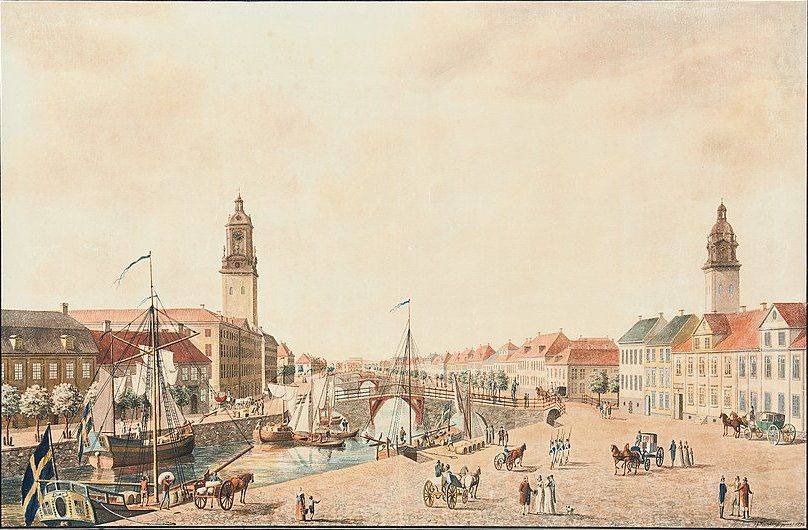
When King Gustavus Adolphus founded Gothenburg in 1621, it was more than a military or economic maneuver—it was an act of cultural assertion. The city was envisioned not as a gradual outgrowth of medieval settlement, but as a rationally planned entity, a port and fortress built to consolidate Sweden’s presence on the North Sea. Its artistic and architectural language reflected this ambition from the outset, blending Dutch pragmatism, Protestant restraint, and emerging Swedish identity into a new urban aesthetic.
The Dutch Grid and the Protestant Ideal
The most striking feature of Gothenburg’s foundation was its imported blueprint. The city was laid out by Dutch engineers and builders, brought in for their expertise in urban planning and hydraulic engineering. The result was a rectangular grid of canals, streets, and defensive bastions—a city that bore more resemblance to Amsterdam than to Stockholm or Uppsala. This was not a coincidence but a deliberate cultural gesture: aligning Sweden’s new west coast city with the mercantile and Protestant ethos of the Dutch Republic.
The grid itself was a form of visual rhetoric. It suggested order, control, and a kind of civic rationalism that resonated with Reformation values. Churches were centrally placed, not elevated on hills but integrated into the city’s fabric. Ornamentation was subdued. Facades emphasized rhythm and proportion over exuberance. This was an art of restraint, where architectural harmony served both spiritual humility and civic pride.
The earliest buildings, many of them made from wood and later reconstructed in stone or brick, adhered to these principles. Even the governor’s residence and royal administrative buildings avoided baroque ostentation. Their beauty lay in their proportions, their clarity of function, and their integration into a defensible whole. Gothenburg was to be a working city, not a stage for royal spectacle.
Fortresses, Facades, and Urban Ornament
Gothenburg’s identity as a fortified city shaped its aesthetics in ways both practical and symbolic. The moat that still encircles the old city center was part of a vast system of ramparts and bastions that once made the city virtually impregnable. The very act of fortification became an architectural language: angular walls, star-shaped plans, and thick, earth-filled embankments were not only military necessities but expressions of state power.
Within the walls, however, the urban landscape allowed room for aesthetic variation. The façades of guild halls, warehouses, and private homes along the canals reveal early gestures toward a civic visual culture. Carved wooden gables, stone doorframes with initials and dates, and decorative ironwork became forms of personal and institutional expression. These details were not ostentatious—they had to respect the overall sobriety of the urban plan—but they offered opportunities for visual distinction within the grid’s strict logic.
The Crown’s architects also commissioned public artworks to mark Gothenburg’s symbolic significance. One of the earliest was a statue of Gustavus Adolphus, later recast in bronze and installed in Gustaf Adolfs torg. Though it stands today as a familiar focal point, its origins lie in a period of intense self-fashioning, when Gothenburg was defining its image both to its inhabitants and to the world.
Maps, Seals, and Emblems of Authority
Beyond its buildings and layout, Gothenburg’s early visual culture took shape through objects: maps, engravings, coins, and civic seals that reproduced the city’s iconography across Sweden and Europe. These representations served multiple purposes—they advertised the city’s modernity, broadcast the stability of Swedish rule, and embedded Gothenburg into the broader symbolic economy of the Swedish Empire.
Maps of Gothenburg from the 17th century are works of art in their own right. Engraved with astonishing precision, they depict not only the street layout and fortifications but also decorative cartouches, allegorical figures, and coats of arms. These visual documents were used for military planning and taxation, but also circulated as prestige items—tokens of a city that, despite its youth, claimed a place in the pantheon of European urban centers.
The city’s official seal, granted in 1621 and modified over time, similarly blended symbolic traditions. It depicted a crowned lion holding a shield and sword—emblems of royal protection and martial readiness—but framed within a stylized urban context. As these symbols were stamped onto legal documents, trade permits, and letters, they helped to fix the city’s identity in both bureaucratic and imaginative terms.
Even everyday objects carried this visual program. Coinage minted in or for Gothenburg featured maritime motifs and royal insignia; merchant’s chests bore carved crests and trade emblems; and ceremonial keys, preserved in city archives, were crafted with a level of detail that elevated them above pure utility. Together, these artifacts formed a dispersed but coherent artistic vocabulary—one that communicated authority, prosperity, and Protestant virtue.
18th Century Port Wealth and the Decorative Arts
In the 18th century, Gothenburg evolved from a fortified outpost into a flourishing port city, fueled by trade, shipbuilding, and the expanding ambitions of Sweden’s merchant elite. This economic transformation had a profound effect on the city’s visual culture—not through monumental architecture or royal patronage, but through the interiors of homes, the refinement of objects, and the quiet opulence of domestic art. As commercial fortunes grew, so too did a distinct aesthetic language: cosmopolitan, Protestant, and finely attuned to material subtlety.
Merchant Patronage and Domestic Aesthetic Worlds
Gothenburg’s rise as a commercial hub was anchored by its maritime prowess. The city became the primary Swedish port for trade with Britain, the Netherlands, and the Americas. By mid-century, it was the headquarters of the Swedish East India Company, whose ships returned laden with tea, porcelain, silk, and exotic hardwoods. These goods didn’t just feed markets—they transformed taste.
Unlike the courtly extravagance of Stockholm, Gothenburg’s elite developed a form of bourgeois connoisseurship rooted in moderation and elegance. Wealthy merchants—many of them of Scottish, German, or Dutch descent—invested in art and decor that signaled refinement without theatricality. Painted panels, marquetry furniture, and ceramic stoves became fixtures of well-appointed homes, particularly in the districts near the harbor.
This domestic focus shaped the production of art. Portraiture was common, but rarely grand. Instead of aristocratic poses, sitters were often shown in half-length, surrounded by books, ledgers, or imported objects. Landscapes of the west coast, still lifes with porcelain and fruit, and genre scenes of shipping or trade activities also found favor. These works celebrated both local life and global reach, anchoring personal identity in a matrix of commerce, culture, and morality.
Furniture, Porcelain, and Textiles in the West Coast Home
The decorative arts of 18th-century Gothenburg represent one of the richest but least studied chapters in Swedish visual history. Local craftsmen—cabinetmakers, silversmiths, and weavers—developed sophisticated styles that fused international trends with regional materials and constraints.
Chairs and tables often echoed the lines of French Rococo or English Georgian furniture but were rendered in Swedish birch or painted pine. Painted decoration was especially prominent: floral motifs, neoclassical medallions, and chinoiserie panels turned simple cupboards into visual centerpieces. Even more modest homes might feature a corner cabinet or a high-backed bench adorned with folk-style painting in rich reds and greens.
Porcelain, much of it imported through the East India Company, was another key component of visual and social life. Blue-and-white Chinese export wares, Japanese Imari plates, and later Meissen figurines became symbols of worldly knowledge and cultivated taste. These were not hidden away, but displayed in glazed cabinets or on wall-mounted shelves, arranged as much for aesthetic rhythm as for access.
Textiles—both imported and locally produced—added another layer. Handwoven curtains, embroidered cushions, and patterned wall hangings warmed the cold interiors of stone and timber buildings. Many of these followed stylistic cues from abroad but were adapted to Swedish sensibilities, favoring clarity of pattern and restrained color palettes. The home, in this context, was not a retreat from culture but its stage.
Scientific Illustration and the Art of Observation
Alongside this world of domestic beauty and mercantile display, a quieter current of art emerged: the scientific image. Gothenburg’s role as a maritime and botanical hub fostered an unusually strong tradition of visual observation. Explorers, naturalists, and physicians based in or passing through the city contributed to a growing body of illustrated knowledge—plants, animals, minerals, and tools rendered with precision and care.
Botanical illustration was particularly advanced. Carl Linnaeus’s influence radiated outward from Uppsala, but Gothenburg developed its own networks of collectors and illustrators. Gardens such as the one maintained by the East India Company became sites of both leisure and taxonomy. Drawings and engravings from this milieu often blur the boundary between science and art: orchids and ferns depicted with such attention to texture and hue that they transcend their function as data.
Shipbuilding manuals, anatomical diagrams, and coastal maps also partook of this aesthetic of clarity. Even utilitarian engravings—such as those used in marine insurance documents—show a visual economy that valued legibility, balance, and beauty. The act of seeing, in 18th-century Gothenburg, became a disciplined art, shaped by Enlightenment ideals and calibrated through mercantile need.
What emerges from this period is a portrait of a city that invested its wealth not in palaces or spectacle, but in interiors, objects, and images that reflected its hybrid identity: international yet provincial, practical yet aspirational, modest yet deeply cultured. The artistic legacy of this time survives not in grand canvases but in woodwork, porcelain, and the quiet confidence of a well-laid table.
Romanticism and the West Coast Sublime
By the early 19th century, Gothenburg found itself swept into a cultural transformation that had already reshaped much of Europe. Romanticism—with its emphasis on nature, emotion, and individual vision—found fertile ground along Sweden’s dramatic west coast. For artists, poets, and visitors alike, Gothenburg and its surrounding archipelago came to embody a particular kind of sublime: wild, wind-swept, and human-scaled. The visual language of the period shifted accordingly, from portraiture and urban detail to seascapes, ruins, and expressive landscapes that made the coastal terrain both subject and symbol.
Seascapes, Shipwrecks, and the Drama of Nature
The sea, ever-present in Gothenburg’s life and identity, took on new meaning during the Romantic period. No longer merely a site of trade or migration, it became a psychological and aesthetic force—unpredictable, immense, and deeply emotional. Painters began to depict the coastline not as a background but as a protagonist: clouds boiling over granite headlands, waves lashing against fishing boats, lighthouses barely holding against the darkening sky.
The local variant of Romanticism was shaped by this maritime context. Unlike the Alpine or forested scenes preferred by German and French painters, Swedish artists looked to the skerries, cliffs, and heaths of Bohuslän and Halland. This terrain lacked monumental peaks, but its very bleakness became a kind of visual power. The west coast offered a sublime of exposure, not elevation—its storms, sea mists, and endless horizons stirred a sense of the infinite on a human scale.
One of the most evocative examples comes from Marcus Larson (1825–1864), whose paintings of stormy seas and burning ships combined technical bravura with an almost operatic emotionalism. Though Larson spent much of his life in Stockholm and abroad, his scenes of maritime catastrophe resonated with Gothenburg’s seafaring culture and were frequently exhibited in the city. Local painters, too, turned their attention to the coast, rendering fishing villages, weathered rocks, and lone figures staring out at the water with a seriousness that suggested more than mere genre painting.
Bohuslän as a Painter’s Destination
The sparsely populated province of Bohuslän, just north of Gothenburg, became a pilgrimage site for artists during the 19th century. With its rugged coastline, scattered islands, and lingering sense of ancientness, it offered the kind of unspoiled scenery that Romantic artists sought. Though its landscapes were less overtly dramatic than those of Norway or the Alps, their very austerity offered a different kind of emotional charge—somber, elemental, and profoundly atmospheric.
Inns and farms began to host artists who arrived with easels and sketchbooks, seeking a direct engagement with nature. Many of these painters were trained at the Royal Swedish Academy of Arts but looked to the coast for inspiration beyond academic conventions. The emphasis shifted from classical balance to atmospheric effect: muted palettes, low skies, and the quiet interplay of rock and sea.
Among the most influential of these figures was Carl Wilhelmson (1866–1928), who later became a key figure in Gothenburg’s artistic education. Though technically post-Romantic, his early works—painted in coastal villages like Fiskebäckskil and Lysekil—carry the emotional weight and compositional strategies of Romanticism: solitary figures, weather-worn houses, and skies that seem to mirror internal states.
These artists did not paint Bohuslän as a picturesque escape but as a place of lived hardness and beauty. Fishermen, widows, and children appear not as types but as presences—part of the landscape, shaped by it and shaping it in turn. The result was a regional visual culture that combined Romantic feeling with ethnographic attention, a blend that would influence Swedish painting for generations.
Art and the Emerging Tourist Gaze
As Romanticism fed a broader fascination with the wild and the remote, the Gothenburg region also became an object of the tourist’s eye. Guidebooks, travel sketches, and illustrated journals began to present the west coast not only as a site of artistic inspiration but as a destination for educated leisure. This development brought new audiences to local art and helped to shape the kinds of scenes that painters produced.
The city itself responded to this shift. Gothenburg’s museums and salons began to exhibit works that reflected the region’s coastal identity. Illustrated newspapers published engravings of shipwrecks, sunsets, and harbor views, feeding both local pride and national curiosity. Even amateur artists, often women from middle-class families, began to sketch and paint the scenery as part of a broader cultivation of taste.
This was also the period in which photography began to reshape the visual landscape. Early photographers in Gothenburg captured the same scenes that painters had idealized, but with a different kind of realism. The combination of painterly mood and photographic detail created a layered image of the region—simultaneously romantic and documentary, nostalgic and contemporary.
By the late 19th century, the Romantic gaze had become part of Gothenburg’s cultural DNA. It shaped how the region was perceived, how it represented itself, and how it imagined its place within Sweden’s national story. What began as a European aesthetic movement had, on the west coast, become a local idiom—one that linked landscape, labor, and longing in ways that would reverberate into the next century.
Gothenburg in the Age of Industrial Modernity (1850–1900)
As the 19th century progressed, Gothenburg entered a new phase of transformation—less romantic, more infrastructural. The industrial revolution reached the Swedish west coast with steely force, reshaping not only the city’s economy and population but also its visual culture. This was an era of factories, railways, mechanized ports, and a newly assertive working class. Art began to reflect these changes—not always with celebration, but with a new kind of attentiveness to the urban, the social, and the real.
Urban Scenes, Factory Haze, and Maritime Labour
By 1850, Gothenburg had become Sweden’s second city—not just in size but in economic importance. Its shipyards, textile mills, and engineering workshops hummed with the energy of transformation. The Göta älv was no longer just a natural harbor; it was an industrial artery, choked with steamers, cranes, and floating logs. Artists began to turn their gaze toward these altered realities, capturing the grit and rhythm of industrial life.
Where Romanticism had dwelled on the sublime aspects of nature, modern painters of Gothenburg started to depict the urban environment as it was: smoky, crowded, and filled with human labor. The port became a favored subject. Dockworkers hauling crates, cranes silhouetted against orange sunsets, and ships under repair were painted with a sense of immediacy and unsentimental respect. These were not heroic images, but they carried a quiet dignity.
One figure emblematic of this shift is Carl Skånberg (1850–1883), whose moody depictions of Gothenburg’s quays and rain-slicked streets hint at both melancholy and fascination. Though better known for his scenes of Venice and Paris, Skånberg captured a sense of place in Gothenburg that combined the palette of impressionism with the structure of realism. Other artists, trained in the emerging plein air tradition, followed his lead—sketching outdoors, painting directly from life, and embracing the everyday.
The industrial city also drew photographers. Some of the earliest documentary photographs of Gothenburg—narrow alleys, factory interiors, shipyards in mid-construction—reveal the stark contrasts of the new urban reality. The aesthetics of smog, scaffolding, and iron bridges entered the visual lexicon, even if they remained outside the realm of high art.
Exhibitions, Museums, and the Institutional Turn
As Gothenburg industrialized, it also institutionalized. The late 19th century saw the founding of the city’s first major cultural institutions—museums, art societies, and public libraries—reflecting a civic ambition that paralleled its economic ascent. These spaces helped to formalize taste, support artists, and bring art into the public sphere in new ways.
The Göteborgs Konstförening (Gothenburg Art Association), established in 1854, played a foundational role in shaping the city’s art scene. It organized exhibitions, purchased works for public display, and cultivated a new audience among the rising middle class. Though initially conservative in its preferences—favoring academic history painting and idealized landscapes—it gradually opened to more contemporary styles and subjects.
The Göteborgs Stadsmuseum, which evolved from the city’s natural history collections, began to collect not only artifacts but also paintings and prints that documented local life. These included portraits of civic leaders, topographic views of the expanding city, and depictions of industrial sites. The museum became a space where Gothenburg could see itself—not as myth or memory, but as it was becoming.
Public art, too, began to appear in earnest. Statues of historical figures, decorative friezes on civic buildings, and commemorative plaques marked the city’s growing self-confidence. Though often conventional in style, these works reinforced a visual narrative of progress, stability, and bourgeois virtue.
The Working-Class Atelier and Middle-Class Collector
Perhaps the most significant transformation of this period was the expansion of the art public. The industrial economy had created not only wealth but also new social layers—engineers, managers, teachers, and clerks—who now had the means and desire to purchase art. This shift changed what artists painted and how they sold their work.
A network of independent studios, artist cooperatives, and small galleries emerged to meet this demand. Some artists sold directly from their ateliers, offering watercolors, etchings, or small oil paintings at prices accessible to the new middle class. Scenes of Gothenburg’s streets, markets, and harbors became popular, as did portraits of children, genre scenes, and marine views. Art became more than decoration; it became a statement of education, taste, and civic belonging.
Working-class artists also began to emerge—not only as subjects but as makers. Though barriers remained high, art schools and evening courses slowly opened access to those outside the traditional elite. Their work often focused on labor, family life, and urban hardship, bringing a new tone of realism and critique to the Gothenburg art scene.
This democratization of art was mirrored in its reception. Newspapers reviewed exhibitions; art societies hosted lectures; and illustrated journals reproduced engravings of local paintings. The visual culture of Gothenburg in the late 19th century was no longer confined to salons and drawing rooms—it was part of the city’s daily fabric.
By the turn of the century, Gothenburg had become a fully modern city, and its art reflected that reality. The old motifs of the sublime coast and pastoral village had not disappeared, but they now coexisted with smoke, steel, and crowd. The canvas had changed. The city had become its own subject.
Valand School of Art: Personalities, Pedagogy, and Polemics
Few institutions have shaped Gothenburg’s artistic identity as decisively as the Valand School of Art. Founded in 1865 and formalized by 1891 under the auspices of the Gothenburg Art Association, Valand quickly became more than just a training ground for painters. It was a crucible for ideas—about aesthetics, society, the role of the artist, and the tension between tradition and innovation. Through its teachers, students, and recurring controversies, Valand defined what it meant to be an artist on the Swedish west coast—and often, what it meant to resist Stockholm’s centralizing pull.
Gunnar Hallström, Ivar Arosenius, and the Turn Inward
The early decades of Valand produced a generation of artists who, while technically skilled, were increasingly drawn to inner worlds. Among the most iconic was Ivar Arosenius (1878–1909), a painter and illustrator whose short life and singular style left a deep imprint on Swedish visual culture. Though he studied briefly in Stockholm and abroad, Arosenius found in Gothenburg a setting more hospitable to his idiosyncrasies—an environment that tolerated whimsy, allegory, and psychological depth.
His paintings—many of which feature grotesque figures, fairy-tale motifs, and fantastical animals—combine Symbolist intensity with childlike naivety. Arosenius’s work defied the sober realism favored by many of his peers, instead conjuring a visual language that bordered on the mystical. Yet it remained deeply grounded in personal experience, often depicting his wife and daughter in dreamlike scenarios. His 1906 watercolor The Little Princess exemplifies this fusion: delicate linework, subdued color, and a fragile sense of wonder.
Other Valand-trained artists explored similarly intimate terrain. Gunnar Hallström (1875–1943), though less flamboyant than Arosenius, brought a brooding stillness to his portraits and interiors. His canvases, often set in dimly lit rooms or quiet natural spaces, reflect an introspective sensibility shaped by Nordic light and existential mood. These artists, while rooted in a figurative tradition, nudged Gothenburg’s art toward the psychological and symbolic—a quiet rebellion against didactic realism.
Symbolism, Myth, and the Childlike
What distinguished Valand’s aesthetic ethos was not a singular style but a set of concerns: subjectivity, ambiguity, and the power of myth. The school never fully aligned with the doctrinaire modernism that would later dominate the continent. Instead, it carved a space for visual poetics—where childhood, folklore, and private vision could coexist with rigorous technique.
Students at Valand were encouraged to look inward as well as outward. Many developed hybrid practices, blending painting with illustration, printmaking, or applied arts. This flexibility allowed a generation of artists to move between media, audiences, and registers—exhibiting in galleries, contributing to children’s books, or producing decorative panels for public buildings.
Arosenius, again, is emblematic here. His illustrations for Kattresan (The Cat’s Journey), a picture book published posthumously in 1909, became a touchstone of Swedish visual culture: mischievous, melancholy, and rich with associative logic. Other artists followed suit, contributing to a wave of visual storytelling that blurred the lines between art and literature, fine art and popular media.
This orientation toward the mythic and the childlike was not escapism. Rather, it reflected a belief that art could access emotional and symbolic truths unavailable to rational discourse. In an era increasingly defined by industrial progress and political strife, Valand artists offered a counterpoint—an art of mystery, memory, and emotional depth.
Teaching Methods, Gender Politics, and Rebellion
Valand’s pedagogical model was shaped by its semi-autonomous status. Unlike the Royal Swedish Academy in Stockholm, it was not beholden to state bureaucracy or rigid hierarchies. This allowed for a degree of experimentation and informality, but also bred tension. Debates over curriculum, faculty appointments, and artistic standards were frequent—and often public.
At the center of many of these debates was the question of what kind of art education Valand should provide. Should it emphasize classical drawing and anatomy, or encourage modernist abstraction? Should it prepare students for national exhibitions, or support idiosyncratic, even marginal, practices? These questions were never fully resolved, and the school’s identity remained fluid—a site of contention as much as community.
Gender was another fault line. Though women had long been admitted to Valand, they often found themselves marginalized within its institutional culture. Their work was less likely to be collected, reviewed, or exhibited, and their artistic ambitions were frequently shaped—or limited—by societal expectations. Despite this, several women artists trained at Valand in the late 19th and early 20th centuries carved out significant careers. Hilma af Klint, though more closely associated with Stockholm, passed briefly through Gothenburg’s artistic orbit; later, artists like Ester Almqvist and Maj Bring emerged with strong, independent voices shaped in part by Valand’s pedagogical ferment.
The school’s structure also enabled a spirit of rebellion. Students frequently organized their own exhibitions, formed critique circles, and challenged their teachers. This atmosphere of controlled insubordination helped foster a vibrant artistic scene beyond the classroom. Studios, cafes, and print shops around Vasastan and Haga became informal extensions of the school—a network of spaces where art, argument, and experiment intertwined.
By the early 20th century, Valand had established itself not just as a training ground but as a cultural engine: a place where Gothenburg’s artistic identity was made, remade, and contested. Its alumni did not always agree, and its faculty often quarreled, but this very turbulence gave the school its edge. In resisting easy answers, Valand forged a legacy of artistic seriousness that continues to reverberate in Sweden’s cultural life.
Interwar Experimentation and the Rise of Modernism
Between the world wars, Gothenburg’s art scene underwent one of its most dynamic periods of change. The collapse of monarchic empires, the shock of industrialized war, and the rise of radical politics reshaped European culture. In Gothenburg, a city long defined by mercantile pragmatism and regional identity, these forces catalyzed an energetic, if often conflicted, embrace of modernist aesthetics. The old motifs—harbors, coastlines, folk types—did not vanish, but they were fractured, abstracted, or reimagined. The result was a visual language in flux, animated by new materials, ideas, and anxieties.
Göteborgs Konsthall and the Avant-Garde Moment
The 1920s marked the founding of one of Gothenburg’s most ambitious cultural institutions: the Göteborgs Konsthall, an exhibition space built in 1923 as part of the city’s 300th anniversary celebrations. The Konsthall was a declaration of cultural intent. Designed in a stripped neoclassical style, its architecture evoked stability—but its programming often did the opposite. From its earliest exhibitions, the Konsthall presented works that challenged viewers’ expectations, drawing on both international currents and local experimentation.
Futurism, Expressionism, and later Constructivism made appearances on its walls—sometimes imported through traveling shows, other times through the work of Swedish artists returning from Paris, Berlin, or Weimar. The Konsthall helped establish a visual dialogue between Gothenburg and the wider European avant-garde. Paintings by Gösta Adrian-Nilsson (GAN), with their jagged forms and homoerotic undertones, were seen in Gothenburg before they were fully accepted in Stockholm. The city’s distance from the capital became an advantage: a place for risk, not just reverence.
Yet the avant-garde never completely took over. Gothenburg’s audiences were diverse—industrialists, workers, teachers, students—and many remained skeptical of abstraction. This tension fueled the city’s exhibitions, which often juxtaposed traditional realism with modern experiment. The Konsthall became a forum for debate: What should art look like in an age of disillusionment? What could it mean after the trenches of the Somme?
Expressionism, Constructivism, and Social Commentary
Some of the most compelling art of the interwar years emerged from the overlap between formal innovation and social critique. Gothenburg, with its growing working-class population and strong labor movement, proved fertile ground for artists who saw modernism not as an aesthetic revolution alone, but as a tool for political and ethical engagement.
The city’s printmakers led the charge. Lithographs and woodcuts offered both stylistic flexibility and mass reproducibility. Artists like Torsten Billman (1909–1989) produced works that depicted factory interiors, ship crews, and unemployed men with stark clarity and emotional power. Influenced by German Expressionists like Käthe Kollwitz and George Grosz, Billman developed a visual language of empathy and indictment. His figures are not heroic; they are burdened, watchful, often trapped. Yet there is a dignity in their depiction that resists despair.
Constructivist influences also found local adherents. Painters and designers experimented with geometric abstraction, montage, and new typographic systems—often in the service of social messaging. Posters, book covers, and public murals echoed the aesthetic of Soviet and Bauhaus graphics, emphasizing clarity, energy, and functionalism. These were not abstract formal games; they were visual arguments for a better, more rational society.
The debate between figuration and abstraction raged not only in galleries but in classrooms and cafes. Artists split into factions, exhibitions became battlegrounds, and aesthetic choices carried political weight. Yet amid the polemics, new forms of expression continued to emerge—some overtly radical, others more ambivalent. The visual field expanded, accommodating contradiction.
The Painter’s City: Studios, Cafés, and Critical Scenes
Behind the exhibitions and manifestos, a more intimate world of artistic life flourished in Gothenburg. Studios in Vasastan, attic rooms in Haga, and shared spaces in former warehouses became crucibles of creation and camaraderie. The city’s physical structure—its manageable scale, its dense but navigable center—allowed for a high degree of informal contact between artists, critics, and viewers.
Cafés like Bräutigams and Lorensberg became informal salons where painters debated the merits of Cubism, argued about Cézanne, or sketched patrons over coffee. These scenes were not glamorous, but they were fertile. Artistic ideas circulated not through academies but through friendships, rivalries, and impromptu critiques. A canvas shown in a small cooperative gallery might provoke a debate that spilled into print, lecture halls, or classroom studios.
Art criticism gained traction as a serious practice. Local newspapers and journals began to devote more space to exhibition reviews, artist profiles, and polemical essays. The Gothenburg Post often featured writing that sought to mediate between avant-garde innovation and public skepticism, making modern art legible—if not always palatable—to a broader audience.
This dense network of spaces and voices gave Gothenburg’s interwar art scene a distinctive flavor: less centralized than Stockholm, less doctrinaire than Paris or Berlin, but rich in dialogue and committed to relevance. Art was not merely a reflection of modernity; it was a participant in it, shaped by and shaping the tensions of a world in transition.
Postwar Growth and the Public Mural Movement
The end of World War II ushered in a new chapter for Gothenburg: one of rapid urban expansion, increased social welfare, and a renewed investment in the built environment. The visual culture of the city reflected these shifts—not with private commissions or avant-garde manifestos, but with a surge of public art, particularly murals. From housing projects to schools, libraries to subway stations, artists were called upon to decorate the expanding city. These works were not just decorative—they were ideological, participatory, and spatial, weaving aesthetics into everyday life.
Concrete Walls as Civic Canvases
The 1950s and 1960s saw the rise of the so-called “Folkhemmet” (“The People’s Home”), Sweden’s ambitious social-democratic project that reimagined the state as a provider of both material and cultural well-being. In Gothenburg, this vision took architectural form through modernist housing blocks, schools, and civic centers—many of them designed according to functionalist principles. But alongside this rationalism came a desire for humanization: bare concrete was to be softened, contextualized, even uplifted through art.
Murals became the ideal medium for this task. Artists like Endre Nemes and Pär Andersson were commissioned to create large-scale works that integrated with architecture. These murals ranged from abstract compositions to figurative tableaux, from mythological allusions to representations of local industry. The medium encouraged visual generosity—a kind of art that was not elite, not sequestered in museums, but part of daily experience.
One landmark example is Nemes’s 1957 mural at the Gothenburg School of Economics. Using enamel and mosaic, he created a vibrant, symbolic landscape filled with allegorical figures, mythic beasts, and celestial bodies—a dreamlike counterpoint to the rigor of economic theory. Other artists took more narrative approaches: a ceramic mural in a Gothenburg elementary school might depict scenes from regional history, maritime life, or folktales, turning corridors into stories.
These works were not always loved. Critics accused them of didacticism, decoration, or naïveté. But many endured, both physically and culturally. They became visual landmarks, inherited by generations, and in some cases, rediscovered and reappraised by contemporary artists and curators.
Hasselblad, Photography, and Image Culture
While painters were busy transforming walls into civic canvases, another medium came to define Gothenburg’s postwar visual identity: photography. The city was home to the Victor Hasselblad Camera Company, whose medium-format cameras became legendary tools for both commercial and artistic photography. Hasselblad’s presence in Gothenburg helped catalyze a photographic culture that ranged from industrial documentation to fine art.
The company’s influence extended beyond manufacturing. The Hasselblad Foundation, established in 1979, became one of the most important sponsors of photographic research and exhibition in Sweden. Its prize—the Hasselblad Award—is now one of the most prestigious honors in the field, drawing international attention to the Gothenburg art scene.
Local photographers used this visibility to explore the changing face of the city. Black-and-white images of postwar construction, portraits of dockworkers, and studies of everyday urban life created a rich archive of social realism. Photographers like Christer Strömholm and later Anders Petersen brought psychological depth to the medium, capturing vulnerability, alienation, and fleeting connection in the city’s streets and rooms.
Photography also intersected with public art. Some murals incorporated photographic transfers; others served as inspiration for visual motifs. And as photographic exhibitions became more common in public libraries and community centers, the medium reinforced the postwar ethos of art-as-access—art as something that did not need to be explained away or elevated, but simply seen.
Women Artists, Collectives, and Institutions
The postwar period also marked a turning point in the visibility and organization of women artists in Gothenburg. While women had long been part of the city’s artistic life, they now began to organize more assertively—forming collectives, challenging institutions, and creating works that addressed gender, labor, and domesticity.
One significant development was the emergence of artist-run spaces and cooperatives where women played central roles—not only as creators but as curators, teachers, and administrators. These included not only urban studios but also summer colonies and retreats along the coast, where artistic and feminist experimentation often went hand in hand.
Textile art, long dismissed as “craft,” gained new prominence. Artists like Barbro Nilsson and later Ingrid Dessau wove monumental tapestries that were both formally rigorous and politically charged. These works often entered public collections, schools, or civic spaces, reframing the decorative as critical and spatial.
Women also shaped institutional policy. By the 1970s, Gothenburg’s art schools and museums began to confront their own gender biases, prompted by internal critique and external pressure. Exhibitions began to include more women artists; acquisitions policies shifted; and a generation of female curators and historians emerged to challenge the dominant narratives of Swedish art.
This was not a revolution in the sense of rupture. It was, instead, a rebalancing—slow, uneven, and contested, but ultimately transformative. The postwar city was no longer just a canvas for male modernists or municipal planners. It was becoming something more layered, more plural, and more honest.
Contemporary Gothenburg: Artists, Spaces, and Ecologies
In the decades since the turn of the millennium, Gothenburg has emerged as one of Scandinavia’s most dynamic and diverse artistic centers—not by mimicking Stockholm or chasing international trends, but by deepening its own peculiar strengths: openness to experimentation, respect for place, and an ethos of collectivity. The city’s artistic identity today is shaped as much by abandoned shipyards and repurposed hospitals as by institutions and galleries. It is a scene where land art, performance, installation, and socially engaged practice coexist, often in unlikely spaces and with unexpected audiences.
Röda Sten, Konstepidemin, and the Artist-Run Wave
Two institutions have come to define Gothenburg’s contemporary art landscape: Röda Sten Konsthall and Konstepidemin. Both grew out of the post-industrial logic of reuse, occupying buildings that once served entirely different purposes. Röda Sten, housed in a former boiler house beneath the Älvsborg Bridge, opened in the late 1990s as a self-organized art space. It quickly became a nexus for large-scale installations, politically inflected exhibitions, and experimental curation.
Röda Sten’s significance lies not just in its programming—which has included everything from post-colonial critique to bio-art—but in its architectural drama. The raw, cavernous interior provides a setting that resists white-cube sterility. Instead, it insists on confrontation: with history, with materiality, with the scale of the industrial past. Exhibitions like the Göteborg International Biennial for Contemporary Art (GIBCA), often staged at Röda Sten, have brought international artists into dialogue with the building and the city, creating a site-specificity that feels earned rather than imposed.
Konstepidemin, by contrast, occupies the former city epidemic hospital—an atmospheric hilltop complex of yellow-brick buildings that once isolated tuberculosis patients. Since the 1980s, it has been transformed into an artist colony: dozens of studios, project spaces, and residences that host both local creators and international guests. Here, the logic is slower, more intimate, and oriented toward process. Open studio days, experimental theatre, community workshops, and cross-disciplinary projects form the backbone of Konstepidemin’s activity. The institution’s name—literally “Art Epidemic”—retains a faint echo of its past, reframed as a metaphor for artistic contagion.
These two sites represent twin poles of Gothenburg’s contemporary art world: the monumental and the domestic, the confrontational and the nurturing. Together, they anchor a broader ecosystem of artist-run initiatives, collectives, and informal networks that give the city its vitality.
Global Conversations, Local Materials
While Gothenburg’s artists are engaged with global concerns—climate change, migration, surveillance, decolonization—they often work in a resolutely local idiom. Material specificity is one hallmark. Granite, rusted steel, driftwood, seaweed, and salvaged ship parts are frequent presences in sculptures and installations. This is not just aesthetic—it reflects an ethos of environmental awareness and a deepening interest in place-based knowledge.
Artists like Ingela Ihrman and Linda Tedsdotter use natural and synthetic materials to explore bodily forms, ecological cycles, and the boundaries between life and artifice. Their works—sometimes humorous, often unsettling—extend the tradition of Nordic environmental art, but with a distinctly Gothenburg flavor: salty, industrial, and laced with irony.
Sound and video art have also flourished. The city’s maritime rhythms—foghorns, gulls, ship engines—frequently appear in works that explore memory, space, and time. Gothenburg’s many tunnels, ferries, and underground reservoirs have become performance sites, studios, and acoustic chambers, blurring the line between infrastructure and imagination.
Residency programs now draw artists from around the world, many of whom are attracted by Gothenburg’s scale and seriousness. The city offers what larger capitals increasingly lack: room to work, communities to engage, and landscapes that inspire without overwhelming. It is a city where artists can disappear into a foggy archipelago for weeks, then return with work that speaks across borders.
Land Art, Climate, and the Archipelago Mindset
One of the most distinctive trends in Gothenburg’s recent art scene is the resurgence of land-based and site-responsive practices. The archipelago—once a Romantic motif, then a tourist destination—has reentered the artistic imagination as a zone of environmental urgency and spatial reflection.
Projects like “Skärgårdsprojektet” (The Archipelago Project) involve artists embedding themselves in island communities, creating works from local materials and engaging with themes of rising seas, shifting economies, and disappearing traditions. These are not nostalgic recreations, but interrogations: What does it mean to live, make, and remember in a place defined by edges and thresholds?
Climate change looms large. Artists have staged underwater sculptures to track sea level rise, created biodegradable installations that erode with the tides, or used oyster shells and sediment to comment on marine biodiversity. The archipelago becomes both canvas and collaborator, a changing environment that refuses to be fixed.
Education has adapted accordingly. Gothenburg’s art schools increasingly emphasize sustainability, interdisciplinary methods, and community engagement. Students might learn as much from biologists, shipbuilders, or divers as from painters or critics. The result is a generation of artists less concerned with mastery than with relation: to space, to history, to the ecosystems in which they work.
Contemporary Gothenburg does not announce itself with spectacle. It unfolds in layers—studio by studio, shore by shore, conversation by conversation. Its art is not unified, but it is coherent: driven by a shared sense that place matters, that collaboration counts, and that the future will be shaped as much by memory as by invention.
Memory and Reinterpretation: Gothenburg’s Past in its Present
Gothenburg, like all cities with long histories, lives in dialogue with its past. But unlike cities where heritage calcifies into monumentality, Gothenburg has taken a different path—one of reactivation, reinterpretation, and even subversion. Its visual culture today is marked not by reverence for static history, but by an ongoing negotiation with the layers of meaning embedded in its buildings, symbols, and spaces. Artists, curators, and citizens alike participate in this process, remaking the city not by erasing its past, but by reframing it.
Archival Art, Reenactment, and Urban Archaeology
A growing strand of Gothenburg’s contemporary art involves archival excavation—not as a dry academic exercise, but as an aesthetic and political act. Artists increasingly draw on historical documents, maps, diaries, municipal records, and family photographs to create works that interrogate the city’s official narratives.
These projects often operate across media. A performance might reenact a long-forgotten legal case from the 1700s. A video installation might juxtapose 19th-century industrial maps with drone footage of present-day redevelopment. A sculpture might incorporate rusted tools or factory detritus uncovered during a renovation. The point is not nostalgia, but friction—placing past and present in tension, and asking who remembers, and why.
One compelling example is the work of artist and researcher Åsa Elzén, who has used historical land use documents and feminist historiography to explore forgotten women’s labor in the Gothenburg region. Her installations, combining soil samples, embroidered texts, and archival prints, suggest that memory is not only visual but tactile and ecological.
Urban archaeology has played its part as well. Construction projects often unearth remnants of the city’s pre-industrial or even medieval past—timber structures, burial grounds, forgotten walls. Rather than vanishing into museums, some of these finds have been integrated into public space or temporary art installations, making the past visible in daily life.
Statues Debated, Memorials Reimagined
As in many cities, Gothenburg’s public monuments have become flashpoints of debate. Statues of national figures, naval commanders, and industrialists dot the city, many erected during Sweden’s period of imperial expansion or 19th-century nationalism. In recent years, artists and activists have called attention to the exclusions and assumptions embedded in these commemorations.
Rather than tearing down monuments, Gothenburg has often chosen to contextualize or supplement them. Plaques with alternative histories have been added. Performative interventions—such as covering statues with cloth or staging public readings nearby—have temporarily reoriented their meaning. In some cases, new artworks have been commissioned to stand beside or in dialogue with existing monuments, creating a polyphonic memorial landscape.
A notable instance is the reinterpretation of the statue of Gustavus Adolphus in Gustaf Adolfs torg. Once an unambiguous symbol of civic pride, the statue has become a site for periodic artistic and political commentary—its imperial pose challenged by installations that emphasize the city’s diverse contemporary population or its colonial entanglements through the East India Company.
Memorial culture in Gothenburg is shifting from singular statements to plural dialogues. New projects often focus not on heroic individuals but on collective experiences: a monument to dockworkers, a sound installation memorializing shipwreck victims, a park design that commemorates the city’s role in refugee resettlement. These are forms of public memory that invite reflection rather than demand allegiance.
Curating the City: Whose History is on Display?
At the institutional level, Gothenburg’s museums have begun to reckon more systematically with questions of representation and omission. The Göteborgs Stadsmuseum has restructured several permanent exhibitions to include more working-class, immigrant, and feminist perspectives. Temporary exhibitions often address the politics of collecting, the aesthetics of power, or the ethics of display.
Artists are increasingly involved in this curatorial work—not just as illustrators of history, but as collaborators in its construction. Exhibitions now include contemporary commissions alongside historical artifacts, using juxtaposition as a curatorial method. The result is a form of storytelling that is layered, critical, and open-ended.
This ethos extends to the street. Neighborhoods like Majorna and Gamlestaden have become canvases for community-driven art that reflects local histories: murals about tenant struggles, window displays about family migration, poetry affixed to tram stops. These are not tourist spectacles but embedded practices—ways of marking space with meaning.
Gothenburg, then, does not merely display its history. It curates it, edits it, questions it. The city’s visual culture is an archive in motion—where past and present fold into each other, and where memory becomes not a burden, but a resource for imagination.