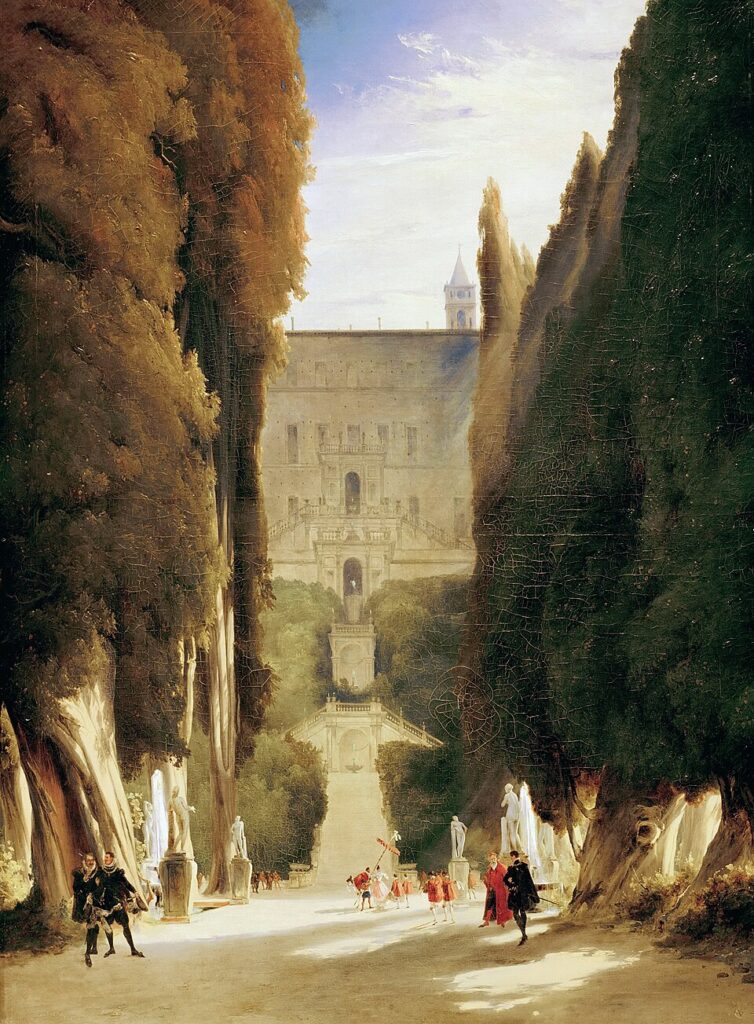
The story of the gardens at Villa d’Este begins with Ippolito II d’Este (1509–1572), son of Alfonso I d’Este and Lucrezia Borgia. He was appointed governor of Tivoli in 1550, a prestigious but frustrating post that came after his unsuccessful bids for the papacy. Despite serving as Archbishop of Milan and Ferrara, and holding cardinalship from the age of ten, his ambitions to become pope were never realized.
In Tivoli, he inherited a run-down Benedictine monastery on a steep hillside. There, he conceived a plan to build a villa and garden complex that would rival anything in Rome. This ambitious project wasn’t just an aesthetic pursuit; it was a power move—a bold, material expression of wealth, status, and classical education in the High Renaissance.
The garden would become a dramatic stage where water, myth, and prestige merged, providing Ippolito with a cultural legacy far beyond the ecclesiastical roles he had once sought.
The Visionary Architect — Pirro Ligorio and His Team
To bring his dream to life, Ippolito II enlisted Pirro Ligorio (circa 1513–1583), an architect, painter, and antiquarian renowned for his deep knowledge of ancient Roman ruins and classical iconography. Ligorio had already worked on St. Peter’s Basilica and had studied Hadrian’s Villa, also in Tivoli.
Ligorio transformed the rugged site by fusing ancient Roman symbolism with cutting-edge 16th-century engineering. He collaborated with expert engineers, including the Bolognese hydraulic specialist Tommaso Chiruchi, who had earlier worked on fountains in Florence and Ferrara. Their collective aim was not simply decorative but technological: they designed a garden where water alone, channeled and pressurized by gravity, would animate every fountain, pool, and grotto.
Construction began in earnest in 1550. By the early 1570s, the garden’s major features were largely complete, though additions and restorations continued into the early 1600s.
Broader Influences and Cultural Context
Villa d’Este reflects the High Renaissance obsession with antiquity—especially the grandeur of Imperial Rome. In Renaissance theory, landscape design wasn’t just horticultural; it was philosophical. Gardens embodied man’s ability to impose order on chaos, to refine wild nature into something ideal.
The aristocracy of Italy often modeled their estates on Roman ideals, particularly villas built during the Republic and Imperial periods. Ippolito II’s garden was intended to rival the elegance of Fontainebleau in France and the sophistication of his family’s palaces in Ferrara.
The site also symbolized intellectual mastery over the elements. Using no pumps or mechanical devices, Ligorio’s design captured, stored, and redirected natural water to produce aesthetic effects—sprays, cascades, and even musical performances—on demand.
This fusion of art, nature, technology, and classical learning set a new benchmark for European landscape architecture.
Layout, Water System, and Garden Design Principles
Terraced Layout & Central Axes
Villa d’Este was built on a steep slope overlooking the Aniene Valley. The villa itself sits at the top of the site, with a vast central terrace (called the Vialone) running along the building’s length. From this terrace, a series of descending levels and cross-axis walkways unfold, revealing fountains, stairways, grottoes, and pools.
The garden’s structure is based on a main longitudinal axis, intersected by several transversal paths. The alignment cleverly disguises the irregular topography, creating an illusion of symmetry and order. Each transverse path concludes in a major visual focal point—usually a fountain—which draws the eye and anchors the visitor’s movement.
This use of forced perspective and geometric ordering made the garden feel much larger and more navigable than its steep terrain might suggest. The descent through the terraces feels like a theatrical sequence—each turn or level revealing a new surprise of water, sculpture, and sound.
The Ingenious Hydraulic System — Water by Gravity Only
One of the marvels of Villa d’Este is that the entire hydraulic system works by gravity alone. The main water source was the Rivellese spring, located approximately 500 meters above the villa. Water was captured and brought into the gardens through underground channels and cisterns.
Not one pump was used. Instead, a combination of sloped channels, vertical drops, siphons, and strategically placed basins maintained water pressure. Engineers channeled flow to drive 51 fountains, 398 spouts, 364 jets, 64 waterfalls, 220 basins, and nearly 875 meters of underground and surface canals.
Each fountain’s function was fine-tuned—some worked on high pressure to create spray, others on gentle gravity to mimic natural streams. This level of engineering was virtually unmatched at the time and remains astonishing today.
The system required constant maintenance and remains functional today only through careful restoration and preservation efforts.
Water and Nature as Art — The “Third Nature” Concept
Renaissance scholars spoke of “three natures”: wild nature, cultivated land, and a third form—nature improved by art. Villa d’Este embodies this third nature. Rather than taming nature completely or imitating it directly, the garden elevates it to an idealized form.
Cypress trees, laurel, box hedges, ivy, and aromatic herbs were chosen not just for aesthetics, but for symbolism. Water flowed naturally but was channeled with mathematical precision. Statues and fountains were arranged to recall myth, empire, and divine favor.
Visitors experienced a full sensory landscape—water plashing in grottos, the sound of wind in trees, statuary emerging from mist and foliage. It wasn’t just beauty—it was a statement about harmony, intellect, and power.
Signature Fountains, Statues & Water Features
Fontana dell’Ovato (Oval Fountain)
Commissioned around 1565 and completed by 1570, the Oval Fountain is among the earliest and most iconic of Villa d’Este’s features. Designed by Ligorio and executed with the help of sculptors like Curzio Maccarone and Raffaello Sangallo, it serves as a centerpiece in the upper garden.
Its name comes from the large oval basin into which water descends from a semi-circular backdrop. The fountain includes niches with statues of Nereids and classical deities, from which jets of water spray in fan-shaped patterns. Above the grotto-like arch is an artificial rock formation meant to resemble the rugged Apennines, with streams cascading down its face.
The entire ensemble represents a symbolic union of mountain, spring, and river—echoing the themes of abundance and fertility tied to the Este family’s heritage.
The Hundred Fountains (Le Cento Fontane)
This long, narrow avenue links the Oval Fountain to the Fountain of Rometta. The name “Hundred Fountains” is modest; the feature contains closer to 300 water spouts, arranged in three parallel tiers along a 130-meter wall.
Each tier features decorative masks, lilies, obelisks, and heraldic symbols—especially the eagle and fleur-de-lis—celebrating both the Este lineage and Ippolito II’s personal ambitions.
The path isn’t just a decorative element; it’s a promenade where the very sound of water creates an immersive sensory experience. The rhythm of spouts and the echo of splashes turn a simple walk into a symphonic composition.
Other Notable Features — Fountains, Water Organ, and Allegories of Rome
- Fountain of Rometta: Built between 1567 and 1570, this fountain depicts a miniature symbolic map of ancient Rome. Features include a she-wolf nursing Romulus and Remus, a model Tiber Island, and personifications of rivers. It asserts the Cardinal’s intellectual connection to Rome and its legacy.
- Fountain of the Dragons: Constructed in 1572, this violent, theatrical fountain marks the central axis of the garden. Four dragons spew water upward in a symbolic reference to the Garden of the Hesperides and Hercules. It also commemorates a brief visit from Pope Gregory XIII.
- Fountain of the Organ: Completed in 1571, this was a technological marvel. A concealed water wheel drove bellows that powered a real organ, which played music as water flowed. Contemporary visitors described it as a magical experience. Though the mechanism fell silent for centuries, it was restored and now plays again today.
- Fountain of Neptune: Originally designed as a cascade by Gian Lorenzo Bernini in the 17th century, it was later remodeled into a grand fountain in the 20th century. It is located at the bottom of the garden and includes massive jets rising from the base into the air—a modern yet respectful homage to the original Renaissance vision.
These fountains are not isolated wonders but parts of a grand narrative told in water and stone—linking classical mythology with Renaissance ideals of order, virtue, and spectacle.
Historical Legacy and Influence on European Garden Design
From Renaissance Masterpiece to UNESCO World Heritage
By the late 16th century, Villa d’Este had gained fame across Europe. It was visited by royalty, popes, scholars, and artists. During the Grand Tour period of the 18th and 19th centuries, it became an obligatory stop for European aristocrats seeking cultural enrichment.
In 2001, UNESCO designated the villa and gardens as a World Heritage Site. Their report praised it as “one of the most remarkable and comprehensive illustrations of Renaissance culture at its most refined,” emphasizing its influence on landscape design and its seamless integration of architecture, engineering, and art.
Even in the centuries of decline and neglect, the garden’s magic persisted. Visitors documented its splendor in engravings, watercolors, and journals, preserving its image even when the fountains ran dry.
Influence on Later European and Global Garden Design
Villa d’Este set the pattern for aristocratic gardens throughout Europe. Its elements—central axes, terraced descents, mythological fountains, and water-driven theatrics—influenced the development of the French formal garden, notably at Vaux-le-Vicomte and later Versailles.
In the 18th and 19th centuries, English and German landscape architects began adapting its principles to newer “picturesque” designs. Even as naturalistic gardens became the vogue, Villa d’Este remained a touchstone of precision and theatricality.
Today, its influence can be seen in formal gardens from Russia to the United States, wherever landscape architecture aspires to unite art and environment with symbolic depth.
Villa d’Este in Art, Literature & Popular Culture
The villa has appeared in hundreds of paintings and engravings, particularly during the Romantic and Neoclassical periods. Writers such as Goethe, Byron, and Nathaniel Hawthorne described it in their travel notes, often linking it to themes of transience, beauty, and grandeur.
In the 20th century, the villa featured in several films, including the 1954 romantic comedy Three Coins in the Fountain. It has been the subject of countless documentaries, books, and tourist itineraries—testimony to its enduring power to enchant.
Its legacy continues not just in physical form, but in the cultural imagination—as a place where man and nature collaborate to elevate both.
Key Takeaways
- The Gardens of Villa d’Este in Tivoli were commissioned in 1550 by Cardinal Ippolito II d’Este, blending classical ideals with Renaissance engineering.
- Architect Pirro Ligorio transformed a rugged hillside into terraced gardens powered entirely by gravity-fed waterworks—no pumps used.
- The site includes over 500 water features, such as the Oval Fountain, Hundred Fountains, Fountain of the Organ, and Fountain of the Dragons.
- Villa d’Este influenced major European gardens, including Versailles, and became a model for aristocratic landscape design across centuries.
- Recognized as a UNESCO World Heritage Site in 2001, the villa remains a symbol of man’s ability to shape nature into art without losing its vitality.
Frequently Asked Questions
- When was Villa d’Este built?
Construction began in 1550, with major features completed by the early 1570s. - Who designed the gardens of Villa d’Este?
The principal designer was Pirro Ligorio, with hydraulic engineering by Tommaso Chiruchi. - How do the fountains work without pumps?
All fountains operate using gravity, water pressure, and elevation from nearby springs. - Is Villa d’Este open to the public today?
Yes, it is open year-round and maintained by the Italian government as a major cultural site. - What makes Villa d’Este historically significant?
It’s a masterpiece of Renaissance culture, combining art, engineering, and symbolism in landscape form.