The eagle has been a symbol of authority and high vision since the ancient world. Roman artists carved eagles into triumphal arches, military standards, and imperial furniture to signal command, discipline, and the far-reaching power of the state. The bird’s ability to soar above storms made it a natural emblem for leadership rooted in clarity rather than impulse. In frescoes and mosaics, the eagle often appears with wings spread wide, a clear sign that a strong order held the world together. When later cultures looked back to Rome for inspiration, the eagle returned as a reminder of firm government and steady leadership. Its bold silhouette made it one of the most recognizable symbols of classical tradition.
As centuries passed, the Roman eagle survived not through living memory but through art and architecture. Craftsmen preserved it in stone, metal, and paint long after the empire fell. This continuity gave the bird a kind of ancient authority, letting later artists draw on a symbol that carried weight simply by appearing in a room or on a banner.
Medieval and Early Modern Heraldry
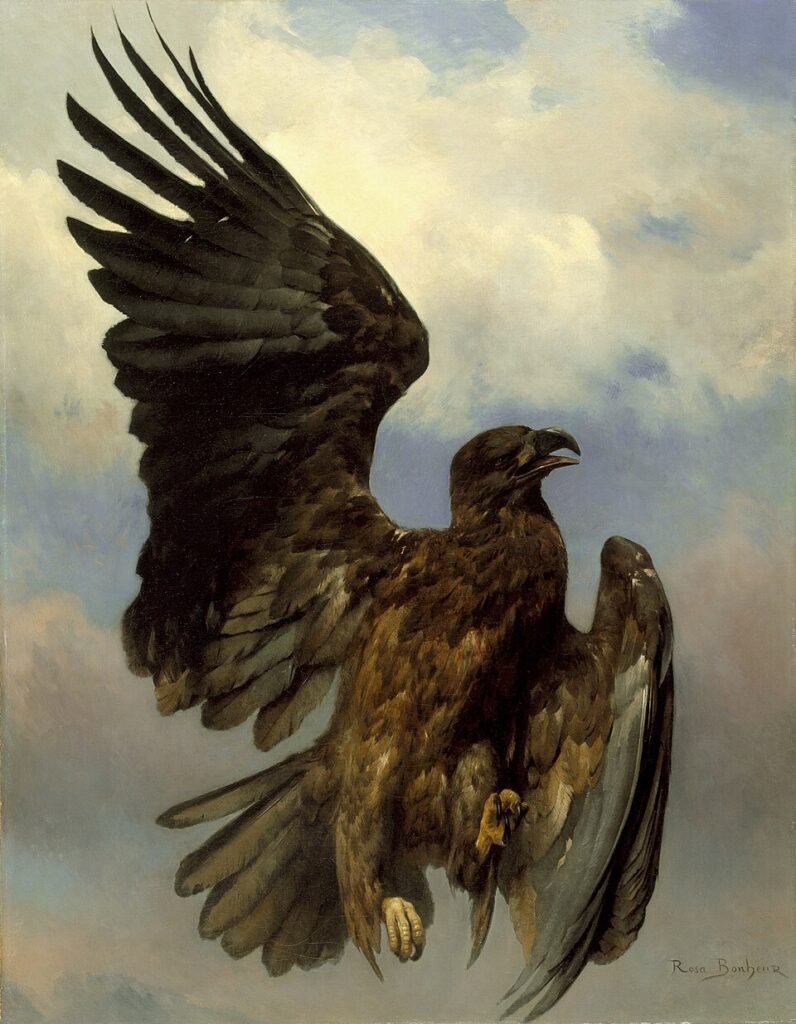
In medieval Europe, the eagle took on new life through heraldry. Kings, dukes, and principalities used one-headed or double-headed eagles to express sovereignty and the right to rule. The bird’s posture—wings raised, talons open—suggested vigilance and the ability to protect a realm. Heraldic artists emphasized clear outlines and strong shapes so the symbol would be unmistakable on shields, armor, and flags.
The double-headed eagle became especially prominent in Central and Eastern Europe, representing an authority that looked both east and west. When painters included eagle-bearing coats of arms in portraits or city scenes, they quietly reinforced the idea that a noble lineage upheld order. The eagle became a visual shorthand for legitimacy, heritage, and responsible power.
Neoclassical Revival
The eighteenth and early nineteenth centuries brought a renewed fascination with classical forms, and the eagle rose again as a major decorative motif. Neoclassical architects placed eagles above doorways, on pediments, and inside civic halls to evoke the dignity of Rome. Carved eagles crowned mirrors, sideboards, and mantelpieces in homes that wanted to show refinement grounded in tradition.
Furniture makers used the eagle to give everyday objects a sense of lasting stability. A chair topped with an eagle’s head, or a table supported by carved talons, suggested that the household looked to classical virtues rather than passing fashions. Even in quieter interiors, a single eagle motif could anchor the room with a sense of honor and clarity.
American Symbolic Uses
Across the Atlantic, the young United States adopted the eagle as a national emblem, drawing on its classical associations with strength and ordered liberty. American painters, engravers, and craftsmen used the eagle on coins, public buildings, and patriotic prints. In many eighteenth- and nineteenth-century works, the eagle holds arrows and an olive branch, representing both the duty to defend the nation and the desire for peace.
American folk artists adapted the eagle into simpler forms suited for weather vanes, carved wall plaques, and household goods. These pieces blended national pride with rural craftsmanship, giving the eagle a place not just in government buildings but in ordinary homes. Its presence signaled respect for the young nation’s ideals, as well as admiration for the older traditions that shaped them.
Decorative Arts
The eagle proved ideal for the decorative arts because its shape is bold, balanced, and adaptable. Metalworkers formed eagles in bronze, brass, and silver to adorn candlesticks, serving trays, clocks, and architectural fittings. Woodcarvers created eagles with spread wings that served as centerpieces for large frames or mantel decorations. Textile artists used eagle motifs in carpets, wall hangings, and embroidered banners.
In many households, a single eagle carving or print offered a sense of tradition and upright character. Whether drawn from Roman strength, medieval heraldry, or neoclassical refinement, the eagle brought dignity into the room. Its clear outline and steady expression made it a lasting emblem of courage, order, and disciplined leadership.