Long before Delft’s famous blue-and-white ceramics or the quiet sunlit interiors of Vermeer, the land that would become the city was a restless edge between water and earth. Its history begins not with painted tiles but with shifting estuaries, reed-choked marshes, and the patient shaping of human life in a landscape that resisted permanence. The story of Delft’s art cannot be told without first seeing this older canvas — one painted not by human hand but by tide and river.
Shorelines and Shifting Rivers
The earliest chapter of Delft’s existence was written in mud and silt. Around 3000 BC, the region sat on the unstable boundary of the North Sea’s tidal plain and the river systems flowing from the Rhine and Maas. Sea levels were still recovering from the great post-glacial melt, and the ground here was in constant transformation — channels cutting new paths, sandbanks forming and vanishing, and floods periodically sweeping across the flat expanse.
The name Delft, derived from the Dutch delven, “to dig,” would come much later, but it reflects an enduring fact: this was never a natural site for easy settlement. The earliest inhabitants adapted by choosing higher ridges — the sandy levees formed by ancient river channels — as places to live and bury their dead. Archaeological digs along the Schie waterway and at Tanthof have unearthed traces of these early communities: scatterings of flint blades, polished stone axes, and animal bones showing a mixed diet of hunted deer, fished pike, and gathered shellfish.
What makes these finds significant for art history is not their crude function alone, but the evidence of embellishment. Even at this stage, people were working bone and antler into shaped, smoothed objects that served no obvious survival purpose. A worked antler point with symmetrical incisions, found in the clay south of Delft, suggests a developing sense of pattern — a desire to make a tool pleasing as well as useful.
Hunters, Fishers, and Early Makers
By the later Neolithic, the cultural landscape was shifting again. Farming communities, part of the Funnel Beaker culture that spread through much of northern Europe, began cultivating barley and wheat in the more stable patches of land. In doing so, they brought with them pottery traditions — thick-walled vessels with distinctive banded decoration pressed into damp clay.
A remarkable aspect of the Delft region is the mixture of inland and maritime influences visible in these finds. Pottery fragments show styles both from the riverine cultures of the central Netherlands and from the coastal Shell Middens groups who decorated their ceramics with cord and textile impressions. This hybridization is a reminder that even in prehistory, Delft was part of a network — not yet the trading powerhouse of the 17th century, but already a place where ideas and techniques converged.
The artistry of this period was modest in scale but quietly inventive. Bone fishhooks were sometimes carved with animal-head finials. Small amber beads, rare in the Netherlands but traded from the Baltic, appear in burial contexts. A barbed harpoon tip found near what is now the Nieuwe Kerk square was so finely made that its serrations still catch the light when cleaned. These objects served daily needs, but they also signaled identity, skill, and perhaps social standing.
Three objects in particular stand out in the prehistoric record of Delft:
- A flint dagger of unusually fine knapping, likely imported from Scandinavia, suggesting long-distance connections.
- A clay figurine fragment, possibly a fertility symbol, which shows traces of red ochre pigment.
- A double-perforated amber bead, an exotic ornament whose material would have traveled hundreds of kilometers to reach the delta.
Each hints at a society where the aesthetic was inseparable from the functional, and where even fragile beauty could be valued enough to carry across dangerous journeys.
Roman Echoes in the Marsh
If prehistoric Delft was a quiet mosaic of farms, fishing camps, and small craft traditions, the arrival of the Roman world to the region — from the first century AD — marked the beginning of a new cultural layering. Delft lay beyond the empire’s official frontier, but its waterways connected it to the Roman trading corridors along the Rhine. Goods, ideas, and coins filtered in.
Excavations have revealed shards of fine Roman Samian ware pottery, with its glossy red slip and molded decoration. These were not locally made; they arrived through trade, perhaps in exchange for salted fish, hides, or worked antler from the wetlands. Bronze brooches in the Roman style have been found in the same soil layers as local hand-built pottery, evidence of cultural overlap.
The Roman influence also extended to building techniques. While no full Roman villa has been found in Delft proper, there are traces of timber-framed structures set on raised platforms to resist flooding — a practical adaptation of Roman architectural forms to delta conditions. Such constructions, though ephemeral, would later echo in Delft’s medieval warehouses and houses, where brick replaced timber but the principle of raising floors above wet ground remained.
The artistic importance of this Roman contact lies less in monumental works and more in the quiet transformation of taste. Imported tableware, coins with imperial portraits, and glass beads tinted cobalt blue — all these were unlike anything the marshland communities had made before. Even if local craftsmen could not match Roman production, they absorbed its motifs: spiral decorations, symmetrical borders, and geometric precision that would resurface centuries later in Delft’s decorative traditions.
What began in the prehistoric wetlands as a modest interplay of survival and ornament was now enriched by distant influences. The cultural soil of Delft — still centuries away from Vermeer’s luminous canvases or the painted tiles of Delftware — was already absorbing, adapting, and quietly making its own hybrid forms. In a sense, the art of Delft began here: in the mingling of local skill with the allure of the foreign, in the slow shaping of beauty from mud, bone, and fire.
And the land itself, with its restless waters and soft light, was already rehearsing the role it would play in every later image made here — a setting that both demands adaptation and rewards those who can see its subtle, shifting character.
From Marsh Hamlet to Market Town: Early Medieval Delft’s Craft and Image
By the early medieval period, the low-lying land that would one day host Delft’s brick gables and painter’s studios was still far from urban — but it was no longer the trackless wetland of prehistory. Across the centuries between AD 700 and 1200, a patchwork of farms, causeways, and timber-framed buildings began to form a coherent settlement. This transformation was gradual, shaped by human engineering as much as by geography, and it left behind both physical traces and an emerging visual culture that would prove foundational to Delft’s later artistic identity.
Building in a Soft World
Delft’s earliest medieval inhabitants faced a paradox: the same waterways that brought fish, trade, and fertile silt also threatened to swallow their homes. To live here required engineering as much as building. In the earliest excavated layers of the city, archaeologists have found evidence of terpen — artificial mounds of earth — raised above the floodplain. These were not grand fortifications but practical solutions, enough to keep a cluster of wooden houses and their workshops dry in an era before the great ring dikes were built.
The buildings themselves were simple but careful. Timber posts were driven deep into the damp soil, their lower ends charred to resist rot. Walls were woven from wattle and daubed with clay, roofs thatched with reed from nearby marshes. Yet even in these modest dwellings, some attention to proportion and ornament can be seen. Posthole patterns suggest symmetrical layouts, while fragments of carved wood — often just a small stylized finial or lintel — hint at a taste for embellishment.
One rare find from a dig near modern-day Oude Delft street revealed a broken doorframe carved with a repeating interlace motif. Such decoration, though crude compared to later Gothic stonework, would have stood out in a world where most surfaces were plain timber or plaster. These details suggest that beauty, however humble, was already part of the built environment.
The Early Market and Its Image-Makers
By the 11th century, Delft had grown beyond a cluster of farmsteads. A market was functioning by this time, likely held near what would later become the Markt square. Its position along the Schie waterway allowed for both river traffic and overland access — vital for exchanging goods in a period when roads were rough and often impassable in winter.
Markets in medieval towns were as much visual spectacles as economic events. Tents and stalls were often striped or dyed; goods were arranged to catch the eye. A well-dyed bolt of wool, deep in woad blue, was not just a commodity but a status symbol for the buyer and a mark of skill for the dyer. These colors mattered — they communicated wealth, trustworthiness, and sometimes even moral standing.
In Delft, cloth was a key industry early on. Archaeological traces of dye vats and shears have been found along the waterways, where runoff could be easily drained. We know from later guild records that the profession valued visual precision: the depth of a blue or the consistency of a red could make or break a merchant’s reputation. While little cloth from this era survives, manuscript depictions from nearby towns suggest that patterned fabrics — checks, stripes, even simple repeating motifs — were appearing in both religious and secular dress by the 12th century.
Ceramics were another craft finding their footing. Delft’s early potters worked in a reduced-oxygen firing process that left vessels in shades of gray and brown, often decorated with incised lines, thumb impressions, or applied bands. These were functional kitchenwares — pitchers, storage jars, cooking pots — but the makers’ urge to add rhythmic patterning hints at the same impulse visible in prehistoric antler carvings: the transformation of the utilitarian into the quietly beautiful.
Imported wares expanded the palette. Glazed jugs from northern France, with splashes of green and yellow over a white slip, arrived via trade, their vivid colors unlike anything made locally. A merchant’s household that could display such a jug in the center of a table was making a statement — of wealth, of connection to far-off places, of discernment. Even before Delft made its own ceramics famous, it was already a place where foreign styles could be adapted and admired.
Sacred Spaces as Artistic Focal Points
The Christianization of the Low Countries in the early medieval period was gradual, but by the late 11th century Delft had its first parish church, the precursor to today’s Oude Kerk. At first likely a timber structure with a simple nave, it was rebuilt and expanded in stone as the community’s wealth grew.
Churches in this period were the primary public art galleries of Europe. Even the humblest parish church would have contained some painted or sculpted imagery — a crucifix above the altar, painted panels of saints, perhaps a carved wooden lectern. In Delft, fragments of wall painting have been found beneath later layers of plaster, showing bold red and black outlines of what appear to be saints or angels. These were not the finely modeled figures of the Renaissance, but they were striking, visible even in candlelight, and they made the stories of scripture tangible for a largely illiterate congregation.
Stained glass was a rarer luxury, but small leaded windows with colored insets were appearing by the 13th century. Delft’s position near trade routes meant glassmakers from Flanders or Utrecht could be hired for special commissions. Imagine the shock of color such windows must have brought to a mostly monochrome world: ruby, sapphire, and emerald glints shifting with the movement of clouds across the sun.
The church also concentrated craftsmanship. Stone carvers shaped fonts and capitals; goldsmiths produced chalices and reliquaries; embroiderers created vestments with intricate patterns of silk and metal thread. Each commission was a training ground for skills that would later spill over into secular art and architecture.
A City Ready to Change
By the turn of the 14th century, Delft was no longer an isolated settlement clinging to the marsh. It had a market square, a parish church, and a network of craftspeople whose work reached beyond mere necessity. Color, proportion, and ornament were becoming part of the city’s public face. Its artisans were already used to borrowing and adapting foreign styles, whether in the form of a French jug, a Flemish glass panel, or a carved motif seen in Utrecht.
In these centuries before the rise of the painters’ guilds, Delft’s artistic identity was still embryonic, scattered across small objects, architectural flourishes, and liturgical commissions. But the habits were forming: the drive for technical mastery, the openness to outside influence, and the quiet belief that even a utilitarian object could carry beauty. These would all become central traits in Delft’s later artistic brilliance — the same traits that would make it a Golden Age city of light, ceramic, and paint.
Guilds, Crafts, and the Painter’s Path
By the late 14th century, Delft had reached a new stage in its development. The dikes and canals had stabilized its land; its markets hummed with regional trade; its churches rose in brick and stone. This was a city confident enough to regulate its crafts, protect its reputation, and demand artistry as well as utility from its makers. In this climate, the Guild of St. Luke emerged — not just as an administrative body but as the crucible in which Delft’s distinctive artistic culture began to take shape.
The Guild of St. Luke: More Than a Trade Union
The Guild of St. Luke was part of a broader European pattern. By the 14th and 15th centuries, nearly every major city in the Low Countries had such an organization, named for the patron saint of painters, who in Christian legend had painted the Virgin’s likeness. But Delft’s guild was unusually broad in scope. It admitted not only panel painters but also manuscript illuminators, stained-glass artists, sculptors, tapestry weavers, and sometimes even those whose work blurred the lines between art and craft — engravers, mapmakers, and makers of decorative furniture.
Membership was a privilege. To join, an aspiring master had to complete a years-long apprenticeship, present a masterpiece (a sample work demonstrating skill), and pay a fee. Once admitted, the artist could legally sell work, take on apprentices, and use the guild’s protections to prevent outsiders from undercutting prices or producing shoddy goods that might damage Delft’s reputation.
The guild enforced quality in subtle but real ways. Inspectors could visit workshops to check pigments and materials, especially for high-profile commissions. Painters were discouraged from using cheaper substitutes for expensive pigments like ultramarine, made from lapis lazuli — unless the contract specifically allowed it. This insistence on quality helped establish a consistency in Delft’s visual output, a kind of shared “house style” that clients came to expect.
The guild also had a social dimension. Members celebrated feast days together, marched in processions carrying their banner, and contributed to religious observances. The St. Luke’s feast on October 18 was marked by both solemnity and conviviality, often ending in a shared meal. These gatherings allowed younger members to mingle with established masters, exchange ideas, and forge the networks that sustained careers.
A City of Interwoven Trades
One of the most striking aspects of Delft’s artistic life in this period was how porous the boundaries were between trades. A painter might be called upon to design a stained-glass window, sketch the embroidery pattern for a cope, or provide decorative motifs for ceramic tiles. Likewise, carvers and metalworkers might adapt designs first developed in painted form.
This cross-pollination was encouraged by the fact that many of these trades shared the same guild, or at least worked in close proximity. In a city as compact as Delft, it was common for workshops to be clustered along the same street or canal, creating a daily visual exchange. Apprentices passing by another shop might glimpse a new pattern or a novel treatment of perspective and carry that idea back to their own master’s bench.
Consider, for instance, the surviving fragments of an altarpiece known to have been produced in Delft around 1500. The painted panels show finely detailed figures in a Gothic architectural setting, but the framework surrounding them is carved with such precision that the tracery seems almost drawn. The painter and carver were clearly working from a coordinated plan — possibly even from the same preparatory drawings — so that painted and sculpted elements blended seamlessly.
This habit of visual translation across media would prove crucial in later centuries, when Delft’s decorative ceramics absorbed and reinterpreted imagery from prints, paintings, and even imported textiles. But the seed of that versatility was planted in the guild workshops of the late Middle Ages.
The Painter’s Path in Late Medieval Delft
For a boy entering the painter’s trade, the journey began with apprenticeship, often at the age of twelve or thirteen. His early years would be spent on the least glamorous tasks: grinding pigments, stretching canvases or preparing wooden panels with gesso, and cleaning the workshop. Drawing lessons began with copying established models, usually kept in a workshop’s pattern book.
By the third or fourth year, the apprentice might be trusted with underpainting less important areas of a commission, or with decorative borders. Masters guarded their reputations closely; the apprentice’s hand had to be nearly indistinguishable from theirs before they were allowed to work on focal points like faces or hands.
Once freed from apprenticeship, the journeyman painter could take work where he found it — sometimes in another Delft workshop, sometimes in The Hague, Rotterdam, or farther afield. Journeymen traveled not only for employment but to absorb styles from other cities, returning to Delft with fresh influences. Eventually, if he saved enough and could produce a masterpiece to the guild’s satisfaction, he might open his own shop and take apprentices in turn.
Life as a master was still precarious. Delft’s art market was not infinite; demand rose and fell with the economy, political stability, and the church’s appetite for commissions. Some painters diversified by offering related services: painting coats of arms for city officials, decorating furniture for wealthy merchants, or producing small devotional panels for private homes. Others specialized — in portraiture, heraldry, or architectural views — and built reputations that extended beyond Delft’s walls.
Civic Pride and Visual Identity
The late medieval period also saw the rise of civic commissions that blended art with politics. Delft’s town hall, rebuilt in stone after a devastating fire in the 16th century, incorporated decorative sculpture and painted coats of arms intended to project authority. Public celebrations — processions, jousts, religious festivals — were occasions for temporary artworks: banners, painted shields, even triumphal arches of wood and cloth.
The guild’s members were often at the center of such efforts, producing the visual language through which Delft presented itself to visitors and to its own citizens. This was art in the service of identity, binding the city’s image to the skill of its artisans.
By the dawn of the 16th century, Delft’s artistic infrastructure was firmly in place. The Guild of St. Luke had shaped generations of makers, the city’s workshops were adept at translating ideas across media, and its citizens had grown accustomed to living among works of visual sophistication. The next century would bring both upheaval and unprecedented opportunity: the Reformation, shifts in patronage, and eventually the extraordinary flowering of the Dutch Golden Age. But the discipline, versatility, and interconnectedness forged in the guild years would remain Delft’s foundation.
Renaissance Currents and Reformation Shifts
In the first decades of the 1500s, Delft was still a city of Gothic arches, gilded altarpieces, and richly colored church interiors. But a tide of change was coming from two directions: from the south, the humanist ideals and classical forms of the Renaissance; from within, the theological and political shockwaves of the Protestant Reformation. Together, they reshaped not only what art looked like in Delft, but what it was for — altering subjects, techniques, and the very spaces where art was made and seen.
Renaissance Ideas in a Northern City
The Renaissance in Delft did not arrive with a single dramatic gesture; it seeped in through prints, traveling artists, and imported works. Italianate architectural motifs began appearing in painted backgrounds and in the carved frames of altarpieces. Engravings by Albrecht Dürer and Lucas van Leyden — widely circulated and affordable — carried both technical innovations in shading and proportion and a new attention to the human figure as an object of study.
Local painters absorbed these influences selectively. Delft’s masters were not simply imitating Florence or Venice; they were adapting Renaissance realism to northern tastes for meticulous detail and complex symbolism. A religious panel from around 1520, attributed to a Delft workshop, shows the Virgin and Child seated before a Renaissance-style loggia — complete with classical columns — yet the flowers in the foreground are painted with the same botanical precision seen in earlier Netherlandish works. This fusion of old and new became a hallmark of Delft’s transition period.
Sculpture and architecture followed a similar pattern. The façades of prominent houses and civic buildings began incorporating pilasters, roundels, and other classical details, but the overall building forms remained rooted in local tradition. Delft’s masons and carvers were experimenting, testing the compatibility of Italian proportion with Dutch practicality.
Iconoclasm and the Disappearance of Images
If the Renaissance was a gradual arrival, the Reformation was an abrupt rupture. The spread of Protestantism in the mid-16th century — especially Calvinism — brought with it a suspicion, even hostility, toward religious imagery. The Beeldenstorm of 1566, a wave of iconoclastic riots across the Low Countries, reached Delft with destructive force.
Altarpieces were dismantled, statues smashed, and wall paintings whitewashed. The great churches of Delft were stripped of much of their decoration; the Oude Kerk and Nieuwe Kerk lost works that had been the pride of their congregations for generations. What could not be destroyed outright — stained glass windows, for instance — was sometimes removed or reworked to eliminate overtly Catholic imagery.
For artists, this was more than a religious or political shift — it was a collapse of the traditional patronage system. Church commissions had been a major source of work for painters, sculptors, and glassmakers. Suddenly, that market was gone, replaced by demand for secular subjects and private commissions. Those who could adapt survived; those who could not faded from the record.
The Rise of Secular Art and Domestic Patronage
In the vacuum left by church patronage, Delft’s art market began to focus more on civic pride, portraiture, and domestic decoration. Wealthy merchants commissioned portraits to display in their homes; civic institutions hired painters to record important events or to depict prominent officials. Maps and city views gained popularity, both as practical tools and as statements of local identity.
A new kind of painting began to take shape: the genre scene. Small-scale depictions of everyday life — a family meal, a street market, a game being played in a courtyard — began to appear in Delft workshops by the late 16th century. While still carrying symbolic meaning, these works celebrated the recognizable and the local.
The domestic interior also became a space for applied arts to flourish. Delft’s furniture makers, textile weavers, and tile producers turned their attention to private homes. Decorative wall tiles with simple blue or manganese-purple designs became a common feature, both functional and ornamental. Their motifs — ships, landscapes, animals — reflected the new, worldly interests of Delft’s citizens in the post-Reformation era.
Adapting to the New Order
By 1600, Delft’s artistic identity had been reshaped. The old Gothic richness was gone from its churches, replaced by austere interiors that emphasized whitewashed walls and clear light. But in the homes of merchants and the chambers of civic institutions, art was thriving in new forms. The flexibility of Delft’s craftsmen — their willingness to translate skills from sacred to secular — was what allowed the city’s art to survive the upheaval.
This adaptability also set the stage for the explosion of creativity in the 17th century. The Guild of St. Luke, having weathered the iconoclastic storm, now turned its attention to regulating and supporting an art market driven not by ecclesiastical commissions but by private and civic clients. From this environment would emerge the Delft School of painters — Gerard Houckgeest, Carel Fabritius, Pieter de Hooch — and eventually Johannes Vermeer himself.
The 16th century had been a crucible, burning away much of Delft’s medieval artistic heritage. What emerged from it was leaner, more versatile, and ready to speak to a broader, more personal audience.
The Delft School: From Workshop to World Stage
By the early decades of the 1600s, Delft had recovered from the iconoclastic shock of the Reformation and the economic disruptions of the previous century. The churches still stood — austere and whitewashed — but the city’s art scene had adapted to the new order. Civic commissions, private patronage, and a growing market for paintings in domestic interiors fueled a burst of creativity. In this environment, a loosely connected group of painters developed what would come to be known as the Delft School — a body of work marked by meticulous perspective, luminous handling of light, and a deep engagement with architectural and domestic space.
Gerard Houckgeest and the Geometry of Faith
One of the earliest and most influential figures in this movement was Gerard Houckgeest (c. 1600–1661). Trained in The Hague but active in Delft by the 1650s, Houckgeest became known for a new kind of church interior painting. Where earlier depictions had treated churches as static, almost schematic spaces, Houckgeest turned them into exercises in dynamic perspective.
In works such as his view of the Nieuwe Kerk, the eye is drawn down the aisle toward a distant monument, the floor’s geometric tiles receding in perfect alignment. Figures are small, almost incidental, dwarfed by the soaring vaults and shafts of light streaming through high windows. These were not merely records of sacred architecture; they were meditations on space itself, using the church interior as a stage for exploring depth, proportion, and the changing effects of light.
Houckgeest’s innovations resonated beyond Delft. His handling of perspective influenced other interior specialists across the Dutch Republic, and his sensitivity to light and texture would echo in the works of his younger contemporaries.
Carel Fabritius: Experiment and Tragedy
If Houckgeest brought geometry to the Delft School, Carel Fabritius (1622–1654) brought experiment. A former pupil of Rembrandt, Fabritius arrived in Delft in the early 1650s with a painterly style that combined his teacher’s rich textures with a lighter, more open palette.
Fabritius’s most famous surviving work, The Goldfinch (1654), is deceptively simple — a small bird chained to a perch, painted with loose yet precise strokes that give it startling presence. But Fabritius also pushed the boundaries of illusionism, creating works that played with extreme perspective and optical effects. His now-lost “viewing box” paintings, designed to be seen through a peephole, immersed the viewer in a convincing three-dimensional scene.
Tragically, Fabritius’s career was cut short by the Delft gunpowder explosion of 1654, which destroyed much of the city’s eastern quarter and killed hundreds, including the artist. The loss of his workshop and works makes it difficult to measure his full impact, but contemporary accounts suggest that his experiments were a source of fascination and influence for younger painters in Delft, possibly including Vermeer.
Pieter de Hooch and the Poetics of the Threshold
Pieter de Hooch (1629–c. 1684) brought another dimension to the Delft School: the intimate domestic scene. Arriving in Delft in the early 1650s, de Hooch began producing carefully constructed interiors and courtyards, often centered on doorways or passages that led the eye from one space to another.
In paintings such as The Courtyard of a House in Delft, the arrangement of bricks, paving stones, and open doorways becomes as important as the figures themselves. Light is used to guide the viewer through space, revealing textures — the rough plaster of a wall, the sheen of a tiled floor — with almost tactile clarity. These works celebrated the ordered beauty of everyday life, transforming ordinary courtyards and rooms into spaces of quiet dignity.
De Hooch’s compositions often included a glimpse beyond the immediate setting — a street, a canal, or another courtyard visible through a doorway — suggesting that Delft itself was always just outside the frame. This blending of interior and exterior space would later be echoed in Vermeer’s work, though with a more concentrated focus on the play of light within a single room.
A Distinctive Synthesis
The Delft School was never a formal academy, and its members were not bound by a unified manifesto. Yet certain traits recur:
- Architectural precision, whether in the measured tiles of a church floor or the brickwork of a courtyard.
- Atmospheric light, soft and natural, shaping space without the theatrical contrasts of Rembrandt’s chiaroscuro.
- Human presence as scale and narrative, with figures often subordinate to their surroundings, yet essential for suggesting life within them.
These painters also benefited from Delft’s stability and its supportive Guild of St. Luke, which maintained high standards and provided a marketplace for their work. Their clients were primarily the city’s merchant and artisan class — people who valued art that reflected both their civic pride and the well-ordered life of their own households.
By the mid-17th century, this synthesis of perspective, light, and domestic intimacy had given Delft a reputation in the Dutch art world out of proportion to its size. It was an achievement built on centuries of craft tradition, sharpened by the discipline of the guild system, and enriched by the adaptability forced upon artists by the upheavals of the Reformation. The stage was now set for Delft’s most famous son, Johannes Vermeer, to take these qualities and turn them into something uniquely his own.
Johannes Vermeer: Light, Silence, and the City
Johannes Vermeer’s career unfolded almost entirely within the confines of Delft, yet his paintings seem to expand far beyond the city’s modest boundaries. He was born here in 1632, the son of an innkeeper and art dealer, and he died here in 1675, having produced a body of work that now numbers fewer than forty paintings. In his lifetime, he was known primarily among fellow artists and local collectors; it would take centuries for his name to become synonymous with the delicate interplay of light and color that defines his surviving works.
A Life Rooted in Delft
Vermeer grew up on Voldersgracht, near the bustling Markt square. His father, Reynier Janszoon, ran an inn called The Flying Fox and traded in paintings, a combination that exposed young Johannes to both the social life of the city and the workings of the art market. By 1653, at the age of twenty-one, Vermeer had joined the Guild of St. Luke — a sign that he had completed his training, though the identity of his master remains uncertain.
That same year, he married Catharina Bolnes, the daughter of a prosperous Catholic family. This marriage brought Vermeer into a different social and religious milieu than the majority of Protestant Delft, and it also provided him with financial stability — at least in the early years. The couple lived in Catharina’s mother’s house on Oude Langendijk, just across from the Jesuit church, a location that may have influenced both his subject matter and the quiet, meditative tone of his work.
Vermeer seems to have rarely left Delft. While many Dutch painters sought patrons in The Hague, Amsterdam, or abroad, he remained tied to his city, painting at a slow pace that suggests both careful craftsmanship and perhaps a limited clientele.
The Camera Obscura and the Question of Technique
Vermeer’s paintings are renowned for their extraordinary rendering of light — the way it falls across a wall, diffuses through a window, or glints on the edge of a pearl earring. Some scholars believe he achieved this through the use of a camera obscura, a device that projects an image through a lens onto a surface inside a darkened room. The optical qualities of certain works, such as the subtle blurring of objects at the edges of focus, seem to support this theory.
Whether or not he used such a device, Vermeer’s approach was meticulous. Infrared analysis of his paintings reveals careful underdrawings and a layering of translucent glazes to build depth and luminosity. He often worked on a limited number of canvases at a time, and his choice of expensive pigments — most notably natural ultramarine, derived from lapis lazuli imported from Afghanistan — suggests a deliberate prioritization of quality over quantity.
The scarcity of his output may also reflect his role as head of the Guild of St. Luke in the 1660s, a position that would have demanded administrative time and attention. Still, the paintings that emerged from his workshop during this period set new standards for intimacy and visual harmony.
Vermeer’s Delft: The City in His Work
Although Vermeer painted only two known cityscapes — View of Delft and The Little Street — both are masterpieces of observation and atmosphere. View of Delft, painted around 1660–1661, is not just a topographical record; it is a portrait of the city bathed in soft, shifting light, with clouds casting patterns across the buildings and water. The work captures a moment in time, yet also conveys a sense of timelessness that later writers, including Marcel Proust, found profoundly moving.
Most of his other works are set within domestic interiors — spaces that, while generic enough to be archetypal, often reflect the architecture and light conditions of Delft houses. The leaded-glass windows, patterned floor tiles, and whitewashed walls are not inventions; they are part of the built environment of his city. In works like Woman Holding a Balance or The Milkmaid, the controlled light streaming from a left-hand window is quintessentially Delft, filtered through the city’s often hazy northern atmosphere.
Even in these intimate scenes, there is a sense of urban quiet — the stillness of a city whose streets are close but not clamorous, whose life is measured by the slow rhythms of trade, church bells, and changing weather. Vermeer’s paintings distilled this environment into a visual language that felt both immediate and enduring.
A Career’s End and a Posthumous Rise
Vermeer’s final years were troubled. The economic downturn following the Franco-Dutch War in the 1670s hit the art market hard. According to his widow, the collapse of demand, coupled with debts and the strain of supporting eleven surviving children, brought on a sudden illness that killed him at the age of forty-three. He was buried in the Oude Kerk, the same church whose tilted Gothic tower appears in the background of View of Delft.
For the next two centuries, Vermeer was largely forgotten outside of specialist circles. His rediscovery in the 19th century — led by scholars such as Théophile Thoré-Bürger — transformed him into a central figure of the Dutch Golden Age, admired for his mastery of light and composition. Today, his name is inseparable from Delft’s cultural identity, drawing visitors from around the world to the city where he lived and worked.
In many ways, Vermeer represents the culmination of the traits that had been developing in Delft for centuries: the disciplined craft of the guild system, the sensitivity to architectural space seen in the Delft School, and the quiet confidence of a city that, though small, could produce works of universal significance. His art remains rooted in Delft’s streets and rooms, yet its reach is global — a paradox that continues to fascinate both scholars and the public.
Delftware: Blue and White Beyond Porcelain
In the same decades that Vermeer and the Delft School painters were refining their treatment of light and space, another artistic revolution was underway in the city’s kilns. Delftware — the tin-glazed earthenware that would carry the city’s name across Europe and into Asia — began as a calculated imitation of imported Chinese porcelain. By the mid-17th century, it had evolved into a distinct art form, marrying foreign motifs with local sensibilities and transforming Delft into a global ceramics capital.
From China to Holland: The Porcelain Craze
The story begins in the early 1600s, when the Dutch East India Company (VOC) established direct trade routes to Asia. Ships returned from China with cargoes of blue-and-white porcelain — lightweight, durable, and decorated with intricate cobalt designs. In a Europe accustomed to heavier, more porous ceramics, Chinese porcelain seemed almost magical: it rang like a bell when tapped, and its surfaces were as smooth as glass.
Demand quickly outstripped supply. Political instability in China during the transition from the Ming to the Qing dynasty disrupted porcelain exports, creating gaps in the market. Dutch merchants, unwilling to lose a lucrative trade, looked for domestic ways to satisfy the appetite for blue-and-white wares. Delft, with its skilled potters and access to fine clay deposits, was well positioned to seize the opportunity.
Local artisans could not replicate true porcelain — the necessary kaolin clay and high-firing kilns were unavailable — but they could imitate its appearance. The solution was tin-glazed earthenware: a layer of opaque white glaze applied to a fired clay body, then painted with cobalt oxide before a second firing. The result was a bright, glossy surface that resembled porcelain to the untrained eye, but with a subtly warmer tone and slightly softer edges to the painted designs.
Local Clay, Global Style
Early Delftware patterns borrowed heavily from Chinese sources. Pagodas, willow trees, cranes, and stylized waves appeared on plates, jars, and tiles. But local tastes soon began to shape the imagery. Dutch ships, windmills, and tulips found their way into the decorative repertoire, often mingling with exotic motifs in a single design.
The most successful workshops — De Porceleyne Fles (The Porcelain Jar), De Drie Posteleyne Astonne (The Three Porcelain Ash Barrels), and others — developed house styles, sometimes signing their pieces with distinctive marks. Competition was fierce; by the 1670s, Delft had more than thirty pottery factories employing hundreds of painters, glaze mixers, and kiln workers.
The city’s potters also diversified their forms. In addition to plates and vases, they produced chargers, tiles, tankards, and elaborate figural groups. One striking example from the period is a pair of large covered urns painted with scenes from the biblical story of Esther, the cobalt designs framed by scrolling floral borders. Such pieces were as much statements of wealth and taste as they were functional containers.
Motifs and Markets
Delftware’s reach was astonishing. Large orders were shipped to England, France, and Spain; pieces even found their way back to Asia, where they were sometimes mistaken for imported porcelain from rival workshops. The adaptability of Delftware painters helped sustain this market. They could produce heraldic arms for an English patron one week, and a set of tulip vases in the Chinese style the next.
The artistry of Delftware extended beyond painting. The shaping of the clay itself became a field of innovation. Potters experimented with lobed dishes, octagonal plates, and fanciful architectural forms such as “pyramids” — tall, tiered vases designed to display cut flowers. These pyramid vases, sometimes over a meter tall, were feats of both design and firing skill, their multiple sections stacked like miniature towers.
The decoration, too, began to explore European subjects with the same delicacy once reserved for Chinese landscapes. Pastoral scenes, mythological figures, and even satirical cartoons found their way onto Delftware surfaces, showing that the medium could handle narrative and wit as well as pattern.
An Enduring Symbol
By the late 17th century, Delftware was more than a commodity — it was a brand. The name “Delft” had become shorthand across Europe for high-quality tin-glazed pottery, much as “Venetian glass” or “Damascus steel” denoted excellence in other crafts. The industry employed a significant portion of the city’s population, from clay diggers on the outskirts to kiln masters overseeing complex firing schedules.
This prominence also made Delftware a cultural symbol of the city, appearing in paintings as a marker of refinement. In some of Vermeer’s works, a piece of Delftware sits unobtrusively on a table or shelf, its presence both natural and quietly proud.
Though the industry would face challenges in the 18th century from cheaper English creamware and revived Chinese exports, its Golden Age in the 1600s left an indelible mark on Delft’s identity. The same willingness to adapt foreign influences seen in the city’s painting tradition was mirrored in its ceramics, and in both cases the results were unmistakably Delft’s own.
Tragedy and Transformation: The 1654 Gunpowder Explosion
On the morning of October 12, 1654, Delft woke to the sound of what witnesses later described as a single, deafening donderklap — a thunderclap that seemed to split the air apart. In an instant, the city’s eastern quarter was torn open. The municipal gunpowder store, housed in a former convent just outside the city wall, had exploded with the force of approximately 30,000 kilograms of powder. The blast flattened buildings, hurled debris into canals, and left a crater that smoldered for days.
The catastrophe, quickly known as the Delftse Donderslag (“Delft Thunderclap”), killed over a hundred people, injured hundreds more, and destroyed a swath of homes, workshops, and warehouses. Among the dead was one of Delft’s most promising young painters: Carel Fabritius.
The City Before the Blast
In the early 1650s, Delft was thriving. The Delft School painters were gaining recognition, the ceramics industry was expanding, and the city’s economy was buoyed by both local trade and overseas commerce through nearby Rotterdam. The area where the gunpowder was stored — the Doelenkwartier — was a mixed zone of artisan workshops, modest houses, and storage buildings.
The powder store itself had been a subject of debate. Housing so much explosive material near a residential district was a known risk, but moving it farther from the city’s defensive walls posed strategic concerns. Powder was essential for the militia, and proximity to the gates allowed for rapid deployment in case of attack. The decision to keep it close would prove fatal.
The Day of the Explosion
Eyewitness accounts describe a sudden flash and a blast that seemed to lift the earth. The sound was heard in The Hague, more than 10 kilometers away. Roof tiles and shards of wood rained down across the city; glass windows shattered far beyond the immediate area. In the epicenter, whole buildings simply vanished.
The painter Hendrick van der Burgh, working in his studio at the time, later recalled being thrown to the floor and emerging to find the street unrecognizable. In the chaos, survivors dug through rubble with bare hands to reach those trapped beneath. Fires broke out in the wreckage, adding to the destruction.
Among the casualties was Carel Fabritius, whose workshop stood near the powder store. He was thirty-two years old, at the height of his creative powers. Several of his paintings were destroyed, though The Goldfinch survived, possibly because it was in a patron’s home at the time. The loss of his experimental perspective works — including the famed “viewing box” — is one of the great gaps in Dutch Golden Age art history.
Artistic Loss and Cultural Resilience
The material losses were immense. Not only were homes and studios obliterated, but entire archives, sketchbooks, and stored artworks were consumed in the blast. Church windows in the Nieuwe Kerk cracked from the pressure wave; decorative tiles were blown from walls. The Guild of St. Luke lost members, tools, and commissions, and for months afterward the focus was on survival and rebuilding rather than on producing art.
Yet the disaster also became a subject for commemoration. The poet Arnold Bon wrote verses on the tragedy, and engravings were made showing the ruined quarter and the crater where the powder store had stood. These images, while sober in tone, also served as a record of resilience — evidence that the city, though wounded, would recover.
One such engraving, by Egbert van der Poel, who had lost a daughter in the explosion, depicts the scene with remarkable clarity: the smoldering ruins in the foreground, the intact spire of the Nieuwe Kerk in the distance. Van der Poel went on to paint multiple variations of the event, each with subtle differences, as though trying to work through the memory in pigment. His works became both souvenirs and memorials, purchased by those who had witnessed the day and those who only knew of it through hearsay.
Rebuilding and Renewal
Reconstruction began almost immediately. The city provided relief funds, and wealthier citizens sponsored the rebuilding of key structures. The ruined quarter was replanned with slightly wider streets and new brick buildings, replacing the older timber structures. This rebuilding gave parts of Delft a more modern, orderly appearance that contrasted with the older medieval core.
For the artistic community, the years after the explosion brought both hardship and opportunity. Painters like Vermeer, who had not yet reached their peak, may have benefited from commissions to replace lost works in civic buildings or private homes. Delftware workshops, largely untouched by the blast, continued to flourish, providing some economic stability.
The Thunderclap became part of Delft’s historical identity, remembered not only as a tragedy but as a turning point in the city’s urban and artistic life. The fact that one of its greatest painters — Fabritius — died that day has ensured that the event holds a special place in art history, a moment where potential was literally blown into dust.
Delft in the Dutch Golden Age Network
In the 17th century, the Dutch Republic was a patchwork of city-states bound together by commerce, shared defense, and a common interest in maritime expansion — but in cultural terms, each city had its own personality and artistic profile. Amsterdam dazzled with its wealth and cosmopolitanism; Haarlem cultivated a reputation for painterly innovation; Leiden excelled in fine detail and learned subjects; The Hague thrived as the seat of government and aristocratic patronage. Delft, though smaller and more reserved than many of its neighbors, carved out a distinctive niche within this network — one built on refinement, versatility, and an unusually harmonious relationship between art and civic life.
Trade Routes and Art Routes
Delft’s position was both advantageous and limiting. Located inland but connected by the Schie and Vliet waterways, it had direct access to Rotterdam’s maritime trade without the chaos of a port city. Goods and ideas flowed into Delft by barge: pigments from overseas colonies, prints from Antwerp, Italian engravings, and the occasional foreign artist passing through en route to The Hague.
The same waterways that carried goods also carried art. Paintings, drawings, and ceramics could be shipped to patrons in other cities within a day or two. Delft’s painters sometimes sent works to Amsterdam dealers, who could place them with wealthy merchant families or even export them to clients in London or Hamburg. Delftware, in particular, moved in bulk through Rotterdam to markets as far afield as the Baltic and the Mediterranean.
These trade routes also meant that Delft’s artists were never isolated from broader stylistic trends. The latest compositional devices from Italy could arrive in the form of engravings; color palettes popular in Haarlem could be observed firsthand on visits to friends and relatives. Yet Delft’s painters often absorbed these influences quietly, bending them to local tastes rather than chasing novelty for its own sake.
Competition with The Hague and Amsterdam
The most direct artistic competition came from The Hague, only 10 kilometers away. As the political capital, The Hague attracted aristocratic and diplomatic patronage on a scale that Delft could not match. Portrait painters like Jan van Ravesteyn catered to the court, producing large, formal likenesses with rich costumes and heraldic flourishes. Delft, by contrast, excelled in more intimate portraiture and domestic scenes — works suited to merchant houses rather than palace halls.
Amsterdam was an even more formidable rival. With its booming population and vast wealth from overseas trade, it supported a large, diverse art market. Painters such as Rembrandt, Govert Flinck, and Ferdinand Bol commanded high prices for dramatic history paintings, portraits, and genre scenes. Delft painters could not compete in sheer scale, but they could compete in quality. Works by Pieter de Hooch and Vermeer offered something Amsterdam’s market did not always prioritize: measured composition, atmospheric subtlety, and an almost meditative engagement with everyday life.
Rather than trying to imitate the bravura theatricality of Rembrandt or the vast allegories commissioned in Amsterdam, Delft’s painters refined their own idiom. This differentiation helped the city maintain its artistic identity even when competing for the same patrons.
Patrons of Note
Patronage in Delft came from several sources. The city’s wealthy burghers, often involved in brewing, cloth production, or civic administration, commissioned portraits and decorative works for their homes. Guild members and church officials also ordered art, particularly in the decades before Calvinist austerity stripped church interiors of imagery.
One particularly interesting group of patrons were Delft’s regents — the governors of civic institutions such as orphanages and almshouses. Regent portraits, typically group depictions of soberly dressed men and women seated around a table, offered painters an opportunity to demonstrate skill in likeness, composition, and the handling of black fabrics and white lace. These works were civic documents as much as artworks, recording the faces of those entrusted with public welfare.
There was also a small but significant Catholic community in Delft, to which Vermeer’s own family was connected. Though constrained by Protestant regulations, Catholic households sometimes commissioned religious art for private devotion. This may explain the quietly spiritual undercurrent in some of Vermeer’s work, even when the subject is ostensibly secular.
A Balance of Local Pride and External Reach
Delft’s strength within the Golden Age network lay in its ability to balance insularity with openness. The city valued its own traditions — the precision of its painters, the elegance of its ceramics — but it was never provincial in outlook. Artists and patrons alike were aware of their place within a wider artistic conversation.
This balance allowed Delft to punch above its weight in cultural influence. Though its output was smaller in volume than Amsterdam’s or Haarlem’s, its works often carried a distinctive quality that collectors recognized and valued. A painting “in the Delft manner” meant something: carefully composed, harmoniously lit, and executed with a craftsman’s discipline.
By the late 1600s, Delft’s name was known in the courts of Europe not just for its blue-and-white pottery but for a style of painting that seemed to embody the Dutch virtues of order, clarity, and quiet prosperity. It was a reputation carefully cultivated — and one that would sustain the city’s cultural prestige long after the Golden Age had passed.
Church Art and the Reformation Shift
The Reformation left a profound and visible mark on Delft’s sacred spaces. Before the mid-16th century, its churches had been vibrant centers of visual culture — their interiors dense with painted panels, carved altarpieces, stained glass, and sculpted tombs. In 1566, the iconoclastic wave known as the Beeldenstorm swept through much of the Low Countries, stripping many of these spaces bare. The impact on Delft was severe, and yet, over the following decades, the city’s churches and religious communities found new, often surprising ways to maintain artistic expression within the austere framework of Protestant worship.
Iconoclasm in Delft
The Beeldenstorm was both sudden and thorough. In August 1566, spurred by a mix of religious zeal, political unrest, and economic frustration, groups of Calvinist reformers began attacking Catholic imagery across the Low Countries. In Delft, the Oude Kerk and Nieuwe Kerk were ransacked: altarpieces dismantled, statues toppled, wall paintings hacked away or whitewashed.
What had been a rich layering of medieval and Renaissance art was reduced to a palette of bare walls, wooden pews, and clear light. To Protestant reformers, this was a purification — a removal of distractions that might tempt worshippers into idolatry. To artists and patrons accustomed to the visual splendor of Catholic worship, it was a cultural shock.
The destruction also had practical consequences. Carvers, painters, and glaziers who had made their living from church commissions suddenly saw their markets collapse. Some shifted to secular work; others emigrated to Catholic strongholds in the southern Netherlands. The artistic landscape of Delft was permanently altered.
Protestant Aesthetics and New Commissions
Yet the post-iconoclasm churches of Delft were not devoid of art. Calvinist interiors emphasized the spoken word, so the pulpit became the focal point. This gave rise to finely crafted pulpits and sounding boards — intricate works of carpentry often adorned with symbolic carving, such as vines representing the spread of the Gospel or figures of the four Evangelists.
Stained glass, though often purged of overtly Catholic iconography, continued to be commissioned. In some cases, biblical scenes were replaced by heraldic emblems or allegories of civic virtue, funded by the city government or local guilds. The Nieuwe Kerk’s later windows include both Old Testament narratives acceptable to Protestant sensibilities and depictions of Delft’s coat of arms, blending religious and civic pride.
Monumental tomb sculpture also flourished in this period. The Nieuwe Kerk became the burial site of William the Silent, leader of the Dutch Revolt, whose grand tomb (completed in 1623) combined white marble allegorical figures with black stone columns and a bronze effigy. While its subject was political, the craftsmanship and iconography echoed the tradition of medieval church monuments, demonstrating how art could adapt to serve both sacred and national narratives.
Hidden Catholicism and Private Devotion
Despite the official dominance of Protestantism, a significant Catholic minority remained in Delft after the Reformation, including Johannes Vermeer’s own family by marriage. Public Catholic worship was banned, but “hidden churches” (schuilkerken) operated discreetly in private houses or adapted loft spaces.
Within these secret spaces, religious art survived in forms that echoed pre-Reformation traditions. Painted panels of saints, crucifixes, and small devotional sculptures were produced for private use. These works tended to be modest in scale, portable, and easily concealed — practical considerations that also fostered a certain intimacy in their imagery.
Some Catholic households commissioned art that could pass as secular to an untrained eye but carried coded devotional meanings. A still life with bread and wine could allude to the Eucharist; a scene of domestic virtue might recall a biblical story without overt iconography. This blending of sacred and everyday imagery had a quiet influence on Delft’s broader artistic culture, contributing to the subtle symbolism that became a hallmark of the city’s Golden Age painting.
Decline and Quiet Persistence in the 18th–19th Centuries
By the early 1700s, Delft’s Golden Age was fading. The 17th century’s swirl of artistic energy — the painters of the Delft School, Vermeer’s luminous interiors, the booming Delftware factories — had given the city a cultural profile far out of proportion to its size. But changes in economics, politics, and taste began to erode this position. What followed was not a sudden collapse but a long, slow contraction of the art market, punctuated by moments of resilience and, eventually, the stirrings of historical preservation.
Economic Downturn and Shifting Tastes
Several factors converged to weaken Delft’s economy in the 18th century. The wars of the early 1700s disrupted trade; Rotterdam and Amsterdam drew maritime commerce away; the brewing industry — once a major source of wealth — declined as consumers shifted to imported beverages like tea and coffee.
For artists, the more damaging change was in taste. In painting, the Dutch preference for intimate genre scenes and meticulously rendered still lifes gave way to the lighter, more decorative styles of the French Rococo. Large-scale pastoral landscapes, mythological scenes, and airy interiors became fashionable among elites — and these were specialties of other centers, particularly The Hague and Paris, rather than Delft.
Delftware, too, faced new competition. The English perfected creamware — a lighter, more durable earthenware that could be produced cheaply and in quantity. By the mid-18th century, Delft’s pottery factories were closing one by one. In 1750, there had been over thirty; by 1800, only a handful remained. Those that survived often shifted from high-end decorative pieces to simpler wares aimed at the local market.
The Last Flourish of Delftware
Despite the contraction, some Delftware makers adapted with ingenuity. They experimented with polychrome glazes, painted pastoral scenes in the new Rococo manner, and created commemorative plates for local events. Certain pieces from the late 18th century display a hybrid style: traditional cobalt-blue borders framing scenes of contemporary military or political events, sometimes copied from popular prints.
De Porceleyne Fles, founded in 1653, managed to survive the downturn by maintaining quality and gradually shifting toward the production of tiles and small domestic objects. By the 19th century, it was the only remaining major Delftware factory — a tenuous but vital link to the city’s ceramic heritage.
Early Historic Preservation
The 19th century brought a slow revival of interest in Delft’s past, fueled in part by a broader Romantic fascination with history. Painters, writers, and tourists began to rediscover the city’s medieval streets and Golden Age associations. The publication of Théophile Thoré-Bürger’s essays on Vermeer in the 1860s, which brought the artist back into public awareness, gave Delft a new cultural touchstone.
Local preservation efforts were modest at first but grew in momentum. The Oude Kerk and Nieuwe Kerk underwent restorations; crumbling gables were repaired rather than replaced; and surviving Delftware began to be collected as antiques rather than merely used until worn out.
By the late 19th century, De Porceleyne Fles had been revitalized under new ownership, producing high-quality Delftware in historic styles alongside modern designs. Its success became a symbol of the city’s ability to honor its artistic heritage while adapting to new markets.
A City in Waiting
By 1900, Delft was no longer a major player in the international art market, but it had something arguably more valuable for its future: a preserved historic character and a growing reputation as the birthplace of both Vermeer and Delftware. The city’s quieter pace meant that many of its medieval streets, canals, and buildings survived the waves of modernization that reshaped other Dutch cities.
This combination of physical preservation and revived cultural memory laid the groundwork for Delft’s 20th-century transformation into a center of heritage tourism and historical scholarship. The centuries of decline had not erased its artistic identity; they had, in some ways, protected it.
Delft’s Revival Through National Romanticism
By the late 19th century, the long quietude of Delft’s post–Golden Age centuries was giving way to a new kind of attention. Across Europe, the Romantic movement — and later, national romanticism — had fostered a hunger for places that could be seen as authentic vessels of the past. Delft, with its preserved canals, brick gables, and rich artistic associations, became an ideal subject for painters, writers, and tourists seeking a distilled image of Dutch identity.
Rediscovery Through the Artist’s Eye
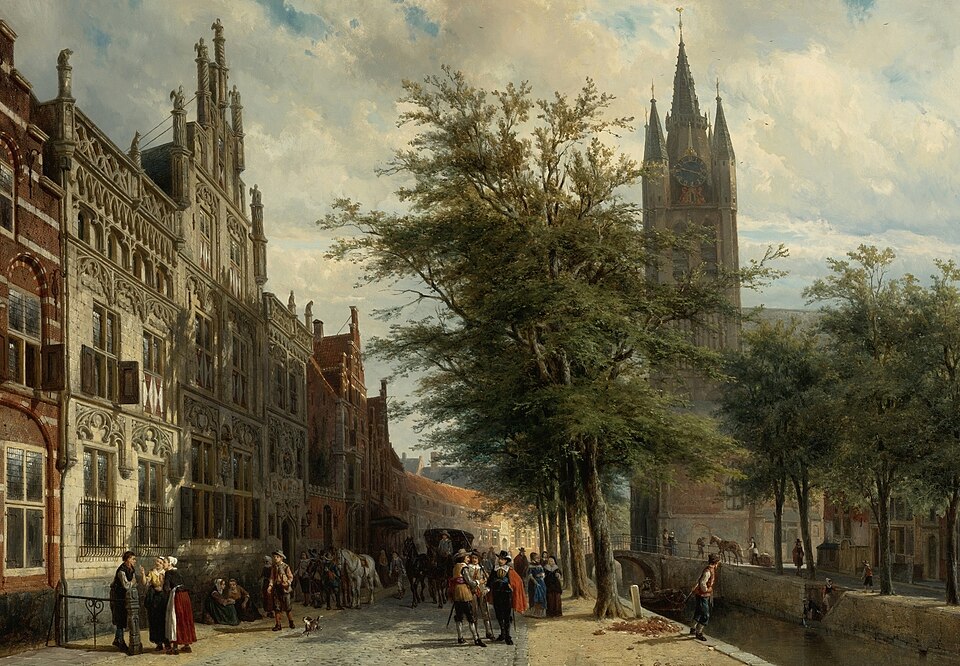
The revival owed much to artists who saw in Delft not just picturesque streets but a continuity with the Golden Age. Dutch painters such as Cornelis Springer, Johannes Bosboom, and the Hague School’s members made Delft’s architecture and canals recurring subjects. They lingered on the same motifs that had fascinated Vermeer and de Hooch: sunlight angling through narrow streets, the geometry of tiled courtyards, the tranquil reflection of gables in water.
Bosboom, in particular, painted church interiors in a style that was almost an homage to the 17th-century Delft School. His views of the Oude Kerk and Nieuwe Kerk returned color and atmosphere to spaces that, in reality, were stripped-down Protestant interiors — a gentle re-enchantment of the present through the lens of the past.
These works circulated in exhibitions and print reproductions, reintroducing Delft’s visual character to audiences both in the Netherlands and abroad.
Cultural Nostalgia and the Vermeer Effect
The rediscovery of Johannes Vermeer in the mid-19th century gave Delft a cultural touchstone unlike any other. French critic Théophile Thoré-Bürger’s essays in the 1860s and 1870s celebrated Vermeer’s View of Delft as a masterpiece of light and truth, inspiring art historians and collectors to seek out his other works.
For visitors, seeing Delft became an act of entering Vermeer’s world. Travelers sought the vantage points of The Little Street and View of Delft, searching for continuity between the painted image and the lived city. Guidebooks began to include Vermeer in their descriptions, and the city itself embraced the association. By the turn of the 20th century, Vermeer’s name was part of Delft’s identity, used in everything from tourism literature to marketing for Delftware.
This “Vermeer effect” combined with the broader Romantic tendency to see cities as living museums. In Delft’s case, the museum metaphor became literal with the establishment of institutions such as the Prinsenhof Museum, which preserved historic buildings and displayed the city’s art and artifacts in situ.
The Rise of Museum Culture and Craft Revival
The late 19th century also saw the revival of Delftware as a deliberate act of heritage-making. In 1876, Joost Thooft took over De Porceleyne Fles and transformed it from a struggling pottery into a thriving enterprise. He hired skilled designers, experimented with new glazes, and reintroduced historical patterns alongside fresh designs influenced by Art Nouveau.
The factory opened its doors to visitors, blending production with tourism in a way that made Delftware both a living craft and a curated tradition. This model mirrored the broader European Arts and Crafts movement, which sought to elevate craftsmanship as a counterpoint to industrial mass production.
Museums played a central role in shaping Delft’s image during this period. The Prinsenhof collected not only paintings and ceramics but also documents, tools, and furniture, creating a narrative of the city’s past that visitors could walk through. This institutional framing of history reinforced Delft’s position as a custodian of Dutch heritage.
Delft as National Symbol
By the early 20th century, Delft had become more than just a city; it was an emblem of a certain vision of the Netherlands. Its careful preservation of historic architecture, its association with Vermeer and Golden Age painting, and its continued production of Delftware positioned it as a touchstone in discussions of national culture.
In paintings, photographs, and tourist postcards, Delft’s image crystallized: canals bordered by brick houses, church towers rising above red-tiled roofs, sunlight playing on water. It was a vision that appealed both to domestic pride and to foreign romanticism — a small, harmonious city where the past seemed palpably present.
This national romanticism did not freeze Delft in amber, but it did encourage a deliberate management of its appearance and cultural offerings. Restoration projects aimed to maintain the “historic” look, sometimes even reconstructing lost details to fit the idealized image. The city had moved from being simply a place where art was made to being, itself, a kind of curated artwork.
Modern and Contemporary Art in Delft
Today, Delft is internationally recognized for its past — for Vermeer’s still interiors, for the crisp cobalt of its ceramics, for its role in the Dutch Golden Age. But it is not a city sealed off from the present. In the decades since World War II, Delft’s artistic life has continued to evolve, embracing modern materials, new forms of public art, and a diverse community of makers while maintaining a constant dialogue with its heritage.
From Craft Schools to Design Academies
The roots of Delft’s modern creative scene lie in its educational institutions. The Technical University of Delft (TU Delft), while primarily known for engineering and architecture, has been a fertile ground for design innovation since the mid-20th century. Its architecture faculty, in particular, has attracted internationally significant figures such as Aldo van Eyck and Herman Hertzberger, whose humanistic modernism influenced generations of Dutch designers.
Art and design education here often blurs the line between technical precision and creative exploration — a sensibility not unlike that of the Golden Age painters and Delftware decorators. Students work on projects ranging from urban planning to product design, sometimes drawing inspiration from the city’s historic fabric while applying contemporary technology.
Local art academies and workshops also support emerging artists. In converted warehouses along the canals, painters, ceramicists, and sculptors share space with designers working in 3D printing and digital media. This mixing of traditional craft with experimental practice keeps Delft’s creative ecosystem adaptable and layered.
Ceramic Innovation and Public Art
Delftware remains a living tradition, though it now shares space with a wide spectrum of ceramic art. Contemporary potters have pushed beyond the classic blue-and-white idiom, experimenting with matte glazes, sculptural forms, and conceptual installations. Some deliberately quote historic Delftware motifs, reimagining them in fractured or oversized compositions; others work entirely outside the tradition but still see themselves as part of the city’s ceramic lineage.
Public art projects have woven ceramics into the city’s everyday landscape. Mosaics along canal walls, tile murals at tram stops, and ceramic plaques marking historic sites blend function with ornament in a way that echoes Delft’s long-standing integration of art into civic space. These works are often collaborative, involving local schools, community groups, and established artists — a 21st-century parallel to the guild-based commissions of earlier centuries.
Delft’s public art extends beyond ceramics. Large-scale murals, temporary installations in the Markt, and light-based artworks during festivals ensure that contemporary art has a visible and evolving presence. The city’s scale — intimate enough that public interventions are quickly noticed — allows for a lively dialogue between residents and the works that appear in their midst.
Gallery Culture and Contemporary Voices
The gallery scene in Delft is small but resilient. Independent spaces often double as studios, with exhibitions ranging from painting and photography to experimental video. These venues provide crucial platforms for local artists to test ideas and connect with collectors without having to relocate to Amsterdam or Rotterdam.
Annual events such as the Delft Ceramics Days and the Open Studios weekend draw visitors into workshops and encourage direct interaction between makers and audiences. For many residents, these encounters are as much about reinforcing community identity as they are about buying or selling art.
Thematically, contemporary Delft artists engage with a range of issues: environmental change and water management (an inevitable subject in a city built below sea level), the legacy of colonial trade networks that brought wealth to the Dutch Republic, and the role of historical imagery in shaping modern national identity. In this, they extend the city’s tradition of using art to navigate between the local and the global.
The Living Legacy: Delft’s Global Image
Delft’s name now circulates in the world with a resonance that far exceeds its physical size. For many, the word immediately conjures the cool glow of Vermeer’s interiors or the crisp cobalt scrolls of Delftware. For others, it stands for the Dutch city-as-museum — narrow canals, brick façades, church towers — a place where the past appears vividly present. But Delft’s global image is not simply the result of nostalgia; it is the product of centuries of artistic production, reinvention, and careful cultivation.
Vermeer as Brand and Ambassador
Few artists are as intimately tied to a city as Johannes Vermeer is to Delft. Since his 19th-century rediscovery, his paintings have become both an emblem of Dutch cultural heritage and a magnet for tourism. Exhibitions of his work, whether in the Netherlands or abroad, are often accompanied by images of Delft, positioning the city as the essential context for understanding the artist.
Delft has embraced this role. Walking routes guide visitors to supposed Vermeer vantage points; the Vermeer Centrum Delft offers interpretive exhibitions in a former guild building; and the city’s marketing often pairs images of Vermeer’s paintings with photographs of corresponding streetscapes or interiors. In this way, Vermeer functions almost as an informal city logo — a visual shorthand for refinement, harmony, and luminous quiet.
Delftware Imitations and Authenticity Debates
The other pillar of Delft’s global recognition is its ceramics. Delftware has been imitated in England, Germany, China, and beyond since the 17th century, to the point that “Delft” is often used generically for any blue-and-white pottery. While this diffusion has spread the style far beyond the Netherlands, it has also prompted ongoing debates about authenticity.
De Porceleyne Fles remains the most visible guardian of the tradition, marking its wares with distinctive factory symbols and offering certificates of authenticity. Contemporary ceramicists in Delft navigate this legacy carefully: some lean into the historic patterns as a brand identity, while others deliberately subvert them, using the familiar blue-and-white as a starting point for critique or reinvention.
These tensions — between heritage and innovation, between local craft and global replication — keep Delftware from becoming a static souvenir. It remains part of a living conversation about what it means for a tradition to be both preserved and reinterpreted.
The City as Muse
Perhaps the most enduring aspect of Delft’s global image is the city itself. Artists still paint its canals and gables; photographers capture its misty mornings; filmmakers use its streets as ready-made period sets. The compactness of the historic center, largely intact despite centuries of change, makes it an unusually legible urban canvas — a place where the interplay of architecture, water, and light invites constant reinterpretation.
Seasonal rhythms shape this muse-like quality. In summer, the city bustles with open-air markets, canal tours, and plein air painters. In autumn and winter, the fog and low light lend it a quieter, almost Vermeer-like atmosphere that appeals to those seeking a slower, more contemplative pace. This cyclical shift in mood keeps the city’s image fresh for those who return year after year.
Delft’s art history is not a closed chapter but an ongoing story. Its Golden Age achievements still draw the world’s gaze, but the city’s true vitality lies in the continuity between past and present: the same waterways that once carried pigments and porcelain now bring tourists and international artists; the same streets that framed Vermeer’s “little street” now host contemporary galleries. Delft’s legacy is not just in what it has preserved, but in how it continues to inspire.
Walking the Art History of Delft
Delft’s art history is not locked in glass cases or limited to a few museum galleries. It is embedded in the very fabric of the city — in the lines of its streets, the tilt of its gables, the way light falls on brick and water. To walk through Delft with an awareness of its artistic past is to move through a layered canvas where each corner can recall a different century.
Beginning at the Markt
The Markt square is a natural starting point. Bordered by the ornate Renaissance façade of the Stadhuis (City Hall) on one end and the soaring Gothic spire of the Nieuwe Kerk on the other, it frames Delft’s civic and religious life in a single view. Stand in the center and you can almost read the city’s history in the skyline: the medieval church, the 17th-century civic pride in the town hall’s ornamentation, the layers of brickwork in the surrounding houses.
From here, step into the Nieuwe Kerk itself. Though stripped of its medieval Catholic imagery, its interior is a lesson in post-Reformation Protestant aesthetics — whitewashed walls, clear glass, the pulpit as focal point — and in monumental sculpture, with the tomb of William the Silent dominating the chancel.
Along Oude Delft
From the Markt, walk west along Oude Delft, one of the city’s oldest canals. Here, centuries-old merchant houses lean slightly toward the water, their reflections forming a distorted double in the canal below. Many of these façades conceal interiors that have been updated countless times, but their exteriors retain the rhythms and proportions familiar to Vermeer’s generation.
About halfway down the canal lies the Prinsenhof Museum, housed in a former convent. Inside, you can trace Delft’s political and artistic history — portraits of guild leaders, Delftware of every style, and artifacts from the Eighty Years’ War. Step into the courtyard and you stand on the spot where William the Silent was assassinated in 1584 — a moment that entwines Delft’s political and artistic narratives, since his tomb became a key work of post-Reformation monument design.
Traces of Vermeer
No Vermeer paintings remain in Delft’s permanent collections, but the city holds his presence in other ways. The Vermeer Centrum Delft, near the Markt, offers detailed reproductions and analysis of his works in the context of the city’s architecture and light. A short walk away on Voldersgracht, you can stand near the site of his childhood home and his father’s inn, imagining the mixture of merchant chatter, tavern noise, and painterly discussion that shaped his early years.
Continue toward the Oude Kerk, whose leaning tower punctuates many of Vermeer’s city views. Inside, find his grave marker — modest, almost hidden in the stone floor — a quiet counterpoint to the grandeur of his legacy.
The Kilns and the Clay
To connect with Delft’s ceramic heritage, follow the Schie canal north to the still-active De Porceleyne Fles factory. Here, artisans work in light-filled studios, hand-painting the cobalt designs that have made Delftware famous since the 17th century. Visitors can see the full process, from shaping and glazing to the careful brushwork that transforms blank tiles and vases into works of art.
Back in the city center, shops and galleries sell both traditional pieces and contemporary reinterpretations. Some combine historic motifs with modern forms; others break entirely from tradition, using Delft’s ceramic reputation as a springboard for innovation.
Seasonal Rhythms and Contemporary Stops
If your walk coincides with the annual Delft Ceramics Days in early summer, the Markt fills with stalls selling ceramics from around the world — a modern echo of the city’s historic role as a trade hub. In autumn, the Open Studios weekend invites visitors into artists’ workspaces, offering a glimpse of contemporary creativity in converted warehouses and canal-side ateliers.
Along the way, you may encounter public artworks that weave past and present together: a tile mural depicting a 17th-century scene with a contemporary twist; a light installation reflecting ripples across a brick wall at night.
Walking Delft’s art history is less about ticking off monuments than about recognizing how the city itself is an artwork in progress — one where prehistoric clay, Gothic stone, Golden Age light, and modern imagination all coexist in a few square kilometers. Each step folds another layer into your experience, until the line between history and the present feels as fluid as the reflections in its canals.