The Cuzco School, also known as the Escuela Cuzqueña, represents a singular chapter in the history of art—a cultural fusion where Spanish Catholicism met Andean tradition in the highlands of Peru. Emerging after the Spanish conquest in the 16th century, this movement gave birth to a vibrant school of painting and sculpture that thrived from the late 1500s through the 1700s. These works were deeply spiritual, lavishly decorative, and often infused with local symbolism that revealed a quiet resistance beneath religious conformity. Unlike European art of the time, the Cuzco School wasn’t just about aesthetics—it was a missionary tool, a political strategy, and a cultural compromise.
Centered in the colonial capital of Cuzco, Peru, the school trained generations of indigenous and mestizo (mixed European and indigenous) artists under the supervision of Spanish priests and craftsmen. Over time, however, native artists adapted European forms into something uniquely their own. With flattened perspectives, glowing gold leaf, and a love for natural detail, the Cuzco School’s paintings became a reflection of a people preserving their identity while serving a foreign power. This duality is what makes the tradition so powerful—and so visually arresting.
Today, the Cuzco School is increasingly recognized by global museums, collectors, and scholars. Works once seen as “provincial” or “folk” are now appreciated for their complexity, beauty, and historical importance. They offer not only religious imagery but also an artistic record of colonial negotiation, adaptation, and resilience in the Andes.
Origins of the Cuzco School in Colonial Peru
The Cuzco School began to take shape in the second half of the 16th century, just a few decades after Francisco Pizarro conquered the Inca Empire in 1532. With the city of Cuzco—once the capital of the Inca world—transformed into a colonial stronghold, Spanish missionaries quickly began using art as a tool for religious instruction. The Catholic Church commissioned paintings to decorate new churches and convert indigenous populations unfamiliar with European-style worship. Workshops were set up with the goal of replicating religious imagery from Spain and Italy, reinforcing the Catholic worldview in a land still steeped in Inca traditions.
Art became a way to teach theology to the newly baptized, many of whom were illiterate. Missionaries such as the Jesuits and Franciscans brought religious engravings from Europe, which served as visual templates for local artists to follow. These reproductions featured scenes from the life of Christ, the Virgin Mary, and saints—subjects that needed no words but carried immense theological weight. Religious instruction wasn’t just about obedience; it was about reshaping an entire civilization’s understanding of God, history, and morality.
The Influence of Italian and Spanish Baroque Artists
One of the earliest influential European painters in Peru was the Italian Jesuit Bernardo Bitti, who arrived in Lima in 1575. Bitti introduced Mannerist and early Baroque techniques—chiaroscuro (the use of light and shadow), delicate figure proportions, and idealized facial expressions—that set a stylistic precedent for what would later become characteristic of the Cuzco School. His works, such as The Virgin of the Candelaria and The Coronation of the Virgin, left a lasting impression on local workshops. Bitti trained and inspired a generation of painters who carried his techniques into the mountainous heart of Peru.
As more Spanish and Italian clergy arrived in the Andes during the late 1500s and early 1600s, they brought with them books of prints by European masters like Peter Paul Rubens and Francisco de Zurbarán. These print collections became invaluable guides for native artists who never traveled to Europe but nonetheless produced art grounded in European models. However, these artists would soon transform those imported images into something much more personal, colorful, and spiritually layered.
Indigenous and Mestizo Artists Take the Lead
By the early 17th century, a growing number of indigenous and mestizo artists were no longer just assistants in Spanish-run workshops—they were taking full creative control. These artists had mastered the formal techniques taught by their European instructors and began producing original compositions with distinctly Andean stylistic features. The shift wasn’t merely technical; it represented an intellectual and cultural assertion by people who were expected only to imitate. This independence signaled the rise of a new visual language within the colonial system.
The tension between Spanish-born artists (peninsulares) and native Andean painters came to a head in 1688, when the Asociación de Pintores (Painters’ Guild) in Cuzco split along ethnic lines. Native artists rejected the idea that they should remain subordinate in guild hierarchy and began operating independently. From this moment onward, the Cuzco School took on more local characteristics—brighter palettes, symbolic plants and animals, flattened perspective, and a sense of reverence more mystical than theological.
Diego Quispe Tito and the Rise of Local Masters
Among the earliest and most important native painters was Diego Quispe Tito, born in Cuzco in 1611. By the time of his death in 1681, he had established himself as a foundational figure in the development of the Cuzco School. His work is marked by a unique blend of European composition and Andean detail—celestial skies, decorative foliage, and native birds populate his religious scenes. One of his best-known works, a series on the life of St. John the Baptist, reveals both technical brilliance and spiritual intensity.
Quispe Tito’s style became a model for generations of painters who followed. His use of color, fantastical backgrounds, and balanced forms reflected not just artistic talent, but a deep engagement with both Catholic mysticism and indigenous cosmology. He also trained apprentices in his own workshop, ensuring that his artistic vision would shape the visual culture of the region well beyond his lifetime. His legacy helped root the Cuzco School in indigenous agency rather than European control.
Religious Themes and Syncretism in Cuzco Art
At its heart, the Cuzco School was a religious art tradition, with nearly every painting featuring sacred Catholic subjects—especially the Virgin Mary, saints, angels, and episodes from Christ’s life. However, these familiar icons often contained hidden or modified elements drawn from pre-Columbian Andean beliefs. This syncretism—where two belief systems blend—wasn’t merely accidental. It was an intentional effort by native artists to reconcile the spiritual landscape of their ancestors with the imposed Catholic worldview. The result was a rich visual language that communicated to native viewers in subtle, symbolic ways.
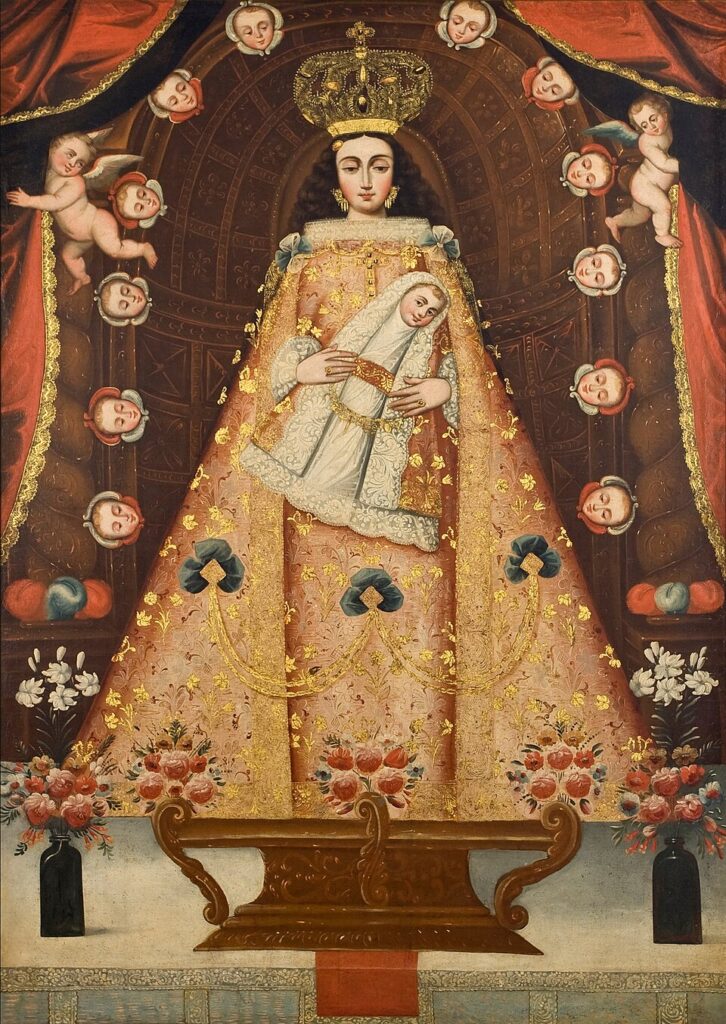
One of the most compelling examples is the widespread representation of the Virgin Mary as the Virgin of the Mountain. In these paintings, her cloak resembles the shape of a mountain, often linked to the sacred Apus (mountain spirits) of Andean cosmology. Scholars debate whether this was an act of religious subversion or merely visual resonance, but the symbolism is unmistakable. The Virgin, once a European queen of heaven, became Pachamama—the Andean earth mother—without ever being named as such. This type of symbolic layering gave Cuzco School paintings an emotional and cultural depth rarely found in imported European works.
Angels with Muskets and Winged Warriors
One of the most iconic and unusual elements of Cuzco School art is the “arcabucero” angel—heavenly figures armed with arquebuses (early muskets), dressed in military regalia resembling Spanish officers. These angels, painted with serene expressions and elegant posture, are unique to Latin American colonial art. They first appeared in the 17th century and became especially prominent in Bolivia and southern Peru, including Cuzco. Their presence combines Spanish military power with celestial authority, projecting an image of order and conquest divinely sanctioned.
But these angels likely drew inspiration from older Andean warrior deities, who were often depicted with weapons and revered as protectors of the land. The muskets, then, may not have symbolized European violence alone, but also the protective strength of native traditions reimagined. Many of these angelic figures were named—such as Uriel, Michael, and Barachiel—yet their poses, garments, and settings had no direct European precedent. The result was a startling new iconography that merged battlefield and heaven, gunpowder and gold leaf, in a truly Andean visual theology.
Materials, Techniques, and Distinctive Aesthetics
What immediately sets Cuzco School paintings apart is their luminous, decorative quality. Artists favored bright, saturated colors—particularly reds, golds, and blues—and frequently applied gold leaf to halos, garments, and backgrounds. Rather than mimicking the realism of European masters, Cuzco artists leaned into stylization, symbolism, and ornate detail. This created a visual intensity that reflected a sacred, otherworldly dimension rather than the material world. While the themes were Catholic, the execution was Andean in soul.
Artists typically painted on linen canvas or wooden panels, often using materials available locally. Binding agents such as llama-hide glue and pigments made from crushed minerals, plants, and insects were common. The result was a slightly textured surface that gave Cuzco paintings a distinctive, tactile presence. These materials aged well in the Andean climate, allowing many works to survive intact across centuries. In rural churches across Peru and Bolivia today, you can still find original Cuzco paintings in their original settings, glowing in candlelight.
How Cuzco Artists Transformed European Techniques
Cuzco painters did not prioritize realistic proportion or three-dimensionality. Instead, they adapted Renaissance and Baroque techniques to emphasize flatness, pattern, and spirituality. Human figures are often elongated or simplified, with little concern for anatomical precision. What mattered more was the emotional clarity and symbolic power of the image. Ornate robes, flowing patterns, and ethereal expressions captured the sense of divine presence in a way that resonated with local viewers.
The emphasis on light came not from accurate depiction of shadows, but from decorative radiance. Gold leaf was not just a flourish—it symbolized heaven itself. This divergence from European realism wasn’t a failure; it was a choice rooted in a different understanding of visual storytelling. In Cuzco School art, spiritual truth mattered more than physical reality. This decision gave rise to an aesthetic that, while technically influenced by Europe, stood wholly on its own.
The Role of Workshops and Artistic Collaboration
The Cuzco School thrived through the institution of workshops—structured, guild-like environments where master painters trained apprentices and oversaw the production of commissioned works. These talleres became the heartbeat of Andean artistic production from the 1600s to the late 1700s. Many of these workshops were multigenerational, with fathers passing skills and stylistic traits down to their sons. This familial continuity preserved stylistic coherence while allowing for innovation.
Because churches across the Andes needed religious images quickly and affordably, these workshops often produced paintings in series. Depictions of the Life of the Virgin, Stations of the Cross, or Lives of the Saints would be completed by multiple hands—one artist might paint the figures, another the background, and yet another the embellishments. This assembly-line approach made sacred imagery accessible even in remote villages. Cuzco’s central location allowed it to distribute these paintings throughout Spanish South America.
Famous Collaborative Works and Exportation
The output of the Cuzco School wasn’t confined to Peru. By the late 17th century, its paintings were being shipped to Bolivia, Ecuador, Chile, and Argentina, and even as far as Mexico and Spain. These exports were highly prized for their beauty and affordability. Churches, monasteries, and private homes ordered images from Cuzco in bulk, ensuring the city’s reputation as the artistic capital of colonial South America.
Some of the most famous collaborative series from this period include the Corpus Christi Procession, a multi-panel depiction of the festival featuring civic, religious, and indigenous participants. Others include the Passion of Christ cycles produced for altarpieces in Bolivia and Northern Argentina. These works weren’t just religious—they were also cultural exports, showcasing the unique spiritual and aesthetic values of the Andes to the wider Spanish Empire.
Decline, Rediscovery, and Legacy in Modern Times
By the end of the 18th century, the Cuzco School began to decline. Enlightenment ideals, which emphasized reason and scientific realism, began to replace the mystical and symbolic tone of Baroque art. The Bourbon Reforms, initiated by the Spanish crown in the 1760s, centralized cultural authority in Lima and Madrid, undermining regional artistic centers like Cuzco. At the same time, academic painting academies pushed for more Europeanized standards, marginalizing the distinctive aesthetic of mestizo and indigenous painters.
As independence movements swept Latin America in the early 1800s, colonial art fell out of favor. It was seen as part of the oppressive Spanish legacy and largely forgotten. Only in the 20th century did scholars and collectors begin to reassess the Cuzco School’s historical and artistic value. Art historians began publishing serious studies, while museums began acquiring major works. What had once been dismissed as provincial became recognized as profoundly original.
Cuzco School in Contemporary Appreciation
Today, the Cuzco School is celebrated as a vital part of Peru’s national heritage. Exhibitions in cities such as Lima, New York, Paris, and Madrid have showcased its intricate beauty and cultural depth. Museums like the Museo de Arte de Lima and the Brooklyn Museum hold significant collections. Its style continues to influence folk artists across Latin America, particularly in devotional art, processional statues, and nativity scenes.
In academic circles, the Cuzco School is now discussed not only as an art movement but also as a form of resistance and adaptation. It stands as a testament to how a conquered people used beauty and faith to maintain their identity. More than just religious illustrations, these paintings are visual records of cultural survival. The growing global interest in Latin American colonial art ensures that the Cuzco School’s light will continue to shine.
Key Figures and Works of the Cuzco School
The Cuzco School produced many artists of note, but a few stand out for their extraordinary contributions. Basilio Santa Cruz Pumacallao, active in the mid-to-late 17th century, was another major indigenous master whose style emphasized grace, flowing lines, and celestial settings. His Coronation of the Virgin and other works display a remarkable balance of drama and devotion. Another major figure was Marcos Zapata, born around 1710 and active until his death in 1773, whose prolific output helped define the final phase of the Cuzco School.
These artists didn’t just copy European styles—they added their own symbolic and cultural signatures. Zapata, for instance, is best known for introducing Andean foods and references into biblical scenes. His images of saints and apostles often wore clothing with patterns resembling local textiles, and backgrounds included native plants and birds. These details were subtle but powerful, offering an Andean reinterpretation of sacred history.
The Zapata “Last Supper”: A Perfect Symbol of Syncretism
One of the most iconic paintings from the Cuzco School is The Last Supper by Marcos Zapata, painted around 1753. At first glance, it resembles Leonardo da Vinci’s famous composition, but a closer look reveals surprising changes. On the table is not bread and wine alone, but also roasted cuy (guinea pig) and chicha, a fermented corn drink—both traditional Andean foods. The inclusion of these elements transforms a biblical scene into something deeply Peruvian, blending faith with local identity.
This painting hangs in the cathedral of Cuzco, where it continues to captivate both worshippers and tourists. It stands as a visual metaphor for the entire Cuzco School: European in frame, Andean in content. By inserting familiar food and symbols into a sacred scene, Zapata created an image that honored both his faith and his heritage. It is this layered complexity that makes the Cuzco School not just a style, but a cultural conversation across centuries.
Key Takeaways
- The Cuzco School developed in colonial Peru as a fusion of Catholic and Andean artistic traditions.
- Indigenous and mestizo painters gained autonomy and led the school’s stylistic evolution.
- Religious themes were reinterpreted with local symbols, creating a unique visual language.
- The school’s works were exported across South America and rediscovered in the 20th century.
- Artists like Diego Quispe Tito and Marcos Zapata helped define the movement’s identity.
FAQs
- What is the Cuzco School of painting?
It’s a colonial-era art movement in Peru that combined European religious themes with Andean aesthetics. - Who were the main artists in the Cuzco School?
Notable artists include Diego Quispe Tito, Basilio Santa Cruz Pumacallao, and Marcos Zapata. - What makes Cuzco School art unique?
Its blend of gold leaf, stylized figures, and native symbolism sets it apart from European art. - Where can I see Cuzco School paintings today?
Major collections are found in Lima, Cuzco, New York, and other cities with colonial art museums. - How did indigenous culture influence Cuzco School art?
Artists infused Catholic subjects with local flora, fauna, textiles, and even food traditions.
Meta Description: