In the heart of Argentine Patagonia lies a breathtaking testament to early human creativity—Cueva de las Manos, or “Cave of the Hands.” This ancient site is world-renowned for its striking hand stencils, painted onto the rock faces of a deep river canyon over 9,000 years ago, with some dating as far back as 13,000 years. Located in Santa Cruz Province, this cave system preserves the legacy of prehistoric hunter-gatherers who once roamed the wild landscapes of South America. It was designated a UNESCO World Heritage Site in 1999, a recognition of its cultural, historical, and artistic importance.
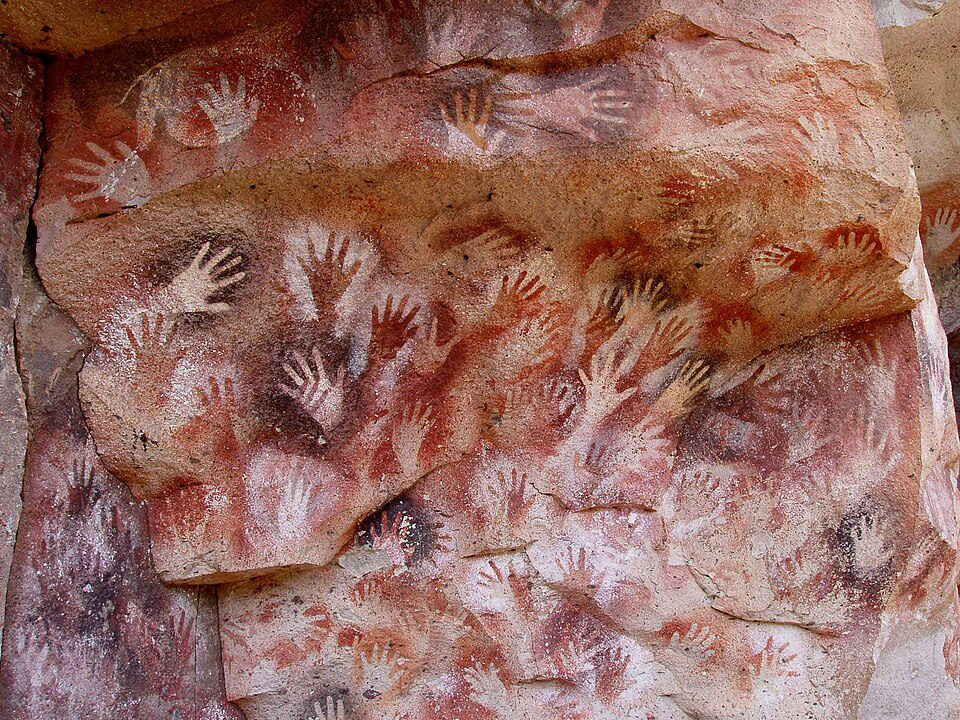
The name “Cueva de las Manos” refers directly to the cave’s most iconic feature—hundreds of human handprints, mainly created using a negative stencil technique. These prints cover the cave walls like a silent chorus of voices from the distant past, their vivid colors still visible after thousands of years. Most of the hands appear to be left hands, suggesting that the artists held the pigment tool with their right hand and sprayed over it. The result is an eerie, mesmerizing effect that still stirs modern viewers with its emotional power.
The artwork was created by pre-Columbian hunter-gatherers during the Late Pleistocene and early Holocene periods. Over several millennia, these early Argentinians returned to the site to leave their mark, creating layers of imagery that tell stories of survival, identity, and spirituality. The cave paintings are not limited to hands—they also include scenes of hunting, native wildlife, and abstract symbols whose meanings are still debated. But it is the hands, more than anything, that capture the imagination.
In this article, we’ll journey deep into Patagonia’s prehistoric past to explore Cueva de las Manos—its history, its artists, and the techniques they used to create lasting art. We’ll also look at what this cave reveals about early human society in South America and how this fragile treasure is being preserved. This is not just a collection of old paintings—it’s a window into the soul of ancient humanity.
Argentina’s Prehistoric Canvas — A Look at Cueva de las Manos
Cueva de las Manos is nestled in a narrow canyon along the Río Pinturas, surrounded by wind-swept plateaus, rugged cliffs, and wide Patagonian skies. The site is about 160 kilometers south of Perito Moreno in Santa Cruz, and access is limited due to its remote location and fragile condition. The cave is part of a larger complex of rock shelters, but it is the central gallery—about 24 meters long—that contains the richest concentration of prehistoric paintings. These were created in phases spanning nearly 4,000 years, giving the site a layered depth rarely seen elsewhere.
The earliest artworks, based on radiocarbon dating of organic pigments and nearby archaeological remains, are estimated to be nearly 13,000 years old—dating back to around 11,000 BC. Later layers were added over time, with most of the hand stencils dating to between 7,300 and 9,300 years ago. This continuous usage suggests that the cave held special cultural or spiritual importance across generations. The fact that the artists returned again and again to this remote location speaks to its enduring place in their society.
In addition to handprints, the walls feature scenes of hunting guanacos, native wild camelids that were essential to the survival of the local people. The paintings show human figures armed with bows and arrows, coordinated in strategic pursuits. This art gives us insight into prehistoric hunting techniques and the deep relationship between humans and the natural environment. There are also abstract patterns, including zigzags, spirals, and clusters of dots, whose meanings remain the subject of speculation.
Altogether, the paintings form one of the most complete visual records of prehistoric life in South America. While ancient art in other regions may depict isolated scenes or symbols, Cueva de las Manos presents a complex, evolving narrative—combining ritual, social identity, and environmental interaction. Its artistic sophistication and historical continuity make it not only a national treasure for Argentina but a masterpiece of global heritage.
The Artists of Deep Time — Who Created These Hand Stencils?
The creators of the Cueva de las Manos paintings were early hunter-gatherers who lived during the Late Glacial period and early Holocene. These were mobile bands of people who adapted to the changing climate and terrain of post-Ice Age Patagonia. They hunted guanacos, gathered edible plants, and likely moved between seasonal camps. While we have no written records or names, the art they left behind offers a direct, emotional link to who they were and how they lived.
Archaeologists associate the site with the early cultures of the Tehuelche ancestors, who were known for their nomadic lifestyle and deep connection to the land. Though the exact ethnic identity of the artists remains unknown, the continuity of artistic tradition points to shared values and customs that spanned generations. The consistent use of symbols, themes, and techniques suggests that knowledge was passed down orally, likely through familial or tribal bonds. This connection between art and oral tradition reflects a society that valued memory and identity.
The hand stencils themselves provide clues to the individuals behind them. The majority are left hands, implying that artists used their right hands to spray pigment over the other. The sizes vary, indicating the presence of both adults and adolescents in the painting process—possibly as part of initiation rites or communal rituals. Some prints show fingers missing, bent, or intentionally masked, which could represent symbolic gestures or even physical trauma. Such details reveal personal, and perhaps spiritual, layers behind what first appears to be a simple image.
There’s also strong evidence that the cave was not merely decorative but ritualistic. The repeated presence of handprints may indicate a rite of passage, a symbolic “mark” left by individuals as they entered adulthood or joined a specific group. Others argue it may have been a way to communicate identity, territory, or social role within the tribe. Whatever the case, these images were clearly meaningful—not random scrawls, but carefully planned and executed acts of cultural expression.
Malacological Tools and Pigments — How the Paintings Were Made
Creating the images inside Cueva de las Manos required ingenuity, patience, and a deep understanding of the natural environment. The artists didn’t have metal tools or synthetic colors—they used what the land gave them. To make the hand stencils, they would place one hand against the wall and blow pigment over it, using either hollow bones or their own mouths to create a spray effect. The result was a negative image, a sort of ghostly silhouette preserved in stone.
The pigments came from mineral and organic sources found in the surrounding landscape. Red and orange hues were derived from iron oxide (ochre), black from manganese or charcoal, white from kaolin clay, and yellow from natural earth minerals. These pigments were ground into fine powders and mixed with binders like water, animal fat, or even saliva. The colors were not just chosen for visibility—they likely held symbolic meanings tied to ritual or tribal identity.
Tools used in the painting process were simple yet effective. Hollow bird bones or tubes made from cane or reeds served as early airbrushes. Some of the more complex hunting scenes were painted with rudimentary brushes made from animal hair or plant fibers, though finger painting was also common. The techniques demonstrate considerable skill in both material preparation and artistic execution. These weren’t random acts—they were planned, practiced, and passed on.
The placement of the artwork also reveals its importance. Many paintings are located high up on cave walls, suggesting the use of scaffolding or teamwork to reach those heights. Others are tucked into corners or narrow passageways, indicating that these spaces held specific ritual meaning. The labor involved—gathering pigment, creating tools, and applying paint—implies a significant investment of time and effort. This was not casual doodling; it was a sacred act of expression, identity, and belonging.
The Legacy and Preservation of Cueva de las Manos
Over the past several decades, Cueva de las Manos has gained increased attention from archaeologists, historians, and cultural preservationists. Recognizing its significance, the Argentine government and UNESCO have taken major steps to ensure its protection. In 1993, the cave was declared a National Historic Monument of Argentina, and it was inscribed as a UNESCO World Heritage Site in 1999. These designations helped bring international support and funding for preservation.
Access to the site is highly controlled to prevent damage from tourism and environmental exposure. Visitors can only enter with certified guides, and the number of visitors per day is restricted. Paths and observation points are carefully laid out to prevent direct contact with the paintings. This balance between public access and conservation is delicate but necessary—without it, the artwork could be damaged by humidity, oils from human skin, or the introduction of foreign bacteria.
In addition to physical preservation, digital documentation projects have played a major role in safeguarding the site. High-resolution 3D scans and photographic archives have been created to allow for virtual tours, academic study, and public education. These efforts ensure that even if natural degradation occurs, the art will not be lost to time. Schools, museums, and universities in Argentina now use these resources to teach about early indigenous cultures and national heritage.
Perhaps most importantly, the site has become a symbol of Argentine identity and continuity. It connects modern Argentinians to a distant past that predates written language, colonization, and modern political boundaries. By protecting the cave, Argentina is not just preserving old art—it is preserving a story of origin, one painted with purpose and passed down not in words, but in vibrant handprints across stone.
Spiritual Echoes in Stone — Why These Handprints Still Matter
Standing before the stenciled walls of Cueva de las Manos, one is struck by the intimacy of the artwork. These aren’t anonymous symbols or decorative marks—they are literal imprints of human hands, left thousands of years ago by individuals with thoughts, fears, hopes, and families. The act of placing a hand on stone and leaving a mark speaks to a universal human desire: to be seen, to be remembered, to belong to something greater than oneself. These handprints are the oldest personal signatures in the Americas.
The sheer number of hands—over 800 identified so far—creates a powerful collective message. Each hand is different, yet together they form a visual symphony of shared identity and purpose. This wasn’t art made for outsiders. It was art made by and for a community, layered with meaning, ritual, and tradition. The emotional impact of seeing so many ancient hands is hard to describe—it’s as if the wall is alive, reaching out across time.
Scholars continue to debate the exact meanings behind the hand stencils. Were they used in initiation rites? Did they mark belonging to a group, or serve as spiritual offerings? Were they commemorations of a journey, a hunt, or a rite of passage? These questions may never be fully answered, but the mystery only deepens the sense of awe. The cave doesn’t just preserve pigment—it preserves purpose, memory, and perhaps even prayer.
In today’s fast-paced, digital world, the paintings of Cueva de las Manos remind us of something deeply human and eternal. They speak to our need to leave a trace—to say “I was here.” More than mere archaeology, these prints are spiritual echoes, passed down not in books, but in red dust and stone. In them, we find not just history, but ourselves.
Key Takeaways
- Cueva de las Manos is located in Argentina’s Santa Cruz Province and dates back to around 13,000 years ago.
- The cave is famous for its negative hand stencils, created by prehistoric hunter-gatherers.
- Art inside includes hunting scenes, abstract symbols, and hundreds of individual handprints.
- The site is a UNESCO World Heritage Site and a national symbol of Argentina’s ancient heritage.
- Modern conservation efforts use technology to protect the art while making it accessible for education.
FAQs
- Where is Cueva de las Manos located?
It’s in southern Argentina, in Santa Cruz Province, within the Río Pinturas canyon. - How old are the paintings in the cave?
Some are nearly 13,000 years old, with most created between 9,300 and 7,300 years ago. - Who made the hand stencils?
Prehistoric hunter-gatherers—possibly ancestors of the Tehuelche people—created the art. - Can tourists visit the cave?
Yes, but only through guided tours with strict limitations to protect the artwork. - Why are most handprints left hands?
Because artists likely used their dominant right hands to spray pigment around the left.