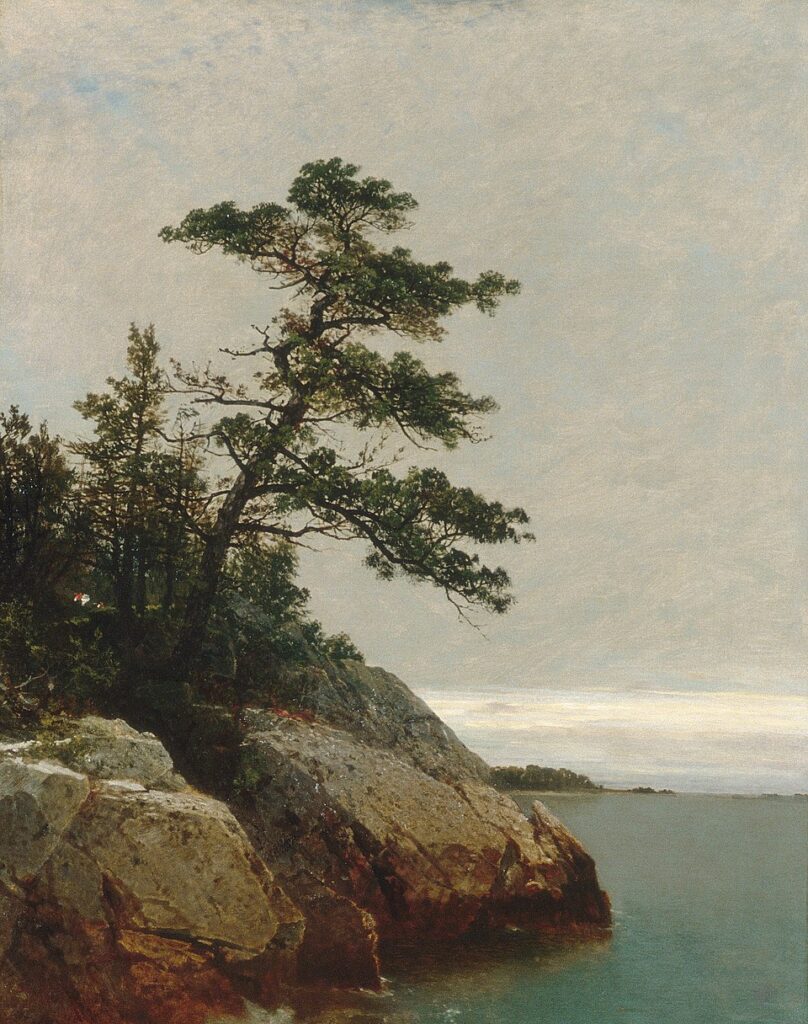
When English settlers brought their Calvinist convictions to the Connecticut River Valley in the early 17th century, they did not come to found an artistic tradition. They came to build a godly commonwealth, and the arts—especially the visual arts—were often seen as distractions at best, corrupting vanities at worst. Yet out of this austere and pragmatic worldview emerged a distinct regional culture of craft and visual expression—one rooted in wood and pigment, scripture and soil.
The earliest artistic expressions in Connecticut were almost always functional. Chairs, chests, and tables were not luxuries but necessities, yet the men who built them—joiners, turners, and carvers—often imbued them with quiet elegance. The famous Hadley chest, an oak chest with intricate carved panels made in the Connecticut River Valley around 1700, exemplifies this paradox: its Puritan simplicity is married to a surprising flourish of geometric and vegetal ornament. Furniture like this—along with silver by makers such as John Potwine of Hartford or Samuel Vernon of Newport—speaks to a restrained yet confident aesthetic: art not for show, but for structure, for order, for keeping things in place.
The Painted Face of Authority: Early Portraiture in a New England Key
While religious suspicion toward image-making remained strong through the 1600s, by the early 18th century a modest portraiture tradition had taken root among the mercantile and clerical elite. These were not the grand, cosmopolitan canvases of London-trained painters. They were flat, stiff, and often severe: figures posed frontally, with rigid hands and vacant backgrounds, eyes staring out in calm defiance of time.
One of the earliest examples still preserved in Connecticut is the portrait of Governor Gurdon Saltonstall (ca. 1725), now part of the Connecticut State Library’s Museum of Connecticut History. Anonymous and provincial, it offers little in the way of technical finesse. Yet it carries symbolic weight. Saltonstall, a theologian-turned-governor, sits unsmiling in Puritan black, holding a book—likely a Bible—his authority rooted in both church and state. These portraits were tools of lineage and legacy, visual assertions of permanence in a volatile world.
What they lack in painterly sophistication they make up for in psychological atmosphere. Portraits from this period operate less as personal likenesses than as visual contracts. They declare who one was, what one believed, what station one held in the covenantal hierarchy of the colony. Even the stylized lace collars or ink-black cloaks served as emblems of moral rectitude.
Among artists of this early period, few names have survived. Most were itinerant or part-time painters—craftsmen like Winthrop Chandler of Woodstock, Connecticut, who would emerge in the later 18th century as a regional figure. The anonymity of many colonial painters reflects both the cultural undervaluing of artistic skill at the time and the utilitarian nature of the work itself.
Crafting the Sacred: Ecclesiastical Design and the Meetinghouse Ideal
The most sustained visual focus in 17th- and early 18th-century Connecticut lay in the architecture and furnishings of the meetinghouse. These were not churches in the European sense, with soaring vaults and iconography. They were timber-framed boxes, whitewashed and bare, where the congregation gathered for sermons that could stretch for hours. But within their stark interiors were carefully wrought pulpits, sounding boards, and communion tables—woodwork designed to elevate the spoken word without distracting from it.
A mid-section surprise for many contemporary visitors to these spaces—reconstructed in historical museums or preserved in situ—is the level of care devoted to proportion and placement. The layout of a meetinghouse was a kind of theological diagram. The pulpit stood high, not for visibility alone but to reflect the authority of scripture. The absence of images was not an oversight but an ideology: in the Puritan view, God spoke through text, not flesh. The Word ruled, and visual art, where allowed, served the Word.
Three distinctive details from Connecticut’s early ecclesiastical art:
- Sounding boards: Intricately carved wooden canopies hung above pulpits to amplify the minister’s voice—often octagonal, elegantly shaped.
- Box pews: Geometrically enclosed seating, often with family names inscribed, reflecting both social order and architectural restraint.
- Hourglasses: Mounted near pulpits to keep preachers mindful of sermon length, a visual metronome for a word-driven culture.
This emphasis on order, balance, and proportion—though theological in origin—would later influence Connecticut’s secular arts, from domestic architecture to industrial design.
Seeds of a Patronage Culture: Collecting Before Museums
Before the founding of public museums, collecting in Connecticut remained largely private and clerical. Ministers and magistrates might possess volumes of sermons, theological prints, or copied maps. Portraits hung in town halls and family estates, passed down as heirlooms. But by the early 19th century, with wealth accumulating in Hartford and New Haven, there emerged a new appetite for formalized cultural life.
This appetite would find institutional form in 1844 with the opening of the Wadsworth Atheneum in Hartford—America’s first public art museum. Its founder, Daniel Wadsworth, was the son of a wealthy merchant family and a man of serious cultural ambition. Though the Atheneum’s initial holdings leaned toward European art and Romantic paintings, its architectural form—Gothic Revival, castellated and sober—felt deeply in tune with Connecticut’s older ideals: dignity, moral seriousness, and civic pride.
The roots of that ambition, however, lay deeper—in the austere beauty of colonial chests, in the restrained symbolism of early portraits, in the care with which an 18th-century craftsman carved a communion table for a wooden meetinghouse on a Connecticut hill.
Constraint as Character
The early art of Connecticut is not grand, theatrical, or lush. It does not seduce with color or gesture. But in its modesty lies its force. The restraint imposed by religion, geography, and economy produced not a cultural vacuum but a framework—a set of constraints within which form could flourish. That legacy, carried through generations of craftsmen, portraitists, and builders, shaped the DNA of Connecticut art: thoughtful, disciplined, and quietly radical in its refusal of excess.
Chapter 2: The Birth of a Yankee Aesthetic
From Necessity to Elegance in the Post-Revolution World
As Connecticut emerged from the Revolutionary War into the uncertain air of nationhood, its cultural life began to shift. No longer a purely Puritan stronghold defined by clerical austerity, the state became a crucible for an evolving American identity—urbane, industrious, and increasingly attuned to refinement. Nowhere is this transformation clearer than in the arts of the Federal period, where a new Yankee aesthetic took root: confident but modest, elegant but never ostentatious.
This was the age of symmetry and restraint, of veneered cherry and brass mounts, of silver teapots and portraiture that aimed to impress not with grandeur but with gravity. Artists and artisans responded to a growing demand among Connecticut’s professional and mercantile class for objects that could signal polish and cultivation without betraying the republican ideals of modesty and self-discipline. The balance was delicate, but in Connecticut—especially in towns like Norwich, Colchester, and Hartford—it was mastered with remarkable consistency.
The Cabinetmaker as Architect of Taste
Nowhere was this refined sensibility more visible than in the furniture crafted by Connecticut’s best-known cabinetmakers of the era. Samuel Loomis of Colchester (1748–1814), whose tall-case clocks and high chests survive in major collections today, exemplified the hybrid nature of this period’s style. His work is grounded in English design, with its cabriole legs and shell carving, but transformed through local materials and practical construction. There is a quiet rationality to it: proportional, functional, exact.
Even more sophisticated was Felix Huntington of Norwich, active from the 1770s through the early 1800s. Huntington’s “chest-on-chest” forms—two stacked case pieces, richly figured, delicately inlaid—suggest a regional baroque sensibility scaled down for Yankee restraint. His use of fan motifs, ogee bracket feet, and sharply defined drawer geometry places him squarely within the New England Federal style. But his execution was personal: no two pieces are quite alike, each responding to the architecture of the room it was destined for.
Three hallmarks of Connecticut’s Federal-era furniture craftsmanship:
- Locally sourced hardwoods: Cherry, maple, and birch were favored over imported mahogany, reinforcing both aesthetic regionalism and economic independence.
- Inlay work: Light, linear embellishments using contrasting woods (e.g., holly or ebony) offered visual sophistication without flamboyance.
- Architectural echoes: Pediments, columns, and cornices drawn from Palladian forms translated into domestic scale, mirroring the influence of pattern books and neoclassical ideals.
These were not anonymous artisans working in backwoods obscurity. They signed their work, advertised in local papers, and developed distinct regional reputations. Their clientele were lawyers, doctors, shipowners, and clergy—men who believed that taste, like character, should be stable and legible.
The Silversmith’s Republic: Crafting Refinement in Metal
Alongside furniture, Connecticut’s silversmiths helped define the material culture of its elite households. While not as numerous as those in Boston or Philadelphia, makers in Hartford, New Haven, and Norwich produced tea services, ladles, tankards, and porringers that combined utility with polish.
A typical Felix Huntington client might commission not only a writing desk but also a set of teaspoons or a cream jug—evidence not only of rising affluence but of a new domestic ritual: the tea table. This wasn’t just about entertaining; it was about discipline, manners, and the assertion of republican refinement in contrast to the aristocratic excesses of Europe. A silver teapot, polished weekly by servants or daughters, became a symbol of civic order and familial pride.
In the inventories of probate courts and estate sales, these objects recur with surprising frequency. They held monetary and symbolic weight, passed through generations, accumulating meaning and patina. Even when melted down, as many were during economic downturns, their forms lived on through pattern books and apprenticeships.
Faces of the Republic: Portraiture Comes Into Its Own
While New York and Boston produced celebrated portraitists like Gilbert Stuart, Connecticut’s contribution to early American painting was more subdued—though no less culturally meaningful. Early works, often by itinerant painters or self-taught locals, began to appear in town halls, private parlors, and court buildings. These paintings reflect a transitional moment in American portraiture: the shift from colonial stiffness to Federal poise.
In New Haven and Hartford, modest civic portrait programs began to emerge. Governors, judges, and prominent businessmen sat for likenesses that avoided aristocratic flourish, opting instead for sober expressions, dark clothing, and restrained settings. If Stuart’s George Washington offered grandeur, Connecticut’s portraits offered gravity.
These portraits served more than vanity. In a newly formed republic, they functioned as anchors of continuity. They reminded viewers of personal virtue, public service, and family lineage—all essential ideas in a society attempting to bind itself without monarchy or tradition. They were, in effect, secular icons for a civic religion of republicanism.
The Domestic Museum: Display, Aspiration, and Identity
By the early 19th century, Connecticut households began to arrange their interiors with an eye toward self-representation. What had once been spaces of pure function—kitchens, parlors, studies—became theaters of taste. The arrangement of a room told a story: imported ceramics on a sideboard, portraits above the fireplace, perhaps a small oil landscape or engraved map of the world framed neatly beside a bookcase.
The emerging bourgeoisie of Connecticut didn’t build castles or commission frescoes. They bought engravings, invested in quality joinery, and cultivated collections of objects that carried cultural capital. It was a form of domestic curatorship—private museums in miniature, long before public institutions would codify the practice.
One compelling detail: many of the homes that would later donate to or influence institutions like the Wadsworth Atheneum were already, by the 1820s, collecting historical relics. Revolutionary War memorabilia, early colonial artifacts, and family portraits were not just preserved but displayed, anchoring the home in a shared past that stretched from Plymouth Rock to Yorktown.
Elegance Without Excess
The Federal-era arts of Connecticut never courted spectacle. Instead, they honed a vocabulary of refinement rooted in proportion, restraint, and confidence. These were not the bombastic statements of empire-building cities, but the measured, well-made objects of a republic still unsure of its destiny. In furniture, silver, and portraiture, Connecticut artists and patrons forged an aesthetic that rejected aristocracy without embracing vulgarity—a style that, even two centuries later, still feels grounded, handsome, and enduring.
Chapter 3: Landscapes and the Lure of the Sublime
The Invention of American Nature
Before the 19th century, landscape painting in America was largely utilitarian—backdrops for portraits, depictions of property, or borrowed classical motifs. But as the young republic matured, so too did its hunger for national identity, and nowhere was this more potently expressed than in the dramatic reinvention of landscape as an autonomous, expressive genre. This transformation was not born in Connecticut, but Connecticut provided some of its most influential sons—and its hills, rivers, and skies offered a kind of quiet alternative to the Hudson Valley’s grand theatricality.
The rise of the Hudson River School in the 1820s and 1830s signaled a turning point. Thomas Cole, an English immigrant raised in Ohio, became its catalytic figure with romantic, reverent visions of untamed wilderness. But it was his student, Frederic Edwin Church, born in Hartford in 1826, who would carry that vision into global prominence. Church’s connection to Connecticut was not incidental—it was formative. His father, Joseph Church, was a prosperous silversmith and insurance executive who encouraged his son’s early study of drawing and introduced him to Thomas Cole at the age of 18.
Church’s career unfolded on a vast scale, taking in volcanoes, icebergs, and Andean vistas. But his sense of nature’s sublimity—its ordered chaos, moral clarity, and spiritual grandeur—grew in Connecticut’s more intimate topographies. Rolling pastures, tidal estuaries, and fog-bound valleys gave him his first vocabulary of atmospheric drama. These quiet scenes, charged with latent energy, would inform even his most monumental compositions.
John Frederick Kensett and the Luminist Turn
Another native son of Connecticut, John Frederick Kensett, born in Cheshire in 1816, traced a different arc through American landscape painting. Where Church pursued scale and spectacle, Kensett developed a style more inward, restrained, and reflective. Often associated with the Luminist movement—a loosely defined group of mid-19th-century painters who emphasized light, stillness, and contemplative serenity—Kensett brought a lyrical clarity to his scenes of the New England coast, Lake George, and Long Island Sound.
His roots in Connecticut show in the way he handles space: broad skies, low horizons, and water surfaces that are neither entirely calm nor entirely in motion. A painting like Eaton’s Neck, Long Island (1872), painted near the end of his life, is less about topography than about mood. The brushwork is minimal, the color palette controlled. It is not nature as theater, but nature as presence—a shift from the sublime to the meditative.
Kensett’s training began in engraving, and his early professional work included banknote design. This background instilled in him a precision of line and an appreciation for subtle variation, qualities that distinguish his paintings from the more impassioned brushwork of earlier Hudson River School canvases. His New England eye—shaped by inland hills and coastal light—brought a tonal discipline to the broader American landscape tradition.
The Connecticut Landscape as Subject and Symbol
Though many of the canonical Hudson River School works depict dramatic wilderness—Niagara Falls, the Catskills, the Andes—Connecticut played a quieter but persistent role. Artists returned to its river valleys and tidal estuaries not for shock and awe, but for balance and form. The Connecticut River, in particular, became a site of recurring interest. Its meandering course, bordered by elms and framed by low hills, offered a natural structure for composition. Unlike the Hudson’s vertical drama, the Connecticut River suggested sequence and flow—a different kind of sublime, based on continuity rather than confrontation.
Three recurring motifs in Connecticut’s 19th-century landscape painting:
- River bends: Visual metaphors for time and movement, often used to guide the viewer’s eye into deep space.
- Cleared pastures with stone walls: Human presence in the landscape without disruption, reflecting New England’s agrarian legacy.
- Soft, vaporous skies: Weather as emotion—overcast mornings, amber sunsets, the tension between clarity and obscurity.
This emphasis on atmosphere and mood anticipated the later tonalists and modernists. In some ways, Connecticut was ahead of its time: its less spectacular terrain forced artists to focus on gradation, nuance, and the emotional resonance of light. These qualities would come to define American modernism at the turn of the century.
Church’s Early Studies and the Training of Vision
While Frederic Church would go on to paint panoramic masterworks like The Heart of the Andes (1859) and Icebergs (1861), his early years in Connecticut were spent sketching along the Farmington River and the foothills west of Hartford. A handful of his juvenile drawings survive—trees bent by wind, church steeples peeking through mist, barns seen from behind. These studies are small and unfinished, but they reveal the formation of a discipline: a way of seeing that treated light not just as illumination but as drama.
It’s easy to forget that Church’s later theatricality was underpinned by observational rigor. Connecticut taught him that a single patch of fog, well-rendered, could carry as much emotional weight as a thunderstorm. This slow apprenticeship in nuance set him apart from many of his peers. Even in his most epic works, there’s always a foreground—some quiet, specific corner of nature, often echoing those early Hartford sketches.
Public Response and Civic Symbolism
The growing popularity of landscape painting in the mid-19th century reflected not only artistic evolution but cultural aspiration. Americans wanted a visual language for their land—something to rival the historic vistas of Europe. Connecticut, with its blend of wilderness and settlement, offered a natural model. Paintings of New England hills or coastal marshes became emblems of national stability and moral clarity. They decorated town halls, banks, and private parlors, speaking not just of nature’s beauty but of American order.
This was more than decoration. In a period of territorial expansion and rising industrialization, landscapes offered a moral counterweight. The wilderness could be sublime or serene, but it was always virtuous. Connecticut artists helped craft this ideal—suggesting that even in a state of stone walls, modest farms, and humid riverbanks, the spirit of the nation could be found and painted.
Connecticut’s Sublime Modesty
The story of landscape painting in America is often told through vast canyons and distant peaks, but Connecticut gave the movement its conscience. Through the early studies of Church, the clarity of Kensett, and the quiet strength of local topography, the state contributed a vision of nature not as spectacle, but as equilibrium. It asked painters not only to behold, but to dwell—to stay, observe, and internalize the rhythms of a lived landscape. In doing so, Connecticut helped define the American eye: reverent, watchful, and attuned to the beauty of restraint.
Chapter 4: The Lyme Art Colony and American Impressionism
A Boardinghouse Becomes a Movement
The most influential center of American Impressionism wasn’t in New York or Boston—it was in a weathered, pale-yellow house nestled beside the Lieutenant River in Old Lyme, Connecticut. In 1899, when painter Henry Ward Ranger stepped off the train and took a room with Miss Florence Griswold, he could not have known he was founding a colony that would shape American art for decades. What began as a modest experiment in communal painting soon grew into a full-scale movement, and Old Lyme became, in the words of some contemporaries, “the American Giverny.”
It was Griswold herself—cultured, unmarried, and financially precarious—who made this possible. Her house, built in 1817 and rich with fading Federal elegance, offered the right mix of domestic charm and available beds. But it was her hospitality, her genuine love of art, and her willingness to host a revolving cast of painters and eccentrics that transformed it into a cultural incubator. Artists painted in the garden, tacked wet canvases to the porch railings, and left murals on the dining-room walls. The Lyme Art Colony wasn’t just a place to work—it was a way to live.
From Tonalist Mood to Impressionist Light
Henry Ward Ranger had come to Old Lyme looking for something specifically American. Trained in the Barbizon style, he favored dark, moody landscapes with dense trees and soft-focus twilight. He saw in the Connecticut countryside a native parallel to the French forest of Fontainebleau—a pastoral retreat where artists could escape the mechanized bustle of modern life and rediscover the spiritual depth of nature.
For the colony’s first few seasons, Ranger’s vision held sway. Painters worked in muted palettes, often at dusk or after rain, focusing on atmosphere and tonal harmony. But in 1903, the colony took a decisive turn when Childe Hassam arrived.
Hassam had already made a name for himself with his sunlit cityscapes and breezy coastal views. A key figure in American Impressionism, his palette was lighter, his brushwork looser, his vision more celebratory. His arrival marked a clear stylistic shift—one that moved the colony away from introspective Tonalism and toward the bright, broken light of plein air painting.
Hassam didn’t just bring a new technique; he brought a new attitude. Where Ranger’s vision was nostalgic and philosophical, Hassam’s was modern and immediate. Within a few seasons, the Lyme colony’s paintings reflected this transformation. Sun-dappled gardens, luminous skies, and shimmering riverbanks began to fill canvases. Painters followed the seasonal rhythms of the Connecticut landscape, seeking fleeting effects of light and air rather than moral gravity or mythic symbolism.
May Night: The Mood of a Moment
Perhaps no painting better captures this transition than Willard Metcalf’s May Night (1906). The canvas depicts the Griswold House at dusk, its windows aglow with lamplight, while a pale moon hovers overhead and shadows stretch across the garden. Painted with a delicate touch, it balances the lyrical softness of Tonalism with the coloristic vivacity of Impressionism.
More than an image, May Night is a mood. It is solitary without being lonely, romantic without sentimentality. It shows the house not as symbol or artifact, but as something gently alive—part of a shared life of work, rest, conversation, and silence. Metcalf, a New Englander by birth, understood that Connecticut light was not Mediterranean: it was misted, cool, and shifting. His brushwork respects this, building form through tonal temperature more than line.
The painting was an immediate success and became the first contemporary work acquired by the Wadsworth Atheneum Museum of Art in Hartford. Its purchase symbolized the broader institutional recognition of what the Lyme colony had achieved: not a derivative copy of French Impressionism, but a native school, rooted in American soil and seasonal light.
A Day in the Colony: Stories from Old Lyme
Life in the colony was structured, yet informal. Mornings were for painting outdoors—along the Lieutenant River, across nearby meadows, or in Griswold’s lush gardens. Lunches were communal and often unruly. Afternoons brought more work or indoor studio time if it rained. Evenings might feature reading aloud, card games, or spirited argument about art.
Artists often paid their room and board not just with money, but with paintings—and sometimes with murals painted directly on the house’s walls or panels. The dining room became an improvised gallery of signature works, many of which survive today. Among the panels are a nocturne by Clark Voorhees, a moonlit tree by Walter Griffin, and a stylized peacock by Charles Ebert.
Three enduring features of daily life at the colony:
- Shared meals in the Griswold House’s wide dining room, where paintings hung just inches from steaming platters.
- Studio work in converted barns and bedrooms, often punctuated by arguments about technique or exhibitions.
- Annual exhibitions held in the village, transforming sleepy Old Lyme into a bustling summer destination for critics and collectors.
This sense of community—competitive, intimate, intensely seasonal—gave the colony its energy. Artists learned from one another, borrowed ideas, experimented, and moved on. Some stayed a single season; others returned for decades.
The Village and Its Myth
Old Lyme itself became part of the aesthetic project. Artists painted its crooked fences, Colonial houses, overgrown gardens, and tidal creeks. But they also began to shape how others saw it. Through exhibitions and magazine illustrations, the village entered the national imagination as an artistic Arcadia: a place where time slowed, where beauty persisted, and where American art could thrive outside the constraints of cities and academies.
Critics of the time sometimes romanticized this vision too heavily. But there was truth in it. The Lyme Art Colony represented an alternative model of artistic life—one based on collaboration, regionalism, and seasonal return. It offered artists the chance to live among their subjects, to paint not merely from sight but from familiarity.
As railroads and roads brought more visitors to Old Lyme, the town evolved. But its artistic core remained intact, largely because of Florence Griswold’s steadiness. She continued to host painters well into the 1930s, maintaining the house as a place of memory and production. When it finally became a museum in her name, the transition was seamless—preserving not only paintings, but a way of life.
An American Light
The Lyme Art Colony did not invent Impressionism, nor did it aspire to European heights. What it did was refine the American eye. It taught a generation of painters to look closely, to live among their subjects, and to honor the transience of color, weather, and day. Connecticut’s landscapes—gentle, irregular, flecked with shadow and bloom—offered the perfect canvas. And through the work of Hassam, Metcalf, and dozens more, that canvas was transformed into vision.
Chapter 5: The Rise of the Arts and Crafts Movement
A Return to the Hand in a Machine Age
By the final decade of the 19th century, Connecticut had become an industrial powerhouse. Its rivers turned mill wheels; its towns produced everything from firearms to typewriters. The wealth generated by these industries flowed into middle-class homes, filling them with Victorian bric-a-brac, manufactured furniture, and mass-produced decoration. But not everyone was content with this progress. In pockets across the state, a quiet revolt took shape—a movement that sought to reclaim beauty, simplicity, and integrity in everyday objects. It was called the Arts and Crafts movement.
Imported from Britain, where it had been championed by thinkers like John Ruskin and William Morris, the movement called for a moral and aesthetic reawakening. Machine production, they argued, had severed the connection between maker and object, between labor and beauty. True art, even in its most humble form, should be rooted in handcraft, honest materials, and natural harmony.
Connecticut, with its dual inheritance of Puritan restraint and Federal elegance, proved a fertile ground for this philosophy. While cities like Boston and Chicago became national centers for the movement’s institutional growth, Connecticut embraced Arts and Crafts ideals in more modest but enduring ways—through architecture, furniture, metalwork, and domestic design that reflected a renewed reverence for tradition and craft.
Colonial Revival and the Craftsman Spirit
The Arts and Crafts movement in Connecticut did not arrive as a rupture with the past, but as a reinterpretation of it. The state’s longstanding pride in colonial and early American design gave the new aesthetic a historical anchor. This overlap is most visible in what came to be known as the Colonial Revival—a parallel cultural phenomenon that began in the 1870s and gained momentum through the 1920s.
In many Connecticut towns, homeowners and builders began to commission houses that blended the horizontal forms and built-in cabinetry of Craftsman style with the clean proportions and modest detailing of colonial architecture. The emphasis was on symmetry, natural materials, and a sense of domestic integrity. Interiors were often fitted with hand-planed paneling, forged hardware, and mission-style furniture—pieces that, while new, gestured toward an earlier age of craftsmanship and self-reliance.
This fusion was not merely nostalgic. It was aspirational. In an era of social flux, the home became a sanctuary, and its furnishings served as a form of quiet resistance to the perceived vulgarity of industrial capitalism. Connecticut’s deep memory of handmade goods—from Samuel Loomis’s chests to Norwich silver—made the movement feel native, even inevitable.
The Architecture of Modesty: The Hooker House and Others
One of the clearest architectural expressions of Arts and Crafts ideals in Connecticut is the Elizabeth R. Hooker House, built in 1914 on Prospect Street in New Haven. Designed in the English Arts and Crafts tradition, the house combines rough stucco walls, a complex roofline, and irregular windows with finely crafted interiors. It avoids grand statements, opting instead for domestic scale and asymmetrical charm.
Though privately commissioned and quietly situated, the Hooker House exemplifies a growing aesthetic among Connecticut’s educated upper-middle class in the early 20th century. Similar homes, often designed by regional architects or inspired by the pattern books of Gustav Stickley, appeared in suburbs and rural enclaves from West Hartford to New Canaan. Their common language included:
- Natural materials: Local fieldstone, oak, and unpainted wood interiors that emphasized texture over ornament.
- Built-in features: Bookcases, window seats, and sideboards integrated into the architecture of the house.
- Handmade lighting and hardware: Iron sconces, stained-glass transoms, and copper hinges created by local craftspeople or regional workshops.
These homes were not only aesthetically distinct—they represented a philosophy. Beauty, their builders believed, should be lived in, not displayed. Function and form should never be at odds. Every object had a role to play in the quiet drama of daily life.
Pottery, Metalwork, and the Studio Ideal
While Connecticut never developed a central Arts and Crafts guild on the scale of Boston’s Society of Arts and Crafts, it fostered a scattered but significant network of makers. Studio pottery, in particular, found a niche among artists trained in Boston or New York who later settled in the state. Small kilns, often built in barns or backyard sheds, produced earthenware bowls, tile work, and matte-glazed vases that were sold at local fairs or through progressive houseware shops.
One such artisan was Adelaide Alsop Robineau, though based primarily in Syracuse, whose work influenced female ceramicists across New England, including those working in Connecticut studios during the 1910s and 1920s. Their work echoed the movement’s emphasis on irregularity and tactile surface—glazes ran, forms wobbled slightly, fingerprints remained visible. Perfection was not the goal; presence was.
Metalwork also flourished on a modest scale. Hand-hammered trays, candleholders, and hardware were made in small workshops, often in conjunction with settlement schools or progressive craft programs. Though few of these artisans are widely remembered today, their works live on in attics, auctions, and historical homes across the state—mute witnesses to a time when daily use and beauty were not at odds.
Domestic Labor as Artistic Labor
The Arts and Crafts movement blurred the line between art and domestic work. In Connecticut, this had particular resonance. Long before industrialization, the home had been the site of spinning, weaving, and woodworking. The revival of these crafts around 1900 did not feel like an exotic import—it felt like a recovery.
Women in particular played a major role. Textile arts, embroidery, and hand-sewn furnishings gained new prestige as Arts and Crafts ideals filtered into home economics programs and women’s clubs. The drawing room and the workshop were briefly united. In many towns, sewing circles became informal design collectives, and furniture built by male craftspeople was softened by textiles made on site—pillows, runners, and coverlets whose colors echoed the subdued palette of the natural world.
Three materials that defined Connecticut’s domestic Arts and Crafts aesthetic:
- Wool and linen textiles in muted greens, browns, and ochres—dyed with natural pigments, often hand-loomed.
- Matte-glazed pottery with botanical motifs—leaf imprints, flowing vines, and asymmetrical silhouettes.
- Hand-planed oak and cherry—domestic woods celebrated for their grain and warmth, left unvarnished to age with use.
These objects didn’t announce themselves as art. They were lived with. They bore the marks of hands, use, and time. And in doing so, they reflected the movement’s deepest ambition: to bring truth and beauty into ordinary life.
Quiet Revolutions in Everyday Things
The Arts and Crafts movement in Connecticut never aspired to grand statements. It unfolded in kitchens and sideboards, in porch columns and door latches. But its quiet insistence on integrity—in materials, in labor, in design—left a lasting imprint on the state’s artistic consciousness. In a culture increasingly dominated by speed and surface, these homes and objects whispered a counterpoint: that dignity lies in the well-made, and that even the humblest tool can carry the soul of the maker.
Chapter 6: Yale as a Crucible of Modernism
From Beaux-Arts to Bauhaus on Chapel Street
Until the mid-20th century, art education in Connecticut, as in much of the United States, was built atop the French academic tradition. Draftsmanship, figure study, perspective, and a reverence for classical antiquity formed the core curriculum. Even as modernism remade the galleries of New York, Yale University remained, in its School of the Fine Arts, largely conservative—its curriculum rooted in a 19th-century hierarchy of values.
That changed decisively in 1950, when Yale appointed Josef Albers—a former Bauhaus master and professor at Black Mountain College—as the founding chair of its newly restructured Department of Design. In a single stroke, Yale turned away from the past and toward a radical pedagogical experiment. Gone were the life-drawing studios as the core of artistic training. In their place: courses in color, form, perception, and structure. The campus, like the art it would now cultivate, became a laboratory for seeing.
Albers was not just a theorist or administrator. He was an artist of precision and restraint, whose famous series Homage to the Square, begun during his Yale tenure, would become iconic of American abstraction. But perhaps his greatest legacy was not a body of work, but a generation of artists trained to see—and to think—differently.
Color, Discipline, and the Practice of Vision
Albers’s teaching methods were as demanding as they were unconventional. He did not lecture. He assigned problems. He asked students to mix color, to make paper sing, to examine how a red square appeared warmer or cooler depending on its neighbor. He dismantled assumptions. What mattered was not theory, but perception.
His course on color, later published as Interaction of Color (1963), became a foundational text in design and art programs around the world. But at Yale, its impact was more personal. Albers insisted that each student begin without style. “I want to open eyes,” he said, again and again. What he meant was literal: vision had to be trained, not assumed. Art was not the result of inspiration, but of attention.
Three essential principles in Albers’s pedagogy at Yale:
- Discipline before expression: Students learned to observe form and relation before attempting to “find their voice.”
- Form as content: There was no message apart from the arrangement of color, space, and shape.
- Education as unlearning: Albers encouraged students to strip away habits, assumptions, and clichés picked up through previous study.
The studio at Yale became not only a place of production, but of philosophical rigor. It was Bauhaus thinking, Americanized and streamlined, channeled into the Ivy League.
An Unlikely Laboratory of Abstraction
Connecticut might not seem the natural home for midcentury modernism. It lacked the scale and urgency of New York, the avant-garde networks of Paris, the desert clarity of New Mexico. But at Yale, under Albers and a cohort of like-minded thinkers, abstraction took on a new clarity. It was not rebellion—it was inquiry.
During his tenure, Albers attracted a series of artists and instructors who extended his method while developing their own vocabularies. Neil Welliver, Cy Twombly, and Richard Serra would pass through the program. Painters like Robert Mangold and Eva Hesse would emerge from Yale’s post-Albers environment with minimalist or conceptual leanings shaped by the rigorous formalism he had instilled.
Even those who rejected Albers’s style carried his method. Serra, whose massive steel arcs have little in common with Homage to the Square, credited Albers with teaching him “how to work.” The influence was less aesthetic than epistemological: a belief that art is built through structure, logic, and an economy of means.
Yale, in the 1950s and 1960s, was not a finishing school—it was a crucible. Students were broken down and rebuilt. What emerged was not a uniform style, but a shared seriousness. Albers did not seek to produce followers. He sought to produce artists who could see structure where others saw chaos.
Architecture, Space, and the Yale Environment
The transformation of Yale’s art education occurred alongside a larger architectural shift. In the early 1950s, architect Louis Kahn was invited to teach at the School of Architecture, bringing with him a formal sensibility deeply sympathetic to Albers’s ideals: restraint, proportion, light.
The buildings themselves began to reflect this new ethos. Paul Rudolph’s 1963 Yale Art and Architecture Building (now Rudolph Hall) rejected traditional campus Gothic in favor of raw concrete, severe geometry, and sculptural form. It was widely derided at the time. But it mirrored, in built form, what Albers had long been preaching: clarity, rigor, and visual force without ornament.
Together, the art and architecture programs forged a language of modernism suited to Connecticut’s climate: not flashy or utopian, but methodical, lucid, and resilient. Here, in the shaded courtyards and brutalist studios of New Haven, a new kind of American artist was being formed—not bohemian, not market-driven, but committed to precision.
Teaching as Art, Art as Teaching
Albers saw no boundary between his own work and his teaching. Homage to the Square was not merely a series of paintings—it was a research project, a form of applied pedagogy. Each canvas tested optical effects, color relationships, perceptual shifts. He kept detailed notes, variations, and comparative studies. The paintings were essays in pigment.
Even his materials reflected this approach. Rather than oils, he used casein and Masonite—industrial, stable, unglamorous. The choice was deliberate. The surface must not distract. What mattered was how red responded to blue, how yellow receded from white. Each composition was simple: three or four nested squares. But within those bounds, he discovered near-infinite variation.
Connecticut was not just where these works were made—it was the place that allowed them. The university setting, with its studios, libraries, and cross-disciplinary dialogue, gave Albers the space to pursue form without distraction. Unlike the commercial bustle of New York, Yale offered a kind of protected intellectual enclave where modernism could develop slowly, deliberately, without needing to prove itself.
Eyes Made New
By the time Albers retired in 1958, Yale had become a model for modernist art education—not because it produced a recognizable style, but because it trained a way of thinking. In New Haven, under Albers’s exacting eye, a generation of artists learned to see with precision, to strip art to its essentials, and to build meaning from relation rather than expression.
Modernism in Connecticut did not begin with a manifesto. It began with a square. And through that form—repeated, studied, varied—Albers and his students remade the American art school from the inside out.
Chapter 7: Between Industry and Imagination
When Factories Funded Painting
In the Connecticut of the late 19th and early 20th centuries, art was not the province of aristocrats or avant-garde provocateurs. It was, instead, a civic pursuit—sponsored, shaped, and sustained by the wealth of machine shops, toolmakers, and manufacturing dynasties. In a state known for inventiveness and precision—from hardware to clocks to insurance—patronage often emerged not from aesthetic theory but from a sense of public duty. Museums were not palaces of taste but engines of cultural literacy. Art, like industry, was seen as a matter of construction.
Few institutions better reflect this ethos than the New Britain Museum of American Art (NBMAA), founded in 1903 through the bequest of industrialist John Butler Talcott, a manufacturer and civic leader whose fortune stemmed from the production of textiles and hardware. His $20,000 endowment—modest by the standards of East Coast philanthropy—carried a simple but revolutionary stipulation: the funds were to be used exclusively to acquire “modern oil paintings either by native or foreign artists.”
That phrasing—modern, oil, native—set the NBMAA on a different trajectory from older institutions like the Wadsworth Atheneum. Where the latter housed European masters and colonial heirlooms, the New Britain museum began with a future-facing mission: to document, celebrate, and elevate American art as it was being made.
American Paintings for an Industrial Town
At the time of its founding, New Britain was known as the “Hardware Capital of the World.” Companies like Stanley Works employed thousands, and the city’s identity was deeply entwined with production and precision. Talcott and his peers saw no contradiction in supporting a museum devoted to modern painting. On the contrary, they believed a working city should have its own cultural memory.
Early acquisitions reflected that ambition. The museum’s first major purchase was “The Salmon Fisher” (1898) by Charles Harold Davis, an American tonal landscape painted with broad atmospheric strokes. Soon after came works by artists of the Hudson River School, American Impressionists, and portraitists who had captured the country’s changing face.
This was not an exercise in connoisseurship. It was a public program. Paintings were hung in borrowed spaces—public libraries, city buildings—before the museum had a permanent home. Factory workers and schoolchildren stood before canvases of New England meadows, Civil War generals, and urban twilight scenes. Art was not something set apart. It was woven into the rhythm of the civic day.
Taste, Strategy, and the Art of the Gift
As the 20th century progressed, the NBMAA’s collection expanded in both scale and scope, often through the careful strategy of acquiring underappreciated artists who would later gain prominence. Its holdings now include works by Winslow Homer, Thomas Cole, Mary Cassatt, Georgia O’Keeffe, Edward Hopper, and many others—assembled not in a rush of fashionable buying, but through decades of methodical selection and philanthropic stewardship.
One of the most notable acquisitions was Thomas Hart Benton’s mural cycle The Arts of Life in America, painted between 1932–1933 as a commission for the Whitney Museum in New York. Deemed politically problematic by the Whitney in the Cold War era (Benton’s social realism fell out of favor), the murals were transferred to New Britain in 1953. Their arrival marked not only a major artistic acquisition but a symbolic shift: the industrial town’s museum had become a sanctuary for politically charged American modernism.
Three characteristics define the NBMAA’s collecting strategy during its formative decades:
- Focused national scope: American artists only—no old masters, no imported trophies.
- Historical breadth with modern emphasis: From colonial portraiture to postwar abstraction.
- Civic-minded acquisition: Works were selected not to flatter donors but to enrich public understanding of American art history.
These principles gave the museum an identity of clarity and purpose. It never aimed to rival the Met or the MFA. Instead, it filled a different role: telling the story of a nation’s visual imagination from the inside out.
Industrial Families and the Making of Museums
The story of the NBMAA is not isolated. Across Connecticut, a constellation of industrial fortunes seeded cultural institutions. In Hartford, the Wadsworth Atheneum, though founded earlier (1844), benefited from insurance money and mercantile bequests. In New Haven, Yale’s art collection expanded through the gifts of manufacturing-era philanthropists. In small towns, historical societies and regional museums began acquiring paintings, textiles, and decorative arts that reflected both local pride and national narratives.
New Britain’s model was distinct, however, in its tight relationship to labor. Unlike Boston’s Brahmin collectors or New York’s cosmopolitan elite, the patrons of the NBMAA often lived within sight of the factories their wealth came from. Their employees were the museum’s visitors. The paintings they purchased—pastoral scenes, heroic figures, abstract experiments—were displayed with the hope that they would instruct, inspire, or simply endure.
This model was not without its tensions. Museum boards, like corporate boards, could be conservative in taste. The preference for representational art lingered well into the era of Abstract Expressionism. But the museum’s commitment to accessibility and continuity rarely wavered.
A Museum in Motion: Growth and Legacy
In the 21st century, the NBMAA has continued to expand its physical footprint and curatorial reach. Its 2003 addition, the Chase Family Building, added 43,000 square feet of gallery space, allowing the museum to rotate its 8,300-piece collection more fully. Exhibitions now range from classic American masters to contemporary installation artists.
What hasn’t changed is the institution’s founding mission: to reflect American life through American art. Its exhibitions remain grounded in historical narrative, formal quality, and public engagement. In an age of fashionable pluralism and niche specialization, the NBMAA still collects with a coherent purpose.
More than a century after Talcott’s bequest, the museum he founded stands not as a monument to one man’s wealth, but as a collective act of cultural stewardship—a small institution with a large vision.
The Aesthetics of Utility
In Connecticut, art patronage never fully detached from work. The men and women who founded museums, donated paintings, and shaped taste were often the same ones who ran factories, managed payrolls, and counted rivets. Their aesthetic values were shaped by proportion, material quality, and structural clarity—the same values that governed their industrial lives.
The NBMAA and its peers reflect that legacy. They are not shrines to genius or vaults of speculation. They are working museums: places where imagination meets infrastructure, where the ideals of art find form in brick, steel, and civic will.
Chapter 8: Connecticut’s Midcentury Modernists
A New Geometry in the Countryside
Connecticut in the mid-20th century offered something unusual: space for reinvention. Close enough to New York to stay current, yet far enough to offer quiet and autonomy, the state became a haven for artists and architects seeking to reshape the American home, studio, and environment. What emerged was not a formal movement, but a dispersed community—a constellation of modernists living and working in barns, farmhouses, and experimental homes across the state. Their work was varied in medium and style, but they shared a commitment to clarity, structure, and the belief that form could elevate daily life.
At the center of this shift stood Alexander Calder, one of the most influential sculptors of the 20th century. Though often associated with Paris, New York, and international exhibitions, Calder spent most of his adult life in Roxbury, Connecticut, where he maintained a home and studio from 1933 until his death in 1976. His work—mobile, stable, domestic, monumental—emerged not from the pressures of the city, but from the quiet logic of the countryside.
Calder’s presence in Connecticut was more than residential. His Roxbury studio became a site of transformation: an old farmhouse expanded with lean-tos, outbuildings, and customized workspaces, filled with tools, wire, wood, and paint. It was here that he invented new forms—not only the kinetic sculpture for which he is best known, but furniture, jewelry, household objects, and large-scale outdoor works. For Calder, modernism was not limited to the gallery. It extended to the kitchen, the garden, the mailbox.
The Studio at Painter Hill Road
The Jehiel Hurd House, a colonial farmhouse in Roxbury, became Calder’s Connecticut base in 1933. From the outside, it remained relatively unassuming. Inside, it morphed into a working space unlike any other in the state. Calder added a barn for large-scale sculpture fabrication, a wire shop, and eventually an outdoor sculpture meadow. The surrounding land offered freedom of scale. Here he could build not only mobiles that danced in the breeze, but stabiles—his rooted, architectural sculptures—meant to converse with landscape.
One visitor to Calder’s studio in the 1950s described it as “a place where nothing matched, yet everything made sense.” Handmade stools, bent-wire chandeliers, and painted utensils were interspersed with monumental works-in-progress. His house was not a retreat from art but an extension of it. Every object—down to the door handles—bore his touch.
Three hallmarks of Calder’s Connecticut-based creativity:
- Domestic modernism: He crafted coffee tables, chairs, and lighting fixtures in playful yet rigorous forms—each one sculptural, yet functional.
- Material improvisation: Wire, sheet metal, stone, and wood were used interchangeably, chosen not for prestige but potential.
- Integration with land: Calder treated the natural world not as backdrop, but as partner—placing works to move with wind, light, and time.
In Roxbury, Calder was not isolated. He was part of a wider network of artists and designers who found in Connecticut’s open spaces and low-key towns a zone for experimentation.
The Architects of New Canaan
While Calder worked in the northwest, a revolution in domestic architecture was unfolding to the south. In the affluent suburb of New Canaan, a group of architects—many of them Bauhaus-trained or influenced—began designing radically modern homes in the postwar years. Chief among them was Marcel Breuer, whose House II (built in 1947 on Sunset Hill Road) introduced a new vocabulary of steel, glass, and cantilevered planes to a town once filled with colonials and capes.
Breuer’s design was stark: horizontal lines, flat roofs, exposed materials. But it was not cold. The house embraced nature—framing views, floating above the sloping terrain, using sunlight and shadow as architectural elements. Like Calder’s mobiles, Breuer’s structures were precise but never static. They invited movement, change, and seasonal variation.
Other architects soon followed. Philip Johnson, Eliot Noyes, and Landis Gores all built homes in New Canaan, creating what would later be called the “Harvard Five”—a loosely affiliated group that reshaped American residential architecture. Their work was experimental but lived-in. These were not showpieces. They were homes for families, places to test ideas in real time.
The Durisol House, designed in 1949 using an innovative cement-bonded fiber material, epitomized this experimental spirit. Commissioned by Jens Risom, a Danish-American furniture designer, the house was compact, efficient, and quietly radical. It reflected a key principle of Connecticut modernism: high design should serve ordinary life.
Sculpture, Structure, and the Modernist Mindset
What linked these modernists—sculptors like Calder, architects like Breuer, designers like Risom—was not merely aesthetic but conceptual. They believed that form should follow idea, and that every detail mattered. This mindset aligned closely with the post-Bauhaus ethos emerging from Yale at the same time (see Chapter 6), and it extended into the countryside in unexpected ways.
Calder’s mobiles, though playful, were grounded in mathematical balance. Breuer’s buildings, though minimalist, were deeply structural. Both artists relied on engineering as much as inspiration. And both saw Connecticut not as a retreat, but as a laboratory.
The state’s appeal lay in its contradictions:
- Rural land near cultural centers: New Canaan and Roxbury were within reach of New York but far enough to escape its distractions.
- Affordable property: Mid-century Connecticut still offered large tracts of land and old structures ripe for reinvention.
- Discretion and space: The state did not impose a unified style or demand visibility. It let modernism evolve quietly.
This environment attracted not just star figures, but also a broad cohort of lesser-known artists, sculptors, and fabricators who worked in similar ways. Their homes, studios, and gardens became testing grounds—modest, experimental, durable.
The Legacy of Connecticut’s Quiet Avant-Garde
Unlike the mythic scenes of Greenwich Village or the sprawling studios of Los Angeles, mid-century modernism in Connecticut unfolded without fanfare. There were no manifestos, no bohemian theatrics. The artists and architects here were often married, often raising children, often splitting time between commercial work and personal experimentation. But this very balance gave their work resonance. They were building not just for critics, but for life.
Today, the legacy of that period remains visible in Connecticut’s built environment and artistic culture. Calder’s sculptures stand in public and private collections across the state. The New Canaan houses, many now preserved or restored, continue to inform discussions of residential design. And the ethos—clarity, discipline, integration with place—has filtered into the language of contemporary art and architecture.
Modernism as Landscape
Connecticut’s midcentury modernists didn’t impose their vision on the land. They entered into dialogue with it. Whether through Calder’s mobiles responding to wind, or Breuer’s homes shaped by slope and shadow, these artists understood modernism not as a break from nature, but as a way of seeing it more clearly. In that clarity, they found form—not as doctrine, but as invitation.
Chapter 9: The Quiet Revolution of Abstraction
A Landscape of Reduction
In the decades after World War II, Connecticut became home to a curious contradiction: an art scene both radical and reserved. While the art world’s headlines were dominated by Manhattan’s lofts and galleries, something more measured took shape along Connecticut’s wooded backroads and suburban studios. The state became a zone of abstraction—not of noise, but of reduction, precision, and silence. The artists who lived and worked here didn’t shout their intentions. They pursued quiet revolutions, often alone, driven not by theory but by intuition, structure, and the possibilities of paint.
Connecticut’s earlier art colonies and academic traditions laid the groundwork. But by the 1960s, the state was drawing a different kind of artist: minimalists, conceptualists, and those engaged in abstraction not as gesture but as discipline. These artists rejected narrative and symbolism. They turned instead to color, surface, and perception. Their studios were spare, their canvases often nearly empty. Yet within those limits, they discovered vast fields of meaning.
The terrain of Connecticut—the mists, the meadows, the shadows of stone walls—played its part. It offered quietude, but also rigor. It provided the psychological space for artists to pare down. And for a select few, it gave the chance to exhibit work in spaces that matched their sensibility: uncluttered, focused, fiercely contemporary.
The Aldrich: A Museum Without a Collection
In 1964, fashion executive and art collector Larry Aldrich founded a museum in Ridgefield, Connecticut that would become one of the most unusual and influential institutions in the country. The Aldrich Contemporary Art Museum had no permanent collection. It was not interested in building a canon, only in showing what was happening now. It focused exclusively on living artists, often before they had gained recognition elsewhere. For postwar abstractionists looking for serious venues outside New York, it was a revelation.
The Aldrich operated more like a laboratory than a museum. Its early exhibitions included work by emerging minimalists, color field painters, and conceptualists. There were no grand staircases or historic halls—just clean walls, natural light, and space to experiment.
In 1970, the museum mounted an exhibition titled Lyrical Abstraction, showcasing a generation of painters whose work occupied a subtle territory between hard-edged minimalism and expressive abstraction. These artists—among them Dan Christensen, Ronnie Landfield, and Pat Lipsky—were united less by style than by temperament. They embraced color, gesture, and scale, but rejected the drama of Abstract Expressionism. Their paintings hummed rather than roared.
Three key qualities defined the Aldrich’s influence on Connecticut abstraction:
- Commitment to emerging artists: Many were exhibited before receiving recognition in major urban centers.
- Experimental curating: Shows were often thematic, provisional, and unconcerned with market trends.
- Geographic openness: Unlike Manhattan-based institutions, the Aldrich welcomed regional artists without tokenism.
It became a magnet not only for artists but for collectors, critics, and curators willing to drive out from the city for something different: art that asked for attention, not applause.
Painters of Light, Space, and Thought
Connecticut’s contribution to postwar abstraction was not numerical—it didn’t generate dozens of stars—but conceptual. Its artists pursued variations of minimalism that valued subtlety over spectacle. Among them was Nancy Haynes, born in Waterbury in 1947, whose work exemplifies the meditative quality of this regional modernism.
Haynes’s paintings—fields of shifting color, barely perceptible gradations—draw the viewer into prolonged looking. They are visual essays in nuance, exploring the tension between presence and absence. Though her work gained recognition nationally, it is best understood in relation to the Connecticut setting: the long horizon lines, the diffused winter light, the silence of snow.
Other artists working in or near the state followed similar paths. Some came from teaching backgrounds, others from design. Many maintained careers outside the spotlight, exhibiting occasionally but focusing primarily on studio development. Theirs was an art of patience.
This ethos echoed the broader influence of Josef Albers, who had laid the intellectual groundwork for such practice at Yale a decade earlier (see Chapter 6). Albers’s insistence on form, structure, and the discipline of perception filtered into the culture of abstraction across Connecticut—through his students, his writings, and the reverberations of his method.
Domestic Studios and Suburban Modernism
Connecticut’s suburbs, once defined by colonial houses and Impressionist gardens, quietly adapted to modernist practice. Detached garages became studios. Spare bedrooms became project spaces. Artists worked in silence, in barns and basements, producing paintings that asked nothing but attention.
This mode of working—private, rigorous, domestic—gave rise to an understated modernism distinct from the more performative strains emerging in downtown New York or on the West Coast. There were no manifestos. No loft parties. Only process.
Three elements characterized this studio culture:
- Isolation as discipline: Artists used their remove from cultural centers as a tool, not a burden.
- Routine over spectacle: Daily work, long development cycles, and quiet exhibition schedules defined their lives.
- Architecture as frame: Many artists designed or modified their own studios to fit the scale and logic of their work.
In this way, Connecticut’s abstract artists embodied an ideal: not simply modernist, but monastic. Their studios were not arenas for combat but cloisters for inquiry.
A New Kind of Regionalism
It would be a mistake to think of this scene as “provincial.” The abstraction that emerged in Connecticut after 1950 was not a derivative of coastal trends. It was, instead, a different kind of regionalism—one defined by attitude rather than geography.
This new regionalism embraced the values of the land—restraint, structure, endurance—and applied them to modernist questions. It rejected both folk nostalgia and urban aggression. It sought, instead, a middle path: rigorous, quiet, and deeply visual.
Over time, the influence of these Connecticut-based artists and institutions spread. The Aldrich became a national model for non-collecting museums. Artists trained in the state moved elsewhere, bringing with them a seriousness and clarity shaped by their early context. And the paintings themselves—spare, luminous, often misread—began to find new audiences.
Silence as Statement
The postwar abstraction that emerged from Connecticut was not loud. It did not clamor for inclusion or bend toward fashion. Instead, it whispered. In its stillness, it asked something rare of its viewers: to stop, to look, and to stay.
In a state known for its colonial roots and picturesque pastures, this revolution in paint and thought unfolded almost invisibly. But its effects endure—in galleries, in collections, and in the persistent idea that art can be as spare and deliberate as a stone wall in snow.
Chapter 10: Museums, Collectors, and Cultural Capital
From Private Vision to Public Trust
In Connecticut, the formation of art museums was not the result of royal fiat, academic mandate, or municipal planning. It was a private act—often the vision of one individual, supported by a small circle of patrons, and sustained by a steady stream of donations, loans, and bequests. This legacy is nowhere more clearly embodied than in the Wadsworth Atheneum Museum of Art, the oldest continually operating public art museum in the United States.
Founded in 1842 and opened to the public in 1844, the Wadsworth emerged from the conviction of one man: Daniel Wadsworth, a wealthy Hartford resident and amateur painter, who believed that a young republic needed public access to serious art. Wadsworth was not a dilettante. He was well-traveled, intellectually curious, and deeply committed to the idea that culture was not a luxury but a civic necessity. His gift included the land, the original building, and a collection of 78 paintings and sculptures—mostly by contemporary European and American artists.
That gesture marked the beginning of a tradition in Connecticut: art made public by private generosity. In the decades that followed, the Wadsworth’s holdings expanded through the gifts of other citizens—merchants, lawyers, industrialists—each contributing according to his means and taste. What they built, cumulatively, was not just a museum but a model of institutional stewardship grounded in local pride and long-term thinking.
A Museum That Never Stopped Collecting
Today, the Wadsworth’s collection numbers nearly 50,000 works spanning 5,000 years—a remarkable achievement for a museum in a mid-sized city. Its holdings range from Caravaggio to Kara Walker, from ancient Egyptian artifacts to 20th-century American abstraction. Yet what sets the institution apart is not just the breadth of its collection, but the way that collection grew: slowly, strategically, and with a consistent eye toward both excellence and relevance.
Unlike some encyclopedic museums that pursue size for its own sake, the Wadsworth’s acquisitions have always reflected curatorial vision and donor alignment. Key bequests included not only old master paintings but also Hudson River School works, American decorative arts, Surrealist prints, and major 20th-century pieces. Many of these additions were made possible by individuals whose names rarely appear in textbooks but whose impact is permanent—bankers, local industrialists, and longtime residents who believed that great art belonged in Connecticut.
Three features define the Wadsworth’s collecting strategy over time:
- Continuity with change: While grounded in European and American traditions, the museum adapted to include contemporary and global voices.
- Patron-curator collaboration: Donor contributions were often guided by, or in response to, curatorial advice—preventing the accumulation of vanity gifts.
- Strategic risk: The museum has shown a willingness to acquire emerging or experimental work ahead of consensus, especially through its MATRIX series.
This evolution positioned the Wadsworth not just as a regional repository, but as a nationally respected institution—quietly influential, intellectually ambitious, and deeply local.
MATRIX and the Commitment to the Present
In 1975, the Wadsworth launched MATRIX, an experimental exhibition program dedicated to emerging and underrepresented artists. It was a bold move for a museum rooted in traditional painting and decorative arts. MATRIX offered a gallery space with minimal constraints: artists were invited to respond to the site, explore new media, or present work that might not yet have found support in larger institutions.
The results were often surprising—and often historic. MATRIX shows have included early exhibitions by Jean-Michel Basquiat, Sol LeWitt, Cindy Sherman, and Carrie Mae Weems, among others. These exhibitions were not blockbusters; they were precise, focused, and challenging. They signaled the museum’s belief that relevance required risk.
In this, the Wadsworth followed a long-standing pattern in Connecticut’s cultural infrastructure: a balance of tradition and innovation. Whether through acquisitions, exhibitions, or educational programs, the museum understood that art history was not a closed canon but a living conversation.
The Power and Limits of Private Collectors
Behind every great museum in Connecticut stands a network of collectors. Their motivations varied—some sought posterity, others genuinely wished to serve the public. But their impact was cumulative. Private gifts formed the backbone of most major institutions, especially in the 19th and early 20th centuries.
Unlike larger cities where collector-donors often bought on the international market, Connecticut’s patrons tended to support American artists, especially those with regional ties. This preference shaped museum holdings—and public taste. It explains, in part, the state’s strong representation of Hudson River School landscapes, American Impressionism, and early modernist work.
But reliance on private collectors also had limits. It created gaps in representation, especially of non-Western art, contemporary work by emerging voices, and media outside traditional painting and sculpture. Institutions like the Wadsworth have spent the last several decades addressing those gaps, often through grants, curatorial hires, and targeted campaigns.
The collector-museum relationship also defined how art was seen. Donors often dictated terms of display, conservation, or naming. Yet over time, museums in Connecticut have increasingly asserted curatorial independence—reorganizing galleries, reattributing works, and placing older holdings in conversation with newer acquisitions.
A Network of Cultural Trust
While the Wadsworth remains the state’s most prominent museum, it is part of a broader network of institutions that preserve, present, and interpret art in Connecticut. The New Britain Museum of American Art, the Florence Griswold Museum, the Yale University Art Gallery, and numerous historical societies and university collections form a layered cultural landscape.
Each institution serves a different role. Some preserve local history, others push forward contemporary practice. Some are teaching museums; others focus on research or conservation. But all share a common thread: they are, at root, acts of trust—trust that the art assembled today will matter tomorrow.
This trust is sustained by community. Patrons fund exhibitions, attend openings, and support acquisitions. Local governments offer grants or tax incentives. Volunteers serve as docents, archivists, and board members. In Connecticut, cultural capital is not simply money—it is time, attention, and a belief that art enriches place.
Legacy as Infrastructure
The art institutions of Connecticut were not created overnight. They are the result of decades—often centuries—of incremental effort. Their collections did not arrive fully formed, but grew piece by piece, guided by curators, donors, and civic resolve.
In an age of spectacle, these museums continue to resist flash. They are places of depth and coherence. They remind us that art, like community, is built over time. In the quiet halls of Hartford, Ridgefield, and New Britain, the past meets the present not through nostalgia, but through stewardship.
Chapter 11: Art Education and the Regional Imagination
Where the Studio Meets the Seminar
Connecticut’s visual culture has always been shaped not only by its museums and patrons, but by its classrooms. Here, perhaps more than in any other state of its size, the training of artists has been institutionalized—rooted in tradition, refined through experimentation, and inseparable from the intellectual life of the region. In New Haven and Hartford, in purpose-built studios and historic lecture halls, students have been taught not just how to paint or sculpt, but how to see, how to think, and how to situate their work in the long, unpredictable continuum of art history.
This pedagogical infrastructure is not ornamental. It is foundational. Many of the artists who made Connecticut their home—whether in a hilltop farmhouse, a New Canaan modernist house, or a modest urban studio—passed through these institutions. Others, even if they didn’t enroll, absorbed their influence through visiting exhibitions, public lectures, or contact with teacher-artists whose work was as much about transmission as creation.
Education in Connecticut has not produced a single style or school. What it has nurtured is a sense of seriousness—a belief that art is an intellectual pursuit as much as a visual one. This belief has helped to sustain a culture where art is made thoughtfully, taught rigorously, and discussed with clarity.
The Yale School of Art: Legacy and Reinvention
No single institution has had a more profound influence on American art education than the Yale School of Art, founded in 1869 as the first professional fine arts school at an American university. It emerged from the earlier Trumbull Gallery—established in 1832 to house works by Revolutionary War painter John Trumbull—and developed into a comprehensive, degree-granting program in drawing, painting, sculpture, and printmaking.
Over the decades, Yale attracted and cultivated a succession of extraordinary figures. In the early 20th century, its faculty included John Ferguson Weir and John Trumbull Thompson, both painters grounded in traditional European techniques. Later, under the leadership of Josef Albers (see Chapter 6), it became a laboratory for modernist experimentation. That dual identity—historical depth and avant-garde rigor—remains the school’s hallmark.
Students at Yale have included Eva Hesse, Chuck Close, Richard Serra, Brice Marden, and many others who went on to transform the postwar art landscape. But equally important are the thousands of graduates who became studio artists, teachers, illustrators, museum professionals, and designers—people whose work, often unseen by critics, helped embed visual literacy into the fabric of Connecticut’s cultural life.
Yale’s art history department, founded separately but closely linked to the School of Art, played a parallel role. It trained generations of scholars, curators, and critics. The rigorous connoisseurship, iconographic analysis, and historical contextualization that defined its method set a national standard. Together, the studio and the seminar created an environment where making and thinking were not separate acts but extensions of one another.
Hartford Art School: Regional Roots, Expansive Reach
Founded in 1877 by a group of artists and educators led by Charles Noel Flagg, the Hartford Art School began as a school of design for women—a rare offering at the time—and evolved into one of the region’s most vital centers for studio education. Now part of the University of Hartford, it maintains a focused, intimate atmosphere with strong ties to the regional art world.
Unlike Yale, which draws students from across the globe, Hartford Art School has often served Connecticut and New England more directly. Its alumni populate school districts, community colleges, galleries, and nonprofit spaces throughout the state. Many return to teach, mentor, or open studios nearby. The school’s emphasis on material exploration, interdisciplinary practice, and professional preparation has created a practical, hands-on culture that balances experimentation with craft.
Its programs in illustration, ceramics, printmaking, and photography have gained national recognition. But the school’s impact extends beyond professionalization. For generations of young artists, it has been a place where a Connecticut identity—rooted in the landscape, the seasons, and the everyday—could be translated into visual form.
Three defining features of the Hartford Art School’s educational approach:
- Balance of tradition and technology: Students work in both analog and digital modes, reflecting the continuity of craft and innovation.
- Community integration: Exhibitions, internships, and public programs connect students directly to Hartford’s cultural life.
- Teacher-artist model: Many faculty maintain active practices, making pedagogy an extension of studio work.
Through these principles, the school has contributed to a quiet but enduring regionalism—one that values place, process, and permanence.
Beyond the Universities: Alternative Paths and Public Exposure
Formal higher education is only part of the story. Connecticut’s art ecosystem also includes secondary-level arts programs, magnet schools, community workshops, and museum-based education, all of which play essential roles in cultivating the visual imagination.
The Greater Hartford Academy of the Arts, a magnet school serving grades 9–12, provides intensive arts training alongside academic study. Its graduates often go on to attend art schools nationwide, but more importantly, the school fosters a culture in which young people are treated as serious creative thinkers from an early age.
Other programs, such as the Florence Griswold Museum’s education center or the New Britain Museum’s youth outreach, offer non-degree pathways for artistic development. These initiatives have been particularly important in cities and towns without easy access to university-level resources. Through workshops, studio residencies, and teaching artist programs, they extend the reach of art education well beyond institutional walls.
Three notable effects of these decentralized programs:
- Democratization of access: Students from diverse backgrounds engage with art early and consistently.
- Local retention: Young artists are more likely to stay in Connecticut if they feel connected to its cultural life.
- Intergenerational exchange: Programs often pair emerging artists with older mentors, preserving knowledge and craft traditions.
In this way, the educational landscape of Connecticut resembles a web more than a ladder: multiple entry points, feedback loops, and overlapping communities that sustain one another.
The Teacher as Cultural Node
One of the defining features of Connecticut’s art scene is the prominence of the teacher-artist. Many of the state’s most influential figures have maintained dual roles—making work while mentoring students, exhibiting while grading. This model has allowed art to flow continuously through generations, with each teacher acting as a cultural node connecting past and future.
From elementary-school art rooms to graduate seminars, these educators shape not only skills but values: attention, discipline, curiosity, and a respect for form. In a state known for its restraint and seriousness, the art classroom often becomes a place where rigor meets risk.
The impact is cumulative. A high-school teacher inspires a student to apply to art school. A college professor connects a graduate to a regional gallery. A visiting artist offers a different way of seeing. These moments, multiplied over decades, create a living tradition—not static, but rooted.
Pedagogy as Place-Making
In Connecticut, art education is not just about skill. It’s about shaping vision. It teaches students not only how to make, but how to notice—how to see structure in a tree, rhythm in a river, or geometry in an old mill wall. Through its institutions, teachers, and programs, the state has built more than a curriculum. It has cultivated an imaginative region—a place where art is taught not as escape, but as a way of dwelling.
Chapter 12: Connecticut Today — Tradition and Reinvention
The Persistence of Place
Connecticut does not clamor for attention in the national art scene. It doesn’t brand itself with biennials or chase cultural headlines. Yet, beneath this discretion lies a deep and continuing engagement with the visual arts—a tradition sustained not by fashion, but by structure, memory, and the quiet urgency of creation. Today, the state is home to a dynamic network of artists, museums, and project spaces that carry forward its long-standing devotion to visual culture, while also redefining what it means to live and work as an artist in the 21st century.
What has emerged in recent years is not a new movement or dominant style, but a return to fundamentals. Artists are drawn to Connecticut’s blend of isolation and access, its well-preserved buildings and adaptable barns, its proximity to urban markets and rural calm. In this context, reinvention does not mean rupture. It means integration: of past and present, form and experiment, discipline and risk.
This is a state where one might find a minimalist painter working in an 18th-century carriage house, a printmaker running a studio near an abandoned mill, or a digital artist teaching in a community college surrounded by WPA murals. The art is new, but the infrastructure—built over two centuries—holds firm.
Contemporary Institutions, Contemporary Questions
Connecticut’s museums continue to evolve. The Aldrich Contemporary Art Museum, founded in Ridgefield in 1964, remains one of the state’s most forward-looking institutions. Without a permanent collection, it operates as a commissioning and exhibition space for new work. Recent shows have ranged from conceptual installation to large-scale painting, performance, and site-specific architecture. What unites them is immediacy. The Aldrich remains committed to showing living artists at the moments of risk and transition—not after the consensus is formed.
Similarly, the Museum of Contemporary Art Connecticut (MoCA Westport) has expanded the state’s visual and performing arts infrastructure, providing a venue for rotating exhibitions, concerts, and artist residencies. Its location—on the edge of New York’s gravitational pull but distinct in sensibility—allows it to serve both as a satellite for urban talent and as a standalone platform for regional voices.
Other institutions have taken a more focused approach. The Center for Contemporary Printmaking in Norwalk offers not only exhibitions but studio access, education, and technical support for artists working in etching, lithography, silkscreen, and digital processes. It represents a broader resurgence of medium-specific institutions—places where process is emphasized alongside product, and where the history of making is folded into the making of history.
In Bridgeport, the Housatonic Museum of Art offers a unique model: a significant permanent collection embedded in a community college, accessible daily to students and the public alike. It houses works by Picasso, Warhol, and Matisse—without fanfare—alongside teaching displays and rotating contemporary exhibitions. It is not a prestige project. It is a working museum, embedded in education.
Three common threads unite these contemporary institutions:
- Access and engagement: Many operate without admission fees and prioritize education and public programming.
- Support for process: Emphasis is placed on studios, residencies, and production—not just display.
- Connection to place: Exhibitions often reflect regional histories, materials, or landscapes—avoiding generic “art fair” aesthetics.
In their variety, these institutions reflect a shared commitment to reinvention through structure, rather than spectacle.
Artists at Work: The New Connecticut Studio
Living artists in Connecticut today are drawn to the same features that attracted their predecessors: space, light, quiet, and nearness to cultural centers without the costs of urban life. But today’s artists also carry different tools: laptops, 3D printers, digital projectors. They work across disciplines, often combining traditional materials with experimental formats. Their subject matter ranges from abstraction to ecological process, data systems, memory, and design.
One representative figure is Egan Frantz, born in Norwalk in 1986. His large-scale abstract paintings—dense with color, gesture, and layered surface—have been shown internationally, but remain grounded in a studio practice that values materials and time. Though his aesthetic would not have found a home in Connecticut’s earlier institutions, today’s museums have made room for his kind of work. His presence underscores the state’s capacity to support ambitious, forward-looking artists without demanding allegiance to style or trend.
Dozens of other working artists—some with long careers, others emerging—populate the state’s coast, hills, and towns. Many maintain teaching posts or community ties. Others operate small press studios, digital labs, or hybrid creative spaces. What defines them is not aesthetic unity, but a shared attention to the conditions of work: how space, light, material, and discipline shape what is possible.
This is an environment that fosters continuity. Young artists learn from older peers. Experimental projects are incubated alongside traditional techniques. There is no need to erase the past in order to innovate. Instead, invention is grounded—rooted in Connecticut’s long memory of what it means to make.
Reclaiming Craft, Rethinking Legacy
One of the most striking features of Connecticut’s contemporary art landscape is a renewed embrace of craft and material intelligence. Where earlier periods may have privileged concept over technique, many of today’s artists seek both. This turn is visible in the resurgence of handmade books, ceramics, textile-based installation, and hand-processed photography.
This impulse is not nostalgic. It’s responsive. In an era of digital speed and informational overload, many Connecticut artists turn back to slow methods as a form of resistance and focus. Whether throwing a pot, carving wood, or hand-inking a plate, the act of making becomes both meditative and political.
This return to material also reactivates the state’s decorative-arts lineage—from colonial cabinetmakers to Arts and Crafts potters. But it’s reimagined through a contemporary lens. Artists explore identity, environment, and temporality through the logic of form. An embroidered landscape can comment on land use. A woven sculpture might encode data. A handmade object becomes both artifact and argument.
Institutions are responding. Workshops, process-oriented exhibitions, and maker-focused residencies have become more common. Museums host artist demonstrations alongside lectures. What was once the fringe—craft, process, material specificity—has become central to a new understanding of what contemporary art can be.
A Culture That Endures
Contemporary art in Connecticut does not try to reinvent itself every season. It does not chase trends or panic over relevance. Instead, it builds. Studio by studio, show by show, it extends the long line of artists who have found in this small state not a refuge, but a resource.
The state’s geography—compact, varied, self-contained—mirrors its artistic ethos. There is discipline, yes, but also generosity. There is rigor, but room for reinvention. It is a place where tradition is not embalmed, but reworked—where the past is not a weight, but a tool.
From the quiet revolution of early portraitists to the storm of postwar abstraction, from colonial chests to digital prints, Connecticut has remained stubbornly creative. And in its museums, studios, classrooms, and back roads, that creativity endures—not loudly, but with clarity, purpose, and the confidence of work well made.