The origins of Catherine Palace stretch back to the early 18th century. Around 1710, Tsarskoye Selo—then a quiet village near Saint Petersburg—was granted by Peter the Great to his wife, Catherine I. It was here, in 1717, that she ordered the construction of a modest two-story summer residence. The architect tasked with this project was Johann Friedrich Braunstein, a Baltic German with ties to the Russian court.
This first palace was more refined than grand. It included alabaster-finished rooms and decorative tapestries, and it sat within a planned garden featuring terraces and ponds. Though unassuming by later standards, it was the beginning of what would become one of Russia’s most resplendent imperial residences.
The real transformation began under their daughter, Empress Elizabeth. In 1744, she directed that the estate be dramatically expanded. Russian architects Mikhail Zemtsov and Andrey Kvasov added new wings, a chapel, and extensive galleries. By 1745, the summer residence had grown considerably—both in size and splendor. This expansion reflected Elizabeth’s vision of imperial magnificence and marked the palace’s shift from retreat to emblem of power.
By the mid-18th century, Tsarskoye Selo had become the chosen summer estate of the imperial family, and Elizabeth wanted a structure that would surpass all others in luxury and grandeur.
Architecture & Design — The Baroque Masterpiece
The Vision of Bartolomeo Francesco Rastrelli
In May 1752, Empress Elizabeth commissioned Bartolomeo Rastrelli, the imperial architect of Italian descent, to redesign the palace completely. Over the next four years, Rastrelli transformed it into a 325-meter-long Baroque showpiece, completed in 1756.
The palace’s iconic exterior was painted sky blue, accented with white columns and lavish gold ornamentation. It was designed to overwhelm visitors with its sheer length and decorative excess. Reportedly, nearly 100 kilograms of gold were used to gild its stucco ornamentation—an astonishing display of royal wealth.
Rastrelli incorporated both existing structures and new construction to unify the palace into one seamless composition. It remains one of the most elaborate examples of Russian Baroque, with rhythmic symmetry, theatrical flair, and imposing scale.
Interior Splendor — Grand Halls and Royal Apartments
Inside, the opulence continued. Rastrelli created a ceremonial suite of rooms known as the Golden Enfilade, which opened with the Grand Hall—also called the Hall of Lights. This ballroom stretched nearly 1,000 square meters and featured massive mirrors, gilded carvings, and ceiling paintings that reflected light from dozens of chandeliers.
Beyond the hall were the Picture Gallery, the Chinese Room with porcelain panels, and numerous formal dining rooms, portrait salons, and private apartments. The sculptor Johann Dunker and the painter Giuseppe Valeriani contributed to the decorative schemes, including allegorical ceiling paintings and elaborate stucco.
Later generations modified or added to these interiors. For instance, Ippolito Monighetti designed a new central staircase in the 1860s, and Charles Cameron introduced classical-style interiors under Catherine the Great. These changes added stylistic layers, blending Rococo, Baroque, and Neoclassicism into a uniquely Russian vision of court life.
Key Architectural & Decorative Features
- Sky-blue façade stretching over 325 meters
- White columns with gilded Baroque stucco work
- The Grand Hall (Hall of Lights) for ceremonial events
- The Golden Enfilade — suite of formal state rooms
- Decorative rooms featuring mirrors, porcelain, and allegorical ceiling frescoes
The Famous Amber Room & Other Treasures
The Amber Room — Legend, Loss, and Rebirth
The most celebrated room in the palace is the Amber Room, often called the “Eighth Wonder of the World.” Its origin lies in Prussia, where artisans began constructing it in 1701. In 1716, it was presented as a gift by King Frederick William I of Prussia to Peter the Great of Russia, symbolizing a strengthening alliance.
Initially installed in the Winter Palace in Saint Petersburg, the amber panels were later moved to Catherine Palace under Empress Elizabeth in 1755. Rastrelli adapted the room’s structure to fit its new home, adding gilded carvings and mirrors to enhance its glow.
During the Second World War, German forces occupied the estate. The Amber Room was dismantled and transported to Königsberg in East Prussia. By the end of the war, it had vanished. Despite various rumors and investigations, the original panels were never recovered.
In 1979, the Soviet government initiated a meticulous reconstruction effort. Craftsmen studied black-and-white photographs and surviving fragments to recreate the room’s lost glory. After 24 years of labor, the new Amber Room opened in 2003 during the 300th anniversary celebrations of Saint Petersburg. Today, it dazzles visitors once again with its walls covered in amber mosaics, gilded trim, and glowing ambiance.
Other Notable Rooms and Decorations
Catherine Palace boasts many other lavish interiors. The Picture Hall displays over a hundred 18th-century paintings, most by Western European artists. The Chinese Room is decorated with rare lacquer panels, porcelain figurines, and Chinese silks—reflecting the period’s fascination with the Orient.
The Portrait Hall, designed for formal receptions, contains full-length paintings of Romanov rulers. The Arabesque Hall, completed under Catherine the Great, presents a more restrained Neoclassical design, highlighting changing tastes in the late 18th century.
These rooms vary stylistically, but together they reveal a coherent imperial aesthetic: a union of spectacle, tradition, and cultural ambition.
Historical Trials — Revolution, War, and Restoration
From Imperial Residence to Museum After 1917
The Russian Revolution of 1917 marked a dramatic turning point. The Romanovs were overthrown, and Catherine Palace—along with other royal residences—was nationalized. The estate became part of the Soviet state museum network, and its artworks and furnishings were catalogued or relocated.
The surrounding village of Tsarskoye Selo was renamed “Detskoye Selo” in 1918, and later “Pushkin” in 1937, to honor the poet Alexander Pushkin, who had studied nearby. Despite the ideological shift, the palace remained open to the public as a museum, drawing visitors to its imperial architecture and collections.
Though preserved, the palace suffered from underfunding and neglect during certain periods. Nevertheless, its core structure remained intact—until the destruction of the Second World War.
Destruction in World War II and the Long Road to Restoration
When German forces occupied Tsarskoye Selo in 1941, they turned the palace into a military barracks and warehouse. Over three years of occupation, priceless decorations were stripped, stolen, or destroyed. Before retreating in 1944, the palace was deliberately burned. Its roof collapsed, interior walls were gutted, and the once-grand rooms were reduced to ash and rubble.
Restoration began slowly after the war, but gained momentum in the 1950s. Led by Russian conservators, teams of artisans rebuilt façades, reconstructed interiors, and used surviving fragments as templates. Restoration of the Amber Room became a national priority in 1979.
As of 2003, the palace had regained much of its former glory. Restoration continues today in select wings and rooms, including the private apartments of Catherine the Great. These efforts use historical photographs, architectural drawings, and fragments preserved in museums.
Catherine Palace stands today as both a monument to imperial Russia and a testament to cultural perseverance against war and destruction.
Visiting Catherine Palace Today — What to See & Practical Tips
What to Expect — Highlights of a Modern Visit
Modern visitors are welcomed into a dazzling world of Russian imperial grandeur. The tour typically begins in the restored Amber Room, now one of the most visited chambers in the country. The Golden Enfilade offers a progression through the Great Hall, portrait galleries, and richly gilded state rooms.
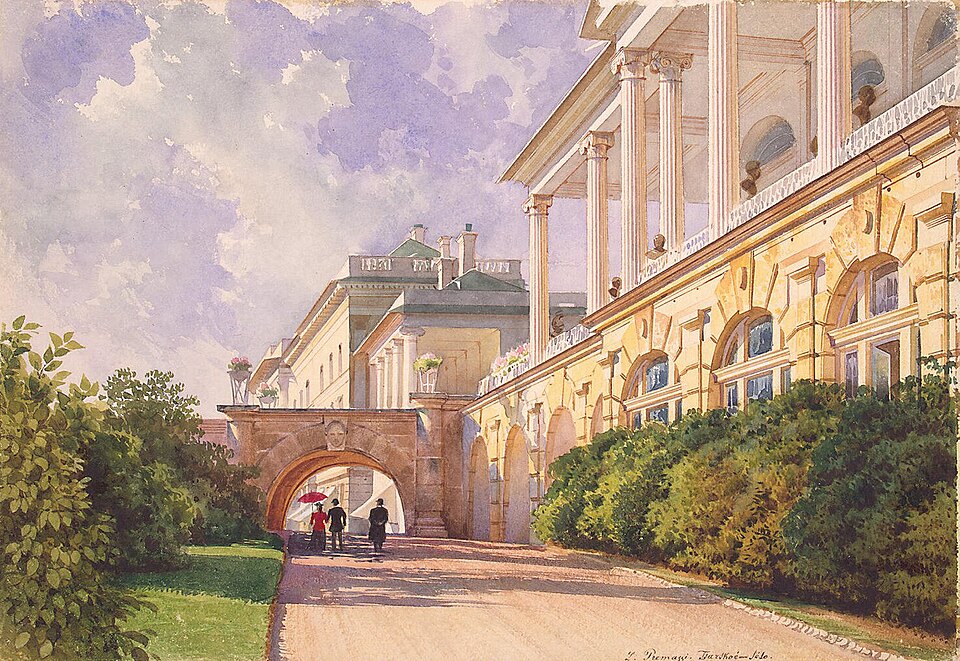
One of the most memorable parts of the experience is the harmony between architecture and setting. Beyond the palace lies Catherine Park—an extensive landscaped garden featuring pavilions, lakes, and monuments. Structures like the Grotto Pavilion, the Cameron Gallery, and the Turkish Bathhouse add variety and charm.
Together, the palace and park form a seamless royal retreat, ideal for a half-day or full-day visit. The contrast between the lavish interiors and tranquil natural surroundings is striking.
Practical Info — Access, Tickets, and Visitor Advice
- Location: The palace is in Pushkin, approximately 15 miles south of Saint Petersburg.
- Transportation: Visitors can reach the site by suburban train to Tsarskoye Selo Station, followed by a local bus or taxi. Tour buses are also widely available.
- Opening Hours: The palace and park are open most days, with seasonal hours. Early arrival is advisable.
- Tickets: Advance booking is recommended, especially during peak summer months. Guided tours are available in multiple languages.
- Tips: Wear comfortable shoes, plan at least three hours, and be prepared for security checks. Photography is restricted in some interior rooms.
A visit to Catherine Palace is not just a tour—it’s a journey through centuries of history, architecture, and artistic achievement.
Key Takeaways
- Catherine Palace began as a modest summer residence built for Catherine I in 1717 and was later transformed into a Baroque masterpiece under Empress Elizabeth.
- The architect Bartolomeo Rastrelli redesigned the palace between 1752 and 1756, creating its iconic sky-blue façade and richly gilded interiors.
- The Amber Room, originally a Prussian gift to Peter the Great, was installed in the palace in 1755, looted during World War II, and reconstructed between 1979 and 2003.
- Catherine Palace was severely damaged during the German occupation in World War II but has since been meticulously restored, with ongoing conservation projects.
- Today, it serves as a major museum and tourist destination, offering visitors access to grand state rooms, private imperial chambers, and expansive landscaped gardens.
Frequently Asked Questions
What is the best time to visit Catherine Palace?
Late spring through early fall offers the best weather, though it’s also peak tourist season. Early mornings and weekdays tend to be less crowded.
Is the Amber Room original or a replica?
The current Amber Room is a reconstruction completed in 2003. The original was lost during World War II and has never been recovered.
Can you visit the entire palace?
No, not all rooms are open to the public. However, most of the key interiors, including the Great Hall, Amber Room, and state apartments, are accessible.
How long does a visit typically take?
A full visit, including both the palace and Catherine Park, takes between three and five hours.
Are English-speaking tours available?
Yes, guided tours in English and other languages are available and recommended for understanding the historical context and artwork.