The French Revolution is often celebrated for its slogans of liberty, equality, and fraternity—but the Vendée Uprising tells a very different story. In the quiet countryside of western France, faith and tradition met the full force of radical revolutionary violence. Between 1793 and 1796, an estimated 200,000 people—many of them women, children, and elderly peasants—were killed in what became one of the most brutal episodes of the entire revolutionary period. While Paris was commissioning neoclassical paintings celebrating reason and revolution, the rural Vendée was soaked in blood and nearly erased from artistic memory.
This article explores how art, both sacred and secular, has memorialized—or ignored—the Vendée Massacre. From early Catholic imagery to Romantic interpretations and modern memorials, the visual culture surrounding the Vendée tells us more than textbooks ever could. We’ll look at what was painted, what wasn’t, and why. In doing so, we confront both the beauty and the brutality of a forgotten war for the soul of France.
The Vendée Uprising: History Written in Blood
The Vendée Uprising erupted in March 1793 in response to a conscription law passed by the revolutionary government. While much of France was swept up in revolutionary fervor, the Vendée region remained deeply Catholic and royalist in sentiment. Located in western France, its rural population was closely tied to the Church and to monarchist traditions that had held sway for centuries. The spark came when the French Republic began enforcing mandatory military service, ordering local boys to fight for a regime they neither trusted nor supported.
Compounding this was the Civil Constitution of the Clergy, enacted in 1790, which subordinated the Church to the state. Priests who refused to swear allegiance to the Republic—called “non-jurors”—were stripped of their duties, exiled, or executed. Many Vendée villagers chose to hide or defend these priests, drawing the ire of the revolutionary authorities. This religious persecution—combined with economic hardship, taxation, and aggressive secularism—pushed the people into open revolt.
A Civil War Within a Revolution
By June 1793, the rebellion had spread across four départements: Vendée, Loire-Inférieure, Maine-et-Loire, and Deux-Sèvres. The royalist peasant fighters, known as the “Catholic and Royal Army,” were led by local nobles and farmers like Jacques Cathelineau and Henri de La Rochejaquelein. Although briefly successful, the rebels were eventually crushed by the revolutionary army through scorched-earth tactics known as the “Infernal Columns.” Entire villages were razed, crops destroyed, and civilians murdered on suspicion of aiding the rebels.
The worst atrocities occurred from January to May 1794, under orders from General Louis-Marie Turreau and with the backing of the Jacobin regime in Paris. Women were raped, children were bayoneted, and churches were turned into slaughterhouses. In places like Les Lucs-sur-Boulogne, entire congregations were locked inside chapels and burned alive. Unlike other conflicts of the time, the Vendée was not merely a military campaign—it was a war of extermination against faith, family, and the countryside.
Martyrs and Memory: The Vendée in Religious Art
In the aftermath of the uprising, while official France tried to forget the Vendée, religious artists quietly remembered. The massacre of the faithful was preserved through sacred art that borrowed heavily from Christian martyr iconography. Peasant families were depicted with halos, clutching rosaries, often set against backdrops of burning fields and crucifixes. This artistic movement transformed rural victims into spiritual warriors, echoing biblical themes of innocence and sacrifice.
One notable feature in this tradition was the use of altar paintings and chapel murals in rural churches, particularly in the Loire Valley. These works portrayed Vendéans in simple, devout postures, often kneeling or looking heavenward as revolutionary soldiers approached. The similarity to scenes of the Massacre of the Innocents or the Martyrdom of Saint Sebastian was not coincidental. These parallels created a visual theology that placed the Vendée dead among the saints.
Sacrifice, Saints, and Silent Altars
Among the early contributors to this imagery was Jean-François Millet (1814–1875), born in Gruchy, Normandy, near regions touched by the Vendée conflict. Raised in a devout Catholic family, Millet’s early sketches—less known than his later masterpieces like The Gleaners (1857)—revealed a fascination with rural suffering and spiritual endurance. While not overtly political, these works used rustic religious themes to highlight the dignity of peasant life and the sorrows of revolutionary intrusion. His formative years at the Cherbourg school of drawing and later the École des Beaux-Arts in Paris gave him the technical tools to refine this vision.
Millet’s biographers note that while he seldom referenced the Vendée by name, his works bore the emotional scars of a region haunted by the memory of massacre. The spiritual solemnity and reverence in his religious-themed sketches can be read as a quiet protest against secularism. In particular, his use of light, often breaking through clouds or pouring in through chapel windows, signaled divine witness to human suffering. Through his subdued tones and solemn compositions, Millet contributed to a legacy of memory that kept the Vendée alive in spirit, if not in history books.
Suppressed on Canvas: Revolutionary Silence in Official Art
While the Vendée was a defining conflict of the French Revolution, it was curiously absent from revolutionary-era paintings and state-sponsored commissions. Official art during this period glorified the heroes of the Republic and the drama of urban revolt. Artists like Jacques-Louis David (1748–1825), the leading painter of the Revolution, created stirring images such as The Death of Marat (1793), celebrating revolutionary martyrs. Yet no major work from this era even acknowledged the atrocities committed against Vendéan civilians.
This silence was not accidental. The revolutionary government understood the power of visual propaganda and carefully curated its image through art. By emphasizing Parisian events and secular themes, it avoided drawing attention to the bloodbath in the countryside. Depicting the Vendée would have required confronting the dark reality of revolutionary violence—something that did not align with the utopian narrative being constructed. In this sense, the blank canvas of the Vendée was as telling as any painting.
From Versailles to the Salon: Art as Political Tool
Jacques-Louis David, who had studied at the Royal Academy and later aligned himself with Robespierre, deliberately avoided subjects that could compromise the revolutionary mythos. While he painted scenes of Roman virtue and contemporary revolutionaries, he ignored the counter-revolution entirely. His student, Antoine-Jean Gros, continued in this vein, illustrating Napoleonic triumphs rather than internal massacres. This artistic strategy shaped public consciousness, drawing eyes away from the countryside’s agony and toward the supposed glory of revolution.
The erasure of the Vendée from official French art set a precedent that would endure for decades. Even after the fall of the Jacobins and the rise of Napoleon, the Vendée was a subject best left untouched. To paint it honestly would have raised uncomfortable questions about liberty, justice, and the cost of ideological purity. In this void, only the Church and regional artists dared to keep the memory alive, often doing so with limited resources and hidden in quiet chapels.
Romanticism and Royalist Revival
By the mid-19th century, the Romantic movement breathed new life into the story of the Vendée. Romanticism embraced emotion, tragedy, and individual heroism—all themes deeply embedded in the Vendée’s legacy. Artists began to reclaim the story, not as a stain on French history, but as a narrative of noble resistance. The image of the Vendéan peasant transformed from rebel to martyr, from traitor to patriot in the eyes of a growing royalist audience.
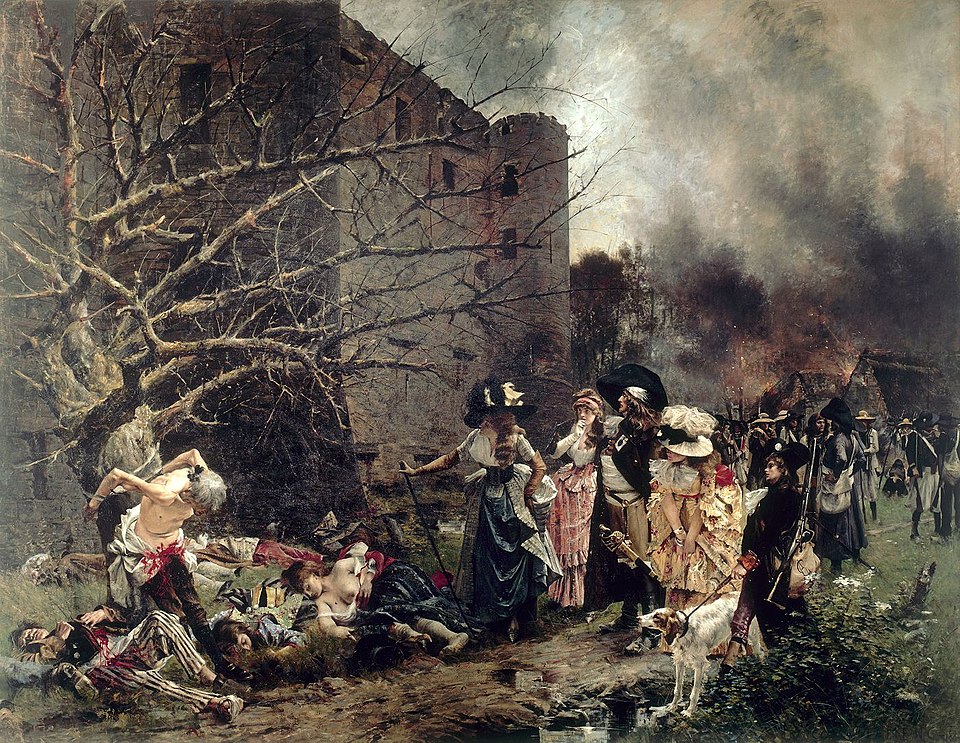
One of the most evocative works of this period is Massacre de Machecoul (1884) by Alexandre Bloch (1857–1919). Trained at the École des Beaux-Arts in Paris, Bloch specialized in military and historical paintings, but his heart clearly lay with subjects that conveyed deep moral emotion. The painting captures the horror of a mass killing in the Vendée, showing women shielding children as soldiers advance, all beneath a stormy sky. The brushwork is loose but intentional, suggesting chaos without losing structure—a hallmark of Romantic historical painting.
Blood and Beauty: The Chouan Aesthetic
The “Chouans,” guerrilla fighters who carried on the Vendée struggle, became cultural icons in this period. They were romanticized as tragic heroes, clinging to faith and homeland against overwhelming odds. Artists depicted them in humble garb, bearing simple weapons, and often shown dying with a crucifix in hand. These portrayals echoed the larger Romantic fascination with lost causes and doomed loyalty, themes popularized by writers like Chateaubriand and later visualized in painting.
Alexandre Bloch was not alone in this revivalist trend. Regional painters and illustrators throughout Brittany and western France began producing scenes inspired by Vendéan folklore and oral history. These works, often displayed in provincial salons or church halls, became part of a broader conservative reassertion of national identity grounded in faith, land, and monarchy. In the face of growing secularism and modernist art, these paintings offered not just memory—but a moral vision of what France had been, and what it might be again.
Forgotten Women and the Feminine Face of Resistance
While most historical records focus on male leaders of the Vendée, women played a critical role in both the resistance and the suffering that followed. Female martyrdom became a recurring theme in devotional art inspired by the conflict. Images of mothers clutching babies, daughters defending altars, and wives mourning their executed husbands filled the walls of chapels and Catholic homes. These depictions were not only emotionally resonant—they were deeply symbolic.
Many of these portrayals borrowed heavily from Marian imagery. Women were shown as sorrowful but dignified, evoking the Virgin Mary at the foot of the Cross. Artists emphasized their purity, modesty, and spiritual fortitude, creating a counter-narrative to the revolutionary ideal of the secular, liberated woman. Instead of representing rebellion against tradition, these women embodied fidelity to faith, family, and sacrifice.
Madonnas of the Vendée
One notable contributor to this visual tradition was Jeanne-Marie Jolly (1872–1941), a little-known Catholic illustrator and activist based in the Loire Valley. Her devotional prints, circulated quietly in the early 20th century, portrayed Vendéan women as modern-day saints. Often working in ink and watercolor, Jolly blended historical realism with sacred symbolism, placing halos behind figures and inscribing biblical verses beneath their feet. Her work, though not widely published, was treasured in Catholic circles as a visual record of feminine virtue under fire.
Jolly never married and devoted much of her life to teaching in Catholic schools and illustrating catechisms. Her artistic training came through private mentorship and diocesan support rather than formal academy instruction. In a time when academic art was moving toward abstraction, Jolly’s works stood as deliberate acts of counter-cultural remembrance. Her illustrations served not just as historical memory but as devotional tools, calling viewers to prayer, reverence, and a recommitment to the ideals the Vendée died defending.
Memorializing the Vendée in Modern Art and Monuments
As France entered the 20th century, memory of the Vendée Uprising continued to live on—not in major museums or textbooks, but in sculpture, stained glass, and public memorials scattered across the countryside. These works were often created by deeply devout artists or local patrons determined to preserve a vision of history that the mainstream had long sought to forget. Unlike the grandiose and often impersonal monuments of the Revolution, these pieces conveyed intimate suffering, community solidarity, and religious conviction. They were, in many cases, physical acts of spiritual defiance against the long silence imposed by secular historians.
The most notable of these is the Memorial Chapel at Les Lucs-sur-Boulogne, built in 1993 to mark the bicentenary of the massacre that took place there on February 28, 1794. Revolutionary troops had rounded up 564 civilians—mostly women and children—and slaughtered them in the village chapel. The modern chapel, designed to evoke both reverence and reflection, contains walls inscribed with the names of each known victim. The inclusion of stained glass panels, etched with both crosses and flames, speaks to the twin themes of sacrifice and purification that define the Vendée’s legacy.
From Stone to Stained Glass: Memory Set in Light
One of the key contributors to modern Vendée memorial art was Philippe Kaeppelin (1929–2011), a Catholic sculptor and stained glass artist based in Lyon. His deeply spiritual work, featured in both churches and war memorials, blended abstract form with traditional Christian symbols. Kaeppelin’s sculptures often featured twisted figures rising upward—symbolizing resurrection, martyrdom, and transcendence. In Vendée-related works, his use of charred wood and scorched bronze alluded to the burned villages and bodies of the revolutionary terror, offering a silent but powerful indictment of past crimes.
Kaeppelin’s training came from the École Nationale Supérieure des Beaux-Arts, but his artistic philosophy remained rooted in Catholic tradition and liturgical function. He believed art should not only beautify but sanctify space. His contributions to the Lucs-sur-Boulogne Chapel and other Vendée-related memorials helped give physical presence to stories long excluded from national memory. Through his work, Kaeppelin turned memorials into sacred places—part museum, part sanctuary—where history and faith intersect in stone and light.
Faith, Flesh, and Fire: Interpreting the Vendée Through a Conservative Lens
The story of the Vendée is not just a regional tragedy—it is a moral reckoning. The suppression of the uprising was not merely a military action but an ideological crusade against faith, tradition, and the family. When we view Vendée-inspired art through a conservative lens, we see more than victims—we see witnesses. These were men and women who refused to renounce their Church, their monarchy, or their way of life. They stood as living contradictions to the revolutionary myth of liberation, and in their martyrdom, they exposed the false promises of the secular utopia.
In many ways, the artistic legacy of the Vendée offers a visual rebuttal to the revolutionary narrative. The revolutionary ideal was abstract and theoretical; Vendée art is physical, emotional, and rooted in the land. Paintings of mothers shielding their children, priests blessing the condemned, or peasants defending a crucifix speak more deeply to the soul than any political slogan. They invite the viewer not just to reflect, but to choose—between the fleeting glory of ideology and the eternal truth of faith.
A War for the Soul of France
In recent years, conservative intellectuals such as Philippe de Villiers have worked to resurrect the Vendée as a symbol of cultural and spiritual renewal. De Villiers, born in 1949 in Boulogne, is a prominent political figure and founder of the historical theme park Puy du Fou, which dramatizes the story of the Vendée through immersive performance and design. His efforts have helped bring the Vendée narrative back into public consciousness, particularly among Catholics, monarchists, and traditionalists disillusioned with modern France. Through this cultural movement, the Vendée has become not only a historical episode but a moral compass.
Art has always played a central role in this revival. Whether through sculpture, painting, or architecture, the beauty and pain of the Vendée continue to be rendered in powerful ways. Each brushstroke, chisel mark, or pane of stained glass stands in quiet defiance of the forgetting that once reigned. This is not nostalgia—it is remembrance. And in remembering, we reclaim the values of faith, loyalty, and sacrifice that once defined a people—and still can.
Key Takeaways
- The Vendée Uprising (1793–1796) was a rural Catholic revolt brutally suppressed by the French Revolution, resulting in mass killings of civilians.
- Religious and regional artists used martyr imagery to preserve the memory of Vendéan victims, portraying them as Christian heroes.
- Revolutionary and official state art deliberately ignored the Vendée Massacre to uphold the myth of the Revolution as just and humane.
- Romantic and royalist painters like Alexandre Bloch reclaimed the Vendée narrative, emphasizing heroism, tragedy, and faith.
- Modern memorials and conservative cultural efforts continue to honor the Vendée as a symbol of resistance, remembrance, and moral clarity.
FAQs
- What caused the Vendée Uprising?
The uprising began in 1793 due to conscription laws, anti-Catholic persecution, and widespread rural loyalty to the monarchy. - Are there famous paintings of the Vendée Massacre?
Yes, notably Massacre de Machecoul (1884) by Alexandre Bloch, which vividly depicts revolutionary violence against civilians. - Why didn’t Revolutionary artists depict the Vendée?
Revolutionary art was used as propaganda and avoided subjects that contradicted the ideals of liberty, equality, and fraternity. - Is there religious symbolism in Vendée art?
Absolutely—Vendéan victims are often shown as saints, martyrs, or Christ-like figures, echoing biblical themes of sacrifice. - Where can I see Vendée memorial art today?
Key sites include the Memorial Chapel at Les Lucs-sur-Boulogne and various regional churches in western France with related works.