The Belarusian landscape—flat, forested, and braided with slow rivers—has always whispered its presence through wood, stone, and water. Long before writing entered the region, before the rise of Christian principalities or the drawing of borders, the land itself bore witness to the human impulse to shape, to ornament, and to signify. What survives of that impulse is fragmentary but far from mute. The prehistoric and pagan visual cultures of what is now Belarus offer a quiet but persistent foundation to the region’s later aesthetic vocabulary, rooted in materiality, rhythm, and myth.
Stone Idols and the First Decorative Objects
Neolithic Belarus—roughly 5000 to 2000 BC—was home to semi-nomadic hunter-gatherers whose artistic legacy lies mostly in durable media: stone, bone, clay. Though no towering Venus figurines or cave murals have been found in Belarus to rival those of the Upper Paleolithic West, a subtler repertoire emerges in the archaeological record. Carved flint tools with symmetrical grooves, bone amulets with incised zigzags, and ceramic vessels pressed with cord or fingernail patterns speak to a developed visual language rooted in texture and repetition.
One of the most intriguing finds comes from the Sozh River basin: a set of anthropomorphic stone figures, worn and simple, their human features barely indicated. These so-called kamennye baby—stone grandmothers—echo similar forms found across the Eurasian steppe, and their meaning remains speculative. Were they fertility totems, markers of clan territory, or ancestors made tangible? What matters is that someone in the distant past saw fit to fashion the human form from rock, to position it upright, and to imbue it with significance.
More frequently encountered are ornamented ceramic vessels from the Dnieper-Donets and Narva cultures. The motifs—parallel lines, chevrons, comb-stamped swirls—suggest both decorative and symbolic functions. These patterns may have marked ownership, indicated contents, or enacted protective spells. In the absence of text, decoration becomes both record and ritual. Even at this early stage, Belarusian soil was generating a vocabulary of form grounded in labor, repetition, and natural rhythm.
Bronze Forms, Animal Spirits, and Forest Cosmology
The arrival of metallurgy in the second millennium BC brought new materials and techniques into play, especially among the communities of the Trzciniec and later Lusatian cultures. Small bronze fibulae (brooches), pendants, and blades begin to appear in burial contexts. The transition from stone to metal marks not only a technological leap but an aesthetic one. Metal could be shaped with greater precision, allowing for finer curves, perforations, and embossing.
Animal motifs now begin to surface more distinctly—stylized deer antlers, bird heads, serpentine coils. These were not decorative flourishes but embodiments of belief. In a forest world governed by seasonal cycles and populated with seen and unseen forces, animals were not mere subjects of hunting but fellow beings in a shared cosmology. The use of antler and bone for tools, often with etched ornament, reinforces the link between utility and the sacred.
The Iron Age brought larger settlements and defensive structures, especially in hillforts along the western Dnieper and Pripyat rivers. Burial mounds from this period often contain elaborate grave goods: torcs, earrings, knife hilts, and pottery. In the burial complex at Lyahovichi, for instance, archaeologists uncovered a series of bronze spirals thought to have been sewn onto garments—a kind of wearable code. These spiral patterns appear across Slavic and Baltic territories, pointing to a shared symbolic lexicon centered on solar and cyclical motifs.
Three recurring forms from this period deserve special note:
- The solar spiral, often carved into bone discs or bronze plaques, likely symbolized rebirth, continuity, or the sun itself.
- The waterbird pendant, a shape echoing cranes or ducks, suggests the importance of migratory birds in seasonal rites and myth.
- The zigzag or wave line, etched into ceramics and tools, may have represented water, lightning, or the path between worlds.
Each of these shapes persisted, in altered forms, into Christian-era folk art—a faint but insistent continuity across the rupture of religion and empire.
Slavic Paganism and Sacred Landscapes
By the early medieval period—roughly 500 to 1000 AD—the Slavic tribes who would become the ancestors of the Belarusians had settled across the region, bringing with them a rich pagan cosmology rooted in animism, ancestor worship, and seasonal ritual. Visual culture at this stage becomes harder to disentangle from ritual practice, as few monumental remains survive. But sacredness was not always built—it was inscribed on the land itself.
Hilltops, river bends, groves of oak and ash: these became ritual spaces long before the first church foundations were laid. In the Polesia region, oral traditions persisted into the 19th century of “god-places” (bozhishcha) where idols once stood, often marked by standing stones or carved posts. Some scholars suggest that Christian roadside crosses in rural Belarus retain echoes of these earlier ritual markers, especially when placed at liminal points—near springs, crossroads, or ancient burial sites.
Among the most tantalizing pagan artifacts are the so-called Zbruch idol (discovered in neighboring western Ukraine but associated with Slavic tribal territory extending into Belarus). This four-sided stone pillar, carved with human and animal figures in stacked tiers, is widely believed to represent a pantheon of Slavic deities or cosmic levels—underworld, earthly, and celestial. Though not found on Belarusian soil, it has become a touchstone for imagining what lost visual systems might once have stood on Belarusian ground.
Belarusian folk art, particularly embroidery and weaving, preserves traces of these earlier beliefs through form and symbol. The recurring berehynia motif—often interpreted as a goddess-figure or guardian spirit—appears in traditional textiles well into the modern era. These stylized, triangular-bodied figures with outstretched “arms” are perhaps the most direct visual descendants of a prehistoric worldview embedded in daily life.
As Christianity spread through the region in the 10th and 11th centuries, these earlier artistic and spatial logics did not vanish—they were layered over, absorbed, domesticated. Pagan shrines became church sites; idols were broken or baptized; motifs were reinterpreted as decorative rather than divine. Yet the substratum remains legible, if one learns how to read it.
The earliest Belarusian art, then, is not found in galleries or frescoes but in the quiet persistence of form: in spirals etched into clay, in bird-shapes worn against the skin, in the rhythms of woven thread. It is a legacy without authors but not without meaning—a visual memory stored in the land, not the archive.
Land Between Powers: Foundations of Belarusian Visual Culture
The earliest written culture of what is now Belarus emerged not in a vacuum but at a crossroads—of religion, of empire, of script. From the 9th to the 13th centuries, the territory was defined less by fixed borders than by its participation in a series of dynamic, overlapping spheres: the Kievan Rus’, Byzantine Orthodoxy, Norse trade routes, and eventually Mongol incursions. In this setting, art did not develop as a courtly luxury or purely liturgical product, but as an evolving language of continuity and power—carried by monks, shaped by stonecutters, and preserved in manuscripts and frescoes.
Orthodox Icons and Early Literacy
Christianization reached the lands of Polatsk and Turaŭ, two of the earliest urban centers in Belarus, in the late 10th century, following the baptism of Kievan Rus’ under Prince Vladimir in 988. With the arrival of Orthodox Christianity came a radical transformation in visual culture. Sacred art—especially icons—became the new medium through which belief was taught, worship conducted, and memory sustained. But icon painting in Belarus was never purely imported. From the outset, it showed signs of local adaptation: softer contours, gentler color transitions, and often a greater focus on narrative than hierarchical stillness.
Icons in Belarus were typically painted on linden boards with egg tempera and finished with gold leaf, but few examples from the earliest period survive intact. The so-called Our Lady of Turaŭ, now lost but reconstructed through later copies, depicted the Virgin not with the austerity of Byzantine prototypes but with an almost tender melancholy, her head inclined toward the viewer in a gesture of intimacy rather than authority. This tonal shift would persist in Belarusian iconography for centuries: a preference for human warmth over theological abstraction.
The development of early literacy was inseparable from this visual culture. Monastic scriptoria in Turaŭ and Polatsk produced illuminated manuscripts in Old Church Slavonic, often with elaborate headpieces and marginal flourishes. These were not merely functional texts but visual-spiritual artifacts. The 11th-century Turaŭ Gospel—though fragmentary—includes stylized vine motifs and zoomorphic initials that reflect both Eastern Christian and local folk traditions. Decorative embellishment became a form of silent exegesis: the visual texture of the word reinforcing its sacred content.
The Polatsk and Turaŭ Schools of Illumination
If Kyiv provided the theological blueprint, Polatsk and Turaŭ developed regional styles that resisted full assimilation. Polatsk, an influential principality along the Dvina River, became a center for ecclesiastical learning and manuscript production. The city’s cathedral—founded by Saint Euphrosyne of Polatsk in the 12th century—was both a religious and artistic beacon. Euphrosyne herself commissioned a richly decorated cross, now known as the Cross of Euphrosyne, which became an emblem of Belarusian spiritual and artistic identity.
Crafted by the artisan Lazar Bohsha in 1161, the cross was a masterpiece of goldwork and enamel, inlaid with gems and bearing intricate iconographic panels. Though it was lost during World War II, prewar photographs and descriptions allow art historians to trace its complex program: scenes of the Passion and Resurrection interwoven with saints and angels rendered in miniature enamel medallions. Its artistry went beyond devotion; it was a precise, learned synthesis of Eastern and local traditions. The Polatsk school, in both manuscript and metalwork, consistently favored rich coloration, dense composition, and expressive linework.
Turaŭ, though smaller, rivaled Polatsk in its literary and artistic production. Bishop Cyril of Turaŭ, active in the 12th century, was both a theologian and a stylist, producing homilies and allegories that were copied and adorned in monasteries across the region. His texts survive in illuminated versions featuring floral border designs and arcaded title pages—a formal inheritance from Byzantine codices, but transformed through a Slavic sensibility. In contrast to the imperial stillness of Constantinople, Turaŭ’s illuminations often pulse with organic, almost folkloric vitality.
The manuscript tradition during this period served several functions at once: it preserved doctrine, beautified the sacred word, and elevated local authority. In a land without a centralized political state, the monastic book became both archive and altar, political document and devotional icon.
Stone, Wood, and Symbol: Pre-Mongol Church Art
Though Belarus lacked the massive stone cathedrals of Western Europe, it developed its own architectural idiom in church construction—initially in stone, later in brick and wood. The Church of the Transfiguration in Polatsk, also founded by Euphrosyne, remains a rare surviving example of 12th-century Belarusian ecclesiastical architecture. Its interior once featured frescoes in a distinctive local palette: ochres, muted blues, and pale greens arranged in flat, rhythmic planes that emphasized movement over volume.
While only fragments of these frescoes remain, they reveal a stylistic divergence from Kyiv’s more monumental mosaics. The figures in Polatsk lean forward, eyes widened, hands extended—not icons of imperturbable sanctity, but beings in motion, engaged with the world. This approach, though rooted in Orthodox theology, suggests a theological anthropology inclined toward participation and emotion rather than pure detachment.
Wood, far more abundant than stone, became the dominant medium for vernacular religious art. Wooden chapels and village crosses from the period (reconstructed or referenced in later folk architecture) often featured sculptural embellishments, carved roof beams, and painted panels. Even where theological correctness dictated restraint, local artisans introduced subtle flourishes: a vine motif curling into a bird’s head, a border pattern that recalled pagan embroidery.
Three symbolic forms recur across church art of this era, often migrating between media:
- The triple arch, used in church façades and manuscripts alike, echoing the Trinity and perhaps earlier vernacular house forms.
- The eight-pointed star, which in local usage often blends Christian symbolism with older solar meanings.
- The vine-scroll, initially Byzantine in origin, but adapted in Belarus to include native flora—oak leaves, poppy pods, and stylized fern shapes.
In these forms, the borderland nature of early Belarusian visual culture becomes most apparent. It is neither purely Eastern nor Western, neither strictly canonical nor fully idiosyncratic. It is a hybrid art—shaped by faith, fortified by memory, and marked by a persistent instinct for synthesis.
Even in the wake of the Mongol invasions in the 13th century, which devastated southern Rus’ but largely spared the northern Belarusian territories, the visual culture retained its continuity. Monasteries adapted; patrons shifted; artisans migrated. But the icon did not vanish, nor did the manuscript. They remained—worn, reworked, and persistently remade—quiet anchors in a land always passing between powers.
Gothic Light and Ruthenian Line: Art Under the Grand Duchy of Lithuania
From the 14th to the early 16th centuries, the territories that now comprise Belarus were drawn into the orbit of the Grand Duchy of Lithuania—a sprawling, multi-ethnic polity stretching from the Baltic to the Black Sea. Unlike the centralized monarchies of Western Europe, the Grand Duchy governed through a complex network of regional elites, religious pluralism, and shifting allegiances. Art under its rule reflected this ambiguity: it was polyglot, hybrid, and often fiercely local in its expressions. The collision between Latin and Orthodox cultures, between Gothic verticality and Ruthenian linearity, produced a distinct visual language that left its imprint on manuscript, architecture, and religious iconography alike.
Latin and Cyrillic Aesthetics in Collision
The Christianization of Lithuania in 1387 and the subsequent political union with Poland brought increasing Latin Catholic influence into Belarusian lands—especially through noble patronage, ecclesiastical appointments, and the educational missions of the Franciscans and Dominicans. While the peasantry and much of the urban population remained Orthodox, the elite began to commission art and architecture in a Gothic idiom, imported via Kraków and Vilnius. But these forms did not arrive in pristine condition. They were absorbed, reinterpreted, and often fused with local visual traditions.
Nowhere is this more evident than in the Orthodox churches and Catholic cathedrals that rose side by side in cities like Navahrudak, Hrodna, and Brest. The Church of Boris and Gleb in Hrodna, originally built in the 12th century but extensively modified in the Gothic period, presents a case in point. Its pointed arches and ribbed vaults echo Western Gothic, yet the overall layout—three apses, absence of sculptural portals, austere façades—retains a distinctively Eastern structure. Inside, the decorative scheme often remained tied to iconographic conventions: frontal saints, linear drapery, gold backgrounds. What emerged was a hybrid style sometimes called Belarusian Gothic—a local adaptation where verticality met flatness, and imported form bowed to inherited symbolism.
The manuscript arts, too, reflected this collision. In monasteries such as those at Zhyrovichy and Slutsk, scribes copied and illustrated religious texts in both Cyrillic and Latin alphabets. A single codex might contain prayers in Church Slavonic, marginalia in Ruthenian, and decorative motifs borrowed from Gothic bestiaries or Western floral borders. These were not merely technical borrowings—they marked a cultural negotiation, a way of being both local and cosmopolitan without succumbing to either pole.
The architectural ornament of the time is particularly telling: Gothic finials appear alongside Slavic fretwork; stained glass shares space with icon stands; Latin inscriptions adorn buildings where services were held in Church Slavonic. It was an aesthetic of coexistence, sometimes tense, always creative.
Manuscript Illumination and the Rise of Sapieha Patronage
As the 15th century progressed, elite families such as the Sapiehas, Radziwiłłs, and Ostrogski began to play a decisive role in shaping artistic production. These magnates acted as both political stewards and cultural patrons, commissioning churches, schools, and manuscripts that reflected their dual allegiances: loyalty to the Grand Duchy, and pride in their Ruthenian heritage.
One of the most striking results of this patronage was the blossoming of manuscript illumination in secular and religious texts alike. The Liturgical Gospel Books produced under the Sapieha and Ostrogski aegis feature lavish miniatures that synthesize Byzantine icon forms with Western stylistic flourishes. A 15th-century Gospel book from Navahrudak, for example, includes evangelist portraits framed by architectural arcades in the Gothic style, while the figures themselves are rendered with elongated proportions and gently modeled faces—an inheritance from the Paleologan tradition.
Equally notable are the Psalters and didactic works that emerged in this period, such as the Izbornik (miscellany) compilations and early chronicles. These often included allegorical images, diagrams, and hybrid creatures—reflecting both Orthodox theological influences and the growing popularity of Western emblem literature. One particularly vivid image from a 1480s Psalter shows King David strumming a harp beneath a vine-covered arch, flanked by personifications of Justice and Mercy—a visual schema unknown in earlier Rus’ art but common in the Latin West.
The scriptoria that produced these works were not confined to monastic enclaves. Increasingly, lay workshops operated under noble sponsorship, staffed by itinerant calligraphers and illustrators who moved between courts and towns. Their output was not only devotional but legal and literary: illuminated copies of the Lithuanian Statute, translated into Ruthenian, featured ornate initials, heraldic devices, and marginalia that merged legal precision with artistic ambition.
What emerged from this milieu was a distinctly Belarusian manuscript culture—neither fully Eastern nor fully Western, deeply enmeshed in the regional politics of language, faith, and power.
The Vilna School and the Itinerant Artisan
The rise of Vilnius (Vilna) as the capital of the Grand Duchy brought new artistic currents into Belarusian lands. While the city itself was more Catholic and Polish in its courtly culture, it attracted Ruthenian artisans who carried their skills across the borderlands. The so-called Vilna School—an informal term used by art historians to describe this regionally mobile style—was characterized by a fusion of formal clarity, narrative density, and ornamental restraint.
One of the defining traits of this school was its itinerancy. Unlike the centralized workshops of Italy or France, artistic production in the Grand Duchy often depended on roving craftsmen: stonecutters, icon painters, illuminators, and carpenters who moved from commission to commission. This mobility fostered both stylistic variation and the transmission of motifs across linguistic and confessional lines.
A typical example might be an icon of St. George painted in the early 1500s in Slutsk, bearing the hallmarks of the Vilna School: clean contour lines, a dynamic pose, restrained color palette, and detailed rendering of armor and steed. Similar icons appear in both Orthodox and Uniate (Greek Catholic) churches, often altered only in inscriptions and minor iconographic details. In this fluid context, artisans adapted their style to the expectations of patrons rather than fixed doctrinal guidelines.
Fresco painting also flourished during this period, especially in small village churches where wooden interiors provided broad surfaces for narrative cycles. In the Church of the Nativity in Muravanka, for instance, surviving fragments show scenes of the Passion rendered with emotional intensity and narrative movement—figures gesturing, heads tilted in anguish, blood rendered in quick, dark strokes. These are not static saints but actors in a cosmic drama, their humanity unshielded by stylized distance.
Three features defined the visual culture of this era:
- Architectural hybridity: buildings that blended Gothic and Byzantine forms, with pointed arches, domes, and flat facades coexisting uneasily but productively.
- Narrative complexity: art that increasingly told stories—biblical, hagiographic, even allegorical—rather than simply presenting sacred presence.
- Material modesty: the use of brick, plaster, and tempera in place of marble and mosaic, yielding a warm, textural aesthetic rooted in earth and labor.
The art of Belarus under the Grand Duchy of Lithuania was not a monument to any one ideology or empire. It was, rather, a record of cultural negotiation—sober, syncretic, and grounded in the lived tensions of faith, power, and geography.
Baroque Splendor and Uniate Adaptation
By the 17th century, the artistic landscape of Belarus had entered a new and dazzling phase. The Union of Brest in 1596, which brought a significant portion of the Orthodox clergy into communion with the Roman Catholic Church under the Byzantine rite, gave rise to the Uniate Church—an institution both rooted in Slavic tradition and aligned with Rome. This development transformed not only the ecclesiastical structure of Belarus but its visual culture as well. It unleashed a flood of Baroque aesthetics into the region, brought by Jesuit and Basilian missions, while simultaneously catalyzing a defensive cultural refinement among Orthodox communities. The result was an era of exuberant form, hybrid iconography, and profound religious competition.
Catholic Patronage and Jesuit Aesthetics
The Jesuits, arriving in force in the early 1600s, quickly established schools, churches, and seminaries across Belarus, using architecture and the visual arts as tools of persuasion and pedagogy. In towns like Nesvizh, Polatsk, and Hrodna, they commissioned churches in the High Baroque style: structures of stuccoed drama, gilded detail, and theatrical space. The Church of Corpus Christi in Nesvizh, designed by the Italian architect Giovanni Maria Bernardoni and completed in 1603, was one of the first Baroque buildings in the region. Its monumental façade, twin towers, and sculptural interior set a new standard for religious architecture in Belarus.
The Jesuits understood that art could serve doctrine, but they also knew how to appeal to emotion. Inside their churches, vast ceiling frescoes stretched into illusionistic heavens; saints leaned out of frames toward the viewer; swirling acanthus and cherub faces surrounded the altar. These were not merely aesthetic choices—they were ideological weapons, intended to awe, instruct, and convert. Latin inscriptions and classical motifs appeared beside Slavic icons and local saints, crafting a narrative of unity under Catholic order without erasing local identity.
In addition to architecture and fresco, Jesuit colleges became centers of visual training. Engraving, printmaking, and theatrical set design were taught alongside rhetoric and theology. The Polatsk Jesuit College, among the most prestigious in the region, produced a generation of artists and draftsmen whose works ranged from devotional prints to anatomical diagrams. Many of these artisans went on to work for both Uniate and Orthodox patrons, further blurring confessional lines in the realm of visual production.
Yet the spread of Baroque aesthetics did not always imply submission to Catholic authority. Local artists and communities adapted the style, stripping it of its triumphalism and infusing it with vernacular restraint. The Uniate Church, in particular, cultivated a Baroque that was Slavic in content but Western in form—ornate, yes, but focused on the familiar saints, cycles, and rituals of the Eastern tradition.
Polychrome Frescoes and Woodcarving in Monastic Centers
While the Jesuits favored grandeur, the Basilian order—founded to support the Uniate Church—tended toward intimacy and devotional intensity. Basilian monasteries, such as those in Zhyrovichy, Byten, and Supraśl (now just beyond Belarus’s eastern border), became hubs of liturgical art. These centers preserved Byzantine iconographic traditions while embracing the sensuality and ornament of the Baroque.
One of the most remarkable developments was the rise of polychrome fresco painting in wooden churches. Painters like Joseph Hermenevich and Ivan Strokin, though little known outside the region, created vast narrative cycles inside modest structures. The walls of the Church of the Transfiguration in Slabodka, for instance, were covered with scenes from the Passion rendered in rich reds, ochres, and deep blues, with figures that gestured, wept, and bled. These were not icons in the strict sense but theatrical tableaux, more akin to sacred drama than liturgical stillness.
Wood, always the most accessible material in Belarus, became a medium of exquisite artistry during this period. Iconostases—wooden screens separating the nave from the sanctuary in Eastern churches—were carved with astounding complexity. In Uniate churches, these iconostases often featured Solomonic columns, shell motifs, and fruit garlands familiar from Italian Baroque, while retaining the tiered icon arrangement central to Orthodox practice. The combination was visually lush and theologically bold: an assertion of continuity amid change.
Beyond churches, woodcarving adorned civic buildings, domestic interiors, and even gravestones. Belarusian Baroque funerary art, especially among the nobility, often blended Latin inscriptions with Orthodox crosses, floral scrolls, and heraldic devices. The visual grammar of death became another stage where identities were negotiated and displayed.
Three distinct artistic tendencies can be seen across Belarus during this time:
- Theatrical realism, especially in fresco and sculpture, designed to draw the viewer into sacred narrative.
- Material syncretism, where Western forms were executed in traditional media—plaster, lime, wood, and natural pigments.
- Localized grandeur, with even small parish churches aspiring to decorative schemes once reserved for cathedrals.
These were not the gestures of an imposed style, but the evolution of a local aesthetic that absorbed and redirected outside influence.
Resistance and Absorption: Orthodox Iconography in Baroque Dress
For Orthodox communities not brought under the Uniate umbrella, the Baroque period posed challenges and opportunities. On the one hand, they faced increasing marginalization, especially under the Polish–Lithuanian Commonwealth’s policy of Catholic favor. On the other, they witnessed how visual power could function as theological assertion. In response, many Orthodox churches began to adopt Baroque forms—not to capitulate, but to compete.
The result was a fascinating stylistic hybrid: icons painted in traditional flat perspective but placed in gilded Baroque frames; domed churches with Gothic bell towers; liturgical processions accompanied by banners bearing saints rendered in oil and canvas, not just tempera on wood. The sacred image expanded its reach, moving into public ritual space with unprecedented visual force.
One particularly rich example comes from the Brotherhood of the Holy Spirit in Minsk, an Orthodox confraternity that maintained schools, printing presses, and an active art workshop in the 17th century. The Brotherhood’s icon painters produced works that mirrored Uniate stylistic advances—naturalistic faces, atmospheric backgrounds—while preserving the theological rigor of Orthodox iconography. Their printing press, meanwhile, issued books with elaborate engraved frontispieces, often showing saints trampling heretics or defending the True Faith against invaders. This was art as polemic, but also art as continuity: a refusal to vanish.
By the early 18th century, the visual language of Belarusian sacred art had become almost completely hybridized. Few works could be identified as purely “Western” or “Eastern.” Instead, a new regional idiom emerged: one that spoke in Latin curves and Slavic lines, in golden niches and painted saints, in the flicker of candlelight against a carved wooden frame. This was not the art of a cultural defeat, but of a profound negotiation—one that would shape Belarus’s visual identity for centuries to come.
Under the Empire’s Eye: Belarus in the Russian Imperial Frame
The final partitions of the Polish–Lithuanian Commonwealth in the late 18th century redrew the map of Eastern Europe, placing most of Belarus under the authority of the Russian Empire. The annexation was not merely territorial—it was administrative, linguistic, and cultural. For Belarusian art, the imperial era marked a period of recalibration. Orthodox visual traditions were officially reinstated and reinforced, while Polish-influenced Catholic aesthetics were surveilled, marginalized, or transformed. At the same time, the Empire’s own artistic ideals—especially academic realism and neoclassicism—filtered into Belarusian cities and estates via imperial institutions and patronage networks. The result was a century of cautious adaptation, marked by tension between rural continuity and elite assimilation.
Academic Realism and the Petersburg Circuit
Imperial rule brought with it institutions of cultural centralization. Chief among them was the Imperial Academy of Arts in Saint Petersburg, which came to dominate the artistic life of the Empire, setting stylistic norms and career pathways for painters, sculptors, and architects. For Belarusian artists, admission to the Academy was both an opportunity and a constraint. It provided training, visibility, and patronage—but it also demanded conformity to official styles and subjects.
Ivan Khrutsky, one of the first Belarusian-born artists to gain recognition within the imperial system, exemplifies this duality. Trained in Vilnius and later in Saint Petersburg, Khrutsky became renowned for his still lifes and portraits, combining academic precision with a distinctly introspective tone. His 1839 Still Life with a Bible is a technical marvel—grapes, flowers, and religious texts rendered with luminous realism—but also a quiet allegory of cultural inheritance, placing spiritual objects at the center of domestic life.
Khrutsky’s career also illustrates the spatial tension faced by many Belarusian artists: educated in capitals, but spiritually rooted in the provinces. After achieving recognition in Saint Petersburg, he retired to his family estate in Zakopytie, where he continued to paint religious icons and local portraits, maintaining a dialogue between cosmopolitan training and rural tradition.
This tension extended to architecture and sculpture. Neoclassical design principles—domes, porticoes, Corinthian columns—became standard for state buildings, churches, and manor houses in Belarusian towns like Vitebsk, Mogilev, and Minsk. Russian architects such as Vasily Stasov and Andrei Voronikhin were commissioned to “modernize” provincial centers, bringing imperial order to places whose visual history was polyglot and idiosyncratic.
The consequence was twofold: provincial Belarusian cities acquired a veneer of Russian imperial style, even as their inhabitants retained distinct linguistic and religious identities. Visual uniformity did not guarantee cultural erasure—but it did introduce a new regime of visibility.
Peasant Romanticism and the Noble Estate Genre
Parallel to official art, a quieter movement was taking shape in the homes and private studios of the landed gentry. The 19th-century Belarusian nobility, many of whom identified with Polish cultural traditions, commissioned portraits, landscape paintings, and interior scenes that combined sentimentality with social self-representation. These works formed a genre that could be called the noble estate aesthetic: a vision of Belarus as a land of pastoral order, ancestral virtue, and seasonal rhythm.
Painters like Napoleon Orda, born near Pinsk in 1807, played a key role in constructing this vision. Though best known for his architectural lithographs—delicate, precise views of castles, manors, and churches—Orda’s work functions as a visual elegy for a fading world. His images of Nesvizh Castle or the ruins of Kreva evoke a sense of melancholic grandeur, portraying architecture not as monument but as memory.
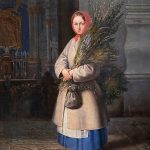
This visual nostalgia extended to depictions of peasant life. While rarely painted by peasants themselves, rural scenes became popular among educated elites. Harvesting, spinning, churchgoing—these were rendered in oil and watercolor with a blend of affection and distance. Artists such as Wincenty Dmochowski and Alfred Romer painted Belarusian village life not as ethnography, but as cultural theater: a place where national character might be glimpsed in the arrangement of headscarves or the arc of a plow.
Yet these works also reveal a fundamental ambiguity. Were they celebrations of a shared homeland, or romanticizations of social hierarchy? The peasant appeared in these images as both symbol and subject—idealized, often static, and rarely named. Visual authenticity often masked ideological gentility.
Three recurrent motifs in noble estate art suggest this paradox:
- The birch tree, used as a symbol of native rootedness, often placed near chapels or graves.
- The winding path, typically leading to a manor or a shrine, evoking both personal memory and national longing.
- The crossroad chapel, a recurring setting for prayer, departure, or homecoming, where faith and folk memory converged.
These images became not just private mementos but cultural emblems, reproduced in prints and albums that circulated among émigré communities after the 1830 and 1863 uprisings against Russian rule.
Church Art and Censorship in the Age of Russification
After the failed Polish-led insurrections, the Russian Empire intensified its policy of Russification in Belarus. This involved not only administrative centralization and language suppression but a systematic campaign to realign religious and visual culture with Russian Orthodox norms. The Uniate Church, once dominant in many regions, was officially abolished in 1839, its properties transferred to the Russian Orthodox Church. Thousands of churches were repainted, re-consecrated, or demolished; Baroque iconostases were replaced with neo-Byzantine panels imported from Moscow workshops.
The transformation was not merely liturgical but visual. New Orthodox churches were built in the “Russian Revival” style—characterized by onion domes, horseshoe arches, and interior murals that imitated medieval Novgorod or Vladimir-Suzdal frescoes. While impressive in scale, these churches often displaced local architectural traditions, enforcing a centralized aesthetic of spiritual authority.
Icon painting, long a vernacular art in Belarus, was now regulated by ecclesiastical academies and subject to censorship. Standardization replaced variation; theological correctness trumped stylistic nuance. Local saints, once depicted with regional attributes or stories, were either marginalized or redrawn in imperial format.
Despite this, elements of resistance and adaptation persisted. In rural areas, older icons were often preserved in private chapels or hidden in barns. Folk painters continued to produce devotional images for household use—simplified, colorful, and emotionally direct. These works, sometimes dismissed as “primitive,” maintained a continuity of vision that official art sought to suppress.
One striking example is the persistence of the Mother of God of the Sign motif, in which the Virgin is depicted frontally with outstretched arms and the Christ Child within a medallion on her chest. In imperial-approved versions, this icon was rendered with technical finesse and standardized features. In local variants, the lines are cruder, the colors bolder, the expression more intimate. Here, artistic “error” becomes cultural fidelity.
The 19th century, then, was a time of aesthetic constraint and subterranean continuity. Belarusian visual culture bent under the weight of empire—but did not break. It absorbed, adapted, and remembered, often in the margins of form and the quiet of household walls.
Between Revolution and Nation: The 1905–1920s Avant-Garde Moment
The early decades of the 20th century were a time of convulsion—political, philosophical, and aesthetic—across the Russian Empire and, more specifically, in Belarus. In art, this rupture was not gradual but electric. Within a single generation, Belarusian visual culture passed from peasant pastoralism to geometric abstraction, from anonymous folk devotional painting to international avant-garde experimentation. Cities like Vitebsk and Minsk, once provincial and culturally marginal, briefly stood at the epicenter of global artistic revolutions. At the heart of this moment was a paradox: the desire to invent a radical new visual language while rediscovering the primal forms of local tradition.
Marc Chagall’s Vitebsk: A Provincial Visionary
No figure better embodies the strange brilliance of this moment than Marc Chagall, born Moishe Shagal in 1887 in Vitebsk to a Hasidic Jewish family. Chagall’s work, suffused with dreamlike imagery and folkloric references, defies easy classification. It is not nationalist, yet it is saturated with place. It is not Orthodox in style or subject, yet it is religious in mood. Chagall left Vitebsk for Saint Petersburg and then Paris, where he encountered Fauvism and Cubism, but his visual world remained anchored in the rooftops, goats, fiddlers, and Sabbath tables of his Belarusian childhood.
In early works like I and the Village (1911), Chagall merges personal memory with formal experimentation: a floating man gazes at a cow’s face; geometric planes intersect with Orthodox churches and shtetl lanes. His 1914–1915 return to Vitebsk, just before the outbreak of the First World War, intensified this vision. Paintings such as The Praying Jew (1914) or The Green Donkey (1911) depict local life in a palette of dreams: melancholy, comic, defiant.
But Chagall’s Vitebsk was not just a backdrop—it became, through his work, a concept. It was a symbolic homeland, half-lost and half-invented, in which Jewish tradition, Slavic ritual, and modernist rupture coexisted. His canvases offered neither propaganda nor nostalgia. They were, instead, emotional cartographies of a place in perpetual motion.
After the October Revolution, Chagall returned to Vitebsk once more—this time as a cultural official. In 1918, he was appointed Commissar for the Arts in the Vitebsk province. He founded the Vitebsk People’s Art School, an institution that would, briefly, become a battleground of avant-garde ideologies.
UNOVIS and Kazimir Malevich’s Pedagogical Experiment
Chagall’s idealism as a cultural organizer collided almost immediately with a more radical aesthetic doctrine. In 1919, Kazimir Malevich—painter of Black Square and founder of Suprematism—was invited to teach at the Vitebsk school. Within a year, Chagall had resigned, and Malevich had transformed the institution into a revolutionary experiment: UNOVIS, short for “Utverditeli Novogo Iskusstva” or “Champions of the New Art.”
Under Malevich’s leadership, the school abandoned naturalistic drawing and decorative craft in favor of geometric abstraction, constructivist theory, and functional design. Students and faculty alike wore black squares on their sleeves as emblems of a new artistic faith. They repainted buildings in bold colors and shapes, designed propaganda posters and ceramics, and envisioned a visual world liberated from the past.
El Lissitzky, another key figure, emerged from this milieu with works that blended suprematist form and typographic innovation. His Proun series—part painting, part architectural blueprint—proposed a new space of visual logic, hovering between two and three dimensions. In posters like Beat the Whites with the Red Wedge (1919), Lissitzky gave abstract art an agitational voice, making geometry into a weapon of class war.
UNOVIS was not simply a school of painting. It was an educational utopia, a movement, a design collective, and a philosophical sect. Its members signed work collectively, rejecting the bourgeois notion of individual authorship. They published manifestos, designed new alphabets, and imagined cities constructed of planar forms and functional surfaces. Vitebsk, for a brief moment, was the staging ground for a universal visual grammar.
Yet this radicalism came at a cost. By the early 1920s, UNOVIS had exhausted both its internal momentum and the state’s tolerance. Malevich left for Petrograd, and the Vitebsk school was reabsorbed into a more conventional curriculum. The black square faded, for a time, from Belarusian walls.
Jewish Folk Motifs and Abstract Utopia
The avant-garde in Belarus was not a clean break with tradition—it was a mutation of it. Many of the artists involved in UNOVIS and related movements came from Jewish backgrounds, and their visual imagination retained traces of religious and folk culture, even in the most abstract forms.
The painter and designer Yehuda Pen, who had taught both Chagall and Lissitzky, continued to work in a more representational style during this time. His portraits of Jewish tradesmen and scholars—rendered with quiet dignity and textured brushwork—provided a human counterpoint to the avant-garde’s theoretical extremes. Pen’s studio, filled with old books, Yiddish signs, and tea glasses, remained a haven for students who sought a bridge between cultural memory and visual innovation.
Folk ornament, too, persisted beneath the surface of abstraction. Suprematist compositions, though often framed in universalist rhetoric, echoed the rhythm and symmetry of Belarusian textiles, embroidery, and religious decoration. The diagonal line, the nested square, the rotating cross—these were not alien forms but modernist echoes of ancient craft.
At the same time, the language of the avant-garde made space for new national imaginaries. Belarusian-language books, magazines, and posters appeared with bold typographic design and stylized imagery. The Belarusian People’s Republic, briefly declared in 1918, fostered an art of national renewal, even as the Soviet regime sought to suppress such expressions. For a few years, visual modernism and national culture cohabited an unstable ground.
Three scenes from this period capture its wild contradictions:
- A peasant woman walks through Vitebsk holding a loaf of bread wrapped in a suprematist-printed cloth.
- A synagogue wall displays a Chagall-designed mural beside a state-decreed propaganda banner.
- A typography class sets Old Belarusian proverbs in Lissitzky’s sans-serif modular alphabet.
These were not anomalies but symptoms of a culture in upheaval, uncertain whether it was building the future or burying the past.
By the mid-1920s, the Soviet Union had begun to consolidate artistic life under centralized directives. The freedoms of the early revolutionary years gave way to ideological surveillance. But for a time—brief, incandescent, and almost unbelievable—Belarus was a place where geometric abstraction, mystical folklore, and utopian pedagogy shared a common roof.
Socialist Realism and the Stalinist Canvas
The 1930s in Belarus marked the end of experimentation and the beginning of strict visual discipline. As Stalin consolidated power in Moscow, the Soviet cultural apparatus underwent radical transformation. Modernist abstraction, once tolerated and even celebrated, was denounced as “formalism”—a symptom of bourgeois decadence. In its place, the doctrine of Socialist Realism was imposed across all Soviet republics, including Belarus. Art was now tasked with a singular mission: to depict reality not as it was, but as it should become. This meant peasants smiling in the fields, steelworkers glowing with triumph, and leaders rendered in postures of near-divinity. It also meant surveillance, censorship, and, in many cases, death.
The Vitebsk School Under Surveillance
By the early 1930s, the Vitebsk Art School—once the staging ground of UNOVIS and the avant-garde—had been absorbed into a centralized Soviet educational framework. Its curriculum was rewritten, its instructors monitored, and its buildings adorned with red banners and portraits of Stalin. Students were now trained in “correct” visual depiction: anatomical accuracy, narrative clarity, and ideological precision. The black square gave way to the red banner; the floating fiddler to the idealized collective farm.
Some former avant-gardists attempted to adapt. El Lissitzky moved into exhibition design and architecture, shifting his utopian rhetoric toward state goals. Others, like Chagall, left the country. But many Belarusian artists who remained were either purged or forced into silence. Yehuda Pen, the quiet chronicler of Jewish life in Vitebsk, died in 1937 under suspicious circumstances, possibly murdered during the height of the Great Terror. His students scattered. His studio was closed. The air thickened.
State-sponsored exhibitions replaced independent studios, and new visual themes became mandatory. The Belarusian peasant, once depicted with ethnographic curiosity or symbolic pathos, was now shown planting wheat in heroic formation. The Red Army appeared not as a human institution but a mythic force. Even religious imagery, deeply embedded in Belarusian visual culture, was purged or rewritten. Icons were banned, church frescoes whitewashed, and folk motifs repurposed as “Soviet ornaments.”
Yet artists continued to work, even under impossible conditions. They found ways to encode ambiguity into their state commissions, to embed private gestures within official forms. A careful viewer could still detect a crooked tree in the background, a peasant’s unsmiling eyes, a borrowed palette from an earlier era.
Heroic Farmers and Silent Martyrs
At the center of Socialist Realist painting in Belarus were three official archetypes: the model worker, the collectivized peasant, and the enlightened soldier. These figures appeared in paintings, murals, sculptures, and posters with monotonous regularity—but with regional variation in execution and tone.
Artists like Ivan Akhremchik and Vitaly Tsvirka became prominent voices of Soviet Belarusian painting. Their canvases, often vast in scale, depicted tractor brigades, factory girls, partisan units, and plenary meetings with reverent seriousness. Tsvirka’s Belarusian Landscape with Harvesters (1949), for instance, shows a sun-drenched field with workers posed as if in classical relief: ideal bodies in ideal motion. There is no mud, no hunger, no death—only production and progress.
Yet even within these strictures, traces of personal style survived. Tsvirka’s backgrounds often include gently rolling hills, birch groves, and rivers that evoke an older Belarusian sense of place. Akhremchik’s group portraits, though ideologically sound, contain delicate tonal transitions and careful attention to hands, suggesting a humanism that slipped past the censors.
Some works did more than slip. They smuggled grief into triumph. In the 1937 painting After the Meeting, an anonymous Belarusian artist portrays a group of peasants returning from a kolkhoz assembly. They smile as required—but one elderly man turns away from the viewer, his face half-obscured, his posture weighted. It is a small act of resistance, but unmistakable to those who knew what the meetings really meant.
The repression of religious imagery also had its martyrs. Folk icon painters were imprisoned; church murals painted over; altarpieces destroyed or rebranded. But in some rural villages, clandestine workshops continued to produce devotional objects—crucifixes carved from firewood, saints painted on the reverse sides of furniture panels, angels scratched into barn walls. These images rarely reached the public eye, but they formed a quiet visual counter-narrative: a faith sustained in material, not speech.
Three visual codes emerged in unofficial or compromised Belarusian art during this period:
- The turned face, used to signal doubt, mourning, or interior resistance.
- The crooked line, breaking the harmony of state-sanctioned composition.
- The isolated tree, symbolizing endurance or orphanhood in an otherwise collectivized scene.
These were not mistakes—they were the punctuation marks of visual survival.
The Art of Survival: Allegory, Detail, and Disguise
For those artists unwilling or unable to flee, survival meant adaptation. Not just stylistic compromise, but the invention of new strategies for embedding complexity into apparently simple images.
One approach was allegory. Officially discouraged, allegorical painting nonetheless appeared in disguised forms. A pastoral scene might secretly echo an Old Testament parable; a still life might encode a political lament. In the 1940s, Belarusian painter Mikhail Savitsky—later celebrated as a national artist—began to develop a visual language rooted in layered reference. His wartime paintings, especially those dealing with Nazi occupation and Soviet resilience, veered toward allegorical depth even while fulfilling state themes.
Another strategy was excessive detail. By overwhelming the viewer with texture—embroidery patterns, facial wrinkles, fabric folds—artists could slow down interpretation, forcing the eye to linger and perhaps notice more than doctrine allowed. A painting of a kolkhoz feast might include a barely perceptible scar, an overripe apple, a crack in the floorboards. These were not acts of sabotage, but gestures of preservation: reminders that life exceeds its ideological frames.
Finally, some artists simply painted what they were told—but signed with a hesitation, a distortion, a slight asymmetry. These were the realists who did not lie, but whispered. Their work is difficult to categorize—neither dissident nor loyalist—but it formed the backbone of Belarusian visual culture under Stalin: not heroic, but human.
By the time of Stalin’s death in 1953, Belarus had lost much of its artistic independence. Its institutions were purged, its innovators silenced, its aesthetics subordinated to state myth. And yet, the visual tradition survived—not in manifestos or museums, but in the line of a shoulder, the curl of smoke, the unspoken space between two figures in a painting.
Postwar Rebuilding and State Commissions
When the Second World War ended, the territory of Belarus was in ruins. A full quarter of its population had perished. Entire villages had been erased, forests mined, churches flattened, and cities turned to ash. Yet amid this devastation, a vast reconstruction effort began—both literal and symbolic. The Soviet regime not only rebuilt Belarusian cities and industries but actively reengineered their visual and ideological landscapes. In this context, art was not peripheral but central. It helped lay the psychic infrastructure of the new Belarus: mourning coded as heroism, trauma aestheticized as endurance, and public space transformed into a theater of patriotic memory.
Murals, Mosaics, and the Factory Style
As Minsk, Hrodna, Vitebsk, and other cities rose from the rubble, their architecture was joined by a flood of large-scale public artworks: mosaics on ministry walls, murals in railway stations, sculptural reliefs on factory façades. These works were state-commissioned, mass-produced, and ideologically policed—but they also represent a unique visual idiom: the Soviet monumental decorative style.
This aesthetic combined several imperatives: legibility, optimism, and durability. Art was integrated into architecture, not merely appended. In the Minsk House of Government, a 1940s mosaic by artist Mikhail Pavlovich draws on Byzantine tessellation to depict idealized workers and students against a radiant sunrise. The color palette is restrained—burnt sienna, brick red, slate gray—but the composition surges upward, as if history itself were ascending.
Elsewhere, mosaics depicted wartime sacrifice in allegorical form: a woman cradling a rifle like a child; partisans melting into pine forests; stylized flames consuming a swastika. The line between commemoration and propaganda was blurred, but the emotional charge was often sincere. Artists who had lived through the occupation brought personal memory to bear on official commissions.
The postwar muralists—often anonymous or collectively credited—developed a recognizable set of motifs:
- Diagonal movement, symbolizing forward momentum and collective will.
- Backlit figures, evoking transcendence or martyrdom.
- Interlaced arms or tools, linking labor, unity, and identity.
Even factory interiors were adorned. Cafeterias, administrative lobbies, and stairwells featured stylized depictions of engineers, milkmaids, metallurgists—real workers turned into ideal types. These were not portraits but visual affirmations: you are part of something vast, necessary, and enduring.
Yet not all of this art was didactic. In some cases, it offered a genuine attempt to restore beauty to places of grief. A tile mural in Vitebsk’s School No. 15, completed in 1955, shows children reading beneath a stylized oak. It’s not a masterpiece, but it is tender. Its pastel blues and cream-colored bricks speak of renewal, not just ideology.
War Memorials as Sculptural Rhetoric
If the murals and mosaics of the postwar period told stories of collective labor and rebirth, then the war memorials performed a different function: they monumentalized trauma. Belarus, having suffered some of the worst atrocities of the war—especially in rural massacres like those at Khatyn, Krasny Bereg, and Osipovichi—developed a commemorative style that was at once austere, expressionist, and operatic.
The most iconic of these is the Khatyn Memorial, inaugurated in 1969. Designed by architect Yuri Gradow and sculptor Sergey Selikhanov, the complex includes a charred replica of a village, an eternal flame, and the haunting figure of a man carrying his dead son. The sculpture, The Unconquered Man, has no overt Soviet symbols. Its power lies in its silence: the man is gaunt, barefoot, immobile; the child limp. The bells that toll at regular intervals mimic the number of Belarusian villages destroyed during the war.
Unlike earlier Stalin-era memorials, which tended to frame sacrifice in terms of glory, these postwar works often adopted a tragic tone. The 1960s and ’70s saw a relative thaw in artistic policy, and many sculptors used this space to explore grief and memory more directly. Vasily Shmatov’s Mother (1972), at the Brest Hero-Fortress complex, shows a woman’s face emerging from stone—part lament, part warning. The piece borrows from both classical funerary sculpture and Slavic folk motifs.
Three sculptural strategies dominated this era of Belarusian memorial art:
- Subtractive form, where figures emerge from rough stone or concrete, suggesting both incompletion and resistance.
- Anti-heroic posture, with slumped shoulders, covered faces, or empty hands.
- Topographic integration, where memorials are built into hillsides, forests, or ruins, merging land and loss.
These works did not always conform to Soviet triumphalism. Some even bordered on dissidence. But they were tolerated, perhaps because they gave form to suffering the state could not afford to ignore.
National Motifs in a Soviet Mold
By the 1960s and 1970s, Belarusian visual artists had developed an intricate language of national expression within Soviet parameters. This often took the form of decorative folk revival—rendered not in nostalgic tones but through bold stylization. Officially sanctioned exhibitions included embroidery patterns, carved wood, and floral motifs—but recontextualized through graphic design, sculpture, and state theater.
Artists like Mikhail Savitsky, a partisan during the war and later a People’s Artist of the USSR, mastered the art of ideological double meaning. His Figures on the Heart series (1970s) uses religious iconography veiled in allegory: Madonna-like women holding wounded children, battle scenes rendered as Last Judgments, faces modeled on saints rather than soldiers. Though the language was officially secular, the emotional grammar was Christian, Belarusian, and historical.
In applied arts, the “folk” idiom became a site of visual experimentation. The Vitebsk Tapestry Factory produced large-scale weavings with geometric abstractions derived from regional textiles. These were hung in government offices, hotels, and auditoriums—simultaneously decorative and symbolic. They suggested rootedness without dissent.
Graphic designers, too, walked a fine line. Posters celebrating the harvest or Revolution Day often featured stylized folk elements: the kalach (twisted bread), the vyshevanka (embroidered shirt), and the zhytniy kolos (rye stalk). These symbols were framed as socialist, yet their visual ancestry stretched back centuries. The Belarusian peasant, once idealized in oil on canvas, was now distilled into line, color, and shape.
This subtle nationalism within the Soviet mold operated in visual code. Three such recurring devices include:
- Red-and-white geometric bands, referencing traditional embroidery patterns.
- Interlocking rosettes, drawn from wooden ceiling panels and pagan solar signs.
- Framed central figures, echoing the structure of iconostases, even when depicting Lenin or harvesters.
The result was an art that both obeyed and exceeded its orders. It praised labor, peace, and unity—but in a voice tinged with memory, myth, and restraint.
As Belarus approached the 1980s, the weight of official visual culture began to falter. The next wave—born in basements, kitchens, and quiet conversations—would chart a different path altogether.
Underground Currents: Nonconformist Art in Late Soviet Belarus
By the 1970s and 1980s, a quiet revolution was taking place in the cultural shadows of Belarus. While the official art world continued to produce state commissions, factory mosaics, and patriotic tapestries, a parallel current of nonconformist expression began to flow—first slowly, then with increasing confidence. This was not an organized movement with manifestos or schools. It was a network of informal gatherings, personal studios, clandestine exhibitions, and private refusals. It was art made in defiance of uniformity, in pursuit of truth, ambiguity, and interiority. In Belarus, nonconformism took a particular shape: not confrontational, but melancholic; not overtly dissident, but unmistakably other.
Kitchen Exhibitions and the Minsk Circle
In Minsk and a few other Belarusian cities, unofficial artists began to form what would later be called kvartirniki—apartment exhibitions. These were intimate, ephemeral displays mounted in private homes, often accompanied by poetry readings, improvised concerts, or political jokes told with studied casualness. To be invited was a gesture of trust. To show work was an act of risk.
One of the earliest and most enduring informal groups was the so-called Minsk Circle: a loose constellation of painters, graphic artists, and intellectuals who refused the aesthetic confines of Socialist Realism. They included figures like Leonid Shchemelev, whose landscapes evoked solitude rather than heroism; Mikhail Savitsky in his more personal works; and lesser-known artists like Valery Slauk, whose detailed ink drawings wove myth, memory, and grotesque allegory into dense, near-medieval tableaux.
These artists did not traffic in slogans. Their rebellion was tonal—rooted in the refusal to simplify, the insistence on opacity. In one Minsk apartment exhibition in 1978, a series of paintings depicted anonymous faces emerging from fog, their features barely legible. A curator—if there had been one—might have labeled them as “existential portraits.” But in context, they functioned as political metaphor: a people blurred, silenced, enduring.
Even stylistically conservative artists found themselves drifting toward quiet subversion. A painting of a snow-covered field could become a meditation on absence. A still life could suggest decay. A portrait might include a single off-kilter detail: an untied shoelace, a cracked window, a glance that did not meet the viewer’s eye.
Three core characteristics defined the kitchen exhibition culture of Belarus:
- Intimacy, with works viewed in close quarters, often lit by lamps or candles.
- Ambiguity, where meaning was multiple, deferred, or deliberately unclear.
- Durational resistance, not through protest but persistence—making and sharing art despite disapproval, marginalization, or obscurity.
This was not art that sought a revolution. It sought a voice.
Graphic Arts, Irony, and the Lure of the Book
The graphic arts—etching, illustration, linocut—played a particularly important role in the nonconformist Belarusian scene. These media were relatively portable, reproducible, and could fly under the radar of censorship more easily than large-scale paintings or public installations. Artists turned to them not out of limitation, but with a sense of precision. The book, the print, the folio: these became zones of coded meaning.
Illustration was a key site of disguised experimentation. Officially, it was a safe domain—children’s books, classic literary editions, folklore collections. But within these projects, Belarusian illustrators embedded visual strategies far more complex than the texts demanded. Take, for example, the work of Heorhiy Paplauski, who illustrated editions of Belarusian epics and fairytales with a dark, angular line and baroque density. His characters stared outward, silent and unyielding, as if aware of the authorial gaze behind the page.
Bookplates—small engraved designs to mark ownership—became another subterranean genre. Artists like Anatol Tsitou designed ex libris images filled with esoteric references: archaic scripts, pre-Christian symbols, Kafkaesque architecture. These were not simply flourishes but assertions of inner territory—visual declarations of private identity amid public conformity.
Irony, too, became a favored mode. In a 1983 linocut series by a then-anonymous artist, scenes of harvest celebrations were rendered in near-constructivist style—but each included a flaw: a scythe broken in two, a loaf of bread molded with worms, a sun that refused to rise. To an inattentive viewer, they looked like cheerful genre scenes. To those who knew the context, they were visual jokes played with a straight face.
Books as objects took on talismanic significance. Samizdat editions—illegal, hand-copied literary texts—often circulated with illustrated covers or marginal drawings. A volume of Mandelstam or Vasil Bykaŭ passed hand to hand with careful reverence. Sometimes an artist would slip an original drawing into a borrowed book, as both gift and shield.
This private print culture cultivated a form of resistance that was non-heroic but enduring. It rejected spectacle in favor of detail. It found freedom not in confrontation, but in the act of making something unasked-for.
The Pushkin Club and Artistic Samizdat
One of the most unusual platforms for unofficial Belarusian art during the late Soviet period was the Pushkin Club—a literary and artistic salon founded in Minsk in the 1970s. Ostensibly a forum for celebrating Russian poetic heritage, it quietly expanded into a space for dialogue, dissent, and exhibition. Artists who could not exhibit in state galleries showed their work on the club’s walls. Poets read verses that had never passed a censor’s desk. Musicians played forbidden ballads.
The club’s official name provided cover. After all, who could object to Pushkin? But beneath the surface, it functioned as a network: a place to find sympathetic viewers, exchange ideas, and imagine other futures.
The Pushkin Club was also a hub for artistic samizdat—handmade, self-published materials. These ranged from illustrated zines to one-off books, portfolios of drawings, or even collaged photo-albums. Some mimicked official publications in format and typography, a parody of state language. Others were entirely idiosyncratic: stitched bindings, calligraphy over old newspaper clippings, paintings folded into accordion books.
Three of the more striking examples from this underground publishing scene include:
- A hand-bound volume titled Autumn Field, with dry leaves pressed between illustrated pages, combining poetry and visual decay.
- A 12-page graphic narrative of an empty village, etched in drypoint, where only shadows speak.
- A mock-official report titled Productivity of the Muse, in which artistic failure is charted like factory output, complete with graphs and faux-official stamps.
These were not widely seen. They were meant for a dozen people, sometimes only one. But they forged a network of trust, intimacy, and creative defiance. In a system that equated visibility with control, invisibility became a form of protection—and freedom.
By the time perestroika arrived in the mid-1980s, the nonconformist artists of Belarus had spent two decades building a shadow culture of considerable sophistication. Their work was not always dramatic. It was often modest, cryptic, and deeply interior. But it endured—and when the Soviet Union collapsed, it provided one of the few surviving reservoirs of genuine artistic continuity.
The 1990s: Collapse, Freedom, and the Shock of the Market
When the Soviet Union collapsed in 1991, Belarus was reborn—at least on paper—as an independent republic. In practice, the situation was more ambiguous. The machinery of the old state still clattered on, its buildings intact, its bureaucrats reshuffled. But in the art world, something truly ruptured. Suddenly, artists were no longer constrained by state commissions or ideological filters. They could paint what they wished, exhibit how they chose, and speak without permission. This was liberation, but also exposure. The structures that had once stifled also, paradoxically, supported. Without them, many artists found themselves unmoored—celebrated abroad, neglected at home, or swept into the disorienting currents of capitalism. Belarusian art in the 1990s was wild, uneven, fiercely experimental—and often, deeply solitary.
Independence and Institutional Breakdown
The formal institutions of Soviet visual culture—the Artists’ Union, the State Committee for Culture, the network of official galleries—began to fragment or collapse entirely after 1991. State funding dried up. Exhibition schedules were suspended or improvised. Museums lost staff and electricity. What had been a tightly administered, if ideologically narrow, ecosystem became a landscape of artistic freelance.
Some artists, particularly those with reputations in Moscow or abroad, adapted quickly. Others struggled. Studios were closed. Supplies became unaffordable. The few remaining galleries—many of them repurposed from former House of Culture spaces—lacked heat, lighting, and coherent direction. A generation of painters who had mastered the Soviet visual language found themselves displaced in both form and context. Their canvases, once destined for patriotic halls or factory foyers, now leaned against cold apartment walls, unsold.
In the face of this disintegration, a handful of independent spaces emerged. The Galeria Y, opened in Minsk in 1993, hosted raw, provocative exhibitions with minimal resources and maximal urgency. In smaller towns, artists opened cooperative workshops, often in former industrial buildings. The language of art grew harder, stranger, less polished. It no longer needed to flatter authority. It needed only to exist.
Three immediate consequences of this institutional collapse defined the visual culture of the 1990s:
- Aesthetics of scarcity, where materials dictated form: cardboard, salvaged wood, found metal.
- Fragmentation of audience, with works seen only by peers, passersby, or foreign curators.
- Disintegration of genre boundaries, as painters became performers, sculptors turned to video, and illustrators wrote manifestos.
This was not a “scene” in the fashionable sense. It was a series of desperate, joyful, furious gestures in a world that no longer made promises.
Postmodern Irony and National Longing
The ideological vacuum left by Soviet collapse was filled—not always comfortably—by questions of identity. What did it mean to be Belarusian now? What visual language could express a country with no clear center, no stable narrative, and no market?
For some artists, the answer was irony. The postmodern turn arrived in Belarus with a specific flavor: sardonic, melancholic, and steeped in local absurdity. The painter Aleh Vysotsky, for example, began producing canvases that mimicked Socialist Realist form only to subvert it from within—portraits of Lenin as a family man, kolkhoz scenes with ghostly figures, tractors melting into swamp. His work was not parody, exactly. It was a recognition of cultural exhaustion, rendered in the very language that had produced it.
Other artists embraced quotation, pastiche, and defacement. In one 1996 exhibition titled Tomb of the Unknown Picture, a Minsk collective displayed salvaged paintings from Soviet institutions—overpainted, slashed, rearranged. A portrait of a heroic engineer was turned into a triptych: left panel empty, right panel burned, central panel bearing only a red question mark. It was less a joke than an exorcism.
At the same time, a deeper current of national longing emerged—not nationalist in the political sense, but cultural, genealogical. Painters and graphic artists returned to Belarusian medieval and folk motifs: the Slutsk sash, the pagan god Radegast, the lost icon of Euphrosyne of Polatsk. These were not naïve returns to tradition. They were acts of salvage, attempts to reassemble a visual language that had been buried under a century of rupture.
Three visual strategies defined this complex blend of irony and longing:
- Layered surfaces, where oil paint, collage, and text competed for space—signaling multiplicity rather than resolution.
- Partial figures, with bodies interrupted, faces obscured, gestures suspended—suggesting a people half-remembered, half-invented.
- References to loss, often literal (burned villages, destroyed churches) or symbolic (blank scrolls, erased signs).
This was an art of aftermath, seeking not to build a new canon, but to chart the debris.
New Spaces: Squats, Cooperatives, and Private Galleries
With public institutions hollowed out, Belarusian artists sought new spaces—physical, conceptual, and legal. These included squatted buildings, borrowed basements, and ad hoc cooperatives. In Minsk, a former textile factory became the site of a short-lived but influential artist commune, hosting open studios, film screenings, and overnight installations. In Brest and Hrodna, apartment galleries—part throwback to the Soviet kvartirnik, part new capitalist venture—allowed for eclectic, unpredictable exhibitions.
Private galleries also began to appear, often run by artists themselves or sympathetic entrepreneurs. Some were linked to Western cultural foundations, bringing in funding and exchange opportunities. The Soros Center for Contemporary Arts, opened in Minsk in 1994, provided grants, technical support, and access to global networks. Its influence, while short-lived, was catalytic. Artists began to think in international terms—not to please the West, but to escape provincialism.
Installation art and performance flourished in these marginal venues. A 1998 piece titled Linen Resurrection filled a warehouse with suspended shirts, stitched with fragments of Belarusian wartime letters. A performance in 1995 featured an artist walking the length of a Minsk boulevard wearing a gas mask and carrying a loaf of bread painted gold. These works were poetic, difficult, and mostly undocumented. Their audience was small, their reach uncertain, but their emotional intensity unmistakable.
Three qualities defined these new artistic spaces:
- Ephemerality, with works often destroyed, undocumented, or performed once.
- Collaboration, across disciplines, generations, and geographies.
- Ambiguity of purpose, as artists navigated between expression, survival, and market exposure.
By the end of the 1990s, Belarusian art had neither a clear center nor a unifying style. But it had something more vital: autonomy. Artists had discovered the possibility of speaking in their own voice—even if few were listening, even if the language itself was still being invented.
Memory, Monumentality, and the Official Style Under Lukashenko
In 1994, Alyaksandr Lukashenko was elected President of Belarus. Over the decades that followed, he constructed not only an authoritarian political system but a visual regime—an official style that merged Soviet nostalgia, state-sanctioned nationalism, and monumental aesthetics into a single, coherent language of control. Art under Lukashenko was neither wholly repressive nor culturally void. It was, in many ways, productive: of statues, public murals, official exhibitions, and mass pageantry. But it was productive on the state’s terms. The new Belarusian state offered artists visibility, commissions, even honors—if they worked within the sanctioned idiom. Outside that idiom, silence or exile remained the norm.
State Patronage and the Heroic Mold
The early years of Lukashenko’s presidency coincided with a backlash against the perceived chaos of the 1990s. The state reasserted control over cultural life, reinstated Soviet-style institutions, and prioritized art that celebrated continuity, stability, and national pride. The Ministry of Culture resumed its role as arbiter of acceptable taste. State-funded art academies, museums, and media platforms once again set the tone.
This meant the return of monumental realism: large-scale paintings of partisans, busts of cultural heroes, murals of wheat and peace. Sculptors such as Andrei Zaspitsky and Lev Gumilevsky received major public commissions for works celebrating wartime heroism, industrial achievement, and Belarusian statehood. In Victory Park and Independence Square, enormous bronze and granite compositions declared the moral clarity of the past and the legitimacy of the present.
But unlike the high Stalinist style of the 1930s, Lukashenko-era monumentality was less about utopia and more about preservation. The state no longer promised a radiant future—it defended the sanctity of survival. This shift was clearest in memorial design. The Brest Fortress, already a Soviet sacred site, was further developed with new structures emphasizing patriotic sacrifice and unity. Official art exhibitions increasingly centered on “memory” and “valor,” using traditional oil painting and academic drawing to convey historical gravitas.
Artists who worked in this idiom—such as Vladimir Tovstik, known for his meticulous historical scenes—were awarded national honors, exhibitions in state museums, and access to state contracts. Their work adhered to certain formal and thematic expectations:
- Figurative clarity, avoiding abstraction or ambiguity.
- Moral legibility, portraying good and evil in unmistakable terms.
- National symbolism, such as flags, traditional dress, and landscape as metaphor.
This was not art in the service of ideology in the old Soviet sense. It was art in the service of identity politics—cultural continuity rendered in stone, bronze, and oil.
Folk Revival or Folklorism?
Parallel to the heroic narrative was a state-sponsored folk revival, framed as a return to Belarusian roots. This included embroidery patterns, pagan and Orthodox motifs, and village iconography—all stripped of their original spiritual or political meanings and repurposed as cultural branding.
The state organized festivals of “Slavic Unity,” commissioned folk costume pageants, and supported decorative arts with national themes. In this framework, the Belarusian peasant became a symbol of harmony and timelessness. But the visual result was often sanitized—folklore reimagined as tourism, not lived memory.
This folklorism infiltrated all levels of visual culture. Posters for Independence Day showed women in vyshyvanka, surrounded by sheaves of wheat and smiling children. State TV aired puppet shows based on Belarusian fairy tales, rendered in soft pastels and moral allegory. Even architecture followed suit: new churches and government buildings incorporated stylized Slavic ornaments, often with no reference to historical precedent.
At times, the revival produced impressive craftsmanship. The Glinka School of Applied Arts, for example, trained students in traditional weaving, woodcarving, and ceramic techniques. Some graduates used these skills in original ways, blending pagan symbols with contemporary design. But most remained within the ornamental boundaries set by state funding.
Three traits distinguished this official folklorism from authentic cultural memory:
- Decontextualization, where traditional motifs were isolated from ritual or community use.
- Idealization, presenting rural life as picturesque and unchanging.
- Instrumentality, using “folk” symbols to support narratives of state unity.
The result was a visual landscape saturated with signs but drained of ambiguity—a curated past in service of the present.
Censorship, Compromise, and Commissions
Artists who resisted the official style—whether through subject matter, technique, or tone—found themselves increasingly marginalized. Some were denied exhibition space; others lost teaching posts or were excluded from official artist unions. For many, compromise became the default strategy. Painters submitted realist works to state shows while pursuing private abstraction in their studios. Graphic designers took government contracts while circulating alternative posters online or abroad.
Censorship in Lukashenko’s Belarus has rarely been total. It has been strategic, informal, and bureaucratic. An artist might be told their work is “unsuitable for the current context.” A gallery might lose funding or face fire inspections. A regional festival might cancel an exhibition citing “logistical issues.” This ambient repression led many to self-censor or withdraw entirely from public artistic life.
Yet some artists continued to operate at the edges. The painter Viktar Kopach created a series of large-scale canvases that, on the surface, appeared to depict war scenes and village life—but included surreal distortions: floating children, bleeding trees, faces without mouths. Others, like photographer Aleksei Shinkarenko, turned to documentation—capturing decaying Soviet interiors, empty school auditoriums, and worn-out Lenin busts with a gaze that was neither nostalgic nor mocking, but forensic.
A few artists fled the country, joining diasporic networks in Poland, Germany, or Lithuania. Others built informal communities within Belarus, mounting exhibitions in cafes, bookstores, and friends’ apartments. The visual culture of the Lukashenko era thus bifurcated:
- Visible art, monumental, folkloric, sanctioned.
- Invisible art, critical, experimental, and often undocumented.
This division shaped not only what was seen, but what could be remembered.
By the end of the 2010s, Belarusian art had become a study in contrast: monumental facades versus hidden backrooms, official memory versus personal grief, continuity asserted versus rupture lived. But beneath the granite of state-sponsored history, a quieter art continued—attentive, unresolved, and waiting.
Contemporary Belarusian Art and the Digital Public
In the 2020s, Belarusian art finds itself at a decisive threshold—dispersed across borders, fractured by repression, and yet more present than ever. The street has become a gallery. The cloud has become an archive. Artists once bound by institutional frameworks or nationalist constraints now operate in a volatile digital agora, where images move faster than arrests and memory is as portable as a phone. The events of 2020—the mass protests against the contested reelection of Alyaksandr Lukashenko—did not merely politicize the art world. They forced it into open confrontation with the regime, altering the terrain of Belarusian visual culture in ways that are still unfolding.
Cyber-Exile and the Diaspora Aesthetic
The post-2020 crackdown on dissent in Belarus has created a dispersed community of artists, many now living and working in exile. Cities such as Warsaw, Vilnius, and Berlin have become nodes in a new Belarusian artistic network—diasporic, politically active, and digitally interlinked.
These artists operate in a hybrid space: physically located outside Belarus, but emotionally and intellectually tethered to its fate. Painter Rufina Bazlova, based in the Czech Republic, has become emblematic of this shift. Her embroidery-based works—rendered in red thread on white fabric—repurpose the traditional Belarusian vyshyvanka form to depict scenes of protest, police violence, and resistance. Her 2020 series The History of Belarusian Vyzhyvanka circulated widely online, combining folk aesthetics with immediate political relevance. Bazlova’s work exists simultaneously as textile, meme, protest poster, and cultural artifact.
Video art, animation, and social media-native formats have also become central. Artist Palina Kanavalava’s short video works—often under two minutes—combine found footage, glitch effects, and folk motifs to convey the emotional volatility of displacement. One piece loops the image of a girl spinning in a Belarusian field, overlaid with static and the sounds of police radio. It is both beautiful and unwatchable.
For this diaspora generation, the questions are existential and aesthetic:
- How do you make art about a country you can no longer safely enter?
- What does national identity mean when shaped in transit, not in soil?
- Can beauty be salvaged from surveillance footage?
Rather than answer these directly, contemporary Belarusian artists refract them—into embroidery, collage, interface, silence.
Protest Art, Encryption, and Symbolism
The 2020–2021 protests catalyzed an eruption of street-based visual art unprecedented in Belarusian history. Walls in Minsk became message boards. Balconies turned into galleries. The red-and-white historical flag, banned under Lukashenko, reemerged as a visual shorthand for resistance. Public art—so long dominated by state symbols—was temporarily seized by the people.
Graffiti, once rare and mostly apolitical, became the dominant visual mode. Slogans, stencils, pixelated portraits of disappeared protesters—these proliferated and were erased within hours, only to reappear elsewhere. Artists adapted. They began encoding their work in symbols: pinecones (for persistence), embroidery lines (for identity), the numbers 97% (a reference to Lukashenko’s supposed minority support). This encryption was not abstraction for its own sake. It was survival.
One particularly haunting phenomenon was the sidewalk memorial. In dozens of cities, citizens laid flowers and candles at spots where protesters had been killed or detained. Artists began adding to these: paper cutouts, red threads tied around trees, miniature sculptures. These gestures were ephemeral, often removed by police within minutes. But they were documented—photographed, shared, memorialized online.
Three motifs emerged as central to protest-era Belarusian visual culture:
- The faceless silhouette, often rendered in red or black, symbolizing both martyrdom and anonymity.
- The winding thread, adapted from embroidery, tracing the continuity of resistance.
- The closed eye, a symbol of grief, refusal, and endurance.
Artists no longer worked only in studios. They worked in SMS threads, Google Drive folders, encrypted chats. Art was made to be copied, stolen, reprinted, destroyed, remembered.
This is not to romanticize the era. Many artists were arrested, beaten, or driven into hiding. Galleries were shuttered. Studio spaces were raided. Yet even under these conditions, Belarusian visual culture not only survived—it expanded.
The Art of Absence: Displacement and Silence
One of the most powerful features of contemporary Belarusian art is what it chooses not to show. Silence, once a constraint imposed by censorship, has become a formal strategy. Artists engage absence directly: erased faces, empty rooms, blank banners.
Sculptor Zhanna Gladko, now working in Lithuania, creates installations that explore institutional abandonment—fragments of hospital beds, broken cabinets, Soviet-era signage hung askew. Her 2022 piece Nothing Is Here featured a series of frosted glass panels through which viewers could barely discern outlines of family photographs. The work is not loud. It accuses without naming.
Sound, too, is used as a medium of subtraction. Composer-artist Roman Sidorov’s audio installation Room Without Windows (2021) plays archival protest chants at a volume just below intelligibility. Visitors strain to understand, only to hear themselves reflected back in the static. It is a sonic metaphor for the Belarusian political condition: presence rendered imperceptible.
Absence also appears in digital spaces. Instagram accounts like @belarusartarchive collect ephemeral works—screen grabs, sketches, protest ephemera—and catalog them not for exhibition, but for memory. These are not galleries; they are repositories of risk. In a country where historical narrative is tightly controlled, simply remembering becomes an artistic act.
Three current tendencies mark this era of absence-as-form:
- Ghosted iconography, where traditional figures (saints, soldiers, mothers) are outlined but not filled.
- Erased text, visible through indentations or overpainting, invoking censorship and forgetting.
- Simulated interfaces, mimicking state documents or online platforms to question authority and authorship.
This is a visual language shaped by threat and intimacy, by exile and return. It resists spectacle, preferring the slow pulse of witness.
Contemporary Belarusian art does not ask for resolution. It doesn’t promise beauty, coherence, or redemption. But it documents. It insists. It places one image after another and says, quietly but without apology: we were here.
Museums, Markets, and the Fight for Historical Narrative
In Belarus today, the past is a contested territory, and art is one of its most visible battlegrounds. The institutions responsible for collecting, displaying, and interpreting the country’s visual heritage—museums, galleries, universities—are both caretakers of culture and agents of ideology. Their choices about what to preserve, what to exhibit, and what to narrate shape not just historical memory but contemporary identity. Parallel to this, an emerging art market—uneven, precarious, and often transnational—is reshaping how Belarusian artists are valued, exported, and remembered. In both arenas, the question is the same: who controls the story?
National Art Museum and the Canonization of Style
The National Art Museum of the Republic of Belarus, located in Minsk, is the country’s central repository of visual heritage. Its collection spans religious icons, Baroque painting, Soviet realism, and contemporary art. But its exhibitions, curation, and acquisitions reflect more than historical sequence—they reflect editorial decisions about national identity.
Since the 1990s, the museum has walked a careful line between presenting Belarus as a distinct cultural entity and as a loyal successor to Soviet tradition. Its permanent collection continues to devote significant space to Socialist Realist works, particularly those emphasizing wartime heroism and industrial achievement. At the same time, it has expanded its holdings of early modern Belarusian art, with a growing interest in Baroque icons, 19th-century estate painting, and interwar avant-garde figures like Chagall, Lissitzky, and Pen.
Yet gaps remain. The avant-garde works on display are often framed through their international relevance rather than national innovation. Nonconformist art of the late Soviet era is minimally represented. Contemporary protest art is absent altogether. Exhibitions that deal with politically sensitive topics—like the repressions of the 1930s, the destruction of Jewish communities, or the post-2020 crackdown—are effectively non-existent.
Instead, the museum privileges three dominant visual narratives:
- Heroic continuity, linking partisan resistance in WWII with present-day sovereignty.
- Cultural longevity, showcasing Belarusian folk traditions and Orthodox iconography as timeless.
- Formal competence, emphasizing technical skill over conceptual experimentation.
These curatorial choices shape the “canon” of Belarusian art, not only for domestic audiences but for international observers. What is left out is as telling as what is included.
The Art Market’s Uneven Terrain
Alongside public institutions, a small but growing art market has emerged in Belarus—often through private galleries, online platforms, and regional auction houses. The market remains small in economic terms, but it plays an outsized role in shaping which artists gain visibility and which narratives gain traction.
Minsk-based galleries such as Dom Kartin or Artel have begun representing living artists, selling both realist works and stylized folk-inspired paintings. Their clients include private collectors, foreign embassies, and the occasional state official. The aesthetics of marketable Belarusian art tend to fall into familiar categories: pastoral landscapes, historical reconstructions, decorative iconography. In other words, works that confirm identity without challenging it.
At the same time, a second market operates informally—especially among younger artists. This includes online sales via Instagram, encrypted Telegram channels, and pop-up shows in apartments or cafes. Here, the work is often conceptual, digital, or ephemeral. Pricing is unstable. Provenance is informal. Yet this shadow market functions as a parallel economy of visibility and survival.
Some artists—particularly those in exile—have found representation through European institutions or NGOs. But for many, especially those still in Belarus, the market poses a dilemma. To sell often means to sanitize. To remain honest often means to go unseen.
Three features define the Belarusian art market’s current fragility:
- Lack of infrastructure, with few reliable institutions for curation, pricing, or provenance.
- Ideological filtering, where market access is often tied to political neutrality or conformity.
- Diasporic asymmetry, in which exiled artists gain foreign visibility while those inside Belarus risk obscurity or persecution.
The market is not neutral. It determines what kind of Belarusian art is preserved, exported, and remembered—and which remains hidden, unvalued, or lost.
Restoration, Repatriation, and the Politics of the Past
Beyond contemporary production and sale, a deeper question haunts the Belarusian art world: what is to be done with the past? Centuries of political upheaval—partition, occupation, censorship, exile—have scattered Belarusian visual heritage across Europe and Russia. Iconic works now reside in foreign collections: Chagall in Paris, Malevich in Amsterdam, Slutsk sashes in Warsaw, Ostrog Bibles in Moscow. The issue is not just legal—it is symbolic. Repatriating art is a way of reclaiming narrative.
The Belarusian state has made limited attempts at repatriation, often tied to diplomatic overtures. A few high-profile items—like fragments of the Cross of Euphrosyne—have returned in symbolic ceremonies. But broader efforts have been sporadic and underfunded. Private collectors, both within and outside the country, sometimes act as de facto custodians of national heritage, often without institutional support or guidance.
Meanwhile, restoration of domestic collections faces its own challenges. Many museums outside Minsk lack climate control, conservation staff, or even basic inventory systems. Soviet-era works are often prioritized for preservation over older or nonconformist pieces. In some cases, local administrators have discarded works they deem politically suspect or visually unfashionable.
The fight for Belarusian historical narrative takes place in the language of frames, labels, and storage rooms:
- A painting’s label determines whether it is Belarusian, Russian, Polish, or “regional.”
- A restoration’s funding source shapes whether it is seen as heritage or subversion.
- A museum’s floorplan dictates which centuries are visible, and which are not.
Artists and historians alike have begun to push back. Independent archives like the Belarusian Council for Culture, digital initiatives cataloging protest art, and diasporic exhibitions abroad are asserting alternative narratives. These efforts are fragmented, underfunded, and often censored—but they continue.
To write the history of Belarusian art is to write the history of its ruptures—of what was preserved, what was erased, and what insisted on being seen despite both. The museum and the market, once instruments of validation, now also serve as sites of resistance and repair.