Albania’s artistic heritage occupies a peculiar position within the broader framework of European art history. It is both embedded in the great tides of Mediterranean civilization and curiously peripheral, often overlooked in canonical surveys. As a cultural terrain, it presents a fractured yet persistent lineage of visual expression—an art history shaped by conquest, religion, insularity, and abrupt ideological ruptures. There is no single school, no uninterrupted tradition, and no universally celebrated master. Instead, what emerges is an intricate tapestry of local idioms, foreign grafts, and submerged continuities—an art history of fragments rather than grand narratives.
This enigmatic status is, in part, a consequence of geography. Albania, situated on the western edge of the Balkan Peninsula, faces the Adriatic Sea but is walled off by the Dinaric Alps. It is a liminal space: eastern and western, pagan and monotheistic, European and Ottoman. Its shores once hosted Hellenistic colonies; its highlands preserved Illyrian traditions long into the Roman era. In medieval times, it oscillated between the spheres of Byzantium, Venice, and later, the Islamic empires. Each wave left its aesthetic sediment—columns and mosaics, minarets and frescoes, filigreed silver and embroidered cloth—layered yet often disconnected, forming a palimpsest of stylistic remnants rather than a cohesive lineage.
The difficulty of tracing Albania’s art history is compounded by the scarcity of written sources and institutional stewardship. Much of the material culture from the ancient and medieval periods was either destroyed or dispersed—looted in wartime, dismantled during iconoclasms, or lost amid the brutal anti-religious campaigns of the 20th century. The Communist period, particularly under the rule of Enver Hoxha (1944–1985), imposed a violently reductionist aesthetic upon artists, promoting a sanitized vision of the peasant-worker-hero and suppressing alternative forms. In this context, the very act of art-making outside official bounds became either dangerous or marginal, leaving vast swathes of Albanian creativity unrecorded or silenced.
Yet this same historical turbulence lends Albanian art its distinct character. Where the grand schools of Italy or France pursued refinement and stylistic coherence, Albania cultivated a culture of adaptation and survival. The miniature icons of the 14th-century School of Berat, the carved stone mosques of the Ottoman period, the feverish battle scenes of early nationalist painters—all attest to an aesthetic shaped not by schools but by circumstance. It is not the lineage of style that defines Albanian art, but the persistence of vision under pressure: the tension between foreign imposition and indigenous assertion, between visibility and erasure.
There is also the problem of narrative ownership. For much of the 20th century, Albanian cultural history was instrumentalized to serve ideological agendas—first nationalist, then Marxist-Leninist. Art was conscripted into the service of myth-making: the figure of Skanderbeg became a totem of resistance, while Socialist Realism portrayed a utopian Albania that never existed. These images, though potent, do not represent a true continuity of artistic development but rather a sequence of imposed visions. It is only in the post-Communist period that scholars and artists have begun to reassess and reclaim the deeper strata of Albania’s visual history, unearthing neglected artifacts and reevaluating the ruptures.
This article seeks to excavate that layered history—not as a linear progression, but as a constellation of moments. From the funerary stelae of the Illyrians to the conceptually rigorous installations of Anri Sala, we will examine how Albanian art has absorbed, resisted, and reconfigured the visual languages imposed upon it. We will trace how motifs were imported through conquest, how traditions survived in isolated monasteries or domestic craft, and how the visual imagination of a people endured through centuries of adversity.
To write the art history of Albania is thus not merely to chart its objects, but to understand its paradoxes. It is to engage with an aesthetic tradition shaped by rupture rather than refinement, by hidden continuity rather than dominant schools. It is to recognize an art born not in the academies of empire, but in the margins of survival.
Illyrian Foundations and Hellenistic Currents
Long before Albania was named, codified, or mapped as a nation, the lands that comprise it today were occupied by the Illyrians—a confederation of tribes whose material culture offers the first sustained evidence of artistic activity in the region. These pre-Roman peoples, scattered across the western Balkans from the Adriatic coast to the inland mountains, left behind a visual language rooted in funerary rites, ritual ornamentation, and martial iconography. Although much remains obscure about Illyrian belief systems and artistic intentions, their archaeological legacy—particularly from sites such as Glasinac, Shkodra, and Mat—reveals a coherent, if non-monumental, aesthetic sensibility: one of earth-bound symbolism, stylized abstraction, and durable forms of social memory.
The artistic corpus of the Illyrians is not monumental in the Greek or Egyptian sense. Instead, it speaks through objects of use and objects of death: burial mounds, bronze fibulae, decorated ceramic vessels, and weapons. These were not produced in courtly ateliers but in tribal contexts, where artistry was inseparable from function and belief. The most enduring form of Illyrian art is found in their funerary culture. The tumuli—stone and earth burial mounds scattered across the Albanian highlands—contain grave goods that illuminate an economy of prestige and continuity. Iron swords, engraved helmets, and geometric ceramics suggest a visual culture steeped in symbolic communication. Spirals, zigzags, and sun discs—rendered with obsessive regularity—testify to a ritual worldview concerned with cyclical time, protection, and transformation.
Though some scholars once dismissed these forms as primitive, modern archaeological perspectives recognize the Illyrians’ distinctive visual idiom as part of a broader Balkan Bronze and Iron Age context. Their art was not isolated but participated in a network of material exchange and influence. The metalwork of the Mat and Glasinac cultures, for instance, shares affinities with Thracian and even early Italic forms, suggesting that Illyrian artisans operated within a dynamic zone of cultural transmission rather than a sealed ethnographic chamber. The craftsmanship of bronze belts and harnesses, in particular, reveals a complex iconography—sometimes anthropomorphic, sometimes zoomorphic—whose meanings remain partially veiled but undeniably deliberate.
By the 7th century BC, the Adriatic coast of Illyria began to absorb a more formal and codified visual lexicon, brought by the establishment of Hellenic colonies. Apollonia and Dyrrachium (modern Durrës), founded by Greek settlers from Corinth and Corcyra, functioned as cultural entrepôts where the abstraction of Illyrian tribal art met the figural naturalism of the Greek world. This encounter, though uneven and often asymmetrical, catalyzed a significant hybridization. The native populations, far from merely adopting Greek styles, reinterpreted and sometimes resisted them—producing a layered art that bore the formal traces of Athens but the symbolic sensibilities of the mountains.
The most emblematic artifacts from this syncretic period are the stone reliefs and funerary stelae found in the regions of Apollonia and Byllis. Here, one finds a transition from geometric abstraction to the stylized human form: warriors clad in crested helmets, women depicted in profile with archaic serenity. These stelae do not mimic Greek prototypes slavishly. The proportions are often elongated, the postures rigid, the inscriptions fragmentary or absent. They bear witness not to the triumph of Hellenism but to its adaptation—filtered through local traditions and repurposed for tribal commemorations.
Perhaps the most extraordinary site from this era is Apollonia itself, a city that rose to regional prominence by the 4th century BC as both a cultural and economic hub. The remains of its monumental stoa, theater, and library suggest an urban visual culture capable of monumental planning and sculptural refinement. The city minted its own coins, adorned with symbols such as the Gorgoneion and the lyre—classical emblems refracted through local prestige. Yet even here, the traces of Illyrian identity persist beneath the surface. While temples and colonnades followed Hellenic models, the domestic spaces and funerary customs retained indigenous structures, reflecting a dual aesthetic allegiance.
An important material expression of this duality is mosaic art. Though most surviving examples in Albania date from later Roman and Christian periods, fragments of early Hellenistic mosaics—particularly black-and-white geometric compositions—suggest that the medium had already entered local vocabulary during this era. These mosaics, often deployed in domestic or public settings, underscore the growing importance of aesthetic display as a form of civic identity. In Apollonia and Dyrrachium, the floor became a site of artistic assertion, where geometry and figuration coexisted with utility.
Yet it would be misleading to imagine a linear progression from Illyrian tribal abstraction to Hellenistic sophistication. The two traditions often ran parallel, with the hinterlands remaining more conservative in their artistic idioms. Inland Albania, particularly the mountainous zones, retained the bronze-age visual language of repetition and symmetry well into the classical era. Greek influence, though strong in coastal polities, did not penetrate uniformly, and this uneven diffusion created an enduring dialectic between center and periphery, monumental and vernacular, imported and indigenous. This dialectic would persist throughout Albanian art history—reappearing in the medieval tension between Byzantine liturgical art and mountain fresco cycles, or in the Ottoman era’s juxtaposition of imperial mosque design and local woodcraft.
By the end of the Hellenistic period, Albania’s art had become something irreducibly composite. It was not Illyrian, not Greek, but both—and more than the sum of its parts. This hybridity would continue to define its artistic evolution, as Roman, Byzantine, and Ottoman cultures left their imprint. But the foundations had been laid: a visual culture born of resistance and absorption, abstraction and figuration, ritual and display.
Roman Dyrrachium and the Provincial Aesthetic
When the Romans arrived on the Adriatic shores in the late 3rd century BC, they did not enter a cultural vacuum but a region already saturated with overlapping Illyrian and Hellenistic influences. The city of Dyrrachium—previously Dyrrachion under the Greeks, and before that known to the Illyrians as Epidamnos—emerged as the principal locus of Roman authority in the territory of present-day Albania. Its port was strategic, serving as the western terminus of the Via Egnatia, the great military and commercial road stretching across the Balkans to Byzantium. As such, Dyrrachium became not merely a provincial outpost but a conduit of Roman culture, ideology, and aesthetics. Yet, as with so much in Albania’s art history, the Romanization of Dyrrachium was less an act of erasure than of layering: native and Hellenistic elements were subsumed but not annihilated, yielding a distinct provincial aesthetic where the empire’s visual codes were refracted through local sensibilities.
Under Roman dominion, Dyrrachium underwent extensive urban development. Public buildings, aqueducts, roads, and fortifications were constructed on a scale that reflected both strategic importance and imperial investment. The amphitheater of Dyrrachium, while not as vast as its counterparts in Italy, was an ambitious work—capable of seating thousands and adorned with sculptural reliefs. Yet even this grand gesture of Roman civic architecture exhibits provincial idiosyncrasies: the layout is irregular, constrained by the terrain; the decorative program more eclectic than canonical. Mosaics within and around the amphitheater hint at a blending of classical mythological scenes with local floral motifs, suggesting that Dyrrachian artisans were not merely copying imperial models but selectively adapting them.
Sculpture during the Roman period followed a similarly hybrid path. Portrait busts found in Dyrrachium and Apollonia display the realism typical of Roman verism: sunken cheeks, furrowed brows, individualized physiognomies. These busts, often made of local marble and installed in civic spaces or private homes, communicated status and Romanitas. Yet their execution, particularly in provincial workshops, can be uneven—blending stylization with realism in ways that deviate from the metropolitan ideal. Some scholars have noted a persistence of schematic elements in hair, eyes, and drapery, indicative of Hellenistic conventions lingering in the visual vocabulary of local sculptors. Moreover, funerary reliefs from the interior regions show an even starker divergence: frontal poses, stiff gestures, and symbolic attributes replace the fluid narrative scenes of Italian sarcophagi, preserving something of the earlier Illyrian funerary tradition beneath the Roman façade.
Perhaps the most vivid and complex expression of Roman aesthetic influence in Albania is mosaic art. The so-called “Beauty of Durrës” mosaic—dating to the 4th century AD but reflecting earlier techniques—is emblematic. This floor mosaic, discovered in a private villa, depicts a female figure in profile, rendered in fine black-and-white tesserae with extraordinary delicacy. Her expression is serene, her hair stylized in classical fashion, yet the abstraction of the lines and the flatness of the composition suggest a deliberate deviation from naturalistic modeling. Here, one sees not simply a provincial echo of Roman portraiture but a sophisticated visual idiom negotiating between realism and symbolism. Whether this figure represents a nymph, a muse, or a household deity remains debated; what is clear is that the mosaic was both an assertion of cultural refinement and a localized interpretation of empire-wide aesthetic ideals.
Other mosaic works from this period—found in Lin, Elbasan, and further inland—reveal a similarly layered vocabulary. Geometric borders, vegetal motifs, and occasional figural scenes co-exist in floor compositions of public buildings and villas. These mosaics are often smaller in scale than their Italian or North African counterparts, and they exhibit a kind of visual economy: symbolic density within constrained formats. This speaks not only to material limitations but to a different approach to pictorial space—more schematic, less concerned with illusionism. The result is a mosaic tradition that, while unmistakably Roman in its materials and techniques, feels rooted in earlier, more abstract aesthetic tendencies.
One must also consider the religious dimensions of Roman visual culture in Albania. Temples dedicated to Jupiter, Minerva, and Dionysus were erected in urban centers like Apollonia, often replacing or overlaying earlier sacred sites. These temples introduced classical architectural orders—Corinthian columns, triangular pediments, friezes adorned with mythological scenes—into the Albanian landscape. Yet the remains suggest a selective appropriation: the scale is reduced, the ornamentation sometimes simplified, and in many cases, reused materials from Hellenistic structures were integrated. Such practices reveal both the prestige of Roman style and the practical constraints of provincial building. Sacred art, too, displays this ambivalence. Statuettes of Roman gods have been found in both urban and rural sites, often alongside objects of local cult: a testament to religious syncretism and the coexistence of multiple visual theologies.
Inland, away from the major urban centers, the Roman impact was more superficial. Villages and minor settlements retained much of their pre-Roman material culture well into the imperial period. Pottery, for example, continued to follow Illyrian forms, even as trade networks brought imported wares from Italy and Greece. Wall paintings, if they existed, have not survived, but the evidence of carved stone markers, decorative metalwork, and vernacular architecture suggests a visual culture that was adapting slowly, cautiously, and selectively to the new imperial order.
This selective Romanization of Albanian visual culture challenges simplistic narratives of cultural assimilation. It reveals instead a dialogic process: empire imposed its architectural forms and artistic ideals, but the provinces reinterpreted them, preserving local aesthetics and meanings beneath imperial surfaces. Roman Albania was not a blank canvas for metropolitan style, but a landscape of negotiation—where old and new, native and foreign, sacred and secular were continually rebalanced. This provincial aesthetic, formed in the crucible of power and adaptation, would outlast the empire itself. When the Western Roman world collapsed in the 5th century AD, Albania’s visual culture did not vanish but transformed—pivoting eastward toward Byzantium, even as local traditions persisted in altered form.
Early Christian and Byzantine Expressions
With the gradual fragmentation of Roman authority in the western Balkans during the 4th and 5th centuries AD, Albania entered a new epoch of cultural and artistic realignment—one shaped less by imperial decree than by religious transformation. Christianity, long a marginal sect in Roman society, had by the reign of Constantine emerged as the dominant spiritual and political force, reshaping the aesthetic priorities of the Mediterranean world. In Albania, this shift was both architectural and iconographic: basilicas rose on former pagan sites, the human figure was reimagined for sacred narrative, and the mosaic—once a display of domestic refinement—became a medium for divine presence. The transition from pagan classicism to Christian visual language, however, was not sudden. It unfolded gradually, refracted through the regional specificities of Byzantine control and local adaptation.
Christianity likely reached the Albanian coast in the early centuries of the Common Era, spreading along trade routes from Italy and Greece. The first physical evidence of Christian worship in Albania appears in Dyrrachium (modern Durrës), where subterranean chapels and catacombs indicate organized liturgical practices by the 3rd century. However, it was not until the 5th and 6th centuries—under the jurisdiction of the Eastern Roman (Byzantine) Empire—that ecclesiastical architecture and Christian iconography assumed monumental form. This period saw the construction of basilicas throughout Albania’s coastal and interior regions: in Lin, Elbasan, Apollonia, and Butrint. These were not mere shelters for worship but architectonic affirmations of the new sacred order, visually and spatially distinct from the temples of antiquity.
The Early Christian basilicas of Albania, though modest in scale compared to those in Constantinople or Ravenna, adhere broadly to the architectural canon of their time: longitudinal plans, semicircular apses, narthexes, and occasionally atria. Yet their construction methods and materials reveal regional variance. The basilica in Lin, for example, is built from local stone and mortar, its walls irregular, its proportions intimate. But its floors—covered in polychrome mosaics—are anything but provincial. Here, we encounter a remarkable cycle of Christian iconography, executed in fine tesserae, depicting vines, peacocks, chalices, and crosses. These images—at once symbolic and decorative—speak to a theology of regeneration, sacrifice, and resurrection. They are among the finest mosaics of the early Byzantine world, and they suggest that Albania, far from a cultural periphery, participated actively in the diffusion and adaptation of Christian visual codes.
One of the most significant sites from this period is the basilica at Butrint, a city with a layered Greco-Roman history. The 6th-century baptistery at Butrint is a masterwork of early Christian architecture: a circular structure centered around a large baptismal font, surrounded by columns that once supported a wooden or tiled roof. The floor mosaic, preserved to this day, is a triumph of symbolic abstraction—replete with interlocking circles, vegetal motifs, and fish, the latter a traditional sign of Christ (Ichthys). The spatial arrangement of the baptistery, emphasizing inwardness and ritual passage, marks a departure from the civic orientation of classical public buildings. This was no forum for debate, but a place for spiritual rebirth.
The aesthetic of early Byzantine Albania is marked not only by its architecture and mosaic art but by a profound shift in figuration. Where Roman art had celebrated the idealized human form—whether heroic or domestic—Christian art reoriented the human image toward theological narrative. This is evident in fresco fragments and iconographic remnants found in the ruins of basilicas and chapels. The emphasis now lay on symbolic clarity rather than anatomical precision: Christ enthroned, the Virgin in orans pose, the Apostles in stylized procession. These images were not portraits but presences; their purpose was not to delight the eye but to instruct the soul. This iconographic austerity, however, did not preclude grace. Many early Christian figures in Albanian contexts possess a haunting stillness—elongated faces, deep-set eyes, gestures of blessing or lament—that foreshadow the fuller flowering of Byzantine iconography.
With the consolidation of Byzantine authority in the 7th and 8th centuries, Albania was formally integrated into the empire’s ecclesiastical and administrative structure. Dyrrachium became a key metropolitan see, and local bishops operated under the jurisdiction of Constantinople. This political and theological centralization brought Albania further into the orbit of imperial style, yet it also exposed it to the vicissitudes of theological controversy—most notably the Iconoclast Crisis (726–843), during which the veneration of images was violently contested within the empire. While Albania’s remote mountain churches may have been spared the systematic destruction seen in Constantinople or Nicaea, the scarcity of surviving figural images from this period suggests that iconoclasm had a chilling effect even in peripheral provinces. For over a century, the production of sacred images in Albania likely receded, replaced by symbolic forms: crosses, liturgical vessels, geometric abstraction.
When icon veneration was restored in 843, Albanian Christian art entered a second phase of development—one marked by a renewed commitment to figural representation and an evolving canon of sacred subjects. This revival was felt most clearly in ecclesiastical fresco programs, which adorned the apses and naves of rural chapels and urban churches. Though few have survived intact, later documentation and conservation efforts have recovered fragments that point to a vibrant tradition of wall painting by the 10th century. These frescoes, executed in tempera on plaster, reveal a visual language increasingly standardized: haloed saints in frontal pose, narrative cycles from the Gospels, depictions of the Dormition, the Crucifixion, and the Last Judgment. The faces are stylized yet expressive, the colors rich and saturated, the compositions carefully calibrated to the liturgical function of the space.
It is important to note that the Byzantine aesthetic in Albania was never a mere replica of Constantinopolitan norms. The geographical and cultural conditions of the region—its mountainous terrain, its tribal social structure, its historical layering—meant that local variants persisted. Albanian icons and frescoes, even when formally orthodox, exhibit a distinct emotional tenor: a solemnity and intimacy absent in the more theatrical grandeur of Byzantine court art. This tension between central prescription and peripheral expression would become a defining feature of Albanian ecclesiastical art, particularly in the centuries following the Macedonian Renaissance.
The early Christian and Byzantine period thus marked Albania’s transition from classical antiquity to medieval Christendom, not only politically but aesthetically. It was a time when sacred space supplanted civic space, when the image became a theological instrument, and when local artisans absorbed, reinterpreted, and at times resisted the visual mandates of empire. The basilicas and baptisteries of this era—fragile, fragmentary, but profound—remain testaments to a spiritualized visual culture rooted in both revelation and continuity. In their mosaic floors and fading frescoes, we glimpse the first flowering of a Christian artistic tradition that would, in time, become unmistakably Albanian.
Medieval Ecclesiastical Art: The Post-Iconoclast Era
The lifting of Byzantine iconoclasm in 843 inaugurated one of the most fruitful periods in the visual history of the Orthodox world. For Albania, this epoch—extending roughly from the 9th through the 15th centuries—was marked by the consolidation of ecclesiastical forms, the flourishing of mural and icon painting, and the development of a vernacular sacred aesthetic. It was an age in which Albanian religious art, nourished by the theological rigor of Byzantium but shaped by the exigencies of its mountainous and often politically fragmented terrain, began to crystallize its own idiom. In churches and monasteries from Berat to Voskopoja, painters and patrons created a sacred world dense with theological meaning, regional inflections, and spiritual intensity.
One of the defining features of this post-iconoclast era was the revival and refinement of figural imagery in ecclesiastical contexts. The icon—once a battleground of imperial theology—returned with renewed symbolic and devotional power. In Albania, this resurgence took the form of both portable icons and monumental fresco cycles. The iconostasis, the screen separating the nave from the sanctuary, became a central architectural and visual element of Orthodox churches, often adorned with tiered rows of icons representing Christ, the Virgin, saints, and biblical scenes. These works, while adhering to the theological and stylistic prescriptions established by the iconophile councils, display local features: distinctive physiognomies, regional saints, and a particular emphasis on austere, hieratic presence.
The School of Berat, active from the 13th century onward, is among the most significant centers of medieval Albanian ecclesiastical art. The town of Berat—perched above the Osum River, its whitewashed houses cascading down the hillside—served not only as a strategic stronghold but also as a religious and cultural hub. The icon painters of Berat developed a style that was at once rigorous and expressive. Their saints are often elongated, with solemn eyes and rigid postures, set against gold or vermilion backgrounds. The theological narrative takes precedence over naturalistic detail, and yet within this constraint emerges a powerful affective charge. The icons attributed to this school, many preserved today in the Onufri Iconographic Museum, reveal a spectrum of stylistic nuance—from the austere to the lyrical—suggesting a lineage of master-pupil transmission, as well as the presence of multiple ateliers.
Among the most celebrated figures associated with this tradition is the 16th-century painter Onufri, who, though active slightly beyond the chronological limits of the medieval period, embodies its culmination. His icons, remarkable for their chromatic richness—especially the vivid “Onufrian red”—and emotive expressiveness, represent the mature synthesis of Byzantine tradition and local sensibility. His Christ Pantocrator and Virgin Hodegetria images demonstrate a technical mastery of proportion and an intensity of gaze that elevate the conventional into the numinous. Though Onufri’s career extends into the post-medieval period, his oeuvre is rooted in the formal and theological canons developed over centuries in Albanian ecclesiastical painting.
Beyond portable icons, the great artistic achievement of the medieval Albanian church lies in its fresco programs. These wall paintings, covering apses, domes, and naves, transformed liturgical space into a theater of salvation history. The decorative schemes followed a hierarchical order: the Pantocrator in the dome, surrounded by angelic hosts; Christological cycles on the upper walls; scenes of martyrdom and miracles below. The figures are rendered in a flat, frontal style, their gestures deliberate, their eyes wide with spiritual vigilance. Yet despite their canonical arrangement, many Albanian frescoes exhibit unique compositional choices—compressed spatial dynamics, localized costume details, or dramatic chromatic contrasts—that reflect a regional adaptation of Byzantine models.
The Church of Saint Nicholas in Mesopotam, dating to the 13th century, offers a striking example of this visual theology in stone and pigment. Nestled amid olive groves and flanked by mountains, the church preserves fragments of its original frescoes: a Transfiguration scene marked by jagged light rays, expressive postures, and a stark landscape that echoes the Albanian topography. Similarly, the Church of the Dormition in Labova e Kryqit—a basilica with 10th-century origins—features an architectural grandeur matched by the iconographic subtlety of its wall paintings, where saints and evangelists are arranged in tightly choreographed liturgical harmony.
It is important to recognize that these churches were not created in isolation. Albania in the medieval period was a borderland of empires and a crossroad of theological currents. The shifting dominion of the Byzantine Empire, the Despotate of Epirus, the Kingdom of Serbia, and various local principalities brought with them competing ecclesiastical hierarchies and stylistic inflections. In the north, under the influence of Serbian Orthodox power, some churches exhibit elements of the Raška school—more monumental figures, deeper modeling, and narrative expansiveness. In the south, the Paleologan revival’s refined elegance found expression in subtler gestures and greater attention to emotional nuance. Yet throughout, Albanian church art maintains a kind of distilled sobriety, less ornate than Greek or Slavic counterparts, more reserved in affect yet equally potent in devotional force.
Patronage during this period was predominantly clerical and aristocratic. Bishops, abbots, and local lords commissioned churches as acts of piety, prestige, and political legitimacy. Their names are often inscribed in dedicatory panels, accompanied by images of donors kneeling before saints or holding models of the church they endowed. These donor portraits—simultaneously documentary and symbolic—reveal the intertwining of religious and social authority. They also underscore the collaborative nature of ecclesiastical art: painters, masons, patrons, and theologians working in concert to produce not merely decoration but the material articulation of divine order.
Yet the production of sacred art in Albania during the medieval centuries was not unbroken. Periods of political instability, foreign invasion, and theological contestation repeatedly disrupted artistic continuity. The 14th century, in particular, saw the encroachment of Ottoman forces and the gradual erosion of centralized ecclesiastical infrastructure. Monasteries were attacked, workshops scattered, and networks of artistic exchange severed. Still, in remote valleys and mountain churches, the tradition persisted—reduced in scale but not extinguished. These rural sanctuaries, often reachable only by foot, became repositories of visual memory, preserving iconographic motifs and painterly techniques long after their metropolitan counterparts had ceased to function.
The post-iconoclast era thus stands as the golden age of Albanian ecclesiastical art—not in the sense of uniform greatness, but in the cumulative richness of its expressions. It was a period in which sacred images reasserted their place in liturgical life, and in which the visual became a medium of both theological precision and local invention. The icons and frescoes of medieval Albania—though lesser known than those of Mount Athos or Thessaloniki—possess a quiet majesty, a gravity borne of endurance. They are not merely remnants of a bygone spirituality, but records of a people’s ongoing negotiation with the eternal, rendered in pigment and plaster, stone and silence.
Venetian and Serbian Intersections in Northern Albania
The medieval artistic landscape of Albania, particularly in its northern territories, cannot be understood apart from the region’s entanglement with two powerful neighbors: the Republic of Venice to the west and the medieval Serbian states to the north and northeast. This period, roughly spanning the 13th to the 15th centuries, saw northern Albania transformed into a zone of cultural hybridity, where Roman Catholic and Orthodox iconographies coexisted, Gothic met Byzantine, and the visual arts became vehicles for political allegiance as much as for spiritual devotion. The result was a distinctive syncretic aesthetic—never unified, always negotiated—emerging from the collision and cohabitation of competing empires, faiths, and artistic vocabularies.
Venetian interest in Albania dates back to the early 13th century, but it was the dissolution of Byzantine hegemony following the Fourth Crusade (1204) that accelerated Venetian encroachment along the Albanian littoral. Durrës, Lezhë, Shkodra, and other Adriatic settlements came increasingly under Venetian control or influence, forming part of the maritime republic’s defensive arc against the rising Ottoman threat. In these cities, the Venetian presence was not merely administrative but architectural and artistic. Romanesque and early Gothic elements appeared in ecclesiastical and civic buildings; coats of arms bearing the lion of St. Mark were carved into city gates and monastery walls. Yet the imposition of Venetian forms did not entirely erase local traditions—instead, it produced architectural and decorative hybrids that reveal the push and pull of cultural authority.
One of the most evocative examples of Venetian ecclesiastical influence is the Franciscan Church of St. Stephen in Shkodra, dating to the late 13th or early 14th century. Though only fragments of its original structure survive, its layout, stone carving, and ornamental motifs reflect the Romanesque-Gothic idiom then prevalent in Venetian Dalmatia. Pointed arches, carved capitals, and ornamental portals signal a departure from the rounded domes and centralized plans of Orthodox architecture. Yet local artisans often executed these forms with idiosyncratic flair—introducing floral or geometric patterns rooted in Balkan vernacular design, and occasionally integrating Orthodox iconographic elements within otherwise Latin liturgical settings.
Northern Albania’s proximity to the expanding Serbian states—especially during the reigns of Stefan Dušan (r. 1331–1355) and his successors—further complicated the region’s artistic allegiances. As Serbian rulers extended their influence southward into Kosovo and northern Albania, they brought with them the visual culture of the Raška and Morava schools: Orthodox ecclesiastical art infused with monumentalism, narrative ambition, and an increasingly sophisticated painterly vocabulary. Churches in this style—such as those built in Dečani, Peć, and Gračanica—had significant impact on the iconographic and architectural programs of northern Albanian Orthodox foundations, particularly in regions where Serbian episcopal authority or noble patronage prevailed.
The Church of the Holy Trinity in Rubik, while later heavily modified, offers architectural clues to this cross-cultural encounter. Its plan—combining a single-nave Latin form with Byzantine-style fresco fragments—suggests a building created in the interstices of Catholic and Orthodox jurisdictions. Indeed, it was not uncommon for churches in the north to serve shifting or dual confessional identities, depending on political realignments and episcopal patronage. This fluidity is visible in both liturgical furnishings and visual decoration: chalices bearing Latin inscriptions used in Eastern rites; frescoes of Eastern saints painted alongside Western iconographic cycles.
This ambiguity extended to artistic production itself. Itinerant painters, some trained in Ohrid or Thessaloniki, others in Dalmatian or Apulian workshops, often found employment in Albanian churches regardless of their stylistic pedigree. The resulting art bears the marks of these peripatetic lives: a Gothic-style Madonna rendered with Byzantine facial conventions; a Crucifixion scene set against a background that oscillates between Eastern abstraction and Western narrative space. Such hybridity was not merely aesthetic but a reflection of the political instability and cultural permeability of the region. Patronage followed power, and power in northern Albania was often transitory.
It is worth noting that this cultural syncretism was not always harmonious. The schism between Eastern and Western Christianity, long formalized since 1054, had real implications on the ground. In regions like Lezhë and Shkodra, the Catholic and Orthodox churches competed for souls and influence, and this rivalry sometimes expressed itself visually. Inscriptions, dedicatory panels, and iconographic programs could all be subtly polemical—emphasizing apostolic succession, Marian theology, or particular saints associated with one tradition over the other. Nonetheless, the exigencies of survival and the realities of local practice often overrode theological purism. What emerged in Albanian ecclesiastical art was less a fusion than a mosaic: fragmented, layered, and responsive to shifting sovereignties.
Alongside church art, the fortification and civic architecture of northern Albania during this period reveals further evidence of cultural entanglement. The castle of Rozafa, overlooking the confluence of three rivers near Shkodra, embodies the composite nature of medieval Albanian construction. With its Illyrian foundations, Roman expansions, Byzantine modifications, and Venetian reconstructions, it is a palimpsest in stone. The walls are inscribed with Latin, Greek, and later Ottoman Arabic, while the chapel within its precincts has served as a Catholic, Orthodox, and Muslim space across centuries. Such buildings resist neat categorization and exemplify the confluence of military, religious, and aesthetic priorities shaped by overlapping cultural spheres.
It is within this context of contested authority and cultural confluence that northern Albanian medieval art must be understood. This was not a province with a single patron, a single tradition, or a single stylistic evolution. It was a zone of contact and conflict, in which artistic forms were shaped by ecclesiastical politics, regional trade, and the needs of communities navigating multiple identities. The resulting visual culture is neither fully Venetian nor wholly Serbian, neither strictly Orthodox nor exclusively Catholic. Instead, it is marked by adaptation, accommodation, and the constant negotiation of form in the face of shifting allegiances.
This capacity for stylistic resilience—absorbing and transforming external influences without losing its internal coherence—would serve Albanian visual culture well in the centuries to come, particularly during the long Ottoman era, when yet another imperial aesthetic would be grafted onto the local landscape. But already, in the frescoes of northern churches and the carved portals of Adriatic sanctuaries, one finds the visual grammar of a culture conditioned to survive at the margins—by absorbing, reconfiguring, and subtly resisting the powers that sought to claim it.
The Ottoman Centuries: Islamic Patronage and Visual Culture
The Ottoman conquest of Albania, completed in stages between the late 14th and late 15th centuries, ushered in a profound transformation of the region’s artistic and cultural landscape. Though military domination was rapid in some areas and protracted in others, the consolidation of Ottoman rule over Albanian territories marked not merely a political shift but a reorientation of the built environment, the patronage of the arts, and the symbolic vocabulary of public space. For over four centuries—longer than any prior regime—Albania functioned as an integral, though sometimes restive, part of the Ottoman Empire. During this time, Islamic artistic patronage reshaped Albanian cities and villages, introduced new architectural typologies, and fostered a visual culture in which calligraphy, geometry, and ornament became bearers of spiritual and political meaning. Yet, as in all previous epochs, this new aesthetic did not replace what came before so much as layer itself upon older forms, producing a hybrid visual idiom at once imperial and local.
The architectural transformation of Albanian urban space under Ottoman rule is the most immediately visible legacy of this era. Cities such as Berat, Gjirokastër, Shkodra, Elbasan, and Kruja were reconfigured according to Ottoman principles of urbanism: the spatial integration of religious, commercial, and social functions; the centrality of the mosque complex (külliye); and the hierarchical arrangement of quarters based on religious affiliation and professional guilds. The mosque became the dominant architectural form—not only as a place of worship but as the nucleus of civic life. Albanian mosques, particularly from the 16th and 17th centuries, reflect both the influence of classical Ottoman architecture, shaped by the legacy of Sinan and his disciples, and the adaptation to local materials, artisanship, and scale.
The Lead Mosque (Xhamia e Plumbit) in Shkodra, built in the 1770s by Mehmed Bushati, exemplifies this synthesis. While its basic structure—a central dome flanked by semi-domes, a slender minaret, and an arcaded portico—follows the formal grammar of Ottoman sacred architecture, the execution is distinctly local. The stonework is heavy, the proportions compact, and the decorative elements subdued. The mosque’s name derives from the use of lead sheets to cover the dome, a solution dictated by climate and available resources. Inside, the decoration is sparse but refined: delicate calligraphy, geometric borders, and floral arabesques executed in tempera. The emphasis on non-figural ornament reflects both Islamic aniconism and the Ottoman preference for abstraction as a mode of spiritual elevation.
Other mosques from the period, such as the Et’hem Bey Mosque in Tirana (constructed 1791–1821), display a more exuberant decorative scheme, particularly in their painted interiors. The Et’hem Bey Mosque is celebrated for its fresco-like panels depicting trees, fountains, imaginary landscapes, and architectural fantasy structures—motifs unusual in the Ottoman canon and almost unique in their Albanian context. These images, though not in violation of Islamic strictures (as they do not depict human figures), introduce a lyrical and almost pastoral sensibility into the mosque’s interior. They suggest a convergence of Ottoman decorative traditions with a distinctly Balkan visual imagination, one possibly rooted in earlier Christian landscape motifs or folk aesthetics. Here, the line between ornament and narrative becomes porous, and the mosque space, while clearly sacral, also becomes a theater of visual delight.
In addition to mosques, the Ottoman centuries witnessed the proliferation of other Islamic architectural types: madrasas, tekkes (Sufi lodges), hamams (public baths), bridges, and caravanserais. Many of these structures were endowed by local elites—pashas, beys, and wealthy merchants—who used architectural patronage as both a religious duty and a means of asserting prestige. The Tekke of the Halveti order in Berat, for example, includes a beautifully carved wooden ceiling, polychrome wall decoration, and inscriptions in Arabic, Ottoman Turkish, and Persian, reflecting the cosmopolitan intellectual life fostered by Sufi orders. These tekkes were not only sites of mystical practice but also hubs of artistic patronage, education, and manuscript production.
Calligraphy, often overlooked in Western assessments of Ottoman art, was a major art form in Albanian Islamic culture. Qur’anic inscriptions, poetry, and devotional texts were rendered in elegant scripts—thuluth, naskh, and nastaliq—adorning mosque interiors, tombstones, and manuscript pages. Though few examples survive in situ, fragmentary inscriptions and preserved documents testify to the high level of skill among Albanian calligraphers, some of whom trained in Istanbul or Edirne. Their work demonstrates that spiritual refinement and aesthetic discipline were deeply intertwined in the production of sacred texts. Unlike the figural painting traditions of Christian iconography, Ottoman calligraphy emphasized the sacred nature of the written word—its visual form a reflection of divine harmony.
Wood carving also flourished under Ottoman patronage, particularly in mihrabs, minbars, and mosque doors. Albanian craftsmen, long skilled in woodworking from earlier Christian traditions, adapted their techniques to Islamic forms. The result is a continuity in material sensibility across religious divides. The mihrab of the Bachelors’ Mosque in Berat, for example, features intricate floral motifs, muqarnas niches, and a subtle sense of movement that draws the eye upward—guiding the faithful toward spiritual focus. The craftsmanship is no less sophisticated than that of earlier Christian iconostases, though the iconographic vocabulary has been entirely reconfigured.
One of the more intriguing aspects of Ottoman-era visual culture in Albania is the persistence and recontextualization of pre-Islamic and Christian forms. In some cases, churches were converted into mosques, retaining elements of their original architecture—apse forms, bell towers converted into minarets, frescoes whitewashed but still faintly visible. These hybrid structures, found in cities like Elbasan and Berat, are material witnesses to the layered history of religious and aesthetic transformation. In others, Islamic buildings were erected using spolia—carved stones, columns, or capitals taken from ancient ruins—thus inscribing the Ottoman presence into a deeper historical continuum. This practice was not simply pragmatic but symbolically potent: it positioned the Ottoman order as the inheritor and surpasser of antiquity.
Ottoman Albania was also a site of significant artisanal production. Metalwork, ceramics, embroidery, and leather goods were produced in guild-regulated workshops (esnafs), many of which maintained high standards of craftsmanship and participated in regional trade networks. The designs used in these crafts often echoed the motifs found in religious architecture: arabesques, star polygons, and stylized vegetal forms. Yet they also incorporated motifs from local folklore, creating a layered symbolic lexicon that blended imperial and indigenous references. Traditional Albanian dress, particularly among Muslims in urban centers, began to reflect Ottoman styles—caftans, sashes, turbans—while retaining regional patterns and weaving techniques. In this sense, clothing became a mobile canvas of cultural integration and differentiation.
It must also be acknowledged that the Ottoman centuries, while culturally productive, were also politically and religiously fraught. The Islamization of Albania was a gradual and uneven process, driven as much by pragmatic considerations—taxation, legal status, and social mobility—as by spiritual conviction. Artistic patronage reflected these complexities. While Islamic visual culture flourished, Christian institutions faced varying degrees of restriction, particularly during periods of centralizing reform or provincial unrest. Yet coexistence and exchange endured. In many cities, Orthodox churches and Muslim mosques stood within walking distance, and artisans moved between communities, adapting their skills to different patrons. This porousness of cultural boundaries, even within an empire often imagined as monolithic, is one of the defining characteristics of Albanian art under Ottoman rule.
By the 19th century, as the Ottoman Empire began its long decline and nationalist movements emerged across the Balkans, the artistic forms cultivated during the imperial centuries came under new scrutiny. Some would be rejected as alien impositions; others would be revalued as part of a shared heritage. Yet regardless of their political afterlife, the mosques, tekkes, and craft traditions of Ottoman Albania represent a vital chapter in the country’s visual history—one in which a new spiritual grammar was written into stone, wood, and calligraphy, expanding the aesthetic horizons of a land long defined by cultural encounter.
Folk Traditions and Vernacular Aesthetics
Beneath the formal currents of ecclesiastical and imperial art in Albania runs a persistent, deeply rooted stratum of folk visual culture—an aesthetic tradition not bound to patrons or theological systems but embedded in the fabric of daily life. While religious art in Albania often bore the stamp of theological prescription and political power, folk art emerged from a different impulse: to mark life’s cycles, to embody collective memory, and to transmit values through material form. It is in this domain—vernacular architecture, costume, embroidery, woodwork, domestic objects, and ritual performance—that one encounters the most continuous and autonomous expression of Albanian identity, shaped over centuries by oral transmission, local cosmology, and the quiet resilience of custom.
Vernacular art in Albania is inseparable from the rhythms of the village and the household. It is not primarily monumental, nor intended for distant admiration, but made for immediate, lived environments. Its logic is mnemonic and symbolic rather than representational: it encodes status, lineage, regional belonging, and belief systems through color, pattern, and form. The decorative geometry found in Albanian embroidery or the carved motifs on household chests often operates within a visual system as rigorous as that of any religious iconography—though its meanings are inherited through usage rather than formal instruction. Unlike the courtly arts, folk aesthetics are anonymous, iterative, and often communal in their production.
Among the most vivid expressions of this tradition is Albanian textile art, particularly the embroidery and weaving of traditional costumes. Each region—from the highlands of Malësia to the plains of Myzeqe—developed its own vocabulary of patterns, materials, and color schemes. Women’s garments, such as the xhubleta (a bell-shaped woolen skirt worn in northern Albania), are not only feats of craftsmanship but carriers of symbolic information. The xhubleta, often decorated with metallic thread, glass beads, and woven symbols, encodes marital status, clan affiliation, and spiritual protection in its design. The concentric motifs and stylized anthropomorphic or zoomorphic forms may recall pre-Christian fertility symbols, preserved and recontextualized through centuries of oral tradition. In this sense, folk costume functions not merely as attire but as a wearable cosmology.
Embroidery, too, was more than decoration: it was an act of transmission. Women, often in matrilineal settings, taught their daughters specific motifs, each with meanings tied to love, protection, harvest, or mourning. These were not arbitrary designs but parts of a visual lexicon whose origins likely predate the Ottoman period and perhaps even the Christianization of the region. The same symbolic grammar appears in the adornment of cradles, pillowcases, dowry chests, and wall hangings—objects that marked transitional moments in life and were imbued with talismanic function. In the highlands, geometric abstraction dominated; in the south, especially around Gjirokastër and Berat, floral and vegetal motifs were more prevalent, reflecting both aesthetic preference and environmental context.
Wood carving was another essential medium of folk expression, practiced by itinerant artisans and transmitted through family workshops. Domestic architecture and interior spaces provided the primary canvas: carved ceiling beams, lintels, doors, and furniture, all adorned with complex patterns that combined geometric precision with organic motifs. The dollap (wooden wall cabinet) and the sofra (low round table) were often the centerpieces of the Albanian home, both functionally and aesthetically. These objects were not merely utilitarian but carried symbolic weight—often inscribed with rosettes, stars, or stylized suns, invoking protection, fertility, and continuity. The placement of these motifs was deliberate, as was their repetition, believed to ward off misfortune or evil influences.
Vernacular architecture further embodies the logic of folk aesthetics. The stone tower houses (kullas) of northern Albania—particularly in the regions of Tropoja and Dukagjin—are austere in silhouette but richly expressive in their internal organization. Built as fortresses for extended families, they reflect the social structures dictated by the Kanun, the customary code that governed Albanian highland life for centuries. The arrangement of rooms, the placement of hearths, and the demarcation between male and female spaces were all expressions of moral and social order, articulated not in writing but through spatial design. In contrast, the southern cities of Gjirokastër and Berat developed a more Ottoman-influenced urban vernacular: multi-story stone houses with wooden balconies, frescoed interiors, and intricately carved ceilings. Though more refined in finish, these homes still operated within a traditional aesthetic economy, where domestic space was a stage for the performance of identity, hospitality, and generational continuity.
Music and oral performance, though often excluded from visual art histories, play a central role in Albanian folk aesthetics and must be understood as part of the broader cultural matrix. The epic song tradition, particularly in the north, used the lahuta (a one-stringed instrument) to accompany tales of heroism, loyalty, and resistance—many centered on the figure of Skanderbeg or other mythicized ancestors. These performances, highly stylized in gesture and tone, served not only as entertainment but as social education and historical memory. The recitation of these epics was often accompanied by symbolic gestures, costume elements, and spatial arrangements, turning oral art into a multisensory event with aesthetic as well as cultural import.
Ritual customs such as weddings, seasonal festivals, and funerary rites were also rich in visual symbolism. Wedding processions often involved elaborate costumes, decorated carriages, and symbolic gestures—such as the breaking of bread or the hanging of textiles—meant to invoke fertility, prosperity, and protection. The Dita e Verës (Day of Summer), celebrated particularly in the Elbasan region, incorporated floral decorations, painted eggs, and ritual dances that reflected the syncretic layering of pagan seasonal rites, Christian feasts, and local agricultural rhythms. These rituals were occasions for the display of folk aesthetics at their most vibrant, reaffirming communal identity through visual and performative means.
Importantly, folk art in Albania was not insulated from larger historical forces. The Ottoman Empire, though politically dominant, had limited influence on the symbolic systems of village life, which remained deeply resistant to external codification. Yet, some Ottoman motifs—crescent forms, arabesques, and architectural details—found their way into domestic decoration, particularly in urban centers. Similarly, Christian and Islamic elements often coexisted in household art, with religious symbols embedded discreetly in everyday objects: a cross stitched into a pillow, a crescent carved into a cupboard, each quietly marking the family’s spiritual orientation.
Throughout the 19th and early 20th centuries, as nationalist consciousness began to stir, folk art was increasingly viewed through the lens of identity politics. Ethnographers, often with ideological motives, sought to codify and preserve “authentic” Albanian traditions, frequently isolating them from their living contexts. This process, while instrumental in the preservation of certain forms, also risked freezing a dynamic and evolving tradition into a static canon. Nonetheless, the resilience of folk aesthetics lies in their adaptability. Even today, in modern Albanian homes and diaspora communities, fragments of these vernacular forms persist—reinterpreted, recontextualized, but never entirely severed from their historical roots.
In the broader trajectory of Albanian art history, the folk tradition stands as both foundation and counterpoint. It operates beneath the thresholds of empire and church, yet informs them at every turn. It is a visual culture of survival and continuity, carried in the hands of women weaving cloth, in the fingers of woodcarvers and musicians, and in the silent grammar of domestic space. Where monumental art seeks permanence, folk art accepts impermanence—and in that acceptance, finds its enduring power.
The National Awakening and the Romantic Mythos of Skanderbeg
By the mid-19th century, as the Ottoman Empire entered its terminal phase, Albania found itself at a cultural crossroads. Centuries of imperial rule had created a fragmented landscape—religiously divided, politically decentralized, and linguistically diverse. Yet within this fragmentation lay the seeds of a new aesthetic and ideological movement: the Albanian National Awakening (Rilindja Kombëtare). This period, roughly spanning from the 1830s to the declaration of independence in 1912, marked a decisive turn in the function and form of Albanian art. The era was defined by the rise of historical painting, patriotic iconography, and the mythologization of national heroes—especially the 15th-century nobleman and military leader Gjergj Kastrioti, known as Skanderbeg. Art was no longer simply devotional or decorative; it became a tool of identity formation, resistance, and nation-building.
The emergence of a national art in Albania was inextricably tied to broader European currents. Romantic nationalism, which had swept across the continent in the wake of the Napoleonic Wars, offered a template for reimagining the past as a source of collective strength. In the Balkans, where the decline of Ottoman power created a vacuum of authority and identity, this Romanticism took on an overtly political character. History painting—long the preserve of academic salons in France, Germany, and Italy—was adapted to Balkan contexts as a means of visualizing national destiny. In Albania, where formal institutions of art education were scarce, this genre was primarily the work of self-taught or foreign-trained painters, many of whom lived and worked abroad, particularly in the Albanian diasporas of Italy, Romania, and Greece.
Skanderbeg emerged as the central figure of this new visual lexicon. As the leader of a 25-year resistance against Ottoman expansion in the 15th century, he provided a historically grounded yet malleable symbol for Albanian national aspirations. His military campaigns, his conversion from Islam to Christianity, and his correspondence with European courts allowed both Catholic and Orthodox Albanians to claim him as a unifying figure. Artists seized upon his image not merely as historical portraiture but as national allegory. Paintings, prints, and illustrations of Skanderbeg proliferated during this time, each iteration subtly inflected by the ideological needs of its moment.
Perhaps the most iconic image to emerge from this period is the equestrian portrait: Skanderbeg astride a rearing horse, sword or mace in hand, gazing defiantly into the horizon. This iconography, derived from both Western chivalric models and Byzantine imperial portraiture, elevates the figure to a quasi-mythical status. It matters little that no contemporary likeness of Skanderbeg survives. The image constructed in the 19th century was never about historical accuracy—it was about mnemonic force, a visual shorthand for valor, autonomy, and defiance. In this sense, Skanderbeg became Albania’s David, its Roland, its King Arthur. His physiognomy—furrowed brow, aquiline nose, thick beard—was invented and then replicated endlessly, achieving a typological fixity that few historical figures attain.
Beyond Skanderbeg, Albanian painters of the National Awakening turned their attention to other moments of resistance and martyrdom. Scenes from Ottoman reprisals, folk rebellions, and episodes of exile and sacrifice became popular subjects. These works often blend Romantic drama with ethnographic detail. Peasant costumes, mountain landscapes, and clan symbols were rendered with loving precision, not only to affirm authenticity but to anchor national identity in visual specificity. The act of painting itself became a form of cultural archaeology—resurrecting a pre-Ottoman past and placing it in the service of modern statehood.
Spiritual and political allegories were also common. The image of Albania as a woman—veiled, chained, or standing atop a ruined fortress—invoked the suffering of the nation under foreign domination. These allegories, heavily influenced by European prototypes such as Delacroix’s Greece Expiring on the Ruins of Missolonghi, became vehicles for projecting emotional and moral claims. They spoke to a literate elite but also circulated widely in print form, on pamphlets, book covers, and posters. In this way, the visual arts played a crucial role in the diffusion of nationalist ideology, reaching audiences beyond the confines of churches and salons.
A particularly important figure in this period was Kolë Idromeno (1860–1939), an artist and polymath based in Shkodra. Trained briefly in Venice, Idromeno returned to Albania to become a painter, photographer, architect, and set designer. His paintings, such as Motra Tone (1883) and Shkodra e Motit (The Old Shkodra), combine academic realism with a deep sensitivity to local atmosphere and detail. While not overtly political, his work embodies the Awakening’s ethos through its commitment to documenting and dignifying Albanian life. In Idromeno’s portraits and cityscapes, one sees an emerging sense of national self-awareness, expressed not through heroic abstraction but through fidelity to place and person.
Photography, too, became an important medium during this period, offering new ways to archive and disseminate Albanian images. Studios in Shkodra, Korça, and Tirana produced portraits of local notables, images of traditional costumes, and scenes of daily life. These photographs were not merely commercial ventures but instruments of cultural memory. They allowed Albanians—many of whom had never seen a painting—to see themselves as subjects worthy of visual representation. In this way, photography complemented painting as a vehicle of national self-fashioning.
While the visual arts of the National Awakening were deeply engaged with history, they were also future-oriented. Their task was not to revive a dead past but to make it usable—to construct a visual genealogy for a nation not yet born. This forward gaze is evident in the frequent juxtaposition of ruins and renewal: castles overgrown with ivy beside marching figures, ancestral portraits alongside schoolchildren, patriarchal authority balanced by youthful aspiration. The nationalist painter became a prophet of sorts, translating history into vision, and vision into aspiration.
Yet this era was not without its limitations. The emphasis on Skanderbeg and martial heroism sometimes narrowed the thematic scope of Albanian art, subordinating complexity to clarity, ambiguity to ideology. Women, for example, appear frequently as symbols but rarely as subjects in their own right. Similarly, the diversity of Albanian religious and regional identities was often streamlined in favor of a unifying but selective narrative. The mountain warrior in northern costume became a visual synecdoche for the entire nation, marginalizing other forms of Albanian life in the process.
Still, the legacy of the National Awakening in Albanian art is profound. It established a visual vocabulary of nationhood, built from fragments of memory, myth, and resistance. It transformed Skanderbeg from a historical figure into a national emblem, and it elevated the act of artistic creation into a form of political engagement. In doing so, it prepared the ground for the emergence of modern Albanian art—an art that would soon grapple not only with identity but with modernity, ideology, and the tensions of a newly independent state.
Modernism in the Shadow of Empire: 1920–1939
The interwar period in Albania, bracketed by the country’s declaration as a republic in 1925 and the Italian occupation in 1939, was one of profound contradiction. On one hand, this was a time of fragile state-building, nationalist consolidation, and earnest if faltering modernization. On the other, it was an era of authoritarianism, foreign intervention, and cultural ambivalence. These tensions were mirrored in the art of the period. The interwar years saw the first serious attempts to establish a modern Albanian artistic culture informed by European currents, but they did so in the absence of institutional infrastructure, coherent public patronage, or a fully autonomous cultural field. The result was a modernism marked by fragmentation: hopeful, imitative, sometimes provincial, but also deeply reflective of a nation still negotiating the burdens of its past and the uncertainties of its future.
The political context is essential to understanding the visual culture of these years. Following centuries of Ottoman rule and the turmoil of the Balkan Wars and World War I, Albania emerged in the 1920s as a sovereign but precarious state. Under the presidency (and later monarchy) of Ahmet Zogu, later King Zog I, the Albanian government sought to project an image of national unity and modernization, while in reality grappling with regional divisions, foreign dependency, and infrastructural underdevelopment. The arts were enlisted to support this project, but not through a systematic state cultural policy. Rather, artistic production was left to a small coterie of intellectuals, self-taught painters, and foreign-educated artists, most of whom worked with little institutional support and limited means.
The interwar period did see the emergence of some rudimentary artistic institutions. The first national art exhibitions were organized in the 1930s, and efforts were made to establish drawing schools in major cities such as Tirana, Shkodra, and Korça. Still, there was no national academy, no professional museum system, and no comprehensive art press. Artistic training was largely pursued abroad—especially in Italy, France, Austria, and Greece—where young Albanian artists absorbed European movements from Academic Realism to Expressionism and early Modernism. Upon returning home, they found themselves in a cultural vacuum, where their imported techniques and styles were often met with incomprehension or indifference.
This cultural dislocation gave rise to a peculiarly Albanian form of modernism: formally derivative but emotionally authentic, intellectually aspirational but socially marginal. Artists like Vangjush Mio (1891–1957), Albania’s first formally trained landscape painter, exemplify this paradox. Educated at the Bucharest Academy of Fine Arts and influenced by Impressionism and Post-Impressionism, Mio returned to Korça, where he painted atmospheric views of his hometown, rural scenes, and pastoral idylls. His works, with their subdued palettes and delicate brushwork, are technically competent and visually pleasing, but they carry a deeper resonance as documents of a vanishing world. Mio’s landscapes are not simply images of place; they are elegies for a rural order under threat from urbanization and political upheaval.
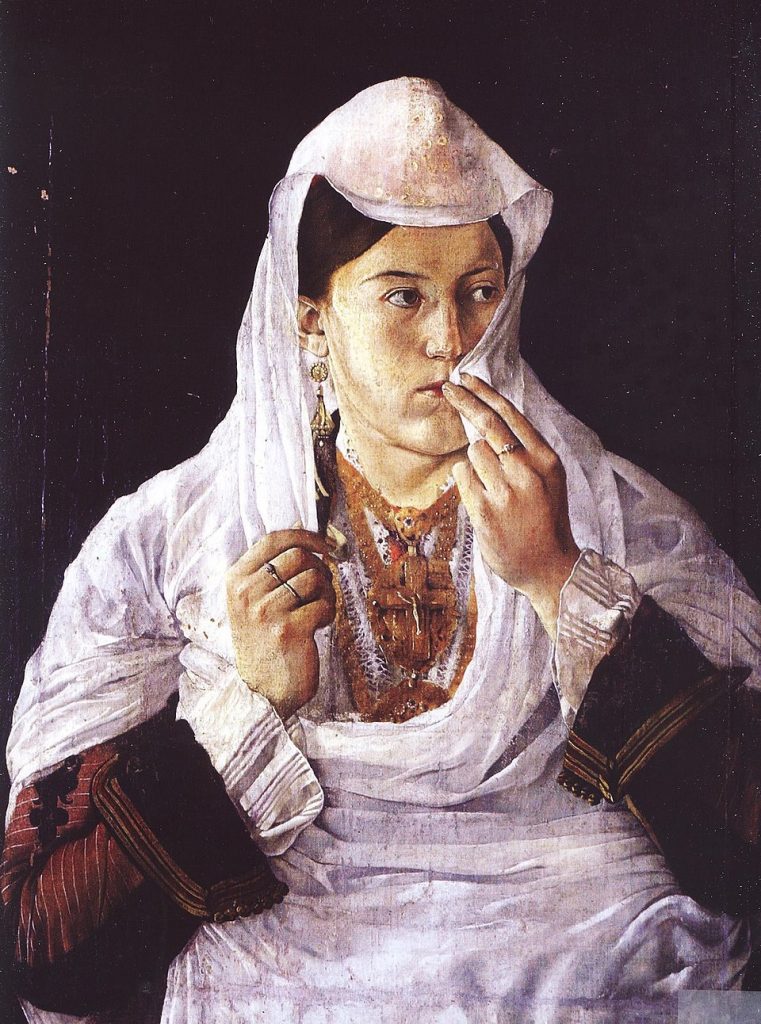
Another key figure of the period is Kolë Idromeno, whose career, though it began in the late 19th century, extended well into the 1920s and shaped the visual sensibility of interwar Albania. His portraits, genre scenes, and architectural work reflect a classical realism tempered by a subtle humanism. Unlike Mio, Idromeno was less concerned with atmospheric effects than with the dignity of the human figure. His portraits—especially of women—are striking for their psychological depth and quiet authority. In an era when Albania was grappling with the role of women in public life, these images offered a rare visual affirmation of female subjectivity. Idromeno’s work also maintained a documentary function, preserving the material culture, dress, and architecture of Shkodra at a moment of rapid change.
If Mio and Idromeno represent the poles of interwar Albanian painting—lyricism and documentation—other artists sought to push beyond these modes toward more self-consciously modernist expressions. Andrea Kushi, for instance, experimented with Cubist and Expressionist vocabularies, though often within the constraints of portrait and still life. His works reveal a desire to escape both academic realism and nationalist allegory, aiming instead for formal innovation and subjective intensity. Yet these efforts often lacked a receptive audience. Without galleries, critics, or an art-buying public, avant-garde gestures risked irrelevance. Albanian modernism, such as it was, remained largely confined to private studios and foreign exhibitions.
Architecture, however, tells a different story. During the interwar period, Tirana was transformed from a small Ottoman town into a European-style capital, largely under the influence of Italian architects. The most prominent among them was Armando Brasini, who, under Mussolini’s patronage, designed the governmental axis of Tirana in the early 1930s. Brasini’s vision—realized in the Ministry of Internal Affairs and other state buildings—combined neoclassical grandeur with Fascist rationalism. These structures, monumental in scale and stripped of ornament, reflected a new aesthetic of power: modern, orderly, and authoritarian. While Albanian architects like Kristo Sotiri and Qemal Butka contributed to the modernization of Tirana’s urban fabric, the dominant visual language remained Italianate, reflecting Albania’s growing dependency on Rome. Architecture thus became the primary medium through which modernism entered Albanian public life, albeit one largely directed from abroad.
Photography also advanced during the interwar period, both as a documentary medium and as a minor art form. The Marubi studio in Shkodra, founded in the 19th century, continued to produce remarkable portraits and urban scenes under the direction of Gegë Marubi, who developed new techniques and expanded the family archive. His images from the 1920s and ’30s are notable for their clarity, composition, and psychological insight. They also serve as a vital counterpoint to state propaganda, capturing the everyday life of Albanians in all its regional variety and social texture. Marubi’s photographs, though often constrained by commercial demands, constitute one of the richest visual records of interwar Albania—a nation caught between archaic customs and modern aspirations.
One should not underestimate the difficulties faced by Albanian artists in this period. There was no significant market for their work, few opportunities for patronage, and limited prospects for critical engagement. Many artists were forced to supplement their income through teaching, photography, or architecture. Yet despite these constraints, the interwar years produced a foundational generation—painters, architects, photographers, and designers—who laid the groundwork for the visual culture of independent Albania. They introduced new techniques, new subjects, and above all, a new understanding of the artist not as a craftsman or iconographer, but as a cultural agent with a public role.
That role, however, would soon be redefined in drastic and often tragic terms. With the Italian occupation in 1939 and the subsequent German invasion, the fragile pluralism of interwar Albanian art gave way to a militarized and ideologically instrumentalized cultural sphere. The forms and freedoms cautiously cultivated during the 1920s and ’30s would be swept aside by totalitarian aesthetics. But the achievements of this era—modest though they may appear in comparison to the canonical modernisms of Western Europe—represent a crucial chapter in Albania’s artistic evolution: a moment when the dream of a national art modern in form and Albanian in spirit seemed, however briefly, within reach.
The Socialist Realist Canon: 1945–1990
The establishment of the People’s Republic of Albania in 1946 under the leadership of Enver Hoxha marked not merely a change in regime, but a radical reconfiguration of the entire cultural field. Under the new Marxist-Leninist order, art was conscripted into the service of ideology, stripped of ambiguity, and redeployed as a didactic instrument of state power. The visual arts—like literature, music, and theater—were brought under the strict control of the Party of Labour, subject to rigorous censorship and bound to a singular aesthetic doctrine: Socialist Realism. Though imported from the Soviet Union, this style found a particularly rigid and enduring expression in Albania, where it remained virtually unchallenged for nearly half a century. The result was a monumental but brittle visual culture—heroic in form, dogmatic in content, and haunted by the absence of dissent.
The roots of Socialist Realism in Albania can be traced to the immediate postwar years, when the new regime sought to consolidate its authority by reshaping national memory and identity. This process began with the erasure of the interwar bourgeois legacy: private studios were closed, avant-garde experimentation denounced, and previously lauded figures like Vangjush Mio and Andrea Kushi were recast, when tolerated at all, as insufficiently revolutionary. In their place arose a new generation of artists trained in Soviet academies or in domestic institutions modeled after them, particularly the Institute of Arts in Tirana (founded in 1960). The curriculum, heavily politicized, emphasized drawing from life, mastery of anatomy, and above all, adherence to ideological correctness. Technical skill was celebrated, but only insofar as it served the higher purpose of revolutionary consciousness.
The stylistic characteristics of Socialist Realism in Albania were largely consistent with those codified by Andrei Zhdanov and the Soviet cultural apparatus: naturalistic representation, didactic clarity, and heroic subject matter. However, Albanian Socialist Realism was marked by an especially stark iconography. The typical painting or sculpture of this era features a triadic composition: the proletarian worker, the peasant woman, and the partisan fighter, each rendered in bold, idealized form, and arranged in dynamic poses suggestive of forward motion, unity, and invincibility. The visual rhetoric is unambiguous: struggle leads to victory, the Party is infallible, and the masses are the engine of history.
One of the most prolific and emblematic artists of the period was Guri Madhi (1921–1988), whose works combine academic precision with ideological orthodoxy. His painting The 11th National Liberation Brigade (1974), for example, is a textbook expression of Socialist Realist composition: a group of partisans, male and female, stride through a mountainous landscape, their gazes resolute, their postures upright, their red stars prominent. The scene is sanitized—there is no blood, no fatigue, no moral ambiguity. Nature itself appears to bend in affirmation, as if the Albanian mountains, long symbols of isolation and endurance, had become active participants in revolutionary triumph.
Another central figure was Sali Shijaku, whose paintings often focus on historical episodes reinterpreted through Marxist teleology. His Skanderbeg’s Oath (1968) reimagines the 15th-century national hero not as a feudal prince but as a proto-revolutionary, his raised arm echoing Communist visual tropes. This retroactive casting of historical figures into the mold of socialist virtue was a defining feature of the era. From medieval resistance fighters to anti-fascist martyrs, all were subsumed into a single moral narrative: the inevitability of proletarian victory under Party leadership.
Monumental sculpture was another favored medium, used to transform the Albanian landscape into a theater of ideological affirmation. Cities and towns were adorned with statues of workers and partisans, often cast in bronze or carved from stone in assertive, angular forms. The most ambitious of these works is the National Martyrs’ Cemetery complex in Tirana, dominated by the Mother Albania statue (1971), designed by Kristaq Rama. Towering over the capital, the figure of a woman—part Madonna, part Soviet heroine—holds a wreath in one hand and a sword in the other. She is not a figure of mourning but of vigilance, her gaze fixed on the horizon of permanent revolution.
Architecture, too, was subsumed into the Socialist Realist canon, though with some Albanian peculiarities. Urban planning emphasized axial symmetry, monumental boulevards, and public buildings with neoclassical façades stripped of decorative excess. In cities like Tirana, Durrës, and Vlora, the Party headquarters, cultural palaces, and people’s libraries became visual centers of civic life, their forms intended to reflect the order, harmony, and rationality of the socialist state. Yet in practice, this architecture often felt heavy, repetitive, and alienating—a stark contrast to the intricate, human-scaled vernacular traditions that preceded it.
The visual arts under Hoxha’s regime were tightly regulated by a complex apparatus of control. The Albanian League of Writers and Artists served as the primary gatekeeper, issuing approvals for exhibitions, commissions, and publications. Deviation from the Socialist Realist line could result in professional ostracism, surveillance, or worse. Abstract art, religious themes, eroticism, or anything smacking of Western decadence was strictly prohibited. In the early years of the regime’s alliance with the Soviet Union, Russian models predominated; after the 1961 break with Moscow and later the rupture with China in 1978, Albania turned inward, creating what was perhaps the most hermetically sealed art world in Europe. This isolation gave Albanian Socialist Realism a peculiar intensity: it became not only the dominant but the only permissible aesthetic, purged even of the minor pluralisms tolerated in other Eastern Bloc countries.
Despite these constraints, some artists managed to inject moments of ambiguity or even quiet dissent into their work. Painters such as Edi Hila, whose early work was censored and later banned, experimented with metaphorical imagery under the radar of state scrutiny. Hila’s symbolic language—domestic interiors, weathered surfaces, and elusive narratives—offered a subtle critique of the regime’s suffocating visual orthodoxy. But such work was the exception, not the rule, and often remained hidden from public view. For most artists, the price of deviation was too high.
It is tempting, in retrospect, to dismiss Socialist Realist art as propaganda—a fossil of an ideological system that no longer commands belief. Yet such a dismissal risks overlooking the genuine skill, labor, and sometimes even sincerity that went into these works. Many Albanian artists of this period were talented draughtsmen and technicians, trained in demanding academies and capable of extraordinary formal control. The limitations of their output lay not in their abilities, but in the uses to which those abilities were put. They operated in a closed symbolic system, where every image had to affirm a single, unyielding vision of reality. Within that system, nuance was often impossible—but not always entirely absent.
By the late 1980s, as Albania’s economy collapsed and Hoxha’s successor, Ramiz Alia, tentatively opened the regime to limited reform, the visual arts began to show the first cracks in their monolithic façade. Painters introduced darker palettes, ambiguous figures, and introspective moods—gestures that, while not overtly political, signaled a retreat from the heroic certainties of earlier decades. These late works anticipated the collapse of the regime in 1991, but they also revealed the exhaustion of an aesthetic that had for too long suppressed ambiguity in favor of ideological purity.
The legacy of Socialist Realist art in Albania remains contested. For some, it is a repository of national pride, a record of sacrifice and struggle. For others, it is a visual embodiment of totalitarianism—grand, empty, and coercive. In either case, it cannot be ignored. The murals, monuments, and paintings of this period continue to shape Albania’s public space and cultural memory, reminders of a time when art was not merely made, but mandated.
Underground Currents and Coded Resistance
To write the art history of Albania under Socialist Realism is to trace the contours of a rigid orthodoxy—but beneath that surface, concealed in ambiguity and often confined to private spaces, there flowed an undercurrent of resistance. It was not the kind of open opposition seen in more pluralistic societies, nor was it always intentional dissent. Rather, it was a quiet refusal to submit entirely to the prescribed visual language of the state. In a system where ambiguity itself was subversive, even the slightest deviation from ideological transparency became an act of cultural defiance. Coded resistance in Albanian art during the dictatorship was, by necessity, subtle, fragmentary, and frequently invisible to all but the most attentive viewers. Yet it endured, and in retrospect, it forms one of the most compelling chapters in the nation’s artistic evolution.
Censorship in Communist Albania was among the most severe in the Eastern Bloc. After the ideological purges of the 1960s and the complete break with the Soviet Union and China, the country became a cultural fortress, almost entirely isolated from foreign influence. Western magazines, books, and artworks were banned. Even within the socialist world, Albania remained intellectually sequestered. This vacuum left artists with few points of reference outside the state’s aesthetic dogma. And yet, even in this tightly sealed system, some artists managed to cultivate personal idioms—visual languages whose ambiguities, silences, and absences offered quiet alternatives to the prevailing myths of heroic collectivism.
One of the earliest and most significant figures in this covert realm was Edi Hila. In 1972, his diploma painting Planting Trees was deemed ideologically suspicious by the authorities, not for any overt criticism, but for its tone. The work’s introspective mood and lack of heroic emphasis were seen as incompatible with Socialist Realism. Hila was banned from painting professionally and reassigned to work as an art teacher and television decorator—a form of bureaucratic exile. Yet this forced retreat from official culture became the condition for a body of work that would redefine the very idea of Albanian resistance. In the privacy of his studio, Hila began to develop a visual vocabulary grounded in silence: domestic interiors, worn furniture, ambiguous spaces, anonymous figures. These images, devoid of slogans and spectacle, offered a kind of existential counterpoint to the bombast of state art.
What makes Hila’s work during this period remarkable is not only its technical restraint but its atmospheric density. In paintings such as The Waiting Room or The Tablecloth, the surface appears empty, but the emptiness is charged—with anxiety, latency, and suppressed memory. The viewer becomes aware not of what is depicted, but of what is missing: the state, the collective, the march forward. In their absence, the individual—long erased from official narratives—returns, albeit in spectral form. These paintings do not protest; they endure. And in a society that equated artistic value with ideological clarity, endurance became its own kind of resistance.
Other artists turned to allegory and ambiguity as protective strategies. The painter Vilson Kilica, who publicly conformed to Socialist Realist conventions in much of his official work, produced a series of private watercolors and sketches that explored abstract compositions and symbolic landscapes. These pieces, rarely shown in his lifetime, suggest a mind wrestling with the contradictions of a regime that demanded both artistic excellence and political subservience. In these works, form fractures into suggestion; color displaces content. They speak not in the declarative tone of propaganda but in the evasive syntax of metaphor.
For some, the act of resistance lay not in imagery but in process. Artists who refused state commissions or who avoided membership in the official Union of Writers and Artists effectively removed themselves from the public sphere, choosing obscurity over compromise. This retreat was not without cost—professional marginalization, surveillance, and even imprisonment—but it allowed for the preservation of personal integrity and, in some cases, the quiet development of alternative practices. A number of these artists—such as Hasan Nallbani or Astrit Delvina—worked in applied arts, graphic design, or theatrical set painting, embedding formal experimentation into ostensibly apolitical domains.
Sculpture posed particular challenges for subversive practice, given its scale and visibility. Yet even here, certain figures managed to navigate the narrow corridor between form and control. The sculptor Thoma Thomai, for instance, produced a series of busts and small-scale figures that, while nominally fitting within the canon of representational art, conveyed a psychological intensity absent from the monumental works of his contemporaries. His heads are heavy-lidded, inward-looking, almost mute. They seem to listen more than to speak. In a world saturated by the voice of the Party, this silence became eloquent.
Architecture, though tightly regulated, offered yet another site of quiet defiance. Some architects, constrained by the need to adhere to state plans and quotas, inserted subtle gestures into their designs—unexpected courtyards, locally sourced materials, or vernacular motifs. These choices, seemingly minor, reasserted a sense of place and memory within the homogenized visual grammar of socialist urbanism. In the southern city of Gjirokastër, for example, restoration projects sometimes smuggled traditional stonework and Ottoman-era details into otherwise modernist façades, creating a visual palimpsest that preserved cultural identity beneath the surface of ideological uniformity.
Photography, too, harbored its own undercurrents. While official photographers were tasked with documenting Party events, model workers, and state parades, others quietly turned their lenses toward unapproved subjects: decaying rural homes, empty streets, children at play in unadorned settings. These images, often never published during their creators’ lifetimes, now form an invaluable counter-archive—one that captures the dissonance between the world as it was and the world as the regime claimed it to be.
What unified these various underground and resistant practices was not necessarily political opposition in a conventional sense. Few artists in Communist Albania made overtly anti-regime statements, and fewer still survived unscathed if they did. Rather, the resistance was ontological: a refusal to reduce the complexity of human experience to a single ideological formula. It was an insistence—quiet, stubborn, and often lonely—that art must bear witness to something more than doctrine.
In this sense, the coded resistance of Albanian artists under Communism forms a kind of negative theology: a faith in absence, silence, and the unspeakable. Their works did not shout; they murmured. They did not instruct; they suggested. And in doing so, they preserved the possibility of meaning outside the reach of power. In the end, it was this preservation—not the official murals or bronze heroes—that became the true legacy of Albanian art during the Hoxha years: a fragile, often invisible thread of freedom running just beneath the surface, waiting to be uncovered.
Post-Communist Flux and the New Albanian Avant-Garde
The collapse of the Communist regime in Albania in 1991 was sudden, violent, and total. It left behind not only a shattered political system and a disoriented public, but an artistic culture adrift in a radically transformed landscape. After nearly five decades of Socialist Realism’s enforced aesthetic, artists found themselves confronting a void—of institutions, of patrons, of shared meaning. In this void, some attempted to reclaim lost traditions; others, more daringly, sought to invent new languages altogether. The post-Communist period in Albanian art, stretching from the early 1990s to the present, has been one of instability and experimentation—a prolonged state of flux in which rupture and reinvention are constant conditions. From this uncertainty has emerged an avant-garde movement that is not defined by a singular style or doctrine, but by its restless search for new forms capable of grappling with trauma, memory, and identity in a dislocated age.
The immediate post-Communist years were marked by chaos—economic collapse, mass emigration, and a profound crisis of cultural authority. The institutions that had sustained Albanian art under the dictatorship—the League of Writers and Artists, the state-run galleries, the art academies—were either dismantled or stripped of their function. In their place emerged a fragmented and underfunded scene: private initiatives, foreign-funded projects, and a generation of artists without precedent. For those who had grown up painting in state studios or teaching Socialist Realism in classrooms, the transition was disorienting. For younger artists, however, the vacuum offered a strange kind of freedom.
That freedom came at a cost. In the absence of a domestic art market or strong local institutions, many of the most significant Albanian artists of the post-1990 generation developed their practices abroad, particularly in Italy, Germany, France, and the United States. For them, the notion of Albanian identity was no longer tied to nation-state iconography or heroic myth, but to displacement, exile, and the uncertain legacy of authoritarian memory. In this diaspora, the new Albanian avant-garde was born—not as a school or movement, but as a dispersed constellation of voices united by a common reckoning with the past and a refusal to aestheticize it.
Chief among these voices is Anri Sala (b. 1974), the most internationally renowned Albanian artist of his generation. Trained in Tirana and later in Paris, Sala rose to prominence in the early 2000s with works that interrogate the unstable relationship between sound, image, and political memory. His video installations—such as Dammi i Colori (2003), which explores the post-Communist transformation of Tirana through colorist interventions by mayor Edi Rama—combine lyrical beauty with a rigorous conceptual framework. In Intervista: Finding the Words (1998), Sala restores and subtitled a lost interview with his mother, a former Party member, confronting her with her past in an act of intimate, forensic aesthetics. These works eschew didacticism; they do not lecture or condemn. Instead, they offer atmospheres of estrangement, moments of suspended recognition in which history returns not as narrative, but as echo.
Sala’s international success signaled to other Albanian artists that the post-Communist condition—so long a source of marginalization—could also become a field of inquiry. Artists such as Adrian Paci, Edi Rama, Driant Zeneli, and Armando Lulaj have each developed distinct practices that explore the psychological, material, and political residues of Albania’s past. Paci, for example, left Albania in 1997 during the country’s near-total collapse and began working in Milan. His videos and photographs, particularly Centro di permanenza temporanea (2007)—in which migrants stand atop a boarding staircase leading to an absent airplane—render displacement not as spectacle but as existential condition. Paci’s work is rooted in the specifics of Albanian history, but it speaks to broader themes of migration, loss, and statelessness.
Armando Lulaj, by contrast, turns to conceptual and archival strategies. His project Albanian Trilogy: A Series of Devious Stratagems (2011–2015) excavates Cold War iconography, state propaganda, and absurd episodes from the Hoxha regime to construct a political archaeology of national myth-making. In one component, he transports a defunct submarine to the mountains, staging a confrontation between military relic and landscape that deflates the rhetoric of power. Lulaj’s irony is precise, never mocking, but always destabilizing. He challenges the solemnity of state symbols by confronting them with their own obsolescence.
Edi Rama—simultaneously an artist and politician, mayor of Tirana and later Prime Minister—embodies perhaps the most paradoxical figure in the post-Communist avant-garde. His drawings, made compulsively on government documents during meetings, blur the lines between bureaucratic routine and private expression. Exhibited internationally, these works suggest that creativity can survive within the machinery of power, though not always unproblematically. Rama’s dual role raises difficult questions about the instrumentalization of art in a post-authoritarian context: can artistic practice maintain critical autonomy when fused with state leadership? Is the aestheticization of governance a continuation of propaganda by other means, or a sincere reimagining of public life?
The new Albanian avant-garde is not confined to fine art alone. Performance, video, installation, and interdisciplinary practices dominate the field. Collectives such as Tirana Ekspres and Tulla Cultural Center have provided ad hoc platforms for emerging artists, while international exhibitions—particularly the Venice Biennale, where Albania has participated since 1999—have offered visibility on a global stage. Yet these opportunities are unevenly distributed, and much of Albania’s domestic art infrastructure remains precarious. The National Gallery of Arts in Tirana, though undergoing renovation and expansion, still struggles with outdated curatorial frameworks and limited acquisitions. Meanwhile, independent curators, critics, and artists continue to operate in a landscape marked by chronic underfunding, institutional volatility, and political cooptation.
Despite—or perhaps because of—these conditions, Albanian contemporary art has produced works of striking intensity. The avant-garde here is not an aesthetic trend but a method of survival: a way of speaking in tongues when the language of public discourse has failed. Artists draw upon documentary material, folk motifs, linguistic disjunctions, and digital media to craft hybrid forms that resist easy categorization. In doing so, they redefine what it means to be Albanian—not as a bearer of a fixed national essence, but as a subject in perpetual negotiation with history, geography, and modernity.
What unites these artists is not a common style, but a shared understanding that the past is never past—that the ghosts of dictatorship, isolation, and enforced unity continue to haunt the present. Their work does not seek closure; it seeks confrontation. Not heroic resolution, but unresolved encounter. This is the true avant-garde impulse in post-Communist Albania: not to declare a new order, but to dwell within the ruins of the old one long enough to discern what might yet be salvaged.
Diaspora and the Transnational Albanian Gaze
No history of Albanian art in the modern era is complete without reckoning with the reality of diaspora. The dispersal of Albanians—through war, persecution, economic necessity, and political exile—has not only reshaped the demographics of the nation but redefined the very scope and language of its visual culture. What we now call Albanian art is as often produced in Milan, New York, Zurich, or Paris as it is in Tirana or Shkodra. This transnational condition has fractured the traditional relationship between artist and homeland, replacing it with a more fluid, and often more critical, set of affiliations: memory rather than territory, inheritance rather than propaganda, distance rather than fidelity. In the hands of diasporic and transnational artists, the Albanian gaze has turned outward and inward simultaneously—probing the dislocations of exile while interrogating the myths and traumas left behind.
The Albanian diaspora is neither recent nor monolithic. Waves of emigration began in the late Ottoman period, intensified during the early 20th century, and reached new heights during and after the Communist regime. Albanians settled in Italy, Greece, Turkey, Romania, the United States, and later in Western Europe, especially after the collapse of the Eastern Bloc. For much of the 20th century, these communities maintained cultural life in exile—through language schools, newspapers, religious institutions—but the visual arts remained secondary, hindered by the practical demands of survival and the lack of a sustaining art infrastructure. It is only in the post-1990 period, with the rise of global networks and expanded access to education, that a distinctive transnational Albanian visual culture has cohered.
Among the most prominent figures of this new condition is Anri Sala, whose work, though examined earlier, is best understood within this transnational framework. Born in Tirana, educated in France and Austria, and based in Berlin, Sala’s practice is inseparable from his experience of displacement. His use of sound, architecture, and historical media—often presented in multilingual formats—reflects a sensibility that is at once Albanian and post-national. Works like Answer Me (2008) or Ravel Ravel Unravel (2013) are not explicitly about Albania, yet they are haunted by the politics of memory and the fragility of communication, themes that bear deep resonance for a country that spent decades in silence and isolation.
Adrian Paci, likewise, has made migration his central theme. In works such as Home to Go (2001) and The Column (2013), Paci stages acts of transit, return, and transformation that double as metaphors for artistic creation. His videos often depict liminal states: waiting rooms, border crossings, half-built homes. The figures in his work are not heroic; they are ordinary people caught in bureaucratic and emotional limbo. In Centro di permanenza temporanea, a group of migrants stands on an airport staircase with no airplane in sight—a stark image of expectation without destination. This iconography of suspension is distinctly diasporic: it refuses resolution, demanding instead that viewers confront the open wound of unfulfilled return.
This sense of suspended identity also permeates the work of Driant Zeneli, a younger artist whose installations and performances explore failure, ambition, and myth in the Albanian context. In The Dream of Icarus Was to Make a Cloud (2018), Zeneli stages an absurd attempt to fly, merging ancient myth with contemporary futility. His characters—often children or anonymous adults—attempt impossible tasks with an earnestness that borders on the tragicomic. The humor is pointed, never dismissive. It reflects a diasporic awareness of both the absurdity of nationalism and the lingering power of its imagery. Zeneli’s work, like that of many transnational Albanian artists, does not reject the homeland; it reimagines it as a site of imaginative projection, no longer a bounded territory but a conceptual field.
A notable strand of this diasporic gaze involves the archival impulse—the drive to recover, reframe, and critique the visual records of Albania’s past. Armando Lulaj, operating between Tirana and Bologna, exemplifies this approach. His work mines state archives, propaganda footage, and discarded monuments, repositioning them in ways that expose the machinery of ideological production. In It Wears as It Grows (2011), a taxidermied dolphin used in Cold War military propaganda is displayed in a museum vitrine, its grotesque absurdity laid bare. For Lulaj, the archive is not a repository of truth but a site of estrangement. His art stages confrontations with history that are neither reverent nor nihilistic, but forensic—unearthing not to restore, but to understand.
The diasporic condition has also expanded the formal language of Albanian art. Freed from the doctrinal constraints of Socialist Realism and the parochialism of nationalist symbolism, transnational artists work in video, performance, installation, conceptual art, and hybrid digital forms. Their Albanian-ness is not always visible in iconography, but it is present in their concerns: borders, memory, language, authority, and displacement. This is not the art of nation-building, but of nation-questioning. It reflects a generation shaped by rupture, whose identity is less a matter of inheritance than of continual negotiation.
Women artists within this diaspora have made particularly important contributions, often challenging both the patriarchal structures of Albanian society and the masculinist tropes of its political history. Lejla Çobo, Alban Muja, and Elira Turdai have developed bodies of work that explore gender, trauma, and the body with a critical acuity shaped by both local and global feminist discourses. Their work complicates the traditional narratives of Albanian heroism and martyrdom, introducing new registers of vulnerability, care, and corporeal memory.
Perhaps what distinguishes the transnational Albanian gaze most powerfully is its dialogic orientation. It speaks not only to Albanians, but to the world—and not in the language of self-exoticization or cultural essentialism, but in a mode of reflective encounter. This gaze is shaped by translation, not simply of language, but of context, of history, of forms. It refuses both nostalgia and repudiation. Instead, it dwells in the in-between: between homeland and hostland, between memory and forgetting, between trauma and imagination.
In the process, this gaze has reshaped the very definition of what constitutes Albanian art. No longer confined to national boundaries or traditional motifs, it has become a mobile, critical, and expansive practice. It has turned exile into method, and distance into perspective. And in doing so, it has ensured that the visual culture of Albania, once so rigorously policed and narrowly defined, now speaks in many tongues, across many borders, with a voice both fractured and unmistakably its own.
Conclusion: Albania’s Art Historical Identity in Europe and Beyond
To trace the art history of Albania is to confront the problem of marginality—not as absence, but as complexity. Albania, at the geographic and cultural edges of empire after empire, has rarely occupied the center of European art historical narratives. It has been excluded from the canonical circuits of Renaissance, Baroque, Enlightenment, or Modernist triumphalism. And yet this marginality has never equated to artistic poverty. On the contrary, Albanian art history—spanning from the funerary stelae of the Illyrians to the conceptual installations of the postmodern diaspora—reveals a unique and resilient visual culture shaped not by stylistic continuity, but by fracture, adaptation, and survival.
What emerges from this long arc is not a single tradition but a set of overlapping visual languages. Albanian art has been continuously formed at the juncture of foreign domination and local response. From Hellenistic colonies and Roman municipia to Byzantine bishoprics and Ottoman vilayets, the visual culture of Albania has repeatedly been forced to reckon with aesthetic and ideological systems not of its own making. But it has done so with a stubborn, often subterranean creativity. The basilicas of Lin and Butrint may echo Constantinople, but their mosaics speak in a regional dialect; the Ottoman mosques of Shkodra and Berat carry echoes of Sinan, but in stone and timber cut by local hands. Even under the totalizing pressure of Socialist Realism, a private, symbolic visual language persisted—coded in interiors, whispered in pigments, deferred in form.
Albania’s art historical identity, then, cannot be captured by a single school, medium, or iconography. It is not the history of a national style, as in 19th-century France, nor of a revolutionary rupture, as in early 20th-century Russia. It is, rather, the history of continuity under pressure. Continuity not of form, but of impulse—the impulse to record, to signify, to make meaning in conditions that often rendered visual production dangerous, uncertain, or compromised. Albanian art survives not because it was institutionalized, but because it was embedded in the lived texture of the land: in its vernacular architecture, its domestic ornament, its ritual gestures, and eventually, its diasporic longing.
This complexity challenges the frameworks imposed by conventional art historiography. For too long, the history of European art has been written from its centers—Florence, Paris, Berlin, Vienna—with only intermittent attention to the Balkans, and even less to Albania. When it is acknowledged, Albanian visual culture is often treated as derivative or belated—a provincial echo of more “important” traditions. Yet such a view not only misrepresents the depth and specificity of Albanian art; it also misunderstands the nature of influence itself. The mosaics of Apollonia are not simply imitations of Greek models; they are hybrid creations shaped by geography, belief, and material constraint. The frescoes of Berat are not failed Byzantium; they are local articulations of the sacred in an unstable world. The contemporary works of Anri Sala or Adrian Paci are not peripheral to the European avant-garde; they interrogate its very assumptions about history, identity, and modernity.
In recent years, there has been a growing effort to incorporate Albanian art into broader regional and transnational narratives. Exhibitions, scholarly publications, and biennial platforms have begun to situate Albanian artists within the context of Southeastern European modernism, post-socialist conceptualism, and Mediterranean cultural flows. These efforts are valuable, but they must resist the temptation to merely assimilate Albania into preexisting categories. The task is not to make Albania legible to the West by rendering it familiar, but to understand its art on its own historical and aesthetic terms—terms shaped by liminality, fracture, and an enduring tension between imposed systems and local resilience.
This perspective also has implications for the way Albanian art is conserved, exhibited, and taught. In many cases, the material legacy of the country’s art remains imperiled. Byzantine frescoes deteriorate in rural churches with no protection; Socialist Realist murals face destruction amid privatization and urban redevelopment; archives of artists and photographers are scattered or inaccessible. The responsibility for preservation and interpretation lies not only with Albanian institutions, but with international scholarship, curatorship, and policy. The art of Albania is not merely a national heritage; it is a part of Europe’s neglected artistic memory, and its survival requires a serious, sustained commitment.
What, then, can we say in closing about Albania’s place in the art history of Europe and beyond? Not that it stands apart from Europe, as a Balkan anomaly; nor that it seamlessly integrates into a continental narrative of stylistic evolution. Rather, Albania offers a different model: an art history not of golden ages and ruptures, but of sediment and accretion. Its identity is neither fixed nor self-contained. It has been shaped by what it has endured, by what it has borrowed and repurposed, and by what it has refused to forget.
In this sense, Albanian art history offers a profound lesson for the discipline as a whole. It reminds us that cultural significance does not always lie in innovation, nor in visibility, but in persistence. That the margins of empire, the peripheries of style, the silences of repression—all harbor meanings that do not yield to quick interpretation. They require attention, patience, and a willingness to read what is hidden or half-erased. Albania’s art history is not merely underwritten by loss and fragmentation; it is shaped by them. And in that shaping lies not diminishment, but distinctiveness—an enduring visual testament to the power of a small nation to survive, signify, and see.