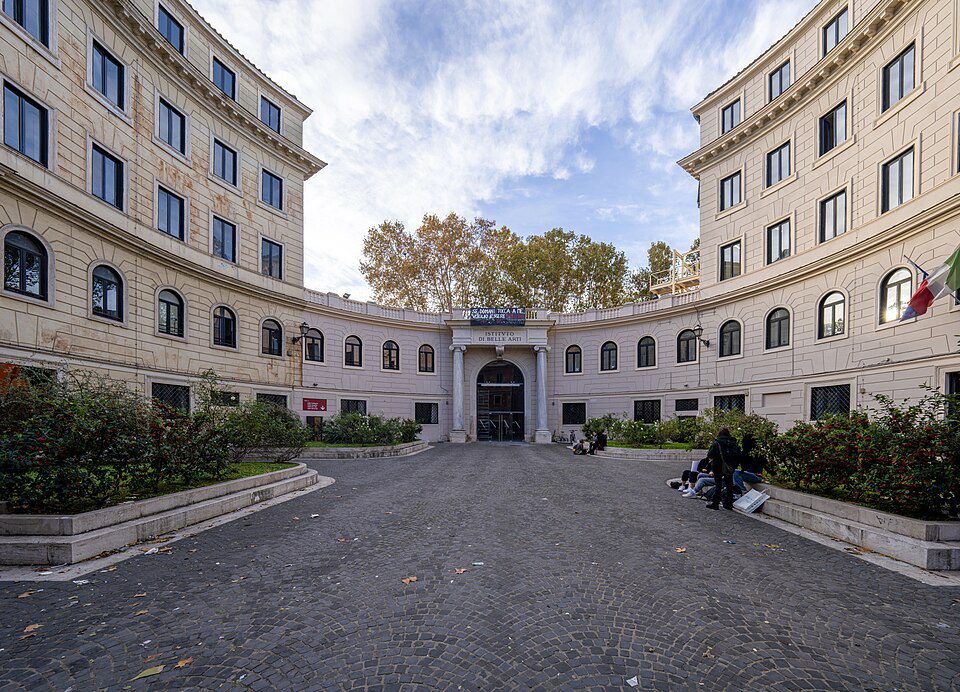
The roots of the Accademia di Belle Arti di Roma stretch back to 1593, when it was originally established under the name Accademia di San Luca. The founder, Federico Zuccari (c. 1540–1609), a prominent Mannerist painter and architect, envisioned an institution that would raise the social status of artists. Rather than being seen as mere craftsmen, Zuccari wanted painters, sculptors, and architects to be recognized as educated thinkers and intellectuals. Under his leadership, and with the patronage of Pope Gregory XIII and later Pope Sixtus V, the academy became a prestigious hub for Roman art.
The early goals of the academy were both artistic and cultural. It promoted the mastery of drawing, or disegno, as the foundation of all visual arts—echoing Renaissance ideals. The institution was also closely tied to the Catholic Church, which at the time was commissioning monumental works of art to assert spiritual authority during the Counter-Reformation. The academy provided training aligned with Church priorities, emphasizing religious themes, classical iconography, and technical excellence.
Early members and supporters of the Accademia di San Luca included influential figures such as Gian Lorenzo Bernini, Carlo Maratta, and Pietro da Cortona. These artists played a vital role in defining the Baroque style, which transformed Rome into a living canvas of grandeur, drama, and spiritual intensity. While the academy focused on education, it also acted as a guild, regulating who could practice as a professional artist within the city.
The location of the academy was deliberately placed in the heart of Rome, near Piazza Venezia and the Roman Forum, symbolizing the intertwining of ancient glory and Christian dominance. This proximity to classical ruins inspired generations of artists to merge historical awareness with contemporary relevance. For over two centuries, the Accademia di San Luca remained the primary authority in the training, accreditation, and promotion of visual artists in the Eternal City.
From San Luca to Modern Academy: The 19th-Century Transformation
By the 1800s, dramatic political and social changes swept through Italy, affecting even time-honored institutions like the Accademia di San Luca. The unification of Italy in 1861, and the subsequent fall of the Papal States in 1870, opened the way for secular reforms in education. In this context, the Accademia di Belle Arti di Roma was formally reorganized and secularized, separating it from its earlier religious and guild-like origins. The transformation signaled a move from Church-centered instruction to a more modern, state-sponsored model of fine arts education.
In the 1870s, the academy was officially recognized under the Italian Ministry of Public Instruction, which aimed to modernize national institutions and promote a unified cultural identity. The reorganization included updating its curriculum, increasing state funding, and opening enrollment to a broader range of students, including, eventually, women. This era marked a decisive shift from religious patronage to national cultural development. The state sought to build a new Italian identity, and visual arts played a central role in crafting that narrative.
During this period, the academy also physically relocated and expanded its facilities. The new site offered larger classrooms, dedicated studio spaces, and exhibition halls. These changes allowed the academy to accommodate the growing demand for artistic training while maintaining Rome’s historical prestige as a center for the arts. As part of its restructuring, the Accademia embraced a broader interpretation of the arts, adding decorative arts, printmaking, and applied design to its offerings.
Key artists and teachers involved in the transformation included Giulio Aristide Sartorio, who would later become a professor and Symbolist painter of national prominence. His blend of poetic mysticism and classical form reflected the evolving spirit of the academy—rooted in tradition but reaching toward the future. As Italy moved through industrialization and modern nation-building, the academy remained a cornerstone of its cultural self-image.
Curriculum and Disciplines: Bridging Classical and Contemporary
Today, the Accademia di Belle Arti di Roma offers a dynamic curriculum that honors its classical foundations while embracing modern technologies and media. Students can pursue a Diploma Accademico di Primo Livello (equivalent to a bachelor’s degree) or a Secondo Livello diploma (master’s level), in a range of disciplines. These include traditional fields like painting (pittura), sculpture (scultura), and scenography (scenografia), as well as contemporary subjects such as video art, photography, and multimedia design. This balanced academic structure ensures that graduates leave with both timeless skills and modern relevance.
The academy’s approach to teaching remains grounded in the atelier system, where students learn through close mentorship with established artists. Hands-on practice is emphasized, particularly in life drawing, color theory, and anatomical studies. However, digital innovation is not neglected. Students now also explore 3D modeling, digital animation, and interactive installations, blending craftsmanship with technology in a uniquely Roman way.
One of the most sought-after departments is Art Conservation and Restoration, where students learn techniques dating back to antiquity. The program includes studies in chemistry, material science, and historic preservation, reflecting Italy’s global leadership in cultural heritage protection. Many of the projects involve partnerships with museums and churches, allowing students to work directly on ancient frescoes, sculptures, and paintings under expert supervision.
The academy also encourages interdisciplinary work. For instance, scenography students often collaborate with those in costume design and video production to stage operas and theater productions across Rome. This collaborative model reinforces the idea that art is not a solitary pursuit, but a community endeavor. It prepares students not just to create art, but to participate in the broader cultural industries of Italy and beyond.
Notable Alumni and Influential Faculty
Over the centuries, the Accademia di Belle Arti di Roma has educated and employed some of Italy’s most celebrated artists. Among its historical luminaries is Antonio Canova (1757–1822), the neoclassical sculptor famed for works like Psyche Revived by Cupid’s Kiss. While Canova’s formal connection was with the earlier Accademia di San Luca, his influence lingered well into the 19th century, shaping the stylistic ideals of the academy’s sculpture program. His devotion to harmony, anatomical precision, and classical beauty still resonates in the school’s teachings.
Another major figure is Giulio Aristide Sartorio (1860–1932), who taught painting and became one of Italy’s foremost Symbolist artists. Sartorio’s work blended romantic mysticism with nationalist themes, and his frescoes at the Palazzo Montecitorio (seat of the Italian Parliament) exemplify his dedication to civic art. As a professor, he mentored numerous students and emphasized both technical mastery and philosophical depth. His tenure reflects a time when the academy was closely tied to national identity-building through monumental public art.
In the 20th century, sculptor Giacomo Manzù (1908–1991) became one of the most prominent artists associated with the academy. Known for his modernist religious works, including the massive bronze Doors of Death for St. Peter’s Basilica, Manzù served as both an instructor and visiting artist. Despite the secular nature of the modern academy, his spiritual themes connected past to present. His mentorship helped shape postwar Italian sculpture, integrating humanist themes with modern forms.
Many other alumni have made significant contributions to both Italian and international culture. These include Carlo Carrà, a leading figure in Futurism and Metaphysical painting, and Mimmo Paladino, a key member of the Transavanguardia movement. The academy’s alumni network is deeply influential, with graduates going on to teach, exhibit, and collaborate in major museums and biennales around the world. These legacies continue to draw aspiring artists to its historic studios.
The Academy in Rome’s Cultural Landscape
Situated within walking distance of landmarks like the Colosseum, Palatine Hill, and Piazza Venezia, the Accademia di Belle Arti di Roma occupies a unique place in the city’s cultural topography. Its central location immerses students in the artistic and architectural heritage of the Eternal City. Daily exposure to ancient ruins, Renaissance churches, and Baroque fountains provides more than inspiration—it becomes part of their creative DNA. In this way, Rome itself becomes a classroom.
The academy maintains active relationships with several neighboring institutions, including the Accademia Nazionale di San Luca, the Galleria Nazionale d’Arte Moderna, and the Musei Capitolini. These partnerships allow students and faculty to access archives, special exhibitions, and collaborative research projects. Cross-institutional events are common, such as joint symposiums on art history, preservation, and aesthetics. These collaborations extend the reach of the academy far beyond its own walls.
Public exhibitions are a key part of the academy’s engagement with Rome’s broader art community. Student work is regularly displayed in galleries throughout the city, and end-of-year showcases are often open to the public. In addition, the academy hosts workshops, guest lectures, and panel discussions that attract both locals and tourists. These events not only provide students with valuable exposure but also strengthen the academy’s role as a living part of Rome’s evolving culture.
Rome’s identity as a city of art is constantly being redefined, and the Accademia di Belle Arti di Roma plays an active role in that process. Whether it’s through mural projects in working-class neighborhoods or avant-garde installations in contemporary galleries, the academy supports both tradition and experimentation. Its presence helps ensure that Rome is not just a city of the past but a city of ongoing creative dialogue. The academy thus serves as both a guardian of legacy and a catalyst for cultural renewal.
Global Collaborations and Modern Impact
The Accademia di Belle Arti di Roma is no longer just a national treasure—it is a globally connected institution. Through participation in the Erasmus+ program, the academy offers exchange opportunities for students and faculty across Europe. Collaborations with art schools in France, Germany, Spain, and Poland foster an exchange of ideas, techniques, and cultural perspectives. These international ties ensure that students graduate with both a deep respect for tradition and a nuanced understanding of the global art world.
Beyond Europe, the academy has established partnerships with institutions in Japan, Brazil, South Korea, and the United States. These programs often include co-curated exhibitions, artist residencies, and research grants. Recent initiatives have explored topics such as ecological art practices, post-digital aesthetics, and indigenous visual traditions. This international approach broadens the academy’s scope and places it on the world stage of fine arts education.
A number of Accademia graduates have exhibited in global events such as the Venice Biennale, Documenta in Kassel, and the São Paulo Biennial. These appearances reflect the academy’s commitment to contemporary relevance and critical engagement. Students are encouraged to respond to pressing issues—from migration to climate change—through their work, while still upholding strong technical standards. This balanced emphasis on content and craft gives the academy a unique voice in global artistic discourse.
International faculty exchanges also enrich the academy’s environment. Visiting artists from abroad frequently conduct short-term workshops and lectures, introducing students to new methodologies and aesthetics. These collaborations help prepare students for diverse career paths in museums, academia, design, and independent artistic practice. As the world becomes increasingly interconnected, the Accademia di Belle Arti di Roma continues to adapt without sacrificing its core values.
Preserving Legacy and Looking Forward
Even as it embraces digital media and contemporary art forms, the Accademia di Belle Arti di Roma remains deeply committed to preserving classical techniques and values. Instruction in traditional crafts such as fresco painting, mosaic, tempera, and gilding is still a core part of the curriculum. These ancient methods are taught not merely for nostalgia but as foundations upon which modern innovations can be built. This dual focus gives students a unique edge, equipping them with skills that are increasingly rare and culturally significant.
The academy has also invested in state-of-the-art digital laboratories and sustainable art studios, blending centuries-old practices with cutting-edge tools. For example, students can now analyze pigments using spectroscopy while also learning how to grind natural minerals by hand, just as Renaissance artists did. Courses in environmentally conscious artmaking, using recycled materials or non-toxic solvents, reflect a growing awareness of art’s impact on the world. These initiatives ensure that the institution remains relevant without compromising its core identity.
Recent years have also seen expansion plans aimed at improving facilities and accessibility. Proposals for new student housing, renovated exhibition halls, and increased studio space have been under review since 2022. Meanwhile, the academy’s leadership—currently under the directorship of Cecilia Casorati, appointed in 2018—has focused on inclusion, transparency, and academic excellence. Casorati, herself a noted art historian and critic, has emphasized internationalization and heritage protection as dual pillars of the academy’s future.
Looking ahead, the Accademia di Belle Arti di Roma is well-positioned to remain a leading force in both preserving Italy’s artistic legacy and shaping its creative future. It holds fast to timeless principles—discipline, skill, and reverence for beauty—while encouraging intellectual curiosity and artistic risk. As Rome continues to evolve, the academy stands firm, a watchtower over the past and a lighthouse guiding new generations forward. In a world increasingly driven by trends, it remains rooted, resilient, and radiant.
Key Takeaways
- The Accademia di Belle Arti di Roma began as the Accademia di San Luca in 1593, founded by Federico Zuccari to elevate the status of artists.
- The academy transformed in the 19th century, becoming a secular, state-funded institution after Italian unification.
- It offers degrees in traditional and modern disciplines, blending classical training with digital innovation.
- Alumni like Antonio Canova, Giacomo Manzù, and Giulio Aristide Sartorio left lasting marks on both Italian and global art.
- With global collaborations and sustainability efforts, the academy balances historical reverence with modern relevance.
Frequently Asked Questions
- What is the Accademia di Belle Arti di Roma known for?
It’s renowned for its classical training in the fine arts and its rich history dating back to 1593. - Who are some famous alumni of the academy?
Notable alumni include Antonio Canova, Giacomo Manzù, Carlo Carrà, and Giulio Aristide Sartorio. - Can international students attend the academy?
Yes, through Erasmus+ and other exchange programs, international students can study at the academy. - What degrees does the academy offer?
It offers undergraduate and graduate degrees known as Diploma Accademico di Primo and Secondo Livello. - Is the academy involved in preserving historic art?
Yes, it has a leading conservation and restoration program that works on historic artworks across Italy.