Some of the most unforgettable women in art are people we barely know. A smile refuses to explain itself. A woman turns toward us as though we have interrupted her. Another stares back without apology. Sometimes we know the sitter’s name but cannot read her thoughts; sometimes we do not even know whether the woman existed. Their mystery is useful because it shows how artists create fascination without explaining everything.
1. Mona Lisa — The Expression Never Quite Settles
Leonardo da Vinci’s Mona Lisa is generally identified as Lisa Gherardini, wife of the Florentine merchant Francesco del Giocondo. Yet the Louvre notes that, during Leonardo’s prolonged work on the painting, the sitter’s individual identity seems to have become less important than his attempt to create a convincing impression of physical and psychological life.
Her famous expression works partly because it refuses to resolve into one obvious emotion. She seems amused from one angle, reserved from another. Leonardo did not need a dramatic gesture or elaborate narrative to hold attention; uncertainty does much of the work.
When depicting emotion, consider leaving the expression slightly unresolved instead of telling the viewer exactly what the subject feels.
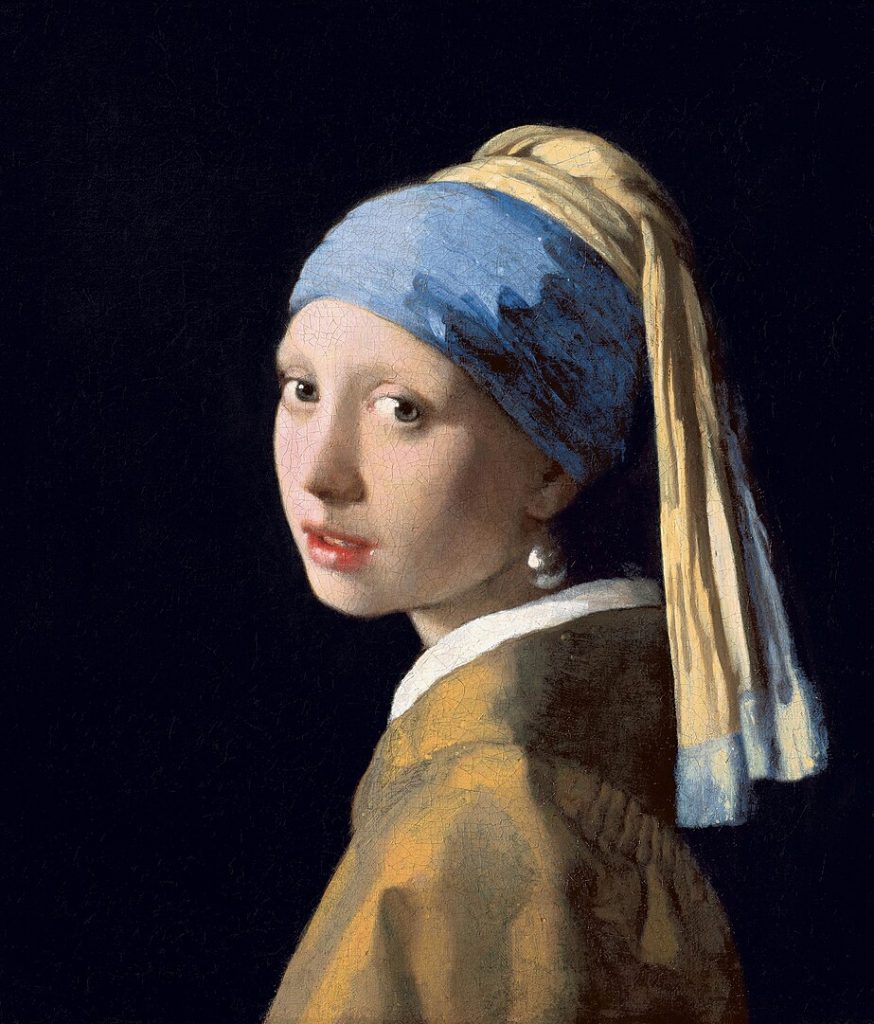
2. Girl with a Pearl Earring — An Unknown Person Can Become More Universal
We still do not know the identity of Vermeer’s Girl with a Pearl Earring. More importantly, the Mauritshuis explains that the painting is not actually a conventional portrait but a tronie—a study of a character or type. Her exotic head covering and enormous “pearl,” which may not even represent a real pearl, helped transform an anonymous model into an imagined figure.
That anonymity creates room for us. Because Vermeer gives us almost no biography, viewers instinctively invent one. Her turned head and parted lips feel like the middle of an encounter whose beginning and ending are missing.
Before giving your audience more backstory, test whether removing one piece of information makes them more curious rather than merely confused.
3. Olympia — Looking Back Changes the Balance of Power
Édouard Manet’s Olympia caused scandal not simply because it showed a nude woman. European painting already contained plenty of nudity. The discomfort came partly from Manet placing contemporary life inside a format associated with the idealized nude—and making his woman look directly outward rather than disappearing into a mythological role.
The model was Victorine Meurent, who appeared repeatedly in Manet’s work and was herself an artist. What makes Olympia psychologically sharp is the refusal to behave like passive decoration. She sees the viewer seeing her.
When you want a figure to feel powerful, pay attention to who is looking at whom rather than relying on dramatic poses or symbols of strength.
4. Madame X — A Portrait Can Reveal Without Explaining
John Singer Sargent painted Virginie Amélie Avegno Gautreau, a Paris society figure celebrated for her appearance, in the portrait eventually known as Madame X. Its presentation at the 1884 Paris Salon produced controversy, particularly around the original position of one jeweled shoulder strap, which Sargent later repainted higher on her shoulder.
Yet the painting’s enduring mystery comes from restraint. Gautreau turns away. Her profile is precise, but psychological access is limited. We can inspect her dress, skin, posture and surroundings while remaining shut out of her thoughts. Visibility is not the same thing as intimacy.
If a portrait feels too explanatory, try making one important element—especially the gaze, gesture, or setting—withhold information from the viewer.
5. Christina — Mystery Can Come From What You Cannot See
Andrew Wyeth’s Christina’s World shows a woman lying in a field and looking toward a distant farmhouse. The figure was inspired by Anna Christina Olson, Wyeth’s neighbor in Maine, whose mobility was severely limited. Yet Wyeth gives us no face to interpret and no explicit action explaining the scene.
That decision turns distance into the subject. The farmhouse is visible but painfully far away, while Christina’s position makes us aware of the ground separating her from it. Instead of illustrating difficulty directly, Wyeth lets space communicate it.
When you need to express a difficult emotion or situation, see whether distance, scale, posture, or environment can carry the meaning before adding explanatory details.
6. The Lady of Shalott — The Most Powerful Moment May Be Just Before the Outcome
John William Waterhouse repeatedly painted the Lady of Shalott, the doomed woman from Alfred Tennyson’s poem. In his famous 1888 version, she has left her tower and sits in a boat that will carry her toward Camelot and her death.
Waterhouse chooses the unstable middle rather than the conclusion. Objects in the boat, the landscape and the woman’s expression create clues, but the event has not finished happening. That suspended state gives the image its tension: she has acted, but the consequences are still approaching.
When choosing which moment of a story to depict, consider the instant after a decision has been made but before its consequences become certain.
7. Adele Bloch-Bauer — Ornament Can Hide as Much as It Reveals
Gustav Klimt’s Portrait of Adele Bloch-Bauer I identifies its sitter clearly, yet almost everything else about her seems to dissolve into decoration. Her face and hands emerge from an extraordinary field of gold, eyes, squares, spirals and geometric ornament until body, dress, chair and background become difficult to separate.
The effect creates a useful contradiction. Adele is simultaneously intensely present and almost swallowed by the painting around her. Klimt shows that decoration does not have to sit behind a subject; it can destabilize the boundary between person and environment.
Instead of treating pattern as something added after the main subject is finished, experiment with letting it interrupt, conceal, or merge with the subject itself.
8. The Infanta Margarita — A Subject Does Not Have to Be the Center of Attention
The young Infanta Margarita Teresa occupies a prominent position in Diego Velázquez’s Las Meninas, surrounded by attendants in a room at the Spanish court. But the painting constantly redirects our attention: toward the painter, the mirror containing the king and queen, the doorway at the back, the attendants, and ultimately toward our own position outside the canvas.
Margarita is visually central without completely controlling the picture. That is one reason Las Meninas remains so strange: its hierarchy keeps shifting. The painting demonstrates that composition can make viewers uncertain about what they are actually supposed to be looking at.
When a composition feels predictable, keep your main subject but give the viewer two or three secondary points of attention that compete meaningfully with it.
9. Whistler’s Mother — Personality Can Be Built From Almost Nothing
James McNeill Whistler’s Arrangement in Grey and Black No. 1 depicts his mother, Anna McNeill Whistler, sitting in profile. The title itself is revealing: Whistler emphasized the formal arrangement of tones and shapes rather than presenting the painting simply as a sentimental family portrait.
The room is severe. The palette is restricted. The pose is still. There is almost no narrative action. Yet those limitations are precisely what make the figure memorable. Her character seems to emerge from posture, silhouette, clothing, spacing and tonal control rather than from an obvious facial expression.
Before adding another object, color, gesture, or piece of symbolism to a portrait, ask whether the subject could become stronger by removing something instead.
The mysterious women of art are not fascinating because artists forgot to explain them. Often, the lack of explanation is exactly what makes them memorable.
Leonardo leaves an expression unsettled. Vermeer leaves a biography blank. Manet turns the gaze back on us. Wyeth uses distance instead of dialogue. Velázquez makes us question where to look. The useful secret behind all nine is simple but demanding: give viewers enough information to become interested, but not so much that there is nothing left for them to discover.