Art history is full of friendships, collaborations, and generous exchanges of ideas. It is also full of insults, jealousy, competition, lawsuits, broken friendships, and people who probably should never have shared a studio.
The interesting part is that conflict sometimes exposes exactly what an artist cares about most. Here are nine famous cases where great artists could not—or eventually could not—get along.
1. Michelangelo and Leonardo — Two Geniuses, One Wall
Leonardo da Vinci and Michelangelo were both commissioned in the early 1500s to create enormous battle scenes for the Palazzo Vecchio in Florence. Neither mural survives, but the pairing has become one of art history’s great unrealized confrontations.
The two men reportedly disliked each other, and their personalities and approaches were strikingly different. Leonardo was fascinated by atmosphere, movement, observation, and experimentation; Michelangelo built much of his visual language around the expressive power of the human body.
Florence effectively put two superstars into the same arena—and rivalry became part of the spectacle.
When someone else’s work makes you competitive, identify the specific ability you envy and turn that irritation into a concrete skill you can practice.
2. Michelangelo and Raphael — Watch Your Rival Carefully
Michelangelo didn’t have only one difficult relationship in Renaissance Rome. Raphael became another rival.
While Michelangelo worked on the Sistine Chapel ceiling, Raphael was painting the Vatican rooms nearby. Giorgio Vasari later helped establish stories of rivalry between them, although separating documented fact from Renaissance artistic gossip can be difficult.
What is clear is that Raphael absorbed lessons from Michelangelo’s monumental figures while developing a visual language distinctly his own. Competition didn’t prevent learning.
When you dislike another artist’s work—or resent how successful it is—study it closely enough to discover what they understand that you don’t.
3. Bernini and Borromini — Rivalry Changed Rome
Gian Lorenzo Bernini and Francesco Borromini were two giants of Baroque architecture, and their rivalry became legendary.
They briefly worked within the same architectural world at St. Peter’s, but their careers and temperaments diverged sharply. Bernini became the charismatic favorite of powerful patrons; Borromini developed an intensely inventive architecture built around unusual geometry, curving walls, and complex spatial effects.
Their differences weren’t merely personal. They represented competing ideas about what architecture could do.
When creative disagreement becomes personal, strip away the personalities for a moment and ask whether the argument is actually revealing two genuinely different solutions to the same problem.
4. Turner and Constable — One Red Mark Stole the Show
J.M.W. Turner and John Constable were major British landscape painters whose approaches could look radically different.
A famous confrontation occurred at the Royal Academy exhibition of 1832. Constable’s large The Opening of Waterloo Bridge hung beside Turner’s comparatively restrained seascape Helvoetsluys. During the final preparations, Turner reportedly added a small but brilliant red buoy to his painting.
That tiny red accent suddenly commanded attention. Constable complained that Turner had “fired a gun.”
Turner understood that visual impact doesn’t always require adding more everywhere.
If another work is overpowering yours, don’t automatically increase everything; find the single contrast of color, scale, value, or placement that can redirect the eye.
5. Degas and Manet — A Portrait Became an Insult
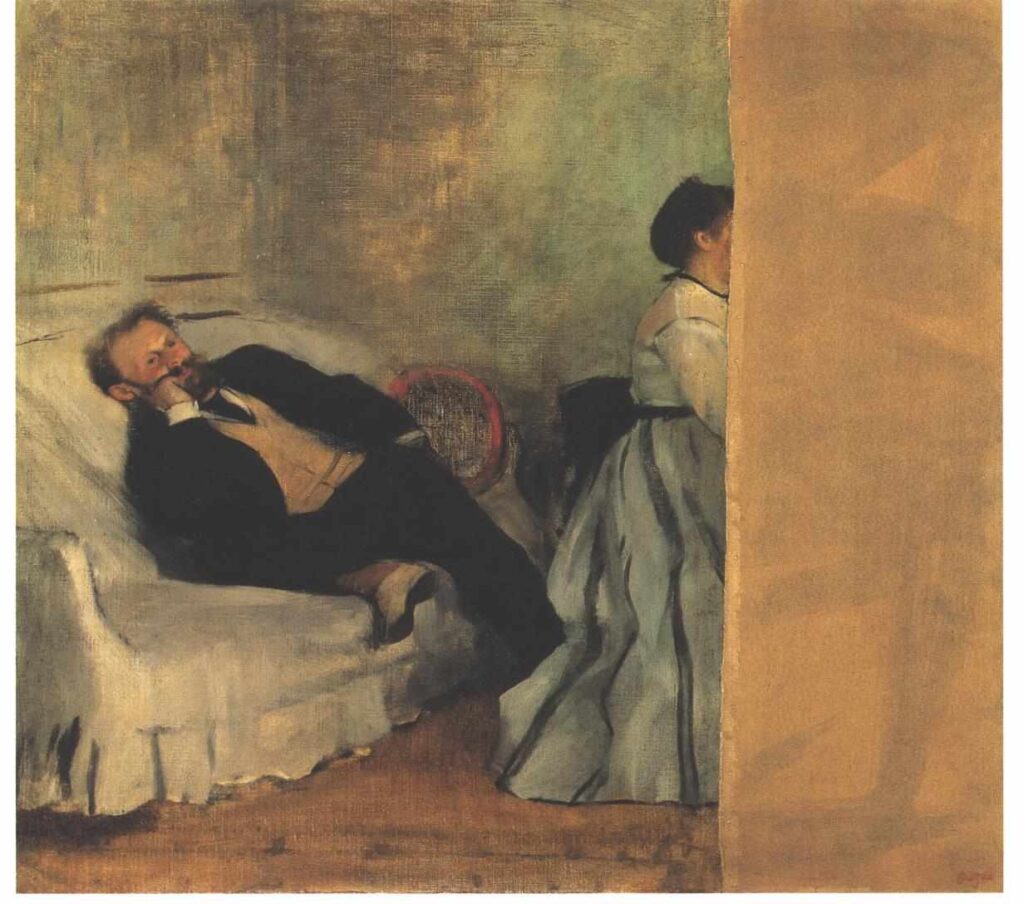
Edgar Degas painted Édouard Manet and his wife Suzanne at home. Manet apparently disliked the way Degas portrayed Suzanne so much that he cut away part of the canvas containing her figure.
Degas was furious. According to the traditional account, he took the damaged painting back and returned a still life Manet had previously given him. The two eventually reconciled, but the mutilated portrait survives as physical evidence of their disagreement.
Imagine criticizing someone’s portrait by cutting the painting.
When giving feedback on another person’s work, describe the problem before trying to fix it yourself; changing someone else’s work without permission turns criticism into control.
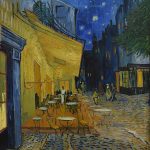
6. Van Gogh and Gauguin — The Dream Studio Lasted Nine Weeks
Vincent van Gogh dreamed of creating a community of artists in Arles. Paul Gauguin eventually joined him in the Yellow House in October 1888.
It went badly.
The two artists painted together and exchanged ideas, but their working philosophies were very different. Van Gogh relied heavily on direct observation; Gauguin increasingly emphasized imagination, memory, and simplification. Their arguments intensified until the famous crisis in December when Van Gogh mutilated his ear after a confrontation surrounding Gauguin’s departure.
Their collaboration was artistically stimulating and personally disastrous.
Before sharing a studio or starting a creative partnership, talk explicitly about working habits, criticism, money, privacy, schedules, and expectations rather than assuming artistic enthusiasm will solve practical incompatibility.
7. Picasso and Matisse — Rivalry Doesn’t Require Hatred
Pablo Picasso and Henri Matisse complicate this list because their relationship wasn’t simply one of mutual dislike.
They were rivals, competitors, occasional antagonists, and eventually deeply attentive admirers of each other’s work. Each understood that the other represented a major alternative direction for modern painting. Picasso watched Matisse. Matisse watched Picasso.
That kind of rivalry can be creatively productive because the opponent becomes a measuring device. Instead of merely asking, “Is this good?” you start asking, “What is my solution that theirs cannot provide?”
Choose one artist whose work challenges your instincts and periodically solve the same visual problem they solve, but deliberately use a method they would probably reject.
8. Bacon and Freud — Friendship Can Become Competition
Francis Bacon and Lucian Freud were once extraordinarily close. They saw each other constantly, painted each other, drank together, gambled, argued about art, and belonged to overlapping circles in postwar London.
Eventually the friendship fractured. Accounts differ about exactly why, suggesting a mixture of personality, rivalry, criticism, and accumulated resentment rather than one clean dramatic event. They spent years largely estranged.
Their artistic relationship remains fascinating because their paintings went in such different directions. Bacon distorted bodies through movement and psychological violence; Freud increasingly built flesh through prolonged, concentrated observation.
When a creative friendship becomes competitive, make sure you can still distinguish useful criticism from the desire to win the relationship.
9. Pollock and de Kooning — Sometimes the Rival Is Mostly in Your Head
Jackson Pollock and Willem de Kooning were leading figures in Abstract Expressionism, and inevitably they were treated as competitors.
Their rivalry was complicated rather than straightforward hatred. Both belonged to the same New York art world, and each recognized the other’s importance. But careers, critics, reputations, and romantic relationships created plenty of tension around them; after Pollock separated from Lee Krasner, his lover Ruth Kligman later became involved with de Kooning.
The larger lesson is that the art world itself manufactures rivalries. Critics want movements to have winners. Markets want rankings. Audiences enjoy battles between personalities.
Artists can waste enormous energy accepting those comparisons.
When someone declares another artist your rival, ask whether you actually want the same things before allowing somebody else’s comparison to determine what success means for you.
Great artists don’t automatically make great colleagues. Sometimes two powerful creative personalities sharpen each other; sometimes they simply make each other miserable.
The useful part of rivalry isn’t the hostility. It’s the information hidden inside it. The artist who irritates you may be revealing the technique you haven’t mastered, the assumption you disagree with, or the direction you most need to define for yourself.