Some love stories survive in letters. Others remain visible in paint. The relationship between Ford Madox Brown and Emma Hill Brown belongs to the second kind. Emma appears throughout Brown’s artistic life as model, wife, mother, and familiar face. Their relationship lasted through financial strain, artistic ambition, children, friendship with leading Victorian artists, illness, and painful family losses. Brown was never officially a member of the Pre-Raphaelite Brotherhood, but he moved closely within its circle and became one of the most distinctive painters associated with it. Emma stood beside him through much of that journey.
Brown was born at Calais on 16 April 1821 and trained as an artist in Bruges, Ghent, Antwerp, and Paris. He married his first cousin Elisabeth Bromley in 1841, and their daughter Lucy was born in Paris in 1843. Elisabeth died in Paris on 5 June 1846, leaving Brown a widower in his mid-twenties with a young child. Not long afterward, Emma Hill entered his life. She came from a very different social and educational background and first knew Brown as a model. By the late 1840s, however, the relationship had become personal.
Brown’s diary provides an unusually intimate glimpse of those early years. In February 1849, while he was working on a composition connected with Shakespeare’s King Lear, he recorded the arrival of a young woman who loved him. Scholars identify her as Emma. Their daughter Catherine Emily, usually called Cathy, was born in 1850. Brown and Emma married on 5 April 1853 at St Dunstan-in-the-West in Fleet Street, London. By then they had already shared several years together, and Emma had become deeply connected with both Brown’s family and his working life.
How Ford Madox Brown Met Emma Hill
From Studio Model to Life Partner
Emma entered Brown’s orbit around 1848, at a time when his career and artistic friendships were beginning to take important new directions. That same year, Dante Gabriel Rossetti approached Brown for instruction. Brown was older than the young founders of the Pre-Raphaelite Brotherhood and had received extensive Continental training, but he became a close friend and artistic ally of Rossetti. Emma therefore arrived just as Brown was becoming tied to the circle that would later define much of Victorian avant-garde painting.
Their early relationship did not follow the tidy conventions of a formal Victorian courtship. Emma first modeled for Brown, and the two became lovers before they married. Cathy’s birth in 1850 confirms that they were already building a family more than two years before their wedding. Brown also had Lucy from his first marriage, so Emma entered a household that was already complex.
The difference in background between Brown and Emma was substantial. Brown had studied across Europe and moved in highly educated artistic circles. Emma did not begin with those advantages. Yet she gradually became part of a household filled with painters, writers, designers, models, and students. Brown helped educate her, while Emma learned to move within a demanding artistic environment in which unfinished paintings, visiting artists, financial worries, and intense creative work were part of daily life.
Their relationship developed quickly. Around 1848, Emma became Brown’s model. By February 1849, Brown’s diary records evidence of her love for him. Cathy followed in 1850. On 5 April 1853, Ford and Emma married. Within roughly five years, Emma had moved from the artist’s studio into the center of his family life.
A Bride Recorded in Chalk
Brown marked his wedding day in the most characteristic way possible: he drew Emma. The Artist’s Wife Emma, on her Wedding Day, dated 5 April 1853, was executed in colored chalks on blue paper and measures 38.1 by 31.8 centimeters. The work is especially moving because it belongs to a precise day in their shared history.
Emma was about twenty-three when she married Brown, who was thirty-one. Their marriage did not begin their relationship; it formalized one that had already produced a child. Emma also became stepmother to Lucy, then approaching ten years old. The wedding-day portrait therefore records more than bridal beauty. It captures the moment when a long-developing domestic arrangement became a legal marriage.
Brown would continue to use Emma as a model after the wedding. The combination of wife and sitter became central to his visual world. He did not merely preserve her face in one private portrait. He repeatedly transformed her appearance to suit different subjects, from domestic scenes to large modern-life compositions.
Marriage, Family, and Life Behind the Paintings
Children, Work, and a Creative Household
Ford and Emma’s family grew after marriage. Their son Oliver Madox Brown was born in 1855, and another son, Arthur, followed in September 1856. For a short period, the household included Ford, Emma, Lucy, Cathy, Oliver, and baby Arthur. Brown’s children frequently entered his artistic life because he relied heavily on relatives and friends as models.
Arthur’s life was tragically brief. He died from tubercular meningitis on 21 July 1857, before his first birthday. Brown’s diary records that he had been using the child as a model. The connection between family and art became painfully direct. A domestic subject Brown had been developing, Take Your Son, Sir!, was altered after Arthur’s birth to include a mother and baby. Brown never completed the work.
Oliver survived childhood and showed striking promise as both a painter and writer. He died on 5 November 1874, aged only eighteen. His death devastated the family and affected their artistic circle. Dante Gabriel Rossetti wrote to Brown during the mourning period and responded to Oliver’s death in verse.
The daughters followed a different path. Lucy became an artist and married William Michael Rossetti, Dante Gabriel Rossetti’s brother, in 1874. Cathy also received artistic training from her father. In 1865, Brown taught Cathy and Lucy alongside Marie Spartali, later Marie Spartali Stillman, who became a respected painter associated with the wider Pre-Raphaelite circle.
Emma therefore lived at the center of a remarkably creative household. She was not simply the silent wife of a painter. She helped sustain a family in which painting, writing, criticism, and design overlapped. Her daughter Cathy later married music critic Francis Hueffer. Their son became the novelist Ford Madox Ford, extending the family’s cultural influence into another generation.
Emma as Model and Mother
Brown repeatedly used Emma and the children in his paintings. One charming example is Pretty Baa-Lambs, worked on between 1851 and 1859. The Birmingham version is oil on panel, measuring 60.9 by 76.2 centimeters, and belongs to Birmingham Museums Trust. Emma and Cathy modeled as mother and child.
Brown wanted the brilliant effect of real sunlight, so he worked directly from nature. He even hired sheep from a local farmer. The result appears relaxed and pastoral, but its making was anything but casual. Emma had to pose outdoors while Brown pursued exact lighting effects.
The picture shows how thoroughly Brown’s domestic and artistic worlds overlapped. Wife, child, animals, costume, and natural light all became materials for a carefully constructed composition. Emma was not merely an inspiration in the vague sense often attached to artists’ wives. She did the practical work of a model.
How Emma Hill Became Part of Brown’s Art
Emma in Work
Brown began Work in 1852 and completed the principal Manchester version in 1865. The painting is oil on canvas, measures 137 by 197.3 centimeters, and is held by Manchester Art Gallery. It is one of Brown’s great modern-life compositions.
The scene grew from roadworks Brown had observed in Hampstead. Laborers dominate the center, but the painting expands into a dense social panorama filled with children, wealthy passersby, unemployed men, animals, and intellectual figures. Thomas Carlyle and F. D. Maurice appear among the so-called “brain workers.”
Emma modeled for one of the fashionable women in the painting. This is important because it shows the difference between a model and the fictional character represented. Brown could borrow Emma’s appearance without turning the image into a literal portrait of his wife.
The same woman who appears as a mother in Pretty Baa-Lambs could therefore be transformed into a fashionable passerby in Work. Brown’s close familiarity with Emma gave him a face he knew from countless angles and moods.
The Last of England: Husband and Wife Together
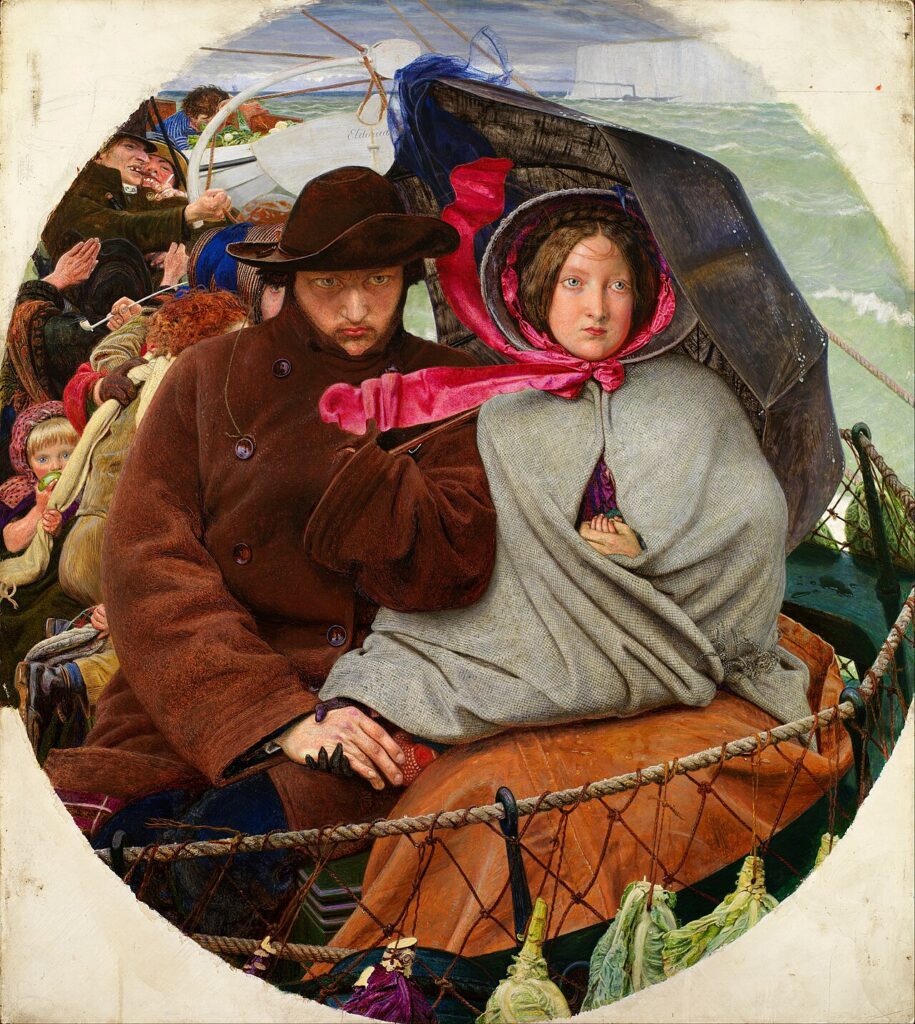
No painting connects Ford and Emma more powerfully than The Last of England. The Birmingham version, completed in 1855, is oil on panel, measuring 82.5 by 75 centimeters, and is held by Birmingham Museums Trust. Brown and Emma modeled for the central married couple.
The picture was inspired by the great wave of emigration during the 1850s. Brown’s friend, the sculptor Thomas Woolner, sailed for Australia in 1852. Brown himself also considered emigrating during periods of financial difficulty. He understood the mixture of hope, fear, and desperation surrounding departure.
The central couple sit pressed together on a crowded vessel as the English coast disappears behind them. Their faces are Ford’s and Emma’s. Their children also entered the composition. Cathy appears among the passengers, while the tiny hand of baby Oliver can be seen beneath Emma’s cloak.
The scene is fictional. Ford and Emma did not leave Britain as emigrants. Yet Brown deliberately used his own family to embody the uncertainty of a husband and wife facing an unknown future. That decision gives the painting its unusual emotional force.
Their hands are especially important. The couple do not indulge in theatrical gestures. They sit close together and clasp hands. Emma’s painted figure shelters the baby beneath her cloak. The husband faces forward with grim determination.
Brown was not secretly documenting his marriage, and the painting should not be treated as a literal confession. Still, the model choice matters. When Brown wanted to portray a married couple facing uncertainty together, he chose himself and Emma.
Emma in Later Life
Brown continued to portray Emma long after the early years of their marriage. In 1872, he created The Convalescent (A Portrait of the Artist’s Wife). The pastel measures 46.7 by 44.1 centimeters and is now in the Metropolitan Museum of Art in New York.
The title shows that Emma was recovering from illness. By then, Brown and Emma had been married for nineteen years. Arthur had been dead for fifteen years, while Oliver was approaching adulthood. The young studio model of the late 1840s had become a middle-aged wife carrying the history of a long marriage.
Seen beside the wedding-day drawing of 1853, The Convalescent creates an extraordinary visual span. Brown recorded Emma first as a bride, then again nearly two decades later as a mature woman recovering from poor health.
The continuity is striking. Brown kept looking at Emma. Even after years of major commissions, friendships, family changes, and hardship, she remained part of his artistic attention.
Love, Hardship, and the Browns’ Final Years
A Long Marriage Tested by Loss
Ford and Emma’s marriage was not a sentimental fairy tale. Brown’s diary and later scholarship show periods of tension, money worries, and domestic difficulty. Emma also struggled at times with alcohol. Those facts belong to the story, but they do not erase the durability of the relationship.
Brown himself could be demanding, stubborn, and intensely perfectionistic. His major paintings often consumed years. Financial uncertainty remained a recurring problem. Emma shared a household shaped by artistic ambition that could be exhilarating one day and exhausting the next.
Their family losses were severe. Arthur died in 1857. Oliver died in 1874. Both sons were gone before Ford and Emma reached old age. The death of Oliver was especially bitter because he had already shown serious artistic and literary promise.
Brown’s later years were dominated by his major Manchester Town Hall commission. Beginning in 1878, he worked on a cycle of twelve murals illustrating episodes from Manchester’s history. By then, Emma had been part of his life for about thirty years.
Emma’s Death and Brown’s Final Years
Emma died on 11 October 1890, aged sixty-one. She and Ford had been married for more than thirty-seven years and had known one another for roughly four decades.
Brown survived her by almost three years. He died on 6 October 1893, aged seventy-two. By then, the artistic movement once considered radical had become part of British cultural history.
Emma’s importance lies partly in the unusual visual record she left behind. She appears as bride, mother, model, fashionable figure, emigrant wife, and convalescent. Few artists’ marriages can be traced through such a varied sequence of images.
Her story is also inseparable from Brown’s mature career. She knew him before many of his famous works were completed. She lived through his friendships with Rossetti, Morris, and Burne-Jones, the rise of the Pre-Raphaelite circle, the deaths of their sons, and the demanding years of his later commissions.
A Love Story Preserved in Paint
The most powerful image of Ford and Emma remains The Last of England. The fictional voyage was not theirs, but the faces were. Brown turned his own family into a picture of courage, uncertainty, and endurance.
That choice is revealing without needing romantic invention. The couple’s real life contained enough hardship. Their relationship began unconventionally. Money was often uncertain. Brown’s career demanded patience. They lost two sons. Emma suffered periods of illness and personal difficulty. Yet they remained married until her death in 1890.
The wedding-day drawing and The Convalescent tell the quieter side of the story. In 1853, Brown drew Emma as his bride. In 1872, he portrayed her again as a middle-aged wife recovering from illness. Between those images lie almost twenty years of shared life.
Brown and Emma’s story is compelling because it is not perfect. It is durable. The paintings preserve a woman who was not merely a footnote in an artist’s biography but a recurring presence in his family, studio, and imagination.
Nearly two centuries later, Ford and Emma still sit together in The Last of England, their hands joined as an uncertain future opens before them.
Key Takeaways
- Ford Madox Brown met Emma Hill around 1848, after the death of his first wife, Elisabeth Bromley, in 1846.
- Their daughter Cathy was born in 1850, and Ford and Emma married on 5 April 1853 at St Dunstan-in-the-West in London.
- Emma became an important recurring model in Brown’s art, including Pretty Baa-Lambs, Work, and The Last of England.
- Brown and Emma modeled together for the central couple in The Last of England of 1855, with their children also incorporated into the painting.
- Their marriage lasted until Emma’s death on 11 October 1890; Brown died on 6 October 1893.
Frequently Asked Questions
- Who was Emma Hill Brown? Emma Matilda Hill was Ford Madox Brown’s second wife and one of his recurring models.
- When did Ford Madox Brown marry Emma Hill? They married on 5 April 1853 at St Dunstan-in-the-West in Fleet Street, London.
- Did Emma appear in Brown’s paintings? Yes. She modeled for several works, including Pretty Baa-Lambs, Work, and The Last of England.
- Are Ford and Emma the couple in The Last of England? They were the models for the central couple, although the painted characters are fictional emigrants.
- How long were Ford and Emma married? More than thirty-seven years, from 5 April 1853 until Emma’s death on 11 October 1890.