When English settlers established the first permanent colony at Jamestown in 1607, they brought with them more than ambition and survival skills—they carried inherited ideas of structure, order, and artistry shaped by generations of European craft traditions. But in the early decades of the Virginia colony, art was not ornamental. It was embedded in survival. The line between aesthetic object and functional necessity was not yet drawn, and the materials of art were the same as those of daily life: wood, earth, iron, and lime.
Domestic Space as the First Gallery
In the absence of formal galleries or commissions, early Virginian art lived inside homes, churches, and public buildings. Domestic interiors were the earliest stages on which artistic sensibilities played out—through joinery, paneling, cabinetry, and metalwork. The art of this period, if one must call it that, often bore the quiet anonymity of the workshop rather than the individual signature of the artist. It was practical, local, and deeply skilled.
The cabinetmakers of Williamsburg, for example, produced objects that remain among the finest American furniture from the 18th century. The corner cupboard attributed to Peter Scott, built between 1745 and 1755, displays a sophisticated understanding of both proportion and material. Scott, like many artisans in Virginia, trained in a tradition imported from Britain but adapted it to local tastes and resources. The choice of walnut and yellow pine, both abundant and workable woods, reflects regional adaptation without sacrificing refinement. This was not rustic improvisation—it was informed design.
Woodwork as Language and Labor
Beyond domestic furniture, wood was the primary material of civic expression. The Governor’s Palace in Williamsburg, completed in 1722, incorporated ornate paneling, carved bannisters, and interior embellishments crafted by hands whose names are largely lost to history. Yet their labor survives as testimony to a form of artistry that merged power with decoration. These artisans were part of a long tradition that saw carpentry not as a low trade, but as a discipline of proportion, surface, and form.
The Bruton Parish Church, built between 1711 and 1715, offers another preserved example. Its box pews, chancel rails, and pulpit are not only ecclesiastical furnishings—they are works of religious visual language, rendered in timber and joinery. Though restrained, they are not austere. Their balance of line and plane reflects Anglican sensibilities transplanted to the colonial world. Ornament was never absent; it was simply tempered by the theology and resources of the place.
Silver, Status, and the Skilled Hand
If wood dominated the built environment, silver signaled social position. Among the wealthier residents of Williamsburg and surrounding towns, silver goods served as visible affirmations of status. The silver tankard by Anthony Hay, circa 1750, combines utility with performance. It was likely displayed as much as used, engraved with fine detail and worked to a high polish. Hay’s ability to move between trades—cabinetry and silversmithing—underscores the porous boundaries among the crafts in this period. These artisans did not work in isolation; they moved in circuits of exchange and apprenticeship, passing down knowledge by demonstration, not theory.
A modest item—like a silver spoon or a worked hinge—could travel far, both physically and symbolically. Tools, too, were often hand-crafted, becoming extensions of the maker’s intention and touch. The artistic culture of colonial Virginia was tactile, patient, and largely male in its transmission. But it was not crude or naïve. These were professionals, working in a disciplined economy of time, skill, and reputation.
Microcosms of Order
The significance of these early works lies not only in their survival, but in what they reveal about colonial values. A mahogany armchair attributed to William Kennedy’s workshop, dating from the 1730s or 1740s, illustrates the early Virginia elite’s investment in classical forms. With cabriole legs and shaped crest rail, it is stylistically aligned with English Queen Anne furniture. Yet the materials—likely sourced from Caribbean trade routes—hint at a complex web of transatlantic commerce that underwrote such artistry. Virginia’s artistic language was never isolated; it was regional in execution but international in aspiration.
Such pieces were not created for export, nor were they made for public admiration in salons or academies. They were absorbed into domestic life, often only recognized as art centuries later. The homes of Tidewater planters functioned as microcosms of taste, and their furnishings reflected the ordering of hierarchy, civility, and decorum. Chairs, cupboards, and tankards may not seem like a starting point for art history, but in Virginia, they are the roots of it.
Tools and Techniques, Not Styles and Movements
Unlike the northeastern colonies, which would later develop distinct painting schools and formal academies, colonial Virginia remained largely artisanal well into the 18th century. There was no singular “Virginia style” in painting or sculpture—there were, instead, patterns of repetition, tools passed down, finishes carefully burnished, and techniques honed through apprenticeship. The artisan’s shop, not the artist’s studio, was the center of gravity.
But that distinction is often misleading. The idea that art must be self-expressive, or that its maker must be a visionary, belongs to later centuries. In the colonial period, beauty was found in craft, and skill was more admired than originality. That ethos is embedded in the surviving works. It explains their restraint, their geometry, their attention to material integrity. These were not theoretical objects—they were things meant to last.
A Strong Foundation in Modest Materials
The art history of Virginia begins not with paintings or sculptures but with the smell of planed wood, the gleam of shaped silver, the cool interior of a handmade brick church. These were objects and environments shaped by necessity, yes—but also by pride, training, and a commitment to craft that is no less artistic for being practical. To understand Virginia’s later artistic flowering, one must begin here: among the cabinetmakers, silversmiths, and builders who carved a legacy into wood and earth.
Theirs was a world without manifestos or manifest fame. But their work remains—quiet, usable, and still unmistakably made by hands that cared how things looked, how they lasted, and how they fit into a life well-ordered.
Chapter 2: Portraits and Patrons – Art in the Planter Aristocracy
Imported Eyes and Domestic Power
In the parlor rooms of Tidewater mansions, amid carved wood and imported china, portraiture became the silent witness of a rising elite. These canvases—often stiff in composition but rich in significance—did not exist for public acclaim. They hung in private homes, watching generations pass. In colonial Virginia, portrait painting was less an art form in the romantic sense and more a contractual expression of lineage, wealth, and refinement. Yet in these careful likenesses, painted largely by foreign-born hands, the seeds of a regional artistic identity began to take shape.
The Arrival of the Itinerant Painter
Few painters were born in Virginia in the 18th century. Nearly all were imported. John Wollaston, an English portraitist trained in the London tradition, arrived in the colonies around 1749 and soon found eager patrons among the planter class. His portraits of Virginia aristocracy—such as his 1753 likeness of Mrs. Thomas Fielder Ludwell Lee, now in the Colonial Williamsburg collection—offered not only a visual record but a declaration of cultivated taste. In Wollaston’s work, figures float slightly away from realism, with elongated eyes and a certain theatrical grace. The effect was flattering, distant, and unmistakably fashionable.
Wollaston was not alone. Robert Feke, another early colonial portraitist, and later John Hesselius, who painted extensively throughout Virginia and Maryland in the 1750s and 1760s, filled similar roles. Their patrons did not seek innovation; they wanted permanence. The planter elite, conscious of their social position but geographically distant from Europe, used portraiture to solidify claims to gentility, continuity, and civility.
The Planter’s Gaze
In these portraits, setting matters as much as face. Sitters are often depicted against curtained backdrops, with glimpses of columns, drapery, or vaguely classical landscapes. Costumes are opulent but not always contemporary—many wear anachronistic robes of state or imagined attire. These visual codes mattered. They gestured toward lineage, education, and stability in a colony still shaped by volatility and labor. For many patrons, the portrait was an argument: I belong. I endure.
It’s easy to forget that many of these paintings were created not for future museum walls, but for the daily gaze of family members and visitors. The image of a matriarch or patriarch in a drawing room was not passive. It was a claim. A presence. The portraits did not merely reflect power—they reinforced it.
The Commission as Ritual
Commissioning a portrait in 18th-century Virginia was a formal event. The painter would often reside at the plantation for several days, studying the sitter, preparing sketches, and selecting poses. Paints were costly, canvases were imported, and the process itself often required multiple sessions. Children, too, were painted, especially heirs. The family group portrait emerged as a form by the later 1700s, bringing an almost liturgical quality to the household’s self-image.
In urban centers like Williamsburg and later Richmond, this culture of patronage was less tied to land and more to office. Lawyers, judges, and merchants began to appear on canvas with the same solemnity formerly reserved for large estate holders. By the 1770s and 1780s, the Virginian portrait had begun to evolve—not stylistically, but socially. The visual language remained consistent, but the pool of patrons expanded.
Faces of the Republic
One figure looms largest over this period, of course: George Washington. His likeness, painted many times and by many hands, began its visual life long before it was mythologized in federal imagery. Early portraits, such as those attributed to Robert Feke or later to Charles Willson Peale, depicted Washington in military uniform or plain dress, reflecting republican ideals even before independence was declared. These images were copied, adapted, and distributed—not by Virginia planters but by Philadelphia publishers and nationalists after 1776. Still, the Virginian origins of Washington’s image played a central role in shaping how Americans saw leadership: patrician, calm, reserved, and deeply tied to land.
In this way, portraiture in Virginia helped birth a broader visual politics. The face of the planter became the face of the Republic. But this was not a revolution in artistic terms. Rather, it was a continuation of the planter class’s desire to preserve and project power—now in service of a different political structure.
Stylistic Restraint, Social Flourish
Unlike the baroque exuberance seen in European portraiture of the same period, Virginian portraits remain stylistically reserved. There is little allegory, little mythic allusion. The painter’s hand often remains visible: a slightly clumsy fold in fabric, a too-flat rendering of hair, a background more schematic than spatial. Yet none of this diminished their power. On the contrary, the very stiffness of these images added to their authority. They resisted sentimentality. They presented their subjects not as expressive individuals but as roles—father, widow, colonel, heir.
This restraint suited the values of the class commissioning them. In a region shaped by Anglican hierarchy, classical education, and agricultural rhythms, art was meant to affirm existing order, not challenge it. These were not modernist experiments in subjectivity. They were mirrors—smoothed and slightly elevated—held up to a world of tradition, landholding, and succession.
The Legacy on the Wall
By the close of the 18th century, portraiture had become a naturalized element of Virginia’s cultural architecture. It adorned courthouse walls, university halls, and plantation libraries. Even as painters improved in technique and new names emerged, the visual conventions remained largely intact. Sitters faced forward. Hands were often posed delicately on a book or table. Drapery fell in practiced folds.
What began as imported labor by itinerant Europeans had, by century’s end, become a distinctly Virginian mode of self-representation. The artists may have changed, but the intention did not: to record, to honor, to stabilize. These portraits were not acts of self-expression. They were acts of continuity—brushstrokes of permanence in a landscape that was, even then, shifting beneath their feet.
Chapter 3: The Architecture of Authority – Classical Ideals in a New Republic
Stone, Law, and the Language of Antiquity
When Virginia emerged from the Revolution no longer a colony but a cornerstone of a new republic, its leaders looked backward to move forward. The chaos of war had torn at legal and political structures, but in its aftermath came a drive to rebuild—not just governments, but the visual symbols that housed them. Architecture, in this transitional period, became more than shelter or spectacle. It was political language. In the hands of Virginia’s most learned minds, it took the shape of Rome.
Monticello: A Mind Made Visible
Thomas Jefferson called architecture his “delight,” and Monticello was its physical proof—a living experiment in classical form and American circumstance. The first phase of construction began in 1769, but Jefferson reworked and expanded the house continually until around 1809. Unlike Georgian houses of the planter class, which borrowed English proportion and brick symmetry, Monticello drew on Palladio’s Four Books of Architecture and Jefferson’s intense admiration for ancient Roman design.
The resulting structure—dominated by a central dome, columned porticoes, and an elongated facade—is not simply a home, but a thesis. The house expresses republican ideals not through ornament but through order: axial balance, harmony of parts, restraint in surface. Jefferson used classical form not as revivalism but as an assertion. Where European aristocrats used Gothic or Baroque styles to signify grandeur or piety, Jefferson sought in the Roman tradition a model of civic virtue. Monticello is not theatrical. It is reason rendered in brick.
Yet it is also deeply personal. The dome, for instance—an architectural rarity in American homes—was inspired by the Roman Pantheon but scaled to domestic use. The materials, while modeled on European precedent, are local: Virginia clay bricks, timber from nearby forests, and design adapted to climate and light. Classical ideals, in Jefferson’s hands, were not foreign imports but tools of reinvention. The architecture was aspirational, but it was also local.
The Capitol as Civic Template
If Monticello was Jefferson’s private republic, the Virginia State Capitol in Richmond was his public declaration. Designed with the assistance of French architect Charles-Louis Clérisseau, its core inspiration was the Maison Carrée, a Roman temple in Nîmes. Jefferson encountered it during his time as minister to France and believed it ideal for representing republican government in the New World. Construction began in 1785, and by 1792, the building housed the state legislature.
The decision to model a state capitol after a Roman temple was no aesthetic whim. It was calculated. The ancient temple connoted law, order, permanence—qualities urgently needed in the fledgling United States. At a time when few American cities possessed monumental buildings, the Capitol in Richmond stood apart: not massive, but authoritative. Ionic columns fronted a raised platform. The facade was white and symmetrical. There were no medieval towers, no Gothic flourishes—only the clarity of antiquity.
Here, too, Jefferson adapted ideals to local needs. The Capitol lacked the fine stone and artisans of Europe, so stuccoed brick stood in for marble. Yet this did not diminish its impact. On the contrary, its restrained grandeur became a prototype. Other states copied it. So did Washington, D.C. Jefferson’s design helped establish the classical mode as the visual language of American government. In this way, Virginia’s architecture set the precedent for a nation.
A Campus of Order: The University of Virginia
By the 1810s, Jefferson’s architectural ambitions turned to education. The University of Virginia, authorized in 1819, was built according to a plan as radical as it was rational: the Academical Village, an interlinked series of pavilions, dormitories, and a central Rotunda, all arranged around a long lawn. Jefferson designed each element with explicit reference to classical precedent. The Rotunda, modeled after the Roman Pantheon, anchored the scheme not just physically but symbolically—as the temple of knowledge.
Each pavilion housed professors, and each was designed with different classical orders—Doric, Ionic, Corinthian—creating a kind of open-air textbook in built form. Students would learn not only from books but from buildings. Jefferson called architecture a “public art,” and the University was its most didactic expression.
The project, completed just before Jefferson’s death in 1826, offered more than neoclassical aesthetics. It was a philosophical statement: education as civic formation, knowledge as a foundation of self-governance. The very layout reinforced hierarchy, harmony, and reason—virtues Jefferson associated with republicanism itself.
A Republican Aesthetic
What united these buildings—Monticello, the Capitol, and the University—was not simply their classical style but the message it carried. These were not nostalgic recreations of Europe’s past. They were strategic adoptions. In the young United States, especially in Virginia, classical architecture became a form of political expression. It emphasized the rule of law over the rule of men, the dignity of institutions over the chaos of personality.
Three principles defined this architectural approach:
- Proportion over ornament: Decoration was secondary to symmetry and structural logic.
- Elevation of the civic over the private: Even private buildings, like Monticello, were shaped by public ideals.
- Regional adaptation: While forms came from Rome or Palladio, execution depended on Virginian materials and builders.
The result was an architectural language that shaped not just landscapes but minds. Classical buildings taught citizens how to see power: balanced, measured, restrained. In a region where tobacco had once dominated every decision, these buildings introduced new values—education, law, deliberation.
Legacy in Brick and Stone
By the 1830s, the classical mode had become so widespread that its political origins began to fade. Greek Revival houses appeared across Virginia’s countryside. Courthouses and churches mimicked Jeffersonian models. The use of columns became so common it lost, in some cases, its ideological charge. Yet the original buildings endured—not as nostalgic artifacts, but as foundational works of American civic imagination.
Monticello, the Capitol, and the University of Virginia still stand—not merely as tourist sites, but as documents. They record a moment when Virginia, once a colonial frontier, recast itself as a cultural leader. Through architecture, it laid claim to something older than monarchy, deeper than commerce. It aligned itself with antiquity—not to imitate the past, but to shape the future.
Chapter 4: Wilderness, Battlefields, and Landscapes – 19th Century Paintings of Place
The Land Before the Lens
Before the camera claimed the American landscape, painters gave it meaning. In 19th-century Virginia, that meaning was shaped by tension—between wildness and settlement, grandeur and ruin, memory and motion. Landscape painting during this period became a way of seeing the state itself: as site, as story, and as stage for a growing national identity. From the Blue Ridge to the James River, Virginia’s terrain was no longer just background. It became subject.
Romantic Territory
By the 1830s, the romantic sensibilities that had animated European landscape art began filtering into American studios. Painters no longer depicted land purely for its practical features—topography, farmland, rivers—but for mood, atmosphere, and moral meaning. Virginia, with its dramatic valleys and storied past, became a ready canvas for this vision.
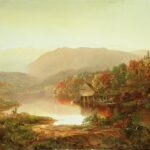
One of the earliest and most influential visual records of the state’s landscape was Joshua H. Shaw’s “Virginia Landscape” (c. 1835). Though less known than Hudson River School works, Shaw’s painting draws on similar principles: a sweeping horizon, soft light, and the suggestion of harmonious relationship between man and nature. It does not dramatize. It meditates. Trees bend gently toward a quiet stream, and distant hills suggest depth without threat. In such works, the land is not exotic—it is ideal.
This quiet idealism, however, was soon overshadowed by more assertive visions. By the 1850s, Virginia’s scenery began to appear in more theatrical renderings, reflecting a growing appetite for sublime and picturesque imagery.
The Sublime Made Local: Frederic Edwin Church and Natural Bridge
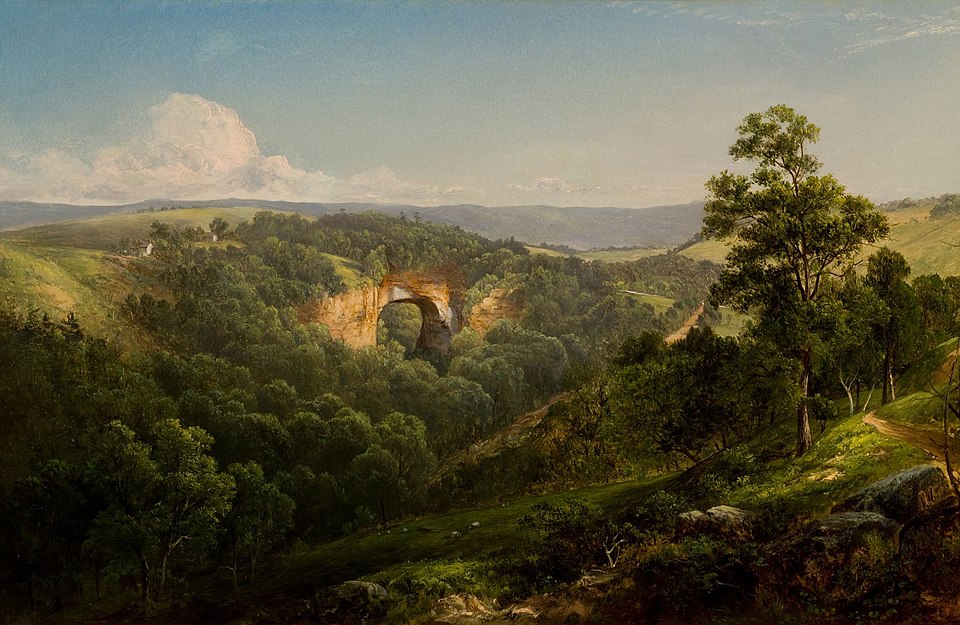
No figure better exemplifies this shift than Frederic Edwin Church, whose 1852 painting “The Natural Bridge, Virginia” reimagines the iconic limestone arch not just as a geological marvel but as a cathedral of stone. In Church’s hands, the bridge soars above shadowed woods, rendered with luminous detail. Light streams down in near-divine shafts. The scene feels sacred, not because it is untouched, but because it has been revealed.
Natural Bridge had long fascinated visitors—George Washington surveyed it, Thomas Jefferson owned the land around it—but Church transformed it into a national emblem. By framing the bridge as a place of awe, he reinforced the romantic notion that America’s natural features held not only beauty but moral resonance.
His composition echoes the ideals of the sublime: vast scale, dramatic contrast, and a certain metaphysical charge. The landscape is no longer a mere view. It is a revelation. And in choosing a Virginian site, Church helped position the state—typically seen as agrarian and settled—as a terrain of spiritual and visual significance.
A Traveler’s Portfolio: Edward Beyer’s “Album of Virginia”
Not every painter could rival Church’s grandeur, but others made Virginia central to their work through volume and intimacy. Edward Beyer, a German-born artist who spent several years in Virginia during the 1850s, compiled a sweeping series of views in his “Album of Virginia” (1857–58). This ambitious portfolio included more than 40 hand-colored lithographs based on his sketches from travels across the state—from the Alleghenies to the Potomac.
Unlike Church’s elevated symbolism, Beyer’s work is observational. His images document towns, mills, mineral springs, and railroad bridges, often from panoramic viewpoints. In one scene, a locomotive curls across a valley; in another, bathers gather at White Sulphur Springs. These are landscapes of transition—where wilderness meets industry, and where the picturesque begins to accommodate the practical.
What makes Beyer’s album remarkable is its balance. He does not mythologize the land, but neither does he strip it of beauty. He records Virginia in flux: a place where the agrarian economy still dominates, but signs of modernity—steam, iron, and enterprise—creep into the horizon.
The Landscape as Theatre of War
As the century progressed, Virginia’s terrain acquired a new kind of visibility—not for its natural beauty, but for its tactical relevance. Between 1861 and 1865, the Civil War transformed fields and forests into battlegrounds. Painters and illustrators responded, not only with battlefield scenes but with landscape studies that bore the weight of memory.
Some postwar artists returned to sites of conflict with a quiet reverence. The fields of Manassas or Cold Harbor were rendered with less blood than stillness. Others focused on ruins—burned bridges, crumbling homesteads—as silent emblems of loss. While not strictly landscape painting, these images used the land to suggest psychological aftermath. Trees became witnesses. Roads led not to prosperity but to reflection.
Though few major works from this period reached the prestige of earlier romantic landscapes, the Civil War redefined how Virginia was seen—by its own residents and by the country at large. Land once framed as eternal became transient, vulnerable, and marked by history.
Light, Space, and the Changing View
By the late 19th century, Virginia’s landscape painters had begun to absorb new influences—Barbizon softness, tonalism, and, in rare cases, early impressionist color. The Blue Ridge remained a favored subject, as did pastoral scenes in the Piedmont. Yet the tone had shifted.
Where mid-century painters like Church sought awe and Beyer sought documentation, later artists sought mood. Light became less symbolic and more sensory. Trees blurred into mist. Sky overtook structure. The land had ceased to be a metaphor for national virtue. It had become something quieter: a place to observe.
This evolution mirrored broader changes in American painting, but in Virginia it retained a distinctive local gravity. Artists here still saw the land as meaningful, but the terms had changed. The monumental had given way to the personal. The land endured, but it no longer explained everything.
Chapter 5: Lost Cause Monuments and Memorial Sculpture
Stone in the Shape of Memory
Between the 1890s and the 1920s, Virginia entered a period of monument-making that would reshape not only its public spaces, but the way its past was physically imagined. Across courthouse lawns, urban boulevards, and civic greens, bronze and granite monuments rose in honor of the defeated Confederacy. These were not the spontaneous tributes of mourning. They were deliberate constructs—designed, funded, and placed to cast a particular version of history in enduring form.
Sculpture in Virginia during this period was not experimental. It was narrative. These monuments told stories—about heroism, loyalty, endurance, and sacrifice. But they told only one kind of story, from one point of view. That they endured so long in the landscape is not merely a testament to craftsmanship or public art funding. It is a reminder of how successfully sculpture can shape public memory when it aligns with institutional power.
The Lee Monument: Pedestal and Purpose
The most prominent and symbolically charged of all Virginia’s Confederate monuments was the Robert E. Lee Monument, erected in Richmond in 1890. Designed by French sculptor Antonin Mercié, the bronze equestrian figure towered over a massive granite pedestal conceived by Paul Pujol. It was the first and largest statue on what would become Monument Avenue, a boulevard eventually lined with Confederate figures.
The Lee statue was intended not merely as a tribute to a general, but as the anchor of a new civic identity for Richmond—a city that had lost its military and political centrality after the war but sought symbolic restoration. The monument was unveiled before a crowd of more than 100,000 people, many of whom arrived by special train from across the South. The occasion was orchestrated with precision: bands played, children waved flags, and speeches invoked both valor and regional pride.
The statue itself follows a classical mode. Lee sits upright on horseback, calm and composed, reins in hand. The figure is not dynamic. There is no action or agony. It is sculpted serenity—an image of control, discipline, and dignity. The effect is deliberate. The monument does not ask viewers to remember the chaos of war or the ambiguity of defeat. It projects stillness and stability. In its scale, it exceeds the human. In its pose, it removes complexity.
For decades, the Lee Monument stood unchallenged. Its symbolism evolved with each generation, but its form remained. Only in the 21st century did it come under sustained public pressure, culminating in its removal in 2021–22—a rare reversal in the life cycle of civic sculpture.
A Boulevard of Bronze: Stuart, Davis, Maury
The Lee Monument was followed by others. In 1907, the city unveiled statues of J. E. B. Stuart, the flamboyant Confederate cavalry officer, and Jefferson Davis, the president of the Confederacy. Stuart’s statue, sculpted by Frederick Moynihan, continued the equestrian tradition. His horse rears dramatically, the reins taut, Stuart’s hat extended high in his right hand. Where Lee was composed, Stuart was theatrical. It is not a portrait but a performance.
The Jefferson Davis Memorial, created by Edward Virginius Valentine, took a different approach. Davis stands in oratorical pose before a curved colonnade inscribed with the names of Confederate states. The structure is architectural as much as sculptural, intended to elevate Davis beyond mortal politics. Valentine, a native of Richmond and one of the South’s most prolific monument sculptors, infused the work with neoclassical gravitas. But unlike the restrained Lee, Davis is more self-conscious—a man positioned in history rather than above it.
In 1929, the Matthew Fontaine Maury Monument—honoring the Confederate naval officer and pioneering oceanographer—completed the monumental sequence on Monument Avenue. Designed by Frederick William Sievers, it is arguably the most complex of the group. Maury is shown seated before a bronze globe, surrounded by allegorical figures representing his contributions to navigation and science. The sea swirls beneath them. Unlike the other statues, this one gestures toward intellect rather than valor, suggesting a broader Southern legacy beyond the battlefield.
All of these monuments have since been removed between 2020 and 2022, under public pressure and political mandate. Their absence is now as historically charged as their presence once was.
The Courthouse Soldier: Repetition as Ritual
Beyond Richmond, Confederate monuments appeared in nearly every Virginia county seat between 1890 and the 1920s. These were not custom commissions by renowned sculptors. Most followed a generic model: a life-sized soldier, hat in hand or musket at rest, atop a pedestal engraved with the names of the fallen. They were often installed by local chapters of the United Daughters of the Confederacy (UDC) or similar civic groups, who raised funds, selected sites, and coordinated unveilings.
Their uniformity was part of their power. The figure was humble, anonymous, and affectless. It stood not for generals but for “the boys”—a phrase often used in dedication speeches. These statues were not meant to provoke awe, but to normalize a particular version of the past. They placed the Confederate cause not in debate, but in marble.
Many of these statues still stand. Others have been removed or relocated, though far more quietly than their urban counterparts. But the logic that placed them—the desire to shape public memory through visible permanence—remains instructive.
Sculpting a Narrative
The period’s dominant sculptors, particularly Edward Virginius Valentine, played key roles not only in execution but in interpretation. Valentine was a trained artist, having studied in Europe, but his career was largely defined by commissions from Virginia patrons seeking monumental representations of Confederate figures. His studio became a kind of workshop of memory, where marble busts, bronze plaques, and full-scale statues emerged to populate courthouses and cemeteries.
Valentine’s style, like that of his contemporaries, was academic. It emphasized anatomical precision, dignified poses, and a restrained emotional register. In this sense, it stood in contrast to emerging trends in European modernism, which began to embrace distortion, abstraction, and fragmentation. Virginia’s memorial sculpture did not evolve. It solidified.
This was not simply conservatism in taste. It was a strategic choice. The goal was to fix meaning—to make the past unambiguous and unchanging. The sculptures presented loss without defeat, rebellion without disloyalty, hierarchy without cruelty. In this way, they did not merely commemorate. They instructed.
Legacy in Flux
The story of Virginia’s Confederate monuments cannot be confined to their construction. Their removals have now become part of their history. But as works of art, they reveal much about the period in which they were made—not just in their style or scale, but in their intent. These were not passive objects. They were active interventions in public space, meant to order the past as much as honor it.
Their materials—bronze, granite, marble—were chosen for durability. But durability does not guarantee permanence. In the end, the monuments spoke less to the men they depicted than to the decades that produced them. Their legacy is not only in the statues themselves, but in the questions they leave behind: about memory, about public art, and about how history is made visible, and undone, in stone.
Chapter 6: Regional Schools and Rural Romanticism – Early 20th Century Painting
A Quiet Kind of Vision
By the early 20th century, the towering monuments of Richmond had little to say about the subtler rhythms of life elsewhere in Virginia. While civic sculpture cast bronze narratives of war and order, a different visual culture was taking shape in smaller towns and pastoral interiors. Painters working in Lynchburg, Charlottesville, and the valleys of the Shenandoah turned away from the grandiose and toward the seasonal, the local, and the lyrical. What emerged was not a unified school, but a mood: one of rural romanticism, personal observation, and sustained engagement with the land.
This period marked a shift in Virginia’s art scene—from imported forms of celebration to homegrown acts of reflection. These were not avant-garde experimenters or urban modernists. They were painters who stayed close to home, who looked carefully at farms, ridges, and barns, and who found, in ordinary subjects, a painterly dignity.
The Lynchburg Circle and Louise Jordan Smith
If this chapter in Virginia’s art history has a center, it is Lynchburg—a mid-sized city in the foothills of the Blue Ridge that, for several decades, became a hub of artistic activity. At its heart was Louise Jordan Smith, a painter, teacher, and advocate whose influence far exceeded her modest fame. Born in 1868, Smith studied abroad, taught at Randolph-Macon Woman’s College, and brought an ambitious sense of art education back to Virginia. She helped establish the Lynchburg Art League, promoted regional exhibitions, and worked to bring serious instruction and discourse to the community.
Smith’s own paintings focused on landscape and still life. They were quiet, composed, and suffused with the kind of tonal subtlety that came to characterize much Virginian painting during this era. Under her influence, a network of artists in Lynchburg embraced a form of gentle regionalism—not strident, not nostalgic, but sincerely attentive to local surroundings.
This ethos extended to students and collaborators, many of whom painted in oil and watercolor, depicting the orchards, porches, and fields they knew firsthand. While New York galleries embraced Cubism and abstraction, the Lynchburg painters stayed with form and observation. Their canvases were windows, not arguments.
Weather and Memory: Alexis Fournier’s Shenandoah
One of the clearest examples of this rural romanticism comes not from a Virginian-born artist, but from Alexis Fournier, whose 1924 painting “The Passing Storm, Shenandoah Valley” captures the precise tone many local painters aimed for. Fournier, associated with the Arts and Crafts movement and the Roycroft community in New York, traveled to Virginia and produced several landscape scenes.
In this particular work, a storm has just moved across the hills. Clouds linger in the sky, and sunlight begins to return, striking the trees and fields with tentative brightness. There are no figures, no narrative—only weather, light, and place. But the emotion is unmistakable: the hush after rainfall, the return of peace. This kind of painting became increasingly common in Virginia by the 1920s—emphasizing atmosphere over incident, presence over drama.
Paintings like this were not sold as statements. They were acquired by local institutions, hung in libraries or schools, or purchased by those who recognized the places depicted. Their value was in resonance, not in innovation.
Drawing from the Land: John Douglas Woodward
A generation earlier, John Douglas Woodward, born in 1846 in Virginia, had pioneered a related sensibility. Though best known as a topographical illustrator for publications and guidebooks, Woodward also produced landscape watercolors and oil paintings that anticipated later rural themes.
His sketches of mountain ranges, winding roads, and rivers maintain a documentary precision but also convey affection for the land’s idiosyncrasies. His drawing style—light, sure, responsive—offered viewers a version of Virginia that was not idealized but intimately known. In some ways, he bridged the gap between the topographical traditions of the 19th century and the emerging painterly observations of the 20th.
While Woodward traveled widely, including to Europe and the Middle East, his Virginia works retained a quiet primacy. They do not shout. They invite. And in that, they resemble the paintings that would follow.
The Continued Gaze: Elizabeth Nottingham and WPA-Era Painting
In the decades that followed, Virginian landscape painting remained resilient, if increasingly out of step with the broader art world. One artist who maintained its spirit was Elizabeth Nottingham (Mary Elizabeth Nottingham Day). Active during the 1930s–1950s, she painted numerous Virginia landscapes and participated in WPA-sponsored art programs, which brought government patronage to local artists during the Great Depression.
Nottingham’s works blend observation with stylization. Hills are simplified, trees rendered in broad masses, skies given expressive tonal ranges. Her paintings do not document places so much as evoke them—fields rendered with a sense of mood and metaphor, not merely geography.
This approach resonated with other Virginia artists of the time, many of whom continued to work outside the spotlight of national movements. Their art was not reactionary. It was rooted. They painted what they knew: quiet roads, red barns, fenced pastures, blue shadows on snow.
Three Tendencies of the Regional Eye
Across this era of rural painting in Virginia, certain tendencies recur—reflected in both subject and treatment:
- Atmospheric focus: Virginia painters emphasized mood and weather—morning fog, twilight glow, drifting snow—rather than architecture or narrative.
- Muted palettes: Bright color was rare; earth tones and grays dominated, echoing the soil, stone, and sky of the region.
- Restraint of form: Even when stylized, composition remained clear and centered—no jarring diagonals or fractured planes.
This was not resistance to modernism, but a quiet parallel to it. These artists knew the art world was changing, but they stayed with what was close.
Why It Endures
Though largely bypassed by the critical attention that favored abstraction and later conceptualism, Virginia’s early 20th-century landscape painters left behind a rich body of work—small in scale, modest in claim, but enduring in sensibility. Their legacy lives in regional collections, in community colleges, in historical societies, and occasionally, in attic discoveries.
They remind us that not all art aims to change the world. Some aims to keep it. To observe, to record, to interpret—gently, carefully, and with affection. In a state increasingly shaped by cities and highways, these paintings still offer a view of Virginia held in light and stillness: seen not from above, but from within.
Chapter 7: The Arts and Crafts Movement in Virginia
Hands in the Grain
The Arts and Crafts movement never swept through Virginia as a branded revolution. It did not build utopian communities or produce a distinct stylistic manifesto. But it arrived nonetheless—quietly, through the hands of weavers, woodworkers, metal smiths, and printmakers—each of them committed to the integrity of material and the dignity of labor. What emerged in Virginia from the 1890s through the 1930s was a craft culture grounded not in ideology, but in practice: functional, regional, and enduring.
While places like Boston and Pasadena became national centers of the movement, Virginia’s contributions lived in smaller rooms—churches with stained glass, studios with handmade presses, and workshops where skill passed not through theory but through touch. The resulting work bore all the hallmarks of Arts and Crafts ideals: simplicity, honesty of construction, and fidelity to nature—not as theme, but as principle.
The Quiet Flame of Glass: Trinity Episcopal Church
In Staunton, Virginia, the Trinity Episcopal Church offers an unusually refined example of Arts and Crafts influence embedded in sacred architecture. Though the church itself predates the movement, its windows reflect the turn-of-the-century shift toward handmade beauty in religious spaces. Stained glass artists, inspired by both English and American Arts and Crafts studios, replaced rigid biblical literalism with softened forms, vegetal patterns, and an embrace of natural light.
These windows are not triumphal. They are meditative. Their design follows the rhythms of foliage and stone, linking spiritual atmosphere with craftsmanship. The use of colored glass, thick lead cames, and softly diffused imagery connects the sacred and the artisanal. There is no theatrical glow—only a filtered calm, shaped by human hand.
Such interventions were not isolated. Across Virginia, churches and civic buildings incorporated Arts and Crafts elements in subtle but lasting ways—door carvings, ornamental ironwork, and tile inlays—each a small revolt against mass production, even if they were never named as such.
Forging and Framing: The Taverns Become Workshops
At Rice’s Hotel / Hughlett’s Tavern in Heathsville, built originally in the 18th century, a much later transformation brought renewed life to historical form. By the late 20th century, the tavern had become home to active artisan guilds dedicated to blacksmithing, quilting, weaving, and woodworking. These were not reenactments or costume performances. They were— and are—serious guilds preserving and teaching methods of traditional handcraft, rooted in techniques used in Virginia’s earlier centuries.
This living tradition aligns almost seamlessly with Arts and Crafts principles: respect for material, refusal of industrial shortcuts, and cultivation of skilled hand labor within a shared community. A hand-forged hook or hand-stitched quilt made here carries the same values that Gustav Stickley or William Morris espoused, though with Virginian modesty in place of polemic. The guilds do not preach theory. They teach process.
The setting matters too. The tavern itself—a structure of brick, wood, and early Virginian joinery—acts not as a museum but as a working vessel. In its rooms, history is not displayed; it is practiced.
Round the Mountain: A Continuing Craft Region
The ‘Round the Mountain Artisan Network of Southwest Virginia represents a modern continuation of this sensibility—an organized effort to sustain and celebrate regional craftsmanship across multiple disciplines: pottery, textiles, woodworking, metals, glass, and leather.
Rooted in the Appalachian Highlands, this network extends the reach of Arts and Crafts values into the 21st century, though without ever naming them explicitly. The emphasis is on regional connection, material sourcing, and artisan livelihood. Makers work in small studios or converted barns, producing wares for local use and regional sale: mugs thrown by hand, spoons carved from native hardwood, scarves dyed with seasonal plants.
Though this is not a “movement” in the historical sense, it preserves the essential logic of Arts and Crafts thinking:
- Human scale over industrial scale: objects made for homes, not markets.
- Tools as extensions of the hand: not automation, but intention.
- Materials as meaning: clay that cracks if misfired, wood that warps if rushed—each demanding respect.
This is not nostalgia. It is a form of cultural durability, born from necessity and sustained by choice.
The Woodcut’s Return: J. J. Lankes in Newport News
Among the few Virginia artists directly associated with national Arts and Crafts circles, J. J. Lankes stands out. Born in 1884 and active through the mid-20th century, Lankes developed a disciplined and poetic form of woodcut printmaking that mirrored the aesthetics and ideals of the movement, even as it moved toward fine art status.
Lankes worked for a time in Hilton Village, a planned community in Newport News built for shipyard workers after World War I—a project that itself carried echoes of the English garden city model so central to Arts and Crafts planning. In this environment, Lankes carved images of barns, tools, grain fields, and trees—rendered with sharp lines, careful balance, and reverence for form.
His prints are small but resonant. A single tree, rendered in black and white, becomes a meditation on structure and life. A farmhouse, etched with vertical grain, carries the weight of years without sentimentality. Lankes was not illustrating an ideal; he was documenting a place. In this, he fulfilled a central tenet of Arts and Crafts philosophy: that art should be shaped by where and how one lives.
His influence extended to book illustration, where he collaborated with writers like Robert Frost, reinforcing the link between handmade images and literary craft. Lankes’s woodcuts remain among the most refined expressions of Arts and Crafts discipline in the American South.
Craft as Continuity, Not Trend
The Arts and Crafts movement in Virginia was never centralized. It was local by nature—shaped by church committees, solitary printers, backwoods carvers, and guild artisans. It had no official journal, no manifestos, no exhibitions at large national fairs. But it was deeply present, particularly in regions where hand labor had always been a mode of survival.
In many respects, this gave Virginia’s version of the movement a longer life. While metropolitan expressions of Arts and Crafts declined after the 1920s, Virginia’s craft culture persisted—often unrecognized, but rooted in function and form. Its values lived on not in museums, but in tools still used, fabrics still worn, and objects still handled every day.
Chapter 8: Museums and Institutions – The Infrastructure of Art in Virginia
The Frame Around the Canvas
No matter how rooted or refined an art tradition may be, it cannot flourish without infrastructure. Art does not live only in the artist’s studio—it requires spaces to be preserved, interpreted, and seen. In Virginia, the development of museums and institutions lagged behind the making of art itself. For much of the 19th century, artworks circulated in private homes, church halls, and academic salons. The idea of public access to fine art was slow to materialize, and when it did, it was driven by a mix of state ambition, private philanthropy, and educational idealism.
By the mid-20th century, however, Virginia possessed one of the strongest regional museum systems in the South. Institutions in Richmond, Charlottesville, Williamsburg, and elsewhere provided not only physical homes for the state’s artistic legacy but also shaped how that legacy was interpreted. These institutions became arbiters of taste, stewards of memory, and—perhaps most importantly—builders of context.
The Foundational Model: The Virginia Museum of Fine Arts
The Virginia Museum of Fine Arts (VMFA) opened in 1936, but its roots stretch back to 1919, when Judge John Barton Payne donated 50 paintings to the state. What began as a small gesture of civic generosity grew into one of the most comprehensive art museums in the United States. Located in Richmond and supported by a combination of public funding and private endowment, the VMFA stands as a rare example of a state-operated fine arts museum—an institution conceived not by a university or a private collector, but as a public good.
The museum’s growth paralleled the state’s aspirations. Early acquisitions focused on European painting and decorative arts, with a growing emphasis on American works throughout the mid-20th century. The museum’s later holdings would expand to include African, East Asian, and modern collections. One of its most singular holdings—the Fabergé collection, originally assembled by Lillian Thomas Pratt—set it apart in the national landscape of decorative arts.
But the VMFA’s influence extended beyond its walls. Through statewide loan programs, traveling exhibitions, and educational initiatives, it became not just a museum in Richmond but a cultural engine for all of Virginia. It gave structure to what had long been informal. And in doing so, it helped define a Virginian standard for what constituted fine art.
The Academic Model: Fralin and Muscarelle
Alongside the VMFA’s public mandate, Virginia’s universities developed their own institutions, shaped by different rhythms and priorities. Chief among them is the Fralin Museum of Art at the University of Virginia, originally established as the university’s art museum in 1935. Housed in a Jeffersonian building just off the central Lawn, the museum holds a collection of nearly 14,000 works, ranging from European old masters to contemporary photography.
Its role is dual: to serve as an academic resource for students and scholars, and to function as a public-facing institution for Charlottesville and the surrounding region. Unlike the VMFA, the Fralin has often embraced thematic and interdisciplinary exhibitions—framing art not only by chronology or medium, but by questions and ideas. This makes it particularly responsive to shifts in curatorial practice, while still grounded in collection stewardship.
Further east, the Muscarelle Museum of Art at the College of William & Mary in Williamsburg, founded in 1983, provides a similar hybrid model. Though a relatively young institution, it draws from one of the oldest academic art collections in the country—dating to an 18th-century gift from artist Benjamin West. Its holdings include European prints, American painting, and Japanese ceramics, among other areas. The museum has recently undergone architectural expansion, signaling its growing role as both a teaching institution and public cultural space.
Together, the Fralin and Muscarelle represent the university museum tradition at its best: rigorous, agile, and committed to both scholarship and public engagement.
Craft, Colonialism, and the Decorative Arts
Virginia’s institutional approach to art has never been limited to painting and sculpture. Decorative arts—furniture, ceramics, textiles, and glass—have long held a place of prominence, particularly in institutions shaped by historical preservation.
The DeWitt Wallace Decorative Arts Museum, opened in 1985 in Williamsburg, reflects this ethos. Funded by a major gift from Reader’s Digest founders DeWitt and Lila Wallace, the museum is built into the historic structure of the Public Hospital of 1773—the first mental hospital in the American colonies. Within this layered setting, the museum displays furniture, silver, and decorative arts from 1670 to 1840, largely from Britain and early America.
This focus aligns with Williamsburg’s broader historical narrative. It is not an aesthetic display in isolation, but part of a carefully constructed vision of colonial material culture. The Wallace Museum allows decorative art to be seen not as domestic filler but as cultural artifact—objects that shaped and reflected life in early Virginia. Chippendale chairs, salt-glazed jugs, and clock faces are presented with the same seriousness usually reserved for canvas and marble.
Such institutions complicate the hierarchy of the fine arts by honoring the craftsmanship that defined early Virginian visual life—often anonymous, often utilitarian, but rich in symbolic and material meaning.
Expanding the Frame
Not all of Virginia’s institutional development has followed traditional Western lines. In 1999, the University of Virginia opened the Kluge-Ruhe Aboriginal Art Collection, one of the world’s largest collections of Indigenous Australian art. While its location in Charlottesville may seem geographically incongruous, the museum serves as a platform for global artistic dialogue—emphasizing the contemporary relevance and visual sophistication of Aboriginal painting, sculpture, and printmaking.
Though not focused on Virginia’s own artistic output, the Kluge-Ruhe’s presence signals a widening of curatorial focus in the state’s institutions. It reflects a growing understanding that regional museums can still be sites of international importance—not because of their size, but because of their vision.
What Museums Make Visible
The institutionalization of art in Virginia has been uneven, shaped by politics, philanthropy, and place. But it has also been deeply consequential. Museums here have determined not only what survives, but how it is understood. They have rescued works from obscurity, contextualized craft as culture, and created spaces where history can be examined rather than simply celebrated.
They have also shaped taste—by curating certain styles, acquiring certain works, and framing narratives of influence and tradition. These are not neutral acts. They define what counts as Virginian art. They influence what gets taught in schools, what gets remembered in public, and what gets passed down to the next generation.
Institutions as Interpretive Engines
By building museums, Virginia built more than collections. It built interpretive engines—mechanisms that connect the past to the present, the local to the global. Whether in the quiet wood-paneled galleries of Williamsburg or the modern halls of the VMFA, these institutions have taken the work of individuals and embedded it in public life.
Their role is not only to show art. It is to make meaning out of it. And in a state with such a layered artistic history—from artisans to academicians, from landscape painters to monument builders—that responsibility is both a burden and a gift.
Chapter 9: Between Realism and Abstraction – Virginia Artists in the Postwar Era
A Shift in Vocabulary
After 1945, American art turned sharply—sometimes violently—away from its past. The war had shattered old certainties, and with them, the stylistic codes that had long governed painting and sculpture. In New York, abstraction seized the cultural center. In San Francisco, figuration bent toward the surreal. For Virginia, the story was slower and more layered. Here, postwar art unfolded not as a rupture but as a negotiation—between inherited forms and new freedoms, between landscape and gesture, memory and invention.
By the mid-20th century, Virginia had artists working in both realist and abstract modes, often within the same region and sometimes even within the same studio. The boundary between tradition and innovation was porous. What defined this period wasn’t a dominant style or manifesto. It was movement—across media, across subjects, across degrees of representation.
The Last of the Realists: Marion Forgey Line and the Persistence of Place
Among the most compelling postwar realists in Virginia was Marion Forgey Line (1919–1999), whose work did not reject narrative or local subject matter but leaned into it. Born in the Midwest and later settling in Virginia, Line painted scenes of family life, rural memories, and community events with a directness that avoided sentimentality while embracing specificity.
Her work—now held in the Longwood Center for the Visual Arts—is often categorized as folk art, though this label flattens its nuance. Her paintings, typically on board or canvas, show fairs, porch visits, weddings, and funerals in compressed space and flattened perspective. But they are not primitive. They are composed with intention, and they echo the larger postwar American interest in memory as form—akin to the narrative stylings of figures like Horace Pippin or Grandma Moses, but tinged with personal melancholy.
Line’s realism was not nostalgic. It was rooted. In a decade when abstraction dominated the East Coast, she kept her gaze local and her visual language legible. Her contribution lies not in resistance to modernism, but in ignoring it—working instead in a mode where painting remained a tool of witness and continuity.
The Quiet Surge: Virginia Abstraction in Transition
While realism lingered, abstraction began to assert itself—first quietly, then with confidence. In places like Norfolk, Charlottesville, and Arlington, artists explored non-representational forms without the bravado of the New York School. For them, abstraction was less a break with tradition than an extension of it: a way to distill emotion, space, and time into shape and surface.
Among the earliest and most prominent abstract painters from Virginia is Ann Purcell, born in Arlington County in 1941. Though she spent much of her career in New York and Washington, Purcell’s Virginia origins informed her sense of rhythm, color, and movement. Her large-scale canvases pulse with layered brushwork, gestural sweep, and atmospheric density. They are abstract, yes—but they are also deeply tied to light and landscape.
Purcell’s work belongs to the tradition of lyrical abstraction, in which gesture is not explosive but melodic. Her paintings suggest landscape without depicting it. They allude to seasons, tides, and weather systems through color and form. In doing so, they sustain a relationship to the Virginian landscape that abstraction, at first glance, might seem to deny.
Her work, collected by the Virginia Museum of Fine Arts, bridges the local and the national. It demonstrates how a painter can move between regions without abandoning the visual intuitions shaped by her home terrain.
Layers and Language: Sheila Giolitti and the Norfolk Scene
Further south, in Norfolk, painter Sheila Giolitti developed an abstract vocabulary that draws from both natural forms and urban patterning. Her work, built from multiple layers of resin, pigment, and drawing, often resembles geological strata or botanical networks. Unlike the flatness of early abstraction, Giolitti’s paintings have depth—literal and metaphorical.
Giolitti also represents a broader trend in Virginia’s postwar and contemporary art scene: the merging of abstraction with environmental concern, spatial ambiguity, and material experimentation. Her work suggests growth, decay, repetition. It is both structured and unpredictable—a visual parallel to the shifting coastlines and humid summers of the Tidewater region.
Norfolk, long seen as a Navy town rather than an art center, has quietly cultivated a serious community of painters, sculptors, and installation artists since the 1970s. Much of this development occurred outside the purview of major critics, but its impact is cumulative. Today, the city supports galleries, residencies, and experimental spaces that trace their origins to this postwar ferment.
Atmospheric Drift: Abby Kasonik and the Contemporary Landscape
In Charlottesville, Abby Kasonik (b. 1975) continues the tradition of Virginia abstraction with a distinctly contemporary tone. Her paintings—often large, horizontal canvases—balance between landscape and abstraction, gesture and stillness. Swaths of color drift across the surface like fog, and thin vertical marks suggest tree lines, waterlines, or rain.
Kasonik’s work does not depict specific places, but it carries the emotional weight of landscape. Like Purcell, she renders light as atmosphere, and space as sensation. Her palette is often muted—greys, greens, pale blues—echoing the hills and mists of the Blue Ridge. In an era of digital image saturation, her restraint feels deliberate. These paintings require stillness, and reward attention.
Though not overtly political or conceptual, Kasonik’s work participates in a larger cultural return to slowness, quiet, and observation—a continuation of Virginia’s longstanding artistic preoccupation with place, seen now through a diffused and dreamlike lens.
Currents, Not Schools
What unites these artists is not a shared program or manifesto, but a shared geography—a region in which abstraction was adopted on different terms than in the urban North. In Virginia, abstract painting emerged not as rupture but as evolution. It grew alongside realism, sometimes within the same artist’s lifetime.
Several traits distinguish this development:
- Atmospheric color: A focus on soft transitions, muted tones, and spatial ambiguity.
- Landscape memory: Even in abstraction, forms often suggest land, weather, or topography.
- Material layering: From resin to graphite to oil glazes, many Virginia abstract painters work through buildup rather than immediacy.
This tendency toward patience, modulation, and material nuance marks Virginia’s postwar art as distinct. It is neither defiantly local nor anxiously cosmopolitan. It occupies the space between.
Institutions Catching Up
Museums, once slow to embrace local abstraction, have expanded their scope. The Virginia Museum of Fine Arts now includes mid-century and contemporary Virginia artists in its Modern and Contemporary Art holdings. The Longwood Center for the Visual Arts maintains a robust Virginia Artists Collection, reflecting the state’s breadth of realist and abstract output alike. These efforts, while ongoing, suggest a growing institutional recognition of what had long been evident on the ground: that Virginia’s art scene, especially since 1945, is rich, layered, and artistically serious—even if it has often worked without spotlight or applause.
Chapter 10: Sacred and Vernacular – Church Art and Rural Visual Culture
Faith in Wood and Glass
In Virginia, sacred art did not arrive with spectacle. It took root slowly—often anonymously—in hand-planed pews, carved pulpits, and stained-glass windows whose colors deepened with the morning sun. From colonial parish churches to modest rural chapels, religious visual culture in the state evolved less as a matter of iconography than of atmosphere. Here, faith shaped form, and form shaped space—quietly, reverently, and with remarkable continuity.
What survives of this tradition is often unheralded: a wooden cross worn smooth by time, a lancet window glowing above a stone altar, a cemetery gate wrought by a local blacksmith. Yet together, these objects constitute a visual language as enduring as any museum collection. They mark the sacred not only through symbolism, but through touch, repetition, and communal memory.
The Stained Light of Blandford Church
Among the most striking examples of sacred visual culture in Virginia is Blandford Church in Petersburg, whose windows represent one of the only complete church programs executed by Louis Comfort Tiffany. Between 1901 and 1912, Tiffany Studios installed stained glass in nearly every window, each one memorializing a Confederate state. The result is not only a rare ensemble of ecclesiastical art, but a work of coordinated design at the highest level of the American Arts and Crafts period.
Unlike mass-produced glass of the era, Tiffany’s windows were constructed using his signature “Favrile” technique—layering and folding colored glass to create depth and form without painting on the surface. The effect is luminous and sculptural: folds of robes shimmer, leaves seem to tremble, and skin tones appear soft and bodily, all through the manipulation of molten silica.
Each window at Blandford is themed, but the visual power lies in their totality. The sanctuary is bathed in chromatic light—blues, purples, reds—and the effect is not merely decorative. It is devotional. Blandford’s windows transform the church interior into something theatrical and intimate, grand and enclosed. They speak in silence, in light.
Though the iconography is filtered through Lost Cause memorialization, the visual accomplishment stands apart. It represents the highest expression of sacred glasswork in Virginia—one that links the state to the broader lineage of ecclesiastical art from Chartres to Syracuse.
Parish Walls and Local Hands
While Blandford showcases national craftsmanship, most of Virginia’s sacred spaces evolved through regional materials and community labor. The St. James Episcopal Church in Roanoke illustrates this more modest approach: its windows, designed by local artisans and stained-glass studios, incorporate regional motifs—leaves from the Blue Ridge, colors from the Shenandoah autumn. These choices are not overtly symbolic. They reflect a kind of theological localization—where grace is not abstract, but rooted in the soil and sky of the place.
Other churches followed similar paths. St. John’s Episcopal Church in Tappahannock, dating to 1895, contains windows attributed to or modeled after Tiffany and European styles. Their designs feature saints, scriptural scenes, and floral tracery. But their placement within a small, rural church gives them a different register. They are not monumental. They are intimate—part of the daily rhythm of parish life, part of the long conversation between form and faith.
Even in modest chapels, stained glass became a way of shaping space—visually and theologically. It filtered the world, not to exclude it, but to sanctify it.
Rural Architecture as Sacred Structure
In rural counties, sacred art often lived not in windows or paintings, but in the buildings themselves. The Buck Mountain Episcopal Church, built between 1747 and 1750 in Albemarle County, stands as a testament to early Virginia’s vernacular ecclesiastical architecture. Its hand-hewn beams, narrow windows, and brick-and-wood construction reflect both Anglican tradition and local resourcefulness. The structure lacks ornament, but it has proportion. Its beauty lies in balance, in weathered surfaces, in silence.
Churches like Lanesville Christadelphian Church in King William County—a small, unadorned frame building from c. 1875—embody a different theology but similar values: simplicity, durability, humility of means. These buildings, often painted white and left unheated in winter, framed worship with honesty. They did not preach through decoration. They offered space, light, and order.
The absence of visual excess in these churches is not a lack of art. It is an art of absence—of discipline, of spiritual geometry. When decoration did appear, it was often subtle: a carved pulpit, a wrought-iron hinge, a locally made communion table. These objects were not labeled as art. They were made well, and that was enough.
The Gothic Thread
As the 19th century progressed, many Virginian churches embraced the Gothic Revival, following broader trends in ecclesiastical architecture. Steep gables, pointed arches, and stained-glass tracery became common, particularly in Episcopal, Catholic, and Methodist churches. Historic St. Luke’s Church in Smithfield, though originally built in the 17th century, was later modified with Gothic elements, including stained glass and Victorian woodwork.
This stylistic shift allowed for greater visual richness in rural settings. Churches began to incorporate patterned tiles, colored glass, and carved screens—not to dazzle, but to align sacred architecture with a broader historical lineage. The Gothic style, with its emphasis on verticality and light, was seen as naturally suited to spiritual aspiration.
Yet even here, Virginia’s version of the Gothic was often restrained. Stone was rare; brick and wood dominated. Vaults gave way to trussed roofs. Stained glass rarely depicted grand scenes—more often, it used color and pattern to frame space and time.
Sacred Vernacular: Graveyards, Festivals, and Folk Forms
Outside church walls, sacred visual culture found expression in cemeteries, seasonal festivals, and domestic spaces. Headstones carved with weeping willows, clasped hands, or lambs reflect vernacular iconography passed down through generations. These forms, though repetitive, were not generic. They carried meaning—grief, hope, resurrection—coded in local stone.
In some rural areas, particularly in the Blue Ridge and Appalachian foothills, seasonal altars, wreaths, and hand-painted signs accompanied church gatherings. These were not art objects in the gallery sense, but they were visually rich—layered with fabric, flowers, and found materials. Decoration was ephemeral, improvised, and sincere.
Even in homes, sacred art lived quietly: embroidered scripture verses, hand-carved crosses, or painted plaques with biblical imagery. These were not meant for exhibition. They were reminders—for the family, not the public.
A Visual Theology of Restraint
What characterizes sacred and vernacular art in Virginia is not grandeur but restraint. Even when color is present, it is tempered. Even when ornament appears, it is disciplined. The spiritual architecture of Virginia—visual and physical—reflects a theology shaped by order, humility, and endurance.
This is not the austere minimalism of doctrinal suspicion, but the careful elegance of communities who made things to last. From Tiffany windows to pinewood pews, from Gothic arches to unpainted clapboard, the sacred in Virginia is always shaped by hands—local hands, working within their means, guided by tradition and belief.
Chapter 11: Landscapes in Transition – Urbanization and Suburban Imagery
From Pasture to Parking Lot
Virginia’s art has long found its footing in the land. For centuries, the subject was field and mountain, tidewater and treeline—spaces shaped by agriculture, memory, and restraint. But by the middle of the 20th century, the landscape itself was changing. Tobacco fields gave way to strip malls. Farm roads were widened into interstates. Suburbs swelled, cities contracted, and the built environment overtook the natural one. Artists, photographers, and muralists in Virginia responded—not by resisting change, but by chronicling its visual effects.
The art of this period, from the 1950s through the 1990s, did not seek harmony. It worked with tension—with juxtapositions of old and new, decay and development, vacancy and sprawl. The result was not a school or movement, but a body of work that traced the state’s transformation in real time: a visual record of what it looks like when a landscape outgrows its own proportions.
Downtown in Flux: Joseph H. Haskins and the Urban Eye
In the 1970s, Virginia painter Joseph H. Haskins turned his attention to the changing streets of Richmond. His canvas, Richmond—Street Scene, is both documentary and interpretive: a portrait of a city in motion, where signage, traffic lights, and pedestrians become part of a crowded, layered surface. Haskins worked with realism, but his style carried the marks of observation under pressure—edges blur, lines tilt, figures are caught mid-step. The city is not composed. It is captured.
Haskins’s urban work is valuable not just for its technique, but for what it reveals about the subject. These were not grand monuments or civic plazas. He painted bus stops, storefronts, narrow alleys—spaces in transition. His Richmond is not an ideal. It is a lived-in place, marked by weather and wear. The composition implies the passage of time—not just in clock hours, but in decades. The viewer senses what was once here, and what is now gone.
This type of urban observation became increasingly important as Virginia’s cities grappled with the visual residue of economic shifts: industrial closure, white flight, federal redevelopment, and downtown decline. Haskins didn’t illustrate these forces. He simply painted their results.
Murals on Brick and Concrete
As the fabric of Virginia’s cities aged, it also became a canvas. From the 1980s onward, downtown development authorities and arts councils in Norfolk, Richmond, and Roanoke began commissioning murals to brighten public spaces and honor community identity. These works varied in ambition and quality, but they shared a common motive: to assert place in the face of disappearance.
In Richmond, early murals in neighborhoods like Jackson Ward or along Broad Street depicted historical figures, jazz musicians, and neighborhood scenes. These were not abstractions; they were mnemonic images—anchoring history to wall and sidewalk. In Norfolk, large-format murals began appearing along granary walls and underpasses, sometimes playful, sometimes solemn. Few survived the decades intact, but their presence marked a turning point: public art as commentary, not decoration.
These murals represented a shift in where and how art was made visible. No longer confined to galleries or museums, it moved into the street, often executed by local artists with support from small grants or neighborhood organizations. Their surfaces faded, chipped, and sometimes vanished. But for a time, they gave color and meaning to places in visual limbo.
Asphalt and Absence: The Roadside View
As cities contended with decline, the countryside grappled with encroachment. The Interstate Highway System, expanded aggressively from the 1950s through the 1970s, carved new corridors through Virginia. What had once been two-lane roads lined with barns and silos became stretches of asphalt flanked by billboards, motels, and fast-food signage. For artists and photographers, these new corridors offered a different kind of landscape—not sublime or scenic, but coded and commercial.
The roadside, with its repeated motifs of gas stations, neon signs, and overpasses, became a subject in its own right. It lacked the organic contours of the Shenandoah Valley or the storied architecture of Williamsburg, but it offered something else: a contemporary vernacular. Even as painters rarely tackled this terrain head-on, photographers and printmakers began documenting it with increasing frequency.
Images of collapsing barns behind chain-link fences, churches beside strip malls, and antique stores with plastic signage all speak to the same aesthetic dissonance. Virginia’s rural identity had not vanished. But it had been reframed—literally—by road signs and zoning maps.
Documentary Impulse: Marion Post Wolcott’s Foresight
Though working earlier, Marion Post Wolcott’s photographs for the Farm Security Administration in the 1930s–1940s presage much of the later visual vocabulary. Her images of small-town Virginia show clapboard houses, dirt roads, and general stores—capturing a world just before the onset of mass suburbanization. In retrospect, these scenes appear prophetic: not because they anticipate sprawl, but because they document its threshold.
Wolcott’s lens was empathetic but unsentimental. A boy sits on a fence outside a general store; a street curves toward an unused railroad crossing. These moments are small, but they carry the weight of larger transitions. The images are not nostalgic. They are poised. And in doing so, they provide a vital prelude to the suburban and exurban Virginia that would follow.
Development as Environment
Urban redevelopment projects in cities like Richmond, Norfolk, and Charlottesville reshaped not only infrastructure but visual identity. The Charlottesville Downtown Mall, created in the 1970s, turned a declining main street into a pedestrian plaza with brick paving, fountains, and small-scale sculpture. Richmond’s canal walk, developed in the 1990s, layered industrial heritage with public art and walking trails. Norfolk’s Waterside District imposed a more corporate model of revitalization, blending commercial interests with aesthetic redesign.
These projects were not “artworks” in the strict sense. But they functioned as visual environments—deliberate constructions of space and sightline. Their signage, lighting, landscaping, and sculptural elements shaped how citizens and visitors moved through them, what they saw, and how they remembered.
Artists responded to these changes in subtle ways: sketching storefronts before demolition, photographing vanished neighborhoods, painting new shopping centers with an irony just beneath the surface. The cityscape became both subject and question. What is preserved, and what is erased? What kind of beauty is allowed to remain?
The Aesthetic of Interruption
Virginia’s postwar visual culture, especially in relation to landscape and built space, is marked by interruption. The old and the new sit side by side, rarely reconciled. A colonial church across from a gas station. A Civil War marker next to a vape shop. A dirt road that ends at a six-lane bypass. These juxtapositions are not accidents. They are the state’s visual condition.
Artists who engage with this condition—whether painters like Haskins or muralists working with cinderblock—do so not to resolve the tension, but to dwell in it. Their work is not protest or praise. It is observation. And through that observation, they reveal a state still negotiating its identity—not in ideology, but in form.
Chapter 12: Preservation and Revival – Collecting and Curating Virginia’s Art Legacy
The Work of Keeping
Preservation is not passive. It is an act—repetitive, technical, and often invisible. In Virginia, where art and architecture stretch back centuries, preservation has required not only vision but structure: institutions willing to conserve, interpret, and sometimes reconstruct what time and weather erode. The result is a layered record of artistic legacy—protected not in vaults alone, but in streetscapes, museum galleries, and archaeological soil.
By the late 20th century, Virginia’s approach to art preservation had grown from scattered efforts into a deliberate system, anchored by museums, universities, private donors, and nonprofit organizations. What they preserved was not just objects, but meaning: how Virginian art came to be understood, displayed, and taught. This final chapter traces the structures that gave the state’s visual history its second life.
Building from the Ground Up: Colonial Williamsburg and the Art of Restoration
The most ambitious and enduring preservation project in the state—and one of the most significant in the nation—is Colonial Williamsburg. Beginning in the 1920s and intensifying through the 1930s and beyond, the project aimed not merely to save buildings but to recreate an 18th-century town with historical accuracy. At its core was the belief that architecture, furniture, and craft were not background—they were cultural texts.
Through a combination of archaeological excavation, archival research, and material conservation, more than 580 buildings in the historic area have been restored or reconstructed. Every beam, hinge, and windowpane is treated as evidence. Conservation here is slow, deliberate work: bricks re-fired using colonial techniques; nail holes examined for original joinery; paint layers analyzed microscopically to determine original color schemes.
Behind the scenes, Colonial Williamsburg maintains laboratories for the preservation of furniture, ceramics, textiles, and architectural materials. The Art Museums of Colonial Williamsburg—particularly the DeWitt Wallace Decorative Arts Museum and the Abby Aldrich Rockefeller Folk Art Museum—house and interpret objects that provide context for the restored town. These institutions curate not just style, but use: what chairs were sat in, what pitchers poured, what tools worn smooth by repetition.
This vision of preservation is immersive. It assumes that art lives not only in isolated objects but in whole environments. It also acknowledges that to reconstruct the past, one must first understand its fragments.
The Labor of Legacy: Monticello and the Conservation Century
Another preservation epic unfolded at Monticello, where efforts to restore Thomas Jefferson’s home to its early 19th-century appearance have been ongoing for nearly a century. The project extends beyond architecture. It includes the conservation of Jefferson’s original furnishings, the replanting of historic gardens, and the archaeological investigation of Mulberry Row, where enslaved laborers lived and worked.
Monticello’s preservation strategy is layered. It conserves original material—woodwork, plaster, ironwork—while also interpreting Jefferson’s intellectual and visual world through careful reconstruction. Each wallpaper fragment or doorknob is treated as part of a larger composition. Conservation here serves not only aesthetic recovery but historical clarity.
Scientific techniques, such as laser scanning, micro-excavation, and materials testing, coexist with traditional crafts: lime plastering, hand-planing, and ink calligraphy. Monticello has become a model for how to integrate rigorous conservation with public engagement. The result is not a monument, but a living archive—restored and reinterpreted, year after year.
Guardians of the Fragments: Preservation Virginia and Jamestowne
Founded in 1889, Preservation Virginia (formerly the Association for the Preservation of Virginia Antiquities) was the first statewide preservation group in the United States. Long before public funding or national momentum for historical conservation existed, this organization safeguarded sites like Historic Jamestowne, where archaeologists later unearthed the remains of James Fort.
These discoveries redefined assumptions about early colonial architecture, settlement patterns, and visual culture. But just as critical as the finds was the framework of care surrounding them: conservation labs, interpretive exhibits, and trained staff tasked with stabilizing objects as fragile as buttons, fragments of pipe, or coins eaten by corrosion.
Preservation Virginia’s efforts extend statewide—advocating for historic properties, assisting in restoration projects, and awarding excellence in preservation annually. Their work connects material survival with community continuity.
Museums as Memory Engines
Within museums, preservation takes on another scale. The Virginia Museum of Fine Arts (VMFA) in Richmond operates full conservation laboratories for painting, sculpture, works on paper, textiles, and time-based media. Conservators not only repair and stabilize; they research, document, and reframe. A painting by a Virginian artist might undergo infrared scanning to reveal an underdrawing; a 19th-century landscape may be cleaned to show the atmospheric precision lost beneath a century of grime.
These acts are interpretive. To clean or not to clean; to reframe or preserve original mounts—each decision shapes what the viewer sees and how the work is read.
Smaller institutions do equally vital work. The Maier Museum of Art at Randolph College, for instance, holds one of the strongest college collections of American art in the country. Its focus on late 19th- and 20th-century painting ensures that modern and regional artists are preserved not only physically, but within the historical narrative.
University galleries across Virginia provide critical conservation infrastructure: preserving works on paper, archiving student and faculty art, and sustaining regional art histories that might otherwise be lost.
The Folk Art Revival
Preservation is often associated with elite objects—portraits, silver, mansions. But one of Virginia’s most vital curatorial projects has been the conservation and reevaluation of folk art. The Abby Aldrich Rockefeller Folk Art Museum, part of Colonial Williamsburg, began with a collection of about 400 works. Today, it includes over 7,000: from carved figures to painted furniture, fraktur to hooked rugs.
Each object carries dual weight—as artifact and as art. A weathered weathervane is conserved not to restore function, but to preserve form. A hand-carved figure is not retouched to perfection, but stabilized in its original condition. This kind of preservation resists the polish of conventional taste. It respects surface irregularities, the touch of the maker, and the survival of use.
This approach has allowed curators and historians to reposition folk art not as quaint, but as essential—part of the fuller narrative of Virginia’s visual culture, from tavern signs to quilts to anonymous carvings.
Awards and the Future of Conservation
Each year, Preservation Virginia honors restoration projects that exemplify craftsmanship, authenticity, and public value. Winners range from restored schoolhouses to adaptive reuse of industrial spaces, from church steeples to downtown storefronts. These awards matter because they emphasize that preservation is not finished. It is ongoing. It is a future-oriented practice rooted in the past.
Many of Virginia’s most significant art objects—architectural or portable—survive because someone decided to intervene: to patch a roof, to remount a canvas, to stabilize a fresco. These interventions are rarely heroic. They are incremental. But they matter, deeply.
The Afterlife of Art
In Virginia, preservation is not about freezing time. It is about continuity. A building repaired today becomes tomorrow’s history. A painting conserved now may speak differently in a century. The visual legacy of the state—its paintings, its pews, its carved staircases and stitched samplers—depends not only on what was made, but on what was kept.
And in that keeping, a new kind of art is born: the art of care, of judgment, of choice. To preserve is to believe that the past still matters—not as nostalgia, but as form, as labor, and as a still-vital presence in the shaping of place.