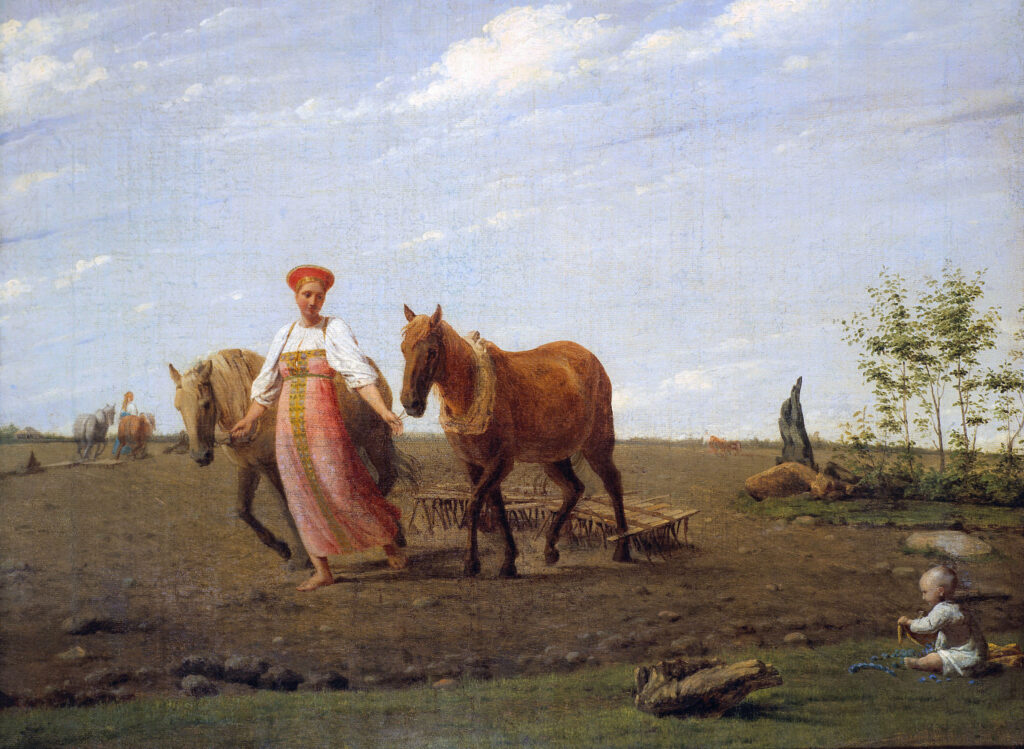
In the nineteenth century, few animals carried as much weight in daily life as the horse. Before the age of machines, horses were essential partners in agriculture, travel, and trade. Realist painters in both Russia and France recognized this and treated the horse with serious respect. Instead of romanticizing it, they showed the animal honestly: strong, steady, and woven into the fabric of ordinary life. In French rural scenes, you often see horses pulling carts through muddy village roads or standing patiently beside fields ready for plowing. These paintings were not sentimental. They were acknowledgments of honest labor, the kind that shaped the countryside and kept families fed.
Russian painters saw the horse in a similar spirit, but with added attention to the harshness of climate and the resilience needed to endure long journeys. The horse appears in winter scenes where its breath clouds the cold air, or in quiet village squares where it waits beside a sleigh. Artists painted these moments with affection, showing how the horse served as a faithful companion to people who faced demanding terrain and long seasons.
Military and Historic Art
Horses also carried weight in military traditions. French painters recorded cavalry units in motion, using careful brushwork to capture the rhythm of hooves and the tension of battle. These works often highlighted discipline and order, reflecting the structured life of soldiers who relied on their mounts for speed and strength. Even in calmer scenes—festival parades, ceremonial reviews, or portraits of officers—the horse is never just a prop. It represents readiness, authority, and a controlled power that viewers of the time understood readily.
In Russia, military depictions frequently showed horses in harsher settings. Battlefields in cold climates, long marches across open plains, and historical episodes from earlier centuries gave artists the opportunity to show endurance. Russian painters often portrayed the horse as patient and loyal, a symbol of the steadfast spirit that defined national identity during periods of upheaval.
Rural Romanticism
Despite the Realist commitment to depicting life as it truly was, some paintings allowed for moments of quiet beauty. A horse grazing in the last light of day or resting beside a small wooden bridge could add warmth to a scene without drifting into fantasy. The softer side of rural life appears in French works where the horse stands near a farmhouse or drinks from a stream. These scenes reflect a steady world grounded in tradition, showing how animals and people shared the same simple rhythm.
Russian Romantic scenes often placed horses near the edge of vast landscapes. A lone rider moving across the steppe, a team pulling a sleigh through silent snow, or a herd standing beside a birch forest could create a feeling of openness and dignity. Even in these gentler paintings, artists honored the horse’s practical role in daily life. Beauty was found in truth, not in idealization.
Russian Realist Traditions
Russian Realists, especially those associated with the Peredvizhniki movement, looked closely at village life and seasonal hardship. Their horses tend to be sturdy, well-worn, and accustomed to frost and long labor. A horse in a Russian painting often carries a sense of character—a quiet strength shaped by years of work. In winter scenes, its coat gathers snow while its posture shows patience. In summer, dust clings to its legs as it pulls a cart along a dirt road. These details reflect a deep respect for the animal’s role in a nation where distance and climate demanded resilience.
Artists also used the horse to explore themes of travel and human connection. A troika racing across winter fields, or a rider approaching a quiet village, helps the viewer imagine the broader world beyond the frame. The horse becomes not only a helper in daily tasks but a link between the individual and the vast landscape.
Decorative and Sporting Images
Both Russian and French craftsmen brought horses into decorative arts as well. Prints, metalwork, and carved items often show horses in active poses, celebrating speed and movement. Sporting scenes—races, hunts, and ceremonial events—gave artisans many chances to capture the animal’s energy. Even small objects like tobacco boxes, painted tiles, or embroidered textiles might include a horse, especially in regions where the animal was part of civic pride.
These worked pieces helped bring a touch of countryside life into the home. They also reminded viewers of the virtues associated with the horse: strength, trust, and an honest day’s work. In both nations, the horse remained a sign of honor and tradition long after the rise of industrial machinery.