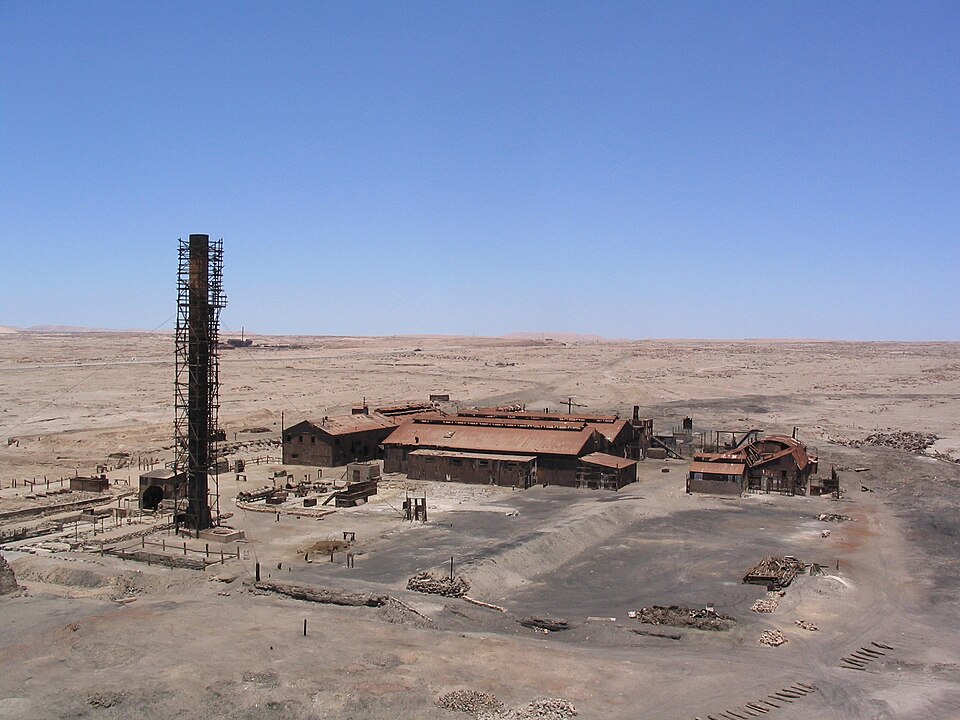
Humberstone stands in one of the harshest and most visually arresting environments on earth: the Atacama Desert of northern Chile. This region receives virtually no annual rainfall, with long-term meteorological records showing that some weather stations near Tarapacá reported zero measurable rainfall between the late 1800s and the mid-1900s. The desert’s dryness preserves wood, metal, and architectural structures far longer than in more humid climates. These conditions create a setting of crisp, angular shadows where buildings seem almost suspended in time. Artists and photographers who travel through the Atacama consistently describe its light as unusually sharp, with midday sun producing an intense contrast that accentuates every texture of rust, dust, and corrugated metal.
The land surrounding Humberstone holds wide plains called pampas, stretching toward distant cordillera ridges. When the town was active, workers described the open horizon as both liberating and isolating. For artists, this extreme openness becomes an enormous natural backdrop that frames the man-made structures in a stark, almost theatrical way. The combination of unbroken horizon, faded industrial buildings, and luminous sky has made Humberstone a popular subject for contemporary sketchers, documentary photographers, and architectural historians since the 1990s. While not home to traditional fine art collections, the site itself functions as an open-air composition shaped by light, weathering, and abandonment.
Key Visual Characteristics Artists Notice in Humberstone
- Intense desert sunlight creating deep architectural shadows
- Rusted industrial metal that forms natural abstract patterns
- Long sightlines and uninterrupted horizon lines
- Weather-seared wood that retains unusual color tones
- Contrasts between geometric machinery and open desert
Humberstone’s Historical Context as Visual Foundation
Humberstone began as Oficina La Palma in the 1870s, during the height of the natural nitrate boom that transformed northern Chile. The British chemical engineer James Thomas Humberstone (1850–1939) arrived in the region in the late 1870s, contributing advancements in nitrate extraction that made several facilities more efficient. After the War of the Pacific (1879–1884) secured Tarapacá for Chile, the nitrate industry expanded dramatically. By 1934, the settlement was renamed Oficina Santiago Humberstone in his honor. The structures visible today—housing blocks, processing machinery, boilers, and communal buildings—were primarily developed between 1920 and 1940, reflecting both industrial engineering trends and the architectural needs of a self-sufficient desert settlement.
For visual interpreters, these dates matter because the buildings still standing correspond directly to that period’s materials and methods. The worker housing, for example, shows the modular, repetitive wooden structures typical of early 20th-century nitrate camps. The processing plants contain riveted steel plates, large boilers, and elevated walkways that carry the unmistakable imprint of 1920s industrial design. These details allow photographers, architects, and historians to approach Humberstone not as a random ghost town but as a preserved chapter of early modern industrial history. The site’s age and condition contribute to its artistic appeal, giving every machine and board a patina that speaks to decades of desert exposure.
Industrial Architecture and the Beauty of Ruin
The Geometry of Saltpeter Works
The industrial heart of Humberstone is filled with structures whose geometry attracts artists and architectural photographers. The saltpeter-processing facilities—particularly the leaching plant, boilers, and calderas—feature repeating lines, heavy steel components, and sharply defined silhouettes. UNESCO’s 2005 World Heritage documentation emphasizes the significance of these industrial forms, noting that they represent one of the largest surviving nitrate-processing complexes in the world. Many of these structures were installed between 1920 and 1933, a period when the site underwent modernization to remain competitive in the global nitrate market.
The desert climate plays a major role in shaping the look of these metal structures. Without moisture, rust forms slowly but visibly, taking on deep orange and brown hues that catch sunlight dramatically throughout the day. Weathering patterns create natural abstraction, with rusted surfaces producing accidental compositions reminiscent of early 20th-century industrial art movements. While no verified fine artworks from those movements depict Humberstone directly, the visual parallels are undeniable. Straight pipelines, angled chutes, and repeating metal ribs echo the aesthetics of geometric abstraction, even though these patterns arose from utilitarian engineering rather than artistic intention.
Verified Documentary Visual References
Among the most reliable historical visual records of nitrate towns are the documentary photographs captured by Martin Gusinde in the 1930s. Gusinde, a well-known Austrian priest and ethnologist, conducted expeditions through northern Chile during this period. His archives, held in the Martin Gusinde Anthropological Museum in Chile, contain numerous photographs of nitrate workers, industrial structures, and daily life in the Tarapacá region. While his images are not categorized as fine art, they provide an invaluable visual reference for understanding the appearance and human rhythms of nitrate towns near Humberstone.
UNESCO’s photographic archives also document Humberstone and the neighboring Santa Laura works extensively. These verified photographs capture the processing towers, boilers, housing modules, and communal buildings as they appeared in the late 20th and early 21st centuries, before and after conservation efforts. For writers, historians, and sketch artists, these images provide reliable source material that avoids guesswork. They allow modern interpreters to understand how structures have changed over time and how abandonment has altered their appearance. The certainty of these sources helps ensure that artistic interpretation remains grounded in fact rather than romanticized speculation.
Human Stories Translated into Visual Expression
Photography of the Nitrate Communities
The workers who lived in Humberstone during its peak years—from roughly 1925 to 1940—created a unique social world that continues to inspire artists, photographers, and historians. Although Humberstone was an industrial settlement, it also contained family housing, a large theater, a school, a church, a market, and sports facilities. These elements give the town more emotional resonance than industrial ruins alone. Life in the nitrate pampas was demanding, with long workdays and harsh environmental conditions, yet workers built tight-knit communities with festivals, music, and shared traditions. Photographers who visit today often try to capture this mixture of hardship and solidarity.
Martin Gusinde’s verified 1930s nitrate-region photographs help document the human side of these desert settlements. Though not every image can be linked directly to Humberstone, many were taken in nearby oficinas operating under similar cultural and architectural conditions. His portraits of workers in protective clothing, families gathered in dusty courtyards, and children standing in front of wooden school buildings provide a reliable visual window into daily life. These scenes reflect the blend of dignity and resilience that characterized the nitrate workforce during the early 20th century. For modern viewers, the cultural details—clothing styles, tools, and household objects—offer a sense of connection to people who lived in a remote and challenging place.
Historical Subjects Often Depicted by Photographers in Humberstone
- Worker housing rows and modular community layouts
- Schoolyards, theaters, and communal gathering spaces
- Machinery yards and oversized industrial components
- The contrast between human presence and vast desert emptiness
- Abandoned belongings left behind after the 1960 closure
The Emotional Weight of an Abandoned Town
Humberstone’s abandonment in 1960 left behind a remarkably intact settlement, with homes still furnished, personal items scattered, and mechanical components frozen in place. This sudden halt to daily routines gives the town a stillness that many photographers find emotionally charged. The long shadows cast across empty plazas and rusted playgrounds create compositions that naturally evoke reflection. These scenes offer a rare chance to contemplate how industrial cycles shape human lives—building, sustaining, and eventually abandoning entire communities.
Artists often comment on the eerie quiet of Humberstone during early morning or late afternoon visits. Wind whistling through the metal frameworks of old conveyor towers can create an atmosphere that feels both solemn and strangely peaceful. This combination draws creatives from around the world who are searching for places where history remains visible not through polished museums but through weathered structures standing exactly where they were left. The town becomes a visual testament to endurance, decline, and memory, themes that naturally invite expressive interpretation.
Humberstone in Modern Artistic Interpretation
Urban Sketching, Watercolor, and Preservation Art
Visitors who reach Humberstone today often bring sketchbooks, cameras, or portable watercolor sets, drawn by the unusual combination of industrial geometry and desert quiet. Since the 1990s, the site has become a recurring subject for South American and international urban sketching groups, thanks in part to its intact early 20th-century structures. The long sightlines of the Atacama, along with the sharply defined shadows created by midday sunlight, give sketch artists a natural sense of composition. Even beginners find that the heavy beams, riveted plates, and corrugated roofs provide clear lines that translate well to pen-and-ink drawings. These sketches often emphasize perspective, shadow, and weathering rather than human presence, capturing the town as it stands—silent, austere, and undeniably compelling.
Watercolor artists often approach Humberstone differently, focusing on color transitions rather than precise line. The desert brings a muted palette: sand-washed pinks, oxidized oranges, deep browns, and slate-blue shadows. Structures that were once painted in utilitarian industrial colors now appear softened by decades of sun exposure. Many watercolorists note that Humberstone demands a slower approach than typical cityscapes because the light shifts quickly and dramatically across surfaces. This encourages longer observation, which in turn produces paintings that highlight subtle tonal differences in the metal and wood. Preservation-minded painters often donate their sketches to heritage groups as informal visual records, especially since buildings can deteriorate between visits despite restoration efforts.
Humberstone also attracts those who practice “preservation art,” a term used by some architectural illustrators who document endangered structures. While not an official academic category, it reflects a commitment to detail and historical accuracy. These artists often create measured drawings, shading studies, or panoramic watercolors showing the full extent of the industrial yards. Their work is not done for aesthetic experimentation alone; it becomes part of the cultural record. When paired with verified photographs from UNESCO or the Martin Gusinde archives, these artworks help show how the site’s condition evolves over time. For historians, such visual records offer a valuable supplement to written documentation, especially in a place where the desert environment can reshape surfaces between seasons.
The Continuing Role of Photography
Photography remains the most widely used artistic medium at Humberstone. The site’s mix of abandonment and preservation invites both documentary and interpretive photography. Modern photographers often arrive at sunrise or late afternoon to capture the “golden hour” light as it rakes across rusted equipment. Unlike industrial sites in more temperate climates, Humberstone lacks the moss, vegetation, and water damage that can obscure structural details. As a result, its surfaces reveal nearly a century of weathering, allowing photographers to document textures that are rarely found elsewhere. These details—chipped paint, rivet heads, worn planks—appear almost sculptural under the desert light.
Contemporary travel photographers frequently show Humberstone’s contrast between vast openness and tightly arranged industrial machinery. Some focus on the arrangement of worker housing rows, which demonstrate early 20th-century attempts at efficient desert settlement planning. Others emphasize the abandoned theater, whose large proscenium arch and wooden seating evoke memories of mid-century entertainment. While these images are not artworks that belong in museums, they serve as visual interpretations of history, shaped by the photographer’s approach, timing, and perspective. The consistency of factual subject matter allows for creative expression without distorting historical truth.
Artistic Meaning Within an Industrial Ghost Town
What Abandonment Reveals
Abandoned industrial settlements often inspire artists because they reveal how human ambition interacts with harsh environments. Humberstone is particularly compelling because its abandonment was sudden, tied to economic changes rather than natural disaster or war. The synthetic nitrate industry, which expanded rapidly after the 1910s, made natural nitrate increasingly uncompetitive. By the 1950s, demand had fallen sharply, and Humberstone finally closed in 1960. This unexpected silence gave the town an emotional weight that continues to influence artistic interpretation. Visitors often sense not only the passage of time but also the abruptness of the day when machines stopped and families moved away.
The ghost town setting encourages reflection on the interplay between labor, innovation, and impermanence. Large boilers sit motionless under the sun, their once-roaring heat now replaced by silence. Conveyor belts that once carried raw material across the plant remain suspended mid-task. Artistically, these images symbolize endurance and decline without requiring any fictional embellishment. The reality of Humberstone’s history is compelling on its own. Many photographers and sketchers emphasize this authenticity by avoiding staged scenes or added elements, focusing instead on the way the desert and the structures tell the story together.
A Cultural Landscape Frozen in Time
Humberstone’s preservation owes much to its climate. The Atacama Desert’s extreme dryness—historically documented as one of the driest regions on earth—slows decay dramatically. Wooden houses still show original joinery techniques from the 1920s and 1930s. Sheet-metal walls retain patterns of hammering, riveting, and machine stamping. These details grant artists a rare chance to study early 20th-century industrial construction without the layers of corrosion or vegetation typical of other heritage sites. For scholars, this accuracy makes Humberstone invaluable; for artists, it offers inspiration grounded in precise historical context.
Because of this preservation, walking through Humberstone feels like stepping into a moment paused in the mid-20th century. The school building still carries chalk residue from long-ago lessons. The theater stage, though fragile, hints at the shows once performed there. Even daily objects—bottles, tools, chairs—remain in place in some structures. Artists often describe an unusual sense of calm in these spaces, where remnants of daily life exist without the bustle that once animated them. This quietness becomes part of the visual vocabulary used to represent the town, encouraging compositions that balance structure with emptiness.
Architectural Memory and Creative Interpretation
Geometry, Texture, and Light
Artists who study industrial forms find Humberstone an ideal environment for exploring geometry. The processing plant features heavy vertical and horizontal elements, creating a natural grid against the open sky. This grid becomes more striking during early morning and late afternoon, when long shadows turn beams and supports into dark, crisp shapes. Painters often note that these shadows shift rapidly, requiring quick decisions to capture a moment accurately. Sketchers may focus on the rhythmic repetition of rooftops or the interplay of straight lines and broken edges.
Texture plays an equally important role. Liquid-storage tanks show streaks left by decades of condensation that formed during the rare cool nights. Walkway railings display layers of peeling paint baked by relentless sun. These details make Humberstone a rich subject for ink drawings, charcoal studies, or photography that emphasizes surface patterns. The combination of geometric clarity and organic weathering gives the town an aesthetic depth comparable to industrial sites documented in Europe or North America, but Humberstone’s environment adds a uniqueness that cannot be replicated elsewhere.
Ethical Representation of a Historic Site
Artists who visit Humberstone often discuss how to depict the site respectfully. Unlike purely abandoned industrial sites, Humberstone represents decades of human labor, migration, and community formation. Although the nitrate industry brought difficult working conditions and economic volatility, the people who lived there built real lives with lasting traditions. Modern artistic interpretation seeks to honor that reality without imposing fictional narratives or exaggerated emotional themes. This requires accurate representation of structures, careful treatment of communal spaces, and factual grounding in the site’s known history.
Preservation groups in Chile emphasize that Humberstone is not merely an “aesthetic ruin” but part of national heritage. For that reason, artists who sketch, photograph, or paint the site often share their work with local cultural organizations to support awareness and conservation. This relationship deepens the artistic experience, transforming interpretation into participation. Although not all visitors contribute formally, many find that understanding the site’s historical significance enriches their creative work. The real events, dates, and surviving structures provide a level of authenticity that elevates visual interpretation beyond decorative imagery.
Continuing Influence and Conclusion
Humberstone remains a compelling subject for artists because it brings together dramatic light, preserved industrial architecture, and a poignant sense of halted time. Its founding as La Palma in the 1870s, its expansion through the 1920s and 1930s, and its closure in 1960 form a timeline that is both historically grounded and visually expressive. The town tells a story not through monuments or curated exhibits but through rusted machinery, quiet courtyards, and weather-beaten boards. For painters, photographers, and sketchers, these elements provide a wealth of material that requires no embellishment. They stand as they are, shaped by sun, wind, and the lives of the people who once called the desert home.
As modern Chile preserves Humberstone as a World Heritage Site, artistic interest continues to grow. Each visitor brings a new perspective, whether through the immediacy of a pen sketch, the subtle washes of watercolor, or the clarity of a documentary photograph. Though no major fine art collections include works specifically from Humberstone, the site itself functions as an open-air archive of industrial history. Its forms, textures, and silence offer an honest and visually rich subject for anyone willing to explore its streets. In this way, Humberstone remains not only a historical landmark, but a place where art and memory intersect in the bright solitude of the Atacama Desert.