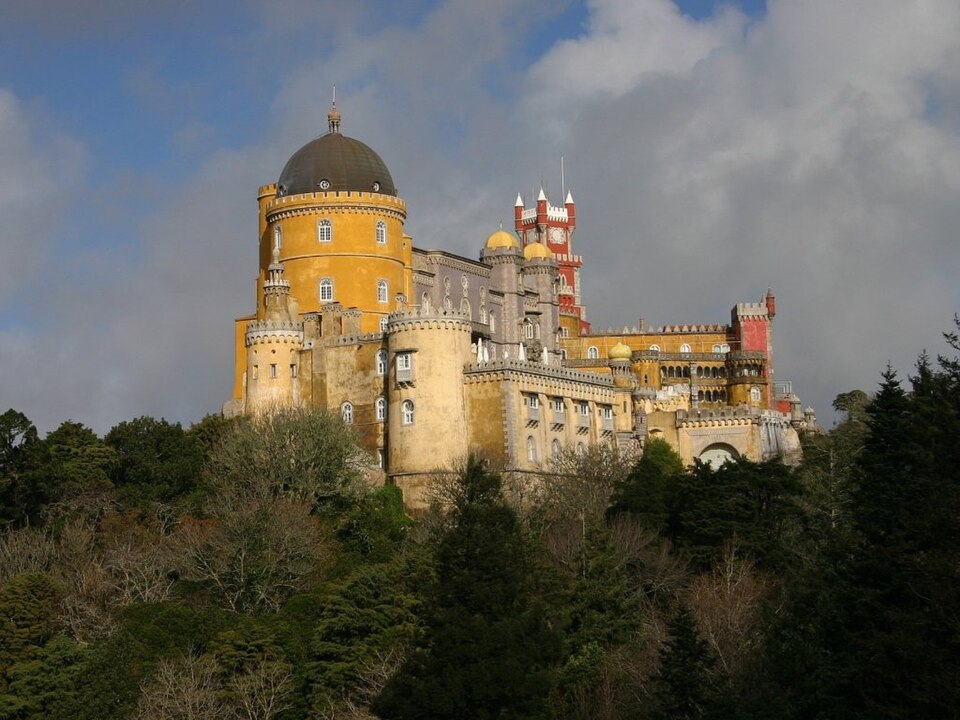
The site now occupied by the Pena National Palace was originally home to a modest Hieronymite monastery founded in 1503 under the patronage of King Manuel I. Located high in the Sintra Mountains, the monastery served as a quiet retreat for 18 monks and reflected Portugal’s late Gothic Manueline style. This remote spiritual enclave remained active for centuries, but it was heavily damaged in the devastating Lisbon Earthquake of 1755, which toppled most of its structure and left only the chapel and part of the cloister intact. The ruins sat in near abandonment for nearly a century, with occasional maintenance by religious orders.
It was not until 1838 that the abandoned monastery took on new life. That year, Prince Ferdinand of Saxe-Coburg and Gotha, who had married Queen Maria II of Portugal in 1836 and had been granted the title of King Consort, purchased the ruins and surrounding lands. Ferdinand was enchanted by the foggy hills of Sintra and envisioned a summer residence that would capture the grandeur of bygone ages. The remains of the monastery would become the foundation for an architectural marvel that merged fantasy and history. This act of transformation marked the first significant Romanticist building in Portugal.
The Role of King Ferdinand II as a Creative Patron
Ferdinand II (1816–1885), born into the German aristocracy, brought with him a deep appreciation for the arts, music, and architecture. Educated in Vienna, he was profoundly influenced by German Romanticism and admired the Gothic Revival projects of Central Europe. His travels to Bavaria and Saxony introduced him to castles like Hohenschwangau, which inspired his vision for Pena. Far more than a passive monarch, Ferdinand took a direct and active role in planning the palace, sketching designs, choosing materials, and working alongside the architect to ensure every aspect reflected his ideals.
Often dubbed the “Artist King” or Kunstkönig, Ferdinand transformed Sintra into a Romanticist landscape. He filled the Pena Park with exotic trees and plants from across the Portuguese empire, reflecting his appreciation for natural beauty and cultural diversity within the bounds of monarchy. His dedication to this vision made him a central figure in 19th-century Portuguese cultural life. Pena Palace was not merely a royal residence but a manifestation of Ferdinand’s Romantic imagination—one rooted in history, faith, myth, and national pride.
Architect Wilhelm Ludwig von Eschwege and His Design
To realize his vision, Ferdinand hired Baron Wilhelm Ludwig von Eschwege (1777–1855), a German mining engineer and amateur architect who had previously worked in Brazil. Eschwege was not a court architect in the traditional sense, but his background in geological surveying and civil engineering made him an ideal partner for a project that required mastering a difficult, mountainous terrain. Construction began in 1842 and continued for roughly 16 years, though portions were modified after Ferdinand’s death.
Eschwege’s design for the palace is a deliberately eclectic blend of architectural styles. The structure incorporates Neo-Gothic turrets, Moorish domes, Manueline windows, and Renaissance loggias. These stylistic choices weren’t accidental—they reflected the Romantic principle that architecture should evoke memory, fantasy, and emotional resonance. The palace layout itself is symbolic, with distinct zones for monastic legacy, royal living quarters, and theatrical facades. The result is a castle that looks like it was dreamed rather than designed, standing out vividly against the Sintra skyline.
Architectural Styles Featured in the Palace:
- Neo-Gothic
- Neo-Manueline
- Islamic/Moorish Revival
- Neo-Renaissance
- Baroque decorative elements
Symbolism and Architectural Features
Color, Contrast, and Fantasy in Design
Perhaps the most immediately striking feature of the Pena Palace is its bold and contrasting color scheme. The bright red clock tower, vivid yellow cloister walls, and blue domes are not original to the earliest construction phase but were added during restoration work in the early 20th century. These colors follow Romanticist principles of visual stimulation and symbolism. Red signifies power and history, yellow represents wealth and majesty, while the blue domes recall the heavens and the Moorish influence on Iberian architecture.
Unlike neoclassical buildings that stress symmetry and order, Pena thrives on asymmetry and surprise. Its exterior resembles a stage set, deliberately arranged to provoke awe and wonder. Turrets and domes rise from unexpected corners, arches open onto sudden terraces, and winding stairways lead through deliberately irregular corridors. The palace’s style encourages viewers to see it not just as a residence but as a journey through history and legend.
Notable Features and Artistic Details
Among the most distinctive features is the Triton Arch, located above a central doorway between the new palace and the original monastic structures. Created in the 1850s by unknown artisans, this stone sculpture represents a mythical sea god emerging from a shell, symbolizing the transition between the terrestrial and marine worlds. It is often interpreted as a metaphor for creation and the natural forces binding heaven and earth. Its grotesque expression and detailed carving are quintessentially Romantic, blending mythology with wild natural forms.
Inside the palace, rooms like the Great Hall and the Royal Dining Room reflect 19th-century court life, decorated with stucco ceilings, Moorish-influenced arches, and Portuguese azulejos—hand-painted ceramic tiles. One particularly striking chamber is the chapel, which preserves the rib-vaulted ceiling of the 16th-century monastery, enhanced with trompe-l’œil frescoes and gilded woodwork. These details, while decorative, are loaded with symbolism: the vaulting echoes heaven, the tiles ground the space in Portuguese tradition, and the frescoes connect the past with the present.
Gardens and Park of Pena Palace
Beyond the palace walls lies a vast romantic park that covers more than 200 hectares. Designed between 1843 and 1855 under Ferdinand’s guidance, the park was meant to contrast the wildness of nature with the cultivation of art. Inspired by English landscape gardens and German forest estates, the park features winding paths, artificial lakes, fern valleys, and rustic cottages. Rather than imposing geometric order, the garden encourages discovery and reflection.
Ferdinand ordered exotic species of trees to be planted throughout the park, including North American sequoias, Chinese ginkgos, Japanese camellias, and Australian tree ferns. This was not only a botanical experiment but also a subtle political gesture celebrating Portugal’s global reach and imperial connections. Several garden “follies” such as the Temple of Columns and the Queen’s Throne offer panoramic views over Sintra and the Atlantic coast. The gardens are as essential to the Romantic vision of Pena as the architecture itself.
Historical and Cultural Significance
Pena Palace and Portuguese National Identity
Pena Palace is not just a curious royal retreat—it reflects a broader movement in 19th-century Portugal to reassert cultural identity after the Napoleonic invasions and the Liberal Wars. In an era of political instability and competing ideologies, Romantic architecture became a way for the monarchy to root itself in national myth and heritage. Ferdinand’s decision to incorporate Manueline motifs and religious symbolism was not nostalgic sentiment but a deliberate strategy to associate the Braganza monarchy with Portugal’s Age of Discovery and Catholic faith.
Moreover, the palace served as a symbol of cultural renewal. While many European monarchs of the time sought to emulate classical antiquity, Pena looked instead to Portugal’s own medieval and maritime past. In this way, Pena Palace is both European and distinctly Portuguese—drawing on foreign styles but reinterpreting them through the lens of national tradition. It was also the first Romantic palace in Europe, predating the construction of Germany’s Neuschwanstein Castle by over 30 years.
Status as a UNESCO World Heritage Site
In 1995, UNESCO recognized Pena Palace as part of the “Cultural Landscape of Sintra,” one of the first cultural sites to be honored for the integration of built and natural heritage. According to UNESCO, the palace and its park demonstrate “the first expression of European Romanticism in architectural form” and represent a “pioneering example of landscape design.” This recognition helped solidify the palace’s international status and secured funds for its preservation.
Efforts to maintain the palace are ongoing. The Parques de Sintra–Monte da Lua company now manages the site, focusing on responsible tourism and conservation. Detailed restorations have returned parts of the palace to their original 19th-century appearance, including interior color schemes and furniture placements based on historical inventories. The site’s inscription by UNESCO ensures that the palace will be protected for future generations as a cultural landmark of world significance.
Use During the 20th Century and Beyond
After the Republican revolution of 1910, the Portuguese monarchy was overthrown, and royal properties were nationalized. Pena Palace was classified as a national monument and quickly converted into a museum. While some of the royal furnishings were removed or auctioned, many were recovered in later decades. The palace thus transitioned from a private royal residence to a site of public memory.
During the Estado Novo regime (1933–1974), the palace was showcased as part of a nationalist narrative centered on Portuguese grandeur. In the 1990s, following the return to democratic governance, the palace underwent renewed scholarly attention and restoration. Today, Pena is one of Portugal’s most visited sites, receiving over two million visitors annually. It continues to symbolize Portugal’s unique blend of monarchic, religious, and Romantic traditions.
Visiting Pena Palace Today
Planning a Trip from Lisbon to Sintra
A visit to the Pena Palace is an essential part of any trip to Portugal. Located just 30 kilometers northwest of Lisbon, the town of Sintra is easily accessible by train from Rossio Station. The journey takes about 40 minutes. From Sintra’s train station, visitors can take bus 434 to the palace or hire a tuk-tuk or taxi to the top of the mountain. Given the steep climb, walking is not recommended unless one is in excellent shape.
The palace is open year-round, though opening hours vary seasonally. From April through September, hours are generally 9:30 AM to 7:00 PM, with last admission at 6:00 PM. Tickets can be purchased online in advance, which is strongly advised during peak seasons to avoid long waits. Combination tickets that include access to the park and additional sites like the Moorish Castle are also available.
What to See Inside and Around the Palace
Inside the palace, each room is filled with period furnishings, tapestries, and objets d’art arranged as they were during the late 19th century. Highlights include the King’s Bedroom, the Arab Room with painted stucco walls imitating Islamic architecture, and the Royal Chapel, which still preserves the Renaissance-era altarpiece from the original monastery. The Great Hall features portraits of the royal family and glass chandeliers from Bohemia.
Outside, the Pena Park deserves at least an hour of exploration. The Chalet of the Countess of Edla, a Swiss-style cottage built by Ferdinand for his second wife, Elise Hensler, is located within the grounds and has been fully restored. From the Cruz Alta (High Cross), the highest point in the Sintra hills, visitors can enjoy sweeping views over the countryside to the Atlantic Ocean. Nearby landmarks include the Moorish Castle and Quinta da Regaleira, making Sintra ideal for a full day of exploration.
Photography, Accessibility, and Visitor Experience
Photography is allowed throughout most of the palace, though flash is prohibited in interior rooms. The vibrant colors and unique architecture make it one of the most photogenic sites in Portugal. For the best views, the Queen’s Terrace offers a commanding panorama of the landscape, particularly dramatic when morning mists roll through the Sintra hills. Visitors should be prepared for sudden weather changes, as fog and drizzle are common even in summer.
Accessibility is limited due to the age and topography of the palace. Steep staircases, uneven walkways, and narrow corridors make it difficult for those with mobility issues. However, the park is somewhat more accessible, and shuttle services are available. Visitor reviews consistently praise the palace’s fairy-tale atmosphere, attention to detail, and the surreal beauty of its surroundings. For a complete experience, plan at least three hours to explore both the palace and the park.
Visitor Checklist:
- Comfortable walking shoes
- Weather-appropriate clothing
- Fully charged camera or phone
- Refillable water bottle
- Advance ticket (printed or digital)
Key Takeaways
- Pena Palace was built by King Ferdinand II beginning in 1838 on the ruins of a 16th-century monastery.
- The palace is an eclectic Romantic masterpiece combining Gothic, Moorish, and Manueline styles.
- Architect Baron von Eschwege oversaw construction, influenced by Ferdinand’s artistic vision.
- It became a museum after the 1910 revolution and a UNESCO site in 1995.
- Today, it stands as Portugal’s most visited palace and a symbol of 19th-century national identity.
Frequently Asked Questions
What year was Pena Palace built?
Construction began in 1842 and continued into the 1850s under the direction of Ferdinand II and architect Baron von Eschwege.
Who designed Pena Palace?
The palace was designed by Wilhelm Ludwig von Eschwege, a German engineer and architect selected by King Ferdinand II.
What styles are seen in Pena Palace?
The palace includes Neo-Gothic, Neo-Manueline, Islamic/Moorish Revival, and Romanticist styles with touches of Baroque.
Can you visit the inside of Pena Palace?
Yes, the interior is open to the public and features restored 19th-century furnishings and royal rooms.
Is Pena Palace part of a UNESCO site?
Yes, it was inscribed in 1995 as part of the Cultural Landscape of Sintra World Heritage Site.