The first art of Oregon was inseparable from life itself—woven into cedar bark, carved into river cliffs, and traded along forest trails that predated written history by thousands of years. Long before European arrival, the peoples of this region created objects that served as both practical tools and visual records of thought, belief, and memory. Their aesthetic languages grew from the same landscape that shaped their survival: basalt ridges, volcanic plains, salmon rivers, and the Pacific coast.
Patterns of Land and Material
Each cultural group of Oregon—Chinookan peoples of the Columbia River, Klamath and Modoc of the southern plateau, Coos and Coquille along the coast, and numerous others—developed distinct yet related traditions shaped by ecology. Cedar, bear grass, tule reed, bone, and shell formed a vocabulary of form. Basketry in particular became a medium of intelligence. Coiled or twined, baskets were designed not only to store food or carry roots but to encode visual rhythm. Patterns might indicate a family lineage, a story of migration, or the memory of a seasonal route.
Rock imagery also marked the landscape from the Columbia Plateau to the Great Basin. Petroglyphs such as those preserved near Horsethief Lake and Picture Gorge record centuries of visual language—spirals, anthropomorphic figures, animals, and hunting scenes. These images are not “art” in the Western sense but acts of inscription, each carved into basalt as a kind of treaty between humans and place. Archaeologists date some to more than 6,000 years old, making them among the oldest surviving visual systems in the region.
Three materials especially reveal the sophistication of Oregon’s precontact art:
- Cedar wood: carved into canoes, masks, and ritual objects with tools of bone or shell.
- Shell and trade beads: used in ornament and currency, linking coastal and interior peoples.
- Painted hides: combining mineral pigments with narrative imagery of battles, hunts, or dreams.
Forms of Meaning
Basket patterns or petroglyph figures were not isolated motifs but part of a continuum of oral tradition. A design might recall a mythic episode; a carved figure could act as both emblem and witness. Among the Wasco and Wishram peoples along the Columbia, stories of Coyote—trickster, transformer, and culture hero—appeared in both narrative and imagery. The same tale that was spoken at night by firelight might also appear in a carved cedar panel or incised stone.
This interdependence of voice and image is crucial. Art was not a category separate from religion, economy, or storytelling. A finely made basket or decorated spoon expressed mastery of skill but also responsibility. The maker’s precision honored the materials themselves. Every surface, whether wood or stone, carried a moral dimension: a recognition that human life was bound to the landscape.
The anthropologist Franz Boas once noted that Pacific Northwest objects seemed “alive with system,” and Oregon’s examples confirm that observation. Symmetry, repetition, and variation were not arbitrary decoration but visual thought. In this sense, the early art of Oregon operates like a form of philosophy rendered in fiber and pigment.
Continuity and Adaptation
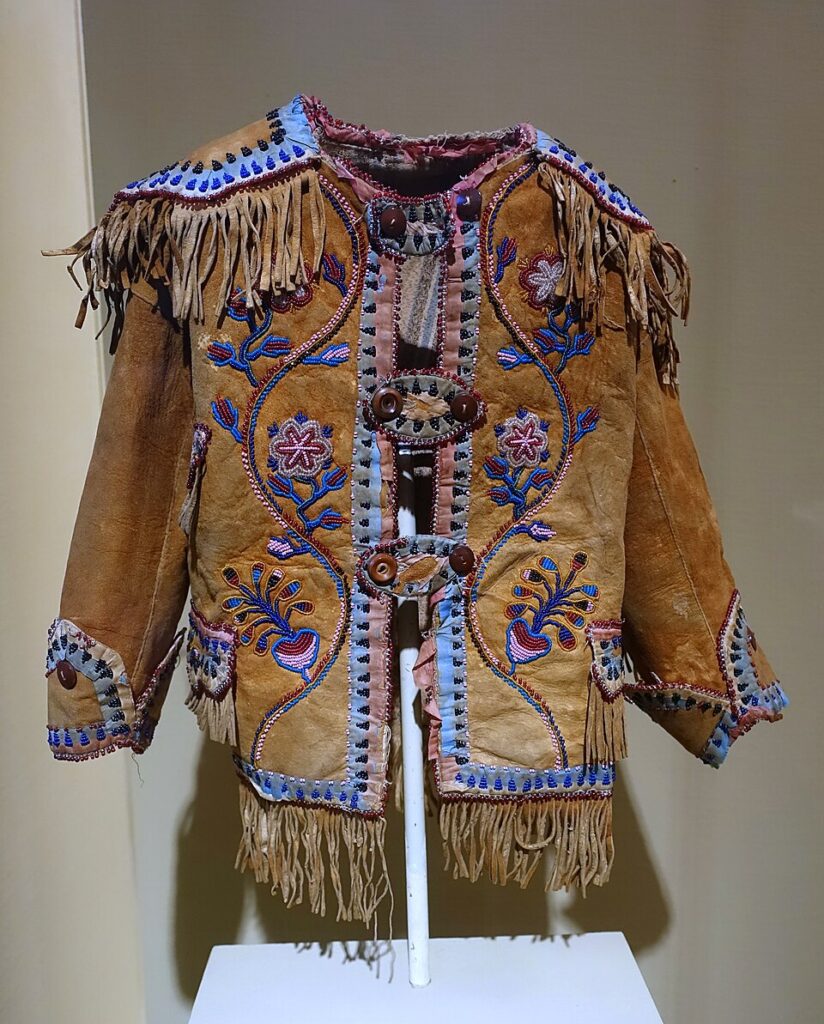
When fur traders and settlers entered the region in the late 18th and early 19th centuries, these art traditions did not vanish; they adapted. Glass beads replaced shell and copper ornaments; new pigments and metal tools expanded technique. Basket weavers incorporated motifs inspired by imported textiles. Yet the underlying cosmology—the idea that objects carried both utility and spirit—remained intact.
A striking instance of this continuity can be seen in the art of the Columbia River salmon. For millennia, carving and painting celebrated this fish as both sustenance and symbol. Even after the construction of dams altered the river’s ecology, artists continued to represent salmon in carving, printmaking, and contemporary sculpture. In that persistence lies a larger truth about Oregon’s visual heritage: art functions as a vessel of endurance, a reminder that cultural identity adapts without dissolving.
The 20th and 21st centuries have witnessed deliberate revitalization. Artists descended from regional tribes—such as contemporary carvers and basket makers trained in both traditional and modern methods—reconnect with ancestral techniques. Their work bridges time: a woven pattern may recall ancient iconography while existing comfortably within a gallery context. It challenges linear ideas of “ancient” versus “modern.” Instead, Oregon’s Indigenous art demonstrates continuity as a living practice, not a recovered relic.
Among the most striking modern examples are:
- Woven cedar panels inspired by Chinookan architecture, reinterpreted in contemporary design.
- Printmaking and painting that adapt traditional symbols to new media.
- Collaborative restoration projects of petroglyph sites, merging archaeology and community stewardship.
These acts of making and preserving serve not nostalgia but dialogue—between the deep past and the present moment, between traditional knowledge and modern artistic expression.
The Landscape as Archive
To understand Oregon’s earliest art, one must read the land as a gallery. The high desert bears carved basalt panels; the coastal forests hold remnants of totemic carving; riverbanks yield beads and ochre stones. The land itself functions as an unwritten museum. In this geography of traces, art and environment are indistinguishable.
Consider the petroglyph known as “She Who Watches,” located near the Columbia River. Her large, round eyes and enigmatic smile dominate a cliff face, overlooking the water. Oral accounts describe her as a guardian turned to stone to oversee her people. The image operates simultaneously as narrative, moral lesson, and aesthetic marvel. Its meaning depends not on the line itself but on its placement—on how it faces the current, the wind, the journey of salmon upstream.
Such works reveal an aesthetic that privileges relationship over spectacle. In Western art history, the masterpiece is typically a self-contained object. In the Indigenous art of Oregon, the masterpiece is an event—an exchange between maker, material, and place. To remove it from its setting is to mute part of its language.
Legacy and Reflection
The story of Oregon’s art does not begin with museums or markets. It begins with the patient intelligence of materials shaped to record belonging. When later artists—pioneers, modernists, or conceptual experimenters—sought to represent the Oregon landscape, they inherited not only scenery but precedent: an ancient understanding that art and land speak to each other.
That inheritance still influences Oregon’s creative culture. Whether in contemporary ecological art or in modern architecture inspired by Indigenous spatial design, echoes of these early visual systems remain. They remind artists and viewers alike that beauty in Oregon has always been inseparable from relationship—between people, river, and mountain.
The carved stones of the Columbia Plateau, the woven baskets of the Klamath Basin, the painted hides of the plateau tribes—all endure as evidence that art in Oregon has always carried the dual purpose of knowledge and care. To look closely at them is to see the origin of the region’s visual conscience: art as an act of remembering the world well enough to live in it.
Early Encounters and the Territorial Era (19th Century)
When the first Euro-American explorers entered the Oregon Country, they arrived not only with surveying instruments and trade goods but with sketchbooks. Art, in these early years, served both as record and persuasion—a way to translate the distant and unfamiliar into forms that could be carried home. The Oregon landscape, vast and often forbidding, became a stage on which curiosity, ambition, and imagination played out in watercolor, ink, and oil.
Mapping the Sublime
The earliest images of what is now Oregon came from explorers charting routes along the Columbia and Pacific coasts. Men such as George Vancouver’s expedition artists, working in the late 18th century, created views of capes and harbors that combined topographic accuracy with theatrical beauty. These drawings, later engraved in London, helped shape Europe’s early idea of the Pacific Northwest: a land of mist, forest, and scale.
By the early 1800s, trappers and fur company employees were adding their own visual testimony. Sketches of the Columbia River, Fort Astoria, and inland valleys circulated in journals and company reports. Their makers were not “artists” in a professional sense but observers who treated drawing as a form of notation. Yet even in these rough field sketches, a kind of artistic logic emerges—a balance of detail and distance that mirrored the commercial ambition of the time.
Three kinds of image defined this early visual culture:
- Surveying sketches, focused on coastline and river geometry.
- Ethnographic portraits, showing Native leaders or daily life, often idealized.
- Landscape studies, capturing weather, forest, and mountain profiles.
Each reflected a different motive: control, curiosity, and wonder. Together they built the visual foundation upon which later Oregon art would stand.
Portraits of a Changing Frontier
As missionaries and settlers followed, the region became a site of visual translation. Artists such as Paul Kane, the Irish-Canadian painter who traveled through the Oregon Territory in the 1840s, produced hundreds of field sketches depicting Native villages, river canoes, and volcanic horizons. Kane’s work, later developed into oil paintings in his Toronto studio, straddles documentary and imagination. His figures often appear stylized, their settings romanticized; yet his on-the-spot pencil drawings remain invaluable records of lifeways soon to be disrupted by settlement.
In this period, art also began to reflect domestic aspiration. Portrait painters and itinerant miniaturists found clientele among the growing settler towns of Oregon City and Portland. Their work, though provincial by East Coast standards, carried emotional precision: family likenesses, keepsakes of survival in a distant land. The portraits show self-possession, even in hardship—a visual assertion of belonging.
One surviving example, a small 1850s oil portrait of a merchant’s wife held by the Oregon Historical Society, demonstrates this blend of European technique and frontier directness. The sitter’s eyes meet the viewer with unembellished clarity, her dress rendered simply. The background is neutral, the brushwork restrained. The effect is neither grand nor sentimental; it is a statement of presence.
Art and Settlement
By the 1860s, Oregon had become a state, and with that shift came a slow professionalization of its art world. Painters began to settle in Portland, Salem, and smaller valley towns, taking commissions and teaching lessons. The landscape itself remained the great subject. Artists sought to reconcile the grandeur of the Cascades and coastal ranges with the everyday textures of homesteads, rivers, and fields.
The mid-century saw an influx of trained artists from the East Coast and Europe. Among them was William Samuel Parrott, whose atmospheric views of Mount Hood captured both romantic and realistic impulses. Parrott’s works, with their luminous skies and detailed foliage, served as Oregon’s first landscape icons—images that travelers would recognize in railroad brochures and civic exhibitions.
These landscapes performed several overlapping roles:
- They confirmed the region’s promise of settlement and cultivation.
- They reflected pride in natural abundance and geographic identity.
- They positioned Oregon within a broader American aesthetic of the sublime.
This dual function—celebration and persuasion—would continue through the century, shaping how Oregonians saw themselves and how others saw them.
Cultural Crosscurrents
While Euro-American artists mapped and painted, Native artisans continued to create within their own traditions, often adapting materials introduced through trade. Beadwork, metalwork, and hybrid forms evolved during this period. Trade beads from Europe appeared on traditional garments; silver ornaments replaced carved bone or shell. These objects were not merely byproducts of contact but active experiments in cultural continuity.
A particularly vivid example is the persistence of Columbia River carving traditions into the 19th century. Canoe prows and ceremonial figures retained traditional proportions even as tools and pigments changed. Visitors often misread such works as “imitations” of European art, but they were in fact deliberate assertions of ongoing identity within altered conditions.
At the same time, photographers began to replace draughtsmen as chroniclers of the frontier. Studios in Portland and Astoria produced cartes-de-visite portraits that circulated widely. Photographers such as Joseph Buchtel and Peter Britt combined documentary intent with aesthetic ambition. Britt, based in Jacksonville, became known for his photographs of Southern Oregon landscapes—particularly Crater Lake—which prefigured later tourism imagery. His darkroom was both laboratory and stage, transforming rough terrain into accessible vision.
Building an Art Infrastructure
By the 1880s and 1890s, Oregon’s growing towns demanded more organized cultural life. Art societies formed, exhibitions were held in schools and public halls, and imported paintings from San Francisco and New York occasionally reached Portland. A handful of early collectors—often merchants and lawyers—acquired both local and European works, seeding what would become institutional collections.
The culmination of these efforts came in 1892 with the founding of the Portland Art Association, which laid the groundwork for the future Portland Art Museum. Its exhibitions, lectures, and art classes provided a gathering point for artists across the region. The visual narrative of Oregon was no longer confined to travel journals or homestead parlors; it now had a civic platform.
The final decade of the century saw a transition from individual recorders to organized community. Art shifted from documentation toward interpretation. Painters were no longer merely describing what they saw—they were deciding how Oregon should look in the collective imagination. The frontier, once a site of uncertainty, became a subject for pride and style.
Echoes and Reflections
The 19th century established two enduring patterns in Oregon art. The first was the impulse to see the land as both resource and revelation—a source of livelihood and aesthetic wonder. The second was the habit of mediation: art as translation between worlds, whether geographic, cultural, or imaginative.
From the petroglyph carver to the explorer’s sketch artist, from the settler portraitist to the early museum founder, each participated in an unfolding dialogue about what it meant to see Oregon and to belong to it. By the century’s end, that dialogue had matured into a regional identity recognizable to itself.
The sketches of mountains, the portraits of new citizens, the woven baskets and beadwork still being made along the Columbia—all these visual traces survive as witnesses to a century of encounter, adaptation, and assertion. They remind us that Oregon’s artistic history began not with a style but with a conversation: between memory and ambition, between land and those who sought to call it home.
The Turn of the Century & The Progressive Era (c. 1890–1920)
At the dawn of the twentieth century, Oregon’s art world began to find both audience and ambition. The state, no longer a frontier, sought to define its own aesthetic identity amid national shifts toward urbanization, reform, and progress. Art became part of civic aspiration—a way to express maturity and confidence after decades of expansion. The period between 1890 and 1920 would transform Oregon from a loosely connected constellation of painters and craftspeople into a regional art culture with institutions, teachers, and a public vocabulary of taste.
Foundations of a Cultural City
The most visible sign of this transformation was the founding of the Portland Art Association in 1892, which quickly became the center of organized art life in Oregon. Its founders—businessmen, educators, and artists—hoped to give the city a cultural gravitas equal to its growing commercial power. Exhibitions were held in borrowed spaces until the Association acquired its own building in 1905, the same year Portland hosted the Lewis and Clark Centennial Exposition.
That exposition marked a symbolic moment: Oregon presenting itself to the world as a place of achievement and culture. Alongside displays of industry and agriculture, the art pavilion exhibited paintings and sculptures from both local and national artists. The effect was electric. For many Oregonians, it was their first exposure to large-scale art display. Critics described the exhibition as a revelation, proof that art could belong not just to New York or Paris but to the Pacific Northwest.
Amid this civic energy, Portland began to attract a new generation of artists trained in East Coast and European academies. They brought with them academic realism, Impressionist color, and a belief in the social mission of art. Painters such as Clyde Leon Keller and Clara Jane Stephens helped anchor a community of professionals who exhibited, taught, and debated the direction of Oregon’s aesthetic future.
Three overlapping ambitions guided these efforts:
- Education: teaching art as both craft and moral discipline.
- Visibility: creating a public audience through exhibitions and print coverage.
- Regional pride: presenting Oregon’s landscape and people as worthy artistic subjects.
These ambitions set the tone for decades to come.
The Landscape as Ideal
Even as Oregon’s cities grew, the landscape remained its most enduring muse. Painters traveled to the Cascades, the Columbia Gorge, and the coast to capture scenes that balanced grandeur with intimacy. The influence of Hudson River School romanticism persisted, but filtered through the softer light and dense atmosphere of the Pacific Northwest.
Artists like William Samuel Parrott, Childe Hassam (who visited the region), and later C.S. Price explored variations of this regional landscape idiom. Their canvases were less about exact representation than about mood—fog rising over pine forests, reflections in still lakes, the play of clouds on snow peaks. Oregon’s environment lent itself to a quiet lyricism rather than spectacle, and this subtlety became a regional hallmark.
At the same time, photography began to claim its own artistic territory. Peter Britt’s landscape photographs of Southern Oregon, already admired for their precision, were reinterpreted as art rather than documentation. The Photo-Secession movement in the East inspired Oregon photographers to explore composition, shadow, and texture with painterly intent. The boundary between fine art and record-keeping began to blur.
Amid this landscape tradition, smaller craft practices thrived. Women’s art clubs, such as Portland’s Art Students League and similar organizations in Salem and Eugene, offered both instruction and exhibition space. Many of these groups emphasized watercolor, printmaking, and applied design—mediums that fit domestic and civic settings alike. Their work expanded the definition of who could be an artist in Oregon, laying groundwork for later craft movements.
Art Education and Civic Morality
Art schools and universities recognized the growing public appetite for instruction. The Portland Art School, precursor to the Museum Art School (and later the Pacific Northwest College of Art), opened under the Art Association’s guidance. Its curriculum mirrored national trends: figure drawing, composition, perspective, and design. Students were taught that art cultivated not just skill but character—a moral training for the modern age.
This belief aligned with the Progressive Era’s broader ideals. Reformers across the United States saw art as a tool for civic betterment. Oregon followed suit. Public murals, decorative friezes, and school art programs all carried a social purpose: to refine taste, uplift communities, and counteract the perceived coarseness of industrial life.
Even the city’s architecture reflected this ethos. The City Beautiful movement, which swept across America after the 1893 Chicago World’s Fair, influenced Portland’s planners and architects. Sculptors and painters contributed decorative reliefs and allegorical panels to public buildings, merging fine and applied art. In this period, art was not confined to galleries—it entered the texture of daily civic experience.
Regional Networks and the Idea of the West
Oregon artists were not isolated. They exhibited in Seattle, San Francisco, and occasionally in Chicago or New York. The Panama-Pacific International Exposition of 1915 in San Francisco exposed many Oregonians to international modernism for the first time. Though few embraced abstraction immediately, they returned with a broadened sense of artistic possibility.
Critics began to speak of a distinct “Pacific sensibility”—a term suggesting both distance from and conversation with Eastern models. Oregon’s version of this sensibility leaned toward serenity and restraint. Where California artists often favored brightness and theatrical color, Oregon painters emphasized mist, shadow, and tone. Their work embodied a different climate of perception, one attuned to gradual change rather than spectacle.
One small but telling episode captures the spirit of the era. In 1913, a local newspaper reviewed a group exhibition at the Portland Art Museum and praised a young painter’s depiction of Mount Hood at dusk. The critic wrote that the painting “caught the silence between daylight and darkness, that peculiar stillness which only our own mountains know.” That phrase—“our own”—signaled a shift from colonial curiosity to cultural ownership. Oregon art was no longer an imitation of elsewhere; it had begun to speak with a local accent.
Craft, Gender, and Everyday Beauty
Alongside painting and sculpture, the applied arts gained stature. Women artists in particular advanced these crafts into public recognition. Weaving, ceramics, metalwork, and book design reflected the ideals of the Arts and Crafts movement, which valued hand labor and honesty of materials. In Portland, the Society of Arts and Crafts promoted exhibitions that blurred boundaries between fine and decorative art.
These crafts held social significance. They suggested that beauty should infuse everyday life—a table, a lamp, a textile—as a form of ethical improvement. While modest in scale, this vision had profound cultural reach. It democratized the idea of art, linking it to home, community, and the dignity of work.
By 1920, Oregon’s art scene had matured into an organized ecosystem: artists, schools, collectors, critics, and institutions coexisting with a growing sense of mission. The Progressive Era’s optimism—that art could shape moral and civic health—found practical expression in these networks.
Echoes of a New Century
The art of early twentieth-century Oregon captured a balance between confidence and restraint. It was not avant-garde in the radical sense, yet it was modern in spirit: open to experimentation, civic in purpose, and increasingly self-aware. Painters turned to the landscape not as frontier but as homeland. Sculptors and architects sought harmony between built form and environment. Craftspeople treated utility as an aesthetic principle.
What emerged was a visual culture both idealistic and grounded. The Oregon of 1920 possessed institutions that would anchor its future art movements—the Portland Art Museum, the Museum Art School, and a network of artist societies. Behind their polished exhibitions lay decades of collective effort: explorers’ sketches, settlers’ portraits, civic boosters’ dreams, and the quiet work of craftswomen transforming daily objects into art.
The Progressive Era gave Oregon not only its first art institutions but also its enduring faith that art could help define a community’s character. That belief, tempered but unbroken, would guide the next chapters of the state’s artistic life.
The Interwar Years: Growth, Identity, and the Great Depression
When the First World War ended, Oregon entered a period of both optimism and strain. Industry expanded, cities modernized, and the state’s population grew—but the arts, still fragile, had to redefine their purpose amid changing economics and taste. Between 1918 and the late 1930s, Oregon’s art scene evolved from genteel regionalism into a more self-conscious search for identity. Painters, sculptors, and craftspeople responded to both the promise and the insecurity of modern life. The result was an art that balanced tradition and experimentation, comfort and unease—a mirror of an era that could not quite decide what the future should look like.
Between Prosperity and Uncertainty
The 1920s brought a new energy to Portland and other Oregon cities. Automobiles, theaters, and department stores transformed urban life. The Portland Art Museum, strengthened by the resources of the Art Association, began to mount larger and more ambitious exhibitions. Its annual juried shows became social events, drawing artists from across the Pacific Northwest.
This was also a decade of personality. Artists such as C.S. Price, Amanda Snyder, and Henry Frederick Wentz came to prominence, each developing a style that diverged from polite realism. Price, who had worked as a cowboy before turning to art, produced semi-abstract figures and animals rendered in earthy tones. His paintings, dense with emotion and formal tension, broke decisively from decorative prettiness. Snyder, largely self-taught, painted expressionist interiors and still lifes that conveyed psychological depth rather than surface charm. Wentz, a teacher at the Museum Art School, experimented with color harmonies influenced by modernist theories from Europe.
For the first time, Oregon’s art seemed to look inward rather than outward. Instead of trying to emulate the East Coast, local artists began to treat their own environment as a source of formal and emotional exploration. The landscape persisted as subject, but not as mere scenery; it became a structure for feeling.
Three interlocking impulses defined Oregon’s art during this decade:
- Modernist curiosity: an interest in abstraction and expressive color.
- Regional attachment: loyalty to local subjects and moods.
- Craft idealism: faith in manual skill as moral and aesthetic foundation.
Together, they gave Oregon art a voice that was neither provincial nor imitative—quietly modern, regionally grounded, and emotionally resonant.
The 1930s and the WPA
Then came the Depression. By 1930, galleries closed, collectors retreated, and private commissions dwindled. Yet paradoxically, this hardship produced one of the most productive periods in Oregon’s art history, thanks to federal support. The Works Progress Administration (WPA) and its related programs, including the Federal Art Project, provided employment to artists across the country. Oregon benefited disproportionately for its size, with dozens of painters, printmakers, sculptors, and teachers supported through public commissions and community projects.
Murals appeared in post offices, schools, and libraries throughout the state. Many depicted logging, fishing, and agricultural scenes—celebrations of labor rendered in a simplified, heroic style influenced by Social Realism. While these works often echoed national themes, their execution revealed local nuance: Oregon’s damp forests and soft light tempered the monumentality of the WPA idiom, giving it an understated dignity.
Two examples illustrate the era’s range. In Salem, a post office mural depicted workers harvesting hops beneath clouded skies, the figures arranged with almost Renaissance balance. In Portland, another mural celebrated maritime industry with stylized cranes and ships, merging realism and abstraction. Both works conveyed optimism amid hardship—a belief that collective effort could be beautiful.
The WPA also sponsored art education, traveling exhibitions, and community workshops. For many Oregonians, this was their first direct contact with professional artists. The effect on public taste was profound. Art was no longer a luxury for elites; it became a shared civic experience.
For the artists themselves, federal support meant survival and experimentation. Painters like Charles Heaney, who combined precision drawing with poetic restraint, found space to develop. Heaney’s urban and industrial scenes, often nearly monochrome, evoke both solitude and structure—an Oregon modernism born of silence rather than rhetoric.
Regionalism and the Question of Style
The 1930s were marked by tension between regional realism and international modernism. In Oregon, the balance tilted toward the regional. Critics and curators spoke of a “Northwest character” defined by muted color, simplified form, and a sense of introspection. The landscape—rain, forest, mountain, and mist—was again central, but now as psychological atmosphere rather than mere geography.
Artists such as Louis Bunce, who would later emerge as a major modernist after World War II, began their careers in this regionalist moment. Their early works already hinted at abstraction but remained rooted in Oregon’s visual language: subtle light, restrained emotion, and measured rhythm. Even when modernist influences arrived through reproduction and visiting exhibitions, Oregon artists absorbed them selectively, filtering them through local temperament.
Three qualities often distinguished Oregon regionalism from its Midwestern or Southern counterparts:
- Subdued tone: preference for cool palettes over bright patriotism.
- Emphasis on weather and mood rather than narrative action.
- Introspective realism, where even labor scenes feel contemplative.
This regional restraint would later shape how modernism took root in the Pacific Northwest.
Craft and Continuity
The interwar years also deepened Oregon’s craft traditions. The Arts and Crafts ideals of the previous generation evolved into organized movements in ceramics, metalwork, and weaving. The Oregon Ceramic Studio, founded in 1937 by Leta Kennedy, offered exhibitions, classes, and national exchanges. It would later become the Museum of Contemporary Craft, a cornerstone of Oregon’s design culture.
Craft, during this period, was not seen as secondary to fine art. Instead, it represented endurance—art’s ability to survive economic depression by returning to the human hand. Potters and weavers often collaborated with WPA programs, teaching practical skills that doubled as aesthetic education. Their work aligned with Oregon’s pragmatic sensibility: beauty that served function, simplicity that carried moral weight.
This emphasis on craft also opened the door for more women to participate in the state’s artistic life. Many female artists found in ceramics and fiber a space for professional seriousness outside the competitive hierarchies of painting. Their quiet persistence ensured that when postwar modernism arrived, Oregon already possessed an infrastructure of making grounded in skill and collaboration.
Institutions and Community
Despite economic strain, institutions survived. The Portland Art Museum continued its exhibitions, sometimes relying on traveling shows from the East but increasingly showcasing local artists. Criticism in newspapers like The Oregonian became more sophisticated, treating art as civic dialogue rather than decoration. Clubs and cooperatives, including the Oregon Society of Artists, provided support networks that sustained creative life through lean years.
The interwar period also witnessed a subtle shift in audience. Middle-class patrons, many of them professionals and educators, began to see art as part of community identity. Public lectures, art education programs, and gallery talks fostered a sense that Oregon’s art belonged to its citizens. That democratic ideal—art as shared good rather than private possession—would remain a regional constant.
The Poetics of Restraint
By the time the Depression eased, Oregon had developed an artistic personality distinct from its coastal neighbors. California’s art was exuberant and sunlit; Washington’s, brooding and spiritual. Oregon’s was measured, introspective, and humane. It preferred half-tones to extremes. This temperament, shaped by climate and culture alike, made it well-suited to the modest optimism that followed the New Deal.
The interwar years left Oregon with enduring legacies: a professional class of artists, a network of institutions, and a belief that art could mirror collective experience without resorting to grandiosity. In their subdued murals, quiet landscapes, and carefully thrown pots, Oregonians found an image of themselves—resilient, restrained, and quietly modern.
The Great Depression had tested both the economy and the imagination. Yet, through its trials, Oregon’s art discovered its own voice: one of endurance rather than spectacle, reflection rather than rhetoric. It was a voice that would deepen in the postwar decades, as abstraction and new materials reshaped the meaning of the modern in the Pacific Northwest.
Postwar Modernism and the Pacific Northwest Outlook (c. 1945–1970s)
When peace returned in 1945, Oregon’s art world entered a period of confident change. The state had weathered two wars and a depression; now its artists, teachers, and patrons faced a different challenge: defining modernity on their own terms. Across the United States, abstraction and expressionism were reshaping artistic values. In Oregon, these currents arrived neither as rebellion nor imitation but as translation—filtered through a region already inclined toward restraint, atmosphere, and structure. The postwar decades transformed Oregon into a serious, if understated, participant in American modernism.
A New Language of Form
The immediate postwar years saw an influx of veterans attending art school under the GI Bill. At the Museum Art School in Portland, enrollment surged. Classrooms filled with returning soldiers, many of whom had encountered European art firsthand. They brought curiosity and discipline, forming a generation eager to break from the illustrative realism that had dominated before the war.
Among the teachers guiding this transformation was Louis Bunce, whose career became central to Oregon’s modernist story. Bunce had studied in New York, absorbed the energy of abstract expressionism, and returned to Portland with a conviction that the Northwest could speak modernism in its own accent. His paintings—gestural yet structured, abstract yet evocative of landscape—embodied that conviction. Bunce also worked tirelessly as an organizer, curator, and advocate. Through his efforts, Portland hosted traveling exhibitions of national significance, connecting local artists to broader debates about abstraction, form, and meaning.
The Museum Art School became the crucible of this modernist shift. Under Bunce and colleagues like Jack McLarty and Michele Russo, students were encouraged to pursue experimentation rather than conformity. Painting classes emphasized gesture, rhythm, and composition over subject. Critiques were lively, often heated, but they forged a community that treated art as intellectual pursuit, not mere craft.
Three characteristics distinguished Oregon’s version of postwar modernism:
- Atmospheric abstraction: Color and form suggested landscape without describing it.
- Measured expressionism: Emotional intensity balanced by structural discipline.
- Communal ethos: Modernism as dialogue, not doctrine.
This synthesis—emotional but not flamboyant, rigorous but not doctrinaire—would become the region’s defining modern idiom.
The Northwest School and Oregon’s Kinship
While Washington’s “Northwest School,” centered around Mark Tobey, Morris Graves, and Kenneth Callahan, often receives more national attention, Oregon developed a parallel sensibility. The two states shared climate, geography, and a preference for introspection over spectacle. Yet Oregon’s artists were less mystical and more formal in approach. They translated the rain-soaked landscape into abstract geometry rather than transcendental vision.
Bunce and his contemporaries maintained connections with Seattle’s scene but cultivated distinct priorities. Where Tobey used calligraphic brushwork to evoke spiritual unity, Oregon painters emphasized balance, texture, and the physical properties of paint. The result was a quieter modernism—less cosmic, more material.
Sculpture also flourished. Lee Kelly, whose career began in the late 1950s, developed monumental steel works that integrated industrial technique with organic rhythm. His later piece Akbar’s Garden, installed at the University of Oregon, embodies this synthesis: modern fabrication meeting contemplative form. Kelly’s sculptures, often set outdoors, made abstraction tangible in public space, translating studio experimentation into civic encounter.
Photography and printmaking likewise modernized. Artists such as Manuel Izquierdo explored both figurative and abstract modes in print and sculpture, while photographers experimented with texture and composition rather than narrative subject. The mood was exploratory yet disciplined, echoing the tone of Oregon’s postwar architecture—clean lines, natural materials, functional elegance.
Institutions and the Growth of a Scene
As artists modernized, so did institutions. The Portland Art Museum, under directors such as Thomas Colt Jr. and later Gordon Gilkey, expanded its collection and embraced contemporary programming. Gilkey, a printmaker and a major figure in art preservation during World War II, championed both historical prints and modern graphic art. His advocacy for printmaking helped establish the Oregon Printmakers’ Society and encouraged university programs to treat the medium seriously.
Colleges across the state—University of Oregon, Oregon State College, Reed College, and others—built or expanded art departments. These institutions nurtured cross-disciplinary approaches that mirrored national modernist trends: design merged with fine art, and architecture drew from sculpture and painting. The result was an intellectual ecology rather than an isolated movement.
The 1950s and 1960s also witnessed the rise of new exhibition venues. Cooperative galleries, often artist-run, provided alternatives to museum hierarchy. In Portland, spaces such as the Image Gallery and the Fountain Gallery gave visibility to emerging talents and allowed experimental work to flourish outside academic settings. The art scene became more dynamic, more conversational, and—significantly—more public.
Public Modernism
Oregon’s modernization extended into its built environment. Architects like Pietro Belluschi, trained in Portland and later internationally renowned, applied modernist principles to architecture that harmonized with landscape and material. Belluschi’s Equitable Building (1948), one of the first glass-curtain-wall skyscrapers in the United States, stood as a symbol of progressive design integrated with environmental sensitivity.
Artists collaborated with architects to incorporate murals, sculpture, and reliefs into new civic structures. Public buildings became showcases for abstract art, embedding modern aesthetics into the daily life of Oregonians. Rather than alienating the public, these works often gained acceptance through their restraint and craftsmanship. Oregon modernism, in its quiet way, became part of civic decorum.
Education, Criticism, and the Artist’s Life
By the late 1960s, Oregon possessed a fully formed art ecosystem. The Museum Art School trained successive generations; the Portland Art Museum maintained national connections; university galleries curated experimental shows. Local critics, including journalists for The Oregonian and independent publications, wrote with increasing sophistication, situating Oregon art within national conversation.
The artist’s life, however, remained modest. Few could live solely from sales; most taught, worked as designers, or held part-time jobs. Yet this economic modesty fostered independence. Without pressure to commercialize, Oregon artists maintained autonomy of vision. Their studios—often converted barns, garages, or small urban lofts—became laboratories for disciplined inquiry.
The state’s relative distance from the major art centers, rather than isolating its artists, offered insulation from trends. Oregon modernists could absorb influences selectively, testing abstraction without surrendering to fashion. This distance also encouraged collaboration. Painters, sculptors, and architects often worked side by side, exchanging ideas across media. The atmosphere resembled a collegial workshop rather than a marketplace.
Transitions and Tensions
By the early 1970s, modernism itself was evolving. Younger artists questioned its formal austerity, exploring conceptual and environmental art. Yet the groundwork laid by Bunce, Kelly, and their peers ensured that experimentation remained central to Oregon’s creative ethos. Even as Pop Art and Minimalism gained attention elsewhere, Oregon maintained a commitment to balance—innovation tempered by reflection.
One can trace the emotional contour of these decades through a single visual gesture: the measured brushstroke. Whether in Bunce’s controlled abstractions or Snyder’s late expressionist canvases, the brushstroke stands as an emblem of Oregon modernism—neither explosion nor ornament, but disciplined motion. It embodies the region’s character: deliberate, persistent, quietly adventurous.
Legacy of the Postwar Outlook
By the close of the 1970s, Oregon had achieved something rare—a regional modernism that felt neither derivative nor provincial. Its artists had absorbed international vocabulary while preserving local cadence. The combination of institutional stability, teaching culture, and personal integrity created a continuum that later generations would inherit.
Oregon’s postwar art tells a story of moderation as strength. In a national culture that often equated progress with noise, Oregon cultivated another virtue: depth without dramatics. The steel arcs of Lee Kelly, the luminous surfaces of Bunce, the thoughtful prints of Gilkey—all share a conviction that modernism, properly understood, is not a rupture but a refinement.
What began in modest classrooms and converted studios became a sustained conversation between place and form. The echoes of that conversation still shape Oregon’s art today: the belief that abstraction can carry feeling, that innovation can coexist with civility, and that even at the far edge of the continent, art can quietly redefine what modern means.
The Expansion of Contemporary Art (1970s–2000s)
By the mid-1970s, Oregon’s art scene found itself standing at a threshold. The postwar generation had built strong institutions and a disciplined modernist ethos; now, younger artists sought to test those foundations. Across the United States, conceptual art, performance, feminism, installation, and new media were reshaping what “art” could mean. Oregon, characteristically, absorbed these influences with quiet persistence rather than theatrical revolt. The decades between 1970 and 2000 witnessed an extraordinary diversification of practice—a period in which experimentation became the norm and institutions expanded to meet it.
From Modernism to Experimentation
The transition began within the Museum Art School (later renamed the Pacific Northwest College of Art). Students who had grown up amid the abstractions of Bunce and Russo now questioned the autonomy of painting itself. They built environments, staged performances, and recorded ephemeral gestures on film or video. The museum’s studios, once dominated by easels and presses, filled with projection screens, found objects, and mixed materials.
Portland’s cultural climate encouraged this shift. The city’s size allowed close contact between artists, writers, and musicians; the cost of living remained low enough to support creative risk. Art departments at Portland State University, the University of Oregon, and Oregon State University fostered similar experimentation, often bringing visiting artists from California and New York to expose students to emerging trends.
During these years, Oregon produced a generation of boundary-crossing artists whose work often defied classification. Installation and process art became especially prominent. Instead of treating art as object, they treated it as event—a temporary negotiation with space and material. The influence of minimalism and conceptualism merged with the region’s characteristic sensitivity to environment and texture.
Three overlapping directions characterized this expansion:
- Process-based practices, emphasizing time, decay, and repetition.
- Environmental and site-responsive art, often created outdoors.
- Interdisciplinary collaboration, joining visual art with music, theater, or poetry.
This shift didn’t abandon modernist integrity; it redefined it as openness—a willingness to treat form as inquiry rather than conclusion.
Alternative Spaces and Artist Collectives
As the 1970s unfolded, artists sought venues that could match their new ambitions. Commercial galleries were rare and conservative; museums moved cautiously. Out of this tension emerged alternative spaces, often artist-run, that became the heart of Oregon’s contemporary scene.
The most influential was Portland Center for the Visual Arts (PCVA), founded in 1972 by artists and community organizers. Its program was radical for the region: installations, performances, conceptual pieces, and collaborations with national figures such as Robert Irwin and Carl Andre. PCVA connected Portland to the avant-garde circuit while nurturing local talent. Its exhibitions often took over warehouses or temporary spaces, embodying a DIY ethos that matched the city’s emerging countercultural identity.
PCVA’s legacy was not just in the art it showed but in the model it offered. It demonstrated that serious contemporary art could thrive outside major art markets through energy, cooperation, and modest means. Its closure in 1987, due to funding exhaustion, left a void—but also a blueprint that later organizations would follow.
In its wake came a wave of independent galleries and collectives: Nine Gallery, Blackfish Gallery, Blue Sky Gallery, and others. Blue Sky, founded in 1975 by a group of photographers, played a particularly crucial role in elevating photography as a major art form in Oregon. Its exhibitions brought national attention to regional photographers and later evolved into a respected nonprofit institution still active today.
These spaces shared a spirit of equality and experimentation. Membership was open, curation collaborative, and hierarchy minimal. They reflected Oregon’s broader social temperament—pragmatic, community-minded, skeptical of grandstanding. Through them, contemporary art became less about prestige and more about conversation.
Institutional Maturity
While the grassroots scene thrived, established institutions also evolved. The Portland Art Museum expanded its building, professional staff, and curatorial scope, mounting exhibitions that balanced local artists with major national shows. Under directors such as Francis Newton and later John Buchanan, the museum navigated the challenge of remaining accessible while embracing contemporary work.
The Hallie Ford Museum of Art, founded in 1998 at Willamette University in Salem, became another cornerstone. Its mission to combine regional art with national and historical exhibitions offered a model of balance between scholarship and community engagement. Smaller university museums in Eugene, Corvallis, and Ashland likewise developed their own curatorial programs, ensuring that contemporary art reached audiences beyond Portland.
Public funding also played a role. The establishment of the Oregon Arts Commission and local cultural agencies provided grants that sustained artists and organizations through fluctuating economies. This infrastructure made it possible for experimental practices to persist without dependence on private patronage alone.
By the 1980s, Oregon’s art world displayed a complex ecology:
- Museums and universities provided stability and visibility.
- Artist-run spaces nurtured risk and experimentation.
- Public commissions and grants connected art to civic identity.
This layered system, unusual for a mid-sized state, gave Oregon a cultural resilience that would carry it into the digital age.
The Body, the Environment, and the Everyday
Nationally, the 1970s and 1980s were decades of political and social debate, and Oregon’s artists responded through form rather than rhetoric. Performance and body art explored presence, endurance, and vulnerability; environmental works engaged forests, rivers, and urban change. The region’s longstanding awareness of ecology found artistic voice in temporary installations made from organic materials or in photographic documentation of natural cycles.
One striking example was the rise of land and environmental art on the Oregon coast and in the high desert. Artists created temporary structures from driftwood or stone, photographing them before wind and tide reclaimed them. Others worked with light and weather, turning observation into collaboration. These works, rarely commercial and often anonymous, echoed the humility of earlier regional traditions while participating in global conceptual movements.
Meanwhile, craft traditions gained renewed respect. The Oregon Ceramic Studio—renamed the Contemporary Crafts Gallery in 1965—championed studio ceramics, glass, and fiber art at a time when national critics still debated whether craft belonged in museums. Under directors like Leta Kennedy McClure and later Carolyn Hazel Drake, the institution bridged modernism and craft, showing that precision, design, and experimentation could coexist. This integration became a hallmark of Oregon’s identity: art that valued touch as much as concept.
Toward the Millennium
By the 1990s, Oregon’s art landscape had become both sophisticated and self-aware. The early experimentalists had become mentors; the institutions they built now supported younger voices exploring video, installation, and social practice. Portland’s emerging reputation as a creative city—bolstered by design, music, and literature—drew artists from across the country seeking community over competition.
The decade also saw a renewed interest in identity and narrative. While avoiding the stridency that marked some national discourses, Oregon artists explored memory, family, environment, and belonging through subtle, often poetic approaches. Photography and mixed media became dominant forms, well suited to a culture that prized observation over proclamation.
As the new millennium approached, the infrastructure built since the 1970s—schools, museums, collectives, and public programs—had given Oregon an art world that was both stable and exploratory. The scene no longer asked whether contemporary art could exist here; it had become part of the fabric of civic life.
Legacy of Expansion
The period from the 1970s to the early 2000s was not a revolution but a widening—a deliberate, cumulative broadening of what art could mean in Oregon. The state’s creative community embraced plurality without losing coherence. Painters worked alongside performance artists; potters exhibited beside photographers. Institutions and individuals learned to accommodate contradiction.
What persisted through all this was a distinctive temperament: the belief that experimentation need not abandon craftsmanship, and that local community can sustain global conversation. Oregon’s contemporary art matured not through declarations but through patience. Its artists, like the region itself, learned to treat change as a form of continuity.
Craft Traditions: Glass, Ceramics, and Wood
If Oregon’s modernism taught discipline and its contemporary art scene championed experimentation, the state’s craft traditions revealed something subtler: endurance. Across the 20th century, craft in Oregon did not retreat to nostalgia or hobbyism—it became one of the state’s most vital and consistent artistic languages. Ceramics, glass, fiber, and woodwork formed a parallel narrative to painting and sculpture, one that joined material intelligence to human warmth. By the late 20th century, Oregon had become a national center for studio craft, combining technical excellence with the understated sensibility that defines the region’s visual character.
The Studio as Workshop and Philosophy
The roots of Oregon’s studio craft movement trace to the 1930s, when the Oregon Ceramic Studio opened in Portland under the leadership of Leta Kennedy. At a time when few American museums took functional art seriously, Kennedy envisioned a space where ceramics could stand beside painting as a discipline of equal rigor. The Studio’s exhibitions attracted artists from across the country, including Bernard Leach’s disciples from Britain and innovators from California.
By the 1950s, this institution—later renamed the Museum of Contemporary Craft—had become a hub of exchange. Its classrooms and kilns fostered both professional training and community participation. The studio model reflected a moral idea as much as an artistic one: that the making of objects by hand connected artist and audience through shared material experience.
This philosophy aligned naturally with Oregon’s ethos of restraint and utility. Ceramics, glass, and wood offered tactility and discipline; they rewarded patience over spectacle. While New York debated the purity of abstraction, Oregon’s potters and weavers quietly pursued perfection in form and function.
Three values defined the state’s craft tradition:
- Honesty of materials: form emerging from inherent qualities of clay, wood, or glass.
- Usefulness as virtue: beauty integrated with purpose.
- Community of makers: cooperation rather than competition as the driver of excellence.
These values would sustain Oregon’s craft movement through decades of shifting aesthetics.
Ceramics: Earth and Fire
Oregon’s geography—a land rich in clay deposits and forest fuel—naturally lent itself to ceramics. The craft flourished both in urban studios and rural workshops. In the postwar decades, university programs at University of Oregon and Oregon State University cultivated a new generation of ceramic artists who combined Eastern and Western techniques, drawing from Japanese traditions of firing and glaze.
Figures such as Tom Rohr, Betty Feves, and Don Sprague developed bodies of work that emphasized texture, mass, and muted color. Feves, based in Pendleton, became a pivotal figure in Oregon ceramics, bridging modernist design and vernacular sensibility. Her vessels, with their earthy surfaces and architectural profiles, embodied a harmony between sculpture and function. She once described her process as “working with gravity”—a phrase that could stand for Oregon craft as a whole.
In Portland and Eugene, community studios flourished, offering kilns and instruction for amateurs and professionals alike. Ceramics became not only an art form but a social fabric—a place where making, teaching, and conversation coexisted. These workshops blurred the line between education and practice, ensuring that technique remained a living, evolving knowledge.
Glass: Fire and Light
While ceramics grounded Oregon craft in the earth, studio glass lifted it toward light. The American studio glass movement began in the early 1960s, inspired by Harvey Littleton’s experiments in Wisconsin. In Oregon, artists quickly recognized glass’s affinity with the region’s aesthetic temperament: luminous, fluid, and responsive to environment.
Ray Grimm and Mazzi Tanner were among the first to establish serious glass programs in the state, followed by Boyd Sugiki and others who would connect Oregon to the broader Pacific Northwest glass community centered around Seattle’s Pilchuck Glass School. Yet Oregon’s approach differed from Washington’s flamboyant colorism. Where Seattle favored theatrical form and technical bravura, Oregon glass leaned toward minimalism and subtle modulation—more vessel than spectacle, more meditation than display.
The Museum of Contemporary Craft championed these artists, mounting exhibitions that treated glass as both design and sculpture. By the 1990s, Oregon glass had earned recognition for its restraint: clear forms, nuanced transparency, and the interplay of light with structure. The movement fused chemistry, engineering, and aesthetics—an embodiment of the state’s pragmatic creativity.
Wood and the Language of Form
Oregon’s forests supplied not just industry but inspiration. Woodworkers turned to the region’s abundance of maple, myrtle, and walnut as both material and metaphor. From the 1960s onward, furniture makers and sculptors explored wood’s expressive potential, combining traditional joinery with modern design.
Sam Maloof’s influence reached Oregon through students and admirers who valued craftsmanship as moral practice. Local artisans developed their own idiom—functional yet lyrical, shaped by the Pacific climate and architectural modernism. The simplicity of Oregon’s wood design mirrored the landscape’s quiet grandeur: clean lines, tactile surfaces, and sensitivity to grain.
Institutions such as the Oregon College of Art and Craft (OCAC), which evolved from the original Oregon Ceramic Studio, became central to this craft renaissance. OCAC offered degrees in ceramics, metals, wood, and fiber, uniting hand skill with conceptual rigor. The campus, surrounded by trees in Portland’s West Hills, embodied the workshop ideal—a community of making where the act of craft was inseparable from the ethics of care.
The Crossroads of Art and Design
By the 1980s and 1990s, the distinction between fine art and craft had largely eroded. Oregon artists moved fluidly between disciplines: ceramicists collaborated with architects; woodworkers created abstract sculptures; glass artists embraced installation and performance. Galleries and museums, once hesitant, began to exhibit craft alongside painting and photography.
The Contemporary Crafts Gallery (as the Museum of Contemporary Craft was then known) championed this synthesis. Its exhibitions juxtaposed utilitarian vessels with conceptual projects, showing that mastery of material could coexist with intellectual ambition. The gallery’s curators argued that craft offered a more democratic, humane model of creativity—one grounded in touch, process, and patience.
This period also brought national recognition. Oregon craftspeople exhibited at major fairs and museums, while local collectors supported studio production. Yet success never eclipsed intimacy. Most makers continued to work in small studios, valuing independence over scale. Their economy was one of relationship: between maker and material, maker and community, object and user.
Endurance and Transformation
By the turn of the millennium, Oregon’s craft institutions faced new pressures—rising costs, shifting audiences, and debates about relevance in an increasingly digital culture. Yet their legacy remained formidable. When the Museum of Contemporary Craft closed in 2016, after nearly eight decades, it left behind not a void but a lineage: artists, teachers, and collectors who had internalized its values.
The enduring lessons of Oregon’s craft tradition are simple and profound:
- That making is a form of thinking.
- That utility can express beauty.
- That material skill anchors artistic freedom.
Craft in Oregon has never been marginal; it has been the quiet pulse beneath the state’s entire artistic history. From clay to glass to wood, the dialogue between hand and material has shaped how Oregonians understand creativity itself—not as display, but as care.
In a culture that often equates innovation with novelty, Oregon’s craft tradition insists on another kind of modernity: one measured by depth of touch and integrity of form. Its legacy continues in every handmade cup, turned bowl, and luminous glass vessel that carries the trace of its maker’s patience—a small, enduring act of order in a restless world.
Public Art, Sculpture, and the Shaping of Place
If Oregon’s craft traditions spoke of intimacy, its public art revealed a different dimension: conversation at scale. From civic plazas to university campuses, sculpture and environmental design became a visible measure of the state’s cultural confidence. Between the 1970s and early 21st century, Oregon developed one of the most active public art programs in the United States, transforming everyday spaces into sites of reflection and encounter. The story of Oregon’s public art is as much about landscape and civic identity as it is about individual artists—it is a dialogue between permanence and weather, steel and moss, human intention and Pacific rain.
Civic Vision and the Percent for Art
Oregon’s commitment to public art began formally in 1975, when the state legislature established the Percent for Art program, allocating one percent of the construction budget of new public buildings to commissioned artworks. This policy, modest in language but radical in effect, ensured that art would no longer be an afterthought of architecture but an integral part of civic planning.
The law’s passage reflected the optimism of the era: a belief that public spaces could nurture shared values and that visual art, placed in daily view, could refine civic life. Within a decade, similar programs had spread to cities and universities across Oregon, including Portland’s own Public Art Program (1980), administered by the Regional Arts & Culture Council.
These initiatives changed the visual texture of Oregon’s cities. Sculptures appeared in plazas, schools, hospitals, and libraries—art not as spectacle but as companion. The range was wide: abstract steel forms, environmental installations, murals, mosaics, and kinetic pieces. What united them was accessibility. In Oregon, public art was expected to converse rather than proclaim.
Three principles guided the program’s ethos:
- Integration: art conceived in harmony with architecture and site.
- Durability: materials suited to the region’s demanding climate.
- Public encounter: works designed to engage rather than intimidate.
The Percent for Art framework also offered steady support for artists, ensuring that creative labor became part of Oregon’s civic infrastructure.
The Sculptural Landscape
No figure embodies Oregon’s public art more fully than Lee Kelly (1932–2022). Over a career spanning six decades, Kelly transformed steel into a language of quiet monumentality. His sculptures—part geometry, part memory—populate campuses, parks, and corporate courtyards throughout the state. Akbar’s Garden (1983), installed at the University of Oregon, exemplifies his approach: industrial material reimagined as meditative form. Its curved planes suggest both architecture and ruin, machine and shrine.
Kelly’s work captures the paradox at the heart of Oregon sculpture—its union of mass and grace. He was joined by contemporaries such as Manuel Izquierdo, whose lyrical bronze and steel figures, including the beloved The Dreamer along Portland’s waterfront, offered sensual counterpoint to Kelly’s structural clarity. Izquierdo, born in Spain and a longtime teacher at the Museum Art School, infused public spaces with warmth and movement.
The 1970s and 1980s also saw a flourishing of abstract and figurative work by Frederick Littman, Tom Hardy, and others who balanced classical skill with modern restraint. Their sculptures often drew on natural motifs—fish, birds, waves—rendered with formal economy. Oregon’s climate, light, and texture seemed to demand sculpture that weathered well and spoke softly.
Meanwhile, younger artists experimented with site-specific installations that merged art and ecology. Works in parks and along rivers integrated stone, wood, and vegetation, blurring the line between sculpture and landscape design. These projects reflected a regional instinct: to let art coexist with nature rather than dominate it.
Portland as an Open-Air Gallery
By the late 20th century, Portland had become one of America’s most sculpture-dense cities relative to its size. Downtown plazas featured modernist pieces commissioned through the city’s vigorous public art program. The Transit Mall, redeveloped in the 1970s, included dozens of installations that turned commuting into an aesthetic experience.
The most iconic addition came in 1986 with Raymond Kaskey’s Portlandia, a monumental copper figure installed on the Portland Building. Based on the city’s seal, Portlandia depicts a kneeling woman lowering her trident—a gesture both protective and welcoming. While the building’s postmodern architecture divided opinion, the sculpture quickly became a local symbol, blending myth with municipal identity.
Smaller interventions carried equal importance. Murals, mosaics, and community projects animated neighborhoods. The Public Art Murals Program, introduced later, supported artists working on large-scale paintings that reflected local history and culture. The result was a city where art no longer lived solely in museums but met residents in transit stations, parks, and street corners.
The effect of this saturation was cumulative rather than dramatic. Portlanders grew accustomed to living among artworks; the city’s visual rhythm subtly changed. Public art became part of orientation—landmarks by which people navigated, met, and remembered.
Universities, Campuses, and Regional Reach
Beyond Portland, Oregon’s universities became custodians of significant public collections. The University of Oregon, Oregon State University, and Southern Oregon University all participated in Percent for Art commissions, integrating sculpture and installation into academic life. Outdoor works turned campuses into informal museums: Kelly’s steel arcs beside lecture halls, Izquierdo’s bronzes in courtyards, experimental student projects dotting greens.
Regional towns also embraced the movement. In Eugene, public murals and sculptures complemented the city’s festival culture. In Salem, the state capital, civic buildings incorporated mosaics and reliefs referencing local flora and history. Even smaller communities commissioned works through regional programs, affirming that art could anchor civic pride beyond metropolitan centers.
Public art’s expansion created new professional roles: conservators, curators, and administrators specialized in outdoor installation and maintenance. Oregon’s damp climate tested materials relentlessly, forcing artists to consider endurance from the outset. Stainless steel, bronze, basalt, and treated wood became favored media—robust enough to weather decades of rain.
Controversies and Conversations
Public art inevitably provoked debate. Questions of taste, relevance, and cost surfaced whenever a new work appeared. Some residents viewed abstraction with suspicion; others objected to figuration as sentimental. Yet these controversies, though occasionally heated, reflected a healthy civic engagement.
One recurring tension lay between accessibility and innovation. Should public art aim to please the widest audience or challenge perception? Oregon’s response tended to favor balance. Artists were encouraged to experiment but also to listen—to design works that invited curiosity rather than confrontation. This ethos preserved public trust and ensured the program’s longevity.
Funding controversies occasionally flared, especially during economic downturns, but the principle of integrating art into public life endured. Even critics often admitted that the state’s cities felt more humane for their visual investments. In this sense, Oregon succeeded where many regions struggled: making public art both ordinary and essential.
The Spirit of Place
The deeper significance of Oregon’s public art lies not in quantity but in sensibility. Whether monumental or modest, these works share an attentiveness to setting. They respect rain, shadow, and silence. The best pieces seem to listen as much as they speak.
A walk through downtown Portland or a university quad reveals this continuity: steel softened by moss, bronze darkened by drizzle, stone warmed by low light. Oregon’s artists long ago learned that permanence here is provisional—that weather is collaborator, not enemy. The dialogue between sculpture and climate gives the state’s public art its peculiar grace: endurance without arrogance.
By the early 2000s, Oregon’s commitment to public art had created a landscape of quiet abundance. From Kelly’s monumental abstractions to community mosaics, from campus installations to riverside bronzes, the state had woven creativity into its public fabric. Art had become not a spectacle to visit but a presence to live among.
Continuing Resonance
Public art in Oregon remains a living system rather than a static legacy. New commissions adapt to contemporary concerns—ecology, memory, social connection—while older works gain patina and story. The sculpture trails, plazas, and murals continue to teach a local lesson: that beauty and civic life are not separate realms.
In a region defined by weather and restraint, Oregon’s public art has found a fitting voice. It does not shout from pedestals; it stands, waits, and ages with its surroundings. In doing so, it exemplifies the state’s artistic character—a belief that art, like rain, belongs to everyone.
Institutions, Collections, and Exhibition Cultures
Every mature art world eventually confronts a central question: who preserves, interprets, and presents the work once it is made? For Oregon, the answer unfolded through a dense network of museums, universities, and community organizations that together shaped how the state sees and remembers its art. The story of Oregon’s art institutions is not one of instant prestige but of steady accumulation—of collections built piece by piece, of exhibitions mounted with care, and of audiences gradually taught to look more deeply. From Portland to Salem, Eugene, and beyond, Oregon’s museums and galleries became laboratories for both scholarship and civic identity.
The Portland Art Museum: From Regional Gallery to Cultural Anchor
Founded in 1892 as the Portland Art Association, the Portland Art Museum (PAM) stands as Oregon’s oldest and largest visual arts institution, and one of the earliest on the West Coast. In its early decades, the museum served primarily as an educational and social forum. Exhibitions mixed loaned European paintings with local works, offering instruction as much as display.
During the interwar years, under director Anna Belle Crocker, the museum established its first permanent collection and professionalized its exhibitions. Yet it was after World War II, under directors Thomas Colt Jr., Gordon Gilkey, and later Francis Newton, that PAM developed true institutional gravity. The museum expanded its building, initiated major acquisitions, and began to mount ambitious thematic and historical exhibitions.
Gilkey, a printmaker and advocate for graphic arts, played a pivotal role in broadening the museum’s reach. He founded the Gilkey Center for Graphic Arts, assembling one of the most significant print collections in the western United States. His belief that prints could democratize art ownership resonated deeply with Oregon’s egalitarian temperament.
By the 1970s, PAM had become a civic landmark. Its exhibitions balanced regional artists with international retrospectives, creating dialogue between local practice and global art history. The museum hosted traveling shows from institutions such as the Smithsonian and the Metropolitan Museum of Art, while also curating exhibitions on Oregon modernism, Native art, and Pacific Rim aesthetics.
Three elements defined its enduring success:
- Continuity of leadership and vision, avoiding abrupt ideological swings.
- Strong educational programs, including lectures and studio classes.
- Integration with community, maintaining accessibility without dilution of quality.
PAM’s evolution mirrors Oregon’s cultural maturation: incremental, inclusive, and grounded in continuity rather than spectacle.
University Museums and Academic Collections
While the Portland Art Museum dominated the metropolitan sphere, Oregon’s universities cultivated parallel centers of art. Each institution developed its own focus, collectively shaping a geographically dispersed but intellectually unified museum network.
At Willamette University, the Hallie Ford Museum of Art (founded 1998) quickly established itself as a model of regional excellence. Its director, John Olbrantz, curated exhibitions that combined rigorous scholarship with attention to Oregon’s living artists. The museum’s collection spans Native art, Pacific Northwest modernism, and contemporary works, reflecting the layered narrative of the state’s culture. Its balanced approach—equal respect for heritage and innovation—earned national recognition for a museum of its modest scale.
The University of Oregon’s Jordan Schnitzer Museum of Art (originally the University of Oregon Museum of Art, opened 1933) represented another kind of ambition. Designed by Ellis Lawrence in a blend of Byzantine and modern styles, the building itself stands as an architectural masterpiece. The museum became known for its holdings of Asian art, emphasizing cross-cultural study alongside Western traditions. Through decades of expansion, it remained a vital site for exhibitions bridging scholarship and creativity.
Oregon State University, Southern Oregon University, and Portland State University also developed notable collections and galleries. These academic spaces played a crucial pedagogical role, exposing students and local audiences to both historical and experimental work. Their curatorial programs often highlighted environmental and scientific connections, reflecting each university’s broader mission.
Together, Oregon’s academic museums offered something unique: not isolated bastions of high culture but porous institutions where learning and viewing intertwined. The boundary between classroom and gallery blurred, embodying the state’s preference for integration over hierarchy.
Regional Museums and Community Spaces
Beyond the metropolitan and academic centers, regional museums preserved the diversity of Oregon’s artistic life. Institutions such as the High Desert Museum in Bend, the Columbia Gorge Interpretive Center, and numerous local historical societies curated art alongside artifacts, presenting creativity as part of daily history rather than a detached pursuit.
In coastal towns, small nonprofit galleries showcased local painters, potters, and photographers who drew directly from the surrounding landscape. These venues—often volunteer-run—functioned as cultural anchors, proving that art could thrive far from urban centers. They cultivated local pride and offered emerging artists a first audience.
Community centers, libraries, and even hospitals became exhibition sites through public art programs and traveling shows organized by the Oregon Arts Commission. The Commission’s commitment to equitable access turned the entire state into a potential gallery, sustaining an ethos that art should belong to everyone, not only those near institutions.
Collecting as a Regional Practice
Collecting in Oregon developed differently than in older art markets. Wealth was modest, and patronage often stemmed from civic duty rather than speculation. The early collectors—businessmen, lawyers, and educators—purchased works to support artists or to enrich public life rather than to build personal empires.
By the mid-20th century, private collections began to mature, yet even these retained a community-minded tone. Families often donated significant works to museums rather than keeping them in private estates. This pattern gave Oregon museums unusually coherent regional holdings: landscapes, crafts, and prints representing decades of local production.
Corporate collecting also played a notable role. Companies such as The Standard Insurance Company and Portland General Electric invested in public art and maintained in-house collections displayed in lobbies and offices. This practice extended the reach of art into professional environments, integrating aesthetics with workday experience.
The result was an ecology of ownership that reinforced public trust. Art collecting in Oregon rarely appeared ostentatious; it was a form of stewardship. Even contemporary collectors who acquired international work often did so with the intention of sharing it through loans or donations.
Exhibition Culture and Curatorial Experimentation
From the 1980s onward, Oregon’s exhibition culture diversified. The Portland Institute for Contemporary Art (PICA), founded in 1995 by Kristy Edmunds, redefined what an art institution could be. Eschewing a permanent collection, PICA focused on performance, installation, and time-based art, connecting Oregon to global contemporary networks. Its annual festival, the Time-Based Art Festival (TBA), became an international event, bringing artists from around the world to collaborate with local communities.
Meanwhile, smaller museums and galleries experimented with thematic exhibitions exploring ecology, technology, and social change. The state’s institutions proved adaptable: traditional museums integrated contemporary practices, while experimental spaces engaged history and craft. The binary between “old” and “new” art eroded, replaced by a fluid continuum of inquiry.
Print culture also flourished through exhibitions organized by the Gilkey Center, the Oregon Society of Artists, and university presses. These shows emphasized technique, scholarship, and accessibility—reflecting a belief that education remained the foundation of aesthetic life.
Museums as Civic Mirrors
By the early 2000s, Oregon’s art institutions had matured into a reflective system—a network of mirrors through which the state saw itself. The Portland Art Museum anchored prestige; university museums fostered scholarship; regional centers sustained community. Together they offered Oregonians multiple ways to encounter art: as education, pleasure, and shared heritage.
What distinguishes Oregon’s museum culture is its tone. It avoids spectacle. Its ambition lies not in grandeur but in coherence. The exhibitions, collections, and programs build upon one another with a cumulative steadiness that mirrors the landscape’s rhythms—slow, layered, and enduring.
The success of these institutions rests on a distinctly Oregonian balance: professional seriousness joined with public modesty. They serve as stewards rather than gatekeepers, maintaining the conviction that art, when tended carefully, can express a community’s continuity through change.
Art, Society, and Cultural Expression in Oregon
Art in Oregon has always unfolded in conversation with its society—sometimes gently, sometimes critically, but rarely in isolation. From the late 20th century onward, artists began to treat social themes not as ideological banners but as materials for inquiry: questions of belonging, community, labor, environment, and memory. Oregon’s civic temperament—measured, curious, and pragmatic—shaped how these conversations took form. The state’s artists have tended to favor subtle dialogue over proclamation, using image, space, and craft to explore what it means to live among others in a place defined by both natural beauty and cultural flux.
Communities of Voice
By the 1980s, Oregon’s population had diversified through migration, education, and urban growth. Artists of many backgrounds brought new perspectives to the region’s visual language. Rather than forming rigid movements, they tended to work independently, often within small networks or collectives. Their art reflected hybrid identities: local yet mobile, regional yet cosmopolitan.
Portland, with its universities and alternative galleries, became a magnet for artists exploring the intersections of social and personal identity. Painting, photography, and performance all served as means of self-definition and observation. The emphasis lay on nuance rather than statement. Portraiture and documentary practices recorded everyday lives that had long gone unseen in Oregon’s visual record—immigrant families, urban neighborhoods, working people, and the quietly marginalized.
Several artists used narrative photography to examine domestic and urban environments, finding poetry in the ordinary. Others turned to mixed media, combining text and image to address questions of history and belonging. The most compelling works invited empathy without sentimentality—art that observed rather than preached.
Three overlapping concerns marked this era:
- Cultural memory, expressed through personal and family histories.
- Community experience, portrayed through collaborative or participatory projects.
- Urban transformation, examined through photography, architecture, and installation.
These threads formed a social realism distinct from its earlier WPA version—less heroic, more intimate.
The City as Studio
As Portland grew into a national model of urban design and sustainability, artists increasingly treated the city itself as medium. Abandoned warehouses, vacant lots, and street walls became spaces for temporary interventions. The line between art and activism blurred, though most Oregonians preferred the term “engagement.” The aim was not protest for its own sake but civic reflection: how can a city remain livable, humane, and attentive to memory amid growth?
Temporary installations addressed issues of housing, ecology, and public space. Photographers chronicled neighborhoods undergoing redevelopment, capturing textures soon to vanish. Community art projects invited residents to participate in mural painting, oral history, and neighborhood mapping. The results were often modest in scale but rich in meaning, preserving fragments of local experience otherwise lost to planning documents and real estate maps.
Portland’s ethos of volunteerism and collaboration lent credibility to such projects. Artists were rarely outsiders demanding attention; they were neighbors lending another form of labor. City agencies and nonprofits recognized the value of creative mediation, commissioning works that visualized complex issues—river cleanup, homelessness, transportation—through sculpture and design.
This civic integration had a dual effect. It made art more visible in public life but also more accountable. Oregonians expected public art to serve as conversation, not ornament. The success of these projects rested on restraint: clarity of purpose without propaganda, beauty without pretense.
Nature and Responsibility
Environmental awareness has long defined Oregon’s self-image, and by the late 20th century, it had become an explicit artistic theme. Artists confronted the paradox of a state celebrated for natural beauty yet reliant on extractive industries. Rather than moralize, they tended to explore the relationship between humans and land through observation, material, and process.
Some used reclaimed wood, soil, and stone as primary media, creating installations that decayed or transformed over time. Others photographed clear-cuts, dams, or industrial zones with quiet precision, allowing the viewer to draw conclusions. A few undertook long-term ecological collaborations, working with scientists or conservation groups to restore habitats and document change.
These works extended Oregon’s earlier landscape tradition into contemporary consciousness. Where 19th-century painters sought the sublime in unspoiled scenery, late 20th-century artists found complexity in damaged terrain. The aesthetic shifted from celebration to understanding—land not as backdrop but as participant.
The Columbia River, long central to the state’s imagery, became a recurring symbol: source of sustenance, site of industry, and witness to transformation. Photographers, painters, and filmmakers treated its waters as archive—reflecting both abundance and loss. Through these interpretations, Oregon art continued its oldest dialogue: between human will and the larger forces of nature.
Craft and the Social Fabric
Craft, always central to Oregon’s identity, also became a vehicle for cultural expression. Textile and ceramic artists used their media to explore shared experience—quilts recalling migration routes, vessels incorporating regional soil, woven installations evoking community networks. These works reaffirmed the social role of making: objects as carriers of collective memory.
Workshops and community studios multiplied during this period, supported by arts councils and local grants. They served as spaces where amateurs and professionals met on equal ground. The act of making together—glazing, weaving, turning wood—became a form of quiet solidarity in a changing economy. In this sense, Oregon’s craft revival of the 1980s and 1990s anticipated later conversations about sustainability and localism.
Public art programs extended this ethos through community mosaics, benches, and small sculptural projects. These were not grand monuments but gestures of inclusion—evidence that art could emerge from shared labor rather than solitary genius.
Education and Dialogue
Art education in Oregon, from primary school to university level, reflected a belief that creative literacy was essential to civic health. Programs integrated visual art with environmental studies, history, and design, ensuring that artistic thinking permeated broader learning. Workshops, residencies, and artist-in-schools initiatives exposed thousands of students to professional practice.
Museums reinforced this educational mission through outreach and interpretation. Exhibitions often featured local voices and oral histories, encouraging visitors to see themselves within the narrative of art rather than as spectators. The Portland Art Museum’s community partnerships and the Hallie Ford Museum’s regional retrospectives exemplified this inclusive approach.
By the late 1990s, Oregon had built a cultural ecosystem in which art education, public participation, and professional excellence coexisted. The line between audience and artist blurred, replaced by a shared commitment to looking closely and thinking with materials.
Tone and Temperament
Oregon’s social art, for all its diversity, shares a tone of moderation. Even when addressing urgent issues—inequality, environmental degradation, cultural change—its artists tend to favor empathy over accusation. The works invite reflection rather than shock. This restraint is not timidity but strategy; it preserves trust between artist and audience.
The result is a body of work that documents the evolving moral landscape of Oregon without collapsing into didacticism. Whether through photography, installation, or community craft, these artists have articulated a civic identity based on participation and care.
In Oregon, art’s social role has never required manifesto or dogma. It unfolds in conversation: a mosaic assembled piece by piece, each fragment offering another way of belonging.
Contemporary and Emerging Art in the 21st Century
At the beginning of the 21st century, Oregon’s art world entered a phase of confident maturity. The structures built over the previous hundred years—museums, schools, collectives, and public art programs—gave rise to a new generation of artists working with unprecedented freedom. They were neither regionalists nor followers of global fashion; instead, they treated Oregon as a testing ground for ideas, materials, and communities. The state’s creative ecology—anchored in Portland but extending through Eugene, Bend, Salem, and the coast—became known for its balance of rigor and openness. By the 2010s, Oregon was recognized not just for its natural landscape but for a cultural one equally rich in experimentation.
The Rise of the Cross-Disciplinary Artist
In the 21st century, the boundaries separating art forms largely dissolved. Oregon’s artists, shaped by affordable studio spaces and collaborative networks, moved easily between painting, sound, video, and design. The Pacific Northwest College of Art, Portland State University, and the University of Oregon produced graduates who viewed disciplines as toolkits rather than silos.
Multimedia installations became a regional strength. Artists combined projection, performance, and sculpture to create environments rather than objects. Digital technology—once exotic—became a natural extension of hand and thought. 3D printing, data visualization, and interactive media found homes in Portland’s studios, often mingling with traditional craft.
This fusion reflected both technological access and temperament. Oregonians approached innovation with modesty: technology served perception rather than spectacle. The result was a new hybrid aesthetic—clean, tactile, and conceptually alert.
Three tendencies defined this generation:
- Material intelligence: digital and handmade elements woven seamlessly.
- Spatial storytelling: installations designed as temporal experiences.
- Collaboration: projects emerging from collectives rather than individuals.
The Portland Institute for Contemporary Art (PICA) provided a crucial platform for such work, especially through its annual Time-Based Art Festival (TBA). The festival’s blend of performance, sound, and visual installation made Portland a global node in the network of contemporary experimentation. International artists came not merely to exhibit but to collaborate, drawn by the city’s informality and curiosity.
The City as Laboratory
Portland’s transformation during the 2000s—from a modest regional capital to an emblem of creative urban life—brought both opportunity and tension. The same affordability that had nourished its art scene began to vanish under the pressures of growth. Artists responded not by retreating but by adapting their methods to the changing city.
Industrial buildings in the Pearl District, once home to artists’ studios, became luxury condominiums. Many creatives relocated to outer neighborhoods, establishing new collectives in warehouses and former factories. Spaces such as Disjecta Contemporary Art Center (founded 2000, now renamed Oregon Contemporary) provided infrastructure for large-scale exhibitions and performances. Its programming balanced emerging Oregon artists with national and international voices, ensuring that local practice remained in dialogue with global trends.
Street art and public intervention also flourished during this time. Murals transformed building facades, sometimes through sanctioned programs, sometimes spontaneously. Portland’s walls became open journals of civic emotion—expressive, political, humorous, or poetic. Unlike the monumental murals of midcentury, these works thrived on impermanence. They spoke to a city in flux, one that celebrated its own transience.
In smaller towns and rural areas, artists adapted differently. The rise of digital communication allowed creative communities to form far from urban centers. Residency programs in places such as Sisters, Pendleton, and the Oregon Coast invited national artists to engage with local landscapes and communities. The rural became not periphery but laboratory—a space for slow-making and reflection.
Continuing the Legacy of Craft
Despite the proliferation of technology, Oregon’s deep craft heritage remained visible, evolving into a 21st-century form that blended tradition with innovation. Ceramists experimented with digital modeling, glass artists incorporated LED light, and woodworkers collaborated with architects on public design projects.
The closure of the Museum of Contemporary Craft in 2016 marked the end of an institutional era but not the disappearance of its spirit. Former faculty and students from the Oregon College of Art and Craft (OCAC) carried its philosophy into independent studios, emphasizing process and sustainability. The values of tactility, humility, and community continued to inform Oregon art far beyond the boundaries of craft itself.
Design culture also rose to prominence. Portland’s reputation for sustainable architecture, handmade goods, and independent publishing reflected the same ethos that guided its artists: material consciousness joined to civic responsibility. The barrier between art, design, and everyday life thinned almost to transparency.
Technology, Ecology, and the Human Scale
As global conversations turned toward climate change, data, and digital life, Oregon’s artists found themselves uniquely positioned to respond. Many treated technology not as novelty but as ecology—one more environment to navigate. Interactive installations visualized environmental data, turning numbers into immersive experience. Video artists used drone imagery to examine land use and urban expansion, contrasting human order with natural pattern.
At the same time, a countercurrent favored slowness. Painters and printmakers continued to thrive, emphasizing process and surface in defiance of speed. Their persistence testified to a conviction that the handmade still held ethical and sensory power in a mediated world.
Environmental art took new forms: projects restoring wetlands, documenting wildfires, or mapping urban green corridors. Collaboration between artists, scientists, and planners became common, echoing Oregon’s long tradition of integrating creativity with civic and ecological awareness.
Representation, Story, and Renewal
The 21st century also brought renewed attention to historical representation. Museums and galleries began reassessing their collections, expanding exhibitions to include voices previously overlooked. Curators worked with artists of diverse cultural backgrounds to reinterpret Oregon’s history and redefine its visual identity.
These efforts produced not slogans but stories. Exhibitions juxtaposed archival photographs with contemporary responses, connecting early settler imagery with present-day community life. The result was an art of continuity—acknowledging complexity without dissolving into conflict.
Meanwhile, younger artists embraced narrative through performance, video essays, and hybrid text-image works. Their tone was reflective rather than accusatory, exploring how memory, heritage, and place intersect in a rapidly changing world.
The Global and the Local
Oregon’s position on the Pacific Rim has always made it both peripheral and connected. In the 21st century, that geography became an advantage. Artists collaborated across the ocean with peers in Japan, Korea, and China; exhibitions exchanged between Portland, Seattle, and Vancouver; residencies linked Oregon’s landscapes to international dialogue.
Digital networks further eroded isolation. Artists working in Bend or Astoria could participate in global exhibitions through online platforms while maintaining local roots. The balance between cosmopolitan engagement and regional character—always Oregon’s hallmark—proved resilient.
Yet amid global connectivity, the state’s temperament remained consistent: curiosity tempered by modesty. Oregon’s artists, even when working at international scale, tended to favor intimacy, tactility, and clear thinking. Their works often reveal the evidence of the hand or the trace of attention, even when mediated through code or machine.
The Present Moment
Entering the 2020s, Oregon’s art scene confronted new challenges—pandemic closures, economic uncertainty, and social upheaval—but also new opportunities. Virtual exhibitions, outdoor installations, and hybrid performances expanded the very definition of audience. Artists reimagined the relationship between private and public space, often blurring them entirely.
Museums responded with agility. The Portland Art Museum digitized its collections and hosted online talks; the Hallie Ford Museum continued regional exhibitions with limited attendance but sustained focus. Artist-run spaces adapted through pop-up shows, window galleries, and collaborative fundraising.
Through it all, Oregon’s creative ecosystem demonstrated its old resilience. The same qualities that sustained it through earlier crises—modesty, community, and persistence—proved equally effective in the digital century.
Continuities and New Horizons
Contemporary Oregon art embodies the paradox of the state itself: remote yet connected, progressive yet grounded, experimental yet courteous. Its artists work across media but share a common instinct—to build meaning patiently, to test the possibilities of attention. Whether through glowing screens or hand-thrown vessels, they continue the region’s longest conversation: how to make beauty responsibly within a shared world.
The 21st century has not erased Oregon’s past; it has absorbed it. The patience of the craftsperson, the curiosity of the modernist, and the civic faith of the public artist remain visible in new forms. In an age of acceleration, Oregon’s art endures as a quiet counterexample: proof that thoughtfulness itself can be contemporary.
Challenges and Future Directions
Every generation of Oregon artists has faced a double task: to preserve what makes the region distinctive and to keep it from becoming provincial. At the beginning of the 21st century’s third decade, that challenge feels sharper than ever. Oregon’s art world has achieved coherence, depth, and national recognition—but it also stands at a moment of uncertainty. Economic pressure, institutional change, and shifting public expectations have redrawn the cultural landscape. Yet these difficulties, far from signaling decline, may represent the next phase of renewal: a chance to reconsider how art, ecology, and community might coexist in a changing world.
Economy, Space, and Sustainability
For decades, Oregon’s creative life depended on something intangible but vital: affordable space. Studios in converted warehouses, modest homes, and shared industrial buildings allowed artists to experiment without fear of ruin. As urban growth accelerated through the 2000s and 2010s, that advantage eroded. Portland’s rise as a desirable city brought soaring rents and redevelopment that displaced the very communities that had made it vibrant.
Many artists responded by decentralizing. Studios appeared in smaller towns—Astoria, Hood River, Bend, La Grande—each developing its own microculture. Digital communication and regional networks kept these communities connected, blurring the old line between “center” and “periphery.” The result has been a more distributed creative geography: less concentrated, more resilient.
Funding remains a persistent issue. Public grants and private philanthropy fluctuate with economic cycles. The Oregon Arts Commission and local cultural coalitions continue to provide crucial support, but institutional budgets often struggle to keep pace with inflation and population growth. Artists, as always, find workarounds—shared studios, co-ops, part-time teaching—but sustainability depends increasingly on collective ingenuity rather than predictable income.
These material pressures have also provoked reflection on environmental sustainability. Artists, architects, and designers are rethinking materials and energy use, aligning creative practice with ecological responsibility. Reclaimed wood, biodegradable plastics, and renewable power sources have become integral to the studio vocabulary. This fusion of art and ecology reflects a moral continuity: the belief that beauty should not come at the expense of balance.
Institutions at a Crossroads
Oregon’s major institutions face their own recalibration. The closure of the Oregon College of Art and Craft in 2019 marked a sobering moment, signaling both financial fragility and the risk of undervaluing hands-on education. Alumni and faculty have since dispersed into other schools and independent studios, ensuring that its legacy survives, but the loss underscored how quickly decades of continuity can vanish.
The Portland Art Museum, still the state’s flagship, continues to balance global exhibition programs with local relevance. Plans for expansion and modernization have sparked debate about accessibility and priorities. Some argue that museums must become more transparent and participatory; others fear that overextension could dilute scholarly focus. Yet most agree that PAM’s long-term health depends on maintaining the equilibrium that has defined it for more than a century: ambition tempered by civic duty.
Smaller institutions face equally complex choices. University museums must justify their budgets amid shifting academic priorities, while regional centers navigate the tension between community service and professional standards. The most successful embrace flexibility—rotating between historical shows, contemporary commissions, and educational outreach.
In this transitional era, Oregon’s museums are reasserting a principle older than any policy: that art institutions exist not to dictate taste but to host conversation. Their survival will depend less on expansion than on trust—on sustaining the quiet contract between artist, curator, and public that has long made Oregon’s art culture unusually humane.
Reevaluating Collections and Heritage
As museums and collectors reassess their holdings, a broader reappraisal of heritage is under way. Institutions are cataloging provenance, restoring neglected works, and addressing gaps in representation. These efforts, though sometimes politicized elsewhere, in Oregon tend to unfold as acts of scholarship rather than rhetoric. The goal is clarity, not confession.
Repatriation and cultural restitution have become part of this process, particularly regarding Native artifacts and ancestral remains. Oregon’s museums work increasingly with tribal governments to ensure ethical stewardship and collaborative exhibition. This shift from ownership to partnership aligns with the state’s pragmatic style of reform: incremental, respectful, and based on dialogue.
At the same time, institutions are revisiting the legacies of 20th-century modernism and craft. Works once considered peripheral—ceramics, fiber, design—are being reinterpreted as core to Oregon’s aesthetic identity. Exhibitions pairing contemporary installations with historical craft objects reveal a continuity of values across generations: attention to material, respect for process, and humility before place.
Technology, Connection, and the Changing Audience
Digital transformation—accelerated by the pandemic—has altered how Oregonians encounter art. Virtual exhibitions, online collections, and livestreamed performances have extended reach beyond physical walls. Yet the shift raises philosophical questions: What happens to art’s tactile intimacy when it moves to screens? How can institutions balance digital access with the irreplaceable experience of presence?
Many artists answer by blending both realms. Hybrid works—part physical, part virtual—invite viewers to move between sensory worlds. The resulting experiences often highlight Oregon’s most enduring theme: the negotiation between solitude and community, between wilderness and design.
Audience demographics, too, are evolving. Younger viewers approach art less as spectators than as participants. They expect interactivity, transparency, and responsiveness. Museums and galleries are adapting with participatory programs, residencies, and open studios that shorten the distance between creator and audience. Oregon’s modest scale, once a limitation, now proves an asset: its art world remains small enough for real human connection.
Ecology, Community, and the Future Imagination
Looking ahead, Oregon’s artists confront environmental urgency on a scale unseen before. Wildfires, drought, and urban strain have turned the landscape itself into both subject and collaborator. Art increasingly intersects with environmental science, climate research, and civic planning. Installations double as monitoring stations; performances mark seasonal change; sculptures regenerate habitats. The line between aesthetics and survival grows thin.
Yet these collaborations also renew hope. They reaffirm that creativity can serve as adaptation—a means of imagining coexistence rather than control. This ecological consciousness continues Oregon’s oldest artistic tradition: respect for place as moral foundation.
Meanwhile, artists continue to explore community life in new forms. Cooperative studios, shared galleries, and mobile exhibitions reflect a shift from ownership to stewardship. The value of art is measured less by market price than by depth of relationship. In this sense, Oregon may offer a prototype for the post-industrial art world: decentralized, collaborative, and ethically alert.
The Shape of What Endures
Predicting the future of Oregon’s art is impossible, but its trajectory offers clues. Every previous transformation—the birth of institutions, the rise of modernism, the expansion of contemporary practice—has drawn strength from the same traits: patience, pragmatism, and faith in quiet excellence. These qualities remain intact.
Oregon’s artists will continue to wrestle with new technologies, economic constraints, and cultural debates. Yet they do so within a framework that has weathered greater storms. The landscape still teaches the same lesson it offered to the first weavers and carvers: permanence is provisional, but form can embody continuity.
The next chapter of Oregon’s art will likely be written not in manifestos but in gestures—careful, enduring acts that balance imagination with restraint. If the past century has proven anything, it is that Oregon’s creative life grows stronger through attention, not noise. Its future will belong to those who remember that beauty here has always been a matter of patience.
Case Studies: Works and Sites That Define Oregon Art
Art history often unfolds most vividly through particulars—through single works or places that condense larger patterns of vision, belief, and memory. Oregon’s artistic character, so often described in terms of atmosphere or sensibility, also resides in tangible things: a carved basalt figure overlooking a river, a modernist painting in a quiet museum room, a public sculpture slowly weathering to green. The following three case studies trace this continuity across centuries. Each represents a turning point where art, place, and history meet.
1. “She Who Watches” — Rock Art on the Columbia
Near the Columbia River, at a site now protected within the Columbia Hills State Park, a carved face gazes from basalt cliffs: Tsagaglalal, or “She Who Watches.” For countless generations, she has served as both guardian and witness. Her broad eyes and enigmatic smile mark one of the region’s most renowned examples of ancient rock art. Archaeologists estimate that the carving predates European contact by centuries; oral traditions connect her to a story of transformation and vigilance.
Unlike museum pieces, She Who Watches remains inseparable from its setting. The stone, river, and view constitute a single work. The image functions simultaneously as symbol, boundary, and narrative—an embodiment of the Chinookan peoples’ understanding that art could anchor moral geography.
The face’s persistence across time makes it a fitting emblem for Oregon’s art history. It captures the balance between endurance and erosion, visibility and mystery. Every later artist who turned to Oregon’s landscape—whether painter, sculptor, or photographer—has worked in the shadow of this precedent: the idea that to depict the land is also to acknowledge its watchfulness.
2. C.S. Price’s “Horse and Rider” — Modernism with Local Roots
Created in the late 1930s, C.S. Price’s painting Horse and Rider distills the moment when Oregon’s art shifted from representation toward abstraction without abandoning empathy. Price, who had worked as a cowboy before studying in San Francisco, lived much of his life frugally in Portland boarding houses. His paintings, small in scale but monumental in feeling, combined the structural clarity of modernism with the emotional weight of lived experience.
In Horse and Rider, a muted palette of browns and grays organizes figure and animal into a single rhythmic mass. The composition suggests both motion and stillness—the labor of movement rendered as harmony of form. Price’s brushwork, broad yet controlled, embodies Oregon’s artistic temperament: expressive but not theatrical, modern yet humane.
When the Portland Art Museum acquired his works, critics hailed Price as proof that serious modern art could emerge far from New York or Paris. His influence on students and peers—especially Henry Frederick Wentz and later Louis Bunce—helped root modernism in Oregon’s soil. Today Horse and Rider remains one of the museum’s quiet masterpieces, its modesty concealing an intensity that feels entirely native to its place.
Three qualities make Price’s painting emblematic of Oregon’s wider art tradition:
- Formal clarity drawn from craft rather than theory.
- Emotional honesty achieved through restraint.
- Connection to work and landscape as sources of meaning.
It stands as a reminder that regional art need not be parochial when it speaks with integrity.
3. Lee Kelly’s “Akbar’s Garden” — Modern Monument in a Living Landscape
Installed in 1983 on the University of Oregon campus, Lee Kelly’s Akbar’s Garden exemplifies how modern sculpture redefined Oregon’s public space. Fabricated from welded steel, the work forms a series of arches and planes that seem both architectural and organic. It occupies a meadow bordered by trees—half sculpture, half ruin—its surface darkened by weather and time.
Kelly titled the piece after the Mughal emperor Akbar, whose gardens symbolized order amid natural abundance. In Oregon, that idea acquires new resonance: Akbar’s Garden functions as a metaphor for harmony between structure and environment, human intention and natural process. Students walking past it daily often describe it as “part of the campus,” not an object apart. This absorption into the everyday reflects Kelly’s achievement: he made modernism not an intrusion but a companion to public life.
The sculpture also captures the trajectory of Oregon’s postwar art: industrial material transformed into quiet meditation. Where New York’s minimalists sought purity through reduction, Kelly found lyricism through endurance. His steel arcs echo the bridges and shipyards of the Willamette, binding art to labor and geography.
Interludes of Continuity
Taken together, these three works—ancient carving, modernist painting, and contemporary sculpture—trace a throughline that defines Oregon’s art across millennia. Each embodies a dialogue with place:
- She Who Watches anchors vision in myth and landscape.
- Horse and Rider translates labor into modern form.
- Akbar’s Garden turns industrial matter into contemplative architecture.
Their continuity lies not in style but in temperament. All three works practice attentiveness; all negotiate between endurance and change.
Beyond these examples, Oregon offers countless others: Amanda Snyder’s domestic abstractions, Betty Feves’s ceramic vessels, Manuel Izquierdo’s lyrical bronzes, contemporary installations along the Columbia Gorge and coast. But these three suffice to show the state’s abiding principle—that art here grows from dialogue rather than declaration.
A Landscape Remembered Through Art
Each of these works also reveals a deeper geography: Oregon itself as continuous gallery. The basalt cliffs, the studio walls, the campus meadow—all function as settings for acts of looking. Art in this region does not so much occupy space as converse with it. It accepts impermanence—the moss on Kelly’s steel, the fading pigment of the petroglyph—as part of meaning.
In this acceptance lies Oregon’s quiet radicalism. Where other art histories celebrate rupture, Oregon’s celebrates endurance. Its masterpieces do not shout from pedestals but persist in weather, in patience, in the ordinary paths of those who pass by.
To trace Oregon’s art through these works is to recognize a distinct moral tone: beauty as attentiveness, creativity as stewardship. From the watchful face on the cliff to the steel arcs of the modern campus, Oregon’s art continues to remind its viewers of a simple, durable truth—that to see clearly is itself an act of care.
Conclusion: The Quiet Continuity of Oregon Art
Oregon’s art history unfolds less like a series of ruptures than like a river changing its course—bending, deepening, occasionally flooding, yet always recognizable in character. From petroglyphs carved into basalt to digital installations projected onto city walls, the region’s artists have shared a single preoccupation: how to make meaning within a specific landscape and community without losing contact with the wider world.
The earliest makers—basket weavers, carvers, painters on hide—treated art as a form of knowledge. Their descendants in the 19th and early 20th centuries turned that knowledge into civic identity, using portrait and landscape to define a place newly arrived on the national map. The modernists of the mid-century learned from them that restraint could express depth. The experimenters of the late century learned that openness could coexist with discipline. And the artists of the present, working with light, code, and reclaimed material, have absorbed them all—continuing Oregon’s habit of modest innovation.
Across all these eras, certain qualities persist:
- Material honesty: whether in cedar, clay, or steel, Oregon’s artists trust the intelligence of substance.
- Dialogue with environment: the landscape remains collaborator rather than backdrop.
- Civic conscience: art here rarely isolates itself from the shared life around it.
This continuity has produced a culture at once self-contained and generous, provincial only in the best sense—rooted, attentive, and aware of its own weather. Oregon’s artists have shown that refinement need not require metropolitan noise, and that the most enduring modernism may be the one practiced in quiet.
To walk through Oregon’s museums, campuses, and public spaces is to encounter not a single style but a temperament: the union of patience and precision, imagination and care. The basalt face watching the Columbia, the steel arches rusting gracefully in rain, the contemporary installation flickering under electric light—all share the same pulse. They remind the viewer that in Oregon, art has never been about assertion. It has been about attention: the steady, lifelong act of looking closely at what endures.