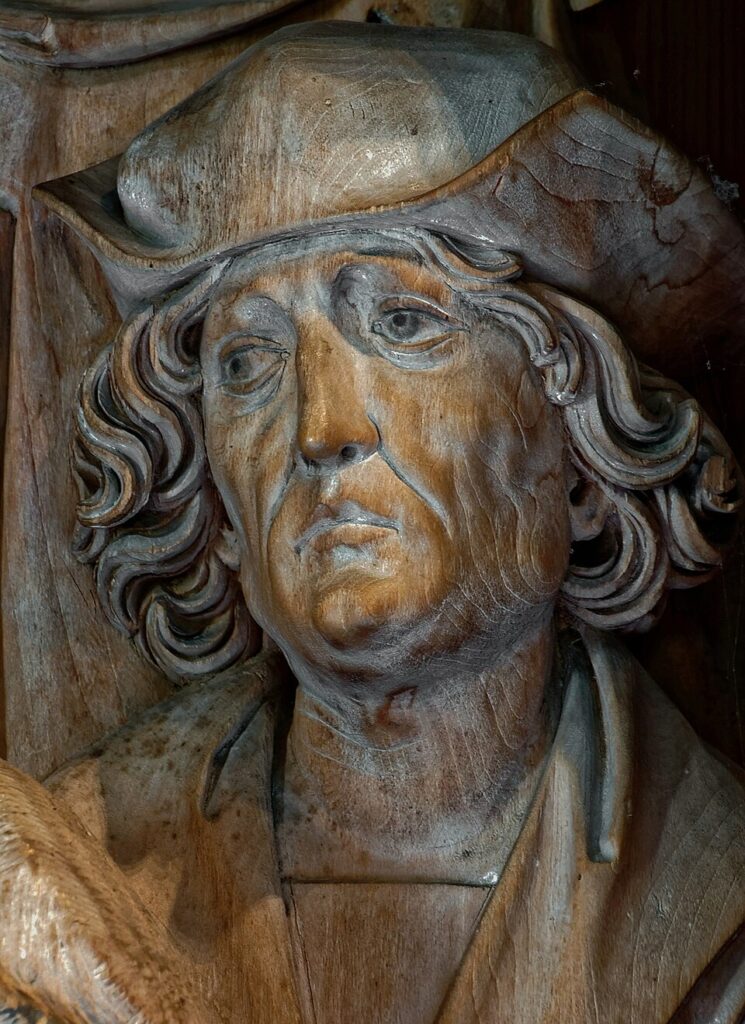
The Late Gothic period in Germany, spanning roughly from 1450 to 1530, marked a time of profound creativity, technical innovation, and spiritual intensity in the arts—particularly in woodcarving. During this time, woodcarvers elevated their craft to astonishing levels of detail and emotional depth. While other regions of Europe leaned more heavily toward stone sculpture or painting, the German lands fostered a unique devotion to sculpting in wood. This choice was not merely practical—it allowed for a softness and expressive range unmatched by harder materials.
Wood, especially lindenwood, became the lifeblood of religious expression in late medieval Germany. From altarpieces to pulpits and choir stalls, woodcarving was central to the spiritual experience of the time. These works were not static; they were charged with emotional energy and a sense of sacred drama. The Late Gothic aesthetic embraced intricacy, motion, and deeply human expressions, qualities that brought Biblical scenes to life in parish churches and cathedrals across the region.
Defining the Late Gothic Aesthetic in Wood
What defines Late Gothic German woodcarving is not merely its technical mastery but its distinctive visual language. Figures are often elongated and fluid, with garments that ripple like wind-blown fabric. Faces show profound suffering, divine peace, or contemplative sorrow, capturing inner states of the soul. Deep relief carving, where figures project dramatically from their architectural backdrops, enhanced the theatricality of these compositions.
This article explores the flourishing of woodcarving in this period through a careful study of its historical context, techniques, key artists, and regional variations. We’ll also trace how these works influenced later generations of artists and collectors. Along the way, we’ll uncover the biographies of several master sculptors whose legacies shaped German art. By the end, readers will understand why Late Gothic woodcarving in Germany stands as one of the pinnacles of Western religious art.
Historical Context — Faith, Function, and Form
The Late Gothic era in Germany emerged during a time of deep religious devotion and societal transformation. The Catholic Church remained the dominant cultural force, and its influence shaped nearly every aspect of visual expression. Woodcarving was not created for private enjoyment—it served the liturgical and devotional needs of the faithful. In churches, monasteries, and chapels, carved altarpieces became focal points for worship, acting as visual sermons for largely illiterate congregations.
As the medieval worldview gave way to early modern sensibilities, German territories experienced both economic growth and civic pride. Wealthy merchant families and religious institutions began commissioning elaborate sculptural works to adorn their towns and sanctuaries. The late 15th century also saw the rise of civic guilds and independent city councils, which sometimes acted as patrons. This democratization of art patronage allowed for a greater diversity of works and artists, breaking away from purely aristocratic or ecclesiastical control.
The Role of Woodcarving in Sacred Spaces
Carved wood occupied almost every corner of sacred German spaces—from intricate choir stalls to towering reredos behind the altar. Altarpieces served not only as decorative elements but also as teaching tools, illustrating the lives of Christ, the Virgin Mary, and various saints. Multi-panel structures, known as polyptychs, allowed for narrative sequences to unfold across hinged wings that could be opened or closed depending on the liturgical season. When opened for feast days, these altars revealed dramatic scenes rendered in three-dimensional splendor.
This was also an era of heightened mystical devotion, especially among the laity. Movements like the Devotio Moderna emphasized personal piety and intimate meditation on the sufferings of Christ. Woodcarvers responded by creating figures with tear-streaked faces, bleeding wounds, and tender gestures that invited emotional identification. In this way, sculpture became a bridge between heaven and earth, making the divine tangible to all who knelt before it.
Techniques and Materials in Late Gothic Sculpture
The technical processes behind Late Gothic woodcarving were as refined as the results they produced. The favored material—lindenwood—was chosen for its fine grain, softness, and ability to hold intricate detail without splitting. Other woods like oak and walnut were also used, particularly for structural elements or where greater durability was required. Linden, however, reigned supreme in the production of figural sculpture due to its ease of manipulation and pale color, which provided a neutral base for painted finishes.
Carving began with large blocks of wood, often joined from multiple planks. Master carvers started with rough outlines, gradually building depth and complexity. Once the general form was established, finer details were carved using chisels, knives, and gouges. The final stages involved surface treatments—gesso, polychromy (color painting), and gilding. These not only protected the wood but added vibrancy and realism, transforming sculptures into lifelike presences.
From Lindenwood to Life: Process and Precision
Workshop organization played a crucial role in the production of these masterpieces. Typically, a master carver led a team of journeymen and apprentices who each specialized in different aspects—some roughing out shapes, others refining details or handling painted finishes. Designs were often drawn first on paper or parchment, then transferred to wood using templates or pin-pricks. Scaling models allowed artists to enlarge a small sketch into monumental sculpture with impressive accuracy.
Although we tend to focus on the named masters, much of this work was collaborative. Painters frequently partnered with sculptors to apply polychromy, while metalworkers might add crowns, swords, or halos. The final product was a multi-media experience that integrated architecture, sculpture, and painting into a unified sacred vision. These pieces were not meant to be viewed casually—they were devotional instruments, crafted with precision to inspire awe and reverence.
Notable Woodcarvers and Their Workshops
Among the many carvers who worked during the Late Gothic period in Germany, a few stand out for their innovation, expressiveness, and impact. One of the greatest was Veit Stoss (c. 1447–1533), born in Horb am Neckar in Swabia. His most famous work is the monumental High Altar of St. Mary’s Basilica in Kraków, completed between 1477 and 1489. Standing over 40 feet tall, this altarpiece displays deeply emotional figures, complex compositions, and extraordinary craftsmanship. Stoss later moved to Nuremberg, where he continued his career despite facing imprisonment in 1503 over forgery charges—an incident that briefly interrupted his artistic output.
Another towering figure of the time was Tilman Riemenschneider (c. 1460–1531), who settled in Würzburg after a period of training in Strasbourg. Riemenschneider is known for blending Gothic expressiveness with early Renaissance realism, often leaving his sculptures unpainted to highlight the quality of the carving itself. One of his most acclaimed works is the Altarpiece of the Holy Blood in Rothenburg ob der Tauber (1500–1505), which presents a delicately modeled Last Supper with individualized apostles. He also served as a town councilor in Würzburg and was briefly imprisoned during the German Peasants’ War in 1525.
Master Craftsmen and Regional Fame
Hans Multscher (c. 1400–1467), active earlier than Stoss or Riemenschneider, laid the groundwork for naturalistic carving in Ulm and Swabia. His Wurzach Altarpiece (1437) demonstrates a sophisticated attention to proportion, anatomy, and perspective rarely seen before in German wood sculpture. Multscher’s workshop also produced painted panels, showing the integrated nature of artistic production in the period. His legacy influenced a generation of carvers who carried his approach into the mature Late Gothic style.
These master sculptors rarely worked alone. Their workshops were hubs of activity, where commissions flowed in from churches, monasteries, and civic authorities. They often collaborated with painters such as Michael Wolgemut (teacher of Albrecht Dürer) and specialized metalworkers. The demand for devotional sculpture created opportunities for carvers to gain regional fame and attract international patrons—most notably in Stoss’s move to Poland. Their legacies live on not only in finished works but in the vibrant artistic ecosystems they cultivated.
Iconography and Thematic Trends
Themes in Late Gothic German woodcarving were shaped by the religious culture of the time, emphasizing the Passion of Christ, Marian devotion, saints’ lives, and eschatological visions. Central to many altarpieces was the crucifixion, often rendered with a raw realism that conveyed Christ’s suffering in excruciating detail. Blood dripped from wounds, faces contorted in agony, and garments clung tightly to anguished bodies. This intense imagery was not gratuitous—it was designed to provoke compassion and penitence among viewers.
The Virgin Mary held a central place in German devotional life. Scenes such as the Annunciation, Pietà, and Coronation of the Virgin frequently appeared in altarpieces, often flanked by narrative cycles showing her life from birth to assumption. The Madonna was depicted not only as Queen of Heaven but also as a grieving mother, her sorrow magnified by the emotional realism of Late Gothic style. These works served both liturgical and emotional purposes, inviting worshippers into a shared experience of divine sorrow and hope.
Suffering Saints, Tender Virgins, and Apocalyptic Visions
Carvers also explored the lives of saints, especially local patrons like Saint Sebaldus, Saint Barbara, and Saint Elizabeth of Hungary. These figures were often included in altarpieces as intercessors or examples of Christian virtue. Their stories were dramatized in vivid reliefs or free-standing figures, enabling worshippers to engage with sacred history on a personal level. Apocalyptic imagery was also popular, particularly the Last Judgment, which reminded viewers of the consequences of sin and the promise of redemption.
Notably, many works show a psychological depth that hints at the coming Renaissance. Figures display individual emotions and reactions, rather than uniform expressions of piety. Carvers began to pay attention to bodily movement, facial muscles, and gestures that conveyed inner life. While still rooted in the medieval worldview, these changes signaled a growing humanism that would flourish in the 16th century. In this transitional moment, Late Gothic woodcarving revealed the soul through the body, capturing the mysteries of faith in wood.
Regional Styles Across German Territories
Though united by common themes and techniques, German Late Gothic woodcarving displayed significant regional variation. In Swabia, especially in the city of Ulm, figures were characterized by elongated bodies, oval faces, and flowing drapery. This style emphasized grace and verticality, as seen in the works of the Ulm School, including Michel Erhart and Jörg Syrlin the Elder. Choir stalls and pulpit carvings from this region exhibit refined elegance, often enhanced with subtle polychromy and gilded ornamentation.
Franconia, with centers like Würzburg and Bamberg, favored a more robust realism. Carvers in this region—including Riemenschneider—tended toward fuller figures with grounded postures and naturalistic expressions. The influence of the Italian Renaissance crept in earlier here, resulting in sculptures that combined traditional Gothic structure with new approaches to anatomy and emotion. The blend of expressive spirituality and measured form marked Franconia as a key innovator in transitional sculpture.
From Swabia to Saxony: Distinct Carving Traditions
In Bavaria, elaborate high altarpieces dominated the sculptural landscape. These works often included architectural frameworks filled with multiple narrative scenes and hundreds of figures. Artists like Erasmus Grasser in Munich produced theatrical compositions teeming with energy and detail. The craftsmanship extended beyond sculpture to include ornate tabernacles, processional crosses, and reliquaries, creating total visual environments that overwhelmed the senses.
In Saxony and Thuringia, the style was often more restrained, with linear figures and simplified compositions. Yet even here, notable artists like Peter Breuer and the workshop of Hans Hesse contributed to the evolving language of Gothic carving. Regional workshops adapted designs based on local taste, theological emphasis, and available resources. Trade routes like those of the Hanseatic League allowed ideas to travel, but regional identity remained strong—resulting in a rich tapestry of stylistic voices across the German lands.
Legacy and Influence in Early Modern Art
As the 16th century progressed, the Gothic style gradually gave way to Renaissance ideals, but German woodcarving maintained its vitality longer than in many parts of Europe. In regions north of the Alps, Late Gothic traditions continued well into the early 1500s. Sculptors like Riemenschneider began integrating Renaissance motifs—such as classical drapery and architectural elements—into otherwise Gothic compositions. This synthesis reflected both aesthetic change and the enduring spiritual intensity of the earlier style.
Religious upheavals during the Reformation (beginning in 1517) and changes in patronage shifted the focus of art commissions. Lutheran regions rejected lavish church imagery, leading to the destruction of some Gothic altars. Yet many works survived, especially in Catholic regions or due to private preservation. By the Baroque period, collectors and scholars began to value these Gothic masterpieces as embodiments of national identity and artistic heritage.
The Decline of the Gothic and Rise of the Renaissance
Late Gothic woodcarving also influenced later sculptors who admired its emotional intensity and technical brilliance. Northern Mannerist artists, such as Joachim Deschler and Hans Gieng, drew upon its dramatic compositions and expressive anatomy. Museums like the Germanisches Nationalmuseum in Nuremberg and the Bavarian National Museum in Munich preserve many of these works today, allowing modern audiences to experience their spiritual and artistic power.
Though often overshadowed in textbooks by the Italian Renaissance, the German Gothic tradition holds a unique place in art history. Its achievements in woodcarving—both technical and theological—represent a peak of medieval Christian artistry. The work of masters like Veit Stoss and Tilman Riemenschneider still inspires awe, not only for their skill but for their profound ability to capture the eternal in carved wood. Their legacy endures as a testament to faith, craftsmanship, and the enduring power of sacred art.
Key Takeaways
- German Late Gothic woodcarving (1450–1530) featured emotional intensity, technical skill, and religious purpose.
- Lindenwood was the primary material due to its softness and ability to hold fine detail.
- Key figures include Veit Stoss, Tilman Riemenschneider, and Hans Multscher, each with distinct styles and regional influence.
- Altarpieces, pulpits, and choir stalls served as both liturgical furnishings and visual theology.
- Regional styles varied greatly, but all reflected deep Christian devotion and emerging Renaissance ideals.
FAQs
- What made Late Gothic German woodcarving unique?
Its emotional expressiveness, deep relief carving, and emphasis on sacred narratives set it apart from other Gothic traditions. - Who were the most famous woodcarvers of the time?
Veit Stoss, Tilman Riemenschneider, and Hans Multscher were among the most influential and innovative. - Why was lindenwood so commonly used?
It was easy to carve, held detail well, and allowed for expressive facial modeling and fine drapery. - How did regional styles differ?
Swabia favored elegance, Franconia emphasized realism, Bavaria showcased grandeur, and Saxony leaned toward restraint. - Where can these works be seen today?
Major collections exist in museums like the Germanisches Nationalmuseum and many churches across Germany and Poland.