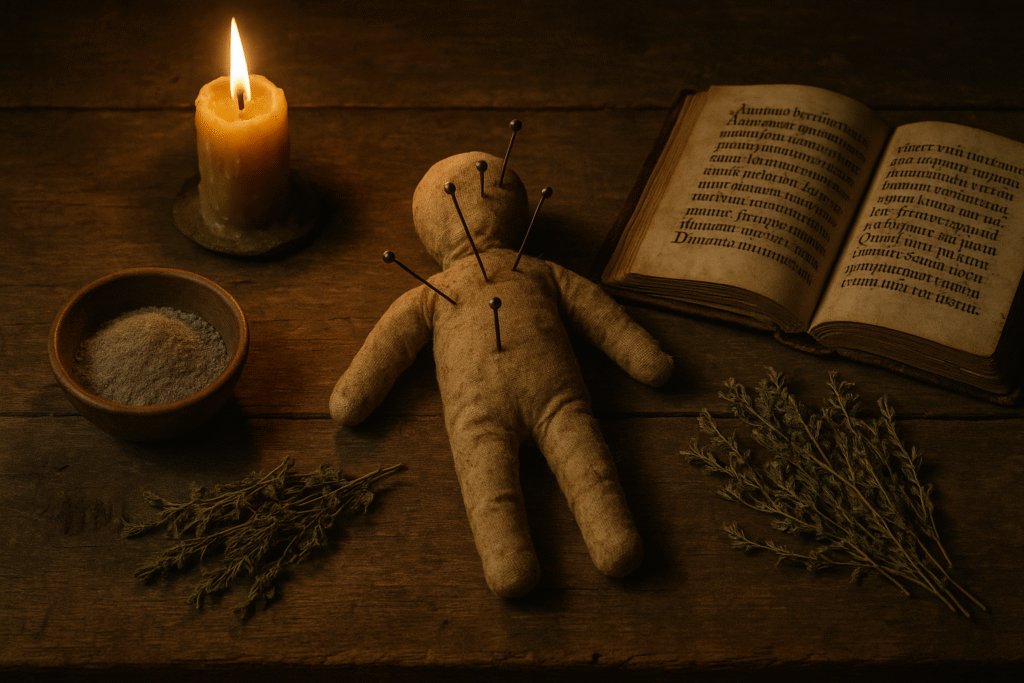
The use of dolls as magical instruments traces back to the ancient civilizations of the Mediterranean. In Greece and Rome, small human-shaped figures made of wax, clay, or lead were commonly used in acts of sympathetic magic. This belief system held that an object resembling a person could influence that individual through ritual actions. In ancient Athens and Delos, figurines called kolossoi were found alongside inscribed curse tablets, dating from as early as the 4th century BC. These were typically buried in graves or sacred sites, symbolizing an appeal to chthonic powers for vengeance or control.
The Romans adopted these practices readily. Known as defixiones, their lead curse tablets were sometimes wrapped around small effigies of enemies or rivals. These figures were often pierced with nails and buried at crossroads or gravesites, where they were believed to be more accessible to spirits of the dead. The ritual act mirrored the desired effect: to paralyze, silence, or emotionally bind the victim. These ancient precedents laid the groundwork for the later European use of dolls in cursing and healing, evolving into what became known in England as poppets.
Medieval and Early Modern England
By the late Middle Ages, poppets began to appear in legal and ecclesiastical records, particularly in the context of witchcraft accusations. These dolls were often made of wax and were closely associated with harmful magic. One of the most significant early references appears in Malleus Maleficarum, written in 1487 by the inquisitor Heinrich Kramer. This influential text described how witches used effigies to harm their victims, either through direct piercing or by melting the doll over fire to simulate wasting sickness.
In England, the 16th and 17th centuries saw a surge of poppet-related accusations during witch trials. In 1590, the North Berwick witch trials in Scotland involved claims of witches crafting wax dolls to harm King James VI. The dolls were said to be melted over slow flames while reciting curses. In 1612, during the Pendle witch trials in Lancashire, poppets were allegedly discovered among the belongings of the accused. These figures were often cited as physical evidence of malevolent intent and were feared as conduits for invisible attacks on both body and soul.
Regional Variants and Terminology
Though the word “poppet” became common in English, other cultures developed their own terminology for magical dolls. In southwestern England, terms like “mommet” or “poppit” were often used. In Scotland, the practice of using wax figures in harmful rituals was known, and the dolls were sometimes called “image figures.” In Germany and Austria, similar magical objects were called Zauberpuppen or fetisch. The terminology varied by region, but the underlying belief in the power of symbolic representation remained consistent.
The specific materials and construction techniques also varied. In some areas, dolls were made of straw or rags, dressed in scraps of the target’s clothing. In others, carved wood or molded wax was preferred. Hair, nail clippings, or even bodily fluids might be included in the figure to strengthen the magical link. These materials were not chosen at random—they reflected long-standing folk beliefs about contagion magic, where physical contact with a person’s belongings could establish a lasting supernatural connection.
- Common materials used in early poppets:
- Wax
- Cloth
- Straw
- Bone
- Animal hair
- Nails
Construction and Use: How Poppets Were Made and Activated
Ritual Crafting Techniques
The creation of a poppet was rarely casual. It was usually a ritual act, often performed in secrecy and with great care. Folk magicians, wise women, and cunning men followed specific procedures for making dolls to ensure their effectiveness. Wax was one of the most commonly used substances due to its human-like texture and its symbolic association with life and death. In many traditions, wax poppets were formed during specific lunar phases, especially the waning moon, when cursing or banishing spells were considered strongest.
Hair, nail clippings, or bits of worn clothing were frequently inserted into the doll to create what was known as a “taglock”—a physical link to the target. In some cases, herbs were sewn into the doll, such as vervain or wormwood for harm, or rosemary and thyme for healing. The figures might be marked with astrological symbols or the initials of the person they represented. The act of making the poppet itself was often accompanied by prayers or spells, muttered in Latin, Middle English, or local dialects, depending on the practitioner’s tradition.
Curses, Healing, and Protection
Though often associated with curses, poppets were used in a wide variety of magical workings. Healing poppets were popular in the rural parts of Britain and continental Europe. In these cases, a doll would be created in the image of a sick person and then ritually treated—bathed in water, rubbed with healing salves, or placed near holy relics—to absorb the illness and restore health. Some traditions also included passing the poppet through church smoke or laying it before altars.
Love and fertility magic were other areas where poppets saw regular use. In folk traditions across England, Ireland, and Germany, women would craft dolls of desired lovers, whispering charms over them or binding them with red string to encourage affection. In agricultural settings, poppets made from corn husks or fruit tree wood were buried in the soil to ensure crop fertility and general abundance. Protective poppets, dressed in white cloth and blessed with holy water, were sometimes hung near doors or in barns to keep away illness or misfortune.
Activation and Disposal Rituals
Once created, a poppet required activation through specific ritual actions. In cursing rites, pins were often inserted into the eyes, heart, or abdomen of the doll, symbolizing direct attacks on the corresponding areas of the victim. Burning was another common method—wax dolls would be slowly melted over flames to bring about wasting illness. In Scotland and Wales, it was believed that burying a doll near a person’s home or under their doorway could invite supernatural harm.
Words of power were typically spoken during the activation, often drawn from biblical phrases, local incantations, or corrupted prayers. For example, in some English traditions, practitioners reversed the Lord’s Prayer or invoked saints in twisted forms to give potency to the spell. Disposal was also considered essential. A poppet used in a harmful spell had to be either completely destroyed or buried in a location where no one would find it. Improper disposal was believed to risk spiritual backlash or even allow the magic to rebound upon the caster.
- Common actions used to activate poppets:
- Pin insertion
- Burning
- Burial under thresholds
- Drowning in running water
- Enchanting with words
Poppets Across Cultures: Beyond Europe
Voodoo Dolls and Haitian Traditions
The image of the voodoo doll as a tool for harm is largely a myth born of fiction, not historical fact. In Haitian Vodou, the use of effigies is more aligned with honoring spirits than attacking people. Dolls and figurines, often richly dressed and respectfully maintained, are used as spiritual vessels for the lwa, or deities. These items are typically placed on altars, not pierced with pins. The modern notion of the pin-stuck voodoo doll was developed in 20th-century pulp literature and later perpetuated by films and television.
Serious studies of Vodou by scholars like Alfred Métraux and Maya Deren found no consistent tradition of using dolls to harm others in Haitian religious practice. In fact, the misuse of effigies for harm was viewed as a form of illicit sorcery rather than sanctioned religious action. The Western misconception of the “voodoo doll” has unfairly distorted the public’s understanding of Vodou, a faith rooted in community, healing, and reverence for ancestors and spirits.
Middle Eastern and North African Practices
In Islamic cultures, magical use of dolls existed despite religious prohibitions against sorcery. Folk practices in Egypt, Syria, and Morocco included the use of clay or wax figures in acts of sihr—a term referring to hidden or forbidden magic. Historical writings from the Mamluk and Ottoman periods describe rituals where dolls were pierced or buried while verses from the Quran were recited, often in reversed or corrupted forms. These figures were sometimes used in love magic, binding rituals, or to cause discord between spouses.
In Morocco, particularly among women, magical dolls were part of domestic ritual life. Dolls might be washed with special herbal waters or smeared with bodily fluids and then buried near the home of a rival. Such practices, though not officially sanctioned, were widely documented by colonial-era ethnographers and remain a part of some rural folk traditions. The magical logic behind these practices mirrored European ideas—symbolic representation plus ritual action equals supernatural influence.
Slavic and Balkan Magic Dolls
Across Eastern Europe, particularly in the Slavic and Balkan regions, dolls were used for both protective and destructive purposes. In Bulgaria, small wool dolls were often made in secret by women seeking to ensure the loyalty or affection of a lover. These figures might be hidden under the target’s bed or placed near food. Ritual instructions for these acts were passed down orally, especially in rural mountain communities.
Romania offers examples of păpuși de blestem, or curse dolls, crafted from wax or rags. These were typically burned while invocations were spoken to summon divine punishment on enemies. In Ukraine, the motanka doll, made without a face, was considered a protective talisman and often placed in homes or cradles to ward off the evil eye. Despite their variety, all of these dolls functioned through the same core principle: that a handmade figure, properly constructed and activated, could influence a person’s fate.
Surviving Artifacts and Modern Resurgence
Museum Collections and Archaeological Finds
Despite their delicate materials, several historical poppets have survived and are housed in museum collections. One of the most significant is a 17th-century wax poppet found near the River Thames in London. This doll, pierced with multiple iron pins, is part of the British Museum’s collection.
- Title: Wax Poppet with Pins
- Artist: Unknown
- Year: 17th century
- Medium: Wax, iron pins
- Dimensions: Approximately 15 cm
- Current Location: British Museum, London
- Accession Number: 1889,0713.1
The doll was likely used in a ritual to cause harm, possibly associated with witchcraft practices during a period when such activities were widely feared. Other institutions, such as the Pitt Rivers Museum in Oxford, also display magical dolls from across Europe, many of which were collected during the 19th and early 20th centuries. These objects offer rare, tangible evidence of a practice that was otherwise kept secret or destroyed after use.
Neo-Paganism and Contemporary Witchcraft
In the 20th century, interest in traditional European witchcraft and folk magic experienced a revival. Modern Neo-Pagan groups, particularly Wiccans and practitioners of traditional witchcraft, have reintroduced the use of poppets into ritual work. However, their focus has largely shifted away from curses toward healing, focus, and protection. Contemporary spell books and websites often include instructions for making cloth poppets filled with herbs, crystals, and handwritten intentions.
Many modern practitioners emphasize ethical considerations, drawing on principles like the Wiccan Rede (“An it harm none, do what ye will”) to guide magical work. Poppets are now commonly used for self-improvement or spiritual development, often functioning as tools for meditation, affirmation, or psychological healing. This shift marks a clear departure from the darker uses of the past, even as the core principle—symbolic representation as a means of influence—remains unchanged.
Poppets in Popular Media and Misconceptions
The image of the poppet has undergone a significant transformation in popular culture, often at the cost of historical accuracy. Films, television shows, and novels—particularly in the horror and fantasy genres—have helped cement the idea of the cursed doll as a terrifying object used for evil. From early 20th-century pulp horror stories to modern franchises like The Conjuring and American Horror Story, dolls are frequently depicted as haunted, malevolent, and inherently dangerous. These representations have created a cultural shorthand where the presence of a doll automatically suggests supernatural menace.
This portrayal often blends the concept of the European poppet with the fictionalized voodoo doll, conflating two very different magical systems into a single image of fear. In doing so, media has stripped these objects of their historical and cultural nuance. While dolls were indeed used for curses in various folk traditions, they also served protective and healing functions. Fiction has exaggerated their role, rarely showing the complex religious and ethical systems that governed their real-life use.
There have been attempts by folklorists, historians, and modern practitioners to correct these misconceptions. Academic works, museum exhibits, and public lectures have explored the real history of magical effigies in a more balanced way. The British Museum and the Pitt Rivers Museum, for instance, include poppets in broader exhibits on folk belief and domestic spirituality, not just witchcraft. By highlighting their varied uses, such efforts aim to reclaim these objects from sensationalized portrayals.
Still, the appeal of the sinister doll endures. It resonates because it plays on primal fears—fear of the uncanny, of being watched, of losing control. These emotional triggers make cursed dolls compelling symbols in fiction, even if they distort the reality. The poppet’s persistence in the cultural imagination reflects both its folkloric power and its adaptability as a symbol of unseen forces, whether spiritual or psychological.
Key Takeaways
- Poppets have been used in magical traditions since at least ancient Greece and Rome, often in rituals of sympathetic magic.
- In medieval and early modern Europe, poppets became strongly associated with witchcraft, especially in England and Scotland.
- Despite their reputation, poppets were used for healing, protection, fertility, and justice—not only for curses.
- Similar effigy practices exist in many cultures, including Haiti, North Africa, and the Balkans, each with unique meanings and methods.
- While often misrepresented in popular media, historical poppets are important cultural artifacts with complex and varied histories.
Frequently Asked Questions
What is a poppet in folk magic?
A poppet is a small human-shaped doll used in folk magic to influence a person through sympathetic ritual. It could be used for healing, cursing, love, or protection.
Are poppets the same as voodoo dolls?
No. The concept of a “voodoo doll” is a modern Western invention. In Haitian Vodou, effigies are used respectfully in religious rituals, not typically for harm.
What materials were traditional poppets made from?
Traditional poppets were crafted from wax, cloth, straw, or wood, and often included personal items like hair or nail clippings to connect them to the target.
Are there real historical poppets in museums?
Yes. A notable example is a 17th-century wax poppet with pins, housed in the British Museum in London, likely used in a historical curse ritual.
Do people still use poppets today?
Yes, particularly in modern Neo-Pagan and witchcraft traditions, though their use today focuses more on healing, protection, and spiritual self-improvement.