The land that would one day become Moscow was not empty when the city’s chronicles first recorded its foundation in the 12th century. Long before princes, monasteries, and stone walls defined its skyline, the forests and river valleys of central Russia bore traces of human presence that shaped an early visual culture. These traces are faint—fragments of pottery, burial mounds, wooden idols long since rotted away—but together they form the deep background against which Moscow’s later art emerged.
Traces of Settlement Along the Moskva River
Archaeological surveys along the Moskva River reveal evidence of human habitation stretching back thousands of years. Stone tools found in river terraces suggest hunters and gatherers moved through the area as early as the Mesolithic. Later, in the Bronze and Iron Ages, more permanent settlements began to appear, marked by earthen fortifications and burial mounds. These burial sites—kurgans—often contained not only weapons and jewelry but objects decorated with geometric or animal motifs. Such artifacts remind us that even in societies without monumental architecture, art functioned as both ornament and symbol, binding the living to their ancestors.
The river itself played a role in shaping culture. The Moskva, winding gently across the plain, was not only a route of travel but a stage for seasonal rituals. Fishermen carved bone hooks with careful incisions, more decorative than practical, suggesting a desire to invest utilitarian tools with meaning. Clay vessels, too, show repetitive patterns—zigzags, waves, and crosshatches—that echoed the rhythms of water and fire. In these modest objects lies a kind of proto-artistic sensibility, the first visual language of the land that would become Moscow.
Decorative Patterns on Pottery and Ritual Objects
When early Slavic tribes settled the region between the 5th and 9th centuries AD, they inherited and transformed these traditions. Pottery fragments uncovered near Kolomenskoye and other early sites display distinctive incised or stamped decoration. Some show solar motifs, circles radiating spokes, which scholars connect to fertility rites and seasonal cycles. Others bear complex woven patterns resembling basketry, perhaps recalling the textures of daily life.
The craftsmanship went beyond functional necessity. Certain vessels, with their carefully burnished surfaces and symmetrical forms, appear to have been made for ritual purposes, not for storing grain or water. Small clay figurines—rare but significant—depict stylized human shapes or animals. Though their meanings are elusive, they almost certainly served as talismans or offerings. In their abstract simplicity, they foreshadow the symbolic condensation that would later mark Orthodox icon painting, where a saint’s presence is invoked not through realism but through essential form.
Three particularly striking categories of artifacts found in the broader Moscow region highlight this early artistic impulse:
- Amulets shaped as animals, worn around the neck, suggesting protective magic linked to forest creatures.
- Bronze ornaments decorated with spirals, perhaps connected to fertility or sun worship.
- Carved bone combs, both practical and aesthetic, sometimes inscribed with geometric patterns.
These objects may seem small, but together they show a people for whom art and life were inseparable. Decoration was not a luxury—it was a necessity, a way of binding the everyday to the sacred.
Pagan Shrines, Wooden Sculpture, and the Arrival of Christianity
If pottery and jewelry reveal the intimate scale of early art, wooden idols hint at its monumental dimension. Chronicles from later centuries recall how the Slavs erected statues of gods such as Perun, the thunder deity, on hilltops and riverbanks. None survive in the Moscow region—wood perishes too easily in damp soil—but parallels from Novgorod and Kiev give us a sense of their appearance: tall, rough-hewn figures with oversized heads and simplified features, sometimes bearing weapons or symbols of power. These images were not meant to be portraits but embodiments, vessels through which divine forces could be approached.
Archaeological remains suggest that sacred groves and outdoor shrines were central to spiritual life. Offerings of food, weapons, or jewelry were left at these sites, linking artistic production directly to religious practice. The rhythm of seasons, harvests, and battles demanded visual expression, and sculpture and ritual objects provided it.
The arrival of Christianity in the late 10th century marked a profound rupture. Pagan idols were toppled, shrines dismantled, and new wooden churches raised. Yet traces of the old imagery persisted, filtering into ornament and folk art. The stylized spirals and animal motifs of Slavic decoration did not vanish; they resurfaced in embroidered garments, in carved window frames, and even in the border patterns of illuminated manuscripts centuries later. The Moscow that would grow into a center of Orthodox art carried in its bones these earlier artistic impulses.
From the decorated pots of prehistoric settlements to the carved idols of pagan shrines, the Moscow region’s earliest art formed a dialogue between survival and belief. It was humble in scale but vast in meaning, connecting communities to the natural world and the unseen forces they felt within it. When Moscow finally emerged as a city in the 12th century, it inherited not a blank slate but a layered memory of symbols and forms—a memory that continued to echo in the art of icons, churches, and palaces to come.
A City of Icons: Moscow’s Emergence in the Medieval World
When Moscow was first mentioned in chronicles in 1147, it was little more than a fortified outpost on the edge of dense forests. Yet within two centuries, it became not only the political center of a growing principality but also a workshop of images that defined Russian Orthodoxy. Art in medieval Moscow cannot be separated from faith: icons, churches, and liturgical objects were not mere decoration but instruments of belief, windows into the sacred.
The Orthodox Faith as Catalyst
The baptism of Rus’ in 988 brought Christianity from Byzantium into the Slavic lands, and with it came a powerful visual tradition. Icons—painted images of Christ, the Virgin, and the saints—were understood not as illustrations but as presences, vehicles through which prayer reached the divine. By the time Moscow rose as a principality, this theological understanding had matured into an art form of extraordinary refinement.
Monasteries played a central role. The Kremlin, originally a wooden fort, soon sheltered not only princes but monks and painters, whose task was to fill its chapels with sacred imagery. Workshops grew up around the city, producing icons for churches, private devotion, and even military campaigns. A Moscow prince would ride into battle with a revered icon at the head of his troops, convinced of its protective power.
The aesthetic of these icons was defined by restraint and symbolism. Gold leaf backdrops dissolved earthly space into eternity; elongated figures reminded the viewer of a higher order beyond flesh; subtle gestures carried layers of theological meaning. Unlike Western painting, which was beginning to explore perspective and naturalism, Moscow’s art sought the opposite: transcendence over realism.
Workshops Around the Kremlin
The Moscow Kremlin became the beating heart of this icon-centered culture. Within its walls, cathedrals rose in stone, and behind their doors, painters worked under candlelight, grinding pigments from minerals and plants. Apprentices learned the long sequence of steps—preparing wooden panels, applying gesso, outlining figures, layering colors from dark to light, and finally applying gold leaf. Each action was accompanied by prayer, turning painting into liturgy.
Not only monks but also lay artisans took part. By the late 14th century, Moscow’s workshops had drawn painters from across the Rus’ lands, eager to contribute to the city’s growing prestige. These workshops did not function as studios in the modern sense; rather, they were guilds of sacred labor, where individual names mattered little compared to collective devotion. Yet, at moments, singular voices emerged with startling clarity.
One such figure was Theophanes the Greek, a painter who had already worked in Novgorod before arriving in Moscow around 1390. His frescoes in the Annunciation Cathedral impressed contemporaries with their dynamism and expressive force. Where earlier icons had been serene and solemn, Theophanes introduced a sense of inner turbulence, a spiritual fire that electrified Moscow’s sacred spaces.
The Role of Andrei Rublev and the Flowering of Icon Painting
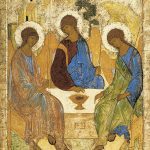
It was Andrei Rublev, however, who transformed Moscow into a center of iconic beauty. Active in the early 15th century, Rublev painted with an unmatched clarity of vision, embodying theological ideas in color and form with a grace that still speaks across centuries. His most famous work, the Trinity icon, created for the Trinity Monastery of St. Sergius, distilled the mystery of divine unity into a serene image of three angels seated around a table. There is no overt drama, no attempt at storytelling. Instead, balance, harmony, and light suffuse the panel, drawing the viewer into contemplation.
Rublev’s art marked the height of Moscow’s medieval style. His palette was luminous, favoring soft blues, gentle greens, and warm ochres that conveyed peace rather than severity. Where Theophanes had been fiery and restless, Rublev was calm and expansive. The church recognized this spiritual clarity: in 1551, the Stoglavy Council declared his icons models to be followed by all painters in Russia.
Rublev’s influence extended beyond a single masterpiece. Frescoes attributed to him and his circle, such as those in the Dormition Cathedral in Vladimir, demonstrate how Moscow’s art fused Byzantine inheritance with local sensibility. Figures are less rigid, gestures more human, colors more transparent. Through Rublev, Moscow became synonymous with a spiritualized vision of humanity—one that would define Russian art for generations.
The rise of Moscow as an icon-painting center was not a matter of local craft alone; it was tied to the city’s growing political destiny. As Moscow’s princes asserted leadership over other Rus’ lands, the city’s art projected both spiritual authority and cultural unity. In gilded icons carried through processions, Muscovites saw not only the face of Christ but the emerging identity of their city as a sacred capital. The seeds of Moscow’s later role as an artistic powerhouse had been planted, shimmering in gold leaf across wooden panels.
White Stone and Golden Domes: Architecture of Early Moscow
If icons provided Moscow with its spiritual imagery, architecture gave the city its physical form. The transformation of Moscow from a modest fortress into a seat of power unfolded in stone and mortar, through cathedrals and towers that still dominate its skyline. From the 14th to the 16th century, architecture became Moscow’s most visible art form, a medium where politics, faith, and aesthetics fused into a single statement.
The Cathedral of the Assumption as Statement of Power
Few buildings illustrate Moscow’s ambitions more vividly than the Cathedral of the Assumption (Uspensky Sobor) inside the Kremlin. Commissioned by Grand Prince Ivan III in the late 15th century, it was built on the site of an earlier church, its construction entrusted to the Italian architect Aristotele Fioravanti. Fioravanti studied the great cathedrals of Vladimir before reimagining them in Moscow’s heart, blending local traditions with Renaissance engineering.
The cathedral’s five domes rise above a broad, harmonious façade of white stone. Inside, soaring vaults create a sense of expansiveness rare in earlier Rus’ churches, while frescoes cover every surface with biblical imagery. The building was more than a house of worship: it became the ceremonial center of Muscovite power, where tsars were crowned and patriarchs enthroned. Each coronation ritual reinforced the idea of Moscow as the “Third Rome,” heir to Byzantium’s spiritual and imperial legacy.
What makes the Assumption Cathedral remarkable is its combination of universality and locality. The domes evoke Byzantine precedent, the white stone echoes Vladimir, and the engineering innovations come from Italy. Yet together, they produce something distinctly Muscovite: a synthesis that would define the city’s architectural identity for centuries.
Italian Architects in Moscow Service
Ivan III’s decision to invite Italian architects was not a concession to foreign taste but a calculated assertion of power. Figures such as Fioravanti, Marco Ruffo, and Pietro Antonio Solari brought technical knowledge that allowed Moscow to build on a scale impossible before. They helped reconstruct the Kremlin with imposing brick walls and towers, transforming the fortress into a symbol of dynastic authority.
Yet these architects did not impose alien forms wholesale. Instead, they adapted their skills to local traditions. Fioravanti’s Assumption Cathedral drew inspiration from the Dormition Cathedral in Vladimir, ensuring continuity with the Rus’ past. Solari’s towers, though Renaissance in engineering, became capped with tented roofs and crenellations suited to Russian climate and taste. The collaboration produced a hybrid style that was neither fully Italian nor entirely Slavic, but unmistakably Muscovite.
The arrival of these architects also introduced new ideas of proportion, symmetry, and structural daring. While earlier churches had been heavy and compact, Moscow’s new cathedrals stretched upward and outward, their interiors more luminous, their exteriors more rhythmically ordered. This architectural revolution paralleled Moscow’s political revolution: just as the city consolidated power over rival principalities, so too it asserted cultural leadership through buildings that dwarfed anything in its rivals’ towns.
Symbolism of Onion Domes and Fortified Monasteries
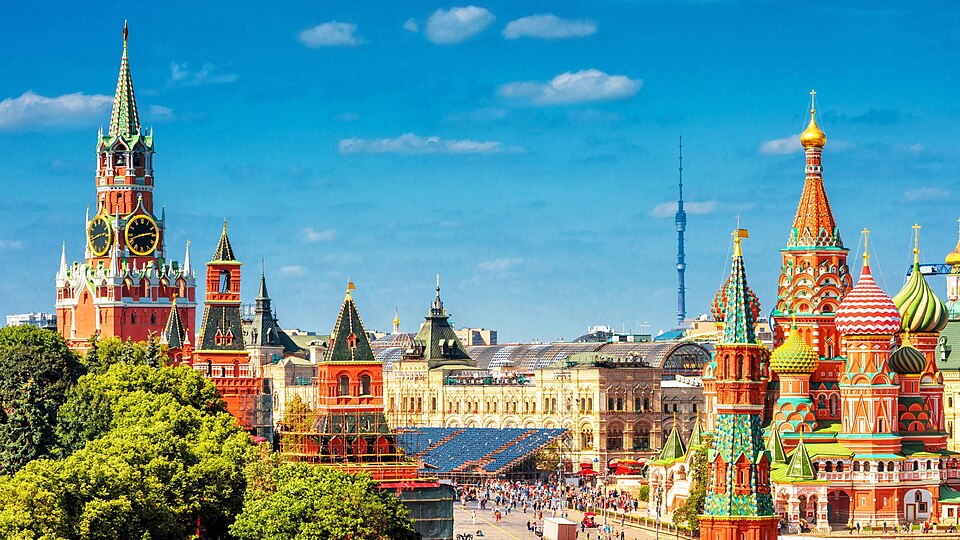
Perhaps no image of Moscow is more iconic than its onion domes, gilded and clustered against the sky. Their origins are debated—some argue they evolved from Byzantine cupolas adapted to withstand Russia’s snow, others suggest they carry Eastern influences filtered through trade routes. Whatever their source, by the 16th century they had become a defining mark of Moscow’s skyline.
The domes’ form was more than functional. Their upward thrust suggested aspiration, fire, and transcendence. Covered in gold leaf, they blazed in sunlight, embodying the heavenly Jerusalem on earth. In religious processions, the gleam of domes framed by the Kremlin walls was itself a spectacle of theology and politics: Moscow as both holy city and imperial seat.
Beyond the Kremlin, fortified monasteries encircled the city like satellites. The Novodevichy Convent, with its high walls and delicate churches, combined military and spiritual functions. These monasteries were both refuges of prayer and bulwarks against invasion, a duality unique to Moscow’s landscape. Their architecture expressed resilience as well as devotion, an acknowledgment that the sacred and the martial were inseparably bound in Muscovite life.
Moscow’s early architecture created more than functional spaces; it inscribed ideology into stone. With each cathedral, tower, and monastery, the city declared itself both guardian of Orthodoxy and heir to imperial grandeur. White stone and golden domes were not just materials or ornaments—they were statements of destiny. Even today, standing before the Assumption Cathedral or gazing at the Kremlin walls, one can feel how architecture turned Moscow from a wooden outpost into the heart of a nation.
Moscow vs. Novgorod: Rival Artistic Traditions
In the medieval landscape of Rus’, no artistic rivalry was more formative than that between Moscow and Novgorod. Each city forged a distinct style, shaped by geography, politics, and faith. While Novgorod looked outward—trading with the Hanseatic League, absorbing influences from the Baltic—Moscow turned inward, consolidating power around princes and monasteries. The contrast between their artistic traditions not only enriched Russian culture but also helped define what would become distinctively Muscovite.
Contrasts in Iconography
Novgorod’s icons are instantly recognizable for their boldness. Painters favored bright, contrasting colors—deep reds, vibrant greens, luminous blues—that created images of extraordinary intensity. Figures are often elongated and angular, their gestures emphatic, their gazes penetrating. The overall effect is one of drama and urgency, well-suited to a mercantile republic that prized civic ritual and collective identity.
Moscow’s icons, by contrast, moved toward harmony and serenity. Rublev’s palette of gentle tones set the standard: pale blues, golden light, soft transitions between hues. Figures in Moscow icons are calmer, their postures more balanced, their expressions suffused with tranquility. Where Novgorod emphasized the dramatic presence of the sacred, Moscow sought to create a contemplative space for prayer.
This divergence was not merely aesthetic but reflected different visions of faith. Novgorod’s republican structure encouraged art that spoke to communal intensity, while Moscow’s princely system nurtured art that mirrored centralized authority and spiritual calm. The two styles clashed, but also cross-pollinated: Moscow painters borrowed Novgorod’s boldness, while Novgorod absorbed Muscovite refinement.
Murals and Manuscript Illumination
The rivalry extended beyond panel icons into mural painting. In Novgorod, church walls blazed with monumental cycles of saints, prophets, and apocalyptic visions. The 14th-century frescoes in the Church of the Transfiguration on Ilyina Street, painted by Theophanes the Greek before he moved to Moscow, embody this intensity: swift brushstrokes, forceful lines, figures filled with inner fire.
When Theophanes later worked in Moscow, his style moderated, shaped by the city’s more contemplative ethos. His frescoes in the Kremlin’s Annunciation Cathedral retained dynamism but were softened by the calmer rhythms of Muscovite iconography. This shift demonstrates how artists themselves navigated between traditions, carrying elements of one city into the other.
Manuscript illumination, too, bore regional flavors. Novgorod codices often contained vivid, almost rustic illustrations, with strong outlines and unblended colors. Moscow manuscripts, particularly those produced in the Kremlin’s workshops, aimed for polish and symmetry, aligning visual ornament with the authority of court and church. Books in both cities served as devotional and educational tools, but their stylistic differences reinforced each city’s identity.
The Forging of a Muscovite Style
By the late 15th and early 16th centuries, Moscow had begun to absorb and dominate Novgorod, both politically and artistically. Ivan III’s conquest of Novgorod in 1478 was not just a military act but a cultural one. Icons, manuscripts, and even craftsmen were transferred to Moscow, enriching its workshops with Novgorodian vigor.
Yet rather than simply subsume Novgorod’s art, Moscow synthesized it. The sharp outlines and saturated colors of Novgorod merged with Muscovite harmony to create a balanced, expansive style. This synthesis reached its height in Rublev’s generation and continued into the great commissions of the 16th century, where frescoes and icons displayed both serenity and strength.
The rivalry left Moscow stronger. By engaging with Novgorod’s intensity, Muscovite art avoided becoming too placid. By imposing its own order, Moscow ensured Novgorod’s drama did not become chaos. The resulting style embodied the very logic of Moscow’s rise: absorbing rivals, reshaping their energy, and projecting a unified vision of spiritual and political authority.
Moscow’s identity as an artistic capital was sharpened against Novgorod’s contrast. Without that northern republic’s brilliance and intensity, Muscovite art might have remained provincial. But by confronting and assimilating Novgorod, Moscow not only secured political dominance but also forged an aesthetic capable of expressing both calm transcendence and living power.
Baroque on Russian Soil: The 17th-Century Shift
By the 1600s, Moscow stood firmly established as the political and spiritual heart of Russia. Yet the city’s art was entering a new phase. The familiar calm of medieval icons and the white-stone cathedrals of earlier centuries gave way to a more ornate, expressive style shaped by both internal reform and external contact. This transformation—often called the “Moscow Baroque” or more specifically “Naryshkin Baroque”—was not a simple import from Europe but a distinctive hybrid. It revealed a city in transition: proud of its Orthodox heritage yet increasingly open to new forms.
Patriarch Nikon and Church Reforms
One of the central figures of this century was Patriarch Nikon, whose reforms in the 1650s shook Russian religious life. Seeking to align Muscovite liturgy with Greek practices, Nikon introduced new rituals, corrected service books, and sought stricter uniformity. These changes caused a major schism—the Old Believers rejecting the reforms, clinging to older traditions, and often producing their own icons with deliberate archaism.
The split had direct artistic consequences. On one side, the official church encouraged painters to adopt a more naturalistic style, influenced by engravings and prints imported from Poland, Ukraine, and Western Europe. Saints gained more rounded bodies, shadows began to suggest volume, and landscapes crept into backgrounds. On the other side, Old Believers preserved the older hieratic style, insisting that the spiritual purity of Rublev’s icons must not be diluted by foreign “realism.” Thus Moscow in the 17th century became a city of parallel visual languages—official, modernizing art and underground traditionalism.
The tension was not purely aesthetic. Every brushstroke, every posture in an icon could signal allegiance to reform or resistance. An Old Believer might venerate an icon painted in an intentionally archaic manner as an act of defiance, while a reformist patron might commission an image showing depth and volume as a sign of openness to Europe. Art became a battlefield of faith.
“Naryshkin Baroque” in Suburban Estates
While icon painters debated tradition and reform, architecture was undergoing a flamboyant transformation. The so-called Naryshkin Baroque—named after the influential Naryshkin family—emerged in the late 17th century, blending Western ornament with Russian forms. These churches, often built on aristocratic estates around Moscow, featured tiered structures of red brick dressed with white stone details. Arched windows, twisted columns, and decorative gables gave façades a lively rhythm, quite unlike the austere cathedrals of earlier times.
One striking example is the Church of the Intercession at Fili, commissioned by Lev Naryshkin. Its tall, multi-tiered form rises like a wedding cake, each level adorned with white pilasters and curved gables. The building demonstrates how Muscovite architects absorbed Western motifs but retained the vertical emphasis and central domes that marked Russian tradition. Inside, baroque ornament—carved iconostases, gilded details, frescoes with perspective—created a sense of theatrical splendor.
These suburban churches were not just places of worship; they were statements of status. The boyar families who commissioned them sought to display loyalty to Orthodoxy while embracing the sophistication of European taste. Moscow’s skyline expanded with these playful, exuberant forms, signaling a city experimenting with ornament and grandeur.
Western Ornament and Russian Tradition in Dialogue
The influx of Western elements did not erase Moscow’s identity. Rather, it created a dialogue between traditions. The onion dome remained dominant, but it was now framed by scrollwork and pilasters. The icon screen, still central to Orthodox ritual, was carved in increasingly elaborate detail, sometimes rivaling the intricacy of Italian altarpieces. Frescoes continued to cover walls, but their compositions borrowed from Western prints, introducing perspective and narrative drama.
In this synthesis, Moscow revealed its adaptability. Unlike St. Petersburg, which Peter the Great would later construct as a deliberately European city, Moscow absorbed European elements into its own fabric. Its Baroque was never purely Western; it always carried Russian rhythms. The result was a style both ornate and rooted, extravagant yet unmistakably Muscovite.
The 17th century reshaped Moscow’s art from within and without. Religious reform fractured icon painting, aristocratic ambition fueled architectural experimentation, and foreign ornament entered into dialogue with native tradition. By the century’s end, Moscow was no longer simply the medieval city of Rublev and white-stone cathedrals—it had become a place where Russian identity negotiated with Europe, producing a Baroque both restless and deeply its own.
Peter the Great and Moscow’s Eclipse
At the dawn of the 18th century, Moscow had stood for centuries as the unquestioned capital of Russian political and artistic life. Its cathedrals, monasteries, icons, and baroque estates embodied the authority of tsars and patriarchs alike. But Peter the Great, determined to transform Russia into a modern European power, founded a new city on the Baltic marshes—St. Petersburg. With this bold move, Moscow was displaced from its position at the center of imperial culture. Yet the eclipse was not absolute. While Peter’s city became the stage for European-style art and architecture, Moscow remained the guardian of Orthodoxy, tradition, and an alternative cultural identity.
The Move to St. Petersburg
Peter’s decision to transfer the capital in 1712 was more than administrative; it was symbolic. St. Petersburg was conceived as a “window to Europe,” its avenues laid out in straight lines, its palaces designed in the latest baroque fashions by foreign architects. In contrast, Moscow’s irregular streets, onion domes, and fortress monasteries looked provincial, even medieval, to reform-minded elites.
As the imperial court moved north, so too did much of the artistic patronage. Painters, architects, and sculptors found commissions in the new city, where Italian, French, and German masters introduced the grandeur of European academies. Moscow workshops, once the pride of the tsars, were sidelined, producing primarily for local demand rather than imperial spectacle.
Yet this apparent decline had an unintended consequence: Moscow was freed from the pressures of imperial fashion. Its artists and patrons turned inward, nurturing traditions that might have vanished under the glare of Petersburg classicism.
Aristocratic Patronage in Decline
With the court gone, Moscow’s boyars and merchants became the main patrons of art. Aristocratic families who remained in the city often commissioned churches, but their resources and ambitions could not match the imperial projects in Petersburg. As a result, many Muscovite churches of the early 18th century show a restrained baroque—ornamented but not lavish, intimate rather than monumental.
Private patronage also shifted toward domestic interiors and smaller devotional objects. Icons continued to be painted in both traditional and Western-influenced styles, with Old Believer communities especially committed to preserving earlier forms. Silverwork, embroidery, and woodcarving flourished, sustaining Moscow’s reputation as a center of applied arts even as monumental architecture waned.
At the same time, foreign artisans who had once flocked to Moscow now preferred Petersburg, where the court offered larger commissions and better prospects. This drained Moscow’s artistic scene of cosmopolitan energy, further isolating it. Yet isolation also meant preservation: Moscow’s churches, workshops, and households maintained practices that might otherwise have been swept away.
Moscow as a Provincial but Spiritual Counterweight
Though Petersburg became the imperial capital, Moscow retained symbolic power. The Kremlin remained the coronation site for every Russian ruler, a reminder that legitimacy flowed not only from European-style palaces but also from ancient Muscovite tradition. Pilgrims still flocked to Moscow’s monasteries, venerating icons and relics with fervor undiminished by political eclipse.
In this sense, Moscow became a counterweight to Petersburg. If the northern capital embodied Western modernity, Moscow embodied spiritual continuity. This duality enriched Russian art as a whole. Petersburg nurtured portraiture, sculpture, and neoclassical architecture; Moscow sustained icon painting, decorative crafts, and religious architecture rooted in older forms.
Three aspects especially defined Moscow’s cultural role in this period:
- Old Believer workshops, producing icons with meticulous devotion to pre-reform models.
- Merchant patronage, funding both religious art and the preservation of Muscovite churches.
- Monastic culture, maintaining libraries, frescoes, and traditions of manuscript illumination even in the shadow of decline.
Thus, while eclipsed politically, Moscow did not fade artistically. Instead, it preserved the depth of Russia’s past, a reservoir of forms and meanings that would later resurface with surprising force in the 19th century.
The shift from Moscow to Petersburg was not a simple replacement but a realignment. Petersburg dazzled with imported brilliance, while Moscow held fast to memory and faith. In that tension—between a European-facing capital and a tradition-bound counter-capital—Russian art gained its distinctive dual character. Moscow’s eclipse was therefore paradoxical: by losing its primacy, the city secured its role as guardian of continuity, a role it continues to play even now.
Return to Splendor: 19th-Century Romanticism
After a century of eclipse under Petersburg’s dominance, Moscow emerged in the 19th century with renewed vitality. The city that had once seemed provincial and antiquated became a center of Romantic imagination, fueled by merchants, collectors, and artists who embraced both nostalgia for Russia’s past and curiosity about new artistic forms. The fires of 1812, which destroyed much of Moscow during Napoleon’s invasion, paradoxically provided an opening: rebuilding the city allowed Muscovites to define its cultural character anew.
Merchants as Patrons of Art
One of the most distinctive features of 19th-century Moscow was the role of its merchant class in shaping artistic life. Unlike the aristocracy, tied closely to Petersburg and its Europeanized court, Moscow’s wealthy merchants remained rooted in the city’s traditions. Yet many of them also had cosmopolitan aspirations, eager to collect, commission, and sponsor art.
The Tretyakov brothers exemplify this phenomenon. Pavel Tretyakov, a textile magnate, began collecting works by Russian painters in the 1850s, determined to create a gallery that would represent the national school. His collection, eventually opened to the public, became the Tretyakov Gallery, still the world’s foremost repository of Russian art. Here, Muscovites encountered the canvases of contemporary masters like Perov, Repin, and Surikov—painters who chronicled Russian life with depth and sympathy.
Other merchants sponsored architectural projects, funding churches, theaters, and public buildings that reshaped Moscow’s urban fabric. Their patronage gave the city a distinctive profile, where gilded domes stood beside neoclassical facades and ornate interiors. In contrast to Petersburg’s state-driven grandeur, Moscow’s cultural vitality came from private initiative, a grassroots flourishing of art.
The Moscow School of Painting, Sculpture and Architecture
Institutional support for the arts also grew. The Moscow School of Painting, Sculpture and Architecture, established in the 19th century, became a hub of training for generations of artists. Unlike the Imperial Academy in Petersburg, which often followed rigid academic conventions, the Moscow school encouraged greater independence, nurturing painters who would later join the Peredvizhniki (Itinerants) movement.
Teachers and students alike cultivated a style that combined technical skill with sensitivity to Russian themes. Portraits, genre scenes, and historical canvases flourished, reflecting both Romantic fascination with the past and realist interest in everyday life. Sculpture, too, gained prominence, with public monuments erected across Moscow to commemorate national heroes, poets, and military victories.
Architecture in this period reflected Romantic historicism. Rebuilding after 1812 saw neoclassical mansions rise along Moscow’s boulevards, while Gothic and “Russian Revival” styles appeared in churches and estates. The eclecticism mirrored the city’s layered identity—ancient and modern, traditional and experimental.
Collectors Who Built National Museums
Private collectors played a role far beyond mere accumulation. They created the foundations of public institutions that still define Moscow today. Alongside Pavel Tretyakov’s gallery, other figures like Sergei Shchukin and Ivan Morozov assembled world-class collections of European modernism, though these would later enter public hands in the Soviet era.
By the late 19th century, Moscow housed a unique constellation of collections: Russian realist painting, Western impressionism, and decorative arts all found homes in its galleries. This diversity reflected the city’s duality—loyal to Russian heritage, yet eager to engage with global currents. For Muscovites, visiting a gallery became both an act of civic pride and a glimpse into worlds beyond their own.
The Romantic revival of 19th-century Moscow was more than aesthetic. It was a declaration that the city, once sidelined by Petersburg, could chart its own cultural path. Merchants and collectors, schools and theaters, artists and architects together turned Moscow into a living museum of Russian identity. The city’s art no longer spoke only of preservation; it spoke of renewal, invention, and the confidence of a people rediscovering their voice.
The Itinerants and the Spirit of Realism
In the second half of the 19th century, Moscow became the crucible of a profound artistic rebellion. A group of painters known as the Peredvizhniki, or Itinerants, broke away from the official Imperial Academy of Arts in St. Petersburg, rejecting its rigid classicism and mythological subjects. They sought instead to depict Russian life with honesty, empathy, and moral weight. Though the movement spanned the entire empire, its heartbeat was in Moscow, where sympathetic patrons and audiences embraced their vision.
Surikov, Repin, and the Moscow Salon
The Peredvizhniki emerged in 1870, forming a cooperative dedicated to organizing traveling exhibitions—hence their name. These shows brought art to provincial towns far beyond the capitals, democratizing access to painting. In Moscow, their exhibitions drew large crowds, particularly among the city’s merchant class, who saw in the canvases reflections of their own world.
Among the most celebrated painters was Vasily Surikov, whose vast historical compositions became highlights of Moscow’s art scene. Works such as The Morning of the Streltsy Execution captured dramatic episodes from Russian history with psychological intensity. Surikov’s canvases were both national epics and human tragedies, filled with faces that revealed suffering, doubt, and defiance.
Another towering figure was Ilya Repin, though more closely associated with Petersburg, who found an eager audience in Moscow. His portraits of intellectuals and his genre scenes—such as Barge Haulers on the Volga—resonated deeply with Muscovite viewers attuned to the realities of labor and hardship. The Moscow salon welcomed Repin’s moral realism as a corrective to the artificialities of academic art.
Through these artists, Moscow positioned itself as the moral conscience of Russian painting, a city where art was not luxury but truth-telling.
The Tretyakov Gallery as a Cultural Anchor
The role of the Tretyakov Gallery cannot be overstated. Pavel Tretyakov not only collected the Itinerants’ works but also created a permanent space where their vision could be encountered by the public. His collection became a kind of parallel academy, where Russian art defined itself not by European models but by its own subjects and values.
Tretyakov’s support provided both financial stability and cultural legitimacy for the movement. His gallery hung canvases that depicted peasants, workers, landscapes, and national history, giving them pride of place in a setting usually reserved for saints and rulers. The gallery became a civic shrine, its walls embodying the belief that art should serve the people.
By the late 19th century, to walk through the Tretyakov was to experience a national narrative told through brush and pigment. Moscow had gained not just a collection but a cultural anchor, one that continues to define Russian identity.
Social Commentary Through Art
What made the Itinerants radical was their insistence that art could serve as social commentary. They depicted poverty, injustice, and the dignity of common life. Painters like Vasily Perov presented scenes of beggars, orphans, and exhausted workers with stark realism. Grigory Myasoyedov painted rural toil, capturing both hardship and resilience.
These canvases were not propaganda in the modern sense—they did not demand revolution—but they challenged viewers to see the moral dimension of everyday life. In Moscow, where social contrasts were visible in crowded streets and bustling markets, such art resonated with immediacy. The city’s audiences recognized themselves in these images, whether as peasants in painted fields or merchants commissioning portraits.
The Itinerants also reinvigorated landscape painting, treating Russia’s vast countryside not as decorative backdrop but as subject in itself. Artists like Isaac Levitan, though younger, carried this impulse forward, turning the Russian landscape into a vehicle of emotion and national identity. His Moscow-connected works showed how even a field, a river, or a birch grove could carry profound spiritual weight.
The Itinerants made Moscow the capital of Russian realism, a place where art shed the robes of allegory and faced life directly. Their canvases combined artistry with conscience, spectacle with intimacy. By the century’s close, Moscow was not just preserving tradition or reviving Romantic splendor—it was leading a revolution in seeing, teaching its viewers to find meaning in the dignity of the ordinary.
Avant-Garde Moscow: A Revolutionary Laboratory
Few cities in the world have hosted such an explosive convergence of artistic innovation as Moscow in the first decades of the 20th century. In the space of less than twenty years, the city witnessed the rise of abstraction, Suprematism, Constructivism, and experimental theater and design—all movements that would shape global modernism. Moscow was not merely influenced by Paris or Berlin; it generated its own radical answers to the question of what art could be.
Kandinsky and Malevich in the Capital
The seeds of Moscow’s avant-garde can be traced to the restless experiments of Wassily Kandinsky. Though he spent much of his career abroad, Kandinsky studied law and ethnography in Moscow and returned periodically to exhibit and teach. His abstract compositions, beginning around 1910, were rooted partly in his memories of Russian folk art, Orthodox icons, and the luminous colors of Moscow’s churches. In his view, color itself carried spiritual force, and painting could dispense with objects altogether.
If Kandinsky pioneered abstraction, Kazimir Malevich brought it to a revolutionary conclusion. His Black Square, first exhibited in Moscow in 1915, was more than a painting: it was an icon of a new world, a declaration that art could renounce representation entirely. For Muscovites accustomed to centuries of icons and realism, the stark black form on a white ground was shocking, even blasphemous. Yet it became the emblem of Suprematism, a movement born not in Paris but in Moscow, asserting the primacy of pure form and color.
Together, Kandinsky and Malevich transformed Moscow into a laboratory where abstraction was not an import but a native language—rooted in Russian traditions yet projected toward the future.
Cubo-Futurist Circles and Radical Exhibitions
Moscow’s avant-garde did not develop in isolation. The city was alive with groups, circles, and exhibitions that fostered constant exchange and rivalry. Cubo-Futurism, blending French Cubism with Italian Futurism, flourished in Moscow studios and cafes. Painters such as Lyubov Popova, Aleksandra Exter, and Aristarkh Lentulov combined fractured geometry with vibrant color, producing works that felt both mechanical and organic.
Exhibitions such as “Jack of Diamonds” (1910) and “0.10” (1915) turned Moscow galleries into arenas of confrontation. At “0.10,” Malevich’s Black Square was hung high in the corner, occupying the position traditionally reserved for an icon. Visitors gasped, debated, and argued in front of canvases that seemed to demand a new way of seeing.
These exhibitions were not just artistic events; they were social spectacles. Students, poets, and critics crowded into rooms, voices raised in excitement or outrage. Newspapers reported on the scandals, and suddenly art was no longer confined to academies or salons—it was part of Moscow’s daily conversation.
From Private Studios to Political Stage
What made Moscow’s avant-garde uniquely potent was the way it intersected with the political upheavals of the time. After the Revolution of 1917, artists who had once shocked the public with abstraction now found themselves engaged in building a new society. Malevich, Vladimir Tatlin, and others proposed new forms of design, architecture, and propaganda. Tatlin’s unbuilt Monument to the Third International—a spiraling tower of glass and steel—symbolized the utopian ambition of art fused with politics.
Private studios became workshops for the state. Artists designed posters, books, textiles, and even theater sets, carrying avant-garde principles into everyday life. Constructivism, born in Moscow in the late 1910s, rejected painting for its own sake and embraced engineering, design, and production. Lyubov Popova designed textiles for factories; Alexander Rodchenko created striking photo-collages and advertisements.
For a brief moment, Moscow seemed to embody a total integration of art and life. The city’s streets, theaters, and publications carried the energy of the avant-garde, as if the entire urban fabric had become an experimental canvas.
The avant-garde in Moscow was a fever dream—brief, intense, and transformative. Within two decades, it would be suppressed by the demands of Socialist Realism, but its impact was permanent. The radical visions of Kandinsky, Malevich, Popova, and Tatlin reverberated far beyond Russia, influencing Bauhaus design, abstract painting, and global modernism. Moscow, once dismissed as provincial, had for a time eclipsed even Paris as the capital of artistic revolution.
Socialist Realism and the Stalin Era
By the 1930s, the feverish experimentation of Moscow’s avant-garde had come to an end. The new Soviet state, consolidating under Joseph Stalin, demanded art that was not exploratory but didactic, not abstract but legible, not personal but collective. Out of this climate emerged Socialist Realism, the official style imposed on painters, sculptors, architects, and writers alike. For Moscow, the shift was seismic. The city that had briefly been the world’s most radical artistic laboratory became instead the stage for monumental propaganda.
Monumental Public Works and Propaganda
The first great arena of Socialist Realism in Moscow was the public monument. Sculptors and architects were tasked with embodying the ideals of socialism in physical form. Projects grew colossal in scale: statues of Lenin and Stalin loomed over squares, while heroic workers and peasants were cast in bronze and stone, their bodies idealized into archetypes of strength and optimism.
Perhaps the most iconic example is Vera Mukhina’s Worker and Kolkhoz Woman (1937), created for the Paris World’s Fair and later installed in Moscow. The sculpture’s sweeping stainless-steel figures—one male, one female—stride forward together, wielding hammer and sickle. It distilled the Socialist Realist ethos: art as an uplifting emblem of collective labor, projecting confidence to both domestic and international audiences.
Murals, mosaics, and paintings filled Moscow’s institutions with similar imagery: factory workers smiling at machines, peasants harvesting under bright skies, children reading in classrooms adorned with Lenin’s portrait. Every work carried the same message—progress, unity, inevitability. Gone was the ambiguity and intensity of the avant-garde; clarity and optimism were mandatory.
The Moscow Metro as “Palace of the People”
If any single project embodies the Stalinist vision of art fused with life, it is the Moscow Metro. Opened in 1935, its stations were conceived not merely as transit spaces but as underground palaces. Architects and artists were instructed to create interiors that conveyed the triumph of socialism to every citizen who descended the escalators.
Marble walls gleamed in soft light, mosaics depicted scenes of workers and soldiers, chandeliers sparkled overhead. Each station became a themed environment: Komsomolskaya celebrated the youth movement, Ploshchad Revolyutsii was lined with bronze sculptures of idealized Soviet citizens, Mayakovskaya dazzled with aviation-themed mosaics set into domed ceilings.
The Metro was propaganda in stone and light, accessible to all. Where aristocrats had once strolled through gilded palaces, now workers rode through corridors of art designed for them. The project fused Socialist Realism with architecture on a vast scale, making Moscow’s infrastructure itself a gallery of ideology.
Architects and Painters Under Strict Control
For Moscow’s artists, the Stalin era meant submission or silence. Avant-garde experimentation was denounced as “formalism,” a bourgeois indulgence incompatible with the needs of the people. Painters such as Aleksandr Deineka adjusted their style, producing heroic depictions of athletes, workers, and industrial landscapes. Architects who had once dreamed of Constructivist towers were forced to embrace neoclassical monumentalism, producing colossal government buildings crowned with spires and statues.
The Palace of the Soviets, a project begun in the 1930s but never completed, epitomized these ambitions. Planned as the tallest building in the world, crowned by a gargantuan statue of Lenin, it would have dominated Moscow’s skyline. Though war halted its construction, the project reveals how Stalin’s regime sought to harness architecture as a global statement of ideological supremacy.
Control extended beyond commissions. The Union of Artists, established in 1932, centralized artistic life, dictating subjects, styles, and even training. Exhibitions were carefully curated to display only Socialist Realist works. Dissenters risked exclusion, poverty, or worse. The city that had once fostered Malevich and Tatlin now produced endless canvases of beaming kolkhozniks and victorious generals.
Moscow in the Stalin era became a city of spectacle, where art served power with unmatched intensity. The avant-garde’s daring was buried under marble corridors, heroic statues, and uniform canvases. Yet even within these constraints, flashes of artistry endured—Deineka’s dynamic figures, the craftsmanship of Metro mosaics, the ingenuity of engineers who created monumental structures under impossible conditions. The city’s art lost its freedom but gained an unparalleled visibility, its monuments still shaping the way Moscow is seen today.
Thaw and Underground: Moscow in the Postwar Period
After Stalin’s death in 1953, Moscow entered a new phase of cultural tension. On the surface, the city was adorned with monumental Socialist Realist works, celebrating the Soviet Union’s industrial and military might. Yet beneath that façade, new artistic currents stirred—some sanctioned during the relative openness of the “Thaw” under Nikita Khrushchev, others hidden away in apartments and garages where unofficial artists created in defiance of the state. Moscow became a city of two art worlds: the official and the underground.
Official Art vs. Nonconformist Movements
The 1950s and 60s saw cautious loosening of artistic policy. Khrushchev criticized excesses of Stalinist monumentalism, encouraging a return to simpler, more human themes. Painters such as Aleksandr Deineka continued to work, now focusing on sport, youth, and modern life, while new voices like Tair Salakhov infused Socialist Realism with greater individuality.
At the same time, a younger generation grew restless with official art’s limitations. Some experimented with abstraction, others with surreal or conceptual approaches. Collectively, they became known as the nonconformists, working outside the sanctioned unions and exhibitions. Artists such as Ernst Neizvestny, Ilya Kabakov, and Oskar Rabin produced works that challenged both stylistic norms and ideological dictates.
Moscow’s apartments became private galleries. Friends would gather in cramped kitchens to view canvases rolled out on the floor or pinned to walls. These “apartment exhibitions” were both artistic and social events, where painters, poets, and musicians mingled in a fragile community of dissent.
The Bulldozer Exhibition and Artistic Dissent
The tension between official and underground art erupted dramatically in 1974 with the Bulldozer Exhibition. A group of nonconformist artists attempted to display their works in a vacant field outside Moscow. Authorities, determined to suppress the event, sent police, water cannons, and bulldozers to destroy the paintings. Images of canvases being trampled and drenched in mud circulated internationally, embarrassing the Soviet state.
Ironically, the crackdown led to greater visibility for the nonconformists. A week later, the government allowed a more controlled outdoor show, where Muscovites could see avant-garde art openly, if briefly. The episode revealed both the vulnerability of unofficial art and its resilience. Moscow’s underground painters had forced the state to acknowledge their existence.
Stories from this period illustrate the precariousness of creativity. One painter might stash canvases behind wardrobes, another in dachas outside the city. Collectors and foreign diplomats sometimes smuggled works abroad. Despite censorship and harassment, a body of art was produced that captured the contradictions of Soviet life: alienation, absurdity, resilience, and dark humor.
The Rise of Conceptual Art in Hidden Studios
By the late 1960s and 70s, Moscow became the birthplace of Moscow Conceptualism, a movement that approached art with irony and philosophical subtlety. Figures like Ilya Kabakov created installations that mocked Soviet bureaucracy, presenting fictional communal apartments or endless filing cabinets as metaphors for life under the system.
Kabakov’s works were rarely shown publicly, but in private studios they astonished visitors with their inventiveness. Other conceptualists, such as Andrei Monastyrsky and the Collective Actions group, staged performances in the outskirts of Moscow, where small groups of participants engaged in cryptic rituals that blurred the line between art and life. These actions, recorded in photographs and texts, became underground legends.
The coexistence of Socialist Realism and underground conceptualism gave Moscow a unique dual identity. Official exhibitions continued to display smiling workers and heroic cosmonauts, while just a few blocks away, in a hidden attic, an artist might be painting black squares, constructing absurd installations, or staging performances in snow-covered fields.
Postwar Moscow was thus a city of contradictions. Its boulevards boasted grand statues and mosaics extolling the Soviet ideal, while behind closed doors, artists sketched, painted, and performed works that questioned everything around them. Out of this tension emerged a culture at once constrained and irrepressible, preparing the ground for the explosion of expression that would follow in the 1980s and 90s.
Moscow in the Global Art World Today
In the decades since the Soviet Union’s collapse, Moscow has undergone another artistic transformation. From the hidden studios of the 1970s to the bustling galleries and biennales of the 21st century, the city has reemerged as a dynamic hub of contemporary art. Yet unlike Paris in the 1900s or New York in the 1950s, Moscow today is defined less by a single movement than by the coexistence of past and present, tradition and experiment, local identity and international exchange.
Rebirth of Galleries After 1991
The dissolution of Soviet censorship in the early 1990s unleashed an explosion of creative energy. Artists who had worked underground suddenly found themselves free to exhibit. Ilya Kabakov, long smuggled abroad, became celebrated internationally. Oskar Rabin and other nonconformists were rediscovered as foundational figures of late 20th-century art.
Private galleries sprang up across Moscow, some short-lived, others establishing lasting reputations. The city’s new collectors—often wealthy entrepreneurs emerging from post-Soviet capitalism—invested heavily in contemporary art, both Russian and international. The gallery scene became a laboratory of experiment, with photography, installation, performance, and digital media entering Moscow’s artistic vocabulary.
This period was chaotic, even anarchic. Studios, squats, and warehouses hosted exhibitions with little concern for permanence. Yet out of this ferment grew institutions that gave contemporary art a foothold in the city.
International Biennales and Contemporary Spaces
The new millennium brought consolidation and global ambition. The Moscow Biennale of Contemporary Art, launched in 2005, signaled the city’s desire to participate fully in the international art circuit. Drawing curators and artists from across the world, the Biennale turned Moscow into a meeting point for global conversations about art, politics, and technology.
Permanent institutions also expanded. The Garage Museum of Contemporary Art, founded by Dasha Zhukova in 2008 and later housed in a repurposed Soviet modernist building designed by Rem Koolhaas, became a flagship for Moscow’s contemporary scene. The Winzavod Center for Contemporary Art, located in a former wine factory, offered studios and exhibition spaces for emerging artists. These venues signaled that Moscow was no longer just reviving its past but actively shaping the future.
Yet these global-facing projects coexisted with deeply local traditions. Orthodox icon painters continued their craft, folk artisans maintained workshops, and the Tretyakov Gallery remained a magnet for those seeking Russia’s classical heritage. In Moscow, the 21st century does not erase the past; it layers itself over centuries of memory.
The Balance of Heritage and Modernity
Today, Moscow’s art world exists in a delicate balance. On one side stand the golden domes, medieval icons, and the monumental legacy of Socialist Realism—visible on every boulevard and in every Metro station. On the other side are cutting-edge installations, video art, and digital experiments displayed in sleek museums and converted factories.
The coexistence is not always harmonious. Some critics argue that contemporary institutions risk becoming showcases for oligarch wealth rather than genuine cultural exchange. Others point to state influence, noting that official narratives still shape what is shown and celebrated. Yet despite these tensions, Moscow remains a city where art is central to civic identity. Tourists marvel at the Kremlin and Red Square, locals debate exhibitions at Garage, and students gather in modest studios on the city’s outskirts to invent the next wave.
In this layering lies Moscow’s uniqueness. Unlike cities that reinvent themselves entirely, Moscow accumulates. Pagan idols gave way to icons, icons to baroque churches, churches to avant-garde canvases, avant-garde canvases to Socialist Realist mosaics, mosaics to conceptual installations. Each survives in fragments, visible in churches, galleries, apartments, and streets.
In the 21st century, Moscow no longer claims to be the sole center of world art, as it briefly did in the 1910s. But it offers something different: a city where centuries of artistic history coexist in a single urban fabric. To walk through Moscow today is to pass from medieval fresco to baroque spire, from Stalinist marble corridor to cutting-edge installation, all within a few metro stops. Few cities embody such continuity and contrast. Moscow’s art history is not a straight line but a vast mosaic—and in its shifting light, the city continues to reveal new patterns.
Epilogue: The City as a Living Canvas
To trace Moscow’s art history is to follow a city that never stands still. From prehistoric pottery patterned with spirals to 21st-century installations glowing in converted factories, each era has left a visible layer in Moscow’s fabric. What makes the city remarkable is not the supremacy of one style or school, but the coexistence of many—icons beside avant-garde, baroque façades beside constructivist towers, gilded domes rising over underground stations that gleam with socialist mosaics.
Moscow’s art has always served more than aesthetic ends. In the medieval city, it was a form of prayer; in the baroque estates, a mark of boyar prestige; in the 19th century, a declaration of national pride; in the Soviet era, an instrument of ideology. Today, art in Moscow is both a private pursuit and a public spectacle, shaped by collectors, museums, and global audiences. Through each transformation, the city has preserved something of its past even as it reinvented itself.
There is also a rhythm to Moscow’s artistic life: flourishing, eclipse, renewal. Icons flowered, then yielded to baroque ornament; baroque grandeur was eclipsed by Petersburg, only for Moscow to rise again with Romanticism and realism; avant-garde brilliance burst forth, only to be crushed under Socialist Realism; the underground sustained creativity, later reborn in global galleries. This cycle has given Moscow an identity rooted not in linear progress but in resilience.
The city’s art remains inseparable from its character: at once spiritual and political, traditional and experimental, introverted and expansive. A single walk through its streets can offer glimpses of Rublev’s calm angels, Naryshkin baroque towers, Repin’s raw humanity, Tatlin’s spirals, and Kabakov’s ironic installations. In this layered simultaneity lies Moscow’s enduring allure.
Moscow is not only the backdrop of art; it is itself a work of art, a living canvas painted and repainted over centuries. To look at its cathedrals, galleries, and studios is to see not just buildings and objects, but the unfolding of a cultural imagination that has never ceased to reinvent itself.