Henry Fuseli, born Johann Heinrich Füssli on February 7, 1741, in Zurich, Switzerland, remains one of the most enigmatic and unconventional figures of the Romantic era. The son of Johann Caspar Füssli, a noted portrait painter and art historian, Fuseli grew up steeped in a world of aesthetics, biblical study, and classical scholarship. His early education included a robust grounding in theology, Greek, Latin, and philosophy—preparing him initially for a career in the clergy. Yet, driven by an independent mind and an eye for the dramatic, Fuseli would veer off the straight path, trading pulpit for palette.
In 1761, Fuseli’s life changed dramatically after he became entangled in a political dispute. He authored and distributed a pamphlet that exposed a corrupt Swiss magistrate, an act that led to his forced departure from Zurich. Exiled for his integrity, he traveled across Germany before settling in England in 1764. There, with letters of introduction from the Enlightenment philosopher Johann Lavater, he met influential artist Sir Joshua Reynolds. Reynolds, recognizing Fuseli’s innate talent, encouraged him to study painting seriously. That pivotal encounter set Fuseli on the artistic course that would eventually lead to The Nightmare.
Fuseli joined the Royal Academy in 1770, and his artistic career flourished. Though his early training was informal, he adopted many of the classical techniques admired by the Academy. However, his thematic content was anything but traditional. While he possessed the anatomical precision of a Renaissance master, Fuseli rejected the sterile rationalism of the 18th century in favor of a more sublime, unsettling vision of the human experience. He was elected an Associate of the Royal Academy in 1788 and a full Academician in 1790, eventually serving as Professor of Painting from 1799 until his death, save for a brief interruption.
Equally significant was Fuseli’s time in Rome from 1770 to 1778. While there, he studied the works of Michelangelo and classical sculpture, which profoundly influenced his muscular, dramatic style. He filled hundreds of sketchbooks with mythological and biblical studies, soaking in the grandeur of Western civilization’s artistic heritage. That Italian sojourn was not merely an artistic pilgrimage; it was a spiritual reaffirmation. Fuseli didn’t seek novelty—he sought meaning, anchoring his work in the eternal themes of sin, redemption, beauty, and terror.
A Swiss Scholar Turned British Visionary
Fuseli’s intellectual pedigree was uncommon even among his Romantic peers. Educated at the Collegium Carolinum in Zurich, he had initially intended to follow in the footsteps of his father as a Protestant pastor. But his appetite for literature and art eclipsed his religious career aspirations. Fluent in multiple languages, he translated classical texts and even took up literary criticism in his youth. By the time he left Zurich under pressure, he had already become something of a Renaissance man.
When he arrived in London, Fuseli began contributing to periodicals while teaching and supporting himself through literary work. He was eventually mentored by Reynolds, whose guidance turned his natural gift for drawing into formal training in oil painting. Though Fuseli’s themes would diverge sharply from Reynolds’ classical restraint, their mutual respect never wavered. The relationship also helped Fuseli become embedded in the vibrant London art world, then thriving with exhibitions and patronage opportunities.
In 1769, before leaving for Italy, Fuseli had already begun experimenting with illustrations for literary classics. He translated Winckelmann’s treatises on ancient art into English and published his own interpretations of Homer, Shakespeare, and Milton. These early efforts foreshadowed his later fusion of visual drama with literary and psychological depth. Unlike the Enlightenment thinkers who viewed the world as a clockwork machine, Fuseli saw a battleground of eternal truths and unseen forces.
After returning from Rome in 1779, Fuseli’s art took on a new intensity. It was then that his most famous painting, The Nightmare, began to take form—both as a composition and as a declaration. This was not simply a horror scene; it was an artistic challenge to the shallow optimism of his time. Fuseli’s style became a mirror to the human soul, not its surface.
Fuseli and the Royal Academy
Fuseli’s relationship with the Royal Academy was unique. Though many of his works featured grotesque or mystical subjects, his technique remained classically rooted, aligning with the Academy’s standards. He was inducted as an Associate in 1788 and became a full Royal Academician in 1790, reflecting both the respect and controversy he commanded. His appointment as Professor of Painting in 1799 cemented his place as a leading figure in British art.
As a teacher, Fuseli was known for his demanding standards and intense lectures. He emphasized anatomical study, dramatic composition, and emotional clarity—all traits visible in his own works. He urged students to think beyond the canvas, drawing connections between art, literature, and moral vision. His influence extended beyond brushstrokes; he shaped the moral and philosophical compass of an entire generation of painters.
Despite his success, Fuseli never pandered to public taste. He refused to paint flattering portraits for aristocrats and was largely indifferent to commercial commissions. What mattered to him was not popularity, but legacy—art that would last. This integrity earned him not only admirers, but also critics. Yet even his detractors admitted the undeniable force of his vision.
Fuseli passed away on April 16, 1825, in Putney Hill, London. He was buried in the crypt of St. Paul’s Cathedral, near his friend Sir Joshua Reynolds. His life was a testament to discipline, imagination, and an unwavering devotion to timeless truths.
Influence of Literature and the Sublime
Fuseli’s art was deeply informed by his literary passions. He revered Shakespeare and Milton—not just for their poetic grandeur, but for their spiritual gravity. His compositions often read like visual translations of Paradise Lost or Macbeth, capturing the struggle between light and darkness in bold, theatrical scenes. He illustrated dozens of literary works, using ink and graphite to explore themes of destiny, temptation, and divine wrath.
He was also close to William Blake, though their temperaments differed. While Blake’s mysticism leaned toward prophecy and inner vision, Fuseli’s imagery was grounded in external drama and classical structure. Still, both artists sought to re-enchant a disenchanted world and shared contempt for art that served only the senses. Together, they helped define the visual language of English Romanticism.
Fuseli’s notion of the sublime was tied to Edmund Burke’s philosophical work. In Burke’s view, true beauty could evoke terror when it approached the infinite or the unknown. Fuseli internalized this concept, using his art to stir awe rather than comfort. He didn’t fear frightening the viewer; he feared dulling the soul. The Nightmare would be his clearest articulation of that aesthetic creed.
Even in his lesser-known works—such as Thor Battering the Midgard Serpent (1790) or Titania and Bottom (1790)—Fuseli’s blend of high drama and mythological weight makes his hand unmistakable. These were not decorative images. They were moral dramas painted with a sword, not a brush.
Bullet List: Key Personal and Professional Milestones in Fuseli’s Life
- Born in Zurich on February 7, 1741, to a family of artists and scholars
- Exiled from Switzerland in 1761 for exposing corruption
- Studied in Rome from 1770–1778, drawing inspiration from Michelangelo
- Became Royal Academician in 1790 and Professor of Painting in 1799
- Died on April 16, 1825; buried in St. Paul’s Cathedral
A Painting Like No Other: Introducing The Nightmare
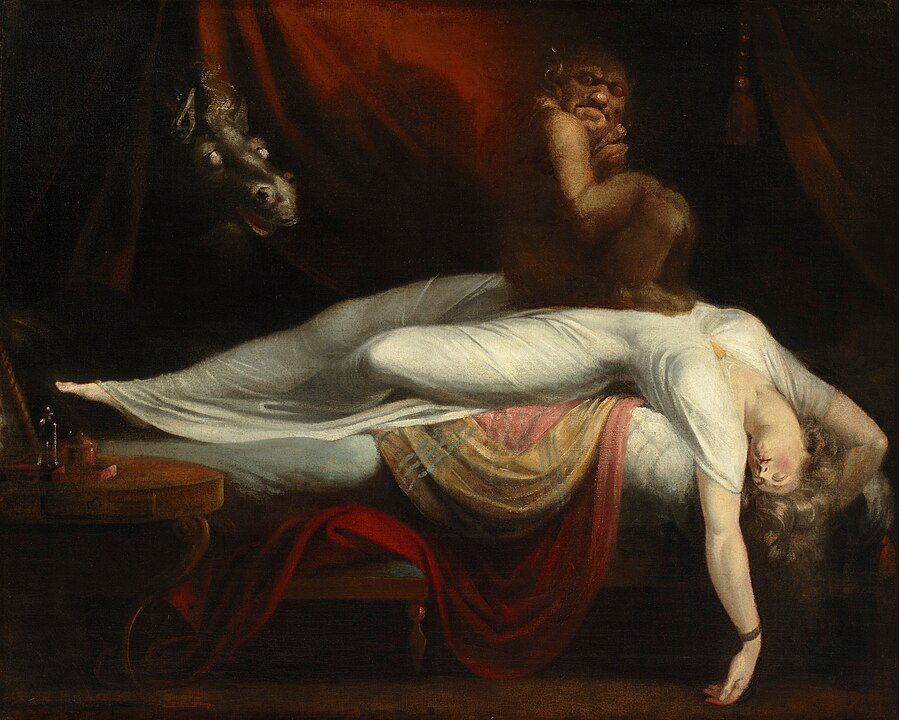
When The Nightmare was first exhibited at the Royal Academy in 1782, it caused an immediate sensation. Painted in 1781 and measuring approximately 40 by 50 inches, the canvas depicted a chilling yet captivating scene: a woman draped unconscious across a bed, an apelike demon perched on her chest, and a ghostly horse peering from behind a crimson curtain. Critics and admirers alike were stunned. Here was not a historical battle or pastoral landscape, but a plunge into the darker corners of the mind.
The painting is now housed at the Detroit Institute of Arts, and its technical excellence is undeniable. Fuseli used oil on canvas to execute the composition with a mastery of form and shadow that matched the Renaissance greats. But it was the subject matter—eerie, ambiguous, even terrifying—that launched it into legend. At a time when most painters were producing flattering portraits or idealized nudes, Fuseli dared to offer something far more visceral.
The Nightmare was never meant to comfort. It was a challenge, a provocation, and perhaps even a warning. Rather than depict a rational world governed by logic, Fuseli painted the terrifying chaos lurking beneath polite society. The sleeping figure is vulnerable; the demon triumphant. It was a far cry from the Enlightenment’s clean optimism. Instead, it echoed the biblical reality that evil was real—and closer than we’d like to think.
The public reaction was electric. Caricaturists like Thomas Rowlandson parodied the work, while reproductions circulated widely across Britain and Europe. It even inspired a theatrical play and countless imitations. Though some dismissed it as grotesque or vulgar, others praised it as a breakthrough—an image that broke from convention and forced viewers to grapple with their own fears.
Visual Description of the Work
The painting features a woman, dressed in white, draped over a bed in what appears to be either unconsciousness or death. Her head tilts back, exposing her throat, and her right arm dangles toward the floor. The bed is draped in blood-red velvet, and a plush pillow props up her limp figure. The lighting bathes her in a pale, almost ghostly glow, emphasizing her vulnerability.
Atop her chest crouches a squat, muscular demon—an incubus from medieval legend—staring directly at the viewer with beady, malevolent eyes. The creature’s posture is possessive, as if asserting dominance over the sleeping figure. From behind a curtain emerges the head of a black horse with glowing eyes and flared nostrils, intensifying the scene’s supernatural horror. This “mare” serves as a literal embodiment of the word “nightmare.”
The visual elements work together in perfect symmetry. Fuseli’s understanding of anatomy is evident in the woman’s finely drawn limbs, while the demon’s exaggerated features signal a shift from realism to the grotesque. The contrast between light and dark—caravaggiesque chiaroscuro—heightens the painting’s psychological tension. Every detail is deliberate, every brushstroke aimed at stirring the soul.
Despite the horror, there’s beauty in the scene’s composition. The curves of the woman’s body, the luxurious texture of the linens, and the baroque folds of the curtain all demonstrate Fuseli’s classical training. But it is beauty in peril—order threatened by chaos.
Technique and Style
Fuseli used a traditional oil-on-canvas technique but manipulated lighting and composition in groundbreaking ways. His use of tenebrism—where dramatic illumination highlights key forms against deep shadows—owes much to Caravaggio and Rembrandt. But Fuseli takes it further, using light not just to reveal form but to unsettle the viewer.
His anatomical precision, especially in the musculature of both the demon and the woman, reflects years of study in Rome. The twisted posture of the woman, arched and vulnerable, would have been impossible without extensive life drawing. Yet Fuseli does not use anatomy to flatter or eroticize. Instead, it adds weight to the psychological realism of the scene.
Color plays a secondary role in The Nightmare, dominated as it is by black, red, and white. The crimson curtain frames the scene like a theatrical backdrop, while the horse and demon emerge from the void of night. This limited palette reinforces the dreamlike—or nightmarish—quality of the scene, trapping the viewer in a half-lit world of fear and fascination.
The painting’s composition is also carefully balanced. The vertical curtain on the left and the woman’s horizontal form create a visual cross, while the horse and demon pull the eye into the depths of the image. This deliberate structure contrasts with the chaos it depicts, suggesting that even terror obeys a higher order.
The Public’s First Reaction
When The Nightmare debuted at the Royal Academy’s 1782 Summer Exhibition, it captivated and scandalized in equal measure. Viewers were unprepared for such a graphic and surreal depiction of terror, especially from an academic painter. In a time when portraiture and classical themes dominated the English art world, Fuseli’s haunting tableau stood out like a thunderclap. Some critics called it grotesque; others hailed it as revolutionary. Either way, it was impossible to ignore.
Printmakers quickly capitalized on its fame. Engraver Thomas Burke reproduced The Nightmare in mezzotint in 1783, helping to spread its eerie presence across Britain and even to the American colonies. Within months, copies adorned private drawing rooms, taverns, and shopfronts. Caricaturists like Thomas Rowlandson and James Gillray spoofed it, replacing the demon with political figures or lecherous nobles. Fuseli, however, seemed unfazed by the mockery. He saw it as evidence that the painting struck a nerve.
Many found themselves returning to the painting again and again, not out of delight, but out of unease. This wasn’t horror for its own sake; it was allegory. Viewers in 1782 were not ignorant of religious symbolism or medieval folklore. The incubus was widely recognized as a demonic tempter, a threat to purity. The horse’s spectral gaze echoed centuries-old warnings about spiritual intrusion during sleep. Fuseli had tapped into something deeply buried in the Western imagination.
Fuseli himself never explained the painting’s precise meaning. He believed that good art should remain open to interpretation. Nonetheless, his journals and correspondence from the early 1780s make it clear that he saw dreams—and especially nightmares—as vital expressions of the soul’s inner war. The woman in the painting was not just a passive victim; she was every soul caught between temptation and grace.
Unpacking the Symbols: What The Nightmare Really Means
Though some 20th-century commentators have tried to sexualize The Nightmare, such readings ignore the painting’s cultural and theological context. Fuseli lived in an era still steeped in Christian moral tradition, classical education, and deep respect for the metaphysical realm. His demon was not a Freudian construct—it was a medieval truth. To understand the painting’s symbolism is to rediscover a worldview in which the battle between good and evil was real, visible, and often terrifying.
The Incubus and the Horse: Ancient Evil Returns
The most arresting element of the painting is the demon perched on the woman’s chest. This figure is no figment of abstract surrealism—it is an incubus, a demonic being from ancient and medieval lore. According to European folklore, incubi would visit sleeping women at night, draining them of vitality and, in some tales, corrupting their souls. These creatures were believed to be responsible for sleep paralysis, unexplained illness, or nocturnal terror.
Fuseli’s rendering of the incubus is deliberate and chilling. With its bulging eyes, simian posture, and leathery skin, the creature exudes malevolence. It doesn’t appear surprised or fearful—it looks entirely in control. Its weight pins down the sleeping woman, a symbol of moral and spiritual oppression. For 18th-century audiences, the incubus would have been instantly recognizable as a threat, not a fantasy.
The horse is equally symbolic. Emerging from the curtain in the background, it represents the literal “night mare”—a demonic horse-like creature believed to bring suffocation and dread during sleep. Unlike the nurturing or noble horses of romantic legend, this one is ghostly, its eyes vacant and its nostrils flared. It doesn’t act, but it watches—silent, menacing, and otherworldly.
Together, the incubus and the horse signal a full-scale invasion of the sleeping realm. Fuseli paints not just a bad dream, but a demonic assault on the mind, body, and soul. His viewers would have understood that this was no mere fantasy—it was a moral allegory in the tradition of Dante and Milton.
The Sleeping Woman: Innocence Under Siege
The identity of the woman in The Nightmare has long been a topic of speculation. Some art historians believe she was modeled after Anna Landolt, a Swiss woman Fuseli admired—and possibly loved—during his youth in Zurich. His affection was unrequited, and Fuseli later admitted in a letter that he had dreams of her that tormented him. While no concrete evidence ties Landolt to the painting, the theory provides a human dimension to the work’s emotional intensity.
More importantly, the woman represents a universal figure: innocence or purity overwhelmed by unseen forces. Her white gown and pale skin suggest spiritual vulnerability, not sensuality. Her limp posture and exposed neck recall classical depictions of martyrdom, rather than eroticism. She lies not in pleasure but in paralysis.
In the Christian tradition, sleep often symbolizes the soul’s passivity or openness to divine—or demonic—influence. This theological framing would not have been lost on Fuseli or his viewers. The sleeping woman becomes a battlefield, her vulnerability an invitation to both danger and revelation. Far from being a mere subject of fear, she is the central moral focus of the painting.
Her positioning on the bed also resembles pietà figures from Renaissance art, in which the Virgin Mary cradles the dead Christ. Though reversed here—she is the one cradled by darkness—the echo is unmistakable. Fuseli combines sacred posture with Gothic menace, reminding the viewer that even the purest soul is not beyond the reach of spiritual danger.
Dream Logic and Spiritual Warnings
Fuseli was fascinated by the boundary between dream and vision. In classical literature and Scripture, dreams are often portals to divine messages—or warnings. From the Book of Job to the visions of St. John in Revelation, the sleeping mind has long been considered fertile ground for spiritual warfare. Fuseli’s The Nightmare draws directly on that tradition.
John Milton’s Paradise Lost—a favorite of Fuseli’s—describes Satan creeping into Paradise disguised as a serpent, corrupting Eve in her moment of vulnerability. That same theme appears here: temptation entering the private realm, unseen by the conscious mind. Like Eve, the woman in the painting is caught in a moment of passive openness, unaware of the evil looming over her.
In this sense, the painting serves as a moral warning. It reminds the viewer that the invisible world is real and that spiritual vigilance is necessary. The incubus and horse are not fantasies to be laughed at; they are archetypes of deeper truths. Fuseli’s Christian worldview, shaped by his early theological training, permeates the painting.
The dreamlike quality of the image—the distortion of space, the theatrical lighting, the surreal presence of the horse—only strengthens this interpretation. Fuseli is not painting a dream; he is painting the spiritual reality that dreams sometimes reveal. In doing so, he places himself in the tradition of the medieval visionary, rather than the modern aesthete.
Bullet List: Common Symbolic Interpretations of Elements in The Nightmare
- Horse (“mare”) – Spiritual fear, demonic presence, literal “night-mare” folklore
- Incubus – Symbol of demonic temptation, moral oppression, or spiritual attack
- Sleeping Woman – Vulnerable soul, possibly representing purity or innocence
- Curtain – The veil between conscious and unconscious; reality and spiritual realm
- White Gown – Visual shorthand for chastity or moral purity under siege
Legacy of The Nightmare: From Horror to High Art
Over the years, The Nightmare has transcended its original shock value to become a cornerstone of Gothic art. While some early critics dismissed it as grotesque or indecent, its influence on literature, visual culture, and psychology has only grown. What began as a bold Romantic statement now stands as a foundational image in the history of supernatural and moral art. Fuseli did not simply paint a bad dream—he painted a vision that would haunt Western culture for centuries.
Impact on Gothic Literature and Poe
The Nightmare is widely considered a precursor to the Gothic literary explosion that followed in the late 18th and early 19th centuries. Mary Shelley, whose Frankenstein (1818) would become a defining Gothic novel, admired Fuseli and absorbed many of his themes—particularly the idea of man playing God and the spiritual consequences that follow. Her creature, like Fuseli’s demon, is both grotesque and tragic.
Edgar Allan Poe, writing decades later, also drew inspiration from the painting’s atmospheric dread. In tales like The Fall of the House of Usher and The Tell-Tale Heart, Poe uses psychological horror rooted in spiritual disarray—techniques Fuseli pioneered visually. The alignment of sleep, madness, and guilt in both their works underscores this connection.
Even more broadly, the painting helped set the stage for an entire genre of Gothic fiction, characterized by decaying mansions, forbidden knowledge, and unseen evil. Fuseli’s blend of classical precision and spiritual terror created a visual vocabulary for horror that would be imitated by artists and writers across Europe and America.
British authors like Matthew Lewis (The Monk, 1796) and Ann Radcliffe (The Mysteries of Udolpho, 1794) also absorbed Fuseli’s themes. Their novels often describe waking nightmares, ghostly visions, and battles between sin and salvation—spiritual dramas that Fuseli had already committed to canvas.
Freud, Jung, and the Psychology of Fear
In the 20th century, The Nightmare gained new life in the fields of psychology and dream analysis. Sigmund Freud famously kept a reproduction of the painting in his Vienna office, interpreting it as a symbolic expression of repressed desire and sexual anxiety. Carl Jung, meanwhile, saw it as an archetype of the “shadow”—the darker aspects of the psyche that surface in dreams.
While interesting, these interpretations say more about Freud and Jung than about Fuseli. The painter was not trying to diagnose neuroses; he was warning against spiritual blindness. Reducing the image to mere psychological projection strips it of its moral weight and theological resonance. From a conservative standpoint, the painting is not about inner drives—it’s about eternal truths.
Nonetheless, the painting’s inclusion in early psychiatric texts helped cement its reputation as a key work in the visual history of dreams. Modern scholars often place The Nightmare alongside Bosch’s Garden of Earthly Delights or Goya’s Los Caprichos as essential to understanding the dark corners of the human condition.
Its influence extends even to visual design in horror films. Directors such as Alfred Hitchcock and Guillermo del Toro have cited Fuseli’s work as inspiration for their use of lighting, psychological tension, and dreamlike settings. Even so, most of these homages lack the original’s moral clarity and spiritual intent.
The Nightmare in Modern Eyes
In the modern era, The Nightmare continues to appear in new contexts, often divorced from its original spiritual and moral framework. It has been referenced in film, advertising, comic books, and even music videos. Unfortunately, many of these modern uses reduce the painting to a simple image of horror or eroticism—ignoring the richness of its symbolic and religious undertones. Still, its enduring appeal speaks to the universal nature of its message: fear, temptation, and vulnerability are not bound by time.
Despite misappropriations, The Nightmare holds a unique place in art history. It bridges the gap between high art and folk legend, drawing from deep wells of tradition. It’s a painting that doesn’t just decorate a wall—it challenges the viewer to wrestle with unseen forces. Its status as one of the most reproduced images of the Romantic era reflects its ability to engage hearts and minds across generations.
Institutions like the Detroit Institute of Arts treat the painting with the reverence it deserves. Curators have noted that it remains one of the museum’s most visited and discussed works. Scholarly exhibitions in London, Zurich, and New York have re-examined Fuseli’s broader career, placing The Nightmare within a tradition of Christian allegory and classical revival rather than mere shock art.
Fuseli’s integrity—his refusal to flatter, compromise, or chase popularity—resonates especially in an age of commercialized creativity. He painted what he believed mattered. For modern conservatives, his legacy offers a powerful reminder: true art should confront, uplift, and illuminate—not merely entertain or provoke.
Standing Against the Enlightenment: Fuseli’s Artistic Courage
At a time when Enlightenment rationalism was flattening the spiritual landscape, Henry Fuseli stood as a counterpoint. His work defied the mechanical view of the universe promoted by Voltaire and Diderot, rejecting the idea that man could live by reason alone. For Fuseli, the unseen world was as real as the visible one. His paintings demanded that viewers look beyond what could be measured and instead reckon with mystery, morality, and the eternal.
Romanticism vs Rationalism
Fuseli was a pioneer of Romanticism before the term was widely used. Unlike Enlightenment painters who emphasized symmetry, proportion, and decorum, Fuseli sought emotional intensity and spiritual urgency. He believed that the artist’s task was not to flatter the senses, but to stir the conscience. In that respect, he followed in the footsteps of Michelangelo and Rembrandt, not the polished academicians of his time.
The Enlightenment treated dreams as random neurological events or psychological curiosities. Fuseli treated them as visions—sometimes divine, sometimes diabolical. His choice to depict the supernatural was not whimsical; it was deliberate. He rejected the Enlightenment’s dismissal of spiritual reality, asserting through his work that man is more than a biological machine. In doing so, he gave visual form to the Romantic belief in the soul’s inner drama.
This spiritual defiance aligns Fuseli with thinkers like Edmund Burke, who argued that tradition, religion, and beauty were the true foundations of civilization. While Burke defended the aesthetic and moral order of the sublime, Fuseli illustrated it. The terror in The Nightmare is not irrational—it is meaningful. It awakens the viewer to the dangers that accompany moral slumber and spiritual neglect.
In a culture growing numb to mystery and virtue, Fuseli reminded his contemporaries—and us—that art could still speak of right and wrong, of heaven and hell, of the eternal war for the human soul.
Moral Meaning in Art
Fuseli believed that great art should contain moral meaning. His canvases, though often filled with unsettling imagery, were not exercises in nihilism or despair. Rather, they were warnings—pictures of what happens when the soul turns inward and lets evil take root. He once remarked that painting should not merely copy nature, but “idealize the passions of man.” In other words, art should not just show the world as it is, but as it could be—or must be.
The Nightmare was designed to disturb, but not for the sake of spectacle. It disturbs because it exposes hidden truths. The painting calls attention to the vulnerability of the soul, the persistence of evil, and the consequences of spiritual neglect. These are themes that are deeply conservative, rooted in Scripture, and relevant across time.
While modern critics often interpret the painting through a lens of psychological repression or social commentary, Fuseli’s original vision was much broader. He saw the human condition as a battleground, and art as a weapon in the defense of truth. His use of demons, darkness, and distortion was never meant to glorify sin—but to reveal it, so that it might be resisted.
That conviction placed Fuseli at odds with fashionable trends, even in his own time. But it also gave his work lasting power. His paintings endure not because they shock—but because they mean something.
Timeless Themes for a Disoriented Age
Today, when art is often used to push agendas or provoke without purpose, The Nightmare stands as a challenge. It reminds us that beauty and terror can coexist, but only if grounded in moral clarity. The painting’s themes—temptation, innocence, fear—remain just as relevant today as they were in 1781. Human nature hasn’t changed. The spiritual realm hasn’t vanished. And the need for art that speaks to the soul is as urgent as ever.
Fuseli’s painting resonates because it touches something eternal. It doesn’t rely on ideology or cultural trends. Instead, it calls the viewer to confront personal weakness, unseen evil, and the hope that still flickers in the dark. In that way, The Nightmare is not just a Romantic masterpiece—it’s a moral statement.
For those who value tradition, order, and spiritual truth, Fuseli’s work offers an antidote to the relativism of modern aesthetics. He painted with conviction, not ambiguity. He believed in good and evil. And he used his considerable talent to make that belief visible.
Romantic Courage in an Age of Irony
Perhaps the most admirable trait in Fuseli’s legacy is his artistic courage. He refused to conform to passing tastes or ideological pressure. He painted what he believed mattered, regardless of who approved. In a world increasingly allergic to conviction, Fuseli’s unwavering dedication to the eternal gives his work a prophetic quality.
His art continues to attract viewers not because it flatters, but because it awakens. Like the best of Western tradition, it teaches that truth is not always comfortable—but it is always necessary.
Key Takeaways
- The Nightmare by Henry Fuseli, painted in 1781, shocked and fascinated audiences with its bold depiction of spiritual terror and moral vulnerability.
- Fuseli’s deep classical training and strong theological education informed his dramatic, symbol-rich style, blending Renaissance technique with Romantic intensity.
- The painting draws on medieval folklore and biblical warnings, using imagery of demons and nightmares to explore themes of temptation, innocence, and fear.
- Though often misinterpreted in modern psychology, the painting’s true meaning is rooted in spiritual and moral allegory rather than repression or fantasy.
- Fuseli stood as a bold voice against Enlightenment rationalism, defending the unseen, eternal truths through art grounded in tradition and spiritual conviction.
FAQs
- Where is The Nightmare currently located?
The original 1781 painting is housed at the Detroit Institute of Arts in Michigan. - What inspired Henry Fuseli to paint The Nightmare?
It was likely inspired by his unrequited love for Anna Landolt and his fascination with dreams, demonology, and moral allegory. - What is the meaning of the demon and horse in the painting?
The demon (incubus) represents spiritual oppression and temptation, while the horse (“mare”) symbolizes fear and the supernatural force of nightmares. - How did the public react to the painting in 1782?
It was met with shock and fascination, quickly becoming a cultural phenomenon and widely reproduced in engravings and parodies. - What is Fuseli’s legacy in art history?
He is remembered as a pioneer of Romanticism who infused classical technique with spiritual urgency, influencing Gothic literature, horror art, and moral expression in painting.