Théodore Géricault was born on September 26, 1791, in Rouen, France, into a well-off family. His early artistic education began under Carle Vernet, a respected painter known for equestrian scenes, and continued under Pierre-Narcisse Guérin, a strict Neoclassical artist. These two influences—one spirited and emotional, the other disciplined and formal—set the foundation for Géricault’s unique synthesis of structure and intensity. From a young age, Géricault gravitated toward themes of suffering, struggle, and human dignity, rejecting the sterile perfection of the academy.
By the time he reached his twenties, Géricault had already grown disillusioned with academic painting. The artificial poses, mythological themes, and forced idealism of the Napoleonic era left him cold. He began sketching scenes of laborers, soldiers, and horses with real anatomical vigor. In 1812, he exhibited The Charging Chasseur, which drew comparisons to Rubens and established him as a bold new voice. His pursuit of truth over flattery would become his trademark.
The pivotal moment in Géricault’s career came with The Raft of the Medusa, completed in 1819. This monumental canvas, measuring over 16 feet by 23 feet, depicted the aftermath of the 1816 shipwreck of the French frigate Méduse. The captain, an incompetent political appointee, had abandoned his crew, leading to horrifying scenes of cannibalism and death. Géricault worked obsessively for months, even studying cadavers in morgues to capture the suffering faithfully.
This masterpiece earned both praise and condemnation. It was too real for some and too politically charged for others. However, it marked Géricault as a fearless artist willing to look tragedy in the face. The same impulse would drive his lesser-known but no less powerful portraits of the mentally ill, painted shortly before his untimely death.
Géricault’s Early Life and Training
Géricault’s time with Carle Vernet introduced him to the dynamism of horses and movement. Vernet’s studio was a lively place, more concerned with energy than restraint. This early exposure would later influence Géricault’s powerful, sinewy forms. When he entered Guérin’s atelier in 1810, however, the tone changed drastically.
Guérin was a devotee of Jacques-Louis David and upheld the principles of Neoclassicism with strict adherence. Géricault struggled with the rigid teachings but absorbed the emphasis on draftsmanship and proportion. This paradox—freedom in spirit, discipline in form—shaped his mature work. By the time he left formal training, he was ready to forge a new path.
His personal library included works by Michelangelo and Rubens, artists who balanced physical force with spiritual depth. Géricault spent countless hours at the Louvre copying masterworks. He found particular inspiration in the works of Caravaggio, whose unflinching realism would echo in Géricault’s future portraits.
Though born into comfort, Géricault lived with the intensity of someone constantly at war with the world and himself. His relationships were tumultuous, and he harbored a deep empathy for the outcast and the afflicted. These qualities would converge in his portraits of the insane.
Rise to Prominence with The Raft of the Medusa
Painted between 1818 and 1819, The Raft of the Medusa was based on a real maritime tragedy that shocked France. The French frigate Méduse had run aground off the coast of present-day Mauritania due to the ineptitude of its Royalist captain. 147 people were left on a makeshift raft with almost no provisions. After 13 days adrift, only 15 survived.
Géricault interviewed survivors and even commissioned a model of the raft for accuracy. He posed live models in his studio, recreated body positions, and spent weeks at the morgue studying corpses in various states of decay. His dedication to realism bordered on morbid obsession. The result was a scene that captured not only death, but also the faint glimmer of hope.
At the 1819 Salon, the painting was met with mixed reactions. It was too dark, too emotional, and too politically provocative for many critics. Yet it couldn’t be ignored. The young artist was only 27, and already he had produced one of the most talked-about paintings in France.
The Raft cemented Géricault’s place in the Romantic movement, alongside contemporaries like Delacroix. But it also left him physically and emotionally drained. Afterward, he withdrew somewhat from public life and turned to quieter yet no less harrowing subjects—among them, the mentally ill.
Context of Madness in 19th-Century France
The early 1800s in France were a period of profound transformation in the way mental illness was understood and treated. As Enlightenment thinking gave way to Romantic inquiry, new questions arose about the soul, the mind, and the limits of reason. Madness was no longer just demonic possession or divine punishment—it became a matter of science and morality.
The Age of Reason and the Rise of Asylums
In the late 1700s, reforms in mental healthcare began to take hold. One of the most significant figures was Philippe Pinel, a French physician who famously removed the chains from patients at the Bicêtre Hospital in 1795. He believed in treating the insane with dignity and understanding rather than cruelty. His approach, called “moral treatment,” emphasized conversation, observation, and humane care.
These ideas were revolutionary for the time and influenced the structure of asylums across France. By the time Géricault painted The Insane Woman, these institutions had become both places of refuge and objects of fascination. The Romantic movement, which was drawn to intense emotions and inner turmoil, found in madness a mirror of its own preoccupations.
Yet despite reforms, many patients were still treated poorly. Diagnoses were broad, often inaccurate, and heavily influenced by class and gender. Women were particularly vulnerable to being labeled “hysterical” or “monomaniacal” for behavior that deviated from social norms. The asylum became both a medical and moral institution—an effort to control as much as to cure.
Géricault’s series on mental illness can only be understood against this backdrop. He wasn’t painting fantasy; he was documenting real people at a time when society was beginning to take madness seriously—but not always compassionately.
The Role of Psychiatry and Portraiture
Portraiture had long served to glorify the powerful, but in Géricault’s hands, it became a vehicle for exposing hidden suffering. Working closely with Dr. Étienne-Jean Georget, a pioneer in psychiatric classification, Géricault was invited to paint patients diagnosed with specific conditions. The goal was not to beautify, but to reveal.
These portraits served a dual purpose. Medically, they were meant to show physical signs associated with mental disorders—furrowed brows, wild eyes, clenched jaws. Artistically, they broke from tradition by presenting these subjects with dignity and individuality, not as monsters or fools.
Georget believed that one could read madness in a person’s facial expression and bearing. Géricault, with his keen observational skills, was the ideal artist for the task. He painted each patient with precision and sympathy, avoiding the temptation to exaggerate or dramatize.
In this way, art and science briefly walked hand in hand. These portraits were not public commissions or grand statements—they were quiet acts of witnessing. Their value lies not in spectacle, but in the moral force they carry.
The Series of the Insane: An Unusual Artistic Mission
Between 1822 and 1823, Théodore Géricault completed a haunting series of ten portraits of mentally ill individuals, though only five are known to survive today. These portraits, including The Insane Woman, were not created for exhibition, profit, or prestige. Instead, they were painted as part of a collaboration with psychiatrist Étienne-Jean Georget. Each subject was believed to represent a specific diagnosis, such as kleptomania, envy, or delusion.
Géricault’s paintings were based on live observation. He visited asylums and spent time with the patients, sketching them with intense focus. What emerged from these sessions were portraits stripped of pretense. There are no symbolic backgrounds, no costumes, no romanticized features—only the bare human face bearing the weight of unspoken torment.
These works were groundbreaking. While many earlier paintings depicted madness through allegory or myth—like King Lear or the tormented Saul—Géricault’s series brought viewers face-to-face with real, anonymous individuals. He did not name them, likely to protect their identities, but also perhaps to emphasize their shared humanity. They were not characters in a play; they were people.
The paintings formed what was likely a private study collection. They may have been intended for use in Georget’s lectures or psychiatric materials. Either way, they remained unseen by the public until many decades later. Only in the 20th century did their true value as both artistic and medical documents come to be appreciated.
Collaboration with Georget
Étienne-Jean Georget, born in 1795, was one of the early minds attempting to categorize mental illnesses with scientific rigor. A protégé of Philippe Pinel, Georget believed that madness could be studied systematically and classified based on behavior and physical expression. He was particularly interested in monomania—an obsession with a single idea or emotion.
In Géricault, Georget found an ideal partner. The artist’s ability to observe subtle facial expressions and emotional nuances made him uniquely suited to depict psychiatric conditions. The two men shared a vision: to make the invisible visible. They believed that art could help society understand those it too often locked away or ignored.
Each portrait was meant to convey a specific type of madness. One showed a man with a delusional smile. Another, a woman consumed by envy. These were not dramatic gestures but slight muscular tensions, asymmetries, and eye movements—all rendered with care and restraint. It was a radical approach at the time.
Though little written documentation survives from their collaboration, the results speak volumes. These portraits are clinical in clarity but rich in human presence. They reflect both Georget’s methodical mind and Géricault’s aching empathy.
Real People Behind the Faces
The subjects of Géricault’s series remain unnamed, their biographies lost to time. This anonymity has sparked considerable speculation. Were they poor? Were they abandoned by families? What crimes, if any, led to their institutionalization? We may never know, but their faces speak loudly.
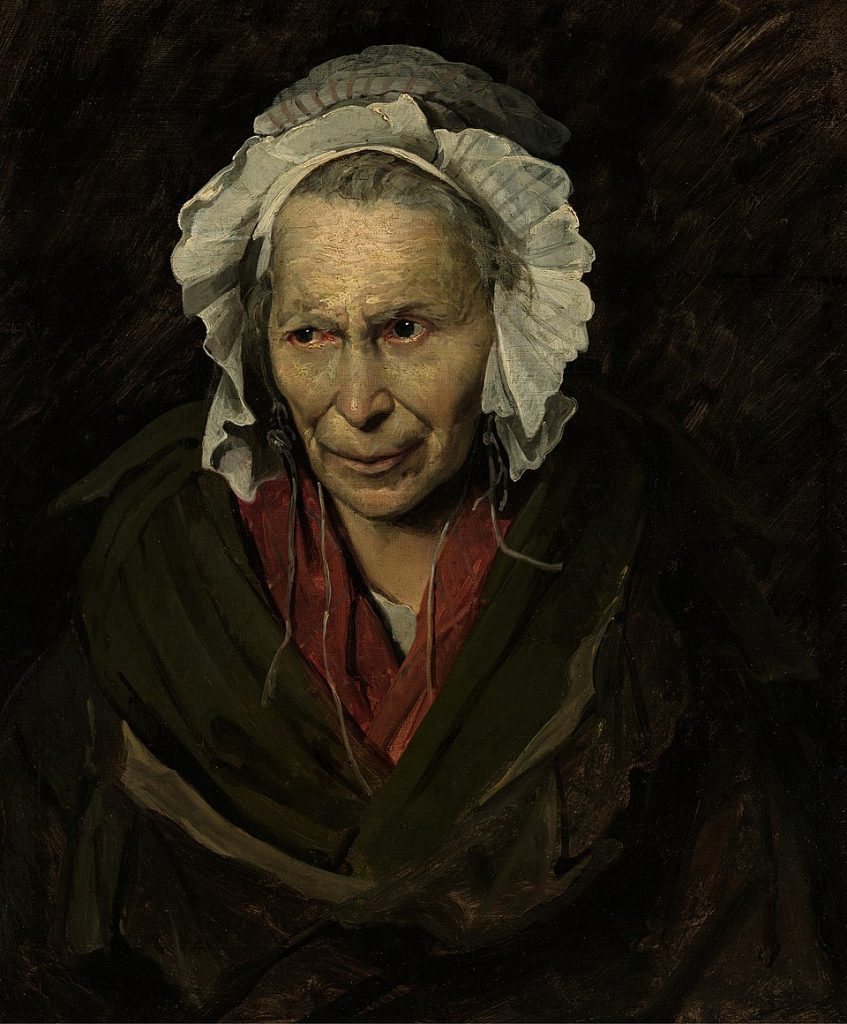
The Insane Woman shows signs of age and wear, suggesting a life of hardship. Her clothes are plain, and her skin bears the soft sag of someone past her prime. But it is her eyes—slightly unfocused, turned inward—that arrest the viewer. They are not pleading, nor defiant, but exhausted. She is present, but only just.
These portraits break from the norm by refusing to either demonize or idealize the mentally ill. Earlier artistic traditions often portrayed the mad as comic, dangerous, or tragic in theatrical ways. Géricault instead invites the viewer to recognize the subject’s personhood. There is no mocking here—only silence and presence.
Today, scholars believe that the models were drawn from institutions in or near Paris. It’s likely that they were selected by Georget for how well their appearance aligned with certain diagnoses. But Géricault didn’t treat them as specimens. He treated them, quietly and powerfully, as human beings.
Analyzing The Insane Woman (La Monomane de l’Envie)
Painted around 1822, The Insane Woman, also known by its more clinical title La Monomane de l’Envie, is one of Géricault’s most arresting portraits. Now housed in the Musée des Beaux-Arts in Lyon, it depicts a woman suffering from what was believed to be obsessive envy—a form of monomania. The painting is small, intimate, and emotionally devastating.
Composition and Color Choices
The painting measures only 77 by 65 centimeters, but its impact is immense. Géricault chose a dark, neutral background to eliminate distraction and pull all focus onto the woman’s face. Her pale skin contrasts with her dark eyes and sunken cheeks, drawing the viewer into her expression. There is no ornate setting, no furniture, no symbols—just the face, slightly turned, as if caught in thought.
The color palette is limited but powerful. Earth tones dominate: browns, ochres, grays. This restraint enhances the realism and prevents sentimentality. The woman’s clothing is modest and drab, reflecting both her station and her mental state. Her white bonnet, loosely tied, adds to the sense of disorder.
What makes the portrait so arresting is the precision of form. Her neck muscles are slightly tense. Her shoulders slope with fatigue. Every detail, from the creases around her mouth to the redness around her eyes, contributes to the emotional atmosphere. Géricault paints with the restraint of a documentarian but the soul of a poet.
This is not theatrical madness. There is no wild hair, no screaming mouth, no melodrama. Instead, the painting shows the quiet, crushing weight of a mind consumed by envy—not the petty kind, but the kind that hollows out the soul.
Facial Expression and Human Suffering
The woman’s expression is one of deep, quiet agony. Her lips are pressed together, slightly downturned, suggesting repression or bitterness. Her gaze is uneven—one eye focused inward, the other seeming to drift. This asymmetry adds to the unsettling effect. She looks almost aware of being watched, but too far gone to care.
Her face is not grotesque, but it is not beautiful either. It is lived-in, wrinkled, weathered. The power of the portrait lies in its unflinching honesty. Géricault saw her—not as a symbol or case study, but as a person caught in a condition she could not control. There is no attempt to “fix” her with beauty or style.
What’s remarkable is how the portrait walks a moral line. It neither condemns nor excuses. It simply shows. In doing so, it compels the viewer to respond—not with fear or mockery, but with contemplation. What is envy, when it goes unchecked? What happens to a soul that has nothing left but longing?
Géricault offers no answers. He does not romanticize or resolve. He simply bears witness, and in doing so, allows the subject to remain visible in her brokenness. That, in itself, is an act of mercy.
Géricault’s Personal Obsession with the Mind
Though Géricault’s paintings are often studied in relation to Romanticism or political art, his deep interest in psychology should not be overlooked. Long before Freud or modern therapy, Géricault was drawn to the invisible struggles of the soul—particularly madness, melancholy, and despair. His portraits of the mentally ill were not detached studies; they were personal. He, too, lived close to the edge of mental collapse.
His Own Mental and Physical Struggles
Géricault was no stranger to suffering. Throughout his short life, he battled physical ailments and deep emotional instability. In 1816, he suffered a serious fall from a horse that left him in chronic pain for the rest of his life. His injuries never fully healed, and he endured long periods of immobility, depression, and weakness. By 1821, he had become increasingly withdrawn and morose.
In addition to physical pain, he showed signs of what today might be diagnosed as bipolar disorder or clinical depression. He isolated himself from friends, avoided public life, and grew obsessed with dark themes. His letters became erratic. He often worked in obsessive bursts followed by long silences. These behaviors, while romanticized by some critics, clearly took a toll on his mind and body.
The emotional toll was worsened by personal failures. His affair with his aunt-by-marriage, Alexandrine-Modeste Caruel, scandalized his family and ended in heartbreak. He was never able to marry her or claim their illegitimate son. The shame and secrecy of that relationship haunted him. Combined with his artistic perfectionism, it created a state of constant inner tension.
By the time he painted The Insane Woman, Géricault was nearing the end. He died on January 26, 1824, at just 32 years old. His final years were marked by illness, solitude, and perhaps a growing identification with those he painted—individuals trapped within invisible prisons.
A Man Drawn to Tragedy and Pathos
Géricault’s entire body of work points to a fascination with human frailty. He painted soldiers, prisoners, shipwreck survivors, and madmen—not for sensationalism, but to show the nobility that could still exist amid despair. His paintings weren’t sermons, but they had a moral weight. He saw suffering not as entertainment, but as a subject worthy of reverence.
His choice of subjects consistently placed him outside the mainstream. While others painted allegorical gods and heroic battles, Géricault gave his canvas to the broken and forgotten. In The Raft of the Medusa, he did not highlight the naval officers but the starving, the dying, and the common sailor. In The Insane Woman, he did not show a beautiful muse, but a weary soul afflicted by obsessive thoughts.
The Romantic era often embraced stormy passions and raw emotions, but few did it with such dignity. Géricault didn’t overdramatize. He let the eyes of his subjects do the speaking. His brush respected what his society did not—those who lived outside the bounds of order, reason, and social approval.
The artist himself was never at ease. His pain, both internal and external, gave him insight into the lives of those deemed “mad.” It wasn’t pity that he offered—it was recognition. In their suffering, he saw a reflection of his own.
Romanticism and the Aesthetic of Suffering
The early 19th century saw the decline of Neoclassicism and the rise of Romanticism—an artistic movement that celebrated emotion over logic, the individual over the collective, and suffering over serenity. Géricault stood at the forefront of this shift. His art exemplified the Romantic belief that truth was found not in ideals, but in raw, lived experience.
Truth Through Emotion, Not Idealization
Romantic painters rejected the cold perfection of their Neoclassical predecessors. Instead of gods and emperors, they painted outlaws, madmen, and rebels. Instead of symmetry and clarity, they favored drama, contrast, and emotion. Géricault’s work is a perfect example of this transition. He painted not what society wanted to see, but what it needed to confront.
In The Insane Woman, the emotional truth is in the details: the downturn of her mouth, the tension in her jaw, the haunted expression in her eyes. These are not signs of madness in the theatrical sense. They are signs of a person worn thin by her own thoughts. That, to Géricault, was worth more than any mythological subject.
Romanticism’s obsession with the inner world—dreams, madness, memory—created space for artists to explore what had once been hidden. Géricault was among the first to explore this terrain not just as metaphor, but as literal subject matter. He wasn’t painting madness as a symbol of society’s ills. He was painting mad people—real ones—who had been cast aside.
This focus on emotion over artifice allowed Romanticism to open up moral questions that Neoclassicism had avoided. What happens to those who fall outside the ideal? What dignity remains for those deemed useless? Géricault answered not with theory, but with portraits.
Contrast with Neoclassical Portraits
The contrast between Géricault’s portraits of the insane and the polished works of painters like Jacques-Louis David or Jean-Auguste-Dominique Ingres is striking. Where the Neoclassicists showed men and women as gods in repose, Géricault showed them as they truly were—flawed, struggling, human. He didn’t use props, allegory, or myth to elevate his subjects. He relied solely on their presence.
In Neoclassical art, beauty often served morality: to be beautiful was to be good. Géricault inverted this. His subjects had no physical beauty, no ideal proportions. Yet he found moral weight in their suffering. They did not inspire admiration, but reflection. Their dignity came not from perfection, but from endurance.
Even in the composition, the difference is clear. Ingres might place a subject against a silk curtain, bathed in clean light. Géricault chose shadow, minimalism, and realism. His backgrounds are empty, his colors muted. He didn’t distract the viewer with wealth or setting—he demanded attention to the face alone.
Géricault’s vision was not fashionable at the time. His works were too unsettling, too far from decorum. But in hindsight, they were prophetic. They pointed to a new kind of art: one that dealt honestly with life’s darker corners.
Reception and Rediscovery
During Géricault’s lifetime, his portraits of the insane were never publicly exhibited. This was not because they lacked quality, but because they defied the accepted norms of both subject and style. The French art world of the early 1800s, even under the growing sway of Romanticism, was not ready for such direct confrontation with the mentally ill. These works remained largely unknown until well into the 20th century.
Largely Ignored During Géricault’s Life
Unlike The Raft of the Medusa, which caused a stir in 1819, the series on madness was never submitted to the Paris Salon. It was likely considered too private, too disturbing, and too far removed from the narrative and historical painting that dominated the exhibition circuit. These were not grand canvases or allegorical images; they were small, somber studies with little commercial appeal.
The reasons for this invisibility were also social. Mental illness carried significant stigma, and to showcase portraits of the insane was to court discomfort. Even for a Romantic artist, this was a step too far. Géricault himself may have understood this, and perhaps intended the paintings only for medical or private study.
After his death in 1824, the portraits were stored or scattered. Some were held by Georget’s estate, others vanished from public record. It would be over a century before they re-emerged and were recognized for their importance. By that time, art history had caught up with what Géricault was doing: showing the truth, no matter how unwelcome.
When seen today, the neglect these works suffered for decades adds to their poignancy. They were not made to impress. They were made to endure—and they have.
Modern Reappraisal and Exhibition
In the 20th century, scholars and curators began to reexamine Géricault’s lesser-known works, particularly those dealing with psychological suffering. The rise of modern psychiatry and interest in the history of mental health created new appreciation for these portraits. They were no longer seen as curiosities, but as pioneering examples of psychological realism.
Museums gradually acquired and displayed the surviving pieces. The Insane Woman found a permanent home at the Musée des Beaux-Arts in Lyon, where it is now recognized as one of the finest early examples of art engaging with mental illness not as metaphor, but as subject. Its display has helped contextualize Géricault’s broader contributions to Romantic art.
These paintings are now frequently included in exhibitions exploring the relationship between art and medicine. They serve not only as masterworks of portraiture, but also as historical documents of psychiatric practice. Their power lies in their quiet dignity. They do not exploit; they reveal.
Today, Géricault’s “mad portraits” are studied in art academies and medical schools alike. They bridge two worlds—artistic and clinical—without losing their emotional force. They remind modern viewers of the humanity behind diagnosis, and the artist who dared to capture it.
Art and Ethics: Respecting the Subject
Few works in the history of Western art have walked the ethical line as delicately as Géricault’s portraits of the insane. These were real people, suffering from real afflictions, at a time when consent and privacy were rarely considered. Yet unlike later portrayals of madness that descended into grotesquery or exploitation, Géricault’s approach remains deeply respectful.
Did Géricault Dignify or Exploit His Subjects?
The question of whether these portraits dignify or exploit is a legitimate one. These were institutionalized individuals, likely without say in how their image would be used. Their names are lost to history. Some modern critics argue this anonymity robs them of their identity, reducing them to case studies.
Yet the way Géricault painted them suggests something else entirely. He did not caricature or exaggerate. He did not place them in sensational poses. Instead, he met them with the same solemnity he gave to his more heroic subjects. There is care in the brushwork, restraint in the emotion, and honesty in the composition.
Importantly, he avoided the common trope of madness as either grotesque or divine. There is no implication that these subjects are evil or enlightened. They are simply human—afflicted, yes, but not reduced. That moral clarity is rare in any era, and especially notable in his own.
The lack of exploitation is further supported by the fact that Géricault never sought to publish or exhibit the works. They were not made for acclaim or profit, but for understanding. That, perhaps, is the strongest evidence of his ethical intent.
Modern Parallels and Lessons
In an age when every face can become content, Géricault’s restraint offers a needed example. He shows what it means to portray suffering without voyeurism. Artists today can learn from his balance of honesty and compassion. There is no need for spectacle when truth is powerful enough.
The portraits also challenge modern medicine. Even with advances in diagnostics and treatment, there is still a risk of dehumanizing patients. Géricault’s subjects are not just “cases”—they are individuals with emotions, dignity, and souls. That message is as relevant now as it was in the 1820s.
Art continues to serve as a bridge between the visible and invisible, the healthy and the afflicted. Contemporary artists who engage with themes of mental illness, trauma, or disability often cite Géricault as a forerunner. His work has quietly shaped a tradition of ethical portraiture that still evolves today.
In the end, The Insane Woman remains a powerful lesson in humility. It asks viewers to see, not judge. It demands no applause, only attention. That alone makes it timeless.
Conclusion: Géricault’s Triumph of Truth Over Idealism
At the intersection of art, science, and suffering, Théodore Géricault carved a legacy that defied the conventions of his age. He could have spent his brief career painting battle scenes or classical myths. Instead, he chose to look at the forgotten—those shipwrecked by fate or madness—and give them a voice.
A Unique Blend of Science and Art
Géricault’s collaboration with Étienne-Jean Georget remains one of the earliest examples of medical portraiture handled with both clinical accuracy and emotional depth. In his work, observation did not preclude compassion. He brought the precision of a draftsman and the empathy of a poet to his canvases.
These paintings were not political protests or public commissions. They were quiet studies of people pushed to the margins. And yet, in their silence, they speak powerfully—about suffering, dignity, and the human condition.
Few artists before or since have approached the subject of madness with such honesty. He neither glorified nor condemned it. He simply recorded it. And in doing so, he created a space where the mentally ill were not freaks or footnotes, but souls worthy of remembrance.
The pairing of scientific curiosity and artistic reverence is rare. But in Géricault’s hands, it produced something transcendent.
Enduring Influence and Cultural Power
Today, Géricault is remembered not only for The Raft of the Medusa, but for these quiet portraits that stayed hidden for so long. They form a counterpoint to his more public works, revealing a man deeply concerned with the soul, not just the spectacle.
The Insane Woman endures because it tells a truth most would rather ignore—that madness is part of the human experience, not a distant curiosity. It forces us to look, to consider, and perhaps to understand. In that way, it still fulfills its purpose more than two centuries later.
The painting remains relevant not because of fashion, but because of its faithfulness to reality. It doesn’t shout. It doesn’t flatter. It simply stands in silence, asking to be seen.
In that silence lies the triumph of Romanticism: the return of feeling, truth, and the moral weight of art.