The earliest gestures of art in what is now Warsaw were not carved into cathedral stone or painted on chapel walls, but pressed into wet clay and scored into bone by people who lived millennia before the city took shape. These were not citizens of a city, nor even subjects of a kingdom, but members of transient tribes, farming settlements, and loosely organized communities who left behind no names, only artifacts. And yet their creative legacy is unmistakable. The prehistoric art of the Warsaw basin—scattered, fragmentary, and often small—nonetheless reveals a continuity of imagination. It speaks of humans who saw more than survival in their surroundings: they saw patterns, presences, and the need to record both.
Neolithic figurines and the grammar of clay
By the late Neolithic period, roughly 4000–2000 BC, the region surrounding modern Warsaw was inhabited by members of the Funnelbeaker culture (TRB), soon joined by groups associated with the Globular Amphora culture. These were communities of early farmers, settled near rivers for access to fresh water, fish, and fertile soil. Though their architecture was rudimentary and perishable—wattle-and-daub huts, timber palisades—their ceramics were anything but.
Excavations in areas such as Białołęka, Wilanów, and Targówek have uncovered shards of pottery whose surface decoration suggests more than mere functionality. These vessels were incised with repeating motifs: zigzags, concentric circles, herringbone patterns, and crossed lines that seem to follow rhythmic, even meditative, systems. While no complete symbolic code has been deciphered, scholars have long argued that such markings were mnemonic or ritual in nature—possibly connected to seasonal cycles, lunar observations, or mythic structures now lost to time.
More enigmatic still are the anthropomorphic and zoomorphic figurines occasionally found at these sites. Made from clay and often small enough to fit in the palm, they typically lack distinct facial features but exaggerate certain body parts—hips, breasts, abdomens. Some scholars interpret these as fertility symbols; others see them as ritual stand-ins for absent ancestors or deities. A small figurine found near the Vistula’s edge in Wilanów, with a tapered body and drilled eye-holes, bears faint similarity to Cycladic idols, though there is no evidence of contact. Its presence suggests an impulse to abstract the human form, to isolate its essence in a few elemental curves.
These figurines were often discovered in pits alongside burned bone, broken tools, and shards of intentionally smashed vessels—arrangements that hint at structured ritual. Whether these were offerings to gods, rites of passage, or funerary customs, they mark the earliest intersection of artistic practice and symbolic behavior in the Warsaw region.
Bronze and iron: ornament, weapon, and sign
By the second millennium BC, the people inhabiting the Mazovian plain began to work bronze—a shift that changed both their tools and their art. The Bronze Age introduced new materials for expression: metal, amber, and finer ceramics. Burial mounds from this period, often found in the Kampinos Forest region just west of present-day Warsaw, contained grave goods whose craftsmanship surpassed mere utility. Spiral fibulae (brooches), twisted neck torcs, and engraved belt plates begin to appear. Some objects were cast using simple molds; others were hammered and engraved by hand.
One particularly striking Bronze Age find—a bronze dagger with an engraved hilt recovered near Żoliborz—was likely never used in combat. Its delicate workmanship and deliberate burial suggest it held ceremonial significance. Elsewhere, cremation urns shaped like stylized houses (a form known across Central Europe) appear in the cemeteries of the Lusatian culture, which dominated the Warsaw basin during the late Bronze and early Iron Ages (circa 1300–500 BC).
The Lusatian people, whose settlements have been found in Bródno and Służew, left behind not only pottery but also the first large-scale use of patterned motifs in domestic settings. Storage jars bore impressed comb designs, while certain amphorae were painted with white slip and incised with geometric borders. This period saw the emergence of standardized motifs—cross-hatching, meanders, swastikas—that likely held specific meanings within the culture’s visual lexicon. Though their significance is now opaque, their repetition across time and geography suggests a shared symbolic vocabulary.
In some burial contexts, iron objects begin to appear: simple blades, buckles, and arm-rings. The transition from bronze to iron was not abrupt, but as the latter became more common, new forms of ornament emerged. Spirals gave way to straight lines, and the circular forms of the Bronze Age were gradually replaced by rectilinear patterns. This stylistic shift, subtle though it was, marked a broader transformation in the cultural worldview—one that would culminate, centuries later, in the arrival of literacy, hierarchy, and the visual cultures of antiquity.
Traces, absences, and enduring patterns
The prehistoric art of the Warsaw region resists easy classification. It offers no monumental sculpture, no standing stones, no frescoes. What survives is intimate, coded, and often broken: a shard of decorated pottery, a burned figurine, a brooch buried in a grave. Yet these fragments speak forcefully of a people attuned to visual rhythm, invested in symbolic meaning, and capable of abstraction. Their works were not aesthetic in the modern sense, but expressive—rooted in ritual, seasonal cycles, and the mapping of identity in a world without maps.
Three details, drawn from across the region’s prehistory, stand out for their quiet resonance:
- A clay figurine with no face but carefully incised pubic triangle, found near a hearth in Tarchomin, suggesting ritual emphasis on fertility or generative power.
- A bronze spiral fibula buried with a woman and child in a Lusatian cemetery in Ursynów, signaling a bond of ornament and status beyond life.
- A series of concentric circle patterns etched into pottery at a Bródno site, each line echoing the curve of the Vistula itself, as if river and vessel mirrored one another.
These objects do not tell a continuous story. There is no clear line from Neolithic figurines to the polychrome friezes of Renaissance Warsaw. But they establish a deep, underlying fact: that humans in this place, long before city or state, sought to shape the world into meaning. They molded earth, marked it with patterns, and gave it back to the soil in acts of remembrance and imagination. The city that would rise here would bury their traces, but not erase them. In every reconstruction of Warsaw’s ruins, there is an echo—faint but persistent—of these earliest makers, shaping symbols in the mud.
Medieval Mazovia and the Birth of Urban Iconography
Warsaw did not emerge in a blaze of founding grandeur. It grew slowly, cautiously, as a fortified outpost on the eastern edge of the Duchy of Mazovia—a land once wooded, war-prone, and religiously fluid. By the early 14th century, it had become a ducal seat. What followed was not a cultural explosion, but a visual solidification: the slow, deliberate shaping of symbols, structures, and sacred images that transformed a river town into a city. Medieval Warsaw’s art was not opulent, but it was defining. It laid down the visual DNA from which future generations would construct the idea of the city itself.
Patron saints and painted panels
The heart of medieval Warsaw’s iconography was religious. From the first parishes and chapels rose a language of painted panels, carved saints, and altars that told the city who it was, and to whom it owed devotion. The earliest surviving works of religious art in the region, though sparse, belong to this ecclesiastical lineage. They were often created by itinerant artists or monastic craftsmen, borrowing from Gothic forms established in Kraków, Gniezno, and Prague, but adapted to local scale and taste.
Among the most important figures in Warsaw’s religious visual identity was St. John the Baptist, patron of the city’s principal parish church, later elevated to cathedral status. His image—often depicted in tempera on wood panels, with his lamb and scroll—became a central motif in devotional art. Some fragments of 14th-century panel paintings, preserved in situ or through secondary documentation, show him rendered with dark, intense features, surrounded by gold leaf halos in the International Gothic style. These paintings were not merely decorative. In a largely illiterate society, they functioned as public theology: transmitting belief through color, proportion, and gesture.
Equally significant were the Marian images that adorned both parish and monastic spaces. Black Madonna-type icons—common throughout Poland—appeared in local variants. Though none of Warsaw’s earliest examples have survived intact, records from the now-vanished Carmelite and Franciscan houses refer to richly adorned altarpieces featuring the Virgin, often depicted with stars, crescent moons, and scepters. These motifs, rooted in older Byzantine models, evolved in Gothic Europe into softer, more anthropomorphic portrayals, blending celestial symbolism with maternal familiarity.
These painted and carved saints did more than populate liturgical space. They inhabited the civic imagination. Processions carried them through Warsaw’s narrow streets on feast days. Bells rang out in their honor. Their likenesses were affixed to city walls, gates, and public fountains, imprinting their authority onto both sacred and secular life.
Stone, timber, and sacred geography
Architectural expression in medieval Warsaw was limited by materials. Unlike Kraków, with its abundant limestone, Warsaw sat on softer soil and lacked high-quality local stone. This geographical constraint meant that early buildings were often timber structures: churches with wooden beams, wattle-and-daub infill, and thatched roofs. Few of these survive, but archaeological digs—especially around the Old Town Market Square—have revealed their footprint.
The earliest stone structures, such as the foundations of St. John’s Cathedral and the Curia Mazoviae (the seat of the Mazovian dukes), began appearing in the late 13th and early 14th centuries. Built in brick and fieldstone, often using the Gothic techniques of ribbed vaulting and pointed arches, these buildings introduced verticality and volume into the Warsaw landscape. Their design echoed trends from Teutonic Prussia and Bohemia, but their scale remained modest.
One notable example is the Church of the Visitation of the Blessed Virgin Mary, built in the second half of the 14th century in the New Town area. Its tall nave and ribbed vaults represent a clear adoption of Northern Gothic architecture, but its ornamentation remains restrained. There are no elaborate tympana or grotesques; instead, one finds corbels carved with vegetal forms, a few coats of arms, and simple traceried windows. The focus was on spiritual function, not grandiosity.
Warsaw’s medieval geography itself had sacred implications. The city’s layout, with churches placed at cardinal points and religious houses clustered near the royal precinct, reflected a kind of spiritual mapmaking. The Vistula, running to the east, became both boundary and metaphor—a liminal space between realms, across which processions would travel, relics would be brought, and sermons would resonate.
Three structures anchor this period of architectural development:
- The original St. John’s Cathedral: a brick basilica with three aisles, buttressed walls, and a modest apse—later destroyed and reconstructed, but foundational in Warsaw’s religious and civic identity.
- The city walls and gates: begun in the 14th century, they were more than military structures—they were visual borders, marked with crucifixes, coats of arms, and saintly icons, signaling entry into sanctified space.
- The ducal castle: initially a fortified wooden manor, gradually rebuilt in brick, with Gothic windows and heraldic reliefs—representing the fusion of political and ecclesiastical power.
Though little decorative sculpture survives from this period, the city’s layout and structural hierarchy reveal a deep alignment between art, ritual, and rule. Medieval Warsaw was not a city of grandeur, but it was one of carefully constructed meaning.
The legend of the mermaid and early iconography
It is also in the medieval period that Warsaw’s most enduring secular symbol begins to emerge: the mermaid, or syrenka. Though the exact origin of the legend is murky—no definitive textual source predates the 15th century—its iconographic roots are older, possibly tied to pagan river worship and protective water spirits from Slavic folklore. Over time, this mythic figure was absorbed into the city’s heraldry and carved onto gates, fountains, and civic seals.
The earliest known seal of Warsaw to feature the mermaid dates to 1390. She is depicted upright, bearing a sword and shield, with a fish tail coiling beneath her. Unlike the languid sirens of classical mythology, Warsaw’s mermaid was armed and alert—more warrior than seductress. This visual choice was deliberate. It positioned the city as under divine and mythic protection, yet also capable of defense. In an era of frequent sieges and dynastic conflict, such imagery carried weight.
By the early 15th century, the mermaid was appearing on legal documents, merchant stamps, and eventually on carved reliefs around the city. These depictions varied in style but kept to the core iconography: shield, sword, tail. In artistic terms, they were often crude—folkish woodcuts or naive stone carvings—but their symbolic potency outweighed their technical finesse.
That this figure endured for over six centuries speaks to the power of iconographic invention. The mermaid made the leap from myth to municipal symbol, from oral tale to artistic emblem. She would later be reimagined by painters, sculptors, and poster artists in dramatically different styles—but always anchored in the visual logic established in these medieval beginnings.
By the close of the Middle Ages, Warsaw had developed a coherent visual identity. It was a city of painted saints, brick churches, ducal coats of arms, and an armed mermaid standing sentinel over its gates. Though many of the original works have vanished—burned, buried, or bombed—their presence is legible in the structure of the Old Town, the rhythms of the skyline, and the persistent recurrence of certain images. The city’s artistic future would be built atop this matrix of saints and symbols, wood and stone, devotion and defense.
Renaissance Echoes: Italian Influence and Royal Aspirations
Warsaw entered the Renaissance not with a flourish, but with an invitation. In the early 16th century, the city was still secondary to Kraków in political and cultural life, a regional seat for the Dukes of Mazovia rather than a royal capital. But when the last Mazovian duke died without an heir in 1526, Warsaw was absorbed into the Polish Crown. What followed was a transformation—not immediate, but decisive—as Italian artists, architects, and thinkers began to migrate north under royal patronage. They brought with them new ideas of space, proportion, and civic image. The Gothic silhouette of medieval Warsaw began to soften. Arches widened. Façades were measured. And behind it all was a growing aspiration: to reimagine Warsaw not only as a seat of governance, but as a cultivated city worthy of Europe’s new aesthetic order.
Sigismund I and the influx of Italian artists
The most consequential figure in ushering Renaissance ideals into Poland was King Sigismund I the Old (r. 1506–1548), whose patronage in Kraków and elsewhere was extensive and deeply informed by Italian models. Though his court remained officially based in Kraków, his annexation of Mazovia brought increasing royal attention to Warsaw. Italian architects such as Bartolommeo Berrecci—already active in Wawel—began to influence the artistic climate more broadly, setting a visual precedent that would eventually touch Warsaw’s architecture.
The earliest signs of this shift are visible in the Royal Castle. Originally a Gothic fortress used by the Mazovian dukes, it underwent several phases of rebuilding under the Polish monarchy. In the mid-16th century, the old medieval forms were gradually overlaid with Renaissance logic: symmetrically arranged windows, classically proportioned portals, rusticated stone bases. While the transformation was not as sweeping as in Kraków or Zamość, it signaled Warsaw’s new status as a courtly city-in-the-making.
This period also saw the arrival of skilled craftsmen and decorative painters from southern Europe, whose work reshaped interiors as much as exteriors. Painted wooden ceilings, coffered and gilded, began appearing in noble residences. Wrought-iron balconies and classical cornices signaled a departure from the steeply gabled, inward-turning houses of the Gothic era. Even in smaller ecclesiastical structures—such as St. Anne’s Church, initially Gothic—there was a quiet infusion of classical detailing and geometric clarity.
What distinguished Warsaw’s Renaissance from that of other Polish cities was not its immediacy or grandeur, but its adaptability. Here, Italian ideals were not imposed wholesale; they were absorbed, interpreted, and often hybridized. A modest townhouse in the Old Town might bear an arched Renaissance portal set beneath a high-pitched Gothic roof. This architectural bilingualism reflected the city’s transitional identity: still medieval in outline, but increasingly modern in ambition.
Polychrome façades and urban identity
Nowhere was this transformation more visible—or more public—than in the decoration of house façades. As Warsaw’s merchant class grew, so too did their desire for urban visibility. The facades of townhouses around the Old Town Square became visual statements: coated in sgraffito, painted in vivid polychrome, and framed with classical pilasters and cornices.
Sgraffito, a technique involving the layering and scratching away of tinted plaster to reveal patterns beneath, became a hallmark of Renaissance decorative art in Poland. Italian-trained artisans introduced it to Warsaw, and local artists quickly mastered it. Houses belonging to guild leaders, city officials, and wealthy traders boasted allegorical scenes—Justice, Temperance, the Triumph of Time—alongside ornamental grotesques and mythological motifs. These decorations served not merely as aesthetic enhancements but as emblems of civic virtue and cultural fluency.
Some façades went further, incorporating trompe-l’œil elements such as false columns, balustrades, or faux niches containing painted statues. One famous example, now lost but recorded in 18th-century drawings, showed a painted figure of Minerva flanked by two lions on a tenement near the New Town Gate—a fusion of classical authority and heraldic pride. Even more modest homes often bore Latin inscriptions, invoking moral or philosophical maxims drawn from Erasmus or Seneca.
Color itself became a form of competition. Whereas medieval buildings were largely earth-toned or whitewashed, Renaissance façades gleamed with blues, ochres, reds, and gold. The result was a city center that, by the late 16th century, offered an urban spectacle of both learning and liveliness—a painted city in the Renaissance sense, where surface was treated as a space for meaning.
This outward display was not just decorative—it was cultural positioning. By embedding classical references and sophisticated ornament in public view, Warsaw’s elites signaled their alignment with the broader currents of European humanism. It was, in effect, a visual argument that Warsaw deserved to stand among the Renaissance cities of the continent.
The Warsaw Castle’s ornamental beginnings
While the city grew more ornate, the Royal Castle remained the nucleus of symbolic and artistic change. During the reign of Sigismund II Augustus (r. 1548–1572), work on the castle intensified. Italian and German artisans collaborated to transform the once-fortified residence into a palace suitable for a Renaissance monarchy. While no comprehensive pictorial record of the 16th-century interiors survives, inventories and fragments suggest an increasing emphasis on ornament, symmetry, and allegory.
One of the most notable additions was the Audience Hall, which featured carved wooden ceilings and murals depicting scenes from classical history and Old Testament narratives—a favorite pairing in Renaissance iconography. Decorative motifs ranged from acanthus leaves to grotesques, and entire rooms were lined with tapestries commissioned from Brussels workshops. These tapestries, part of Sigismund II’s famed collection, included both biblical and allegorical series, woven in rich gold and silk, and brought to Warsaw for court functions.
Furniture, too, played a role in this ornamental language. Cabinets inlaid with ivory and ebony, Italian credenzas, and painted folding screens were imported or locally produced in imitation. The castle’s great halls were lit with Venetian glass chandeliers, and the floors tiled in geometric patterns that mimicked the marquetry of Florentine churches. Every surface became a site of intentional display.
Though much of this early Renaissance decoration would be lost or altered in later reconstructions, it established a precedent: Warsaw could be a city of cultured interiors, not merely administrative exteriors. The Royal Castle became a prototype for courtly taste, influencing noble residences throughout Mazovia and beyond.
Yet the Renaissance in Warsaw was always conditional—contingent on politics, interrupted by war, and often overshadowed by the cultural dominance of Kraków. It was not an age of artistic consolidation, but of aspiration. The visual world that took shape in 16th-century Warsaw was one of adaptation, experimentation, and civic self-fashioning. It laid the groundwork for the city’s later transformations, showing that art here was not a passive import but an active ambition.
Baroque Splendor and the Sarmatian Myth
By the dawn of the 17th century, Warsaw was no longer merely aspiring—it was ascendant. The Polish-Lithuanian Commonwealth, with its elective monarchy and vast territorial reach, had begun to pivot its political center of gravity toward Warsaw, culminating in the city becoming the permanent seat of the royal court in 1596. With kings, diplomats, bishops, and nobles now calling Warsaw home, the city turned into a theater of performance, wealth, and style. And no style more vividly captured this moment than the Baroque.
Baroque art in Warsaw did not unfold as an imported fashion. It was a declaration: of dynastic ambition, of Catholic triumphalism, of noble identity. The aesthetic of exuberance—curved façades, golden altarpieces, theatrical ceiling frescoes—was embraced as the proper visual language for a capital city in a Commonwealth that saw itself not as peripheral but imperial in scope. At the heart of this movement was the mythos of the Polish nobility: the Sarmatians, semi-legendary ancestors whose imagined virtues shaped a powerful and enduring artistic ideology.
Wilanów Palace and theatrical pageantry
No building more perfectly embodies Warsaw’s Baroque ambition than Wilanów Palace. Commissioned in the 1670s by King Jan III Sobieski, hero of the Battle of Vienna, the palace was conceived not as a defensive structure or austere court residence, but as a country villa in the Italian style—an assertion of cultural sophistication in the outskirts of the Polish capital.
Designed by Augustyn Wincenty Locci, an architect of Italian origin, Wilanów was a fusion of Roman villa, French château, and Polish noble manor. Its central block, with projecting pavilions and a high mansard roof, was framed by gardens in geometric symmetry—an early example of formal landscape architecture in Poland. But it was the decoration that truly declared its identity.
Inside, nearly every surface was enlisted into a visual campaign. Ceilings bloomed with allegorical frescoes: Jan III portrayed as a Roman conqueror, the Commonwealth depicted as a serene maiden with cornucopia in hand, and Time itself shown surrendering to the king’s virtue. The audience halls were lined with portraits of Sobieski and his family, not as domestic sitters but as mythic personae—Mars, Minerva, Jupiter. Sculptures of putti held royal symbols. Murals cited both classical mythology and Old Testament triumphs. The palace functioned not only as a residence but as a stage for a cultivated public fantasy: that the Polish king was both pious Christian sovereign and noble Sarmatian warrior-philosopher.
This iconographic program was echoed elsewhere, particularly in magnate palaces and senatorial estates across the city. The Czartoryski, Radziwiłł, and Lubomirski families constructed residences in Warsaw adorned with marble staircases, gilded salons, and imported Venetian mirrors. These were not mere imitations of Western European grandeur; they were statements of parity. Warsaw, through these Baroque spectacles, insisted on its place within the great courts of Europe.
Church interiors: illusion, marble, and vaulting frescoes
If Wilanów spoke to dynastic authority, the city’s churches told another side of the Baroque story: Catholic renewal. The Counter-Reformation was not merely a theological stance but a visual one. Art became the Church’s most persuasive tool, and Warsaw embraced its fullest effects.
The Jesuit Church, begun in 1609 and completed in the 1620s, was among the earliest major Baroque churches in Warsaw. Its façade was stately rather than exuberant, but its interior—redecorated in successive phases—quickly accumulated the full grammar of Baroque ecclesiastical design: gilded altars, illusionistic ceiling paintings, marbleized columns, and radiant sanctuaries that drew the eye toward divine light. Elsewhere, the Church of St. Anne, originally Gothic, underwent a Baroque transformation that reshaped its interior with Corinthian pilasters, dramatic cornices, and oval paintings set in elaborate stucco frames.
The Capuchin Church, funded by King Jan III, added another layer: austerity within grandeur. Here, despite the use of high altar sculptures and trompe-l’œil frescoes, the color palette was muted, the decoration restrained—a counterpoint to the theatrical excesses of Wilanów. Still, even in its simplicity, the effect was unmistakable: to transport the viewer, to instruct and awe, to render theology visible in gold, light, and perspective.
One of the most technically accomplished examples of Baroque illusionism in Warsaw was the ceiling of the Church of the Holy Cross, painted in the late 17th century. Though now lost to war, early descriptions and sketches show a dynamic composition: clouds opening above the nave, revealing a heavenly court of saints and angels arranged in spiraling ascent. This was more than visual embellishment—it was cosmic architecture, expanding the church into a metaphysical dome, linking earth to heaven.
These interiors created a sensorial theology. Incense, echoing music, colored light through stained glass, and swirling frescoes worked in unison to overwhelm the rational and elevate the soul. Warsaw’s Baroque churches were immersive spaces of belief, built to confirm the viewer’s place in a divinely ordered world.
Portraiture and the aesthetics of Polish nobility
While palaces and churches shaped the city’s public image, portraiture became the private theater of Sarmatism—the self-styled ideology of the Polish noble class. These portraits, found in family manors, senatorial palaces, and later museum collections, presented the nobility not as merely rich or powerful, but as embodying a moral and genealogical myth.
Sarmatism, drawn from the supposed descent of Polish nobles from the ancient Sarmatian tribes of the steppes, was both historical fantasy and cultural program. Its values—martial bravery, Catholic devotion, rural virtue, and patriarchal authority—were visually codified in portraiture. Men appeared in kontusze (long belted robes), żupans (embroidered tunics), and fur-lined caps, with curved sabers and ornate sashes. Their poses were static but stern, gazes unwavering, backdrops sparse but symbol-laden: a coat of arms, a crucifix, an open book.
The 17th-century Warsaw portraitist Daniel Schultz, though primarily active in Gdańsk, had patrons among the Warsaw elite. His work combined northern realism with baroque sensibility: aged skin rendered with unflinching detail, eyes alert, hands posed over swords or rosaries. These were not portraits of psychological introspection, but of identity performed.
Women, too, appeared in Sarmatian portraiture, though with different emphases. Clad in embroidered bodices and elaborate pearls, their likenesses focused on dynastic continuity and marital virtue. The gaze was demure, the body modestly composed, but always set against a backdrop that affirmed lineage—an heirloom, a crest, a religious relic.
What distinguished Warsaw’s Baroque portraiture was not its technical innovation—it remained conservative in composition—but its symbolic density. These were images meant to outlast the sitter, to affirm their place within a social and cosmological order. They hung not only in drawing rooms, but in chapels and crypts, marking both presence and posterity.
By the early 18th century, the Baroque had saturated Warsaw’s visual life. It was in the procession banners, the carved pulpits, the gilded balconies, and the celebratory engravings of royal entries and papal decrees. It was both surface and system, linking divine order to dynastic power and noble virtue. In Warsaw, the Baroque was not only an art style—it was a worldview, built in stone, wood, fabric, and light.
The Enlightenment and the Birth of Public Art
By the mid-18th century, Warsaw had outgrown its Baroque ambitions and entered a new phase of civic imagination. The Age of Enlightenment brought not only philosophers and salons, but also a shift in how art interacted with the city and its citizens. No longer confined to palaces and churches, visual expression began to unfold in public spaces—parks, promenades, monuments. Art became a civic practice, aimed at educating and engaging an increasingly curious and socially mobile audience. This era laid foundations for Warsaw to present itself not just as a royal capital, but as a cultured European city.
King Stanisław August and his Thursday Dinners
At the heart of this transformation was the last king of the Polish–Lithuanian Commonwealth, Stanisław August Poniatowski (reigned 1764–1795). Influenced by French high culture and the ideals of the Enlightenment, he hosted weekly “Thursday Dinners” at the Royal Castle—gatherings of poets, painters, scientists, and political thinkers. These salons were more than social—they were commissioning forums where ideas and artworks converged.
Under his influence, the Castle’s interiors were revamped. The Throne Room was frescoed by Marcello Bacciarelli with allegories of Wisdom, Justice, and Prudence, placing virtue at the center of royal authority. Portraits of Polish luminaries—Kosciuszko, Krasicki, Zamoyski—lined the walls of the King’s study, becoming prototypes for civic portraiture. The Royal Library was founded and patronized, acquiring illuminated manuscripts, prints, and archaeological casts. Each Thursday Dinner could involve a discussion, a performance, and perhaps a new portrait unveiled. Art became a mode of public reason and reform.
The Royal Łazienki: sculpture, landscape, and salon culture
If the Thursday Dinners made art social, the King’s redesign of Łazienki Park made it architectural. Formerly a royal bath-house, Łazienki was transformed into a landscaped pleasure garden by the design of Domenico Merlini and Jan Chrystian Kamsetzer between 1764 and 1794. Within this public green space, art became a form of gathering and display.
Paths wound past sculptures of Roman gods, allegorical exedra, and secret temples nestled in groves. The amphitheater hosted open-air concerts, marking one of the earliest integrations of live music and landscape design in Europe. The Palace on the Isle, with its mirrored water façade, became a picturesque backdrop where strolling Warsaw residents saw themselves reflected in stone, water, and bronze. Statue groups of Apollo and Minerva embodied Enlightenment virtues, while memorials to heroic figures—both real and mythic—gave the park a civic narrative as much as royal one.
Łazienki was both spectacle and instruction, a site where art, nature, and reason intermingled. It introduced the idea that Warsaw itself could be curated, experienced, and enjoyed as a public artwork.
Canaletto’s painted Warsaw and proto-documentary aesthetics
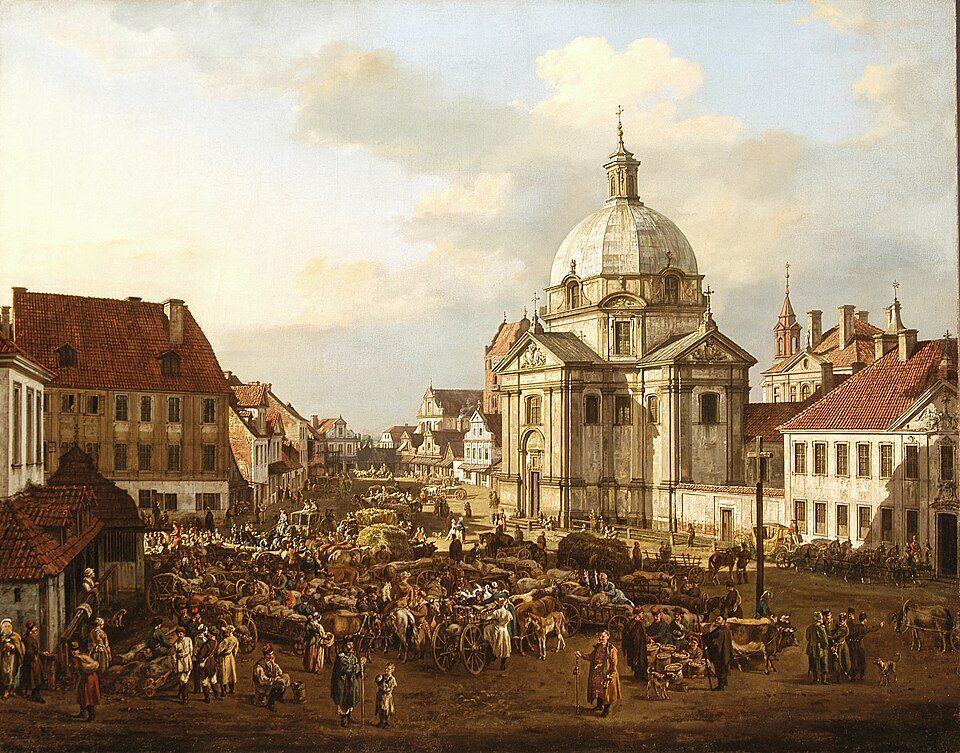
Coinciding with these civic transformations was a wave of visual documentation. The most famous—and still most influential—example is Bernardo Bellotto, known in Poland as Canaletto (1722–1780), nephew of the Venetian cityscape master. In the 1760s and ’70s, the painter produced over fifty meticulously detailed views of Warsaw’s streets, palaces, and squares.
These paintings, commissioned for the king, are remarkable for their precision—the cobblestones, the merchant stalls, the weathered façades. They present a city poised between Baroque tradition and Enlightenment order, with the King’s latest architectural interventions infused into the canvas alongside medieval spires. Bellotto’s work became documentary in intent, indelibly preserving pre-partition Warsaw.
Beyond their value as historical records, these cityscapes subtly shifted the understanding of art. They framed Warsaw as collective inheritance—visual referents that citizens could recognize and take pride in. When much of the city was destroyed in World War II, Bellotto’s paintings served as the basis for the painstaking reconstruction of the Old Town. His art had become part of the urban plan itself.
Partitioned Visions: Art Under Foreign Rule
The partitions of Poland at the end of the 18th century were not only a political dismemberment—they were an aesthetic disruption. For Warsaw, now absorbed into the Russian Empire following the third partition of 1795, the visual culture of independence gave way to a fractured, coded, and often conflicted artistic vocabulary. The institutions that had once radiated Enlightenment optimism—the Royal Castle, the Łazienki, the National Theater—were dimmed or repurposed. Royal patronage vanished. But artistic production did not stop. Instead, it adapted, encoded, and resisted. Across salons, studios, and salons again remade as bastions of silent opposition, Warsaw’s artists developed a visual language of survival: Romanticism laced with allegory, neoclassicism twisted into imperial spectacle, and salon painting layered with double meanings.
Russian classicism and imposed imperial taste
The first and most visible aesthetic imposition came from the Russian imperial authorities, who sought to recast Warsaw in the architectural and cultural mold of St. Petersburg. Russian neoclassicism, with its stripped symmetry and imperial scale, began to overwrite Warsaw’s Baroque and Enlightenment-era silhouette. Grand boulevards were plotted. New government buildings were commissioned, such as the Palace of the Governor-General on Krakowskie Przedmieście, designed to echo Tsarist power rather than local tradition.
Churches were transformed into Orthodox cathedrals, and new Orthodox structures—such as the grand Alexander Nevsky Cathedral (completed in 1912 and demolished in the 1920s)—were planted in central squares as symbolic acts of colonization. Their onion domes and byzantine interiors were alien to Warsaw’s visual heritage but unmistakable in their intention. They were not just places of worship, but imperial monuments.
In the fine arts, Russian academies dictated standards. Artists who wished for state patronage or institutional appointments had to conform to a rigid academic realism that glorified empire, moralized history, and suppressed political nuance. The themes were didactic: peasant virtue, historical grandeur, religious piety. But in Warsaw’s circles, such official art was viewed with skepticism, even contempt. It was art of obedience.
Polish Romanticism and visual nationalism
In response to the heavy hand of empire, a distinct current of Polish Romantic art flourished—quietly, often privately—in the early 19th century. While the Romantic movement in literature had immediate political overtones (as in the poetry of Adam Mickiewicz), the visual arts followed a subtler course. Allegory, historical symbolism, and landscape painting became the vehicles of a veiled nationalism.
One of the most influential figures in this movement was Piotr Michałowski, whose dramatic equestrian portraits and scenes of Napoleonic cavalry evoked both national pride and revolutionary fervor. Although based in Kraków, his works circulated among Warsaw’s intelligentsia and aristocracy, resonating with a generation shaped by the failed uprisings of 1830 and 1863. His brushwork—fluid, stormy, often unfinished—mirrored the volatility of the times.
Józef Simmler, a Warsaw-based painter, took another path. His meticulously detailed historical paintings, such as Death of Barbara Radziwiłł, were drenched in romantic pathos. They depicted private, emotionally charged moments in Polish history—scenes of love, loss, or tragic resistance. To the imperial censors, they were apolitical. To Polish audiences, they were quiet affirmations of cultural continuity.
Meanwhile, genre painting blossomed as a coded form of national expression. Artists like Aleksander Gierymski portrayed Jewish tailors, Warsaw street musicians, and village markets with humanistic clarity. These works were not polemical but restorative. They preserved the specificity of Polish life—its textures, rituals, and cadences—in a time when public affirmation of national identity was forbidden.
This period also saw the emergence of Polish landscape painting as a form of affective cartography. Painters such as Jan Nepomucen Głowacki and Wojciech Gerson depicted the Tatra Mountains, the Mazovian plains, and the crumbling castles of former Polish grandeur. The landscape became a repository of memory, its contours and skies rendered with tenderness and fidelity. Nature stood in for nation.
The 19th-century salon: exile, allegory, and coded protest
By the latter half of the 19th century, Warsaw’s artistic life centered on the salon: a space at once private and public, intimate and performative. Artists, collectors, and intellectuals gathered in the homes of wealthy patrons—many of them women—to view new works, discuss politics under the veil of aesthetics, and cultivate a discreet opposition to Tsarist control.
Within these salons, art functioned as encrypted speech. Historical allegories masked current anxieties. A painting of a medieval king might evoke a banned patriot. A weeping Madonna might allude to national suffering. Every element could be read in double: a ruined tower, a faded standard, a solitary rider at dusk. Warsaw’s artists became fluent in allusion.
Two powerful examples from this milieu are:
- Artur Grottger’s cycle Polonia (1863): a series of black-and-white drawings portraying the January Uprising in stark, symbolic terms. One image shows a Polish woman stripped and bound, her captors faceless. Another depicts a deserted battlefield, scattered with broken standards. Though never exhibited publicly during the artist’s lifetime, the images circulated in private copies and were revered as moral documents.
- Jacek Malczewski’s early allegorical paintings: while he would later become a central figure in Symbolism, his 1880s work already teemed with coded national iconography—nymphs holding Polish flags, blindfolded figures walking through ruins, angels pierced with bayonets.
Despite censorship, Warsaw’s artists found ways to express defiance. Their work didn’t shout—it murmured, sighed, and remembered. The result was a body of art that doubled as archive and witness: a chronicle of a country forced underground.
In this partitioned era, Warsaw’s art was split between compliance and resistance, surface and depth, form and meaning. It bore the outward dress of imperial realism but carried within it a stubbornly Polish pulse. That pulse never fully faded. Even in repression, the city remained visually articulate—its artists crafting a language that empire could not fully suppress.
Modernism Takes Root: Form, Function, and Friction
At the turn of the 20th century, Warsaw stood on a cultural fault line. Still under Russian control, yet increasingly exposed to Western European ideas, the city’s artists faced a world in motion. Trains, factories, newspapers, and electric light transformed daily life. The old genres—historicist painting, Sarmatian portraiture, patriotic allegory—no longer sufficed. A younger generation of artists began to reject ornament for structure, illusion for abstraction, and tradition for confrontation. Modernism in Warsaw was not a stylistic shift—it was a rupture. And it arrived not as a single aesthetic, but as a fractured chorus of visual languages: Secessionist flourish, Constructivist logic, Symbolist dream, and Futurist chaos. Together, they forged one of the most dynamic—and most contentious—periods in the city’s visual history.
Warsaw Secession and decorative revolt
The earliest signs of modernism in Warsaw appeared in the 1890s and early 1900s, with the emergence of the Warsaw Secession. Inspired by the Viennese movement led by Gustav Klimt and Otto Wagner, Polish artists and architects began to rebel against academic historicism and Neoclassical restraint. They embraced fluid line, organic form, and a new integration of visual arts with applied design.
Architects like Franciszek Lilpop and Józef Czajkowski created buildings that blended Secessionist elegance with Polish folk motifs. The House of the Warsaw Photographic Society, with its sinuous façade and stylized floral details, exemplified this new aesthetic: decorative but dynamic, cosmopolitan yet national. Interiors became total works of art—Gesamtkunstwerk—where wall panels, stained glass, furniture, and typography echoed a single design vision.
Painters, too, took part in the decorative revolution. The Society for the Encouragement of Fine Arts (Zachęta), while still a venue for conservative work, began to feature exhibitions by artists influenced by Art Nouveau, Symbolism, and Japonisme. Władysław Podkowiński, once a realist, shocked Warsaw in 1894 with his erotic and tempestuous Frenzy of Exultations—a whirling nude on a rearing horse, drenched in psychological turbulence. The painting scandalized audiences, was slashed by the artist himself, and became a foundational myth of Polish modernism.
Meanwhile, Wojciech Weiss and Józef Mehoffer explored more lyrical variations of Symbolism, painting languid figures in dreamlike gardens, merging Catholic mysticism with pagan sensuality. These artists were not yet fully modernist in form, but they were modern in outlook: searching, destabilized, and visually restless.
Avant-garde experiments: Blok, a.r., and Constructivism
After Poland regained independence in 1918, Warsaw experienced a brief, volatile flowering of radical modernism. The interwar period was a time of experimentation and friction, where competing schools fought over the future of art in the new republic. Chief among these was the Constructivist movement, which sought to align art with science, geometry, and industrial production.
In 1924, a group of young Warsaw artists formed the avant-garde collective Blok. Led by Władysław Strzemiński and Katarzyna Kobro, they rejected easel painting in favor of spatial design, photomontage, and functional typography. Their manifesto declared the death of illusion and the rise of structure. They published journals filled with angular compositions, machine-inspired graphics, and polemical texts. For them, art was not about beauty—it was about clarity, progress, and transformation.
Kobro’s sculptural works, constructed from metal rods and painted planes, were mathematical explorations of space. Strzemiński’s “Unist” paintings reduced composition to pure surface logic—no figure, no ground, only balance. Though their influence was stronger in Łódź, their work was regularly exhibited and debated in Warsaw’s artistic circles.
At the same time, the a.r. group (also featuring Strzemiński and Kobro) advocated for an international modernism grounded in collective progress. Their work aligned with the Bauhaus and De Stijl, and their exhibitions in Warsaw featured artists from across Europe. These shows were modest in scale but revolutionary in content, introducing the city to Mondrian, Lissitzky, and Moholy-Nagy.
The Constructivists clashed openly with more conservative artists, leading to public disputes, gallery boycotts, and rival manifestos. The Polish art scene fractured—between traditionalists loyal to figuration and patriotic narrative, and modernists devoted to abstraction and universality. Warsaw was no longer a unified cultural space; it had become a battlefield of forms.
Mieczysław Szczuka and the politics of photomontage
If any one artist epitomized the radical edge of Warsaw’s modernism, it was Mieczysław Szczuka. A pioneer of photomontage and typographic design, Szczuka worked at the intersection of visual experimentation and political activism. A committed communist and vocal critic of bourgeois art, he saw modernist aesthetics as tools for revolution.
His photomontages—sharp, mechanical, often jarring—combined photographs, type, and geometric form to create works that felt like manifestos. In posters and illustrations for leftist publications, Szczuka depicted factory workers, looming machinery, and fractured urban landscapes. His designs rejected harmony in favor of urgency, clarity in favor of disruption. He collaborated with Teresa Żarnowerówna, another brilliant and politically engaged artist, on exhibitions and publications that brought Warsaw’s avant-garde into direct confrontation with social crisis.
Szczuka also played a major role in redefining graphic design. His book covers and advertisements broke with decorative tradition, favoring sans-serif type, asymmetric layout, and stark contrast. In doing so, he brought Warsaw into alignment with the most advanced currents of European visual culture.
But his life, like his work, was cut short. Szczuka died in a climbing accident in 1927, at just 28 years old. His death marked both a symbolic and literal break in the momentum of the avant-garde. Within a few years, the political winds shifted, and experimental modernism found itself increasingly marginalized in favor of more accessible, state-aligned forms.
Still, the legacy of Warsaw’s interwar modernism endured—in its challenge to tradition, its belief in visual logic, and its refusal to treat art as decoration. It made the city a laboratory of modern form, even if the experiments were often short-lived or violently interrupted.
By the 1930s, Warsaw’s artists faced a narrowing path. The avant-garde had splintered. Economic depression limited public support. Rising authoritarianism in Poland, and the shadow of totalitarianism to the east and west, made radical aesthetics suspect. Yet in the brief window between empires and occupations, Warsaw had produced a body of modernist work that was bold, rigorous, and uncompromising—an art not of compromise, but of confrontation.
Destruction and Documentation: Art in the Shadow of War
In the annals of 20th-century urban catastrophe, few cities experienced cultural devastation as total as Warsaw. Between the German invasion of 1939 and the collapse of the Warsaw Uprising in 1944, the city lost not only hundreds of thousands of lives, but also the great majority of its architectural, artistic, and archival heritage. Churches were shelled, palaces burned, libraries incinerated, and entire streets dynamited in orchestrated cultural erasure. Yet within this apocalypse, artists continued to work. They documented, protested, commemorated. Some fought with pencils and cameras; others perished with their canvases. Art in wartime Warsaw was an act of resistance—against annihilation, against forgetting.
Artists in the Warsaw Ghetto and resistance graphics
Nowhere was the struggle for visual memory more urgent—or more imperiled—than within the Warsaw Ghetto. Established by German occupation authorities in 1940, the Ghetto confined over 400,000 Jews in less than 1.5 square miles. Inside its walls, hunger, disease, and deportations decimated the population. Yet even amid this engineered horror, artists persisted.
One of the most remarkable was Gela Seksztajn, a painter and teacher who had trained at Warsaw’s Academy of Fine Arts. Her watercolors and portraits—many of children—were luminous, expressive, and suffused with dignity. In the final months before her death during the 1943 Ghetto Uprising, she placed her works in metal boxes and entrusted them to historian Emanuel Ringelblum’s secret archive. When discovered decades later, they revealed an astonishing testament: not just to suffering, but to artistic resolve under siege.
The Oneg Shabbat archive, organized by Ringelblum and his colleagues, also preserved hundreds of documents, drawings, posters, and amateur artworks that chronicled daily life in the Ghetto. Among them were satirical illustrations mocking German propaganda, sketches of deportations and executions, and makeshift theater posters. Art here served as both record and weapon—fragile but defiant.
Beyond the Ghetto, Polish underground resistance groups developed their own visual tactics. The Home Army’s Bureau of Information and Propaganda employed graphic designers to create posters, pamphlets, and stamps. Artists such as Mieczysław Jurgielewicz and Tadeusz Trepkowski designed stark visual symbols—the anchor-like “Kotwica” (representing “Polska Walcząca,” or Fighting Poland), hand-printed and wheat-pasted across the city.
These underground artists worked in constant peril. Printing presses were hidden in basements. Materials were scarce. Distribution networks risked arrest and execution. But their imagery—stripped-down, urgent, often only black and red—galvanized public morale and carried coded messages across a city under surveillance.
Bruegel in ruins: the Warsaw Uprising and cultural loss
The Warsaw Uprising of August 1944 marked the city’s last, desperate act of resistance against German occupation. For 63 days, the Polish underground fought to liberate the capital as Soviet forces stood idly across the Vistula. The cost was catastrophic: nearly 200,000 civilians killed, and after the uprising’s suppression, the city was razed in systematic revenge.
Artists were embedded in the uprising from its earliest hours. Painters, students, illustrators, and graphic designers joined the fight—not only with weapons, but with pencils, typewriters, and cameras. Street newspapers such as Biuletyn Informacyjny featured hand-drawn illustrations, comic strips, and morale-boosting cartoons. Banners were hand-painted. Maps were sketched from memory. In the shattered courtyards of Śródmieście, actors performed makeshift dramas; painters transformed ruins into backdrops.
One of the uprising’s enduring visual legacies was the use of public walls as canvases. The symbol of Fighting Poland was painted and re-painted. Street signs were renamed in honor of fallen heroes. Entire tenement buildings became living murals of resistance. These ephemeral artworks were often destroyed within hours, but their memory survived in photographs and survivor accounts.
The city’s prewar art collections fared no better. The Germans looted the National Museum, stripped aristocratic palaces of their furnishings, and burned libraries. Works by Matejko, Chełmoński, and Bacciarelli vanished. Bellotto’s cityscapes, once used to document royal Warsaw, were deliberately targeted. In one of the regime’s most symbolic acts, the Saxon Palace—home to Poland’s military archives—was blown up along with its collection of historical portraits.
The city’s destruction resembled a Bruegel painting reversed: not crowded with allegorical figures but emptied, pulverized, and flattened. What had once been an ornate, layered city was rendered blank—an erasure that demanded not only reconstruction, but re-imagination.
Secret archives and the Ringelblum legacy
Amid the ash and silence that followed, the recovery of hidden archives began. In 1946, in the rubble of Nowolipki Street, Polish workers uncovered a rusted milk canister. Inside were the first fragments of the Ringelblum Archive: pages of testimony, lists of names, children’s drawings, and a bundle of Gela Seksztajn’s paintings. Over the next decade, two more caches would be found.
These documents transformed the understanding of wartime Warsaw. They restored individual voices. They offered visual traces where bodies had been burned and names effaced. They also redefined the purpose of art—not as survival, but as refusal. To draw, to paint, to document in such conditions was not therapeutic. It was political. It insisted on visibility when erasure was the official policy.
Postwar artists took this legacy seriously. Survivors like Józef Szajna, who had been imprisoned at Auschwitz, created installations and stage designs that evoked the skeletal remains of Warsaw’s past. His set for Replika (1971) was built from fragments of wartime detritus—helmets, mannequins, gas masks—arranged like an archaeological dig of the soul.
Others, like Andrzej Wróblewski, painted ghostly, abstracted figures—part body, part void—in muted blues and grays. His “Executed” series from the late 1940s captured not the act of killing, but the moment of transformation: a human turning into absence. His brushwork was abrupt, his compositions tight and airless. The war haunted every canvas.
For Warsaw’s postwar generation, memory was not just a subject—it was a material. The ruins were both physical and symbolic. Artists walked through a city that had once housed Bellotto’s vistas, Mehoffer’s allegories, and Kobro’s sculptures, and now offered only dust and displacement. To make art in this space was to engage with loss—not romantically, but relentlessly.
Rebuilding the Past: Socialist Realism and Historical Reconstruction
In the aftermath of World War II, Warsaw was not merely a damaged city—it was a skeleton of itself. Over 85 percent of its buildings lay in rubble, its archives torched, its art collections plundered or pulverized. The question facing postwar Poland was not whether to rebuild, but how. For Warsaw, the answer was extraordinary: it would reconstruct not a new city, but the old one—brick by brick, façade by façade, fresco by remembered fresco. At the same time, the newly installed communist government insisted that all cultural production conform to the dictates of Socialist Realism, the official style of the Stalinist period. These two agendas—resurrecting Warsaw’s prewar image and promoting a revolutionary aesthetic—seemed contradictory. Yet in their uneasy coexistence, they reshaped the visual fabric of the capital in ways still felt today.
The new Old Town: painting history with bricks
The most ambitious project of postwar Warsaw was the reconstruction of the Old Town. Not a preservation effort, but a re-creation, it was launched in 1945 under the aegis of the Bureau for the Reconstruction of the Capital (Biuro Odbudowy Stolicy, or BOS). The aim was not just to rebuild structures, but to re-establish the city’s symbolic and cultural core. This would be no ordinary rebuilding: it would be an architectural resurrection, fusing historical memory with ideological purpose.
Because so much documentation had been destroyed, architects and planners turned to an unlikely source: 18th-century cityscapes by Bernardo Bellotto (Canaletto). His meticulously detailed paintings of pre-partition Warsaw became visual blueprints. Façades were reconstructed to match Bellotto’s vistas. Windows, cornices, pediments—even the layout of cobblestones—were studied and reproduced with painstaking fidelity.
But the process was never purely historical. Many buildings were simplified, standardized, or altered to align with contemporary ideals of order and hygiene. Interiors were often entirely modern. A number of facades were stylized to emphasize Warsaw’s supposed “medieval” charm, erasing Baroque additions. What emerged was not an authentic Old Town, but a curated one—a synthesis of historical sources, artistic inference, and ideological interpretation.
In 1980, UNESCO recognized Warsaw’s Old Town as a World Heritage Site, calling it “an outstanding example of a near-total reconstruction of a span of history covering the 13th to the 20th century.” It remains the only such site inscribed primarily for its postwar restoration. In effect, Warsaw created a paradox: a historical district that is, in truth, a masterpiece of postwar imagination.
Monumental narratives and party aesthetics
While the Old Town looked backward, the regime’s cultural policy looked relentlessly forward—toward a workers’ utopia articulated through Socialist Realism. Introduced officially in 1949 and enforced through state institutions, Socialist Realism demanded art that glorified labor, collectivism, and the leadership of the Polish United Workers’ Party.
Visual culture in Warsaw was flooded with monumental narratives. Murals depicted factory workers smiling beneath red banners. Sculptures of heroic miners, soldiers, and peasants were installed in squares and in front of public buildings. Painting and sculpture rejected abstraction or ambiguity in favor of clarity and didactic purpose.
One of the era’s most iconic constructions was the Palace of Culture and Science (Pałac Kultury i Nauki), a colossal gift from Stalin and completed in 1955. Designed by Soviet architect Lev Rudnev and based loosely on Moscow’s “Seven Sisters,” the palace combined socialist ideology with Polish Renaissance detailing—an uneasy hybrid. At 237 meters tall, it dwarfed the rest of the city and became both a symbol of modern progress and a visual imposition of Soviet dominance.
Public art extended across media. The Central Committee sponsored propaganda posters with bold compositions and simplified figures reminiscent of Soviet graphic design. Theater sets and film production adhered to the same aesthetics. Even typography and exhibition design were subjected to ideological scrutiny. The result was a pervasive atmosphere of visual conformity—an attempt to standardize perception itself.
Yet beneath this conformity, dissent simmered. Many artists complied outwardly while experimenting privately with forbidden forms—expressionism, surrealism, abstraction. Others embedded subtle subversions in their work: ironic titles, historical allusions, or stylistic anachronisms that eluded censors but spoke volumes to alert viewers.
Jan Zachwatowicz and architectural patriotism
The singular figure who most embodied the moral ambition of Warsaw’s reconstruction was Jan Zachwatowicz, an architect, restorer, and professor who became the chief conservator of Poland after the war. Though not a political dissident, Zachwatowicz was driven by a belief that architectural restoration was an act of national salvation.
He argued forcefully for the reconstruction of Warsaw’s historic center, not as a museum piece but as a living city. He insisted that rebuilding the Old Town was not nostalgia—it was identity. His philosophy of “patriotic restoration” shaped every BOS decision. He believed that Warsaw could not recover unless its past was made visible and habitable.
Under his guidance, churches like St. John’s Cathedral were rebuilt to their prewar Gothic appearance. The Royal Castle, initially deemed too symbolic to restore under Stalinist rule, was reconstructed only in the 1970s—but Zachwatowicz laid the groundwork, collecting documentation, salvaging fragments, and training artisans in lost techniques.
His approach was rigorous but imaginative. Where documentation failed, he relied on paintings, prints, and analogues from other cities. He made controversial choices—restoring some buildings to their 17th-century form, others to their 19th-century state—but always with the aim of preserving Warsaw’s architectural memory as a civic inheritance.
Zachwatowicz’s legacy is immense. He did not simply restore structures; he restored continuity. In a city that had been flattened, burned, and ideologically recoded, he insisted on the right to remember in stone. His work, and that of the teams he led, ensured that Warsaw did not become a postmodern simulacrum or a Soviet tabula rasa, but a place where history was visible, legible, and—however contested—real.
Subversion and Strategy: Artists Under Communism
After the death of Stalin in 1953 and the political thaw that followed, Warsaw’s artistic landscape entered a more ambiguous, improvisational era. The rigid dogmas of Socialist Realism loosened. Censorship remained, and surveillance continued, but a new kind of cultural space emerged—one defined less by overt resistance than by strategic subversion, metaphor, and layered ambiguity. For three decades, Warsaw’s artists navigated the contradictions of life under communist rule: state funding without freedom, institutional platforms laced with ideological expectations, audiences fluent in double meanings. In this climate, art became a form of coded dialogue—a game of signs where compliance and critique often coexisted in a single gesture.
Galeria Foksal and conceptual rebellion
The opening of Galeria Foksal in 1966 marked a turning point in Warsaw’s contemporary art. Founded by a group of artists, critics, and curators—including Tadeusz Kantor, Henryk Stażewski, and Wiesław Borowski—the gallery became a laboratory for conceptual experimentation in the heart of a tightly controlled state.
Foksal was small, modest in size and budget, but ideologically audacious. It refused to serve as a showcase for officially sanctioned art. Instead, it emphasized process over product, context over object, and ideas over aesthetics. Exhibitions featured ephemeral installations, text-based works, performances, and happenings. The goal was not to sell art, but to create a space where artistic inquiry could unfold on its own terms—even if those terms were never stated aloud.
Kantor, in particular, used Foksal as a site of performative rupture. His “Emballage” actions—wrapping objects and people in plastic or burlap—were metaphorically dense: concealment, suffocation, memory under constraint. His later “Theatre of Death” pieces blurred the lines between sculpture, performance, and ritual, confronting Poland’s traumatic past without naming its political present.
Though state authorities tolerated Foksal—partly because its activities were seen as obscure or elitist—it attracted international attention and connected Warsaw to global conceptual currents. Visiting artists from Western Europe and beyond exhibited there, while Polish artists gained exposure to movements like Fluxus, Minimalism, and Arte Povera.
Foksal’s survival depended on a careful balancing act. It pushed boundaries, but never openly defied them. It cultivated ambiguity as both shield and strategy. And in doing so, it demonstrated that under censorship, meaning does not disappear—it multiplies.
Neo-expressionism and metaphorical escape
By the late 1970s and early 1980s, a new generation of Warsaw artists began to reject the conceptual austerity of the previous decade in favor of visceral, painterly expression. This neo-expressionist turn was marked by thick impasto, distorted figures, and vivid, sometimes violent imagery. It was not a return to Socialist Realism, but an eruption of suppressed subjectivity.
Painters such as Jerzy Tchórzewski, Teresa Pągowska, and Zdzisław Beksiński channeled anxiety, myth, and existential dread into works that, while politically ambiguous, spoke powerfully to the psychological atmosphere of late communism. Beksiński’s grotesque landscapes—twisted bodies, skeletal architectures, apocalyptic visions—were read by many as visual allegories of moral and social decay.
Meanwhile, Ryszard Woźniak and members of the “Gruppa” collective painted bold, chaotic canvases that fused political commentary with graffiti-like immediacy. Their exhibitions often skirted censorship through absurdity or visual overload. In one series, grotesque humanoid figures wore helmets emblazoned with party slogans, half-digested and spat back out as nonsense.
Neo-expressionism offered no direct critique—it refused didactic clarity. But in its fury, its distortions, and its use of the human form as a site of conflict, it presented a scathing emotional response to a system that demanded emotional control. These paintings were not manifestos—they were psychic exorcisms.
Censorship, symbolism, and second meanings
Censorship under communist rule was systematic but inconsistent. It targeted overt political criticism, but often failed to suppress metaphor, irony, or ambiguity. Warsaw’s artists learned to speak in layers, crafting works that operated on parallel levels of meaning. The best art of this period was not hidden—it was decoded.
Religious imagery, for example, became a potent site of symbolic defiance. While officially discouraged, sacred motifs persisted in both painting and sculpture—not as devotional content, but as cultural memory. Crosses, Madonnas, saints, and angels appeared in altered forms: wounded, weeping, blindfolded, or broken. The authorities often overlooked them as aesthetic choices, but audiences read them as encrypted commentaries on suffering, surveillance, and spiritual resistance.
Language itself was subverted. In posters and installations, words were scrambled, repeated, or juxtaposed in ways that mimicked the absurdity of party slogans. Artists like Andrzej Dudziński and Waldemar Świerzy created works that appeared to conform but actually undermined state messaging through irony and visual dissonance.
The poster arts—long a Polish specialty—flourished in this liminal space. The Polish School of Posters, centered in Warsaw, produced film, theater, and cultural posters that used surrealism, abstraction, and symbolism to convey emotional and political content under the guise of visual design. Henryk Tomaszewski, Jan Lenica, and Franciszek Starowieyski all created posters that, while nominally promoting cultural events, often carried biting social commentary.
Three characteristics defined Warsaw’s artistic strategy during these decades:
- Metaphor as method: where literal meaning was censored, symbolic substitution thrived.
- Ambiguity as armor: works avoided clear targets, making repression harder to justify.
- Institutional complicity: state-funded institutions provided the very spaces where critical art was shown—often unknowingly.
This peculiar ecology allowed for bursts of genuine creativity within a fundamentally repressive system. It also created lasting habits of indirection, nuance, and double vision that continued to shape Polish art even after communism fell.
By the late 1980s, as the regime crumbled under economic collapse and mass protest, the visual culture of Warsaw stood ready—not just to reflect change, but to imagine it. Art had not brought the regime down, but it had preserved an inner sovereignty: a realm where complexity, irony, and dignity could still operate. It had survived not by shouting, but by whispering in many voices.
Post-1989: Freedom, Flux, and the Market
The fall of communism in 1989 did not simply open the floodgates of political transformation in Warsaw—it upended the entire structure of cultural production. Overnight, artists who had spent decades navigating the censors’ maze were thrust into a landscape of unregulated expression, commercial opportunity, and institutional vacuum. Gone were the predictable restrictions, but gone too was the state funding that had paradoxically sustained much of Poland’s most subversive art. In its place emerged a shifting terrain: new galleries, shifting alliances, international biennales, critical provocations, and the slow, uneven construction of a post-communist cultural economy. Art in Warsaw after 1989 was no longer coded resistance—it was improvisation in the open air.
Commercial galleries and the rise of private collectors
The most immediate change was structural. In the 1990s, Warsaw saw the emergence of its first generation of serious private galleries and art dealers—figures who had to invent an art market more or less from scratch. Among them were Galeria Zderzak (founded in Kraków but influential in Warsaw), Raster Gallery, and Galeria lokal_30. These new spaces did not inherit institutions—they built them, sometimes in borrowed apartments or derelict shops, with limited means but expansive vision.
Without state funding or established collector bases, galleries took risks. They backed young, unknown artists. They embraced installations, video art, and conceptual experiments that might never sell. But as Poland integrated into the European Union and global art circuits, new funding opportunities emerged. Foreign curators and collectors began to take notice. By the early 2000s, Warsaw’s gallery scene had developed a recognizable profile: edgy, ironic, often intellectually dense, and still marked by the habits of metaphor and provocation inherited from the communist period.
At the same time, a new class of Polish collectors emerged—entrepreneurs, financiers, and real estate developers whose wealth allowed them to engage with contemporary art not as patrons in the old sense, but as participants in a new cultural market. Institutions such as the ING Polish Art Foundation and private museum initiatives like the Museum on the Vistula (an outpost of the Museum of Modern Art in Warsaw) began to collect aggressively, giving artists a more stable platform.
This period also marked a shift in the artist’s role: from underground agitator to public intellectual, entrepreneur, or provocateur. For some, this was liberating. For others, it introduced new pressures: to brand, to sell, to circulate internationally. Warsaw’s artists had gained freedom—but it came with a price.
Critical art and the legacy of the “soc art” aesthetic
Amid this new openness, a wave of artists emerged whose work dealt directly—and often confrontationally—with the residue of the communist past and the contradictions of the neoliberal present. Sometimes grouped under the term “critical art,” these artists refused the polite detachment of the market in favor of visual polemics.
Zbigniew Libera’s LEGO Concentration Camp (1996)—a model of a Nazi death camp constructed from toy bricks—remains the most controversial work of the era. Initially misunderstood, the piece was a scathing indictment of how historical trauma is sanitized by consumer culture. Libera’s installation, exhibited internationally, caused outrage in Poland and forced a reckoning with the boundaries of representation, ethics, and memory.
Artur Żmijewski, another key figure, produced video works that directly engaged political, social, and bodily themes. In Repetition (2005), he restaged the infamous Stanford Prison Experiment with Polish volunteers. In The Game of Tag (1999), he filmed nude adults playing tag in a gas chamber at Majdanek, a work that confronted taboos about victimhood, guilt, and historical distance.
These works were not designed for comfort. They exploded inherited conventions of silence and reverence. In doing so, they inherited the tactics of earlier dissidents—but applied them to a very different context. No longer censored, they faced new forms of backlash: legal threats, media outrage, public protests. But they also positioned Warsaw at the forefront of critical discourse in post-communist Europe.
Other artists approached the transformation with a more satirical or ironic eye. Wilhelm Sasnal painted deceptively simple images of Polish banality—haircuts, teenagers, apartment blocks—infused with unease. His stripped-down aesthetic, informed by pop culture and historical rupture alike, gained international acclaim and positioned him as one of the first globally recognized Polish painters of the post-1989 generation.
Together, these artists established that freedom was not simply the absence of repression—it was also the presence of challenge. Their work rejected nostalgia. It interrogated the present, refused the myth of smooth transition, and demanded that Poland’s new era be examined, not celebrated.
Joanna Rajkowska and the new civic imaginary
Perhaps no single artist better embodies the complexities of Warsaw’s post-1989 visual culture than Joanna Rajkowska. Her most famous work, Greetings from Jerusalem Avenue (2002), involved installing a 15-meter-tall artificial palm tree on one of the city’s busiest thoroughfares. The palm had no functional purpose. It referenced neither local flora nor existing monuments. It was a provocation—a question, a riddle, a dislocation.
The palm’s absurdity drew immediate attention. Some mocked it. Others embraced it. But beneath its whimsy lay deeper implications: a commentary on Warsaw’s historical Jewish presence, erased by war and silence; a gesture toward cosmopolitanism in a city once sealed by ideology; a challenge to the aesthetics of monumentalism and memorial.
Rajkowska’s subsequent works continued to explore civic space as both memory field and arena of performance. In Oxygenator (2007), she transformed a derelict square into a temporary urban oasis. In Dotleniacz, she created a public breathing space, physically and symbolically, amid Warsaw’s congested fabric. Her works refuse permanence. They are acts of disruption, of temporary visibility—counter-monuments for a city already overloaded with statues and plaques.
This approach—participatory, playful, yet politically attuned—marked a broader shift in Warsaw’s art scene. The city itself became medium and subject. Artists mapped it, unsettled it, interrupted it. Installation, public intervention, and ephemeral performance became the tools of a new civic aesthetic, one not built for posterity but for impact.
By the end of the 2000s, Warsaw had become a laboratory of urban art, where the boundaries between architecture, memory, protest, and spectacle blurred. The city’s surface—once flattened by war and ideology—had become textured again. And while the market grew, and institutions matured, the tension between commerce and critique remained central to its artistic energy.
Contemporary Crossroads: Biennales, Murals, and Memory
In the early 21st century, Warsaw’s art scene entered a new phase—not marked by a singular movement, but by a dense, overlapping simultaneity. Artists embraced pluralism, mobility, and hybridity. The city, no longer locked into the binaries of past and future, socialism and capitalism, East and West, became a crossroads in every sense. Street art bloomed beside state-funded installations. Biennales courted international curators while grassroots collectives reclaimed abandoned buildings. Memory, always active in Warsaw, took new forms: not just commemoration, but confrontation, critique, and reinvention. Art no longer simply adorned Warsaw or resisted it—it helped make the city visible to itself.
The Warsaw Under Construction festival
Founded in 2009 by the Museum of Modern Art in Warsaw (MSN), Warsaw Under Construction began as a platform to interrogate architecture and urban life. But it quickly expanded into a forum for artistic reflection on the social, spatial, and symbolic state of the city. Each year’s edition focused on a different theme—gentrification, housing policy, public space, post-communist ruins—and invited artists, architects, and citizens to engage directly with Warsaw’s evolving structure.
The festival’s strength lies in its methodology: exhibitions staged in unrenovated tenements, lectures in former factories, performances in courtyards and parking lots. One edition explored the aesthetics of balconies; another, the politics of memorials. In every case, the city became both subject and collaborator.
This blending of curatorial strategy with urban anthropology created a model that was not merely reflective but performative. Warsaw Under Construction turned the process of becoming—the “under construction” of its title—into an ongoing state of cultural alertness. It offered not answers, but proposals, experiments, and provocations.
For artists like Jakub Szczęsny, whose Keret House—the world’s narrowest house—was installed between two Warsaw buildings, the festival provided a space to push the limits of scale and function. His project, barely over a meter wide, was both sculpture and habitation: an intervention that questioned what constitutes livable space in a city haunted by absence and reinvention.
Street art, public installations, and contested spaces
At street level, Warsaw has become an open-air gallery—not in the tourist-friendly sense of decorative murals, but as a battleground of expression. Graffiti, stencils, wheat-paste posters, and unsanctioned interventions have turned walls into pages of public argument.
In neighborhoods like Praga and Wola, artists such as Mariusz Waras (M-City) have painted enormous, industrial-themed murals—complex systems of gears, ships, and cityscapes rendered in stencil technique. His works evoke both utopian and dystopian visions: cities as machines, systems as art. Unlike commercial muralism, his pieces are ambiguous and dark, pushing viewers to consider the mechanisms that shape urban life.
Other interventions are more explicitly political. Anti-fascist graffiti, feminist slogans, and LGBTQ+ flags appear and reappear—often painted over, then resurrected. These inscriptions mark the city’s walls not as heritage sites but as zones of friction. When nationalist groups vandalized a mural commemorating the Jewish past of Praga, local artists repainted it—adding layers, symbols, and responses, transforming the attack into a palimpsest of resistance.
Even sanctioned public art sometimes courts controversy. Paweł Althamer’s Bródno Sculpture Park, created with residents of a working-class district, features a golden figure of the artist himself, floating above a field—part deity, part provocateur. It drew both admiration and ridicule, but its real achievement was in creating a dialogue: between artist and residents, between ambition and absurdity.
Museums of modernity: Zachęta and MSN
At the institutional level, Warsaw’s two major contemporary art venues—Zachęta National Gallery of Art and the Museum of Modern Art—embody different but complementary missions.
Zachęta, housed in a neoclassical building near the Saxon Garden, continues its long tradition of balancing national and international programming. Its exhibitions span avant-garde retrospectives, politically charged installations, and experimental media. Curators have brought in global figures like Christian Boltanski and Kara Walker while also showcasing Polish artists working at the intersection of politics, gender, and memory.
One of its most controversial shows, Passion and Patriotism, examined how national symbols are mobilized in visual culture—raising fierce debate over appropriation, irony, and the line between critique and offense. Zachęta does not avoid controversy; it invites it.
The Museum of Modern Art, by contrast, represents a newer institutional model. Long housed in temporary quarters, it recently opened its permanent building along the Vistula—a bold, minimalist structure by Thomas Phifer that anchors the city’s cultural riverfront. MSN has emphasized new media, performance, and interdisciplinary research. Its programming is often thematic, addressing issues such as migration, climate crisis, and technological change.
Importantly, MSN has redefined what it means to be a museum in Warsaw. It collects not just objects, but practices. It hosts residencies, commissions public interventions, and creates archives of protest. Its exhibitions are not declarations but processes: evolving, reflexive, open-ended.
Together, these institutions reflect Warsaw’s cultural bifurcation. One rooted in history, the other in potential. One in classical architecture, the other in glass and concrete. Both necessary.
The City as Canvas: Continuities and Future Visions
Warsaw today is not a unified aesthetic object. It is fragmented, layered, contradictory—at times exhilarating, at others numbing. The city has been bombed, bulldozed, rebuilt, ideologized, privatized, and recolored. Its architecture swings between restored Baroque, Soviet neoclassicism, and glass towers. Its galleries exist beside supermarkets. Its monuments provoke as often as they console. But this instability is not a failure of urban coherence—it is the condition of Warsaw’s artistic vitality. The city itself has become the dominant medium of expression: a living, changing canvas on which artists, architects, and citizens continue to paint, chisel, mark, and erase.
The skyline debate and vertical symbolism
Nowhere is the city’s visual self-definition more contested than in its skyline. For decades, the Palace of Culture and Science loomed alone, an unambiguous icon of power. But since the 2000s, Warsaw’s vertical profile has been transformed by a spate of new skyscrapers, each claiming symbolic ground.
The most prominent is Varso Tower, completed in 2022, which at 310 meters surpassed the Palace to become the tallest building in the European Union. Designed by Foster + Partners, it is sleek, glassy, and unmistakably global in form—less monument than office complex. Yet its symbolic weight was immediate: a vertical assertion of post-communist ambition.
Critics and urbanists remain divided. Some see in these towers a welcome break from history’s grip—an embrace of modernity and economic integration. Others view them as a kind of forgetting: structures that ignore the city’s traumatic past in favor of corporate gloss. The debate is not just about aesthetics—it’s about memory, visibility, and identity.
What remains constant is the symbolic function of height. In Warsaw, elevation has never been neutral. It signals dominance, transformation, aspiration. And in this new skyline, artists have found both subject and material. Installations that use rooftops, performances staged in high-rise windows, light projections cast against façades—these vertical surfaces are not just inert glass, but potential sites of narrative.
Memory in motion: commemorative art and public trauma
In a city with Warsaw’s past, commemoration is not occasional—it is structural. Every neighborhood holds layers of memory: uprisings, deportations, reconstructions, protests. Artists today continue to grapple with how to mark trauma without monumentalizing it into silence.
New forms of commemorative art have emerged. Instead of bronze statues, artists now employ sound, light, ephemeral materials, and participatory rituals. Projects like Teresa Murak’s Earthworks use soil from mass graves or ruins, linking land and memory. Others, like the March of Shadows, create choreographed walks that trace erased borders of ghettos or razed synagogues.
The former Ghetto area, in particular, has become a field of quiet interventions. The Memory Trail, a project of minimalist plaques and visual cues, marks deportation routes without overwhelming the living city. Artists working with foundations like POLIN (the Museum of the History of Polish Jews) have added layers: light installations, sound works, community projects that draw attention to what is absent rather than assert what remains.
At the same time, contested monuments—especially Soviet-era ones—have provoked fierce debate. Some have been removed; others recontextualized. Artists have responded by creating “anti-monuments”—works that mark forgetting, ambiguity, or unresolved histories. These include Tomasz Szerszeń’s proposals for disappearing sculptures, or Joanna Rajkowska’s Tęcza (Rainbow), a multicolored arch installed in a public square and repeatedly burned by extremists, only to be rebuilt again and again.
These artworks are not heroic—they are restless. They treat memory not as a stone to be carved, but as a process to be kept alive.
Emerging voices and the shape of the next Warsaw
The youngest generation of Warsaw artists has come of age in a world of climate anxiety, political polarization, and technological saturation. Their work reflects this new landscape—conceptually agile, materially diverse, and increasingly transnational.
Collectives like Kem, focused on queer and feminist performance, use urban space as a site of bodily reclamation. Filmmakers and digital artists are exploring Warsaw not as heritage but as interface—mapping data, sound, surveillance, and digital memory onto its surfaces. Ecological artists such as Cecylia Malik have created river-based interventions, drawing attention to Warsaw’s aquatic life and environmental fragility.
At the same time, new platforms are forming. The Museum of Modern Art’s riverfront campus offers not just exhibition space but studios, workshops, archives. Independent venues like Ujazdowski Castle’s Centre for Contemporary Art host residencies, talks, and actions that resist the commercialization of culture. The balance between institutional support and radical autonomy remains precarious—but productive.
Three paths define the city’s near artistic future:
- Civic art as infrastructure: integrating creativity into housing, transit, and environmental planning.
- Ephemeral, digital, participatory media: works designed to circulate, dissolve, or provoke interaction, rather than endure.
- Critical engagement with nationalism and authoritarianism: art that holds space for dissent in a tightening political climate.
In this dense ecology of memory and ambition, Warsaw’s artists continue to make a city that is never finished. Its history remains a resource, not a prison. Its trauma is not aestheticized, but confronted. And its future is not imagined in glass and steel alone, but in gesture, line, and form.
Warsaw is not beautiful in the classical sense. But it is fierce, thinking, and alive. Its art, shaped by centuries of rupture and return, remains a public act of reassembly—perpetual, unfinished, and defiantly visible.