The city of Dubrovnik does not merely contain art—it is art, made stone. From its strategic perch on the Adriatic coast, Dubrovnik rose not by accident but by design, shaped at every level by the political genius and aesthetic discipline of its inhabitants. Before it was known for paintings or manuscripts or music, Dubrovnik was an artistic act of urban engineering, a fortified city that used architecture not just for defense, but for identity, authority, and beauty.
Fortification as Foundation
The first and most commanding artwork in Dubrovnik is the city itself. The 1.2-mile-long city walls—punctuated by towers, bastions, and gateways—were constructed over several centuries, beginning in the 12th century and reaching their present form by the 17th. Their construction involved generations of masons, planners, and military architects. The result is not a monotonous barrier but a dynamically proportioned, visually rhythmic perimeter that both contains and elevates the city.
Unlike the aggressive angularity of Northern European fortifications or the severe verticality of Italian city walls, Dubrovnik’s ramparts curve with the topography, adapting to the terrain with almost sculptural grace. The polygonal towers (Minčeta, Bokar, Revelin) serve not only as defensive points but as visual punctuation marks—an architectural rhythm that mirrors the poetic cadence of Ragusan diplomacy.
These walls were not built solely to keep invaders out. They were a visible expression of sovereignty and sophistication. They signaled to visiting merchants and foreign dignitaries that this was a place of order, wealth, and culture. Ragusa, as Dubrovnik was known in the medieval period, was a city where stone was law—and art was written into that law.
Stone as Canvas
The choice of material was not incidental. Dubrovnik is built almost entirely from local limestone—a pale, durable stone that weathers slowly and reflects the light with a characteristic warmth. Over centuries, it developed a patina that made even the most utilitarian surfaces glow with quiet dignity.
Stone became the city’s medium not just for construction but for expression. Streets were paved in polished blocks that gleamed like silver in the Adriatic sun. Decorative cornices, friezes, and reliefs—subtle rather than flamboyant—emerged on palaces, churches, and public buildings, blending Renaissance precision with Dalmatian restraint.
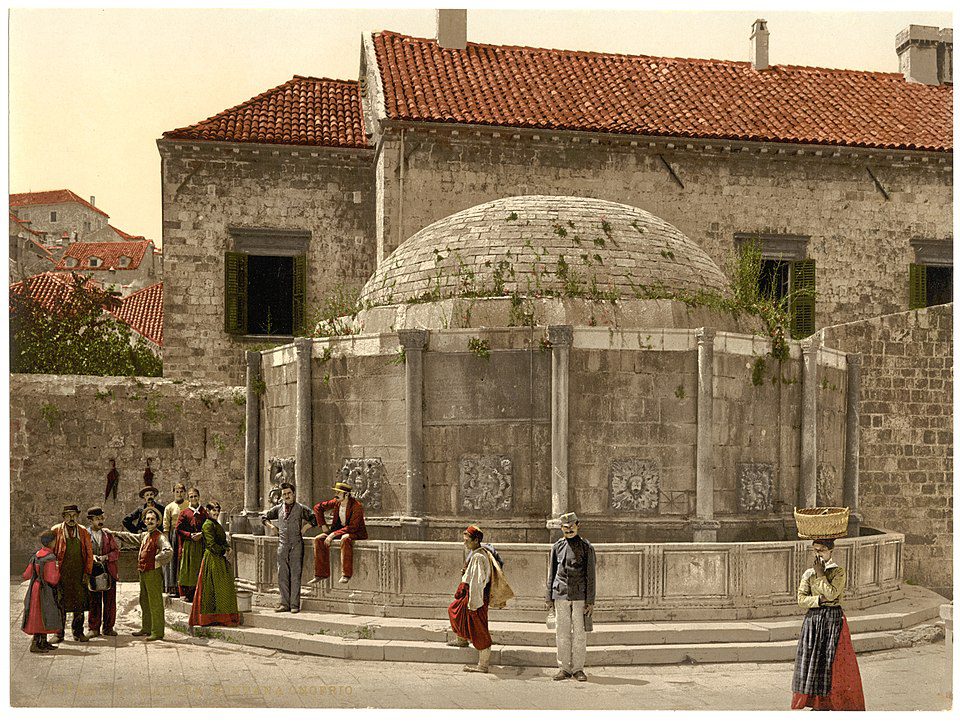
Consider the Rector’s Palace, with its Gothic-Renaissance loggia and delicately carved capitals. Or the cloisters of the Franciscan and Dominican monasteries, whose column designs vary slightly, suggesting the hand of individual carvers. Even the city’s fountains—the Large Onofrio’s Fountain in particular—combine hydraulic utility with geometric elegance, encircling the city’s thirst with stone-crafted civility.
This pervasive use of stone created a paradox: a city of great visual richness rendered in a palette of limited color. Artists responded not with paint but with shadow, texture, and proportion. Dubrovnik’s art, in this period, was primarily architectural—but no less refined for its discipline.
Maritime Wealth, Cultural Patronage
If stone was the medium, the sea was the patron. Dubrovnik’s strategic position between the Latin West and the Orthodox East allowed it to flourish as a maritime republic, especially from the 14th to 16th centuries. With a merchant fleet rivaling those of Genoa and Venice, Dubrovnik amassed wealth not through conquest but through trade and diplomacy.
That wealth flowed into public works, religious foundations, and private commissions. Artisans were invited from across the Adriatic—often from Venice, but also from Naples, Florence, and even further afield—to work alongside local craftsmen. The result was an aesthetic vocabulary that was at once cosmopolitan and conservative: embracing imported ideas while refining them into a uniquely Ragusan style.
Three features define this early artistic patronage:
- Civic investment in religious art: The city’s major churches were both spiritual centers and repositories of cultural pride, often funded by the Senate itself.
- Architectural commissions for diplomacy: The public buildings—the Rector’s Palace, the Customs House, the Arsenal—were not merely functional but carefully crafted spaces of encounter, where form and protocol intertwined.
- Legal and social frameworks supporting art: The Statute of Dubrovnik (1272) includes detailed provisions for urban aesthetics, building codes, and guild regulation, offering one of the most sophisticated civic-artistic systems in medieval Europe.
It is significant that Dubrovnik lacked a royal court, aristocratic patronage in the Western sense, or large-scale military conquest. Its art was civic, collective, and embedded in law and diplomacy. The visual language of the city was not ornamental propaganda—it was a sober, consistent affirmation of stability, order, and restraint. That discipline would carry Dubrovnik through centuries of political turbulence, and shape the arts that followed.
But there is an irony here, one visible even today: the very success of Dubrovnik’s aesthetic discipline made it appear timeless, unchanging. Yet the city’s history is anything but static. It was shaped by earthquakes, empires, religious tension, and ideological transformations. And at each turning point, new forms of art arose—not in rupture, but in adaptation.
Dubrovnik’s walls, then, are not barriers to history. They are membranes, filtering the artistic energies of empires, religions, and revolutions. They do not enclose the city—they frame it.
Gothic Echoes in a Maritime Republic
Gothic art found its way to Dubrovnik not with the armored knights of the north, but with the sails of the south. It arrived not as an imposition, but as a negotiation—shaped by the republic’s diplomatic character, seaborne economy, and distinct urbanism. What emerged was not a replica of Northern Europe’s cathedrals, nor a Venetian satellite. Instead, Dubrovnik developed a regional Gothic that was both reticent and refined, intimate and enduring.
Franciscan and Dominican Cloisters
The Gothic entered Dubrovnik through the cloister—not the cathedral. This is more than an architectural detail; it reveals the contours of the city’s spiritual and artistic development. The monastic orders, especially the Franciscans and Dominicans, were among the earliest institutional patrons of Gothic architecture in the city, and their complexes remain among its most poetic spaces.
The Franciscan Monastery’s cloister, dating largely to the 14th century, is a lyrical structure composed of double-arched columns with individually carved capitals—each a miniature sculpture, no two alike. The rhythm of the arches, the softness of the limestone, and the gentle inward orientation of the space create an almost musical quiet. There is little grandeur here. Instead, one finds humility and refinement—a Gothic not of vaulting ambition, but of contemplation.
The Dominican Monastery, begun in the late 13th century, took shape over centuries, with its cloister eventually reflecting both Gothic and Renaissance sensibilities. The Dominican cloister is more austere, its arches taller and more regular, but it shares the same attention to stone detail, proportional elegance, and visual quietude. These were not architectural afterthoughts—they were expressions of theological values through spatial design: order, rhythm, permanence.
Unlike Gothic cathedrals in France or England, where verticality and stained glass sought to evoke the sublime, Dubrovnik’s monastic Gothic was inward, earthbound, and Mediterranean. Light filtered through narrow openings, and ornament emerged from the material rather than being applied to it. This discipline echoed the Franciscan emphasis on poverty and restraint—but also the Ragusan habit of balancing beauty with economy.
Dubrovnik’s Gothic Synthesis
The civic Gothic of Dubrovnik did not mimic the ecclesiastical. Instead, it engaged with the architectural needs of a merchant republic: palaces, loggias, custom houses, and arsenals. Here, Gothic was not about transcendence but reputation. Its function was to dignify commerce, to lend visual gravitas to the affairs of state.
The Custom House (Divona), originally constructed in the early 15th century, is a striking example. With its slender arches and finely carved details, it presents a public face of order and elegance. Yet its proportions and spacing are pragmatic, designed as much for the movement of goods as for the eye. Aesthetic control in Dubrovnik Gothic never outweighed utility—a hallmark of the city’s governance and visual style.
Elsewhere, private palaces adopted Gothic motifs—triple-arched windows (bifora and trifora), ogee arches, decorative friezes—but always within a tightly regulated urban fabric. The city government enforced strict building codes to ensure harmony. The result is a streetscape where Gothic elements whisper rather than shout, integrated into a broader language of civic restraint.
Three particularly Dubrovnik-inflected features of this style stand out:
- Use of narrow lancet windows framed in stone, which allowed for privacy while softening the facades with rhythm and light.
- Integration of sculpture in architectural niches, especially saints and symbols relevant to maritime life.
- Hybrid forms where Gothic tracery meets early Renaissance order, revealing the city’s receptivity to multiple influences without surrendering its coherence.
This synthesis was not simply a matter of taste—it was political. Dubrovnik had to navigate between Venice, Hungary, the Papacy, and the Ottoman Empire. Its art mirrored this tightrope: visually diplomatic, technically refined, and never flamboyant enough to provoke suspicion or envy.
The Sponza Palace as Visual Archive
If any single building encapsulates Dubrovnik’s late Gothic achievement, it is the Sponza Palace. Built between 1516 and 1522, it is often cited as a Gothic-Renaissance hybrid, but its soul is Gothic: elegant, vertical, and adorned with delicate tracery and pointed arches. The colonnaded loggia on the ground floor opens onto the public square, inviting commerce and conversation, while the upper windows recall Venetian palaces—slim, ornamented, quietly proud.
Sponza was originally a customs house and mint, later a treasury, and eventually home to the city’s archives. Its function was always public, civic, and historical. Inside, it held the records of the republic—legal contracts, trade logs, diplomatic correspondence. It is no accident that the building itself became a kind of architectural memory: stone girding the paper.
This symbolic layering reached its peak in the inscription above the main arch, which reads: “Fallere nostra vetant et falli pondera; meque pondero cum merces ponderat ipse deus” (“Our weights do not permit cheating, and when I weigh, God himself weighs the goods”). It is a motto of moral precision, etched in stone and philosophy, asserting that trade, like architecture, is governed by proportion and justice.
During the 1991 siege of Dubrovnik, Sponza became a literal archive of resistance. Though the city suffered artillery strikes, the palace and its documents survived. Today, it stands not only as an aesthetic gem but as a symbol of endurance—Gothic form as civic philosophy, tested by centuries.
The surprise of Dubrovnik’s Gothic lies not in scale or grandeur, but in subtlety. It is the art of a seafaring republic—flexible yet formal, open to influence yet protective of identity. In its cloisters, palaces, and civic spaces, Gothic architecture becomes not just a style, but a mode of diplomacy carved into stone.
Renaissance in Ragusa: Classicism on the Adriatic
If Gothic Dubrovnik whispered its cultural ambitions through stone, the Renaissance years spoke more clearly—but never shouted. The city’s embrace of Renaissance classicism was neither abrupt nor imitative. Rather, it unfolded as a gradual, deliberate recalibration of artistic language: a shift from vertical to horizontal emphasis, from pointed arches to rounded ones, from spiritual introversion to humanist equilibrium. Dubrovnik absorbed the Renaissance not as a conquest but as a conversation—with Florence, with Venice, and most crucially, with itself.
Humanism in Stone
By the late 15th century, Dubrovnik had become a center not only of trade but of letters. Its poets and thinkers—figures such as Ilija Crijević, Šiško Menčetić, and Džore Držić—were deeply engaged with the ideals of humanism. This intellectual ferment was not limited to literature. It had a material presence in the city’s evolving architecture, sculpture, and urban planning.
One of the pivotal figures in this cultural shift was the Florentine architect and sculptor Michelozzo di Bartolomeo, a student of Ghiberti and collaborator of Brunelleschi. Though his direct impact on Dubrovnik was limited to a few projects, his ideas traveled with the builders and planners who passed through his workshops. One of Michelozzo’s most enduring contributions was the renovation of the Rector’s Palace after a gunpowder explosion in 1435 damaged the original Gothic structure. Michelozzo redesigned parts of the building, introducing classical elements such as semicircular arches, symmetry, and rusticated stonework—tempered by local idioms and materials.
Though Michelozzo’s plans were eventually modified by local architects (and further changed after an earthquake), his intervention marks a turning point: the Renaissance was no longer an imported accent, but a structural principle.
Another crucial figure was Juraj Dalmatinac (Giorgio da Sebenico), the Croatian master mason and sculptor who trained in Italy but brought a distinctive Adriatic sensibility to his work. His emphasis on balance, figural sculpture, and proportionality deeply influenced Dubrovnik’s artistic circles, even if his direct works are more prominent in Šibenik and Split. He represents the channel through which central Italian Renaissance ideals flowed into Dalmatian stonework and civic design.
What makes Dubrovnik’s Renaissance unique is how carefully it accommodated the city’s existing aesthetic grammar. There were no sweeping reconstructions, no papal commissions, no Medici-style urban utopias. Instead, Renaissance language was woven into existing structures:
- Portals and windows became cleaner, rounder, more measured.
- Sculptural ornament began to depict not just saints and martyrs, but civic allegories and classical references.
- Public buildings like the Rector’s Palace and Sponza were updated with classical syntax without erasing their Gothic bones.
The city preserved continuity while experimenting with harmony—a hallmark of its political culture and artistic taste.
A Republic’s Image
Dubrovnik’s embrace of Renaissance art was not simply aesthetic—it was profoundly diplomatic. As a small but sovereign republic wedged between the Kingdom of Hungary, the Ottoman Empire, and the Republic of Venice, Dubrovnik’s survival depended on subtle signaling. It projected strength not through armies, but through buildings, laws, and language. Art played a central role in this strategy.
Renaissance ideals—order, reason, balance—mirrored the political philosophy of the Ragusan Senate. The city’s official motto, “Libertas”, inscribed on gates and coins, was echoed in its proportional buildings and measured facades. Classical columns and rounded arches were more than architectural choices—they were statements of stability and alignment with European humanist values.
This alignment was vital for diplomacy. Foreign ambassadors reported on the city’s appearance; visiting merchants judged its civility by its streets and courtyards. The very scale of Dubrovnik’s Renaissance architecture—dignified but never grandiose—conveyed moderation. The city styled itself not as a dominator but as a cultured interlocutor, a “miniature Florence” of the Adriatic that knew the value of appearances in diplomacy.
An illustrative example is the design of the city’s loggia—a covered public space that served as both a gathering place and a political stage. Its arcades, simple columns, and geometric harmony communicated openness and decorum. It was here that public notices were read, decisions announced, and ceremonies held—where architecture, politics, and theatre intertwined.
The Renaissance also shaped Dubrovnik’s legal buildings, schools, and even pharmacies. The city’s apothecary, founded in the 14th century and redesigned in the Renaissance period, is among the oldest continuously operating pharmacies in Europe. Its architectural modesty belies its cultural role: a physical intersection of art, science, and public service.
Between Venice and Florence
Geographically and culturally, Dubrovnik existed between two giants of Renaissance production: Venice and Florence. Yet it did not fall fully under the spell of either. Instead, it drew selectively from both, filtering them through its own civic priorities and Mediterranean sensibility.
From Venice, Dubrovnik absorbed techniques of stonemasonry, urban rhythm, and facade treatment. Venetian artisans were frequently contracted for major works, and Venetian styles are visible in decorative features such as lion masks, cornices, and reliefs. Yet Dubrovnik resisted the more elaborate aspects of Venetian baroque. Where Venice embraced theatricality, Dubrovnik preferred clarity.
Florence, on the other hand, contributed proportion, order, and philosophical coherence. Dubrovnik’s humanists read Dante and Petrarch, but also translated Aristotle and Cicero. Architectural Renaissance, for Dubrovnik, was not about ornament—it was about ideals embodied in structure. The city’s Renaissance architecture is often understated: single-story facades, clean lines, minimal sculptural flourish. Yet within that restraint lies a distinct intelligence.
There were tensions, of course. Venetian domination of the Adriatic threatened Dubrovnik’s independence. The Ottomans loomed from the east. In this context, Renaissance art functioned as a soft shield. It broadcast allegiance to European values while maintaining neutrality. The city’s visual culture became a kind of visual treaty—inviting, refined, but deliberately unprovocative.
That Dubrovnik’s Renaissance was so understated may explain why it is often overlooked in broader surveys of the period. But that same subtlety is what makes it remarkable. The city managed to absorb the intellectual and aesthetic energy of the Renaissance without surrendering its identity or disrupting its urban harmony.
It did not need towering domes or colossal piazzas. It needed balance. And balance, in Dubrovnik, became an art form.
Sacred Spaces, Civic Identity
In Dubrovnik, the sacred was never solely spiritual. The city’s churches, cathedrals, and religious artworks functioned not only as sites of devotion but as instruments of governance, diplomacy, and historical memory. Art was embedded in stone and ceremony, shaping how the republic imagined its own continuity. From soaring domes to the intimacy of reliquaries, Dubrovnik’s sacred art offered a vision of the divine that served the civic realm just as much as the spiritual one.
Cathedral of the Assumption
Few buildings in Dubrovnik better encapsulate the city’s intersection of faith and statecraft than the Cathedral of the Assumption. The original Romanesque cathedral was reportedly funded in part by King Richard the Lionheart, who, according to local tradition, made a vow to the Virgin Mary after surviving a shipwreck near Lokrum Island in 1192. Whether apocryphal or not, the story became part of the city’s founding myth—a narrative that linked Dubrovnik to the broader Christian world and lent divine legitimacy to its sovereignty.
That original cathedral, however, was leveled by the catastrophic earthquake of 1667. Its destruction not only shattered a physical structure but symbolically ruptured a long-standing alignment of civic and spiritual authority. The decision to rebuild it—quickly, ambitiously, and in a thoroughly Baroque idiom—reveals much about Dubrovnik’s post-earthquake psychology and its use of art to restore identity.
The new cathedral, completed in the early 18th century, was designed by Italian architect Andrea Buffalini and built by a succession of Dalmatian and Roman craftsmen. It replaced the earlier, simpler forms with a powerful, symmetrical plan: a Latin cross layout, a massive central dome, and a richly decorated interior. Its Baroque qualities—light-drenched spaces, theatrical altars, sculptural embellishments—represented not excess, but confidence reborn.
Inside, the cathedral houses one of Dubrovnik’s most prized artistic possessions: a polyptych by Titian, The Assumption of the Virgin, painted in the mid-16th century. The placement of a Venetian masterwork in the city’s central religious space speaks volumes. It signaled cultural alignment with the Italian Renaissance but also served a political purpose: to underscore Dubrovnik’s participation in Europe’s artistic canon without submitting to Venetian dominance.
The treasury of the cathedral, too, is exceptional. It contains over 200 reliquaries, many in the form of body parts—arms, feet, skulls—crafted in gold and silver, studded with gems, and shaped with uncanny realism. These were not merely devotional objects. They were diplomatic gifts, war spoils, and testaments to the city’s connections across Christendom.
The cathedral stood not as a mere house of prayer but as an emblem of continuity—rebuilt after disaster, re-endowed with European art, and reasserting Dubrovnik’s role in the sacred geography of the Adriatic.
Saints and Symbols
Dubrovnik’s spiritual landscape was populated by more than architecture. It was filled with saints—represented in sculpture, fresco, manuscript, and ritual—who functioned as protectors of the city and validators of its moral code. Chief among them was Saint Blaise (Sveti Vlaho), the city’s patron since the 10th century.
The image of Saint Blaise appears everywhere: holding a model of the city in his hands, carved above gates, perched on church facades, stamped into coins. His iconography—bearded, mitred, often bearing a crozier or open hand—was deliberately uniform, forming a recognizable civic brand. He was not merely venerated; he was a kind of constitutional symbol, the sacred embodiment of Libertas.
The Church of Saint Blaise, located in the heart of the Old City and rebuilt in the early 18th century after the earthquake, is a sculptural gem of late Baroque style. Designed by Venetian architect Marino Gropelli, it balances ornate flourishes with geometrical restraint. The altar’s central statue of the saint—gilded, dramatic, holding the city—makes explicit the relationship between faith and the polity. The annual Festa Svetog Vlaha, celebrated every February since 972, is part procession, part civic affirmation, with the city’s leaders participating alongside clergy in a ritual that fuses religion and republic.
Elsewhere in the city, saints appear in painted altarpieces, mosaics, and stone medallions. Churches dedicated to Saint Nicholas, Saint Sebastian, and Saint Francis were not just houses of worship but social institutions, offering refuge, arbitration, and charity. Each religious order brought its own artistic taste, further enriching the visual diversity of Dubrovnik’s sacred art.
This proliferation of sacred imagery was carefully managed. The Ragusan government was deeply involved in religious affairs, often funding church repairs, commissioning artworks, and regulating public devotions. The goal was not theological dominance but civic unity. Religion was the emotional infrastructure of the republic—a visual grammar that helped maintain moral order and collective memory.
Gold and Blood
Nowhere is the intimacy between piety and politics more vivid than in Dubrovnik’s reliquaries. Unlike the monumental grandeur of Western European cathedrals, the city’s devotional focus often turned inward, toward the miniature, the tactile, and the visceral. The reliquaries, many dating from the 11th to the 16th centuries, display an astonishing range of craftsmanship: filigree, enamel, cabochon gems, repoussé, and miniature sculpture.
Several of these reliquaries are shaped as body parts—an arm of Saint Blaise, a skull of Saint Valentine, a foot of Saint Stephen—often made of silver or gold, and sometimes articulated with hinges. These sacred fragments were not locked away in vaults; they were paraded through the streets during plagues, sieges, and festivals, forming part of the city’s emotional and symbolic defense.
Three examples stand out:
- The Arm of Saint Blaise, a reliquary crafted in the 15th century from gilded silver, decorated with reliefs of the Evangelists, worn smooth in places from centuries of ritual handling.
- The Head of Saint Valentine, enclosed in a delicately chased silver bust, used in both public processions and private veneration.
- The Relic of the Holy Cross, encased in a gem-studded cross-shaped reliquary, believed to have healing properties, particularly during outbreaks of disease.
These objects were not only devotional—they were geopolitical. Many were gifts from popes, emperors, or trading partners, and their possession conferred spiritual prestige and diplomatic capital. The artistry involved in their creation also helped sustain local goldsmithing and metalworking traditions, which flourished within the city’s guild structure.
The visual intimacy of Dubrovnik’s sacred art—the scale, materiality, and sensuality of its objects—offers a striking counterpoint to the austere grandeur of its public buildings. This duality mirrors the city’s own psychology: stoic on the outside, deeply passionate beneath the surface.
What emerges from Dubrovnik’s sacred spaces is a deeply entwined vision of religious and civic life. Churches were not enclaves—they were stages, archives, shelters, and courts. Art did not decorate faith; it enacted it. And faith, in turn, gave form and force to the idea of the republic.
Earthquake and Emptiness: 1667 and the Collapse of a Cultural Arc
On the morning of April 6, 1667, Dubrovnik was, by all accounts, a city in full command of its powers—wealthy, independent, and elegant. By evening, it was a ruin. The earthquake that struck shortly after sunrise killed more than 3,000 residents, leveled nearly every major building, and wiped out centuries of artistic and architectural achievement. The destruction was not merely physical—it was cultural. In a matter of minutes, an entire visual and intellectual tradition was shattered. What followed was not only a rebuilding, but a reckoning.
Ashes and Opportunity
The 1667 earthquake remains one of the most destructive seismic events in European urban history. Contemporary accounts describe a sudden roar, fissures opening in the streets, walls toppling into the sea. Fires broke out amid the rubble. The Rector’s Palace was damaged, the Cathedral of the Assumption collapsed, and entire families were buried in their homes. The city’s archival material—some of it centuries old—was lost in the flames. So, too, were irreplaceable paintings, sculptures, manuscripts, and church treasures.
Yet from this cataclysm emerged a paradoxical creative impulse. The very magnitude of the destruction created a cultural blank slate. Dubrovnik, so careful in maintaining stylistic coherence across centuries, was now forced to reimagine itself almost from the ground up. And in doing so, it turned not backward toward the Gothic and Renaissance traditions it had nurtured, but forward—into the vocabulary of the Baroque.
This was partly pragmatic. The builders and architects available to reconstruct the city in the late 17th and early 18th centuries were steeped in the Baroque idiom, which had become dominant across Catholic Europe. But it was also symbolic. The choice of Baroque forms—expressive, symmetrical, dramatic—allowed the city to reassert its vitality and independence through a new aesthetic language.
The reconstructed buildings were not copies of what had been lost. Instead, they represented a shift in tone. Where earlier Dubrovnik had been defined by restraint, post-earthquake Dubrovnik projected confidence and resilience. The rebuilt churches had facades that drew the eye upward; public squares were re-proportioned for grandeur; interiors gleamed with stucco, fresco, and gilt.
Ironically, the very event that severed Dubrovnik from much of its medieval and Renaissance heritage also gave birth to some of its most beloved landmarks.
Baroque Dubrovnik
The architectural and artistic language of post-1667 Dubrovnik is best understood as strategic exuberance—Baroque tempered by the city’s deeply embedded civic character. While the forms became more dramatic, they were never excessive. The artists and patrons of the rebuilt city adopted the emotional vocabulary of the Counter-Reformation—light, movement, contrast—but kept the measured pulse of a merchant republic.
The most emblematic building of this transformation is the Church of Saint Blaise, constructed in 1715 on the ruins of a previous Romanesque structure. Designed by the Venetian architect Marino Gropelli, the new church is a sculptural statement of survival. Its dramatic central dome, ornamental columns, and dynamic interior plan reflect the high Baroque style then prevalent in Venice. But its scale and material—local limestone—root it unmistakably in Dubrovnik.
The Jesuit Church of Saint Ignatius, built between 1699 and 1725, is another masterwork of the post-earthquake period. It occupies an elevated site, approached by a sweeping staircase inspired by Rome’s Spanish Steps. The church’s interior—rich in illusionistic frescoes, gilded altars, and dynamic statuary—was designed to overwhelm the senses. It was a calculated shift from the introspective Gothic cloisters of the earlier era. Here, the faithful were not withdrawn—they were enraptured.
Three motifs dominate Dubrovnik’s Baroque revival:
- Symmetry and spatial drama, especially in staircases, domes, and centralized facades.
- Illusionism in painting, with frescoes and altarpieces designed to open the ceiling or wall to heavenly visions.
- Integration of architecture and sculpture, especially in church interiors where stucco angels, flowing draperies, and narrative tableaux created immersive environments.
These artistic strategies were not decorative flourishes. They were part of a theological and political campaign to reassert continuity, presence, and divine favor. After such catastrophic loss, the city’s very survival had to be made visible—and the Baroque, with its spectacle of faith and stability, offered the ideal vocabulary.
Painters of the Ruins
Yet the earthquake also gave rise to a more introspective, even melancholic artistic current. Among the generation that witnessed the destruction and its aftermath, there emerged a quieter tradition of visual memorialization: drawings of ruined cloisters, fragmentary altarpieces depicting cracked saints, poems and treatises that lamented lost harmony.
One such figure was Nikola Božidarević, whose earlier work had drawn on Venetian models but whose later paintings acquired a somber, restrained palette. Though he died before the earthquake, his altarpieces—some damaged, others spared—took on new resonance as survivors of cultural trauma. In a sense, his posthumous presence haunted the city’s recovery, representing the fragility of artistic lineage.
In the decades following 1667, painting in Dubrovnik became both more decorative and more archival. Portraiture flourished, as patrician families sought to reestablish their lineage and identity through art. Religious themes remained dominant, but the mood shifted—no longer merely celebratory, but often shadowed by mortality and memory.
One striking post-earthquake work is the Procession of Saint Blaise, painted in the early 18th century and attributed to an anonymous local master. The image depicts the saint floating protectively above a crowd of citizens amid the devastated city—a spiritual allegory of reconstruction. The buildings in the background are rendered with eerie precision, part real and part aspirational, suggesting a city simultaneously remembering and reimagining itself.
Even landscape painting, never dominant in Dubrovnik’s earlier artistic canon, gained new poignancy. Views of the ruined city from Mount Srđ or Lokrum Island began to appear—quiet studies in absence, framed by the ever-steady sea. These were not just pictures; they were meditations on impermanence.
The earthquake left Dubrovnik with scars deeper than architecture. It disrupted guild structures, erased centuries of artistic apprenticeship, and decimated the population of trained craftsmen. Yet it also forced a new artistic consciousness—a dual awareness of loss and continuity. In the interplay between grandeur and grief, Dubrovnik found a new visual voice.
That voice would carry it into the 18th century, where Enlightenment ideals and new economic realities would again reshape its cultural identity. But the echo of 1667 would remain in every Baroque angel, every rebuilt dome, every shadow cast by the city walls. It was a pivot point—less a break than a bending of the arc.
Enlightenment by the Sea: 18th-Century Science and Style
In the long wake of catastrophe, Dubrovnik entered the 18th century not with grand designs of empire, but with a quieter ambition: to think. The republic’s political power was waning, and its trade routes were increasingly circumscribed by the rising empires of Venice, Austria, and the Ottomans. But in the realm of letters, science, and the applied arts, Dubrovnik flourished. The city did not become a capital of Enlightenment like Paris or Berlin, but it became something rarer—a place where humanistic learning, maritime cosmopolitanism, and artistic refinement were harmonized into a deeply local idiom.
Artistic Cosmopolitanism
Dubrovnik’s status as a minor republic with major connections enabled a unique form of artistic cosmopolitanism. Unlike inland cities that built empires through force, Dubrovnik remained a diplomatic archipelago, drawing visitors, ideas, and techniques from across Europe and the Mediterranean. Its art in the 18th century reflected this openness, but with characteristic restraint.
Embroidery, miniature painting, scientific illustration, and book design all gained new prominence. These were not the monumental arts of earlier centuries but the intimate, portable expressions of a republic at ease with intellectual modesty. A merchant might commission an exquisitely illustrated maritime atlas; a monk might transcribe scientific texts with botanical marginalia as intricate as any painting. Such works were not meant to awe—they were meant to inform, to please, and to endure.
Among the most curious and impressive examples of this Enlightenment-era synthesis is the Jesuit College of Dubrovnik, adjacent to the Church of Saint Ignatius. The complex housed not just theological training, but studies in astronomy, mathematics, and rhetoric. Its library became a repository of scientific texts in Latin, Italian, and Croatian. The building’s frescoes, painted by Gaetano Garcia, present an idealized vision of intellectual harmony—Saint Ignatius bathed in divine light, surrounded by allegories of the liberal arts, rendered with studied perspective and anatomical precision.
This fusion of religious and scientific iconography was no contradiction. In Dubrovnik, as in much of Southern Europe, the Enlightenment did not erupt in rebellion against the Church, but evolved within it. Art, accordingly, did not shift to radical abstraction or philosophical caricature, but became more diagrammatic, more precise, more referential. Knowledge was beauty.
Three forms of Enlightenment artistry thrived in Dubrovnik:
- Cartographic illustration, blending geographic accuracy with decorative flourishes and coats of arms.
- Scientific drawing, especially in botany and mineralogy, often hand-colored and bound in bespoke volumes.
- Decorative calligraphy and book design, used in religious and legal documents, where marginalia became miniature galleries of civic pride.
These were the visual equivalents of Dubrovnik’s foreign policy—meticulous, well-crafted, deeply aware of audience, and always quietly dignified.
Decorative Arts in a Diplomatic City
While the monumental structures of Dubrovnik changed little after the Baroque rebuilding, the interiors of its homes, shops, and official spaces became showcases of Enlightenment-era decorative arts. Furniture-making reached new heights, drawing on Italian rococo influences but adapted to local materials and tastes. Cabinetry from this period often featured walnut or olive wood, inlaid with mother-of-pearl, bone, or darkened horn. Carved legs, shell motifs, and serpentine lines appeared—but always within a framework of functionality.
One surviving workshop, known through archival records rather than physical remains, was that of the Bogišić family—renowned for its cabinetry, clocks, and maritime instruments. These objects were prized not for ostentation but for their refinement. They were used in diplomatic gifts, dowries, and ecclesiastical inventories, linking the decorative to the ceremonial.
Domestic interiors, too, became increasingly sophisticated. Tapestries from northern Italy and Flanders hung alongside locally woven textiles. Mirrors, still rare and expensive, were imported from Murano and set in carved gilt frames. Even ceiling designs became more ambitious, featuring painted rosettes and allegorical figures—sometimes depicting the virtues of trade, peace, or learning.
Manuscript culture remained strong, particularly among the city’s clergy and bureaucratic class. Ledgers were not mere records; they were often elegantly bound and ornamented with flourishes of ink and color. This visual culture of administration—where calligraphy, illustration, and layout converged—underscored the republic’s foundational belief: that beauty and order were mutually reinforcing.
Perhaps the most revealing artifacts of this period are the formal dinner services used by Dubrovnik’s patriciate. Ceramics from Faenza and Meissen were paired with locally crafted silver cutlery. The table became a diplomatic stage, where aesthetics and etiquette converged. In a city that had always prized civility over spectacle, the arts of dining, hosting, and gift-giving became critical arenas for artistic display.
Portraiture and Self-Fashioning
The 18th century also marked a subtle but important transformation in Dubrovnik’s approach to portraiture. Whereas earlier images of the city’s elite had often emphasized lineage, office, or piety, Enlightenment portraits began to focus on learning, personality, and individual temperament. These were not radical psychological studies in the style of Rembrandt or Goya, but they marked a clear evolution in the city’s self-image.
Typical portraits from this period depict gentlemen in modest robes, sometimes holding a book or a compass, against spare backgrounds with architectural features or maritime vistas. Women are shown in lace-trimmed dresses, hands folded or posed with embroidery—symbols of domestic order, intelligence, and restraint. These images were neither theatrical nor abstract. They were carefully calibrated acts of self-presentation, balancing individuality with collective identity.
One notable example is the portrait of Lukša Sorkočević, a nobleman, composer, and diplomat, painted around the mid-18th century. Sorkočević sits not in brocade or armor, but in scholar’s garb, beside a score of chamber music. His gaze is thoughtful, his posture relaxed, his surroundings spare. The painting is a visual essay on the Enlightenment virtues of reason, creativity, and civic modesty.
Dubrovnik’s portraiture from this era offers a rare glimpse into a society trying to reconcile tradition with progress. These were the faces of a republic increasingly aware of its limits—diplomatically agile, economically vulnerable, culturally fertile. They are, in a sense, farewell images: composed not in triumph, but in clarity.
That sense of composed farewell is the defining mood of 18th-century Dubrovnik. The earthquake had erased much, but not all. The Baroque had reanimated the city’s religious and civic identity, but not indefinitely. Now, amid Enlightenment refinement, the city turned inward—not in despair, but in contemplation. It collected, catalogued, wrote, and designed. It invested in learning, not expansion. It replaced the lost spires of its past with books, furniture, music, and glass.
In doing so, Dubrovnik prepared for the 19th century not with revolutionary zeal, but with an elegance that would prove harder to erase.
The Long 19th Century: Empire, Identity, and Art in Transition
The 19th century in Dubrovnik began not with brushstrokes or building campaigns, but with a long, slow eclipse. In 1808, after centuries of self-rule, the Republic of Ragusa was dissolved by Napoleon’s forces. What followed was a dizzying sequence of foreign administrations—French, Austrian, Yugoslav—each imposing new systems of governance, language, and cultural orientation. And yet, far from extinguishing Dubrovnik’s artistic life, this prolonged disorientation spurred new forms of expression. The 19th century became a time of reinvention, nostalgia, and selective revival. Art in Dubrovnik was no longer a steady mirror of state power; it became a negotiation between memory and modernity.
Austrian Rule, Local Pride
From 1815 until the collapse of the Habsburg Empire in 1918, Dubrovnik became part of the Austrian Empire—specifically the Kingdom of Dalmatia, a provincial entity with limited autonomy. The city’s population, architecture, and economy adjusted to Vienna’s bureaucratic logic, but its cultural consciousness remained stubbornly distinct.
This tension between imperial administration and local identity played out vividly in architecture. The Austrians built roads, barracks, and schools—often functional, neoclassical, and stylistically out of sync with Dubrovnik’s older fabric. But local builders and patrons responded with an architectural countercurrent: a modest neo-Renaissance and neo-Gothic revival aimed at reaffirming Dubrovnik’s historical character.
One example is the renewed interest in the Rector’s Palace, which had suffered various damages over the years and was partially restored in the 19th century. Rather than replacing its Gothic and Renaissance features, preservation efforts (often led by local historians and Austrian-trained architects) emphasized conservation and selective repair. It was an early instance of heritage as resistance—using the past not as ornament but as political assertion.
At the same time, new public spaces emerged. The creation of public promenades, such as Gradac and the park beneath Fort Lovrijenac, reflected the 19th-century European ideal of civic leisure. These were not merely recreational areas—they were aesthetic projects, landscaped with imported trees, arranged with views of the sea, and designed to elevate the public’s sense of order and taste.
This was also the period in which the concept of “Dalmatian culture” was formalized—a double-edged designation that both included and diluted Dubrovnik’s legacy. Local intellectuals such as Medo Pucić and Ivan Kukuljević Sakcinski worked to preserve Dubrovnik’s literary and architectural heritage, publishing poems, treatises, and histories that reclaimed the city’s distinctiveness from the empire’s homogenizing pressure.
Art became a way of asserting continuity:
- Historical costume painting depicted noble families in pre-Napoleonic dress, subtly glorifying the republic’s past.
- Architectural drawings documented medieval structures with almost forensic precision, prefiguring conservationist thought.
- Civic festivals revived old rituals with renewed emphasis on visual display—banners, uniforms, music—turning tradition into spectacle.
In these acts, Dubrovnik began to turn its own history into a cultural resource: not a relic, but a toolkit.
Photography, Nationalism, and Nostalgia
One of the most transformative arrivals of the 19th century was the camera. In Dubrovnik, photography appeared early—by the 1850s—and quickly became a tool for both documentation and idealization. Studios sprang up along the Stradun, offering portrait services to the city’s elite and visiting travelers. But more importantly, local photographers began recording the architecture, ceremonies, and street life of the city with increasing intention.
Photographs from this period—such as those by Andrović or the studio of Tomo Gusić—reveal a Dubrovnik deeply aware of its own myth. Images of Saint Blaise processions, city walls at sunset, or elderly nobles posed in fading finery were not neutral records. They were staged memories, designed to freeze an ideal of Dubrovnik as it once was—or perhaps never was.
Photography also intersected with nationalism. As pan-Slavic movements gathered momentum across the Balkans, Dubrovnik was often claimed as a symbolic origin point. Its language, history, and art were reinterpreted within new ideological frames. Croatian nationalists emphasized its literary tradition; Serbian thinkers claimed its Orthodox roots. Austrians, meanwhile, highlighted its role in the empire’s Adriatic mosaic.
Art, especially visual art, became contested territory. Painters were commissioned to depict historical scenes—ambassadors at court, merchants at sea, the Senate in deliberation. These works, while often historically dubious, served a deeper function: they anchored a people to a place, through image.
Photography, too, contributed to this new mnemonic regime:
- Panoramas of the city walls, often taken from Mount Srđ, emphasized Dubrovnik’s isolation and unity.
- Portraits of elderly nobles, staged with props and regalia, turned living individuals into symbols of a vanished order.
- Still lifes of religious relics, manuscripts, and weaponry constructed a visual museum of the republic in exile.
The cumulative effect was a city that lived increasingly through its reflection—a Dubrovnik more seen than changed.
Painters of the South
Despite the pull of history and empire, a new generation of artists emerged in the late 19th century who sought to chart a different course. Chief among them was Vlaho Bukovac (1855–1922), perhaps the most important painter to emerge from the Dubrovnik region. Born in Cavtat, just south of Dubrovnik, Bukovac trained in Paris and moved easily between academic realism, impressionism, and symbolist fantasy.
His early works—portraits and historical scenes—established his technical mastery and gained him commissions from aristocratic and governmental patrons. But it was his later works, painted during his mature years in Cavtat and Dubrovnik, that brought a new vision of southern light, domestic intimacy, and local identity.
Bukovac’s paintings of Dalmatian women in traditional dress, coastal scenes bathed in shimmering color, and introspective portraits redefined the visual language of the Adriatic. He did not depict Dubrovnik as a museum—he rendered it as a living, breathing atmosphere. His palette brightened, his brushwork loosened, and his subjects expanded beyond nobles and saints to include fishermen, children, and laborers.
Three key themes characterize Bukovac’s Dubrovnik-era paintings:
- The play of Adriatic light, captured in pleated fabrics, sunlit stone, and reflective water.
- Female introspection, often depicted in moments of solitude or quiet labor, balancing realism with lyricism.
- National sentiment without cliché, using color and composition to evoke rootedness rather than slogan.
Bukovac’s legacy extended beyond painting. He mentored younger artists, advocated for regional exhibitions, and championed artistic education in Croatia and Dalmatia. His presence in Dubrovnik signaled a shift: the city was no longer simply preserving its past; it was beginning to reimagine itself through new visual languages.
By the turn of the 20th century, Dubrovnik was caught between imperial inertia and cultural ambition. Its buildings still bore the signatures of Venice and Vienna, but its images—on canvas, in print, through the camera lens—were becoming distinctly its own. The city was learning to see itself anew: as memory, as metaphor, and as muse.
Dubrovnik and the Yugoslav Avant-Garde
The 20th century arrived in Dubrovnik not with manifestos, but with cameras, posters, and festivals. For much of the early century, the city remained visually conservative—its art scene more inclined toward realism, romanticism, or regional sentiment than radical experiment. Yet as Yugoslavia emerged from the wreckage of World War I, and especially after the Second World War, Dubrovnik found itself swept into the orbit of a cultural revolution. The city, long seen as a bastion of heritage, was recast as a platform for new forms. Avant-garde art didn’t replace the city’s past—it occupied its spaces, borrowed its metaphors, and sometimes confronted its silences.
Modernism at the Margins
In the 1920s and 1930s, as European capitals exploded with Cubism, Dada, and Futurism, Dubrovnik remained visually circumspect. Yet the seeds of modernism were being planted. Artists from the region—some trained in Zagreb or Belgrade, others influenced by Paris or Munich—began visiting Dubrovnik and painting its scenes not in faithful academic style, but with new eyes.
The results were striking. Đuro Pulitika, Ivo Dulčić, and Đuro Seder, among others, brought expressionist distortion, abstract color fields, and gestural brushwork to landscapes and religious themes long depicted with literal precision. Their work, sometimes exhibited locally but more often shown in Zagreb or Split, suggested that Dubrovnik could serve as both subject and substrate for modernist reinvention.
Dubrovnik’s architecture and setting—its narrow alleys, blinding light, massive stone walls—lent themselves naturally to abstraction. Its very regularity invited disruption. Artists experimented with visual reduction: white walls became planes of silence; sea horizons collapsed into geometric bands; the human figure dissolved into mood.
The key shift was not in subject matter—boats, saints, facades, and vistas remained—but in attitude. Artists no longer painted Dubrovnik to preserve it, but to interrogate it. They asked: what does it mean to depict a city whose meaning is already overdetermined? Can a wall be more than a wall? Can a saint’s face be an existential mask?
Three modernist strategies emerged:
- Reduction of landscape to color geometry, often using Dubrovnik’s coastlines as horizontal and vertical axes.
- Deconstruction of religious iconography, with saints and martyrs rendered as symbolic archetypes rather than narrative figures.
- Exploration of the metaphysical void, where city spaces were emptied of people and filled with atmosphere, tension, or light.
Dubrovnik thus became, almost against its will, a site of modernist experimentation. The city’s stone was stable; its image was not.
Art in a Socialist Framework
After 1945, with the establishment of socialist Yugoslavia, the art world across the country entered a complex new phase. On the one hand, the state promoted monumental public art—murals, sculptures, and architecture that celebrated collective labor, antifascist victory, and socialist fraternity. On the other, Yugoslavia under Tito famously broke with Soviet-style socialist realism and permitted a surprising degree of artistic autonomy.
Dubrovnik, as a cultural jewel and tourist magnet, was both protected and used. It became a favored venue for high-profile art events, cultural delegations, and international symposia. But its own artists had to navigate the balance between historical preservation, state expectations, and personal expression.
Large-scale state commissions tended to avoid Dubrovnik’s historic core—new buildings were constructed on the outskirts or in the port area. One exception was the 1950s renovation of Fort Lovrijenac, where sculptors and stage designers reimagined the fortress as an open-air theatre, often for Shakespearean productions. Here, modern scenography—minimal sets, abstract lighting—clashed provocatively with medieval stone.
Graphic design and poster art also flourished. The Dubrovnik Summer Festival, founded in 1950, quickly became a locus for visual innovation. Each year’s festival produced a new cycle of posters, programs, stage sets, and signage. Graphic designers such as Mihajlo Arsovski and Ivan Picelj created visually daring works—combining constructivist grids, experimental typography, and photomontage—that brought cutting-edge aesthetics into conversation with the city’s baroque and gothic backdrops.
Performance art, too, made quiet inroads. Though often informal or semi-private, the 1960s and 70s saw a number of actions and interventions in the city—artists reading manifestos in public squares, musicians staging atonal compositions in cloisters, dancers performing minimalist sequences in defunct palaces. These were not acts of rebellion, per se. They were explorations of temporality in a city obsessed with permanence.
Yet not all artists aligned with the state’s ambiguous pluralism. Some chafed at the spectacle of culture used as soft diplomacy. Dubrovnik, increasingly packaged as a symbol of Yugoslav heritage and openness, became a kind of ideological showroom. Artists responded with irony, withdrawal, or coded resistance:
- Video art and photography depicted Dubrovnik as empty, surveilled, or silently decaying.
- Conceptual installations used archival material—maps, letters, city statutes—to raise questions about historical authority.
- Minimalist sculpture appeared in natural sites outside the city, suggesting a new relationship between body, space, and tradition.
In this context, art was no longer merely situated in Dubrovnik. It was about Dubrovnik.
Summer Festival Visuals
Nowhere was this convergence of tradition and modernity more vivid than in the visual culture of the Dubrovnik Summer Festival. Founded with the dual goals of fostering Yugoslav cultural pride and attracting international tourism, the festival quickly became a seasonal crucible of the avant-garde. Theatre, dance, music, and fine arts collided across historic venues—from the steps of Saint Blaise’s Church to the arches of the Rector’s Palace.
Visual design played a key role in setting the tone. The festival’s posters were especially influential. Early posters relied on typographic elegance—bold fonts, limited color palettes, and clean symmetry. But by the 1970s, designs became more daring. Artists began to:
- Use photographic abstraction—blurring or cropping city landmarks into enigmatic forms.
- Incorporate symbolic fragmentation—dissecting traditional emblems (like the Ragusan crest) into graphic puzzles.
- Develop modular typography, turning the words “Dubrovnik Summer Festival” into rhythmic visual sequences.
Stage design similarly evolved. Productions of Hamlet, King Lear, or Antigone used metal scaffolding, modular lighting, or transparent scrims to contrast with the stone venues. These visual contrasts—between old and new, solid and ephemeral—created performances that were as much installations as plays.
This evolving festival culture had lasting consequences. It embedded experimental aesthetics into Dubrovnik’s visual consciousness. It also trained generations of young artists, designers, and stage technicians to think of the city not as a relic, but as a platform.
That Dubrovnik could become a staging ground for experimental art—amid its own frozen beauty—was perhaps the greatest surprise of the Yugoslav avant-garde. In a country navigating ideology, ethnicity, and global perception, the city’s art became a subtle but insistent question: What is history for? And who gets to perform it?
War and Witness: 1991–1995 in Art and Memory
In December 1991, flames rose over Dubrovnik’s Renaissance roofs. For the first time since the 17th-century earthquake, the city’s stones, paintings, and sacred spaces were directly under attack. The siege of Dubrovnik during the Croatian War of Independence was not merely a military campaign. It was a cultural assault—a calculated bombardment of one of Europe’s most historically intact cities. The artistic response to this violence was swift, varied, and urgent. Artists, photographers, poets, and curators did not wait for the war to end; they bore witness in real time, transforming destruction into documentation, loss into statement.
Siege Imagery
The attack on Dubrovnik began in earnest on October 1, 1991, when forces of the Yugoslav People’s Army (JNA) shelled the city and its surroundings from land, sea, and air. Over the following months, despite the absence of military targets in the Old City, more than 600 buildings were damaged or destroyed. The targeting of churches, palaces, and archives shocked the international community—not least because the images of the attacks were instantly visible to the world.
Photography became the frontline art form of the siege. Local photographers, such as Pavo Urban, documented the bombardment from within the walls. Urban’s photographs are searing in their clarity: a nun standing amid rubble, flames rising behind domes, smoke curling through cloisters. His final frame—taken seconds before his death by shelling—shows a courtyard, split by light and shadow, the stones silent as they absorb the blast. His archive, recovered posthumously, has since become emblematic not just of Dubrovnik’s suffering but of art’s fragile bravery in wartime.
Video footage also circulated widely. Amateur recordings captured artillery fire against the backdrop of Saint Blaise’s statue, or the domes of the Cathedral illuminated by fire. In these images, the city’s famous timelessness shattered: suddenly, history had a timestamp—1991.
Yet not all siege imagery was documentary. Some artists responded with abstraction, filtering trauma through gesture and symbol. Dubravka Lošić, a painter and installation artist, produced canvases of scorched hues and fragmented text, invoking both liturgy and war reports. Her visual language was torn between lament and incantation, reflecting the difficulty of aesthetic coherence amid civic trauma.
Three recurring motifs emerged across mediums:
- The broken wall, symbolizing both literal damage and psychological rupture.
- The burning library, referencing not just books lost but the erasure of accumulated identity.
- The watching saint, whose fixed gaze suggested both impotence and endurance.
These were not mere metaphors—they were lived archetypes, drawn from a city where every corner had been a stage for past beauty, and now became a canvas of pain.
Cultural Heritage as Target and Symbol
The most disturbing dimension of the siege was its clear intent: the destruction of cultural identity. Shelling was not incidental—it was symbolic. The Sponza Palace, the Franciscan Monastery, the baroque Church of Saint Blaise, the Rector’s Palace—all suffered damage. Even Onofrio’s Fountain, one of the city’s most beloved public artworks, was cracked by blast impact. These were not military positions. They were Dubrovnik’s face, memory, and soul.
UNESCO, alarmed by the scale and specificity of the cultural destruction, declared Dubrovnik a World Heritage Site “in danger.” International outcry led to a deluge of satellite images, press coverage, and resolutions, but the damage was already profound. Over 100 direct artillery hits struck monuments within the historic core.
Curators and conservators, meanwhile, risked their lives to evacuate artworks. Paintings were removed from churches under fire. Archives were moved into fortified vaults. In some cases, museum staff slept alongside the collections they protected. Their work echoed a wartime ethic of art not as luxury, but as inheritance.
A particularly haunting event occurred in early 1992, when the Dubrovnik archives—housed in the Sponza Palace—were nearly destroyed by fire. The staff, under artillery threat, formed a human chain to remove documents dating back to the 13th century. Their success in saving most of the collection was not just an act of archival defense. It was a symbolic resistance to the siege’s larger purpose: the obliteration of memory.
International solidarity followed. Exhibitions titled Dubrovnik in Flames were mounted in Rome, Paris, and Washington. Artists donated works. Cultural figures wrote essays. But perhaps the most eloquent response came from within: a short poem by the Dubrovnik-born writer Luko Paljetak, written during the shelling, reads in part, “They burn the church where we learned silence.”
In that line lies the siege’s cruelest irony: it turned a city of eloquence into a city of ash.
Artists in Exile and Return
Even as some artists remained in Dubrovnik, many were displaced—some temporarily, others permanently. From exile in Zagreb, Vienna, and abroad, they continued to engage with the city through memory, rumor, and reconstructed images. A new genre emerged: the art of separation.
Josip Škerlj, a painter exiled to Italy during the war, produced a cycle titled Echoes of the Wall, in which the fortifications of Dubrovnik were reimagined as bruised flesh. His canvases avoided literal representation; instead, they evoked topographies of psychological injury. Cracks, wounds, and sutures replaced facades and arches. The wall no longer protected—it wept.
Others took to installation and conceptual art. One striking piece, created by Marina Tomašić in 1994, involved embedding shards of Dubrovnik stone into clear resin blocks, then arranging them as a labyrinth. Viewers walked a path of suspended ruin—unable to touch, forced to see. The installation, titled Neither Past Nor Present, was exhibited in Berlin and Zagreb, and later returned to Dubrovnik’s own museum spaces.
In the immediate post-war years, the artistic community faced a second challenge: the politics of restoration. What did it mean to rebuild a monument? Could a city recover its face without falsifying its scars?
This question divided artists and architects. Some argued for complete restoration—stone-for-stone reconstruction of pre-war Dubrovnik. Others urged the integration of memorial elements: scorch marks left visible, plaques embedded in facades, artworks created from debris.
Eventually, a hybrid path was taken. Restoration, guided by UNESCO protocols and local expertise, prioritized aesthetic continuity while marking certain buildings with subtle war-era insertions: lighter stones, preserved damage, interpretive signage. Artists participated in this process not as decorators but as ethicists—mediating between beauty and truth.
This tension continues to shape post-war art in Dubrovnik. The siege is never far. It echoes in images of empty stages, altered street signs, or sound installations using archival broadcasts of shelling. Artists now born after the war invoke it not through literalism, but through affect—through a poetics of fragility, echo, and interruption.
War did not end Dubrovnik’s artistic lineage. It transformed it. It stripped away illusion, sharpened conscience, and made art a matter not of history, but of survival.
Contemporary Dubrovnik: Gallery, Stage, and Brand
At first glance, contemporary Dubrovnik appears immaculate. The Old City, scrubbed and reassembled, gleams with limestone clarity. Cafés line the Stradun; the harbor sparkles with yachts; summer festivals fill cloisters and fortresses with music, theatre, and international crowds. But behind the polished facade lies a city negotiating multiple, overlapping roles: as heritage site, luxury brand, creative hub, and contested cultural stage. Art today in Dubrovnik is not a matter of style or school—it is a matter of navigation. The artists who live and work here do so in the friction between reverence and reinvention, spectacle and resistance.
Tourism and Aesthetic Control
Dubrovnik’s post-war recovery coincided with the global tourism boom of the early 21st century. The city’s listing as a UNESCO World Heritage Site—originally intended as a protective status—also served as a magnet for international travel. By 2019, more than 1.4 million visitors arrived annually, many from cruise ships docking for a single afternoon. With them came a new kind of gaze: rapid, transactional, aestheticized.
This influx transformed not just the economy but the city’s visual culture. Facades were restored with an eye to photographic appeal. Signage was standardized; souvenirs proliferated. The city began to resemble a curated exhibit—cohesive, picturesque, and oddly static.
Artists responded in a range of ways. Some leaned into the transformation, producing works that mirrored or amplified the tourist gaze. Local painter Kristina Leko, for instance, created a series of hyperrealistic cityscapes that played with postcard composition, only to subvert it with dissonant elements—garbage bins, tired vendors, or half-erased graffiti.
Others resisted more directly. Street artist Slaven Tolj, one of Dubrovnik’s most provocative voices, created interventions in public space—sculptural gestures, ephemeral installations, and text pieces that addressed the erasure of lived experience beneath the spectacle of cultural consumption. One of his early post-war works, Excuse Me, Are You Looking for Dubrovnik?, consisted of tourist maps stained with seawater and ash, offered for free at gallery entrances.
More institutional responses came from galleries such as Galerija Otok, part of the Lazareti complex, which has become a hub for contemporary art, music, and interdisciplinary performance. There, exhibitions grapple with identity, loss, labor, and tourism itself—often asking whether a city can be both preserved and alive.
Key tensions have emerged:
- Who controls Dubrovnik’s image? The municipal government? UNESCO? Artists? Tour operators?
- Can local creativity survive in a city priced for short-term rental? Many artists have relocated to nearby towns or split their time between Dubrovnik and Zagreb.
- What is the function of public space in a heritage economy? Increasingly, it is commercial—but artists continue to claim it, however briefly, for reflection or rupture.
The very success of the city’s visual appeal has made contemporary art both more difficult and more urgent.
Local Artists in a Global City
Despite these constraints, Dubrovnik remains a generative place for artists—particularly those willing to work within and against the city’s dominant narratives. Many now approach the city not as subject, but as condition. Its surfaces, silences, and circulations become the material of work, not just its backdrop.
Ivana Dražić Selmani, for instance, uses drawing, sound, and archival documents to explore the memory structures of Dubrovnik—how stories are passed, erased, or distorted. Her series White Noise maps conversations overheard on the Stradun during tourist season, layering language into abstract visual scores. In her hands, the city becomes a palimpsest not of eras, but of overlapping frequencies.
Photography remains a powerful medium. Younger artists like Ante Verzić and Lea Milić document not monuments, but voids: closed shutters in winter, traces of demolished workshops, faded protest posters. Their work is quiet, observational, and deeply attuned to the contradictions of a place both venerated and emptied.
Video art and new media installations have also found traction, often facilitated through the Dubrovnik Art Association (ULIPUD) and the Museum of Modern Art Dubrovnik (MOMAD). In one recent exhibition, artists were invited to create responses to the Game of Thrones phenomenon—a global franchise that turned the city into a fantasy set. Some pieces embraced the spectacle; others mourned the loss of everyday space.
Three recurring strategies define contemporary Dubrovnik-based art:
- Documentation as critique, using photography, sound, and video to register the dissonance between image and reality.
- Temporal installations, ephemeral works that resist commodification and return space to contemplation, if only briefly.
- Participatory practices, inviting locals and visitors alike to co-create or witness, blurring the line between performer and audience.
These strategies suggest a shift in tone. The goal is not preservation or provocation, but presence.
Biennials, Installations, and Resistance
As Croatia entered the European Union in 2013, Dubrovnik’s cultural position shifted again. EU funding enabled new projects, residencies, and international exchanges, but also came with bureaucratic entanglements and brand pressures. The city was encouraged to “activate its creative potential” while remaining photogenic and manageable.
Artists responded by organizing independent biennials, pop-up exhibitions, and hybrid events that escaped traditional categories. The Dubrovnik Biennale, launched in 2009 and sporadically continued, featured work from across the Balkans, the Mediterranean, and Eastern Europe. Its focus: art that dealt with place, history, and power—not through nostalgia, but through interrogation.
A memorable piece from the first biennale involved a live performance by the collective Bacači Sjenki (Shadow Casters), who led audiences on a silent walk through the city at night, punctuated by projected images of historical injustice, wartime testimony, and present-day vacancy. The city became both stage and archive, experienced without explanation.
In more recent years, environmental themes have joined the repertoire. Artists have addressed:
- Coastal erosion and marine pollution, especially as cruise ship traffic increases.
- The vanishing of artisanal trades, such as stonemasonry and boat-building.
- Climate’s effect on tourism seasonality, exploring its impact on cultural rhythms.
This shift signals a new phase. Dubrovnik’s artists are no longer only wrestling with heritage, war, or tourism—they are confronting planetary precarity, using the city’s unique visibility as a platform for global reflection.
What remains constant is a devotion to specificity. The best contemporary art in Dubrovnik does not generalize. It draws from place—its acoustics, its rituals, its stones—and it resists the temptation to resolve. In a city often mistaken for a museum, artists insist on temporality. They remind viewers: this beauty is not eternal, this silence is not passive, this city is not finished.
Architecture as Continuity and Controversy
Nowhere in Dubrovnik is the tension between past and present more visible—or more politically charged—than in its architecture. Every stone carries weight, but it is the choices around what to rebuild, what to preserve, and what to allow that reveal a deeper struggle. In a city famed for architectural continuity, change is rarely accepted without conflict. Architecture in contemporary Dubrovnik is no longer simply a matter of design. It is a battleground of memory, identity, and power.
Restorations and Reconstructions
The restoration of Dubrovnik after the 1991–1995 war was widely praised for its fidelity. Local artisans trained in centuries-old techniques repaired damaged buildings using the original limestone from quarries near Korčula. Masons, some of whom had worked on restorations in the 1970s, returned to reconstruct domes, arches, and cornices with uncanny precision. From afar, the city seemed untouched.
But this was a carefully managed illusion. Restoration required triage. Some buildings were deemed essential—Saint Blaise’s Church, the Rector’s Palace, the Sponza Palace—and were fast-tracked for complete reconstruction. Others, especially less-visible homes and shops, were left in semi-ruin or rebuilt in simplified forms. The result was a hierarchy of authenticity. Public monuments were fully restored; private ones became compromises.
The politics of this process were quietly fraught. UNESCO funding and international oversight ensured technical excellence, but also imposed uniformity. Historic facades were cleaned to a brightness that some locals found jarring. Roof tiles were standardized, giving the skyline a crispness that erased the irregular patina of age. Certain architectural scars—shrapnel pockmarks, blackened stone—were removed, despite calls to leave them visible.
Some artists and architects argued that Dubrovnik’s story had been over-corrected. By restoring the city to an idealized pre-1991 state, the reconstruction risked flattening the very history it sought to honor.
One artist, Ana Opalić, addressed this concern through a series of photographs titled Restored Views. In them, she juxtaposed archival images of bombed-out sites with current shots of the same locations. The new buildings gleamed—but the trauma was gone. Her work asked: is authenticity aesthetic or emotional?
This debate was not just philosophical. It influenced legislation. New building projects, even in the city’s outskirts, were scrutinized for visual coherence. Height limits, stone sourcing, and roof pitch became subjects of municipal debate. Developers, preservationists, and residents clashed repeatedly over what constituted appropriate growth.
Three persistent architectural dilemmas emerged:
- To what degree should damage be visible in a restored city?
- How much contemporary intervention is permissible within historic zones?
- Can new architecture participate in the city’s story, or must it stand aside?
These questions remain unsettled—and essential.
The Game of Thrones Effect
No recent force has altered Dubrovnik’s architectural experience more than HBO’s Game of Thrones. Between 2011 and 2018, the show transformed the city into “King’s Landing,” the capital of Westeros. Filming occurred across the Old City: Fort Lovrijenac became the Red Keep, Pile Gate hosted riot scenes, and Lokrum Island stood in for the distant city of Qarth.
The results were immediate and profound. Tourism surged. Game of Thrones walking tours became a staple. Visitors posed with replica swords against real battlements. But the city’s architecture, now a fantasy backdrop, began to slip from lived space to spectacle.
Artistic responses were varied. Some artists leaned into the transformation with irony. Marko Ercegović, a visual artist and designer, produced a series of altered postcards that inserted dragons into historical lithographs. The works sold well—but also critiqued the city’s surrender to narrative convenience.
Others were more ambivalent. Architect and theorist Duje Kaliterna wrote of the “fictionalization of authenticity,” arguing that the show’s global popularity had created a second, parasitic Dubrovnik—one that displaced historical memory with myth.
Tourist infrastructure followed suit. Shops installed faux-medieval signs. Hotels renamed rooms with fantasy motifs. Even the city’s official promotional materials began to reference the show. In this context, architecture ceased to be a medium of cultural continuity and became a marketing asset.
And yet, paradoxically, Game of Thrones also raised global awareness of Dubrovnik’s built heritage. UNESCO officials noted increased interest in conservation. International grants expanded. Young architects returned to the city, drawn by its visibility and challenge. The problem was not exposure, but control.
Who owns a city’s image? Who decides how its stones are read?
These questions haunted the post-Game of Thrones moment, leading to new forms of resistance. Artists created counter-tours, guiding small groups through neglected parts of the city, telling stories of labor, migration, and wartime survival. One such project, The Hidden Steps, involved actors performing monologues on staircases not used in the show, reclaiming architectural spaces for personal, non-cinematic histories.
Architecture, always silent, was being made to speak again.
Urban Design and the Art of Preservation
Beyond the Old City walls, Dubrovnik faces a more immediate and unsentimental challenge: how to grow. The city’s geographic constraints—a walled center, steep hills, narrow coastline—make expansion difficult. And yet, pressure mounts. Tourism demands new hotels. Residents need housing. Infrastructure creaks under seasonal strain.
Urban planners are caught between two imperatives: protect the historic core, and allow the city to live.
Some contemporary interventions have been cautiously successful. The Lazareti complex, once a 17th-century quarantine station, has been converted into an arts center. Its vaulted halls now host exhibitions, concerts, and artist residencies. The renovation, led by a team of Croatian architects, retained the structure’s rugged stone while introducing minimal modern elements—glass, steel, and light—that enhanced rather than erased.
Elsewhere, new construction has been less sensitive. Apartment blocks on the city’s periphery mimic nothing, absorbing neither color nor scale. The recent expansion of the port area for cruise traffic has drawn particular ire, with critics citing visual pollution, ecological strain, and the loss of human scale.
In response, a new generation of architects and artists have begun experimenting with site-specific design—temporary installations, modular kiosks, and pop-up pavilions that test ideas without permanent imposition. These ephemeral structures often use recycled materials and aim to dialogue with their surroundings. Some are purely functional—shading stations, information booths—but others are poetic: light structures that flicker, sway, or echo the rhythm of the sea.
One standout example is “Mirror Rampart,” a 2021 installation by a collective of young designers that placed mirrored panels along a forgotten section of the wall. As visitors walked past, the city reflected back at them—fragmented, inverted, ephemeral. It lasted only two weeks. But its impact lingered.
What emerges from these tensions is a deeper understanding of architectural stewardship. In Dubrovnik, preservation is not just about stone. It is about narrative, rhythm, and the slow choreography of meaning over time.
The city must breathe. But how—and where, and by whose design—remains open.
The Art of the Archive: Memory, Myth, and the Dubrovnik Narrative
Dubrovnik has always had a remarkable gift for remembering. Unlike cities whose stories are scattered across ruined stones or faded murals, Dubrovnik wrote itself down—painstakingly, continuously, and often beautifully. For centuries, its scribes, senators, artists, and citizens documented civic life with a fidelity that bordered on obsession. Today, the legacy of that record-keeping lives not only in dusty volumes or municipal vaults, but in the city’s self-image. Dubrovnik is not just a place made of walls and waves—it is a narrative structure, shaped by the art of the archive.
Libraries, Scripts, and the Republic’s Intellectual Art
One of the most extraordinary artistic achievements of Dubrovnik is not visual in the traditional sense. It resides in the language of its charters, the penmanship of its notaries, and the austere elegance of its codices. The Dubrovnik State Archives, housed in the Sponza Palace, contain over 7,000 linear meters of documents dating back to the 11th century. These include legal codes, trade agreements, diplomatic correspondence, and private wills—each meticulously written, often embellished with calligraphic flourish, and sometimes illuminated with decorative motifs or heraldic seals.
In this tradition, writing was not merely administrative. It was visual. Scripts varied by function: rounder cursive for mercantile ledgers, crisp Gothic for edicts, stately uncials for ecclesiastical documents. These distinctions were not just practical—they were aesthetic signals of authority, urgency, or sanctity.
One of the most admired examples is the Statute of Dubrovnik (1272), a legal and urban planning document that outlines everything from trade regulation to building codes. Surviving manuscripts of the statute are beautiful objects, bound in leather, written in Latin, and often ornamented with marginalia. They reveal not just a city obsessed with order, but one that understood the visual power of law. The statute was meant to be read—but also to be seen.
Over time, this archival sensibility shaped Dubrovnik’s identity. Unlike oral cultures or cities lost to conquest, Dubrovnik preserved its continuity in writing. Even during the 1991 siege, one of the most urgent acts by cultural workers was to protect the archives from fire. They did not defend monuments first—they defended memory.
Three unique archival practices define Dubrovnik’s artistic record:
- Ceremonial writing, where official decrees were not just announced but performed in ink, often by designated scribes trained in ornamented script.
- Visual indexing, in which document headings and seals functioned as graphic summaries, allowing readers to scan a manuscript much like a painting.
- Personal marginalia, notes from scribes or senators that reveal the humanity behind the bureaucracy: jokes, laments, even curses etched in faded ink.
This intellectual art—part text, part image—makes Dubrovnik’s archive not only a resource, but a mirror of the city’s soul.
Museums as Monuments
In the post-war decades, Dubrovnik’s museums have grown more important than ever—not merely as repositories of objects, but as curators of myth. The Cultural History Museum, located in the Rector’s Palace, stages the city’s golden age with tactful theatricality: rooms restored to 18th-century elegance, oil portraits of former rectors, ceremonial keys, baroque clocks ticking softly amid shadows. It is a museum not of eras, but of ideals.
Other institutions take a more forensic approach. The Maritime Museum, housed in Fort Saint John, is one such place. Its collection of ship models, navigation tools, and maritime logs presents the republic not as a mythic polity, but as a network of contracts, dangers, and sea routes. Here, the art is in the diagrams, the inked maps, the charts that show a city constantly in motion.
In recent years, newer exhibitions have tried to bridge the gap between reverence and critique. The Museum of Modern Art Dubrovnik (MOMAD), located in a 1930s villa overlooking the sea, houses a rich collection of 20th- and 21st-century Croatian art. Unlike the older institutions, MOMAD does not reconstruct the past—it interrogates it. Exhibitions there have addressed Dubrovnik’s war trauma, its tourism economy, and the visual politics of its self-representation.
One particularly resonant exhibition, “Fragments of a Republic,” juxtaposed historical paintings with contemporary reinterpretations. An 18th-century view of Dubrovnik’s harbor hung beside a digitally distorted video loop of the same view today—tour boats coming and going, selfies replacing sketches, and the stone quays warped by camera filters. The message was not hostile. It was elegiac: memory as distortion, not just preservation.
Museums in Dubrovnik do not merely house art—they curate its meaning. Each room, each display, is a decision about what kind of Dubrovnik survives.
Writing the City Anew
In recent decades, the most powerful art in Dubrovnik has often emerged not from paint or stone, but from language—essays, novels, poems, and scripts that engage the city’s layered identity. Writers such as Luko Paljetak, Slobodan Prosperov Novak, and Marina Vujčić have taken Dubrovnik as subject, stage, or subtext, exploring how a city built on memory can adapt—or refuse—to forget.
Paljetak’s poetry, written during and after the siege, returns again and again to the language of loss: not grand tragedy, but the erosion of daily rituals, the thinning of shared space. His lines often read like oral architecture—syllables arranged like bricks, forming rooms of reflection.
In the realm of theatre, the Dubrovnik Summer Festival has provided a venue for dramatic reinvention. Classic plays—Hamlet, Antigone, Uncle Vanya—are staged amid the city’s palaces and plazas. But newer works have emerged as well, many written by local playwrights who reframe Dubrovnik’s past as dialogue, conflict, or testimony. These plays often incorporate documentary material—letters, court records, diaries—transforming archival content into live performance.
This dramaturgy of memory does not aim to flatter. It asks hard questions: about collaboration during the war, about the ethics of tourism, about the silences that persist in the city’s self-narration.
Younger artists, especially those working across media, have also begun to create what might be called living archives. One recent project involved collecting audio recordings of elderly residents telling stories about unrecorded rituals—how fish were salted, how votes were cast, how flags were sewn before major holidays. These voices, layered into a soundscape and played in an otherwise empty gallery, became a kind of ephemeral architecture: a Dubrovnik of sound, memory, and absence.
The city’s myth has always been powerful. It has protected and endangered it in equal measure. Today, artists walk a line between inheritance and critique. They neither worship nor desecrate the past. Instead, they re-compose it—sometimes gently, sometimes sharply—into a narrative that can still speak.
Dubrovnik’s archive is not finished. It grows, fractures, and recomposes. It is written not only in documents, but in gestures, performances, drawings, and refusals. To walk through the city today is to read a palimpsest—if not in parchment, then in presence.
The art of the archive, in Dubrovnik, is not a relic of the past. It is the method by which the city continues to exist.