The Le Nain brothers—Louis, Antoine, and Mathieu—were born in the early 1600s in Laon, a small town in northern France. Raised in a devout and hard-working family, the brothers moved to Paris in the 1620s, where they established a shared workshop and began their artistic careers. Though they worked individually at times, most of their paintings were unsigned, making precise attribution difficult. Still, their united output formed a distinct voice in French Baroque art—one that focused not on kings or gods, but on ordinary people.
Their subject matter was deeply unusual for the era. While other French painters focused on mythological narratives, courtly scenes, and grand allegories, the Le Nain brothers turned their attention to rural families, humble interiors, and still expressions. Their focus wasn’t born of rebellion, but of reverence for life outside the gilded halls of power. They sought beauty not in fantasy, but in the quiet dignity of everyday labor. This made their art a silent witness to moral truths that still speak today.
While many painters of the 17th century were patronized by the monarchy or the Catholic Church, the Le Nain brothers painted for private collectors who valued honesty over ornament. Their realism was not provocative; it was noble and composed. In a time of artistic pomp, their choice to elevate peasant life was both countercultural and deeply conservative. They did not romanticize poverty but depicted it with restraint, balance, and moral clarity.
Despite their importance, the Le Nain brothers were largely forgotten after their deaths—Antoine and Louis both died in 1648, during a period of social unrest in France. Only much later, in the 19th century, did art historians begin to rediscover their contributions. Today, their work stands as a quiet but firm statement about family, faith, and the eternal dignity of honest labor.
Who Were the Le Nain Brothers?
Antoine Le Nain, the eldest, was born around 1600, followed by Louis around 1603, and Mathieu in 1607. All three were trained in the artistic traditions of their day, but none attended the prestigious Académie royale de peinture et de sculpture, which was not established until 1648—the year two of the brothers died. They preferred working independently, setting up a shared studio in Paris’s Rue Saint Thomas du Louvre.
Their style matured in the 1630s and early 1640s, a time when France was becoming more centralized under Cardinal Richelieu and King Louis XIII. During these years, the brothers painted a wide array of subjects—portraits, religious scenes, and genre paintings—but it is their scenes of peasant life that became most memorable. These works were not common at the time and displayed a unique fusion of northern realism and French restraint.
A Countercultural Vision in Royal France
At a time when royal commissions drove much of the French art market, the Le Nain brothers took a different path. Their peasant subjects weren’t political statements—they were representations of timeless order. Unlike Dutch genre painters, who often added moralizing or humorous elements, the Le Nain scenes are austere and solemn. Their works displayed none of the excesses that characterized courtly life under Cardinal Mazarin or the later reign of Louis XIV.
These painters weren’t radicals. They didn’t glorify social upheaval or criticize the aristocracy. Rather, they found beauty in stability—anchoring their paintings in the familial, the rural, and the grounded. This made their art distinctly moral, aligning with traditional values even while operating outside mainstream themes.
Peasant Family in an Interior: A Masterwork of Realism
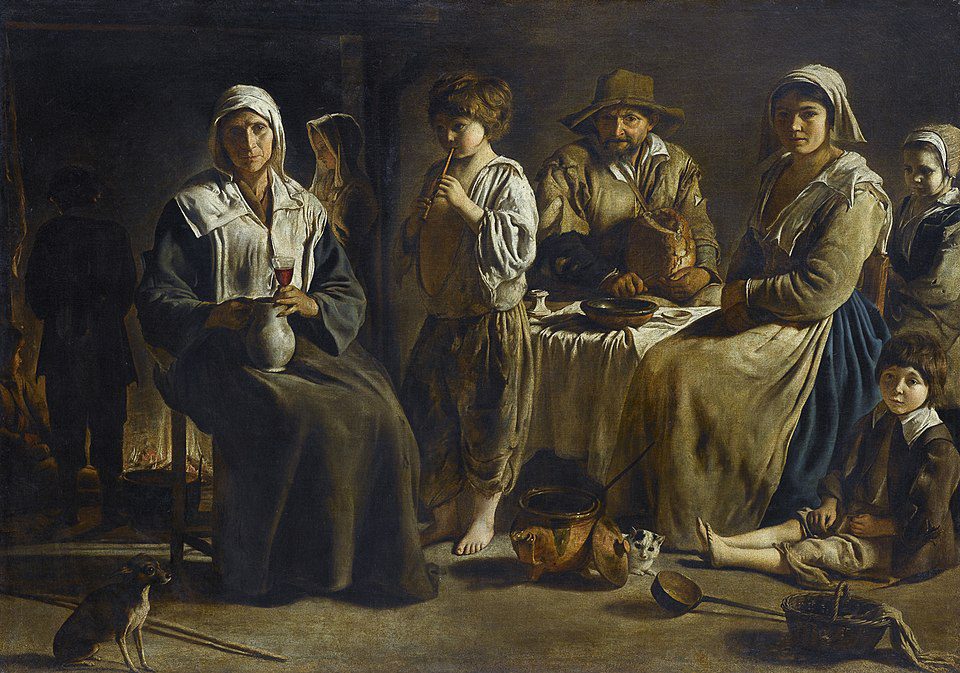
“Peasant Family in an Interior,” painted around 1642, stands as the Le Nain brothers’ greatest achievement and one of the most honest portrayals of domestic life in all of French art. It shows a group of nine figures, presumably a family, gathered in a modest room with bare stone walls, sparse furniture, and soft natural light. Every element of the scene suggests restraint, from the somber color palette to the stiff but composed postures of the figures. This is not a sentimental or dramatic piece—it is contemplative and noble.
The figures are seated around a central table, with one child holding a piece of bread and another resting quietly in the background. A small fire burns in the hearth, but there is no sense of warmth or luxury. The expressions are subdued, yet the silence carries weight. Each figure appears lost in thought, or perhaps simply at peace. It’s a family not indulging in comfort, but enduring with dignity.
The painting measures approximately 113 by 159 centimeters and is currently housed in the Musée du Louvre in Paris. It is widely considered the pinnacle of the brothers’ work, and though it is officially attributed to all three, art historians overwhelmingly suggest Louis Le Nain as the primary hand behind it. The piece captures everything the Le Nain brothers represented: sobriety, balance, tradition, and reverence for the everyday.
Its impact has lasted for centuries, not because it stuns the viewer with color or narrative, but because it speaks to something deeper—moral presence. In an era when artists competed for royal favor with extravagant compositions, this work drew attention through quiet power.
Visual Description and Composition
The arrangement of figures in the painting is nearly symmetrical, suggesting an inner order that mirrors the family’s stability. The father sits near the center, anchoring the composition, while the children and mother form a visual triangle. Their clothing is simple—earth tones, homespun cloth, no jewelry. There is a striking absence of movement, enhancing the painting’s stillness.
Objects in the room are few but telling. A jug rests on a shelf, a dog lies at the family’s feet, and a loaf of bread sits on the table. These are not props; they are emblems of sufficiency and order. The walls are gray and unadorned, but the light falling on the figures gives the scene a soft, sacred glow.
A Mood of Quiet Strength
What makes this work so powerful is not what’s happening, but what’s held back. The family members do not gesture or emote. They sit, they observe, they wait. This sense of composure—of being rooted in place—feels intentional. It’s a portrayal of strength as stillness, not aggression.
The father’s gaze is direct yet calm, and the children seem disciplined, even contemplative. Their environment is humble, but the painting never invokes pity. Rather, it uplifts a lifestyle rooted in traditional roles and virtues. Even the physical closeness of the figures suggests a bond held together not by words but by duty and affection.
Louis Le Nain: The Leading Hand Behind the Work
Though all three Le Nain brothers worked in similar styles, most scholars agree that Louis Le Nain is the likely creator of Peasant Family in an Interior. His works were especially focused on indoor scenes, characterized by muted lighting, rigid composition, and a strong moral presence. Compared to Antoine’s genre works or Mathieu’s more decorative portraits, Louis’s paintings carry a weightier, more solemn tone.
Louis was born around 1603 and died in 1648, at the relatively young age of 45. Despite a limited lifespan, his artistic vision matured early. He began painting domestic interiors in the 1630s and developed a refined technique of balancing realism with structure. His brushwork is controlled, his use of light deliberate. Peasant Family in an Interior reflects all of these qualities, making the attribution plausible.
Art historians note that Louis’s signature approach often involved visual symmetry, reserved facial expressions, and subdued color schemes. These elements are on full display in this painting. The room’s somber palette, the arranged stillness of the figures, and the almost architectural framing of the interior are consistent with Louis’s known techniques. The absence of emotional theatrics further aligns with his other attributed works.
Though the brothers likely collaborated on multiple paintings, experts from institutions such as the Louvre and the Musée des Beaux-Arts de Laon believe Louis was the intellectual driver behind this masterpiece. He wasn’t just painting a scene—he was delivering a worldview grounded in duty, unity, and realism.
Why Louis Stands Out
Among the three brothers, Louis is consistently recognized for his disciplined and deeply moralistic style. While Antoine often painted lighter scenes—music-making, drinking, or social interaction—Louis’s focus was quieter and more serious. His peasant scenes were always infused with structure and a kind of spiritual sobriety.
His preference for interior spaces over outdoor settings also separates his work from the others. Louis used space not merely to locate the figures, but to reinforce the values they embodied. Walls become borders of protection; tables become symbols of unity. His approach was less about surface realism and more about metaphysical order.
Attribution Challenges Among the Brothers
Because most of the Le Nain paintings were unsigned, attribution has remained a topic of scholarly debate. The brothers shared a studio, similar techniques, and even painted on similar canvas types. Sometimes, they may have worked simultaneously on a single painting, which further complicates identification.
That said, stylistic analysis—backed by infrared imaging and pigment testing—has helped distinguish the works. Louis’s careful handling of light, often using a single directional source, is markedly different from Mathieu’s more stylized portraits. In Peasant Family in an Interior, these techniques point to Louis more than either of his brothers.
Traditional Virtues in Paint and Principle
Peasant Family in an Interior is more than a depiction of a rustic household—it’s a visual affirmation of traditional values. The scene celebrates family cohesion, modesty, and moral discipline. Every element in the painting—from the central positioning of the father to the calm presence of the children—reinforces a worldview where duty and order come before self-expression.
The family is not portrayed as pitiful or downtrodden, but as anchored and honorable. Their modest surroundings are clean, organized, and purposeful. There is no luxury, but there is dignity. The bread on the table and the tools by the wall tell a story of earned sufficiency, not dependency or despair. The Le Nain brothers were showing that virtue could flourish even in humble places.
The painting carries no agenda beyond what it presents: a well-ordered family at peace with its station in life. This sense of purpose is deeply conservative—grounded in hierarchy, faith, and responsibility. The father’s central position is not accidental; it reflects his role as the provider and spiritual head of the home. The presence of children reinforces the continuity of values across generations.
It’s also important to note what’s missing from the scene. There is no disorder, no sign of rebellion, no implication that change is needed. This is not social critique—it is moral affirmation. The Le Nain brothers weren’t painting to challenge the existing order; they were preserving its best aspects in visual form.
Family as Moral Center
The placement of family members in a triangular composition reinforces their unity. Everyone is close, both physically and emotionally. The mother’s calm expression and the father’s composure form a foundation that the children mirror. There is no sign of generational conflict, alienation, or self-absorption.
This layout isn’t just artistic—it’s ideological. It asserts that the family, when rightly ordered, is the proper unit of civilization. Unlike modern depictions that often question or undermine family roles, this work affirms them. Fathers lead, mothers nurture, children obey and learn.
Order, Modesty, and Real Labor
The tools resting against the wall and the rough surfaces of the table and floor all indicate work well done. There is no sign of indulgence—no jewelry, no extravagant furnishings, no ornate textiles. The family wears what they need, nothing more. Their postures are upright, their gazes focused.
This is a portrait of modesty, not misery. Modesty here is not a deficiency but a strength. It shows a life well lived within the bounds of tradition and necessity. In many ways, this painting reminds us that greatness can come not from changing the world, but from fulfilling one’s role in it.
Visual and symbolic markers of traditional virtues in the painting:
- Centered table as a symbol of unity
- Modest clothing showing humility
- Children present and engaged
- Tools representing honest work
- Calm postures reflecting moral restraint
Realism Without Rebellion: Art Before Ideology
In recent decades, some modern critics have attempted to reinterpret Peasant Family in an Interior through ideological lenses, casting it as a commentary on class or inequality. But these readings project modern agendas onto a work rooted in an entirely different mindset. The Le Nain brothers were not revolutionaries. Their realism was ethical, not political. They chose to depict rural life truthfully, not to criticize the social order, but to elevate the virtues they saw within it.
The power of this painting lies in its restraint. There are no exaggerated expressions, no dramatic symbolism, and no coded messages of protest. Instead, it portrays a world where duty and faith are lived out quietly and persistently. The family is not depicted as victims of a system, but as participants in a divinely ordered structure of life. Their poverty is not a moral flaw, nor is it romanticized—it simply is.
This realism without rebellion reflects a broader worldview—one that values constancy over chaos and tradition over transformation. The Le Nain brothers weren’t interested in tearing down institutions. Their aim was to hold up a mirror to the common man and say, “You too are made in God’s image.” That’s a message rooted in timeless truth, not temporary ideology.
By avoiding both fantasy and protest, the brothers found a narrow but powerful artistic lane. They told the truth without distortion, respecting their subjects and their viewers alike. That kind of honesty in art is increasingly rare today, and all the more necessary.
Rejecting Idealism, Not Embracing Protest
The Le Nains didn’t use classical myths or exaggerated allegories. Their rejection of idealism was not a critique of monarchy or religion, but a moral choice to focus on what is real and immediate. Their subjects don’t pretend or pose—they endure, they serve, they live. This stands in stark contrast to artists who painted gods and emperors while ignoring the world outside the palace gates.
There’s a quiet clarity to this approach. It affirms that worth isn’t found in wealth or status but in character and vocation. That’s not a revolutionary idea—it’s a deeply conservative one, grounded in centuries of Judeo-Christian teaching and rural tradition.
Dignity Over Drama
Many 17th-century painters thrived on emotional spectacle. Whether it was Caravaggio’s dramatic martyrdoms or Rubens’s theatrical battle scenes, the age was rich with art meant to overwhelm the senses. The Le Nain brothers, and Louis in particular, took the opposite path. Their subjects don’t weep or gesture—they sit, they wait, they work.
This understated presentation offers something stronger than pathos: dignity. Dignity doesn’t shout or demand attention; it exists in how one carries themselves. Peasant Family in an Interior doesn’t ask you to feel sorry for its subjects—it asks you to respect them.
The Cultural Setting: France in the 1640s
The 1640s in France were marked by centralization of power under Cardinal Richelieu and King Louis XIII, followed by increasing instability leading up to the Fronde civil wars. French society was experiencing the early stages of absolutism, with growing control over religion, art, and commerce. Amid this, the French monarchy supported the establishment of classical ideals in art through institutions that later became the Académie Royale.
Art was being shaped to serve the interests of power—mythology, history painting, and allegory dominated elite patronage. Artists were expected to flatter their subjects and reinforce state authority. The Le Nain brothers resisted this trend by painting everyday people, not to subvert power, but to depict an often-ignored part of France with sincerity and moral weight.
Outside Paris, much of France remained rural, devout, and deeply traditional. Life was structured by seasonal rhythms, Catholic ritual, and familial duty. The Le Nain brothers were not abstract theorists—they observed the world around them and painted it with precision. Their scenes likely drew on people they knew personally: neighbors, friends, even relatives.
While the urban elite embraced Italianate styles and academic techniques, the Le Nains clung to northern European realism, rooted in Dutch and Flemish traditions. This gave their work a unique voice—distinct from both the flamboyant court painters and the saccharine genre painters emerging elsewhere in Europe.
Paris and the Royal Academy’s Rise
Paris in the 1640s was becoming the cultural center of Europe, thanks to Cardinal Richelieu’s investment in the arts. In 1648, the same year that Louis and Antoine Le Nain died, the Royal Academy of Painting and Sculpture was founded. Its goal was to formalize the training of artists and promote a specific hierarchy of genres, with history painting at the top and still life at the bottom.
The Le Nain brothers stood outside this academic structure. Their art was too sincere, too rooted in observation to fit into the grand theoretical schemes being developed by Charles Le Brun and others. This outsider status preserved their integrity, even if it limited their fame during their lifetimes.
Religion, Morality, and Rural Faith
The Catholic Church in 17th-century France remained a central moral force, especially outside the royal court. While Paris was navigating political shifts and occasional religious tensions, rural families remained firmly committed to traditional worship and family roles. This influence is subtly evident in the Le Nains’ work.
Though Peasant Family in an Interior does not contain overt religious imagery, its moral tone is unmistakable. The sense of order, restraint, and humility reflects a Catholic worldview—one that prioritizes family, obedience, and moral clarity. The figures do not appear to seek earthly reward; they are grounded in something higher.
Techniques of Sobriety: How the Painting Was Made
The technical execution of Peasant Family in an Interior is as restrained as its subject matter. The Le Nain brothers employed a subdued color palette of ochres, grays, and browns. These colors are not only appropriate to the setting but serve to unify the composition and focus attention on the figures’ presence rather than their surroundings.
Their brushwork is deliberate but not overly polished. There’s a rawness to the textures—rough stone walls, coarse fabric, gnarled hands—that supports the painting’s honest tone. Light enters from an unseen source, gently illuminating faces and objects without theatrical contrast. This lighting creates atmosphere, but also spiritual resonance.
Perspective is tightly controlled. Figures are spaced with care, ensuring balance across the canvas. The horizon line is low, keeping the viewer close to the family rather than gazing down on them. It’s a subtle decision, but one that communicates respect. The viewer becomes a quiet participant, not a distant observer.
Even the negative space in the room—the plain walls, the floor, the darkened corners—serves a purpose. It frames the family and directs the eye inward. The lack of distraction allows the scene’s moral weight to settle in slowly, with lasting effect.
Brushwork and Palette
The brushwork in this piece is neither overly refined nor hasty. Each figure is painted with care, but not embellished. Fabrics are textured, hands and faces are rugged, and backgrounds are kept intentionally sparse. This approach supports the painting’s tone of modesty and authenticity.
The color palette avoids luxury colors like crimson, sapphire, or gold. Instead, it relies on earthen tones—sienna, charcoal, and ochre—that reflect the world of the working class. These tones also harmonize with the painting’s emotional register: calm, sober, and grounded.
Structure and Space
Compositionally, the painting adheres to a stable geometric design. The seated figures form a loose triangle, and architectural elements—walls, doorframes, beams—reinforce vertical and horizontal lines. This structural order mirrors the moral order depicted in the family’s roles and relationships.
The space feels lived-in but not cluttered. Every object has a purpose, and nothing feels accidental. This speaks to both the artist’s technical skill and his underlying philosophy: in a well-ordered life, even the smallest things carry meaning.
How Critics Have Interpreted the Painting
Over the centuries, Peasant Family in an Interior has been interpreted in many ways. Early critics admired its quiet dignity and technical skill. In the 19th century, art historians praised the Le Nain brothers for rescuing French art from excessive flamboyance. In the 20th century, however, some critics began applying Marxist or materialist frameworks to the work, viewing it as a critique of social inequality.
These interpretations, while fashionable in academic circles, miss the mark. The Le Nain brothers did not portray peasants to critique the aristocracy or promote class conflict. They painted these scenes because they believed in the worth of rural life. Their goal was not political commentary, but moral clarity.
Today, more balanced voices have returned to viewing the painting through the lens of virtue, family, and order. Scholars now recognize that trying to fit this work into modern ideological boxes distorts its purpose. The painting was created in a religious, hierarchical society—not a revolutionary one. Its intent was to affirm, not agitate.
Its relevance endures precisely because it avoids slogans and statements. Instead, it offers a vision of life that is rooted in truth, discipline, and quiet strength.
Classical vs. Modern Interpretations
Earlier interpretations of the painting saw it as a celebration of domestic virtue and craftsmanship. Writers such as André Michel and Paul Jamot praised the Le Nains for their spiritual honesty and technical restraint. These readings emphasized the moral and formal elements of the work.
Modern interpretations often inject political motives, suggesting that the painting offers a hidden critique of social structures. These views rely on assumptions not supported by historical context or the artists’ own biographies. Unlike propagandists, the Le Nains showed the world as it was, not how an ideology wished it to be.
Resisting Revisionist Agendas
It’s important to push back against the urge to weaponize art for contemporary narratives. The Le Nain brothers weren’t advocating for revolution, reform, or class struggle. They were painting their neighbors with compassion and clarity. Imposing modern agendas distorts the meaning and disrespects the artist.
Common interpretations — traditional vs. modern:
- Dignified realism vs. class critique
- Moral tableau vs. social documentary
- Faith-centered vs. secular materialist lens
- Rural family values vs. anti-aristocratic messaging
- Craftsmanship vs. commentary
Lasting Legacy: A Testament to Order and Truth
Peasant Family in an Interior remains one of the most quietly powerful works in European art history. In a world often obsessed with spectacle, novelty, or agitation, this painting offers something rare: a vision of life grounded in moral strength and familial duty. Its legacy is not built on controversy or trend, but on timeless truths—faith, work, modesty, and unity.
The Le Nain brothers, especially Louis, never chased fame or favor through flattery or flamboyance. Their works endure precisely because they were honest. In elevating the lives of rural families, they preserved a vision of civilization that respected structure and responsibility. Their restraint became their strength. Their realism became their legacy.
Though for centuries overlooked, the Le Nain brothers are now recognized as essential figures in 17th-century French art. Institutions such as the Louvre, the Musée d’Orsay, and the Musée des Beaux-Arts de Laon have re-evaluated their contributions, showcasing their work as both artistically excellent and culturally vital. Their painting doesn’t demand attention—it commands it.
In today’s fractured cultural landscape, their message is more necessary than ever. Peasant Family in an Interior reminds us that greatness can reside not in noise or rebellion, but in silence, sacrifice, and truth well told.
Why This Work Still Resonates
In an era where art often pushes boundaries for the sake of provocation, Peasant Family in an Interior feels like a breath of moral clarity. It asks nothing of the viewer but respect—for tradition, for labor, for family. That kind of message doesn’t age. It deepens with time.
The painting speaks to those who value rootedness. It portrays a world not of fantasy but of duty lived out quietly. There are no slogans here, no subtextual rebellion—just the daily beauty of ordered life.
The Le Nain Brothers’ Place in Art History
For too long, the Le Nain brothers were seen as an oddity in French Baroque painting. Now, they are rightfully placed alongside the great moral realists of Europe—artists who prized truth above trend. Louis Le Nain in particular stands as a master of disciplined, reverent realism.
Their impact was never about innovation; it was about preservation. In painting rural life without distortion, they gave visual form to the conservative heart of French society. That legacy is quietly monumental.
✅ Key Takeaways
- Peasant Family in an Interior reflects traditional virtues like family, modesty, and honest labor.
- The painting is most likely by Louis Le Nain, although it is commonly attributed to all three brothers.
- Its restrained realism avoids sentimentality or protest, favoring dignity and moral clarity.
- The Le Nain brothers resisted the elite artistic trends of their time, focusing instead on rural truth.
- Today, the painting remains a powerful reminder of order, duty, and timeless cultural values.
Frequently Asked Questions
- Who painted Peasant Family in an Interior?
It is attributed to the Le Nain brothers, most likely Louis Le Nain, based on stylistic evidence. - When was the painting created?
The painting was completed around 1642 AD, during the reign of King Louis XIII. - Where is the painting located today?
The painting is housed in the Musée du Louvre, Paris. - What is the significance of the painting?
It portrays the quiet dignity of a peasant family, emphasizing traditional values like unity and modesty. - Was this painting a political statement?
No. The work emphasizes moral and spiritual truths, not ideological or political critique.