The story of Portuguese art begins long before there was a Portugal to name it—etched into megaliths, patterned into mosaics, and hidden in the ruins of forgotten towns where Atlantic winds now sweep over silent stone.
The prehistoric landscapes of what is now Portugal are marked by stones arranged with a care that suggests more than survival. Across the Alentejo and into the rugged countryside of Évora and Castelo Branco, clusters of megalithic monuments—dolmens, menhirs, and cromlechs—form the first artistic gestures of the peninsula. These were not random piles of rock. They were ritual spaces, sky-calendars, burial sites, and theaters of the unseen. The Cromlech of the Almendres, often likened to a smaller and older cousin of Stonehenge, reveals a deliberate astronomical alignment. Dating from around 6000 BC, its curved arcs of standing stones are among the oldest known monuments in Europe. Some of the stones bear engraved circular motifs and serpentine carvings, offering the first signs of a symbolic visual language.
This early art was not merely decorative. It was functional, ceremonial, and cosmological. The monumental scale, combined with abstraction, suggests a proto-architecture of belief—stone transformed into time, into thresholds between the living and the dead. The act of arranging stones into geometric order was itself an expression of power, structure, and the human need to embed meaning in landscape.
Roman Mosaics and Urban Aesthetics
By the 2nd century BC, the legions of Rome had moved into the Iberian Peninsula, replacing tribal hillforts with paved roads and civic forums. With them came a Mediterranean aesthetic sensibility: harmony, order, symmetry, and spectacle. Roman art in Lusitania—the name for the Roman province that included much of modern Portugal—was not peripheral or diluted. It was deeply integrated into Roman cultural machinery, often of startling refinement.
One of the most exquisite survivals is the Villa Romana de Milreu, near Faro, where floor mosaics reveal not just technical mastery but thematic richness: geometric interlaces, mythological sea creatures, scenes of pastoral life. Mosaics here were not framed paintings—they were part of the architecture, embedded into the daily experience of moving through space. Baths, atriums, and peristyles glowed with tesserae arranged in rhythmic abstraction or narrative figuration.
Urban planning was itself a visual discipline. The ruins of Conimbriga, once a thriving Roman city, still suggest a rational and artistic organization of life: colonnades, symmetrical gardens, and decorative façades. Sculpture followed imperial typologies—busts of emperors, idealized youths, gods rendered in white marble—but occasionally hints at local adaptation. A seated Minerva might appear in a provincial style, her proportions slightly altered, her gestures more rustic than Roman. In such deviations, the beginnings of a Lusitanian aesthetic voice can be traced.
Visigothic Traces in Iberian Foundations
After the collapse of Rome in the 5th century AD, the Visigoths brought a different set of artistic priorities—less cosmopolitan, more symbolic, and markedly religious. The transition was not abrupt but sedimentary. Roman forms persisted, repurposed under new meanings. Stone capitals were carved with crosses instead of eagles; Christian churches emerged within the bones of classical cities.
The Visigothic contribution to Portuguese art history is difficult to pin down in volume but crucial in tone. Their architecture was minimal, favoring horseshoe arches, austere naves, and an emphasis on symbolic numerology. The Church of São Frutuoso de Montélios, though located just outside present-day Braga, illustrates this hybridized style: a central-plan structure with a cruciform interior, blending late Roman planning with early Christian abstraction.
In ornament, the Visigoths leaned toward intricate metalwork—fibulae, votive crowns, and reliquaries that combined geometric rigor with symbolic density. Goldsmithing in this period was both a political and spiritual art. The Treasure of Guarrazar, discovered further east but relevant to Iberian culture as a whole, includes jeweled crowns inscribed with Christian dedications, suspended from churches like celestial metaphors. Though Portugal’s surviving examples are scant, the aesthetic principles—hierarchy, symbolism, and luminous detail—would resurface centuries later in the extravagant forms of the Manueline.
Midway through this period, Christianity became not merely a belief system but a central axis around which visual culture organized itself. This shift—from the civic to the sacred, from public beauty to spiritual transcendence—marked a profound transformation in the function of art. And though the stones remained in place, their meanings changed.
Moorish Light: Islamic Aesthetics in the Western Frontier
When the armies of the Umayyad Caliphate crossed the Strait of Gibraltar in 711, they brought not only swords and governance but geometry, abstraction, and an entirely new visual vocabulary. For over four centuries, the southwestern corner of Europe—Al-Andalus—was shaped by Islamic rule, and although the area corresponding to modern Portugal lay at its outer edge, the cultural influence reached far deeper than borders suggest. Moorish aesthetics became part of the landscape, enduring even after their political dominion ended.
Azulejos Before the Azulejos
The shimmering tiled surfaces that modern visitors associate with Portuguese churches and train stations did not begin with Christian artisans. Their genealogy lies in the Islamic tradition of glazed ceramics and wall coverings, especially those developed in North Africa and later refined in Al-Andalus. The early azulejos—derived from the Arabic al-zulayj, meaning “polished stone”—were geometric rather than narrative, designed to evoke a kind of infinite pattern that hinted at the divine through repetition and symmetry.
In towns like Silves, once the capital of the Algarve under Muslim rule, traces of this aesthetic survive not only in surviving tile fragments but in the very logic of interior space. The Moorish use of ceramic as both surface and symbol turned architecture into a kind of visual prayer: walls became fields of abstract meditation, with tessellations that dissolved the boundary between ornament and structure.
Although the Christian reconquest eventually recontextualized the azulejo within Catholic iconography, its visual DNA remained Islamic in rhythm. Even centuries later, Portuguese tiles would continue to reflect the deep influence of Islamic design:
- Star polygons and interlaced hexagons drawn from Moroccan precedents
- Calligraphic bands that, though now Latinized, retained the spirit of Qur’anic epigraphy
- Glaze palettes of cobalt blue, manganese purple, and jade green echoing eastern ceramic traditions
This continuity was less a cultural memory than a living undercurrent—a style absorbed and adapted, not merely inherited.
Geometry, Gardens, and Hidden Spaces
Moorish urbanism did not impose monumental city planning in the Roman fashion. Instead, it favored inwardness, courtyards, and controlled movement through space. The medinas and alcazabas of southern Iberia were structured around human scale, secrecy, and shade—principles born from desert cultures and translated to the Iberian microclimate.
In the Algarve, archaeological traces reveal domestic architecture that prioritized interior gardens, water channels, and geometric tiling—predecessors of the famed patios of Seville and Córdoba. These were not just aesthetic choices but cultural principles. The Islamic garden, in its ideal form, mirrored the Qur’anic paradise: walled, symmetrical, fed by four rivers. The concept of the riwaq, a shaded arcade bordering a garden, appears even in later Christian monasteries such as Batalha and Alcobaça, where cloisters retain the quiet geometry of their Islamic forebears.
What distinguished Islamic spatial design in Portugal was not just its visual motifs, but its metaphysical orientation. Space was not something to be conquered and displayed; it was to be shaped into microcosms of balance. The famed muqarnas—honeycomb vaults used in ceilings—were more rare in the western provinces, but the principles behind them, of fragmenting mass into lightness, informed later Portuguese vaulting experiments.
A house in Moorish Silves might appear humble from the street—whitewashed, low, even anonymous—but inside, the rooms opened in layers, from cool vestibules to inner gardens with citrus trees and running water. Privacy was not just social; it was spiritual. That instinct for interiors—quiet, enclosed, intricate—remained embedded in Portuguese domestic architecture long after the Moors had been driven out.
The Mosque and the Minaret Reimagined
Few full Islamic structures survive intact in Portugal, largely due to the completeness of the Christian reconquest and the transformation of mosques into churches. But enough remains—in foundations, orientations, and archaeological profiles—to piece together a sense of architectural memory. The remains of a mosque beneath the Church of São João Baptista in Tomar, for example, suggest a continuity of sacred space. Other sites, like Mértola, preserve the original mosque floorplan, even if the walls now bear crucifixes.
Portuguese Christian architecture, especially in the south, sometimes retains the logic of Islamic models:
- Arched colonnades built on Islamic templates
- Narrow, horseshoe arches that persist even when their original symbolism has been lost
- Minaret towers converted into bell towers without altering their essential silhouette
The artistic afterlife of Moorish architecture can be found most explicitly in the Mudéjar tradition—a hybrid style developed after the Christian reconquest, when Muslim artisans continued to build for Christian patrons. While stronger in Spain, Mudéjar flourishes can be found in Portuguese tilework, wooden ceilings (artesonados), and even in lace-like stonework on convent walls.
There’s a quiet irony in the persistence of these forms. While Christian chroniclers celebrated the expulsion of the Moors, they continued to live in their houses, sleep beneath their ceilings, and commission artists trained in Islamic workshops. Cultural boundaries blurred even as political ones hardened.
The legacy of Islamic aesthetics in Portugal is neither ornamental nor secondary. It formed the very framework through which Portuguese art would later understand abstraction, surface, and interiority. Long after the final emir was exiled and the churches reconsecrated, the Moorish light continued to filter through Portuguese stone and ceramic, subtle but indelible.
The Gothic Takes Root: Christianity and Monumentality
It arrived quietly at first, imported by monks and royal marriages, but soon the Gothic style began to shape the very image of medieval Portugal. Rising from the heavy Romanesque foundations of early Christian architecture, the Gothic brought light, height, and a sharpened sense of divine aspiration. In a land newly consolidated by reconquest and crowned with Christian kings, architecture became a public theology—and the Gothic was its chosen language.
Cistercians and the Monastery of Alcobaça
The purest expression of early Gothic in Portugal began not in a royal palace but in a monastic cloister. The Monastery of Alcobaça, founded in 1153 by the Cistercian order, marks a turning point in Portuguese architecture. Its construction, which began shortly after the founding of the Portuguese kingdom itself, was an act of both piety and sovereignty—an artistic declaration that the new realm would stand among the Christian powers of Europe, both spiritually and culturally.
Unlike the heavily ornamented Gothic styles of France or Germany, the Cistercian Gothic at Alcobaça is austere, emphasizing proportion, clarity, and verticality. The monks rejected excessive decoration, believing it distracted from divine contemplation. As a result, the architecture speaks in a stripped, almost skeletal tone—pointed arches, ribbed vaults, and long, tall naves that draw the eye upward in quiet majesty.
The church interior, with its rhythmic procession of columns and vaults, conveys not theatrical grandeur but disciplined transcendence. In contrast to later exuberant Gothic iterations, Alcobaça feels monastic in the deepest sense—both visually and emotionally. Yet its visual restraint only sharpens its impact. Light filters through narrow lancet windows with a precision that seems deliberate, almost sacred.
Over time, additional elements were added to the complex, including a massive kitchen with a stone fish-sorting basin fed by a diverted river—a marvel of monastic engineering. But it is the church that remains central, not just as a place of worship but as a landmark in the visual imagination of the early kingdom.
Pointed Arches and Rising Towers
The spread of Gothic architecture beyond Alcobaça mirrored the growing ambitions of the Portuguese monarchy and church. As the Reconquista advanced southward, each reclaimed territory became an opportunity for new construction—cathedrals, fortresses, monasteries—each designed to proclaim the permanence of Christian rule and the power of Portuguese kingship.
In Lisbon, the construction of the Sé (Cathedral of Santa Maria Maior) began in 1147, immediately after the city’s conquest from the Moors. Though originally Romanesque in form, successive additions layered Gothic elements onto its heavy structure: ribbed vaults, pointed arches, and a rose window that interrupts the fortress-like façade with a sudden moment of delicacy.
Elsewhere, the Batalha Monastery, initiated in 1386 to commemorate the Portuguese victory at Aljubarrota, introduced a more flamboyant Gothic style into the national vocabulary. Here, the vertical lines are more assertive, the ornament richer. Flying buttresses and pinnacles frame elaborate portals. Sculpture becomes narrative again—kings, saints, angels, and grotesques crowd the architecture, turning stone into allegory.
Towers became statements of both defense and faith. The Gothic bell towers of Coimbra and Évora illustrate how the form adapted to urban contexts. They anchor the cityscape, offering views across rooftops and pastures alike. The gothic spire, rather than being foreign, came to symbolize something deeply Portuguese: faith rooted in land, yet stretching toward the infinite.
Three distinctive features mark the Portuguese version of Gothic during this period:
- The use of limestone rather than granite, allowing finer carving and greater height
- Hybridization with local traditions, including Islamic-influenced tracery and arches
- Integration of royal and ecclesiastical heraldry, turning buildings into dynastic monuments
These were not simply buildings—they were instruments of memory, authority, and national myth.
Stone as Theology: Symbols in Sculpture
If architecture framed the divine, sculpture animated it. Portuguese Gothic sculpture, while often modest in comparison to its French or German counterparts, conveys an intensity of expression that makes up for its scale. At Alcobaça, the twin tombs of Pedro I and Inês de Castro—one of Portugal’s most enduring love stories—represent a high point of medieval funerary art.
Pedro, king of Portugal, fell in love with Inês, a Galician noblewoman. Their relationship was condemned, and Inês was executed in 1355. After ascending the throne, Pedro allegedly had her body exhumed and crowned as queen in a symbolic act of defiance. Their tombs, placed facing each other in Alcobaça’s transept, are carved with scenes of their lives, Judgment Day, and angels bearing their souls. The craftsmanship is intricate, the pathos unmistakable.
Elsewhere, tympana over church doors depict the Last Judgment, the lives of saints, and scenes from the Passion. Capitals bear vegetal motifs and small animal forms—lions, dragons, monkeys—speaking to both the moral imagination of the time and lingering folkloric traditions. Stone was not inert; it was a medium of storytelling, and the stories it told were eternal.
Carving extended to choir stalls, altars, and even cloister arcades. At Batalha, the Unfinished Chapels (Capelas Imperfeitas)—a circular arrangement of open-air tombs and arches—showcase some of the finest late Gothic carving in Iberia. The project was never completed, yet its skeletal beauty reveals the architectural ambition of King Duarte and the technical sophistication of 15th-century Portuguese masons.
Gothic art in Portugal was never just a stylistic import. It was a spiritual and political act of anchoring—a way to claim territory, assert legitimacy, and express the cosmic order through stone and space. From the silence of Alcobaça to the grandeur of Batalha, the Gothic age embedded itself in the very geography of the nation, leaving behind a legacy as vertical and enduring as the spires it raised.
Manueline Excess: A Style Born of Empire
To walk through a Manueline cloister or portal is to enter a world of stone turned supple, where rope coils around columns, coral textures erupt from capitals, and windows bloom with maritime emblems. This was not merely decoration—it was the visual language of empire. Named after King Manuel I (reigned 1495–1521), the Manueline style was Portugal’s own artistic invention, a late Gothic flamboyance fused with symbols of oceanic ambition, Christian mysticism, and a kind of controlled extravagance. It emerged as Portugal stood briefly at the apex of global exploration, flush with the wealth of Africa, India, and Brazil. The style shouted—rather than whispered—of its time.
Nautical Imagery and the Sea Route to India
At the heart of the Manueline idiom lies the sea—not as a background but as a source of visual grammar. Ropes twist into spiral columns, anchors and buoys sprout from stone friezes, and maritime plants, fish, and shells appear with uncanny realism. These were not allegories in the classical sense. They were literal acknowledgments of the sea’s central role in the national imagination and economy. The voyages of Vasco da Gama, Cabral, and others were not just state-sponsored missions; they were cultural myths given architectural form.
At the Monastery of Jerónimos in Belém, perhaps the most famous Manueline structure, the sea quite literally surrounds the site. Built beside the Tagus River at the very spot from which da Gama set sail, it was intended as a spiritual safeguard and a political statement: here Portugal prayed for its explorers, and here it declared to the world its divine sanction for empire.
The cloister at Jerónimos is a study in contradiction: symmetrical yet wild, serene yet explosive in detail. Ropes encircle pillars, tropical flora wind between biblical figures, and everywhere the stone seems to pulse with energy. Manueline architecture did not aim for restraint—it embraced spectacle.
Three visual motifs recur obsessively in Manueline buildings:
- The armillary sphere, a celestial navigational instrument, adopted as King Manuel’s personal emblem and a symbol of Portuguese mastery of the heavens and seas.
- The Cross of the Order of Christ, a successor to the Templars in Portugal, which adorned sails, banners, and doorways alike.
- Naturalistic carving of seaweed, coral, and indigenous plants from new colonies, often blended with Gothic architectural elements in hallucinatory density.
This was not art in service of subtlety. It was a baroque before the Baroque—a style too rich for its own frame.
The Hieronymites and the Tower at Belém
Nowhere is the Manueline style more concentrated than in the architectural ensemble of Belém. The Monastery of Jerónimos and the nearby Belém Tower form twin monuments to the Age of Discovery—one monastic, the other military, both ceremonial. The monastery was funded by a tax on spice trade revenue, a fact not incidental to its grandeur. The profits of empire flowed directly into its cloisters, chapels, and carved stone vaults.
Construction of the monastery began in 1501, with master architect Diogo de Boitaca laying its foundations. Later additions by João de Castilho and others pushed the style to greater heights of intricacy. The south portal, often mistaken for the main entrance, bursts with Manueline ornament: saints, royal coats of arms, maritime symbols, and a sculpture of Henry the Navigator. The overall effect is overwhelming, yet coherent—a tide of imagery rendered with surgical precision.
Just downriver, the Belém Tower stands like a stone ship anchored at the mouth of the Tagus. Built between 1514 and 1520 as a fortress and ceremonial gate to Lisbon, its structure is compact but exuberant. Here again, maritime elements abound: twisted ropes, openwork balconies, Moorish-influenced domes, and even carved rhinoceroses—likely inspired by the exotic gifts sent from India and Africa.
Both structures exemplify a peculiar Manueline duality: they are fortified and delicate, rooted in Catholicism but animated by worldly conquest, martial yet ornamental. In their stones, Portugal tried to contain the world it had suddenly acquired.
Rope, Coral, and Armillary Spheres in Stone
What distinguished Manueline from the broader European Flamboyant Gothic wasn’t simply its embellishment, but its thematic unity. Where Northern Gothic might favor religious allegory or classical myth, Manueline rooted its excess in specificity: the sea, empire, and Christian destiny. Every motif, however fantastical, was tethered to real political or navigational meanings.
In the Convent of Christ in Tomar, the famous window of the Chapter House—attributed to Diogo de Arruda—is perhaps the purest distillation of Manueline exuberance. It seems to explode from the wall: ropes frame the window like knotted garlands, vegetal motifs writhe from its base, and a wooden beam juts through the stonework, half-hidden by carved growth. The whole façade seems alive, as if the wall itself had sprouted tendrils in response to empire.
Yet within the ornament lies a profound ideological structure. The style was more than display—it was propaganda. The repeating armillary spheres and Christian crosses announced that this empire was cosmically ordained, not merely economically won. The Manueline style thus functions as a visual theology of conquest—ornament as narrative.
Notably, the Manueline period was short. By the 1530s, it began to merge into early Renaissance forms, and by the mid-century, Mannerism had begun its ascent. But in that narrow window—between 1495 and 1525—Portuguese art reached a kind of ecstatic singularity. There was no other European country whose power, identity, and aesthetic expression were so completely synchronized.
Manueline architecture remains Portugal’s most recognizable visual signature, but it is more than stylistic flourish. It is stone made rhetorical—every spiral a boast, every carved rope a map line. In the excess of Manueline design lies a paradox: the attempt to contain a vast, unfamiliar world in the familiar language of stone, devotion, and royal power. The result is as vertiginous as it is unforgettable.
Painters of the Early Kingdom: Devotion and Detail
If architecture defined the public face of Portugal’s growing empire, painting shaped the private and sacred spaces of its imagination. Long before the advent of courtly portraiture or secular art markets, Portuguese painting evolved within the walls of churches, monasteries, and royal chapels, where image served liturgy, instruction, and power. It was devotional but never merely functional. The painters of the early kingdom, especially those of the 15th and early 16th centuries, combined Flemish precision with Iberian mysticism, producing altarpieces and panel cycles of exquisite complexity. This was not painting as flourish—it was painting as clarity, control, and almost unbearable attention to the visible.
Nuno Gonçalves and the Saint Vincent Panels
There is no better entry into early Portuguese painting than the enigmatic and monumental Saint Vincent Panels, attributed to Nuno Gonçalves, court painter to King Afonso V. Created around 1470 and housed today in Lisbon’s Museu Nacional de Arte Antiga, the polyptych comprises six interlocking panels depicting the veneration of Saint Vincent of Saragossa, patron saint of Lisbon. Its figures are neither idealized nor symbolic—they are startlingly real, and their faces have haunted Portuguese visual culture ever since.
Over sixty figures appear: kings, bishops, knights, monks, children, and sailors. Each is rendered with such specificity that viewers and scholars have spent centuries trying to identify them. Is the kneeling warrior Prince Henry the Navigator? Is the elderly noble in black the painter himself? No definitive answers have emerged. But the mystery is part of the work’s magnetism.
The panels combine Northern European oil technique—careful layering, naturalistic light, attention to textiles—with a uniquely Portuguese sensitivity to group psychology. There is no central drama; instead, the entire composition operates like a visual fugue, a chorus of devotion suspended in time. The expressions are restrained, but their cumulative effect is powerful: solidarity, grief, awe.
What Gonçalves introduced was not merely realism, but psychological realism. In the folds of a monk’s robe, the watery gloss of an eye, or the shy glance of a boy behind a banner, we see the painter grappling with not just representation, but presence. This is not allegory; it is encounter.
Flemish Influence and the Luso-Flemish Synthesis
Portugal’s proximity to Flanders—both through trade and diplomacy—was essential in the evolution of its painting. In the 15th century, Bruges and Ghent were among the most advanced centers of pictorial art in Europe, and Portuguese merchants, diplomats, and clergy absorbed that influence with precision. But what emerged was not imitation—it was a synthesis.
Many Flemish painters worked in Portugal during this time. Others sent works that were integrated into local churches. The technical innovations of Jan van Eyck, Rogier van der Weyden, and Hans Memling—oil-based layering, naturalistic light, and architectural settings—became standard in Iberian workshops. But Portuguese painters, unlike their Spanish or Italian counterparts, rarely adopted classical themes. Their work remained rigorously Christian, often Marian, with a focus on narrative and the sacred human figure.
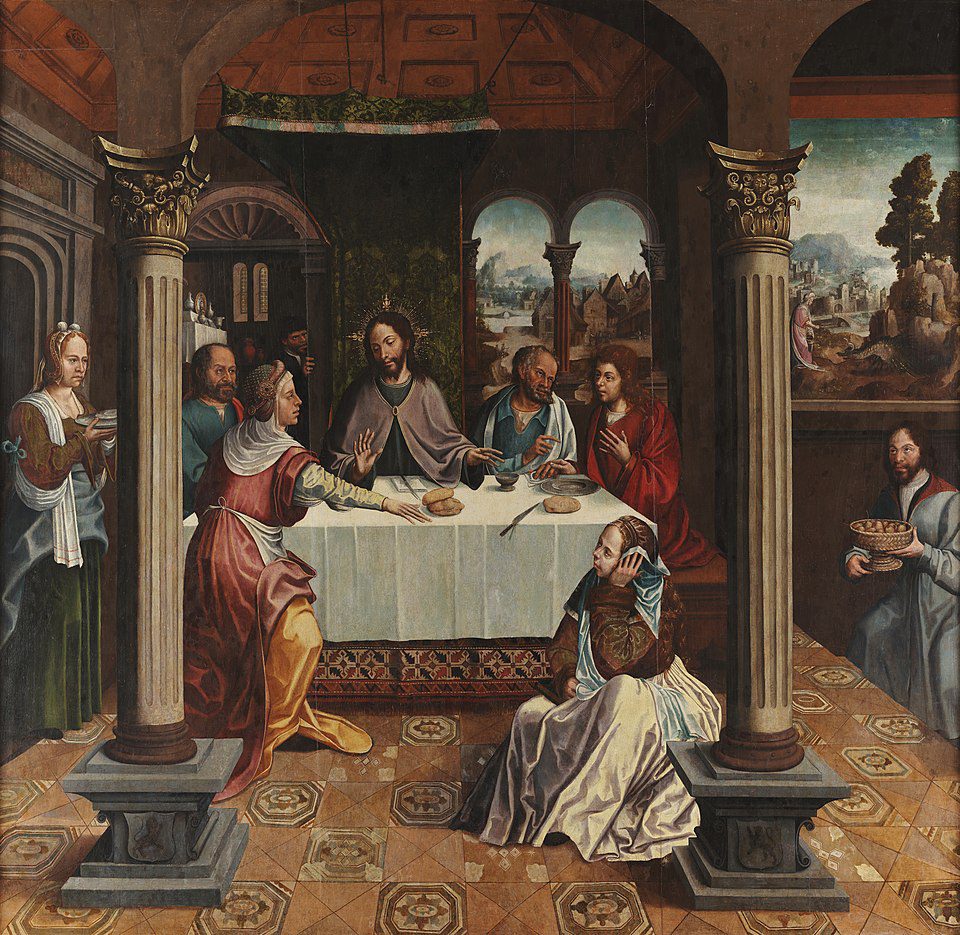
One painter who exemplifies this fusion is Jorge Afonso, active in the early 16th century. As official court painter under King Manuel I, Afonso directed large workshop productions that merged Flemish surface detail with local iconography. His altarpieces, such as the polyptych from the Convento de Jesus in Setúbal, are rich with embroidered textures, gold-threaded vestments, and faces that seem carved from the same stone as Portuguese cathedrals.
What marked Portuguese painting apart, even within the broader Flemish orbit, was:
- A heightened focus on fabric and textile realism—brocade, silk, velvet rendered in obsessive detail
- Emotion expressed through modesty rather than drama: downcast eyes, clasped hands, quiet gestures
- Integration of Portuguese architecture, ships, and local costume into sacred narratives
This was not provincialism, but an insistence on spiritual rootedness. The result was an art both international and deeply national.
Gold Grounds and Narrative Panels
While oil painting was becoming dominant, earlier medieval traditions lingered—particularly the use of gold leaf and gilded backgrounds. These were not relics of the past, but tools of emphasis. Gold was the light of heaven, the aura of sanctity, and in Portuguese panel painting it persisted long after Italy had moved toward spatial illusion.
Painters like Francisco Henriques, a Flemish artist working in Portugal in the early 1500s, combined Gothic iconography with Renaissance modeling. His altarpieces—especially those at Viseu and elsewhere in the north—demonstrate a painter comfortable with both gilded abstraction and atmospheric depth. Figures float against radiant backgrounds, their faces solemn but lifelike. The juxtaposition is disarming: medieval stillness framed by Renaissance light.
At the same time, narrative complexity became a defining feature. Polyptychs told entire theological stories across hinged panels—Annunciations, Crucifixions, Martyrdoms—all arranged for liturgical use. The viewer wasn’t expected to experience the painting as a single unified moment, but as a cyclical meditation. These works were read as much as they were viewed.
In Braga, Évora, and Tomar, regional schools developed subtle stylistic differences—softer modeling in the north, sharper outlines in the south—yet all shared an interest in integrating visual detail with devotional clarity. A painting might show the Virgin in prayer, but the surrounding objects—a book, a lily, a bench, a glimpse of a harbor—were as important as the figure itself. They were symbols, but also records of a world in which the divine appeared in the ordinary.
Portuguese painting in the late medieval and early Renaissance period did not produce an international star to rival Bosch or Raphael. But it did produce something rarer: a cohesive, introspective, and technically masterful body of sacred art that captured the nation’s spiritual temperament. In its combination of detail and restraint, grandeur and intimacy, it remains among the most emotionally honest schools of early European painting.
Baroque Splendor and Sacred Drama
When the Baroque came to Portugal, it arrived not as a foreign transplant but as a revelation. By the late 17th century, following decades of war, disaster, and dynastic shifts, Portuguese society stood at a spiritual and political crossroads. The Baroque style—with its dynamism, opulence, and theatrical force—offered a means to consolidate Catholic faith and royal authority at a moment when both were being tested. Yet what unfolded in Portugal was more than stylistic adaptation. The Portuguese Baroque developed into a distinct aesthetic organism: ornate but introspective, radiant yet rigorously structured. It found its fullest expression not in painting or sculpture alone, but in entire environments—where architecture, decoration, and illusion formed immersive experiences of sacred grandeur.
Painted Illusions on Church Ceilings
The ceilings came first. In the great Jesuit churches of Lisbon and Porto, Portuguese painters learned from their Italian counterparts not simply how to decorate vaults, but how to transform space through optical tricks and pictorial spectacle. One of the most dazzling examples is the ceiling of Igreja de São Roque in Lisbon, completed in the early 18th century. Though appearing to be carved in stone, its coffered vault is, in fact, masterfully painted wood—an illusion so convincing that even close inspection can be deceived.
These illusions weren’t games of deception. They were metaphysical tactics. A ceiling that opened toward a painted heaven was not just decorative—it was theological. In Baroque cosmology, the material world was to reflect the divine, and perspective painting offered the faithful a glimpse beyond the veil. Angels burst from clouds, saints hovered in trompe-l’œil recesses, and golden light seemed to pour through architectural impossibilities.
André Gonçalves and Pedro Alexandrino, two of the most influential painters of the era, developed a Portuguese visual vocabulary that was ornate yet meditative. Their altarpieces and ceiling paintings overflowed with figures but rarely lost compositional control. They understood that in the Baroque, emotion must be orchestrated, not allowed to dissolve into chaos.
The ceilings functioned like the overtures of a sacred opera—setting tone, hinting at divine themes, preparing the viewer for immersion. And for the faithful in 18th-century Portugal, often illiterate and living under strong ecclesiastical influence, these painted heavens were not metaphor. They were invitations.
Tilework as Theology
If the ceiling invited heaven into the church, the walls brought scripture into the city. Azulejos, the blue-and-white ceramic tiles that had once whispered of Moorish abstraction, now spoke in full pictorial sentences. In the Baroque period, tilework underwent a radical transformation: from pattern to narrative, from ornament to didactic tool. Churches, palaces, convents, and even public fountains became tiled stage sets, covered with biblical scenes, hagiographies, and moral allegories.
One of the most spectacular Baroque azulejo ensembles is found in Igreja de São Lourenço, the “golden church” of Almancil. There, nearly every surface is covered in blue-and-white scenes depicting the life of St. Lawrence, rendered with drama, expression, and architectural depth. The painter Policarpo de Oliveira Bernardes, among others, helped develop this large-scale narrative tilework, combining linear perspective with emotional clarity.
The use of azulejos in the Baroque had several key effects:
- They unified architecture and painting into a single, immersive visual field.
- They allowed for mass replication of sacred images, reinforcing doctrinal messages throughout the country.
- They enabled a luminous, almost cinematic experience of biblical time within everyday urban and rural settings.
Even outside religious contexts, tile panels illustrated classical myths, rural festivities, and scenes from imperial conquests, bringing Baroque grandeur into civic life. A Lisbon staircase, a Porto courtyard, or a Coimbra corridor might unfold like a parchment scroll—each tile a sentence in a national epic.
And always, the azulejos spoke in light. The use of cobalt blue on white backgrounds—initially inspired by Ming porcelain—became a Portuguese signature, blending Eastern influence with European iconography in a way no other culture achieved with such consistency or poetic force.
The Architect as Set Designer
Baroque architecture in Portugal evolved beyond the Counter-Reformation monumentality of Italy or Spain. Here, it became scenographic—a kind of three-dimensional liturgy. Buildings were not just structures; they were sacred theaters designed to orchestrate awe. The interiors were shaped not only to accommodate rituals, but to amplify them emotionally and visually.
The Igreja de Santa Engrácia in Lisbon, begun in the 17th century and completed in the 20th, stands as a curious but telling example. Though delayed by politics and engineering, its central-plan structure and undulating walls offer a sculptural boldness that captures the ambitions of the Baroque. More consistent is the Clérigos Church and tower in Porto, designed by Nicolau Nasoni, an Italian architect who became a central figure in Portuguese Baroque. His spiraling tower, completed in 1763, rises like a vertical exclamation mark over the city, visible from every approach.
Inside churches like São Francisco in Porto and Igreja de São João Baptista in Tomar, gilded woodwork (known as talha dourada) engulfs chapels in golden vegetation, angels, and explosive symbols of faith. Altarpieces become living forests of theology. This gilded carving, executed by teams of artisans rather than individual sculptors, was central to the Baroque religious experience in Portugal. It was collaborative, labor-intensive, and intended to dazzle.
The architectural principles behind these spaces were surprisingly modern:
- Controlled movement, guiding the visitor from darkness to light, from nave to apse
- Visual hierarchy, directing attention to key theological elements
- Material saturation, overwhelming the senses to suppress distraction and doubt
Portuguese Baroque architecture did not seek to emulate Rome or Madrid. It sought instead to create its own sacred drama—one in which the viewer was not a spectator, but a participant drawn into the divine story.
Baroque art in Portugal was not simply grandeur for grandeur’s sake. It was a calculated, disciplined exuberance—one that emerged from the anxieties of faith, the ambitions of empire, and the daily hunger for transcendence. In painted ceilings, tile-clad walls, and golden altars, it offered a vision of the world not as it was, but as it might be: ordered, radiant, and flooded with divine presence.
The Azulejo Tradition: Tiles as Language
No art form is more intimately woven into the daily life, architecture, and imagination of Portugal than the azulejo. These glazed ceramic tiles, cool to the touch and luminous in the sun, adorn churches and train stations, palaces and peasant homes, cloisters and city walls. Their aesthetic impact is immediate—shimmering blue-and-white scenes, intricate patterns, monumental narrative cycles—but their deeper significance lies in continuity. Over five centuries, azulejos evolved from decorative fragments of Islamic pattern into an autonomous Portuguese art form, capable of telling stories, shaping space, and even defining national identity. They are more than ornament; they are language.
From Seville Imports to National Identity
The first azulejos in Portugal were not Portuguese at all. They arrived in the 15th century via Seville, where Islamic ceramic traditions had flourished under Nasrid and Mudéjar artisans. These early tiles—typically small, geometric, and multicolored—were used to cover walls and floors in aristocratic and royal residences. Portugal’s adoption of the form was swift and enthusiastic. King Manuel I’s royal palace at Sintra, completed in the early 16th century, features some of the earliest large-scale applications of azulejos, including Arabic-style repeating patterns and Moorish color palettes.
But within a generation, Portuguese tilework began to diverge from its Andalusian origins. In part, this was a technical transformation: artisans began to use the “pintura a fresco” method, painting directly onto the raw glaze surface before firing. This allowed for much larger images, finer brushwork, and increasingly pictorial content. By the mid-17th century, the azulejo had become less about pattern and more about image. And by the early 18th, it was nothing less than a visual chronicle.
In Lisbon’s Palácio Fronteira, built in the late 1600s, azulejos line the garden walls with scenes from courtly life: hunting parties, musical gatherings, battles rendered with a mix of myth and reportage. These panels, sometimes several meters long, are not simply decorative—they are narrative murals on ceramic skin.
This shift in function marked the beginning of the azulejo as a specifically Portuguese art. While Italy had frescoes and France tapestry, Portugal had tile: durable, luminous, and suited to its climate. A tile panel could survive earthquakes, floods, and decades of smoke and candle soot. It was an art of endurance.
Narrative Cycles and Urban Ornament
The 18th century was the azulejo’s golden age. Freed from its architectural origins, it became a standalone medium—capable of illustrating complex narratives across vast surfaces. Churches, especially in Lisbon and Porto, adopted azulejos as both decoration and pedagogy. Entire biblical cycles were rendered in tile: the Passion, the life of Mary, the acts of the Apostles. These images, often based on engravings by Flemish and Italian masters, were adapted and enlarged by Portuguese painters working in cobalt oxide on white-glazed panels.
One of the most celebrated works of this kind is the azulejo cycle in Igreja de São Lourenço in Almancil, executed in the 1730s. Here, every wall becomes a page in a sacred story, each figure drawn with expressive economy—fine lines, soft modeling, and careful spatial depth. The painter Policarpo de Oliveira Bernardes, part of a dynasty of tile artists, brought narrative clarity and visual discipline to the form, using architectural framing to guide the viewer’s eye across the panels.
But it was not only churches that embraced azulejo storytelling. Civic buildings, palaces, and even train stations became vehicles for tile narration. Nowhere is this more evident than in the São Bento station in Porto, completed in the early 20th century. Its walls are clad with monumental blue-and-white panels illustrating scenes from Portuguese history: battles, royal weddings, agrarian rituals. Executed by Jorge Colaço, a painter trained in Paris and Lisbon, the tiles combine romantic nationalism with historical spectacle. What begins as decoration quickly becomes historiography—visual mythmaking at public scale.
This civic embrace of azulejo continued into secular contexts:
- Lisbon’s water reservoirs were lined with allegorical tiles about rainfall and public health
- Noble homes depicted fables, courtly flirtation, and the seasons in tiled salon walls
- Market façades and fountain basins became stages for vernacular and comic tableaux
The city itself became a kind of tiled text—open to reading, layered with meaning.
Blue and White: Chinese Porcelain Refracted
The now-iconic blue-and-white palette of azulejos—so synonymous with Portugal—has a global backstory. Its origin lies in the importation of Ming porcelain from China in the 16th century. Portuguese traders were the first Europeans to access Chinese ceramics at scale, and their appeal was instant. The cobalt blue on white glaze, often depicting clouds, landscapes, and dragons, seemed both exotic and refined. European potters quickly sought to imitate the effect.
By the 17th century, Delftware in the Netherlands and faience in France had adapted the palette. But it was in Portugal that the style fused most deeply with local tradition. Cobalt oxide—imported from Persia and later mined domestically—was ideally suited to the tin-glazed surfaces of azulejos. Its clarity, durability, and expressive range allowed Portuguese tile painters to adopt blue-and-white as their dominant mode.
This chromatic focus created visual unity across diverse architectural settings. A church façade in Porto, a monastery kitchen in Évora, and a villa hallway in Sintra might all speak in the same palette, even if their messages varied. Blue became more than color—it became atmosphere.
The blue-and-white azulejo achieved several aesthetic and symbolic effects:
- It harmonized light: under the strong Portuguese sun, the tiles shimmered without glare
- It suggested purity and transcendence, aligning with Marian themes and religious mysticism
- It allowed for tonal variation and narrative subtlety, from clouds and shadows to fine costume detail
By the late 18th century, however, the dominance of blue began to wane. Polychrome tilework returned, first in Rococo and then Neoclassical styles, introducing greens, ochres, and pinks. But the visual identity had been set. Blue and white remained the soul of the medium.
Azulejos are Portugal’s visual syntax—part painting, part architecture, part public literature. No other European country so fully integrated an artisanal medium into every level of its artistic and social fabric. From palace staircases to rural chapels, they formed an art not of isolation but of communion: with history, with landscape, with the people who walked past them every day. In their glinting surfaces and cool geometry, Portugal found not only beauty but permanence.
Neoclassicism and the Enlightened Eye
Neoclassicism arrived in Portugal not as a revolution but as a recuperation—of order after chaos, clarity after ruin. In the wake of the devastating 1755 Lisbon earthquake, the nation’s capital had to be rebuilt nearly from scratch. The destruction was not only physical but symbolic: it challenged assumptions about divine providence, monarchical power, and urban life itself. Into this fissure stepped Enlightenment ideals—rationality, geometry, universal order—and with them, a new aesthetic language. Neoclassicism in Portugal did not flourish in salons or academies alone; it was inscribed directly into the cityscape, where Enlightened governance met architectural vision, and where artists recalibrated their style to suit a newly empirical world.
Pombal’s Lisbon and the Grid of Reason
The 1755 earthquake—accompanied by tsunami and fire—destroyed large swathes of Lisbon, killing tens of thousands and leveling major churches, libraries, and palaces. The horror of the event reached across Europe; Voltaire famously responded with disillusioned verse, questioning the optimism of the age. But within Portugal, it also catalyzed one of the most ambitious urban reconstruction efforts in modern history, overseen by Sebastião José de Carvalho e Melo, better known as the Marquis of Pombal.
Pombal was not an architect, but he understood that the rebuilding of Lisbon could be a proving ground for Enlightenment ideals. He assembled teams of engineers, mathematicians, and urban planners to redesign the Baixa district—the city’s lower town—according to rational principles: symmetrical grids, wide boulevards, seismic-resistant structures, and a disciplined aesthetic of proportionality. Gone were the narrow medieval alleys and Baroque exuberance. In their place, a city of geometric calm and civic order.
The new buildings, while uniform in height and form, bore elegant classical features: pilasters, triangular pediments, wrought-iron balconies, and restrained ornament. The materials were practical—stone, plaster, tile—but the vision was ideological. Architecture was no longer just symbolic of divine or royal order; it became a tool for human progress.
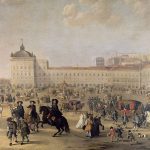
The reconstructed Praça do Comércio, formerly the site of the royal palace, encapsulates this shift. Flanked by arcades and opening directly onto the Tagus, it is both ceremonial and open, both ancient in form and modern in planning. The triumphal Rua Augusta Arch, completed later in the century, crowns the axis with imperial gravitas while adhering to classical motifs—Corinthian columns, allegorical figures, and a restrained palette.
What emerged from the rubble was not only a rebuilt Lisbon, but a physical expression of a state now committed, at least publicly, to reason, utility, and administrative control. Art, in this context, was not peripheral—it was infrastructural.
Academic Painters and Antiquity Reborn
In the visual arts, the Enlightenment reshaped painterly priorities. The Royal Academy of Fine Arts (Academia Real de Belas-Artes), founded in 1836 but with earlier antecedents in Lisbon and Porto, began to train artists in the canons of Greco-Roman antiquity. The emphasis shifted from emotion and mysticism to anatomy, symmetry, and classical narrative. Students copied plaster casts of Roman statuary, read Vitruvius, and internalized the aesthetics of balance and decorum.
One of the leading academic painters of this period was Domingos Sequeira (1768–1837), whose career spanned the waning years of Baroque drama and the rise of Neoclassical sobriety. Trained in Rome, Sequeira mastered both theatrical composition and classical restraint. His works such as Adoração dos Magos (Adoration of the Magi) and A Morte de Camões (The Death of Camões) exemplify a painter at ease with monumental scale, historical gravitas, and idealized form.
What distinguishes Portuguese Neoclassical painting from its French or Italian counterparts is a continued undercurrent of melancholic introspection. Even in scenes of triumph or patriotic fervor, there is often a softness of light, a tonal restraint, an absence of overt triumphalism. The Enlightenment, while embraced institutionally, was tempered emotionally.
Academic painters focused on a hierarchy of genres that privileged:
- History painting, especially classical or national episodes treated with moral seriousness
- Portraiture, often infused with symbolic elements of learning, virtue, or civic identity
- Allegory, in which abstract ideals such as Justice, Commerce, or Patriotism were given classical form
These were not spontaneous works. They were carefully composed arguments in oil.
The Architecture of Rational Empire
Neoclassicism also provided a language for imperial architecture—calm, disciplined, and authoritative. While Portugal’s empire was already in decline by the early 19th century, its architects still sought to project global stability and cultural continuity through classical form. Public buildings—courts, military academies, government ministries—adopted a vocabulary of columns, entablatures, and symmetrical façades that aligned with contemporary French and British models.
One striking example is the Palácio da Ajuda, begun as a royal residence in the late 18th century. Intended to replace the wooden palace destroyed by the 1755 earthquake, it was conceived on a colossal scale in a severe neoclassical style, with monumental porticos and axial plans. Construction was interrupted repeatedly by political turmoil and budgetary constraints, and the building was never completed as planned. Still, its imposing mass and measured rhythm convey a distinct sense of rational order—royalty not as divine spectacle, but as administrative stability.
Elsewhere, the Teatro Nacional de São Carlos, inaugurated in 1793, brought classical grandeur to Lisbon’s cultural life. Modeled after La Scala in Milan, the theater’s interior balanced ornate stucco and gilding with structural clarity. Music, drama, and architecture were integrated into a single Enlightenment experience of moral and aesthetic education.
The Neoclassical movement also left its mark on funerary architecture. Cemeteries such as Prazeres in Lisbon contain mausoleums designed as miniature temples, echoing Roman forms in service of modern memory. Death, too, was given the order and dignity of classical form.
Neoclassicism in Portugal was more than a matter of style—it was a system of thought rendered in line and stone. In the grid of Lisbon’s new streets, in the poise of Sequeira’s figures, in the facades of public monuments, the Enlightenment took visible form. Yet this clarity always bore a shadow. Beneath the measured surfaces and ideal geometries lay a country grappling with loss: of empire, of certainty, of spiritual cohesion. Neoclassicism offered structure—but not resolution.
Romanticism and the Invention of the Portuguese Past
In the 19th century, Portugal began to see its own past not merely as history but as poetry. The Romantic movement, sweeping across Europe in literature, painting, and architecture, arrived in Portugal with a particular urgency. After the Napoleonic invasions, the loss of Brazil in 1822, and the turbulence of civil wars, the country was fractured—politically, spiritually, and emotionally. Romanticism offered a means not only of escape but of reconstruction. It cast medieval castles in golden mist, turned ruins into altars of memory, and transformed the national past into a work of aesthetic fiction. Through brush, chisel, and blueprint, Portugal reimagined itself.
Palácio da Pena and the National Fairy Tale
No monument better embodies Portuguese Romanticism than Palácio da Pena, perched high above Sintra. Completed in the 1850s by King Ferdinand II—himself of German descent—the palace is an orchestrated hallucination. Its towers, domes, battlements, and cloisters seem to have been borrowed from a dream catalog of Iberian history. Manueline, Moorish, Gothic, and even Renaissance motifs appear side by side in unapologetic collage. Here, architecture is not about coherence but about sensation.
Ferdinand, sometimes called “the artist king,” was not just a patron but a Romantic in spirit. He commissioned the palace atop the ruins of an old monastery and filled it with antiques, azulejos, stained glass, and arcane symbols. The surrounding Parque da Pena is a vast landscaped forest filled with exotic trees, winding paths, and scenic overlooks—a botanical imagination made real.
The palace is more than a royal retreat. It is Romantic ideology rendered in stone: nostalgic, eclectic, and designed to provoke wonder. It deliberately blurs fact and fantasy:
- A chapel roofed in medieval fan vaulting, though built in the 19th century
- Faux battlements and drawbridges intended not for defense, but for atmosphere
- Intertwined motifs of Christian chivalry, Templar legends, and maritime grandeur
Pena’s theatricality captured the public imagination. It became a prototype not just for royal architecture but for how the 19th century saw the Middle Ages—not as a period of brutality, but as a source of unity, identity, and lost nobility. The palace turned Portugal’s fractured present into a picturesque myth.
History Painting and the Gothic Revival
Romanticism reshaped painting as well, pulling it away from Neoclassical rationality and toward emotional and national intensity. Portuguese painters turned increasingly to history painting, choosing scenes not from Roman antiquity but from the country’s own medieval and early modern saga: the foundation of the kingdom, the death of Inês de Castro, the voyages of discovery. These were not neutral reconstructions. They were visual epics, designed to stir patriotic feeling and moral reflection.
Domingos Sequeira, though formed in the Neoclassical tradition, evolved toward Romantic sensibility in his later years. His work A Morte de Camões (1825) presents the national poet dying in poverty—a luminous, tragic image of genius unrecognized by its time. The canvas is not about historical accuracy but about emotional resonance. Camões becomes a Christ-like figure of Portuguese soul and sacrifice.
Later artists like Miguel Ângelo Lupi and José Rodrigues painted more intimate and sentimental scenes, but the Gothic Revival reached into sculpture and architecture as well. Monasteries were restored—or reinvented—with pointed arches, stained glass, and medievalizing flourishes. Churches received pseudo-Gothic furniture, and even new civic buildings adopted historical facades meant to recall a lost golden age.
In this, Romanticism was less about reviving the past than about staging it. The Gothic was no longer a historical style—it was a costume for the nation’s anxieties and aspirations.
This nostalgic art often used three devices:
- Ruins, portrayed as melancholic rather than decayed, suggesting lost unity and former glory
- Heroes, idealized to embody virtues of bravery, loyalty, and sacrifice
- Landscape, infused with emotional tone: foggy valleys, stormy coasts, and sunset-soaked battlements
Portugal’s rugged terrain became a mirror of its inner life, its history seen through the lens of sublimity.
Ruins, Landscapes, and Melancholy Nationalism
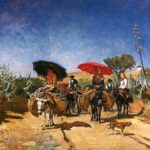
One of Romanticism’s most enduring gifts to Portugal was its transformation of landscape into sentiment. Painters like Carlos Reis and Columbano Bordalo Pinheiro began to treat the Portuguese countryside not merely as backdrop but as subject. Mountain villages, ruined monasteries, overgrown estates, and riverbanks populated by peasants became emblems of a simpler, purer time.
This was not realism. The rural was idealized, often presented through the haze of evening light or the drama of storm clouds. Even Lisbon, in Romantic views, was portrayed not as a modern capital but as a city of domes and decay, towers and memory. The Tejo River—once a highway for empire—became a reflective mirror for poetic longing.
This art was deeply bound to melancholy nationalism: the idea that Portugal’s greatness lay in its past, now lost or endangered. The decline of empire, the instability of liberal politics, and the erosion of traditional life all fed this cultural mood. But the art that emerged from it was not defeatist—it was elegiac. In celebrating what was fading, Romantic artists created a lasting iconography of Portuguese identity.
The tension in this work—between mourning and myth—gave it depth. A ruined convent might evoke both divine mystery and national fragility. A portrait of a medieval king might shine with idealism even as it hinted at obsolescence. Romantic art in Portugal thus became a kind of secular scripture: interpreting the past not to understand it, but to re-enchant the present.
Romanticism in Portugal did not simply embrace the Gothic—it invented it anew. In palaces and paintings, ruins and landscapes, artists forged a visual mythology for a nation searching for continuity in the face of change. The result was an art of longing and light, of beauty touched by sorrow—a mirror in which Portugal saw not just its history, but its soul.
Natural Light: Realism and the Turn Toward the Everyday
As the 19th century waned and the 20th approached, Portuguese artists began to turn their gaze away from castles and crusaders, and toward city streets, village kitchens, and windswept fields. The mythic and melancholic vision of Romanticism gave way to the measured light of Realism—a movement that sought truth in the ordinary, and beauty in the unidealized. This was not a rejection of emotion, but a redirection of it. Painters no longer sought to elevate Portugal through heroic allegory, but to understand it through careful, human observation.
Realism in Portugal did not emerge in rebellion, as it had in France. Instead, it evolved quietly from within Romanticism’s visual discipline. The same artists who had painted historical dramas and pastoral dreams began to explore domestic scenes, natural light, and social nuance. The shift was not abrupt, but it was profound.
The Lisbon School and Peasant Life
In the last decades of the 19th century, a loosely associated group of painters known as the Lisbon School—among them Columbano Bordalo Pinheiro, José Malhoa, and Carlos Reis—began to focus on portraiture, interiors, and rural scenes with an emphasis on character, light, and emotional understatement. These artists were not avant-garde in the Parisian sense. They remained tied to the academy and often aligned with public institutions. But their subjects marked a clear break from national mythmaking.
One of the most beloved examples of this shift is José Malhoa’s O Fado (1910), a large-scale oil painting that depicts a working-class Lisbon couple in a dimly lit tavern, as the woman sings Portugal’s most famous melancholic genre. The composition is direct: the singer leans into the song, her companion smokes in silhouette, the table littered with bottles. But what makes the painting quietly radical is its dignity. There is no caricature, no moralism—only presence.
Malhoa, who also painted peasants at prayer, women at work, and children at play, understood that realism was not a matter of aesthetic restraint alone. It was an ethics of attention. His canvases glow not with sentiment but with a kind of visual empathy—each figure held in balance between individuality and type.
Likewise, Carlos Reis brought a luminous sensitivity to landscapes and domestic interiors. His scenes of mothers and children, often painted in soft natural light, avoid both idealization and despair. They are quiet observations of human closeness, grounded in specific, recognizable Portuguese settings—embroidered linen, tiled kitchens, sunlit doorways.
This generation brought forward several recurring motifs:
- Peasant rituals—not staged for nostalgia, but observed as living culture
- Urban workers, often women, captured in intimate moments of rest or reflection
- Natural light, used to define volume, emotion, and time without theatrics
The result was a new kind of national portrait: modest, attentive, rooted in daily life.
Silva Porto and the Plein Air Instinct
Alongside this human-centered realism, another current developed—one more focused on landscape, atmosphere, and the open air. Its leading figure was António Carvalho da Silva Porto (1850–1893), often credited with introducing plein air painting to Portugal after studying in France and Italy. Deeply influenced by the Barbizon School, Silva Porto sought to capture nature directly, painting outdoors with fluid brushwork, warm palettes, and a focus on light and weather.
His works—sun-dappled hillsides, sheep herders, haystacks, and orchards—are striking not for their subjects, which are modest, but for their immediacy. In Saída da Missa em Barqueiros (Leaving Mass in Barqueiros), he captures a moment of rural procession without pomp: villagers walk home in Sunday clothes under a gauzy sky, their figures balanced between shadow and reflection.
Silva Porto’s landscapes are grounded in geography. He paints the cork oaks of Alentejo, the riverbanks of Douro, the rural textures of Trás-os-Montes. His brush is not sentimental—it is descriptive, engaged. In this way, he helped recalibrate the role of landscape in Portuguese painting: not as backdrop, but as bearer of mood, season, and place.
Other plein air painters followed suit, especially in the north. The Grupo do Leão, founded in the 1880s, brought together artists and intellectuals who aimed to paint the Portuguese world as they saw it, with immediacy and respect. Their motto was neither revolutionary nor nostalgic—it was observational.
This landscape realism accomplished three key shifts:
- It relocated artistic value from cities to countryside, without idealizing rural poverty
- It introduced weather and seasonality as central to composition
- It emphasized local color—olive greens, ochres, soft blue shadows unique to Portugal
What they created was not the drama of nature, but its calm, persistent presence.
Urban Interiors and Bourgeois Truth
As cities modernized, realism moved indoors. Portuguese painters began to depict the interior lives of the bourgeoisie, often with subtle critique or psychological depth. These were not moral tales. They were studies of mood, silence, and private tension.
Columbano Bordalo Pinheiro, perhaps the most complex realist of the group, painted many of Portugal’s intellectuals, writers, and politicians. His portraits are psychologically charged, often darkly lit, with subjects turned inward or half-obscured. Retrato de Antero de Quental, his portrait of the suicidal poet-philosopher, is less a likeness than an atmosphere—a brooding meditation on thought, faith, and national doubt.
Columbano’s interiors, like O Grupo do Leão or Retrato de Família, combine Flemish discipline with a modern understanding of emotional ambiguity. The figures are still, often unsmiling, surrounded by heavy curtains, oil lamps, and thick silence. Yet within these compositions, tension pulses: between youth and age, light and enclosure, presence and absence.
Realist interiors in this period also captured the transformation of the Portuguese middle class—their customs, rooms, and values. Artists painted women reading, children studying, men at solitary meals. The walls are filled with small paintings, the tables with lace and porcelain. It is a world of quiet ritual, often tinged with solitude.
Realism in Portugal was neither manifesto nor rupture. It was a shift in gaze—from myth to presence, from heroism to habit. Whether outdoors among sheepfolds or indoors beneath lampshades, Portuguese artists of the late 19th and early 20th centuries found a new visual idiom: calm, grounded, quietly luminous. Their work offered no grand answers—only close looking, and in that, a deeper kind of faith.
Modernism and the Avant-Garde in Iberia
Modernism entered Portuguese art like a wave that did not break all at once. It came in pulses—first as aesthetic experimentation, then as provocation, and finally as ideology. In contrast to the sweeping manifestos and political insurgencies of modernist movements in France, Italy, and Russia, Portuguese modernism was more fragmented, its gestures often isolated or under-recognized in their time. Yet its best moments rival any in Europe for boldness and originality. Emerging from a country that was still rural, hierarchical, and increasingly authoritarian, Portuguese modernists produced a body of work that combined deep personal intensity with radical formal innovation.
Modernism in Portugal was not imported wholesale. It was seized, dismembered, and remade. Its contradictions—cosmopolitan but peripheral, mystical but machine-obsessed, lyrical yet violently abstract—reflected the fault lines of a nation poised between old and new worlds.
Amadeo de Souza-Cardoso: Cubism’s Portuguese Rebel
The most explosive figure in early Portuguese modernism is Amadeo de Souza-Cardoso (1887–1918). A painter of vast ambition and unpredictable style, Amadeo moved to Paris in 1906, immersing himself in the city’s avant-garde just as Cubism, Futurism, and Orphism were beginning to fracture traditional representation. He met Modigliani, Brancusi, and Apollinaire, exhibited alongside Picasso and Duchamp, and contributed to the storied Armory Show in New York in 1913.
But Amadeo was no follower. His work is distinguished by its refusal to settle into any single style. His paintings from the 1910s—K4: O Quadrado Azul, Autoportrait, Canção Popular—combine Cubist fragmentation with luminous color, dynamic rhythm, and personal symbolism. They draw equally from Portuguese folk art, Eastern miniatures, Iberian Romanesque sculpture, and modern design. If Picasso deconstructed the human form, Amadeo deconstructed aesthetic lineage itself.
Amadeo’s approach was not analytic but volcanic. His canvases pulse with nervous energy—arrows, spirals, letters, and faces erupt from fractured planes. He painted the dynamism of cities, the pulse of machines, but also the metaphysics of rural Portugal: roosters, saints, carnival masks.
Three qualities make Amadeo’s modernism uniquely Portuguese:
- His use of color as structure, not surface—vibrant, aggressive, Iberian hues
- His embrace of spiritual and folkloric symbols within modernist abstraction
- His refusal to subordinate art to ideology or movement—each work a world unto itself
His death at age 30 from the Spanish flu was a cultural catastrophe. Cut off before full maturity, Amadeo became more legend than legacy—an almost mythic first star of Portuguese modernism, whose work remained under-recognized for decades outside of Portugal.
Almada Negreiros and the Orpheu Circle
While Amadeo painted, others wrote—and drew, designed, declaimed. The Orpheu group, founded in 1915, marked a critical moment of Portuguese avant-garde self-consciousness. More than a magazine, Orpheu was a convulsive gesture: brief, explosive, and scandalous. Only two issues were published, but their impact was seismic.
At the center stood Almada Negreiros (1893–1970), a polymath who wrote manifestos, painted murals, choreographed performances, and embraced modernism with theatrical verve. Tall, angular, and charismatic, Almada was modernism personified—irreverent, polemical, obsessed with new forms. He famously declared, “I belong to a generation that squandered its youth with nothing to show for it—but that youth was the most fertile ever.”
His drawings and paintings—like A Dança da Lili, Auto-Retrato com Gato, and Pintura em Movimento—blend Futurist dynamism, symbolist fantasy, and Portuguese mysticism. Trained in design as much as in fine art, Almada had an instinct for surface and stylization. His work draws from Art Deco, African sculpture, and Iberian geometry—but always filters them through a uniquely personal lexicon.
Almada’s texts—manifestos like Ultimatum Futurista—rejected nostalgia and provincialism. He imagined a Portugal that would not copy Paris or London, but forge its own avant-garde in dialogue with classical legacy and national idiosyncrasy. At the same time, he reveled in contradictions:
- A modernist who invoked medieval iconography
- A provocateur who adored mathematical harmony
- A futurist who quoted Camões and Gil Vicente
Almada helped design Lisbon’s visual culture—murals, posters, public art—but remained an outsider. He was too erratic for the academy, too patriotic for the radicals, too self-invented for the state. Yet his influence would ripple across generations.
Futurism, Muralism, and the Machine Age
Portuguese modernism never cohered into a single school. Instead, it produced fragmented avant-gardes, often regional, often multidisciplinary. In Porto, artists like Eduardo Viana and Guilherme Santa-Rita explored variations of Orphism and Delaunay-style abstraction. In Lisbon, others turned to Futurism and Constructivism, merging machine aesthetics with spiritual longing.
Some found patronage in state institutions; others were confined to cafés and private salons. Muralism, in particular, emerged as a powerful form—public, modern, and accessible. While often associated with propaganda elsewhere, in Portugal it became a means of fusing architecture, painting, and social narrative. Almada’s later murals in Lisbon’s Gare Marítima de Alcântara and Gare Marítima de Rocha Conde de Óbidos are explosive, geometric, and mythic—depicting Portugal’s maritime history through a modernist idiom that fuses abstraction and narrative.
A notable paradox: Portuguese artists embraced technological forms—trains, ships, radios, electric lines—while working in a country that remained deeply agrarian and economically fragile. This gave their work a surreal edge. The machine did not symbolize utopia. It was a mask, a mirage, or a lure.
By the 1930s, modernist painting had fractured into multiple responses:
- Abstraction, seen in the early experiments of António Dacosta and Maria Helena Vieira da Silva
- Social realism, adopted by artists aligned with emerging leftist politics
- Mystical-symbolist currents, where geometry merged with alchemy, especially in Almada’s mature work
Modernism in Portugal remained a visual dialect, not a national consensus. Its artists were often in exile—socially, politically, or intellectually.
The Portuguese avant-garde was never defined by schools or manifestos. It was defined by singularities: Amadeo’s eruptive canvases, Almada’s total vision, the Orpheu group’s ephemeral spark. It was fractured, impure, interrupted—but also uniquely alive. In a country at the margins of European modernity, these artists saw not isolation, but possibility. They turned Iberian myth, Catholic ritual, maritime legacy, and Parisian form into a language all their own—wild, luminous, unsummarizable.
Salazar’s Shadow: Art Under Dictatorship
For nearly half of the 20th century, Portuguese art unfolded beneath the long and heavy shadow of authoritarianism. António de Oliveira Salazar, who ruled Portugal from 1932 to 1968 under the Estado Novo (New State), presided over a regime that imposed strict ideological conformity, enforced censorship, and treated culture as an instrument of national mythology. In such a climate, art could become many things: a servant of the regime, a covert act of resistance, a retreat into private formalism, or a silent witness. The period did not lack for creativity, but its terms were defined not by artistic innovation alone, but by the limits—visible and invisible—within which it was allowed to operate.
The result was a complex and sometimes contradictory artistic landscape, in which traditional forms were elevated to propaganda, modernism was suppressed or domesticated, and realism became either a tool of moral didacticism or a vehicle for veiled protest.
Censorship, Conformity, and Quiet Resistance
Salazar’s Estado Novo was an authoritarian regime rooted in Catholic conservatism, ruralism, and anti-modernity. It promoted a vision of Portugal as an eternal, orderly, God-fearing nation defined by family, tradition, and empire. Art that deviated from these ideals—particularly if it was abstract, satirical, political, or socially critical—was likely to be censored, discouraged, or denied state support.
Official exhibitions, academic appointments, and public commissions all came under the influence of cultural watchdogs such as Secretariado da Propaganda Nacional (National Propaganda Secretariat, later renamed Secretariado Nacional de Informação). Though direct bans were not always frequent, a more insidious form of self-censorship took hold: artists learned what could be said and, more importantly, what could not.
But even within these constraints, resistance surfaced—sometimes in plain sight. Painters such as Júlio Pomar, Carlos Botelho, and Marcelino Vespeira created works that navigated the narrow passage between public acceptability and private defiance. Pomar, for example, began as a neo-realist committed to social themes—rural poverty, working-class life—but was repeatedly targeted by censors. After his arrest in 1947 for political activity, he shifted toward semi-abstraction and allegorical figuration, adopting a more coded visual language.
Botelho, whose long-running series of Lisbon cityscapes evolved over decades, used the genre of urban observation to suggest something more ominous: a city frozen in routine, its vibrancy quietly suppressed. His lines became heavier, his figures more withdrawn, as the political chill deepened.
Many artists took refuge in metaphor, allegory, and form:
- Clouded or distorted faces to suggest repression of identity
- Empty streets and desaturated palettes to reflect psychological or political silence
- Fragmentation and dislocation as visual equivalents of ideological confinement
These were not manifestos. They were acts of survival and subversion through visual grammar.
The Estado Novo’s Monumental Aesthetic
While modernism struggled under suspicion, the Estado Novo promoted its own aesthetic—monumental, didactic, and steeped in historical symbolism. Public art was harnessed to support the regime’s ideological pillars: God, Nation, and Empire. Murals, sculptures, and architectural reliefs were commissioned to adorn state buildings, celebrate colonial exploits, and affirm a vision of social harmony rooted in hierarchy.
Architecture became a major vector for this messaging. The regime favored a stripped-down classical revivalism, often termed “Portuguese Suave” or “Soft Portuguese Style”—a hybrid of neoclassical symmetry, Mediterranean vernacular, and authoritarian scale. Structures such as the Instituto Superior Técnico in Lisbon or the Palácio da Justiça in Coimbra combined clean facades with monumental staircases, arcades, and state emblems. The point was clarity, order, permanence.
Public monuments became frozen sermons. The Padrão dos Descobrimentos (Monument to the Discoveries), unveiled in 1960 to mark the 500th anniversary of Prince Henry the Navigator’s death, idealized the Age of Exploration as the moral center of Portuguese history. Thirty-three figures—kings, saints, explorers—march forward in heroic unity, their faces emotionless, their bodies aligned with imperial purpose. It is a striking sculpture, but also a blunt tool of historical whitewashing. There is no room in its granite for ambiguity, suffering, or doubt.
Visual culture under Salazar thus offered a tightly curated version of Portuguese identity—rural, devout, orderly, paternal. Artists who accepted these terms often found success and official commissions. Those who questioned them faced marginalization.
But even within this visual orthodoxy, anomalies surfaced. Almada Negreiros, though aligned at times with the regime, created geometric murals of mysterious abstraction in the maritime stations of Lisbon—works that seem, in retrospect, to exceed the limits of their commission.
And some art simply avoided politics altogether. Maria Helena Vieira da Silva, working largely in exile in Paris, developed an abstract style based on labyrinthine grids and spatial metaphors. Her work was neither protest nor propaganda—it was cosmopolitan, interior, and formally ambitious, and thus largely outside the control of the regime.
Neo-Realism and the Artists Who Watched
One of the most significant artistic movements to emerge in mid-century Portugal was Neo-Realism, a current that sought to reengage with social and political life through representational art. Though associated more closely with literature and cinema, it also shaped painting, photography, and illustration.
Neo-Realist painters focused on the working class, rural hardship, and the small-scale tragedies of everyday life under dictatorship. Their aesthetic avoided Baroque excess or avant-garde dislocation. It was grounded, somber, often monochromatic. Júlio Pomar, Rogério Ribeiro, and Manuel Ribeiro de Pavia produced scenes of workers, fishermen, and mothers that aimed to affirm dignity without sentimentality.
What gave Neo-Realist art its quiet power was its attention to:
- Physical labor—hands, tools, sweat—as a form of moral presence
- Stasis, rather than drama, to convey systemic stagnation
- Muted expressiveness that refused both despair and celebration
While many Neo-Realist artists were politically engaged, their art was more concerned with witness than with agitation. It did not scream. It endured.
As Salazar aged and his grip tightened, a younger generation of artists grew increasingly restless. In the 1960s, experimentalism, pop art, and conceptualism began to surface in academic and underground circles, signaling a shift too broad for the regime to contain. Painters such as António Palolo and Eduardo Batarda would carry this forward in the years immediately before and after the revolution.
Art under Salazar was a terrain of constraint, compromise, and quiet defiance. It rarely exploded, but it endured—through metaphor, through silence, through the very choice to keep looking and painting. For every monument to myth, there were sketches in drawers, whispered exhibitions, and gazes that refused to look away. It is in those margins—not in the proclamations—that the visual truth of this era can still be found.
The Carnation Revolution and the Collapse of Icons
In the early hours of April 25, 1974, tanks rolled through the streets of Lisbon as junior military officers deposed Portugal’s nearly 50-year-old dictatorship without firing a shot. Soldiers placed carnations in the barrels of their rifles; crowds surged into public squares singing revolutionary songs. The Carnation Revolution, bloodless in name and nearly so in fact, marked not only the end of Salazar’s Estado Novo regime, but the sudden birth of modern Portugal. For artists, this was not merely a political change. It was a collapse—of constraints, of hierarchies, of silence—and with it came a rush of expression that had long been held back by fear, censorship, and institutional inertia.
Art was no longer background or adornment. It became declaration, protest, pedagogy, and celebration. In the weeks and months that followed, walls became canvases, streets became theaters, and a generation of artists emerged from the shadows of repression into a new, turbulent light.
Murals, Protest Art, and Democratic Imagination
Almost immediately after the revolution, political murals sprang up across Portuguese cities, especially in working-class neighborhoods, factories, and rural communes. Influenced by Mexican muralism, Soviet poster design, and local traditions of folk decoration, these paintings were not the work of elite artists alone. They were collective, rapid, and often anonymous. Their purpose was not permanence but presence: to claim walls for the people, to turn public space into a forum of memory and hope.
The walls of Lisbon’s Alfama and Porto’s Campanhã became saturated with images: clenched fists, olive branches, tractors, women with raised arms, red stars, and doves. The style was accessible, graphic, and emotionally direct. Many murals were created by artist-activists from the MRPP (Marxist-Leninist groups), neighborhood associations, or unions. In some towns, entire building facades became visual manifestos for agrarian reform or workers’ rights.
This burst of muralism had several key characteristics:
- Direct symbolism: icons easily legible to a newly literate population
- Public authorship: murals signed by collectives, not individuals
- Ephemerality: walls painted over and over again, reflecting ongoing political struggle
While some conservative critics dismissed these works as propaganda, their deeper value lay in their role as acts of ownership—the reclaiming of visual space after decades in which art had either served the regime or stayed silent.
Simultaneously, poster art exploded. Hand-silkscreened prints, often made in university print shops or activist studios, promoted rallies, strikes, literacy campaigns, and women’s rights. The poster became both a weapon and a pedagogy, turning utility into aesthetic energy.
The Return of the Exiles
As the dictatorship collapsed, a generation of artists, writers, and intellectuals—many of whom had spent decades in exile or marginalization—returned to Portugal. Their reentry was not only physical but ideological. They brought with them new styles, techniques, and frameworks that had been absent from the official art scene: conceptualism, pop art, performance, and non-objective abstraction.
Among the most important was Maria Helena Vieira da Silva, who had worked in Paris for decades, achieving international acclaim. Though her abstract work was never directly political, its return to Portuguese galleries after the revolution signaled a reconnection with the broader currents of European modernism. Her spatial matrices—layered, luminous, and mentally architectural—offered a counterpoint to the immediacy of revolutionary murals, speaking instead to deeper forms of memory and perception.
Other returning or newly emboldened artists included:
- Julião Sarmento, who brought conceptualism, text, and eroticism into dialogue with performance and installation
- Álvaro Lapa, a painter-philosopher whose cryptic, often word-based compositions resisted categorization
- Helena Almeida, who used her own body as both subject and medium, photographing herself interacting with painted forms and spaces—an audacious feminist gesture in a still-conservative society
These artists refused to be defined by the binary of regime vs. resistance. Their work was formal, critical, sometimes opaque—insisting that freedom also meant ambiguity, difficulty, and self-interrogation.
A crucial shift occurred here: art began to split between mass political communication (murals, posters, agitprop theater) and elite experimentation (conceptualism, abstraction, performance). This tension would define Portuguese art for decades to come, sometimes productively, sometimes divisively.
Architecture for the People
The revolution also transformed architecture—not immediately, but decisively. The Estado Novo’s monumental classicism was rejected in favor of participatory design, social housing, and the reactivation of vernacular traditions. Younger architects sought to reconcile modernist ideals with local materials and human scale. They wanted buildings that served communities, not power.
Siza Vieira, then in his early forties, emerged as the most influential figure in this new architectural landscape. His Bouça Housing Complex in Porto, designed in the mid-1970s but delayed and later completed, became emblematic of this ethos: clean lines, modular units, integrated public space, and respect for both context and climate. It was neither utopian nor nostalgic. It was precise, humane, and economical.
Siza’s early public projects—often small clinics, schools, or social housing—embodied a post-revolutionary desire to rebuild society from the bottom up, using architecture as a civic tool rather than a symbolic monument. His style, often described as “poetic modernism,” bridged austerity with warmth.
Elsewhere, self-built housing initiatives—legalized after the revolution—allowed working-class communities to claim space and experiment with form. These ad-hoc constructions, sometimes chaotic, sometimes ingenious, represented a radical democratization of design.
By the early 1980s, three architectural currents had emerged:
- Institutional modernism, informed by global trends but focused on public good
- Critical regionalism, which reengaged with Portugal’s diverse landscapes and building traditions
- Grassroots construction, reflecting immediate social need over aesthetic coherence
In all of them, the ghost of Estado Novo’s sterile grandeur was decisively exorcised.
The Carnation Revolution did not produce a singular artistic style. It produced a rupture—a generative chaos in which every assumption could be questioned, every image repurposed. The streets filled with murals, the galleries opened to exile, and architecture turned toward the everyday. What mattered most in those years was not harmony but possibility. In the shattered frame of a dictatorship, Portugal’s artists found not rubble but a field in which to build anew.
Portugal Now: Contemporary Art and the Post-Imperial Eye
In the decades following the Carnation Revolution, Portuguese art has moved into a phase of remarkable autonomy—no longer under the direct shadow of dictatorship, nor beholden to imported movements. Today, its most compelling artists work with full access to the international art world, but their primary conversation is often inward: with Portuguese history, architecture, regional identity, and memory. This is not a turn away from global relevance. It is a grounded re-engagement with national meaning, carried out through mediums that include installation, painting, photography, sculpture, and architecture.
In the process, the country’s visual culture has become richer, more layered, and more confident. Lisbon and Porto are no longer provincial outposts but fully developed cultural capitals. Yet the most thoughtful artists of the present moment resist spectacle and fashion. Their work is slow, material, and locally attentive—aware of Portugal’s past and measured in how it steps forward.
The Weight of History in a Contemporary Vocabulary
One of the defining traits of current Portuguese art is its deep attention to history—not as ideology, but as lived material. Artists such as Rui Chafes, Pedro Calapez, and Nuno Cera explore abstraction, form, and spatial presence with a seriousness that recalls the country’s longstanding dialogue between sacred architecture and philosophical interiority.
Rui Chafes, born in Lisbon in 1966, works almost exclusively in black iron, forging smooth, elongated forms that evoke religious relics, monastic implements, or abstract altarpieces. Installed in cloisters, forests, or bare white galleries, his sculptures suggest silence, weight, and devotion—without ever depicting a single figure. His work stands in conversation not with passing trends, but with stone, gravity, and the metaphysical atmosphere that permeates Portuguese sacred space.
Pedro Calapez, a generation older, continues to develop a form of painting that borders on architectural thinking. His panels are constructed as spatial objects, layered in fields of color, partial gestures, and surfaces that feel weathered or rubbed down—never decorative, always grounded. His work speaks to the landscape not by depicting it, but by enacting its textures and rhythms.
For younger artists like Nuno Cera, photography and video become tools for observing Portugal’s evolving urban and architectural environments. His images of modern housing developments, decaying factories, and emptied interior spaces offer a kind of secular archaeology—showing how form carries memory even when the human presence has receded.
These artists share several qualities that distinguish the best of Portuguese contemporary practice:
- A restraint of means, favoring material integrity and formal clarity
- A commitment to place, working with Portuguese sites, light, and spatial logic
- A philosophical tone, where beauty is often bound to reflection, not display
This is not conceptualism for its own sake. It is an art of thought embodied in form.
Painting, Architecture, and the Art of Measured Change
Despite the rise of new media, painting remains central in Portuguese contemporary art. Artists like Julião Sarmento (until his death in 2021), Manuel Casimiro, and Ana Vidigal have carried the medium forward in radically different ways.
Sarmento merged painting with photography, video, and text, creating a spare, elegant language of absence and fragmentation. His work often alluded to architecture, memory, and emotional withholding—Portuguese in tone even when international in reference. Manuel Casimiro, on the other hand, reworks the form of the frame itself, painting baroque ornamental borders around minimalist fields, subtly probing the limits of tradition and rupture.
Architecture continues to exert a quiet but commanding presence in contemporary art discourse. Eduardo Souto de Moura, Siza Vieira, and younger architects such as Francisco Aires Mateus have brought global attention to Portugal’s unique blend of modernism and regionalism. Their buildings—spare, luminous, and tactile—carry forward the post-revolutionary ethos of clarity and public responsibility, but now with an additional layer of refinement and abstraction.
Many of these architects work closely with artists, commissioning site-specific works or designing exhibition spaces that complement a restrained visual culture. This integration between disciplines reflects a national instinct: to seek synthesis rather than collision, to prize continuity over rupture.
Lisbon’s art schools, such as Faculdade de Belas-Artes and Ar.Co, continue to produce painters, sculptors, and printmakers rooted in strong technical traditions. Even artists who explore experimental formats often retain a respect for composition, draftsmanship, and material craft.
Institutional Support and the Return to Craft
Portugal’s contemporary art infrastructure has grown significantly in recent years, not only through private collections and galleries, but through public institutions committed to Portuguese work. The Museu Nacional de Arte Contemporânea – Museu do Chiado and the Museu de Serralves in Porto now provide serious, sustained platforms for native artists across generations.
Within this context, a return to craft and place-specific practice has emerged—not as nostalgia, but as a measured alternative to international trend-chasing. Ceramics, woodwork, stone, and textile—once dismissed as “applied arts”—are now re-entering serious artistic discourse, often in rural contexts.
In the Alentejo and the interior north, artists are establishing small workshops and collaborative studios that draw on regional materials and local traditions of making. These are not retreats from modernity, but extensions of it: grounding contemporary thought in a specific place and climate, rather than in a generic globalism.
This resurgence in site-based practice brings with it several key tendencies:
- A return to slowness, privileging long-term engagement over spectacle
- A revival of manual skill, rooted in national material traditions
- An ethos of continuity, where the past is not repudiated, but reinterpreted
In this way, Portugal’s newest art is also its oldest: attentive to land, matter, and time.
Portugal’s contemporary art is not caught between the past and the future. It threads them. What emerges is a mature, grounded, and evolving visual culture—serious in tone, unafraid of quiet, and deeply conscious of what has come before. It no longer needs to announce its identity. It builds it, slowly, in iron and pigment, light and shadow, with the patience of a country that knows how to wait—and how to last.