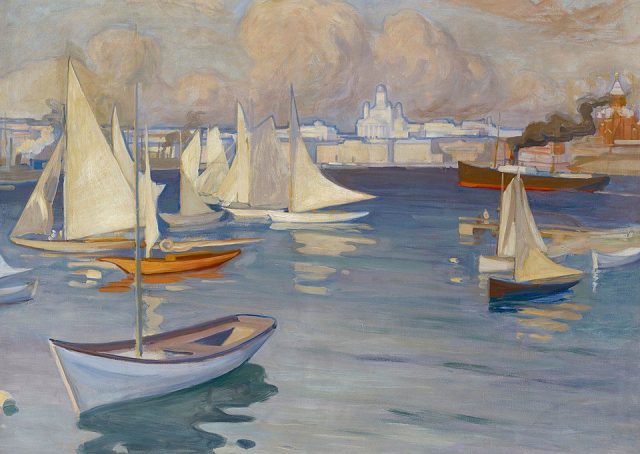
The earliest human lives around what would become Helsinki unfolded in a landscape that barely resembles the modern capital—both in form and in scale. The Baltic Sea was a colder, more erratic force. The land itself was still rising, recovering from the weight of Ice Age glaciers, shifting shorelines by hundreds of meters over centuries. In this changing geography, long before any city walls or harbors, scattered groups of hunters, fishers, and gatherers moved through a coastal mosaic of islands, inlets, and thick forests. The prehistory of Helsinki is a ghost architecture—preserved not in buildings, but in bones, stones, and the ancient shape of the ground.
Stone Age hunters and shoreline shifts
The earliest known settlements in the region date back to roughly 7000 BC, during the Mesolithic period. At that time, the area was still rebounding from the last Ice Age. As the glaciers receded, they left behind vast ridges of moraine, low-lying wetlands, and a rising sea—the Ancylus Lake and later the Littorina Sea. These early humans did not “settle” in the later sense, but moved seasonally along the shores, following seals, fish migrations, and the rhythms of the forest. Archeological finds from Herttoniemi, Malmi, and Vantaa’s environs include stone axes, quartz tools, and hearths—small, direct evidence of a mobile, tool-making population that had no concept of Finland or Helsinki but shaped the land with every firepit and fishtrap.
Unlike many European capitals, Helsinki’s prehistory has no known monumental burials or vast stone architecture. Instead, it offers a subtler archaeological texture: arrowheads pressed into the soil of current suburbs, and shards of pottery in sand ridges that were once archipelagos. The sea’s retreat created new land year by year. Today’s city center would have been underwater; the prehistoric coast ran several kilometers inland from the modern shoreline.
Three distinctive elements shaped this early life:
- Land uplift: The post-glacial rebound created a shifting environment, with new shorelines appearing within human lifespans, constantly redrawing territory and access to marine resources.
- Quartz culture: Many tools were made from local quartz rather than imported flint, revealing both resourcefulness and regional specificity in the hunter-gatherer technology.
- Animal-driven subsistence: Bones of seals, pike, elk, and beaver suggest a reliance on both land and aquatic game, with no evidence of agriculture or animal domestication before 2000 BC.
Bronze Age cairns and early trade traces
By the Bronze Age (roughly 1500–500 BC), burial practices had begun to shift toward more permanent expressions. On coastal ridges and island hilltops around the Gulf of Finland, stone burial cairns—called Hiidenkiukaat in Finnish—emerged as markers of a new worldview. These structures, visible even today in places like Lauttasaari and Espoo, suggest both continuity and change. The people who built them were still embedded in a hunter-fisher economy, but they had begun to invest labor in monuments that connected land, lineage, and death.
There is also evidence that the Helsinki region, despite its peripheral geography, was lightly touched by broader Baltic trade networks. Small bronze objects—axes, pins, and beads—occasionally appear in local burial sites. While Finland had no native bronze resources, its inhabitants bartered for goods and metals that passed through a Nordic and continental exchange system stretching from Sweden to what is now Russia. The Gulf of Finland was not a barrier but a corridor, and these early trade routes would later define the economic and strategic logic for cities like Helsinki and Tallinn.
The material culture remains limited, but even its absences are telling. No large Bronze Age settlements have been found in the Helsinki region; instead, small family units appear to have occupied forest clearings and water edges, living in semi-permanent huts or lean-tos. Their stories are legible only in indirect signs: a crushed burial urn near Tuomarinkylä, or a polished amber bead in Viikki.
Swamp, forest, and the Baltic rhythm of life
The Iron Age (500 BC–1200 AD) saw the gradual coalescence of more stable communities across southern Finland, but the area around modern Helsinki remained sparse and peripheral. To the west, the regions around Lohja and Salo show denser habitation and agricultural traces. To the east, river routes toward Lake Saimaa and Karelia became conduits for cultural transmission, including the eventual adoption of iron tools and weapons.
Helsinki’s future peninsula remained a kind of wilderness margin—valuable for hunting, fishing, and strategic vantage, but unsuited to the early field-based agriculture developing in more protected inland valleys. The region’s dominant natural features—dense forest, rocky outcrops, and wet, peaty lowlands—made it both resource-rich and settlement-poor.
And yet, by the turn of the second millennium, signs of permanent presence begin to mount. Burial finds at Malmi and Tikkurila suggest growing regional importance. In nearby Vantaa, the medieval trading post of Helsinge (later Vanhankaupunginlahti, or “Old Town Bay”) developed as a proto-settlement with links to inland and coastal routes. Here, the long arc of prehistory bends toward the urban. The names survive: “Helsinge” may derive from settlers from Hälsingland, Sweden—a linguistic clue to the region’s growing integration into the Scandinavian orbit, even before the city of Helsinki was officially founded.
One quiet irony: the very marginality of the area in early centuries preserved much of its ancient ecological logic. The fragmented coastline, unpredictable rivers, and uncooperative soils kept large-scale colonization at bay for centuries. This allowed an unusual continuity between prehistory and early modernity, with reindeer paths becoming wagon tracks and eventually tram lines—but only after millennia of patient, invisible shaping by stone tools and footpaths.
The Helsinki that would eventually rise from these marshes and ridges bore no trace of prehistoric grandeur. It lacked Rome’s ruins or Paris’s medieval walls. But in its shallow soil and buried layers, the evidence of ten thousand years of quiet human persistence lies just below the tram rails. Even before its name, the place had a rhythm—and that rhythm was coastal, mutable, and slow.
A Town of Timber and Tension: Helsinki’s Swedish Founding (1550–1809)
Helsinki did not grow organically from a central crossroads or river valley. It was imposed—declared into being by royal command, relocated at least once, and repeatedly threatened by fire, frost, and foreign guns. Unlike older European cities rooted in religious or commercial tradition, Helsinki was a political tool. Sweden founded it not to celebrate culture or consolidate native power, but to steal trade. Its early centuries were defined by instability and artifice, shaped more by imperial anxiety than by local demand. It was a city built with an eye on Tallinn, a capital that began as a counterweight.
A forced city for Baltic trade
The Swedish king Gustav I—more widely known as Gustav Vasa—issued the decree founding Helsinki on June 12, 1550. He ordered the relocation of merchants from various inland towns (notably Porvoo, Rauma, and Ulvila) to a new settlement at the mouth of the Vantaa River, where it spilled into the Gulf of Finland. The king’s aim was straightforward: to break the Hanseatic League’s monopoly on trade in the region and to compete directly with Reval (modern-day Tallinn), then a major port under Danish and German influence.
But forced cities rarely thrive. The merchants brought to Helsinki did not come willingly, and many tried to return to their original homes. The location—known as Vanhankaupunginlahti (Old Town Bay)—was shallow, boggy, and icebound for much of the year. It lacked a natural harbor, had poor road access inland, and suffered repeated outbreaks of disease. By the end of the 16th century, the new town had fewer than 500 inhabitants and was viewed by many Swedes as a failed experiment. Even its name—Helsingfors in Swedish—was a borrowed one, taken from the nearby Helsingeby farms and the rapids (fors) in the river.
And yet, despite these setbacks, Helsinki persisted. Not because it flourished, but because Sweden needed it to exist. It became a symbol of imperial presence at the Baltic’s edge, its failure tolerated for strategic reasons. The town limped into the 17th century with timber houses, muddy lanes, and a tenuous identity as both a trading post and garrison outpost.
The curse of poor location
By the early 1600s, Helsinki’s unsuitability as a port became undeniable. Ice choked the bay for months, and merchant ships struggled to anchor near the shore. In response, the town was moved. In 1640, under the direction of Swedish authorities, Helsinki was relocated a few kilometers south to its current site on the Vironniemi peninsula—closer to deeper water, better access to shipping lanes, and greater potential for long-term development.
The relocation did improve harbor conditions, but it did not bring immediate prosperity. The city remained small and strategically vulnerable. In 1710, during the Great Northern War, a plague epidemic—possibly carried by retreating Swedish troops—killed over half the population. Then, in 1713, Russian forces captured and burned Helsinki. The entire city was razed, and its inhabitants fled inland or perished. The following decades were punctuated by cycles of rebuilding and renewed destruction. When Russian troops returned during the Russo-Swedish War of 1741–43, they again sacked the city, underscoring its exposed position on the empire’s flank.
Three material vulnerabilities haunted the Swedish Helsinki:
- Wooden construction: The city’s buildings were mostly made of timber, making it vulnerable to fire and bombardment. Entire blocks were repeatedly consumed by flames.
- Lack of walls: Unlike Tallinn, Helsinki never developed substantial medieval fortifications. Its defense was largely improvised, relying on earthworks and temporary batteries.
- Weak urban institutions: Governance remained fragile, with town councils dominated by Swedish officials with little local autonomy or cultural continuity.
The city’s turning point came not from within, but from an island off its coast.
Swedish military priorities shape a town
In 1748, construction began on Suomenlinna (originally Sveaborg in Swedish), a vast maritime fortress built across six linked islands just outside the Helsinki harbor. Designed by Swedish engineer Augustin Ehrensvärd, Suomenlinna was part of a broader defensive strategy against growing Russian influence in the Baltic. Unlike the city proper, the fortress was built in stone, with sophisticated bastions, dry docks, and gun batteries—a massive investment that changed Helsinki’s role in the Swedish empire.
The fortress gave Helsinki something it had never possessed before: military gravity. Thousands of soldiers, builders, and administrators flooded into the area. Naval shipyards grew. Civilian populations stabilized to support the garrison. For the first time, Helsinki began to develop a semi-permanent identity—not as a commercial capital, but as a martial colony.
Suomenlinna was never tested on the scale it was built for. During the Finnish War of 1808–09, the Russian Empire again invaded Finland. This time, the fortress surrendered after minimal fighting—its massive walls offering no protection against political collapse. The fall of Sveaborg (as it was still known then) stunned Sweden and helped precipitate its loss of all Finnish territories. By 1809, Helsinki, along with the rest of Finland, was annexed by the Russian Empire.
But Suomenlinna remained. Its bastions and dry docks, even under new rulers, continued to dominate the harbor. They served as a reminder that Helsinki had never been built for peace or permanence. Its foundations were strategic, its early architecture defensive, and its civic identity rooted in the logic of distant capitals.
By the end of Swedish rule, Helsinki was still a modest port—no match for Turku in cultural weight or for Viipuri in population. But it had survived plague, fire, and invasion. The city had developed a skeletal street grid, a modest Lutheran church, and a nascent civic life. Its buildings remained low, its streets largely unpaved, but it now possessed the most important asset for future growth: attention. In the eyes of the Russian tsars, it was a capital-in-waiting.
Russia’s Window to the West: The Tsarist Capital (1809–1917)
The transformation of Helsinki from a vulnerable Swedish outpost into the capital of an autonomous Grand Duchy was sudden, deliberate, and deeply architectural. When the Russian Empire annexed Finland in 1809, it did so with a peculiar blend of military authority and political tact. Finland would not be fully absorbed into the Russian heartland. Instead, it would remain a semi-autonomous buffer, ruled by the Tsar but granted its own administration, legal system, and Lutheran faith. In this context, Helsinki—burned, rebuilt, and still half-military—was chosen in 1812 to replace Turku as the new capital. The reasons were both strategic and symbolic: closer to St. Petersburg, easier to control, and free from the influence of Finland’s old Swedish-speaking elite.
What followed was one of the most radical and centralized urban transformations in 19th-century Europe. Helsinki was not just expanded; it was reinvented.
From provincial outpost to imperial showpiece
The appointment of Helsinki as capital was, on paper, a bureaucratic decision. But its execution was theatrical. To the Russian state, Helsinki represented a chance to craft a loyal miniature—an idealized reflection of imperial ambition in a manageable northern setting. The architect of this vision was Carl Ludvig Engel, a Prussian-born designer who had already worked in Tallinn and St. Petersburg. Invited to Finland by Johan Albrecht Ehrenström, the planner tasked with Helsinki’s redesign, Engel created a Neoclassical city center that would signal both modernity and obedience.
At the heart of Engel’s plan was Senate Square (originally the Great Square), a stark, symmetrical plaza dominated by white stone façades, colonnades, and axial precision. The key structures were ideological as much as functional:
- The Government Palace: Seat of the new Finnish Senate, visually echoing imperial authority with sober Neoclassical discipline.
- The University of Helsinki main building: Replacing the former Royal Academy of Turku, which was moved after the devastating fire of 1827; it was intended to educate a new class of loyal civil servants.
- Helsinki Cathedral (originally St. Nicholas’ Church): A religious statement in classical form, perched above the square with green domes and clear lines—Christianity fused with empire.
The city was reshaped to present an image of order and allegiance. Streets were widened. Wooden buildings gave way to masonry. Russian military engineers helped construct new ports, bridges, and barracks. Helsinki was still small—barely 20,000 people by mid-century—but it had acquired symbolic gravity. It became a stage on which Finland’s new political identity was meant to be performed: not a conquered province, but a willing junior partner.
The irony was that this imperial cityscape was built by many who did not identify with Russia. Engel and most of his collaborators spoke German, Swedish, or Finnish. The aesthetic was borrowed from Berlin and Vienna as much as from St. Petersburg. And the city, while visibly “Russian” in its hierarchy and symbolism, remained linguistically and culturally Nordic.
The making of Senate Square
Senate Square became the architectural and ideological heart of the new capital. Unlike medieval city centers, it had no market stalls, no Gothic churches, and no haphazard growth. It was a blank space filled deliberately—with symmetry, stone, and subtext. Every structure around it served a dual purpose: administrative and symbolic. Engel’s use of Neoclassicism wasn’t just fashionable; it was ideal for projecting order, civility, and power without opulence.
The square’s isolation from commercial activity was also intentional. Markets remained in Kauppatori, closer to the harbor. Senate Square was instead a space of statecraft: processions, proclamations, parades. The vast stairway up to the Cathedral imposed a kind of vertical authority. Citizens walked up into their church, into the shadow of empire.
Yet the square was never entirely Russian. The building façades used pale yellow tones typical of Baltic cities. The Lutheran theology taught at the university remained untouched. And while imperial soldiers drilled on nearby parade grounds, Finnish and Swedish languages dominated daily life. Even the printing presses—used to publish official bulletins and university texts—produced works that subtly resisted total assimilation.
University ambitions and Russification resistance
The University of Helsinki, originally founded in Turku in 1640, was moved to the new capital after Turku’s catastrophic fire in 1827. This event accelerated Helsinki’s rise. The relocation of the university brought scholars, students, printers, and ideas. It also entrenched the city as Finland’s intellectual center—a role it would retain and expand through the coming century.
Under Engel’s architectural direction, the university occupied a dignified Neoclassical structure on the north side of Senate Square. Inside, the curriculum remained closely tied to Swedish and German academic traditions. Professors taught philosophy, medicine, law, and theology. The student body, drawn from across Finland, became increasingly aware of national identity—not in opposition to Russia at first, but in subtle distinction from it.
That changed in the second half of the 19th century. After the assassination of Tsar Alexander II in 1881, Russian policy in Finland shifted dramatically. The era of so-called “Russification” began. Efforts were made to impose Russian language, law, and military conscription more directly on the Finnish population. The resistance was strongest in Helsinki, where newspapers, student organizations, and civic groups quietly organized boycotts and protests.
This resistance found expression not only in politics, but in architecture and the arts. Finnish National Romanticism emerged in reaction to imperial Neoclassicism. New buildings, designed by architects like Eliel Saarinen and Lars Sonck, abandoned Engel’s classical lines in favor of granite facades, asymmetry, and references to Finnish folklore. The Railway Station, the National Museum, and the House of the Estates all embodied this new aesthetic, which presented Finland as culturally distinct—even if still politically subordinate.
By 1900, Helsinki had grown to a city of over 100,000 people. Trams rattled through its streets. Factories lined the harbor. Working-class neighborhoods sprawled into Kallio and Vallila. It was no longer just a capital by decree. It was a living, quarrelsome, vibrant city, shaped by students and stonecutters, bureaucrats and bricklayers.
And just beneath its elegant boulevards and carefully sculpted squares, there simmered a growing tension—between autonomy and obedience, between Russian rule and Finnish identity. The buildings of Engel still stood, but they no longer represented consensus. They had become a kind of polite mask, behind which a different Helsinki was beginning to speak.
Helsinki Awakens: The Cultural Nationalism of the 19th Century
By the late 19th century, Helsinki was no longer just a platform for foreign ambitions—it had begun to generate its own. The city’s Neoclassical core, built to project imperial order, became the backdrop for a quieter revolution in language, identity, and art. Across drawing rooms, printing presses, and university lecture halls, a distinct Finnish cultural nationalism began to take root. Its aim was not rebellion in the street, but revolution in the mind. Helsinki’s artists, architects, musicians, and scholars worked to define Finland not just as a place on the map, but as a meaningful culture—worthy of independence, and with a past and aesthetic sensibility of its own.
The city thus became the cradle of the Finnish national idea—not through open defiance of Russia, but through an increasingly confident articulation of a unique heritage, language, and artistic style. And while much of the cultural momentum came from the elite, its influence gradually spread across social classes, creating a common imaginative world where none had previously existed.
Kalevala dreams and realpolitik
Central to this imaginative project was the Kalevala, the Finnish national epic compiled by Elias Lönnrot from oral poems and songs collected in the eastern regions of Karelia. Published in its first version in 1835 and expanded in 1849, the Kalevala presented a mythic past populated by shape-shifting heroes, tragic lovers, and magical smiths. Although largely unknown outside Finland at the time, it would become a foundational text—informing everything from painting and opera to political rhetoric and school curricula.
In Helsinki, the Kalevala’s influence was immediate and enduring. It gave artists and intellectuals a native wellspring of imagery and narrative to draw upon. Aleksis Kivi, considered Finland’s first true novelist, wrote Seven Brothers in Finnish—an act considered both literary and political. Poets such as J. L. Runeberg (writing in Swedish but celebrated for Finnish themes) elevated the virtues of rustic independence and stoic perseverance. Even in architecture, the motifs of the Kalevala crept into design: runic patterns, forest symbolism, and granite constructions that seemed to rise naturally from the Finnish soil.
But cultural nationalism was never wholly separate from realpolitik. The Russian authorities, especially during the reign of Alexander III and Nicholas II, grew increasingly wary of Finnish autonomy. Efforts to “Russify” the administration—mandating Russian as an official language, enforcing conscription, and weakening the Finnish Diet—met with stiff cultural resistance. The defense of Finnish culture became inseparable from the defense of Finnish institutions. Literature, music, and art carried political resonance far beyond their genres.
Three Helsinki-based developments fused art and politics in powerful ways:
- The founding of the Finnish Literature Society (1831): Created to promote Finnish-language writing and folk culture, it became a key instrument in shaping a national identity anchored in language rather than loyalty to empire.
- The University’s elevation of Finnish language studies: Although still taught mostly in Swedish, the university began to recognize Finnish as a legitimate language of scholarship, helping intellectualize what had long been considered a peasant tongue.
- The press: Newspapers such as Suometar and later Päivälehti (precursor to Helsingin Sanomat) gave cultural nationalism a public voice, even under censorship.
Helsinki, once viewed as a foreign-built administrative city, now became the capital of an increasingly vocal Finnish self-awareness.
Architecture as identity: from Neoclassical to National Romantic
By the 1890s, Helsinki’s cityscape began to shift. The Neoclassical forms of Engel—so stately, so symmetrical, so foreign—no longer spoke to the ambitions of the rising middle class or the increasingly assertive Finnish-speaking elite. A new architectural language emerged: National Romanticism. Influenced by continental Art Nouveau, British Arts and Crafts, and above all, the motifs of Finnish folklore and nature, this movement sought to express national character in stone and silhouette.
The architectural generation of the 1890s and early 1900s—Eliel Saarinen, Lars Sonck, Herman Gesellius—treated buildings not as abstract forms but as civic statements. Their structures incorporated rough granite, asymmetry, deep-set windows, stylized flora and fauna, and ornament inspired by medieval churches and Viking motifs. This new style emphasized rootedness—Finnish buildings made of Finnish materials, decorated with Finnish symbols, for Finnish people.
Several iconic buildings from this period redefined the Helsinki skyline and its cultural identity:
- The National Museum of Finland (1905–10): Designed to resemble a romanticized medieval castle, complete with a tower evoking the church spires of ancient parishes.
- The Finnish National Theatre (1902): A granite-clad statement of cultural confidence located directly across from the Central Railway Station.
- The House of the Estates (1891): Combining both Neoclassical and Romantic elements, this building expressed the evolving identity of the Finnish-speaking political class.
Even Helsinki’s apartment blocks changed. In neighborhoods like Katajanokka and Töölö, tenement houses began to sport Art Nouveau flourishes and native stone exteriors. The aesthetic was as much psychological as stylistic: a way to feel at home in a city that had once seemed borrowed.
Sibelius, Gallén-Kallela, and the mythic imagination
No two figures capture the cultural nationalism of turn-of-the-century Helsinki more vividly than composer Jean Sibelius and painter Akseli Gallén-Kallela. Each, in his own medium, distilled the Kalevala’s mythology and the Finnish landscape into a form that resonated far beyond national borders.
Sibelius, trained in Helsinki and Berlin, composed music that fused Romantic orchestration with Nordic austerity. Works like Finlandia, The Swan of Tuonela, and the Kalevala-inspired Kullervo Symphony electrified audiences with their emotional range and evocations of national struggle. Though wordless, his compositions became rallying cries for a people seeking voice under censorship. His public performances in Helsinki—especially during the “years of oppression” after 1899—often became quasi-political events.
Gallén-Kallela, meanwhile, painted the Kalevala with muscular intensity. His frescoes for the Finnish Pavilion at the 1900 Paris Exposition shocked and captivated foreign viewers: wild-haired heroes, brooding forests, naked witches, and glowing northern skies. His studio, Tarvaspää, just outside Helsinki, became both a personal retreat and an architectural manifesto—part medieval manor, part artist’s sanctuary, fully Finnish.
What both men understood was that nationhood was not only a matter of law and government. It required shared symbols, shared stories, shared aesthetic confidence. Helsinki, though still under Russian rule, had become the engine room of that confidence.
By the outbreak of World War I, Helsinki had outgrown its image as a quiet administrative capital. It was a site of ferment: cultural, political, and increasingly social. Workers’ associations, student societies, women’s suffrage groups, and literary salons all flourished. The city had begun to imagine a future beyond empire. But the tools it would use—architecture, music, language, landscape—had already been forged in the cultural awakening of the 19th century.
Revolution at the Edge: 1917 and the Birth of Finnish Independence
Helsinki in 1917 was a city holding its breath. The streets had grown louder with voices of dissent, labor strikes, and political debate, but also quieter with uncertainty, food shortages, and the shadow of war. Imperial Russia, whose presence had defined Helsinki for over a century, was collapsing in real time. First the abdication of the Tsar in March, then the Bolshevik coup in November, unraveled the threads of an empire that had never fully digested its Finnish frontier. Amid this chaos, Helsinki stood at a threshold—not just of sovereignty, but of violence, division, and fragile hope.
Unlike many capitals, Helsinki did not declare its independence in triumph. It was dragged to it by revolution, foreign implosion, and local desperation. The city that had been engineered to display imperial order now became the laboratory for an experiment in national democracy—and, briefly, civil war.
Russian collapse, Finnish opportunity
The February Revolution in Petrograd sent shockwaves across the Russian Empire. In Helsinki, Russian garrisons, long a fixture of city life, mutinied. Barracks emptied, red flags appeared, and workers’ councils sprang up. Suddenly, imperial oversight had vanished. The Finnish Senate, which had functioned under the Russian Governor-General, found itself unmoored, unsure whether to step forward or wait for permission that might never come.
The first step toward independence came not from radicals, but from cautious parliamentarians. On December 6, 1917, the Finnish Parliament—Eduskunta—declared independence from Russia, just weeks after the Bolshevik Revolution. The declaration was framed as a restoration of sovereignty rather than a rupture. But the situation on the ground was already unraveling. Russian troops remained in Helsinki and other garrison towns. Food was scarce. Inflation soared. And political divisions within Finland deepened into hatred.
The key antagonists were the Reds—socialists and workers influenced by the Russian Revolution—and the Whites—conservatives, nationalists, and landowners. Both had their own militias. Both claimed to speak for the nation. And both saw Helsinki as the decisive prize.
The trauma of civil war in the capital
The Finnish Civil War broke out in January 1918. In Helsinki, the Reds seized control quickly. With support from the remaining Russian troops, they established revolutionary tribunals, armed factory workers, and attempted to implement socialist governance. Red Guards patrolled the streets, and public buildings were requisitioned. The Parliament was dissolved. The city fell into an uneasy occupation, not by a foreign enemy, but by one half of its own population.
The mood was tense, improvisational, surreal. Telephone lines were monitored. Newspapers were censored or shut down. Religious services continued, but many public institutions ground to a halt. The National Theatre stood silent; university lectures were suspended. Wealthier residents either fled or lived in quiet fear. The streetcar system still ran, but few felt safe to travel.
In April 1918, White forces under General Carl Gustaf Emil Mannerheim launched an offensive to retake the city. Backed by German troops from the Baltic, they approached Helsinki from the west. The assault was quick but brutal. Artillery was used sparingly, but street fighting erupted in neighborhoods like Kallio and Sörnäinen, strongholds of the Red Guard. After days of skirmishes, the Reds surrendered. The German commander, Rüdiger von der Goltz, held a victory parade down Mannerheimintie.
What followed was one of the darkest episodes in Helsinki’s history. Summary executions of Reds were carried out in the city’s parks, fields, and jails. Suspected sympathizers were rounded up. Women accused of supporting the Red cause were publicly humiliated, beaten, or worse. The White victory brought order, but at the price of terror. The unity of the new nation was born not in celebration, but in blood.
Three locations in Helsinki bore witness to the brutality:
- Santahamina Island: Used as an internment camp for captured Red fighters, where hunger and disease claimed hundreds.
- The former Russian garrison buildings in Katajanokka: Converted into makeshift prisons.
- The Suomenlinna fortress: Once the pride of Swedish military engineering, now a site of mass incarceration and executions.
The war left thousands dead and tens of thousands displaced. It scarred Helsinki’s psyche for decades. But it also forced the issue of sovereignty. After the war, there was no longer any question: Finland would be independent. The question was what kind of republic it would be.
Red flags, white terror, and the contested city
The immediate aftermath of the civil war was marked by repression and rapid reconstruction. The Finnish Senate, now seated in Helsinki as a de facto government, moved quickly to consolidate power. A new constitution was drafted. The monarchy, briefly entertained as a possibility under a German prince, was abandoned after Germany’s defeat in World War I. In 1919, Finland was declared a republic, with Helsinki as its permanent capital.
But the divisions remained raw. Red neighborhoods such as Kallio were left to decay, stigmatized as nests of rebellion. The working class, devastated by wartime losses and postwar purges, retreated into cultural and political silence. Meanwhile, the conservative elite celebrated Finland’s birth in the stately Neoclassical avenues of the city center, oblivious or indifferent to the suffering just blocks away.
The cultural contradictions of Helsinki in the 1920s were stark:
- The Parliament House (Eduskuntatalo), begun in the mid-1920s and completed in 1931, was built in monumental granite, symbolizing stability—but also aloofness.
- The Finnish Broadcasting Company (YLE) was founded in 1926, creating a national media network—but it avoided discussing the civil war for decades.
- The National Gallery expanded its holdings of nationalist art, celebrating Gallén-Kallela and others—while modernist voices struggled to gain support.
For much of the interwar period, Helsinki lived in two registers. On the surface, it was a functional Nordic capital, with trams, cafés, universities, and growing suburbs. Beneath that surface was a city haunted by its own recent violence, afraid to look directly at what it had done.
It would take another war—and another invasion—for Helsinki to confront its past and reinvent its future.
Fortress Helsinki: Winter War, Continuation War, and Survival (1939–1945)
In November 1939, Soviet bombers appeared over Helsinki’s skies, and the capital of Finland entered a new chapter written not in legislation or literature, but in fire. What followed over the next six years was a near-constant state of siege—both physical and psychological. Yet Helsinki did not collapse. It adapted. It endured. And in doing so, it forged an identity no longer defined by foreign rulers or internal division, but by the unromantic virtue of survival.
World War II tested Helsinki with direct attacks, internal evacuations, martial law, blackout curtains, and diplomatic gymnastics. The city endured three distinct but overlapping conflicts: the Winter War (1939–40), the Continuation War (1941–44), and the Lapland War (1944–45). Each brought its own traumas and transformations. Helsinki’s streets—once the stage for civil war—became air-raid corridors. Schools turned into first-aid centers. And underground shelters became not just practical necessities but symbols of a civic tenacity that defied both Moscow and Berlin.
Bombs over Töölö
The Winter War began when the Soviet Union, invoking security concerns over Leningrad’s proximity to the Finnish border, launched an invasion of Finland. On November 30, 1939, Soviet bombers dropped their first payloads on Helsinki. The targets were not just military: residential neighborhoods, hospitals, and tramlines were hit. The official Soviet narrative claimed they were striking “military infrastructure,” but Finnish civilian casualties told another story.
The air raids of 1939–40 damaged key neighborhoods: Töölö, Vallila, and the dockyards near Katajanokka bore the brunt. Although Helsinki had few tall buildings, its density made it vulnerable. Fire brigades, often made up of volunteers, worked around the clock. The city’s defense relied heavily on anti-aircraft guns and spotters stationed on rooftops and church towers. Schoolchildren carried gas masks. Windows were crisscrossed with tape to prevent glass shrapnel. The subway system did not yet exist, so basements and converted cellars served as makeshift bunkers.
Despite the destruction, the Soviet bombing campaign did not break the city. On the contrary, it galvanized public resolve. The Helsinki of 1939 was a more unified city than the Helsinki of 1918. Political wounds from the civil war had begun to scab over, and the external threat from the Soviet Union created a new, fragile solidarity between left and right.
Three striking examples of wartime civic improvisation illustrate Helsinki’s response:
- The Academic Bookstore remained open throughout the bombing raids, with employees continuing to shelve and sell under blackout conditions, preserving a sense of normalcy.
- Sibelius Hall was turned into a storage depot for medical supplies and rescue equipment, repurposing a cultural space for civic survival.
- Radio Helsinki broadcast civil defense instructions and morale-boosting programs, becoming a lifeline for isolated or frightened residents.
When the Moscow Peace Treaty was signed in March 1940, Helsinki had survived. It was battered, but not broken. But peace would not last.
Diplomacy, espionage, and neutrality in action
After the Winter War, Finland’s leadership faced a stark dilemma: either align more closely with Nazi Germany to counterbalance Soviet pressure, or risk renewed invasion. The Continuation War (1941–44) began as a kind of cynical alliance of convenience. When Germany launched Operation Barbarossa against the Soviet Union, Finland joined in—not as an Axis power formally, but as a “co-belligerent” with overlapping interests.
In Helsinki, this phase brought fewer bombs but greater moral ambiguity. The city played host to a complex matrix of foreign envoys, intelligence operatives, and diplomatic maneuvering. German officers dined in downtown hotels. Swedish and American diplomats met behind closed doors. The Finnish government walked a tightrope—trying to reclaim lost territory while avoiding ideological entanglement with Hitler’s regime.
The capital also became a listening post. Helsinki’s strategic position between East and West made it a hub of espionage. Codes were broken, information traded, and political futures gambled in anonymous rooms behind heavy drapes. Yet even as international actors moved through the city, Helsinki itself remained under threat. Soviet bombers returned in 1944, this time with greater firepower and intent.
The most intense air raids occurred in February 1944. Over three consecutive nights, the Soviets launched more than 2,000 bombs at the city. But Finnish air defense had improved. With assistance from German radar and night fighters, most of the Soviet planes were intercepted before reaching central districts. The raids caused damage—especially in Malmi and Pasila—but the core of Helsinki was largely spared. Notably, the Parliament building, the Presidential Palace, and the National Library survived intact.
Public faith in civil defense reached near-mythic levels. Many citizens credited divine providence or sheer Finnish ingenuity. In truth, Helsinki was lucky—but also unusually well prepared.
Architecture under pressure: bunkers and ruins
Wartime Helsinki was a city in architectural limbo. New construction ground to a halt. Materials were scarce. Labor was diverted to defense works and military needs. Yet even amid war, the city evolved—if only underground.
Helsinki’s granite bedrock allowed for the excavation of deep bomb shelters, many of which still exist today. Entire playgrounds were converted into protected caverns. Some of these spaces, such as the Itäkeskus Civil Defense Shelter, were designed to hold thousands. They included dormitories, kitchens, ventilation systems, and even small libraries.
Above ground, the architectural language of the city shifted subtly. Facades darkened with soot and shrapnel. Statues were sandbagged or removed. Bridges were reinforced or dismantled for strategic reasons. The urban atmosphere grew heavier, more somber. Art Deco stylings gave way to brutal functionalism born of necessity.
Some ruins were never rebuilt. Others were reimagined. The destruction prompted early discussions of urban planning, zoning, and postwar renewal. Architects and city planners began sketching new visions, even during wartime blackouts. Alvar Aalto, who had already begun to influence Finnish architecture, published theoretical designs for a more organic, decentralized capital—ideas that would shape the Helsinki of the 1950s and beyond.
The war left psychological ruins as well. Casualties among Helsinki’s civilian population were relatively low compared to London or Berlin, but the impact was disproportionate. Everyone had lost someone. And the ethical murk of the German alliance lingered, even as Finland broke ties with the Third Reich in late 1944 and fought its own former allies in the Lapland War.
By the end of World War II, Helsinki was still standing—but in many ways, it was a different city. Its population had grown, its landscape had hardened, and its place in the world had changed. No longer an object of conquest, it had become a symbol of survival. Its ruins were modest, but its lessons deep.
Concrete Dreams: Rebuilding and Reimagining Postwar Helsinki
In the years following World War II, Helsinki faced an unusual dilemma. Unlike many European capitals, it had not been leveled by bombing, nor overtaken by mass refugees or foreign armies. But it had been shaken—psychologically, politically, and economically. The city’s wounds were less visible than Berlin’s or Warsaw’s, yet no less profound. Helsinki had survived, but it had to decide what kind of city it would become: a cautious provincial capital or a forward-looking engine of national renewal. The answer, slowly and deliberately, tilted toward the latter.
From the 1950s through the 1970s, Helsinki entered a period of intense transformation. This was not just a matter of building—it was a matter of redefinition. Wooden houses gave way to concrete slabs. Tram lines were extended, then rerouted. Entire neighborhoods were razed, replaced with prefabricated housing blocks. At the same time, a generation of architects, planners, and social reformers pursued a new vision: Helsinki as a model modernist city, practical and humane, rooted in Finnish functionalism and Nordic social ideals. It was a bold experiment, built in gray.
The rise of Alvar Aalto and functional beauty
No single figure embodied postwar Helsinki’s architectural ambitions more completely than Alvar Aalto. Though already internationally recognized by the late 1930s, it was after the war that Aalto became central to the city’s evolution. His work rejected monumentalism in favor of subtle curves, natural materials, and a sense of lived space—humanist modernism that retained emotional warmth. He became both a stylistic and symbolic leader of Helsinki’s postwar reinvention.
Aalto’s Finlandia Hall (1967–71), on the edge of Töölönlahti Bay, is a study in controlled elegance. Clad in white Carrara marble and crowned with asymmetrical lines, it was designed to serve as a concert and congress venue—but also to signal Helsinki’s openness to international dialogue. Its construction was part of a broader effort to create a new civic heart around Töölönlahti, including the Helsinki Music Centre and the later Oodi Library.
Equally influential was Aalto’s role in designing public housing, schools, and university buildings. His work on the Otaniemi campus of what is now Aalto University offered a vision of integrated academic life—blending natural landscape, brick and wood materials, and open-plan interiors. It was the antithesis of Stalinist bulk or international-style anonymity. Aalto’s Helsinki was not about spectacle; it was about livability.
Beyond Aalto, a cohort of Finnish architects—Reima and Raili Pietilä, Viljo Revell, Aarno Ruusuvuori—carried the torch of modernism into the Helsinki fabric, producing churches, libraries, and civic buildings that balanced abstraction with sensitivity to climate and culture.
Urban planning meets social democracy
Postwar Helsinki was shaped not only by architects but by planners and politicians determined to solve the practical challenges of housing, transport, and equity. The 1950s and ’60s saw massive internal migration from rural Finland to the capital region. Between 1950 and 1970, Helsinki’s population swelled by nearly 50%, forcing the city to confront a fundamental question: how to absorb modernity without erasing identity?
The answer lay in zoning plans, mass housing programs, and state-sponsored infrastructure. Inspired in part by Swedish and British welfare models, Helsinki pursued a socially cohesive vision of urban expansion. Entire new districts—such as Kontula, Maunula, and Pihlajamäki—were built on the city’s eastern and northern periphery, featuring:
- Prefabricated concrete apartment blocks, usually five to eight stories, with standardized designs to expedite construction.
- Integrated amenities, including schools, health clinics, and shops, to reduce the need for long commutes and centralization.
- Green corridors and playgrounds, meant to offset the psychological burden of dense living with nature and space.
These projects were often criticized for their aesthetic monotony. Critics derided them as “gray jungles,” and many Finns felt nostalgic for the wooden neighborhoods they replaced. But the social intent was serious. Helsinki planners believed that decent housing, good public transport, and equitable services were the foundation of a just city.
The 1960s also saw aggressive expansion of tram lines, the construction of ring roads, and the early planning of a metro system. The city’s edges blurred as suburban municipalities like Espoo and Vantaa grew into quasi-independent cities, eventually forming the capital region’s triad.
From wooden neighborhoods to prefabricated suburbs
Perhaps the most dramatic change to Helsinki’s visual identity was the disappearance of its wooden house districts. In places like Kallio, Alppiharju, and Vallila, 19th-century timber buildings were cleared—some dilapidated, some lovingly maintained—to make way for high-density housing. This demolition was not driven by greed but by necessity. The postwar housing shortage was dire, and many wooden homes lacked proper plumbing, heating, or space.
Yet something was lost. The wooden neighborhoods had a scale and texture that encouraged community. Their disappearance sparked an early heritage movement, which gained traction by the late 1970s. Preservation efforts saved parts of Käpylä and wooden Vallila, which today offer rare glimpses of pre-modernist Helsinki.
The new suburbs, by contrast, were built for utility. In Kontula, apartment blocks rose beside shopping centers and metro lines. In Myllypuro and Itäkeskus, planners experimented with mixed-use zoning, underground garages, and pedestrian zones. These areas housed tens of thousands and worked remarkably well in terms of social stability and access to services. But they also became associated—fairly or not—with uniformity, youth alienation, and cultural sterility.
Anecdotes from this era capture the contradictions:
- A poetry reading in suburban Vuosaari in 1972 drew more than 400 residents, most of whom had never attended a cultural event before.
- The Itäkeskus shopping mall, opened in 1984, was celebrated in architectural journals as a “town center for a town without a center”—both an innovation and an indictment.
- Local music scenes emerged in basements and community centers, giving birth to punk and electronic acts that rebelled against the rationality of their surroundings.
The tension between vision and result, between intention and perception, remains part of Helsinki’s postwar legacy.
By the end of the 1970s, Helsinki had become something strange: a small capital with global design influence, a socialist-planned city inside a market economy, and a place where harsh weather met optimistic urbanism. Its skyline remained modest, its palette mostly gray, but its civic ambition was profound. The city had redefined itself—not with monuments, but with metros, floorplans, and daycares. Its concrete dreams may have lacked romance, but they were built to last.
The Cold Peace: Helsinki and the Politics of Nonalignment
During the Cold War, Helsinki occupied one of the strangest and most delicate positions on the geopolitical map. Geographically close to the Soviet Union, culturally aligned with the Nordic West, and politically committed to neutrality, Finland walked a tightrope—never fully trusted by either superpower, yet indispensable to both. And Helsinki was its stage.
From the late 1940s to the collapse of the USSR in 1991, Helsinki became a paradoxical capital: both guarded and open, provincial and global, deeply surveilled yet curiously free. The city hosted spies and summits, diplomats and defectors. It built theaters, metro lines, and TV towers, but also maintained a quiet fear of provoking Moscow. It was not a city of overt confrontation, but of quiet accommodation—what the world came to call “Finlandization,” and what Finns simply called survival.
The 1975 Helsinki Accords and global attention
If one moment captures Helsinki’s improbable Cold War stature, it was the signing of the Helsinki Accords in 1975. This monumental conference, formally the Conference on Security and Cooperation in Europe (CSCE), brought together leaders and representatives from 35 countries—including the United States, the Soviet Union, Canada, and all European nations except Albania. For two weeks, Helsinki hosted kings, premiers, and foreign ministers. Hotel Kämp was surrounded by bodyguards; the Finlandia Hall echoed with languages never heard there before.
The Accords themselves were both a triumph of diplomacy and a document of contradiction. On paper, they affirmed the postwar European borders and encouraged respect for human rights. In practice, they allowed the Soviet Union to enshrine the status quo while giving the West a rhetorical tool for pressuring Eastern Bloc regimes. Helsinki, once an imperial garrison town, was now at the symbolic center of détente.
The legacy of the Accords reverberated far beyond that summer:
- Dissidents in Prague, Warsaw, and Moscow invoked the human rights clauses to challenge their governments, often at great personal risk.
- Helsinki Committees for Human Rights were established across Europe, their name a constant reminder of Finland’s unique role.
- The conference cemented Helsinki as a neutral ground for sensitive diplomacy, a role it would reprise in the 1980s and even into the 21st century.
But inside Finland, and especially in Helsinki, the triumph was muted. The city had hosted the world, yes, but not as an equal power. The event was carefully orchestrated to avoid offending Moscow. Finnish President Urho Kekkonen, who had ruled since 1956 and would remain in power until 1981, had made neutrality his personal creed. His ability to maintain cordial relations with both East and West was viewed at home with a mixture of pride and unease. Critics accused him of appeasement; supporters called him a master of necessity.
East-facing neutrality in a Western-facing capital
The tension between Helsinki’s internal aspirations and external constraints defined the city’s Cold War character. In many ways, Helsinki looked, sounded, and behaved like a Western European capital. It had a free press, uncensored libraries, a lively cultural scene, and democratic elections. But its foreign policy language was restrained, and certain topics—such as Soviet repression or Baltic independence—were avoided in polite society, and often in editorial pages.
This selective silence was not entirely imposed from above. Many Finns accepted it as the price of peace. The trauma of the Winter War and the proximity of Soviet power lent the concept of neutrality a gravity that outsiders rarely grasped. In Helsinki, Soviet embassy cars were an everyday sight. Red Army Day receptions were attended by top Finnish officials. Yet Western TV shows aired, rock concerts played, and Soviet defectors occasionally slipped across the border in secret.
The architecture of Helsinki during this time mirrored the compromise. Bold modernist structures appeared—libraries, schools, and office buildings—but skyscrapers were rare. The city retained a modest scale, as if to avoid the arrogance of capitals like Moscow or Berlin. The new metro system, opened in 1982 after decades of debate and delays, was designed to be functional, durable, and largely invisible above ground.
Some of the city’s most iconic Cold War-era developments include:
- The Pasila media complex, housing the Finnish Broadcasting Company (YLE), symbolized the growing role of mass communication—and the balance of openness and self-censorship that defined public discourse.
- The expansion of the Helsinki-Vantaa Airport, which became a key hub for East-West transit, especially for journalists and diplomats avoiding Soviet airspace.
- The suburbanization of the city’s edges, where new housing districts like Mellunmäki and Vuosaari offered affordable homes but were criticized for cultural isolation.
Perhaps nowhere was Helsinki’s Cold War ambivalence more evident than in its intellectual life. Universities were free, and political theory could be debated—but Marxist professors were common, and anti-Soviet voices cautious. The Finnish Communist Party had influence, especially in trade unions and city politics, yet Helsinki also hosted émigré publications from Eastern Europe and offered sanctuary to Soviet Jews and Baltic exiles.
Espoo, Vantaa, and the urban sprawl beyond the narrative
While the center of Helsinki remained symbolically frozen between East and West, its periphery was growing fast. In the postwar decades, especially from the 1960s onward, Helsinki’s neighboring municipalities—Espoo to the west and Vantaa to the north—began to explode in population and infrastructure. What had once been semi-rural zones of villas and farms became dense, modern suburbs connected by commuter rail and ring roads.
This suburbanization fundamentally altered the Helsinki region:
- Espoo became Finland’s tech corridor, home to companies like Nokia and later the site of Aalto University’s science and engineering campuses.
- Vantaa developed as an industrial and logistics hub, housing the main airport and expanding public transport links with the capital.
- Tapiola, the “garden city” in Espoo, was celebrated in international planning circles for its integration of green space, culture, and residential design.
And yet, despite their growth, these municipalities were often excluded from the cultural narrative of Helsinki. The city’s identity remained centered on the peninsula, the Parliament House, the theaters of the city center, and the monuments to independence and survival. For many Helsinki residents, the sprawling modernism of Espoo and the utilitarian zones of Vantaa felt like somewhere else entirely.
This geographic and psychological split deepened class divisions. Urban intellectuals and cultural elites clustered around Kallio, Töölö, and Punavuori, while working families commuted from eastward blocks. The metro helped, but so did television. YLE’s programming, by the 1980s, reached nearly every Finnish home, knitting the region together in a way that no monument or speech could.
By the end of the Cold War, Helsinki had become a master of ambiguity: a city that hosted American jazz concerts and Soviet trade fairs, that built experimental kindergartens and monitored anti-Soviet graffiti, that said little—and suggested everything. It was a place where silence could be patriotic, and smallness could be strength.
Underground Ambitions: Infrastructure and Subterranean Design
Beneath the surface of Helsinki lies a hidden city—a vast and ingeniously organized subterranean world of tunnels, data centers, churches, swimming pools, warehouses, shelters, and infrastructure corridors. Few capitals on Earth have built as extensively or as creatively underground. What began as a defensive necessity during wartime evolved into a defining feature of Helsinki’s urban character: a second Helsinki, carved into rock, invisible but essential.
This subterranean expansion was not merely pragmatic. It was philosophical, ecological, and architectural—driven by geology, shaped by climate, and animated by a characteristically Finnish balance of discretion and ingenuity. To understand Helsinki fully, one must go beneath it.
Why Helsinki builds downward
The origins of Helsinki’s subterranean ambitions trace back to both topography and trauma. The city rests on an ancient bed of granite—dense, stable, and perfect for tunneling. This unique geology made underground construction not just possible but economically rational. And from the Winter War onward, Helsinki’s need for civil defense drove early innovations in underground design. The 1944 Soviet bombing raids, which forced tens of thousands into improvised basements and bunkers, left a lasting imprint on civic planning.
By the 1960s and 70s, the concept of subterranean space in Helsinki had evolved beyond emergency shelters. Urban density was rising, and space on the surface was limited. Architects and planners began to think of the city not just in two dimensions, but in vertical layers. The Helsinki Underground Master Plan, first developed in the 1980s and expanded in the 21st century, formalized this vision. It zoned the city’s underworld just as rigorously as its streets and parks.
Today, Helsinki’s underground network includes:
- Over 400 distinct underground facilities, from hockey rinks to military headquarters.
- A multi-level utility tunnel system that houses electricity, water, and telecommunication lines, allowing for maintenance without surface disruption.
- Extensive civil defense shelters capable of housing the entire population of central Helsinki—many of which double as car parks, gyms, or event spaces in peacetime.
This dual-use philosophy is quintessentially Finnish. Functionality is matched by restraint. The underground spaces are rarely ostentatious, but they are exceptionally well-built, often climate-controlled, and designed for both ordinary and extraordinary needs.
The Rock Church, data bunkers, and underground swimming halls
Perhaps the most iconic example of Helsinki’s subterranean imagination is the Temppeliaukio Church—known colloquially as the Rock Church. Completed in 1969 and designed by Timo and Tuomo Suomalainen, it is literally hewn into bedrock in the Töölö district. The structure has no tower, no steeple. From the outside, it looks like a modest hill. But inside, its circular nave, copper dome, and bare rock walls create an acoustically rich, spiritually striking space. It is one of the most visited landmarks in Helsinki, revered as much for its silence as for its spectacle.
Other underground structures serve less exalted but no less vital purposes:
- The Helsinki Swimming Stadium’s winter training facility, built under the Olympic complex, provides year-round access to a sport that defines Finnish life.
- Data bunkers, such as the former World War II bomb shelter turned secure server facility under the Uspenski Cathedral hill, house critical digital infrastructure for both public and private networks.
- The Itäkeskus underground shopping center, directly connected to the metro, forms a climate-controlled commercial labyrinth in one of Helsinki’s most multicultural districts.
These spaces, far from feeling like fallout shelters, are airy, efficient, and quietly futuristic. Finnish engineers have mastered the art of making underground areas feel inviting rather than oppressive. Walls are often left as natural rock, but lighting and airflow are carefully controlled. And unlike many subterranean zones in other cities, Helsinki’s are integrated into daily life rather than isolated from it.
There’s a philosophical thread running through all of this: a Finnish pragmatism that views underground space not as exile, but as extension—an acceptance that shelter and structure can be the same thing, that silence and solidity have their own kind of beauty.
Metro systems, geological advantages, and climate concerns
Helsinki’s metro system, which opened in 1982, was one of the latest to arrive among major European cities. But it was built with an unusual clarity of purpose. Rather than threading through dense 19th-century neighborhoods, the metro extended eastward into newly planned districts—concrete suburbs shaped in tandem with mass transit. The stations, often dug deep into granite, double as emergency shelters and were designed with Cold War durability in mind.
Some of Helsinki’s most impressive metro stations—such as Rautatientori, Kamppi, and Kalasatama—demonstrate the aesthetic potential of underground design. Clean lines, ample platforms, and raw stone walls turn necessity into minimalism. The metro has only one line (with a split at its eastern end), but its 25+ stations serve nearly 100 million passengers annually—a testament to the system’s integration with buses, trams, and ferries.
Beyond transit, Helsinki’s underground infrastructure has ecological implications. By moving energy and utility systems below the frost line, the city reduces heat loss and maintenance costs. Deep aquifers have been tapped for geothermal heating. Rock caverns store district cooling water for air conditioning systems in summer, reducing electricity consumption.
As Helsinki grapples with climate change, the underground may become even more crucial:
- Rising sea levels threaten shoreline infrastructure; below-ground corridors provide secure, flood-resistant routes.
- Extreme weather events, increasingly common, make subsurface shelters and transport more vital.
- Urban density, which reduces sprawl and emissions, is enhanced by underground construction that frees up surface space for green areas.
Already, the city is experimenting with more ambitious subterranean projects, including an underground art museum and additional multi-use shelters designed for long-term habitation in emergencies. These are not relics of Cold War anxiety, but expressions of future-facing resilience.
Helsinki’s underground is not a metaphor. It is real, vast, and active. It reflects a worldview in which protection does not preclude elegance, and in which quiet utility often wins out over theatrical display. In a world of rising chaos, it is no small thing that one of the safest places in Europe might be beneath its quietest capital.
Design is Destiny: Helsinki’s Aesthetic Identity
There are cities where design is decoration—an afterthought, a matter of ornament or fashion. And then there are cities like Helsinki, where design is a civic ethic, a cultural habit, and an existential proposition. In Helsinki, design does not merely embellish space; it organizes life. It is in the curve of a chair, the layout of a daycare, the signage of a tram stop, the light inside a church. From textiles to urban planning, from ceramics to software, Helsinki treats design as both a democratic right and a shared responsibility. Its aesthetic identity is not loud, but it is unmistakable: clean, careful, contextual, and calm.
This ethic emerged from the same historical arc that shaped Finland’s independence: a desire to distinguish, to function, and to last. Through the 20th century and into the 21st, Helsinki became a capital of human-centered design—not through grand monuments, but through quiet coherence.
From Artek to Marimekko
Midcentury Helsinki was a breeding ground for design that valued function, restraint, and humane form. Two institutions in particular—Artek and Marimekko—transformed Finnish visual culture and exported it globally.
Artek was founded in 1935 by Alvar and Aino Aalto, along with Maire Gullichsen and Nils-Gustav Hahl. Its mission was revolutionary in its understatement: to “promote a modern culture of living.” In practice, this meant producing furniture and lighting that rejected excessive ornamentation in favor of organic forms, natural materials, and modular construction. The Aaltos’ bentwood chairs, undulating stools, and flowing shelves became icons—not just of modernism, but of everyday dignity. Helsinki homes, schools, and public buildings embraced them not as art objects, but as tools for living.
Marimekko, founded in 1951 by Armi Ratia, brought an entirely different energy to Helsinki’s design landscape. Where Artek was calm and architectural, Marimekko was bold and textile-driven. Its screen-printed fabrics—especially the famous Unikko (poppy) pattern by Maija Isola—combined large-scale florals, abstract forms, and vibrant colors that cut against the grayscale of Helsinki winters. Marimekko clothing and interiors offered a kind of psychological insulation: democratic, cheerful, and unmistakably Finnish.
Both brands shared core values:
- Accessibility: These were not luxury goods but were intended for ordinary homes, schools, and hospitals.
- Contextualism: They worked with, not against, the Nordic climate and urban environment.
- Durability: The best Finnish design was made to last decades, not seasons.
Together, Artek and Marimekko helped define a Helsinki look: minimal but warm, structured but soft. Their influence extended into architecture, graphic design, even political aesthetics. A Helsinki election poster might feature Helvetica-style fonts, sharp geometry, and a flat color background—not by accident, but because visual clarity was a civic ideal.
Design Districts and the 2012 World Design Capital
By the turn of the 21st century, Helsinki had fully embraced design as a strategic identity. In 2005, the city created the Design District—a cluster of galleries, studios, shops, and institutions centered in Punavuori and Kaartinkaupunki. It was not conceived as a tourist trap, but as a living ecosystem for designers, artists, and small manufacturers. The initiative helped local makers connect with international audiences and anchored Helsinki’s place on the global design map.
This momentum culminated in 2012, when Helsinki was named World Design Capital by the International Council of Societies of Industrial Design. The designation was not ceremonial. It triggered hundreds of events, exhibitions, and public projects, many of which left permanent traces on the city. Rather than constructing showpiece buildings, Helsinki used the year to focus on service design, participatory planning, and digital tools. Projects included:
- Redesigning municipal websites and services to be more intuitive and user-friendly, blending aesthetics with accessibility.
- Improving signage and public transport maps, particularly for non-Finnish speakers—a subtle but crucial gesture in an increasingly international city.
- Launching initiatives in participatory urban planning, inviting residents to co-design parks, street furniture, and school interiors.
One of the year’s signature ideas was “Design Embedded in Life.” This slogan captured Helsinki’s approach: that design was not about spectacle but about systems. The most beautiful object might be a well-insulated window or an easy-to-navigate eldercare application.
This philosophy distinguished Helsinki from louder design capitals like Milan or New York. There, design often equated with luxury or branding. In Helsinki, it equated with trust, logic, and care.
The everyday artistry of civic space
Helsinki’s streets and public buildings reinforce this ethic of functional elegance. The Oodi Central Library, opened in 2018, exemplifies the city’s most recent wave of design thinking. Its sweeping wood exterior, open-plan interior, and integration of digital and analog services make it less a library than a civic stage. Oodi offers books, yes—but also podcast studios, sewing machines, quiet nooks, and democratic space. It is a building designed not to impress, but to include.
Other examples abound:
- The Helsinki tram network, with its consistently well-designed cars and clear stops, reflects a city where infrastructure is a design opportunity.
- The City Hall renovation, which transformed a 19th-century building into a modern administrative space, balanced historical preservation with daylight-driven interiors and intuitive navigation.
- Neighborhood daycare centers and schools, many designed in the 2000s and 2010s, feature colorful materials, ergonomic furniture, and spaces that reflect children’s scales and needs.
Even Helsinki’s outdoor spaces reflect this sensibility. Benches are often sculptural. Park paths are lit with soft-toned, low-glare fixtures. Trash bins are uniform and discreet. This may seem minor, but together it shapes how residents experience their environment—without anxiety, without confusion, and without visual noise.
Perhaps the most telling aspect of Helsinki’s design culture is that it often goes unremarked. Many of its most thoughtful features are nearly invisible: the double vestibules that reduce heat loss in public buildings, the tactile indicators on metro station floors for the visually impaired, the logic of numbering on street signs. These are not aesthetic luxuries; they are design as ethics.
Helsinki’s aesthetic identity is not one of flamboyance or grand statements. It is cumulative, embedded, and deeply participatory. It insists that how things work is how they look—and that dignity lies not in grandiosity, but in coherence. In a world increasingly shaped by spectacle, that quiet insistence feels almost radical.
Neutral Ground: Helsinki in Global Affairs
Helsinki occupies a unique position in international diplomacy—not as a center of power, but as a preferred site for negotiation, mediation, and strategic dialogue. Over the past several decades, the city has hosted numerous high-level meetings and summits between governments with competing interests. Its status as a stable, secure, and politically moderate capital has made it useful to states seeking neutral territory without symbolic baggage.
From Cold War arms control to modern bilateral summits, Helsinki’s global presence has been defined less by ideology than by infrastructure, discretion, and consistency. The city functions as a venue, not a participant.
A consistent host for international meetings
Since the 1970s, Helsinki has played a recurring role in diplomatic engagements, particularly between East and West. This began in earnest with the Conference on Security and Cooperation in Europe (CSCE), culminating in the signing of the Helsinki Accords in 1975. That agreement, involving 35 states, was designed to reduce Cold War tensions and establish agreed principles for sovereignty, border recognition, and human rights. While its long-term effects were debated, the event itself confirmed Helsinki’s utility as neutral terrain during a divided era.
That precedent continued into the post–Cold War period. Finnish diplomats and Helsinki-based institutions have been involved in peace negotiations in locations as varied as Indonesia, Kosovo, and Namibia. Former Finnish President Martti Ahtisaari, based in Helsinki, was awarded the Nobel Peace Prize in 2008 for his work in international conflict resolution. His organization, Crisis Management Initiative (CMI), remains headquartered in the city.
Helsinki’s appeal rests on three consistent strengths:
- Security and discretion: The city’s small size and efficient governance make it well-suited to managing sensitive visits with minimal disruption or publicity.
- Infrastructure: Modern airports, hotels, and logistics support allow Helsinki to scale quickly for major events while preserving normal operations.
- Neutral political posture: Finland’s historic policy of military nonalignment (until its NATO accession in 2023) allowed Helsinki to function as a venue for adversarial meetings without implicit alignment.
As a result, Helsinki has remained in demand not only for official diplomacy but also for informal backchannel discussions, technical negotiations, and bilateral summits involving competing powers.
The 2018 Trump–Putin summit: Process over pageantry
Among the most high-profile recent events held in Helsinki was the July 2018 summit between U.S. President Donald Trump and Russian President Vladimir Putin. The meeting took place at the Presidential Palace, a 19th-century Neoclassical building overlooking the city’s South Harbor. It included a private discussion between the two leaders, a working lunch, and a joint press conference.
The summit was logistically complex. Thousands of journalists were credentialed; security perimeters were established around government buildings, major roads, and public squares. Protests occurred in designated areas, managed in accordance with Finnish public assembly law. The city’s daily functions—including its transport network, businesses, and public services—continued without major disruption.
International media coverage focused largely on statements made during the press conference, but Helsinki’s role remained constant: to provide a secure, neutral venue. The city did not inject itself into the content of the summit and made no symbolic claims. Its contribution was infrastructural and procedural.
This mirrors Helsinki’s longstanding approach to international diplomacy: support without visibility. Whether the outcome of a meeting is consensus or disagreement, the city’s purpose is to enable its occurrence, not to shape it.
Managing diplomacy and dissent in a compact capital
Helsinki is also well adapted to handling political demonstrations during such events. Its civic culture allows for organized protest within clearly defined rules. Public gatherings are typically approved through municipal authorities and conducted peacefully.
During the 2018 summit, demonstrations took place in Senate Square, Kaisaniemi Park, and other central locations. These included both opposition rallies and more neutral public gatherings. Finnish authorities ensured that demonstrations did not interfere with summit logistics, nor were they suppressed or relocated beyond public view.
Such dual accommodation—of foreign dignitaries and domestic protest—is characteristic of Helsinki’s political life. The city has hosted multiple events involving international institutions, including EU ministerial meetings, UN-sponsored forums, and various regional cooperation summits. In all cases, Helsinki has functioned not as a symbolic representative of a particular agenda, but as a reliable administrative backdrop.
Even Helsinki’s architecture reflects this posture. The Parliament House, Presidential Palace, and Finlandia Hall are modest by global standards. Public infrastructure is designed for function over ceremony. That neutrality—visual as well as political—makes Helsinki well suited to recurring roles in geopolitical coordination.
Rather than promote itself as a major player, Helsinki continues to provide something less common: a city where difficult meetings can take place without unnecessary attention, escalation, or politicization. In a geopolitical environment often defined by visibility and performance, Helsinki’s value lies in its ability to host without intruding.ers. It provides the conditions for answers to be found.
Immigration, Climate, and the Future of Helsinki
The modern Helsinki that looks out across the Gulf of Finland is not the same city that was planned in the age of Aalto or administered during the Cold War. It is denser, more ethnically varied, and facing long-term physical challenges that no amount of planning can avoid. The cultural homogeneity and environmental stability that defined much of its 20th-century growth no longer hold. The question now is whether Helsinki can preserve its coherence and functionality under pressure—from demographic change, from energy and infrastructure strain, and from unpredictable environmental shifts.
The answers, as ever in Finland, lie less in slogans than in design, regulation, and the ability to quietly absorb disruption without losing core structures.
Managing migration in a small, organized capital
Finland historically accepted very low levels of immigration, with Helsinki remaining almost entirely Finnish- and Swedish-speaking for most of the 20th century. That changed in the 1990s, when new asylum policies and EU integration brought a visible increase in foreign-born residents. Helsinki became the primary destination, not by cultural pull but by administrative design. As a result, the city now contains Finland’s largest concentrations of Somali, Iraqi, Russian, Kurdish, and Vietnamese residents, especially in the eastern suburbs built during the 1960s housing boom.
Districts such as Itäkeskus, Vuosaari, and Kontula were not designed with social fragmentation in mind. They were high-density, low-cost zones intended to accommodate a mobile, urbanized native population. Over time, they became the default reception areas for newcomers with limited capital or existing networks. The result: a lopsided pattern of integration. Core Helsinki remains largely Finnish in tone and tempo; outer districts operate under more mixed rules—linguistic, cultural, and economic.
City officials have responded with a technocratic approach: language instruction, basic services, and job training. But integration outcomes remain uneven. Employment rates for non-European immigrants lag significantly behind native-born residents. Parallel social systems—both informal and religious—fill gaps in places where municipal reach is limited or unwelcome. Tensions are mostly contained but not invisible. Certain crimes cluster in specific areas. So do housing disputes. Public debate exists, though less polarized than elsewhere in Europe.
Three realities now shape Helsinki’s immigration landscape:
- The city will not become more homogenous. Even with stricter migration controls, demographic inertia ensures a more plural population.
- Assimilation is inconsistent. Some immigrant groups integrate quickly; others remain semi-detached for decades, especially in linguistically insulated zones.
- The state still sets the rules. Finnish bureaucracy is unusually capable. But enforcement of expectations—on education, conduct, and civic norms—will need to remain non-negotiable if trust is to be preserved.
This isn’t multiculturalism in the rhetorical sense. It’s controlled coexistence—with some successes, some failures, and little room for romantic illusions.
Infrastructure over ideology: responding to climate risk
The other great test facing Helsinki is physical, not social. As a low-lying Baltic port, the city is directly exposed to rising sea levels, harsher seasonal patterns, and new types of resource pressure. The winter is less predictable; storms are more frequent; the shoreline is shifting. Helsinki does not preach about these things—it acts on them, because it has no choice.
Much of its strategy is infrastructural:
- District heating—long the norm in Finland—is being upgraded to run on cleaner energy, with new geothermal fields and waste heat systems replacing coal.
- Stormwater management has become a core planning concern, with the construction of wetlands, overflow basins, and smarter drainage systems.
- Zoning rules now incentivize durable, low-carbon materials and encourage higher-density construction to preserve green space without sprawl.
This is not climate activism. It’s continuity planning. Helsinki is maintaining its grid, its transport systems, and its building stock in a way that anticipates pressure rather than reacting to disaster. Much of it is unglamorous: replacing pipe networks, insulating older apartment blocks, adjusting snow removal equipment for wetter conditions. What’s notable is how calm the process has been. The city has not politicized its climate work. It has absorbed it into its engineering routines.
Helsinki’s coastline will not vanish in fifty years, but some neighborhoods will need to elevate, adapt, or retreat. The city is not making headlines for this. It is issuing building permits and revising flood maps.
Continuity, not reinvention
Talk of “futuristic cities” often involves empty slogans. Helsinki has little patience for that. Its urban vision for 2050 involves no skyscrapers, no flashy megaprojects, and no wholesale reinvention. Instead, the city plans to densify its rail corridors, expand light tram lines, and maintain high levels of public trust in its services. Nature will be preserved where possible, especially along green belts like Central Park and the Vantaa River corridor. But density—not dispersal—is the organizing logic of future growth.
Digital systems are improving (open transit apps, electronic identity services, automated maintenance reporting), but not dictating policy. The “smart city” model here is quiet: minimal surveillance, low algorithmic intervention, high accountability.
Culturally, Helsinki may well drift. Its universities are now full of international students. Its business sector relies increasingly on non-Finnish engineers and developers. Its population ages. Its traditions soften. But the city’s shape—its pace, its logic, its rhythm—still runs on the rails laid down by older generations.
The greatest danger is not that Helsinki will lose its values. It is that it may forget how unusual they are: discretion, durability, refusal to rush. In an age of manufactured urgency and grandstanding, Helsinki’s dull competence might be the most fragile asset it has.