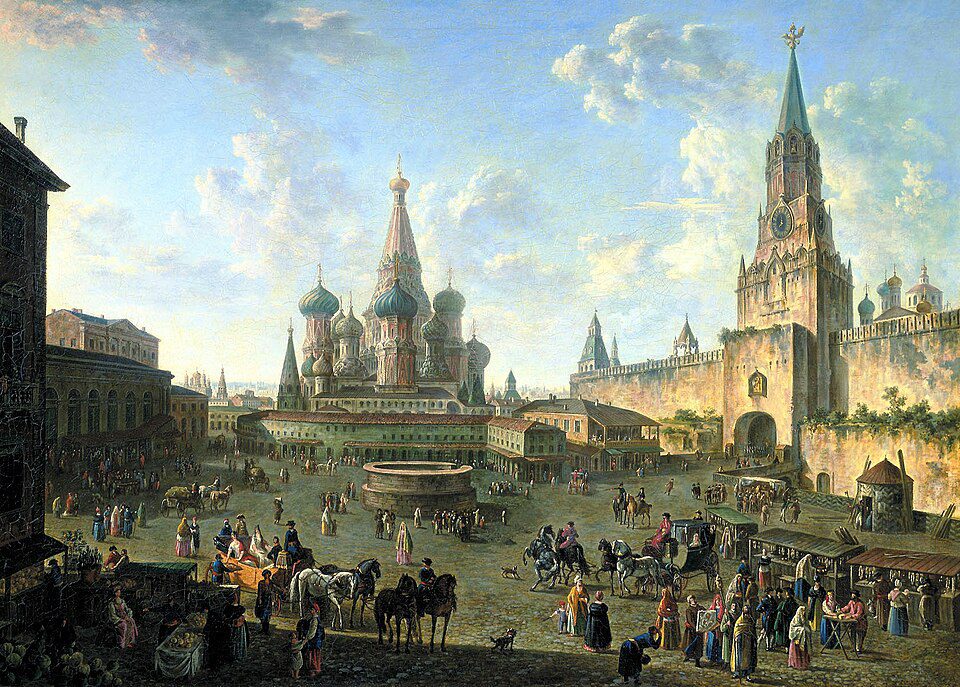
With its blazing colors, onion domes, and fairytale silhouette, St. Basil’s Cathedral is one of the most recognizable buildings in the world. Located at the southern edge of Red Square in Moscow, it has stood since the 16th century as a symbol of both religious piety and imperial ambition. Officially named the Cathedral of the Intercession of the Most Holy Theotokos on the Moat, it is better known by the name it later took from St. Basil the Blessed, a revered local holy man.
Commissioned by Tsar Ivan IV, also known as Ivan the Terrible, to commemorate the conquest of Kazan in 1552, the cathedral was completed in 1561. Unlike anything seen before in Russian architecture, it introduced a dramatic new language of design—a tapestry of towers, chapels, and colors that symbolized both heaven and the might of the Tsar.
Contrary to popular misconception, St. Basil’s is not part of the Kremlin. It stands just outside the Kremlin’s eastern wall, near the Spasskaya Tower, anchoring one end of Red Square. It was built not for military or administrative purposes, but as a religious monument—a cathedral and shrine rolled into one.
Its striking appearance has made it a visual shorthand for Moscow and even for Russia as a whole. But beneath the bright paint and curved domes lies a complex architectural story—a fusion of medieval Russian, Byzantine, and even Asian influences. Understanding the architecture of St. Basil’s is to understand a turning point in Russian identity and a masterpiece that has survived fire, revolution, and attempts at demolition.
Historical Background: Ivan the Terrible’s Monument to Victory
The construction of St. Basil’s Cathedral was directly tied to one of Tsar Ivan IV’s greatest military achievements—the conquest of Kazan, capital of the Kazan Khanate, in October 1552. This victory marked the final defeat of the Tatar Mongol successor state that had dominated parts of Russia for centuries. Ivan ordered a new church built to celebrate this triumph, not just as an act of thanksgiving, but as a symbol of Moscow’s supremacy and his own divine mission.
Construction began in 1555 and was completed in just six years, an astonishingly short time for a structure of such complexity. The architects are traditionally named as Barma and Postnik Yakovlev, though some sources suggest these may have been two names for the same person. A long-standing myth claims that Ivan blinded the architect(s) afterward to prevent them from building anything so beautiful again—but this story is likely apocryphal, as records suggest the same architect worked on future projects in Kazan and elsewhere.
The site chosen was no accident. Red Square, already a public marketplace and gathering space, was highly visible and central to Moscow’s civic life. By placing the cathedral there, just outside the Trinity Tower of the Kremlin, Ivan made a clear statement: his authority extended beyond the walls of old power into the hearts and minds of the people.
Originally, the structure was called the Trinity Church, then the Cathedral of the Intercession—a title it still carries officially. It wasn’t until after the death of the “holy fool” St. Basil in 1557, who was buried on the cathedral grounds, that it gained the name by which it is now commonly known.
Design and Layout: A Central Church with Radiating Chapels
St. Basil’s Cathedral is unique in Russian architecture—not only for its shape, but for the way it challenges conventional cathedral design. Rather than a single unified structure, the cathedral is made up of nine distinct chapels, each crowned with its own tower or dome. These are arranged symmetrically around a central core, which itself is topped by the tallest tented roof in the complex.
The layout forms a kind of geometric flower, with the central nave rising highest and surrounded by four larger and four smaller chapels. Each of the eight surrounding chapels is dedicated to a saint or event associated with the Kazan campaign, such as:
- St. Nicholas the Wonderworker
- The Entry into Jerusalem
- St. Alexander Svirsky
- St. Varlaam Khutynsky
The chapels are connected by narrow corridors and arched galleries, many of which were added during expansions in the late 16th and early 17th centuries. The result is a tightly clustered ensemble, both inward-facing and unified through a shared base.
Architecturally, this approach reflects Russian vernacular traditions, especially the practice of placing multiple domed churches together on a single foundation. But it also reflects a deliberate departure from the symmetrical, centralized churches of Byzantium. St. Basil’s is not about order—it is about celestial mystery and divine multiplicity.
The building’s complexity invites movement. Visitors pass through low passages, into intimate chapels, up narrow stairs, and into wide spaces. It is a pilgrimage in stone, where light, color, and perspective shift at every turn. This design would inspire later Russian churches, but none would quite match the daring of St. Basil’s original layout.
The Domes: Color, Form, and Symbolism
Perhaps the most instantly recognizable element of St. Basil’s Cathedral is its flame-like domes, which resemble swirling bonfires frozen in midair. These onion domes, ribbed helmets, and spiraled cones are richly colored and individually designed—no two are exactly alike. Their visual effect is dazzling, especially under sunlight, giving the cathedral its almost surreal, otherworldly quality.
But the domes weren’t always so vibrant. Originally, they were covered in gilded metal or painted in more subdued patterns. The bright colors we associate with the cathedral today were added gradually, especially during restorations in the 17th and 18th centuries. The polychrome designs—zigzags, chevrons, stripes, and floral motifs—reflect Russian folk art, Eastern ornament, and baroque exuberance.
Each dome covers the tower of an individual chapel, rising in a vertical crescendo from the smaller peripheral domes to the tall, tented central spire. This tented roof, known in Russian as a shatyor, was a uniquely Russian form not found in Byzantine churches. It became associated with divine fire, spiritual ascent, and national identity.
Symbolically, the domes represent the Heavenly Jerusalem, with each tower acting as a beacon of faith. The number eight, formed by the outer chapels, held mystical significance in Eastern Orthodoxy, symbolizing resurrection and eternal life.
Together, the domes perform both an architectural and symbolic function:
- They draw the eye upward—toward God and the heavens.
- They differentiate and sanctify each chapel while unifying them as a whole.
- They express Russian independence in religious art, moving beyond Byzantine norms.
The result is a silhouette that is both complex and cohesive—a visual theology rendered in stone, paint, and metal.
Materials and Construction Techniques
The structural system of St. Basil’s Cathedral is both traditional and inventive. Built primarily from brick, which had become more common in Russia by the mid-16th century, the cathedral marks one of the earliest large-scale uses of fired brick masonry in Russian church construction. The brickwork was then covered with stucco and painted plaster, allowing for intricate detail and the vibrant color schemes added later.
The foundation was laid using white limestone blocks, a technique inherited from earlier Muscovite architecture. Lime mortar bonded the layers of brick, and metal reinforcements were added selectively, especially in arches and domes. Although much of the construction appears chaotic from the outside, it’s a model of internal stability, with load-bearing walls, barrel vaults, and arched ceilings used to distribute the weight of the towers and domes evenly.
Internally, the cathedral employs narrow passageways, which help support the load of the clustered towers above while guiding movement and maintaining an intimate scale. Some chapels are round, others square; all are roofed with either corbelled domes or tented spires, typical of Russian architecture of the era.
The central tower, rising to 47.5 meters (about 156 feet), rests on a tall cylindrical drum and is capped with a wooden and metal tent roof. Supporting this structure required sophisticated vaulting and deep wall construction—up to 1.5 meters thick in places.
Building Materials Used:
- Brick: Main structural material
- White limestone: Foundation and lower walls
- Metal and timber: Used in roofing and dome supports
- Stucco and plaster: For exterior finishing
- Paints and tiles: Added later for polychrome effect
The precise coordination of materials and styles has helped the cathedral survive not only the centuries but also fires, political purges, and planned demolitions. It’s a testament to the strength of Russian traditional craftsmanship, guided by theological and imperial vision.
Interior Spaces: Frescoes, Icons, and Sacred Chambers
Though the exterior captures the imagination, the interior of St. Basil’s Cathedral offers a more contemplative and spiritual experience. Its labyrinthine network of small chapels, vaulted ceilings, and narrow galleries is in stark contrast to the vast nave spaces of Western European cathedrals.
Each chapel is distinct, with its own altar, iconostasis, frescoes, and liturgical furnishings. The walls are covered in traditional Orthodox iconography, painted in layers over the centuries. The earliest surviving interior decorations date from the 1580s, though much was renewed or repainted during the 17th and 18th centuries.
The color palette inside is warmer and earthier than the exterior. Deep reds, golds, and blues dominate, with floral and geometric motifs interwoven with Biblical imagery and the lives of saints. The ceilings are often low, painted with stars, vines, and sacred symbols, giving the impression of being inside a sacred garden or celestial tent.
The central chapel, dedicated to the Intercession of the Virgin, contains the main altar and the spiritual heart of the cathedral. This space is taller and slightly more open, though still enclosed in the traditional Orthodox manner. Light enters through small windows, casting a soft glow on the walls and icons.
One of the most visited and venerated areas is the tomb of St. Basil the Blessed, located beneath a separate chapel added in 1588. His reputation as a “holy fool” who criticized the Tsar yet was revered by the people gives the cathedral a folk-religious dimension rarely seen in other state-sponsored churches.
Unlike many cathedrals built for grandeur, St. Basil’s interior emphasizes:
- Devotion and intimacy, not spectacle
- Private worship, not public ceremony
- Mystery, not clarity
The architecture guides visitors not into a vast public hall, but through a spiritual journey—one chapel, one icon, one prayer at a time.
Symbolism and Style: A Vision of Heavenly Jerusalem
More than just a collection of buildings, St. Basil’s Cathedral is a deeply symbolic structure—a sacred microcosm designed to evoke the Heavenly Jerusalem, the eternal city described in Christian eschatology. This was a common theme in Orthodox architecture, but never before or since has it been executed with such vivid, multi-sensory intensity.
The layout of the cathedral—a central church surrounded by eight chapels—creates a cross-in-square plan radiating outward. The number nine is highly significant in Eastern Orthodox theology, often associated with the Nine Ranks of Angels or divine perfection. This layout reflects not only military victory but cosmic order, placing divine hierarchy at the center of Russia’s capital.
Each chapel represents a facet of divine intercession and heavenly reward. The domes above, with their swirling, flame-like shapes, suggest Pentecostal fire and spiritual illumination. Unlike Western steeples that point directly upward in linear form, the onion domes of Russia expand, curve, and blossom, reflecting growth, abundance, and the mysteries of the divine.
The colorful exterior, often misattributed to a purely decorative purpose, also has spiritual and symbolic meaning:
- Red: Martyrdom and victory
- Green: Eternal life and paradise
- Gold: Divine glory and illumination
- Blue: The heavens and the Virgin Mary
Some scholars have interpreted the cathedral as a visual sermon, its outer chaos masking inner order. Others see it as a bold declaration of Muscovite Orthodoxy—an assertion that Moscow had become the Third Rome, spiritual heir to Byzantium and guardian of true Christianity.
Whatever interpretation one accepts, there is no doubt that St. Basil’s is a work of religious and architectural symbolism, intended to inspire awe, devotion, and national pride in equal measure.
Survival Through Turmoil: Revolution, Atheism, and Preservation
St. Basil’s Cathedral has survived centuries of upheaval, both natural and political. That it still stands today is nothing short of remarkable, considering how often it was nearly destroyed. Its history is intertwined with the turbulent history of Russia itself—tsarist, revolutionary, and modern.
During the Napoleonic Wars, when Napoleon’s army occupied Moscow in 1812, the French allegedly planned to blow up St. Basil’s as they retreated. Fortunately, heavy rains reportedly doused the fuses. The cathedral was saved by inches.
The greatest threat came during the Soviet era. After the Bolshevik Revolution, the Soviet government launched a campaign of state atheism, seizing churches and suppressing religion. St. Basil’s was confiscated by the state in 1929 and turned into a museum of architecture and religion. Its liturgical functions were halted, and its clergy expelled.
One of the most infamous attempts to destroy the cathedral came in the 1930s, when Stalin’s associate, Lazar Kaganovich, proposed demolishing it to make room for military parades on Red Square. The story goes that when Stalin saw the demolition plans, he asked, “And how many churches did you say were like this one?” Upon hearing it was one of a kind, he reportedly told Kaganovich, “Then leave it.” Whether apocryphal or not, the story reflects the precarious fate of sacred architecture under Soviet rule.
Restoration efforts began in earnest in the 1950s, when the cathedral was recognized for its cultural and artistic importance. Though it remained a museum throughout the Soviet period, it was carefully preserved and studied. In 1990, following the collapse of the USSR, it was added to the UNESCO World Heritage List, as part of the “Kremlin and Red Square” designation.
Today, while still functioning primarily as a museum, St. Basil’s occasionally hosts Orthodox services on special feast days. Its survival is a testament to the determination of historians, architects, and believers who refused to let one of Russia’s most treasured structures be lost to ideology or neglect.
St. Basil’s in the Modern Age: Symbol, Museum, and Sacred Site
In the 21st century, St. Basil’s Cathedral remains one of the most powerful symbols of Russian identity, religious resilience, and architectural genius. It continues to function primarily as a museum, operated by the State Historical Museum of Russia. Visitors from around the world come to walk its corridors, stand beneath its domes, and marvel at its color and complexity.
Though it is no longer the center of active parish life, it has resumed some limited liturgical functions since the 1990s. Major Orthodox feast days, particularly the Feast of the Intercession, are occasionally marked with services inside the cathedral. Its chapel of St. Basil the Blessed remains a focus of quiet pilgrimage.
Technologically and curatorially, the cathedral has been brought into the modern era. Restoration teams have worked to stabilize the foundation, preserve the painted interiors, and monitor humidity and temperature levels to protect fragile artwork. Digital mapping and 3D scanning have made it possible to study and simulate the cathedral in unprecedented detail.
Culturally, the cathedral continues to appear in art, literature, film, and even video games as a shorthand for “Russia” or “Moscow.” Its domes are instantly recognizable around the world. It has been featured in works ranging from Doctor Zhivago to Mission: Impossible – Ghost Protocol, cementing its place in the global imagination.
Yet even amid tourism and spectacle, the cathedral retains a powerful spiritual presence. The tomb of St. Basil, located under one of the side chapels, remains a place of quiet prayer. Visitors often light candles or leave flowers at his icon, asking for intercession or giving thanks.
In modern Russia, where national identity, history, and faith remain deeply intertwined, St. Basil’s Cathedral is more than a building—it’s a touchstone. It reminds visitors, both foreign and domestic, that beauty born of faith and forged in fire can endure even the harshest trials.
Key Takeaways
- St. Basil’s Cathedral was commissioned by Ivan the Terrible to commemorate the conquest of Kazan and completed in 1561.
- The building consists of nine chapels, each with unique domes, forming a unified architectural ensemble.
- Its onion domes and vivid colors were added over time and symbolize spiritual fire and heavenly Jerusalem.
- It survived wars, the Soviet atheist campaign, and near-demolition by Stalin’s regime.
- Today, it serves as both a museum and sacred site, drawing millions of visitors and remaining a symbol of Russian heritage.
FAQs
- Is St. Basil’s Cathedral part of the Kremlin?
No—it is located just outside the Kremlin walls, on the south end of Red Square. - Why is it called St. Basil’s?
It was named after St. Basil the Blessed, a holy fool buried at the site in 1557. - When was St. Basil’s Cathedral built?
Construction began in 1555 and was completed in 1561, under Ivan the Terrible. - Can you go inside the cathedral?
Yes—it operates as a museum and is open to the public, with access to chapels, corridors, and galleries. - Are religious services still held there?
Occasionally—especially on major feast days in the Russian Orthodox calendar.