Annibale Carracci (1560–1609) was a central figure in the reform of Italian painting in the late 16th century. Alongside his cousin Ludovico and brother Agostino, he co-founded the Accademia degli Incamminati in Bologna, where he promoted a return to classical harmony and naturalism. Rejecting the artificial, elongated figures of Mannerism, Carracci sought to create art that was grounded in observation, guided by reason, and reflective of the balanced beauty seen in nature. His work paved the way for the Baroque period, yet retained a calm and clarity absent in much of the theatrical art that followed.
One of the purest expressions of his artistic ideals is the painting commonly referred to as River Landscape. Though small in size, the painting represents a monumental shift in landscape painting—from mere backdrop to noble subject. Carracci’s landscapes weren’t just decorative; they carried philosophical and even spiritual significance. Through these vistas, Carracci advanced the belief that nature, in its ideal form, reflected divine order and human virtue.
The Carracci family’s collective mission to revive Renaissance ideals wasn’t just stylistic—it was rooted in a larger cultural and religious movement. In an age marked by the turmoil of the Protestant Reformation, the Catholic Church turned to art as a means of promoting clarity, balance, and truth. Annibale’s naturalistic landscapes suited this aim. His paintings spoke to order, restraint, and the pastoral life as a symbol of moral virtue.
This vision made him unique among his peers. While others turned toward dramatic lighting and emotional intensity, Carracci remained committed to balance and realism. His River Landscape is not dramatic in subject, but its quiet majesty speaks volumes. Through it, Carracci affirms the timeless values of beauty, humility, and structure—a kind of visual anchor in an era of upheaval.
The Man Behind the Canvas – Annibale’s Classical Mission
Annibale Carracci was born in Bologna in 1560, into a modest artisan family. He trained initially under his cousin Ludovico, and later worked alongside both Ludovico and Agostino. Together, they challenged the dominant Mannerist style, which they viewed as mannered and intellectually shallow. Their goal was to revive the spirit of the High Renaissance by fusing ideal beauty with natural observation.
Unlike his contemporary Caravaggio, whose realism often highlighted the grittier side of life, Carracci believed in refining nature—not distorting it or exaggerating it. He saw painting as a way to lead viewers toward virtue by showing nature as God intended it to be. His admiration for the works of Raphael and Titian helped inform his restrained, yet powerful approach to composition and figure drawing.
Carracci’s classical mission culminated in several major commissions, including the ceiling of the Farnese Gallery in Rome (1597–1604), which showcased his ability to combine mythological subjects with dynamic yet controlled compositions. Even in these elaborate frescoes, he maintained a unity and coherence often lacking in the excessive detail of Mannerist painters.
By the time he painted River Landscape, likely in the late 1590s, Carracci had already matured into an artist whose landscapes echoed ancient ideals. His classical mission wasn’t about nostalgia—it was about reviving truths that had been lost to vanity and affectation. He painted with the conviction that nature and tradition could restore beauty to art.
Historical Context of the River Landscape
To understand River Landscape, it’s essential to look at the cultural and religious currents of the late 16th century. Italy was experiencing a powerful wave of spiritual reform under the Catholic Church. Following the Council of Trent (1545–1563), art was expected to reflect clarity, instructiveness, and moral purpose. Abstract experimentation was rejected in favor of concrete, relatable imagery that inspired virtue and religious feeling.
This spiritual and cultural climate deeply influenced the Carracci family, whose studio in Bologna became a beacon for a new kind of sacred and secular art. The Carraccis were devout, yet intellectual—they believed art should uplift, not merely entertain. In a landscape such as the one Carracci painted, the viewer wasn’t just invited to admire beauty but to meditate on order, providence, and humility.
The Italian landscape itself had long played a supporting role in religious and mythological painting. But Annibale elevated it to a subject worthy of focus. In River Landscape, there is no overwhelming narrative, no divine figures. Instead, the scene offers serenity—balanced compositions, modest architecture, and peaceful peasant life. These elements aligned perfectly with the conservative cultural desire for harmony and divine immanence in everyday life.
Though often associated with Rome due to his later career, Carracci’s roots in Bologna shaped his early landscape work. Bologna, situated between the formal Renaissance centers of Florence and the rugged northern regions, gave him access to a blend of styles. It was in this city, rich with religious tradition and academic pursuit, that Carracci developed his foundational values—values that echo throughout River Landscape.
Bologna and the Counter-Reformation’s Artistic Agenda
Bologna, where Carracci spent much of his youth and early adulthood, was a key center for Counter-Reformation art. The Church emphasized art’s role in reinforcing religious orthodoxy and guiding the faithful. This encouraged a return to realism and legibility in painting—qualities that Carracci embraced instinctively.
The Carracci Academy became instrumental in training artists who could meet these new expectations. Rather than merely mimicking forms, students were taught to observe nature, study anatomy, and integrate ancient models. Carracci’s commitment to these principles meant that even his secular landscapes had moral resonance.
In this context, River Landscape becomes more than a study of trees and rivers. It reflects a world where man, nature, and divine order coexist in harmony. The small figures engaged in humble labor or travel reinforce this ideal: life lived in accordance with nature is virtuous and worthy.
It’s no coincidence that Carracci’s landscapes often feature churches, ruins, or classical structures subtly placed within the scenery. They serve as silent reminders of history, faith, and continuity—essential pillars in a society trying to reaffirm tradition against cultural and religious fragmentation.
A Closer Look at River Landscape
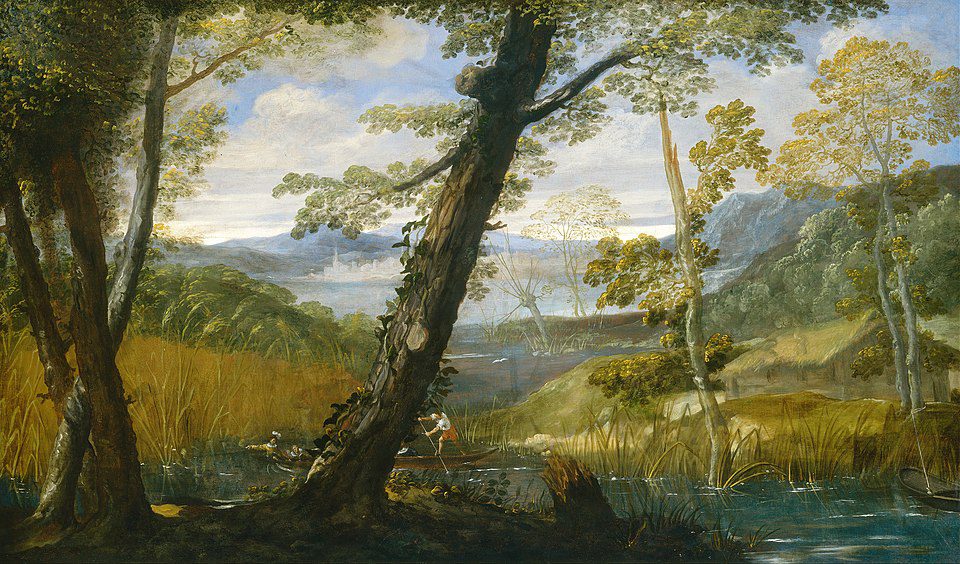
River Landscape is a deceptively simple work. At first glance, it appears to be a peaceful rural scene—trees, distant hills, a winding river. But closer inspection reveals an intricate structure. Every element is placed with precision. The trees form natural vertical markers that frame the scene, while the river leads the eye into the distance, establishing both movement and depth.
Carracci’s use of perspective is masterful. He creates a sense of infinite space without overwhelming the viewer. The gentle slopes, diminishing size of objects, and soft modulation of color temperature from foreground to background mimic the way we actually see the world. This adherence to optical truth was groundbreaking in its time.
Though the human figures are small, they play an essential role. They help establish scale and also communicate the pastoral ideal—man working in concert with nature, not attempting to dominate it. These figures are not idealized or heroic; they are humble and rooted in reality, reflecting the values Carracci held dear.
The architectural features, likely inspired by structures around Bologna or imagined classical forms, anchor the scene in a specific, albeit timeless, geography. Carracci avoided the dramatic ruins and fantastical vistas popular among some of his contemporaries. Instead, he presented a believable, dignified countryside—one that honored labor, faith, and the enduring beauty of the land.
Composition, Color, and Mood
Carracci employed a carefully selected palette in River Landscape, using earthy browns, soft greens, and warm grays to create a sense of unity. The colors don’t scream for attention—they invite contemplation. The golden light filtering through trees suggests either early morning or late afternoon, times associated with calm reflection.
His brushwork is subtle. In the trees and foliage, he used loose, almost impressionistic strokes to convey texture and density. Yet in the buildings and figures, the brush tightens, signaling importance and control. This dynamic brushwork mirrors the classical ideal of moderation—neither too rigid nor too chaotic.
The mood of the painting is tranquil, even meditative. There’s no storm brewing, no looming threat. The river flows steadily, the trees sway gently, and the figures go about their tasks without haste. In a world increasingly marked by rapid change and moral uncertainty, Carracci offers a vision of stability.
Carracci’s sensitivity to light, texture, and space gives River Landscape its enduring power. It’s a painting that doesn’t demand attention but rewards prolonged viewing. The more time one spends with it, the more its quiet complexity reveals itself.
The Innovation of Classical Landscape
Annibale Carracci’s River Landscape stands as a defining moment in the evolution of landscape painting. Prior to Carracci, landscapes were typically relegated to the background of religious or mythological scenes. They served as decorative filler, rather than serious artistic subjects. Carracci changed this by bringing the landscape to the forefront and treating it with the same reverence given to sacred or heroic figures. He introduced a style that was not only visually beautiful but intellectually grounded in classical principles.
Rather than depict nature as chaotic or overwhelming, Carracci idealized the countryside. His landscapes represented a purified vision of the natural world—ordered, serene, and rational. This classical ideal was rooted in his deep study of antiquity. He borrowed compositional methods from ancient Roman frescoes and used balanced structures to organize the scene, echoing the architectural harmony of ancient temples and villas.
This approach reflected not just artistic preference but a philosophical worldview. To Carracci, the countryside was a place of order and virtue, a counterpoint to the moral and political chaos of the cities. It wasn’t an escape from reality but a return to a more grounded, eternal truth. His River Landscape suggests that by living close to nature and embracing simplicity, man aligns more closely with divine intent.
Carracci’s innovation became foundational for what later art historians would call the “ideal landscape.” This was a tradition in which nature was not rendered exactly as seen but improved upon—organized, simplified, and imbued with spiritual meaning. His approach offered a balance between observation and imagination, one that allowed nature to become a vehicle for expressing timeless values.
Landscape as Moral and Spiritual Allegory
For Carracci, nature wasn’t just scenery—it was a language. The gentle river in River Landscape, flowing from the foreground into the distant hills, can be seen as a metaphor for the journey of life: steady, directional, and divinely guided. The inclusion of rural laborers suggests a moral message about the dignity of work and living in harmony with the land.
In this painting and others like it, the landscape serves as a kind of silent sermon. There are no angels or saints, but the message is clear: beauty and virtue go hand in hand. By depicting the land as clean, balanced, and fruitful, Carracci affirms that the natural world reflects the order and wisdom of its Creator. This view was especially important during the Counter-Reformation, when art was expected to inspire moral clarity and religious devotion.
Additionally, Carracci often included classical ruins or ancient-style buildings in his landscapes, symbolizing the enduring legacy of Western civilization. These elements remind viewers that the highest achievements of man were often grounded in a respect for nature and divine order. The ruins are not signs of decay, but of continuity—suggesting that great cultures arise where faith and nature are in balance.
This interpretation of landscape painting—as a vehicle for teaching and contemplation—would have a lasting influence. Carracci wasn’t painting the world as it was, but as it ought to be. He painted with a conservative sense of purpose: to guide the viewer back toward truth, virtue, and beauty.
The Carracci Workshop and Shared Ideals
The success of River Landscape and similar works cannot be fully appreciated without understanding the collaborative power of the Carracci family. Founded in Bologna in the 1580s, their workshop—known as the Accademia degli Incamminati—was unlike anything else in Italy at the time. It emphasized a return to nature, rigorous drawing, and classical composition. Through this academy, the Carraccis trained an entire generation of artists who would carry their values into the 17th century.
Annibale was arguably the most gifted of the trio, but his achievements were made possible by the intellectual and organizational efforts of his cousin Ludovico and brother Agostino. While Annibale focused on innovation in painting, Agostino contributed with theoretical writings and Ludovico with hands-on training. Together, they created a curriculum that rejected the formulaic tendencies of Mannerism in favor of observation and restraint.
This collective effort produced not just paintings but a school of thought. Students were taught to study live models, observe nature closely, and internalize the proportions and harmony of classical art. This was a radical departure from the overly stylized conventions that had dominated earlier in the century. The Carracci workshop was not only a place of instruction but of moral formation—a place where art was seen as a tool for truth and order.
In this conservative environment, the landscape genre flourished. Carracci and his students proved that a painting could be beautiful, morally instructive, and grounded in reality all at once. The simplicity of River Landscape is deceptive; it is the product of rigorous study, deep values, and a collective commitment to elevating art through tradition.
Teaching the Next Generation of Traditionalists
The Carracci academy trained several major figures of the Italian Baroque, many of whom would continue the classical landscape tradition. Chief among them was Domenichino (1581–1641), whose calm and structured landscapes owe much to Annibale’s influence. Another notable pupil, Guido Reni (1575–1642), absorbed the Carracci emphasis on graceful line and proportion, even as he developed a more idealized style.
These artists did not simply copy Carracci; they extended his vision. They refined the landscape into a tool for visual storytelling and spiritual meditation. Through them, the Carracci legacy would spread across Italy and into France, influencing artists such as Claude Lorrain and Nicolas Poussin in the decades to follow.
In this way, the Carracci academy became a bastion of conservative, classical values in a rapidly changing world. Their focus on order, virtue, and natural beauty provided a counterbalance to the more theatrical elements emerging in art. They didn’t reject innovation—but they insisted it be grounded in timeless truths.
By training others in this vision, Carracci ensured that River Landscape was not a solitary achievement but part of a broader movement. His legacy wasn’t just in his brush, but in the ideals he passed on to others: fidelity to nature, respect for tradition, and a belief in the moral power of art.
Comparing Carracci to His Contemporaries
The landscape paintings of Annibale Carracci stand in sharp contrast to those of many of his contemporaries, particularly Michelangelo Merisi da Caravaggio. Caravaggio (1571–1610) is best known for his intense chiaroscuro and dramatic realism, often depicting religious scenes filled with tension and raw emotion. Carracci, by contrast, offered calm, clarity, and compositional balance.
Where Caravaggio focused on the stark and sometimes brutal reality of human experience, Carracci emphasized the enduring beauty of the natural world. Caravaggio’s figures leap out of the canvas with turbulent energy; Carracci’s are subdued, integrated into the landscape like actors within a divine stage. Both artists were revolutionary—but they moved in opposite directions.
Carracci’s approach found favor with patrons who desired art that reflected order, virtue, and tradition. His landscapes were meditative, not sensational. They were grounded in a classical past, whereas Caravaggio’s were rooted in the immediacy of the present. In a time of cultural and spiritual upheaval, Carracci’s vision offered reassurance and stability.
This divide wasn’t just stylistic—it was ideological. Carracci represented a conservatism in art that held fast to hierarchy, natural law, and tradition. Caravaggio’s art, for all its genius, often felt untethered to such values. As a result, Carracci’s landscapes were more than aesthetic achievements—they were moral statements.
Naturalism Without Excess – Carracci vs. Caravaggio
Both Annibale Carracci and Caravaggio embraced naturalism, but they did so for very different reasons. For Carracci, naturalism was a means to uplift and restore. He believed that by painting the world as God intended it, the artist could guide the viewer toward truth and virtue. His brush was gentle, his compositions structured, his message eternal.
Caravaggio’s naturalism, on the other hand, highlighted the gritty realism of human suffering and divine mercy. His figures often bore the marks of hardship—dirty feet, wrinkled hands, haunted expressions. There is power in this, but it is a power rooted in conflict rather than resolution.
Carracci sought moderation. His River Landscape reflects this perfectly. There is no chaos, no theatrical gesture—only peace. His use of light does not dazzle but gently reveals. His figures do not strain but rest, not in despair but in humble labor. Carracci’s landscapes show that naturalism does not require intensity to be profound.
The contrast between the two painters highlights the wider cultural tensions of the time: between spectacle and substance, between innovation and tradition, between the city’s drama and the countryside’s calm. In that contest, Carracci’s classical approach stands as a beacon of enduring values.
Influence on Future Generations of Landscape Painters
Annibale Carracci’s contribution to the development of landscape painting had a profound and lasting impact that stretched far beyond Italy. His idealized yet natural approach to rural scenes served as a blueprint for what would become one of the most influential genres in European painting. Carracci elevated landscape from decorative filler to a subject worthy of independent contemplation, paving the way for artists in the 17th and 18th centuries to treat nature as a central theme in their work.
One of the greatest inheritors of Carracci’s vision was Claude Lorrain (1600–1682), a French painter who spent most of his career in Rome. Lorrain expanded on Carracci’s formula by incorporating golden light and classical ruins, and by emphasizing the poetic mood of the landscape. Though more atmospheric in tone, Lorrain’s work was rooted in Carracci’s structural clarity and respect for natural order. Without Carracci’s foundation, Lorrain’s serene vistas would likely not exist in their mature form.
Nicolas Poussin (1594–1665), another Frenchman working in Italy, was likewise deeply indebted to Carracci’s innovation. Poussin adopted the compositional logic and moral symbolism present in River Landscape, embedding them within his own mythological and biblical scenes. Where Carracci laid the groundwork, Poussin formalized it, turning landscape into a stage for stoic and spiritual narratives that spoke to eternal truths rather than fleeting trends.
Carracci’s influence wasn’t limited to France. In Italy, artists such as Domenichino, Gaspard Dughet (Poussin’s brother-in-law), and Salvator Rosa carried the torch, each adapting the ideal landscape to his own vision. Though some leaned toward drama or fantasy, they retained the essential Carracci emphasis on structure, balance, and moral clarity.
Birth of the Ideal Landscape Tradition
Carracci’s River Landscape became the cornerstone of what would later be labeled the “ideal landscape” tradition. This tradition didn’t aim to reproduce exact views of nature, as seen in later realism or plein-air painting, but instead sought to present nature as it ought to be—elevated, harmonious, and spiritually instructive. The ideal landscape was not an escape from the real world, but a better version of it—rooted in truth, enhanced by wisdom.
Painters within this tradition often incorporated classical ruins, calm water, and pastoral figures engaged in quiet labor or leisure. These were not simply nostalgic motifs—they were carefully chosen symbols of civilization, order, and divine providence. Carracci’s decision to paint the landscape as an ordered system rather than a chaotic wilderness helped establish this entire genre of painting as a noble pursuit.
This approach spread throughout Europe, especially in courts and academic circles. The ideal landscape came to be seen as a high form of art—something educated viewers could interpret on multiple levels. Carracci, though perhaps less well-known to modern audiences than some of his successors, deserves credit for laying the intellectual and visual groundwork for this movement.
The tradition he founded endured well into the 18th century and influenced even early Romantic painters. Though the Romantics would eventually reject some of the restraint seen in Carracci’s work, they continued to see landscape as a medium for expressing profound truths. In this sense, Carracci’s legacy extends even beyond the Baroque and Classical styles, influencing the entire course of Western landscape painting.
Bullet List: Key Painters Influenced by Carracci
- Claude Lorrain – Refined Carracci’s clarity into luminous, poetic atmosphere
- Nicolas Poussin – Brought structure and allegory to landscape scenes
- Domenichino – Continued the idealized rural tradition with spiritual undertones
- Salvator Rosa – Added romantic drama while preserving classical forms
- Gaspard Dughet – Developed the Carracci-Poussin vision into a cohesive style
The Painting’s Journey and Current Location
River Landscape by Annibale Carracci is housed in the Louvre Museum in Paris, France. Acquired in the 19th century, the painting forms part of the museum’s collection of Italian Baroque works, where it is often praised for its subtlety and sophistication. Though relatively small in scale, the painting carries significant historical weight. It represents an early and critical phase in the development of landscape as a respected genre within Western art.
Carracci’s works made their way into several important collections over the centuries, thanks to their reputation among scholars, artists, and collectors. His landscapes, in particular, were prized for their compositional mastery and serene mood. The exact provenance of River Landscape is not fully documented, but records show that it was part of a private French collection before being transferred to the Louvre in the 1800s, during a period of increasing interest in pre-Romantic landscape painting.
At the Louvre, River Landscape is often displayed alongside other Baroque works, including those of Poussin and Claude Lorrain. This curatorial decision highlights Carracci’s role as a forerunner to these artists. Despite its modest size, the painting holds its own in terms of impact, drawing visitors who appreciate its quiet beauty and historical importance.
Today, River Landscape serves not only as an example of Carracci’s talent but as a window into an entire artistic and cultural worldview. It stands as testimony to a time when art was a vehicle for order, virtue, and faith—and when even a simple country scene could carry profound meaning.
Museum Display and Public Reception
When displayed in museum settings, River Landscape typically receives admiration for its refinement and meditative atmosphere. Though it lacks the drama that attracts casual viewers, it often holds the attention of those with a deeper appreciation for art history and classical composition. Visitors familiar with the development of landscape painting frequently recognize Carracci’s piece as a critical stepping stone in that evolution.
Art historians continue to revisit the painting in academic journals and catalogues, particularly when discussing the shift from Mannerist excess to Baroque clarity. River Landscape is often cited as a model of early Baroque restraint—a painting that suggests more than it shows and instructs more than it entertains. It doesn’t rely on grand gestures, but on a quiet sense of rightness that rewards sustained viewing.
Museum docents and educators often use the painting to explain the importance of the Carracci academy and its broader influence on European art. The painting’s subtle composition makes it an excellent case study in balance, rhythm, and spatial organization. It’s often paired in discussion with works by Lorrain and Poussin to demonstrate the stylistic lineage Carracci helped establish.
The painting’s continued presence in one of the world’s most prestigious museums confirms its lasting value. Though not as famous as some of the Louvre’s grand canvases, River Landscape remains a cornerstone in the story of Western landscape painting—a quiet but undeniable voice in a tradition grounded in truth and beauty.
Artistic Techniques: Brushwork and Drawing
Annibale Carracci’s technical prowess is a major reason why River Landscape holds such enduring importance. Though the painting appears effortless in its harmony and composition, it is the result of highly disciplined draftsmanship and a deep understanding of visual structure. Carracci’s ability to render both the human form and the natural world with subtlety and precision set him apart from many of his contemporaries.
Carracci’s brushwork in River Landscape reveals a thoughtful balance between control and spontaneity. The trees and foliage are painted with soft, feathery strokes, giving the impression of gentle movement without sacrificing form. In contrast, the buildings and figures are painted with cleaner, more defined lines. This contrast serves to guide the viewer’s eye and emphasize the deliberate organization of the scene. Carracci’s method respects the individuality of each element while ensuring it contributes to the whole.
Equally important is his mastery of tonal gradation and atmospheric perspective. The way Carracci handles light—especially the warm glow that illuminates the middle ground—adds depth and realism without becoming theatrical. He uses natural lighting not as a dramatic device, but as a gentle revealer of form. This subtle modeling of shapes gives the painting a tactile quality, suggesting volume and texture in a restrained and classical manner.
The painting’s modest size makes these techniques even more impressive. Unlike grand frescoes that rely on scale for effect, River Landscape achieves its impact through composition, color modulation, and elegant spatial construction. It is a testament to Carracci’s belief that truth in art comes from fidelity to nature and disciplined execution.
Draftsmanship and the Role of Drawing in Preparation
Carracci was not just a painter but also an exceptional draftsman. His training emphasized drawing from life, and his preparatory sketches—many of which survive—show his deep commitment to understanding form and structure before applying paint. For River Landscape, it’s likely that Carracci produced several preliminary studies, not just of figures and architecture, but of trees, riverbanks, and horizon lines.
The Carracci Academy placed a strong emphasis on drawing as the foundation of all good painting. Students were required to draw from plaster casts, live models, and natural scenes. This rigorous training ensured that every line served a structural purpose. Carracci’s landscapes, though they appear relaxed, are built upon precise underdrawings that guide the viewer’s eye and organize the visual narrative.
His pen-and-ink drawings from the 1580s and 1590s show a remarkable fluency and confidence in mark-making. These studies are not mere technical exercises—they reflect a mind deeply engaged with the visual world. In many ways, Carracci approached nature the way a classical architect approached a temple: with reverence for proportion, symmetry, and function.
In River Landscape, this preparatory discipline results in a painting that feels both spontaneous and inevitable. Every tree is placed with intention, every figure aligns with a compositional axis, and every architectural form balances the organic contours of the surrounding land. It is drawing, not bravado, that holds the scene together.
Conclusion – Why River Landscape Still Matters
Annibale Carracci’s River Landscape is more than just a painting—it’s a window into a worldview. It expresses a belief in order, restraint, and the moral power of beauty. In a time of upheaval—spiritually, politically, and artistically—Carracci offered a vision grounded in eternal truths. His landscape is a place of peace and purpose, not chaos and ambiguity. That alone sets it apart in a world increasingly drawn to spectacle and transgression.
The values embedded in the painting still resonate. In an age where art often chases novelty or provocation, River Landscape reminds us of the lasting power of tradition. It speaks to a way of seeing the world that honors what is permanent rather than what is passing. The calm river, the dignified laborers, the balanced architecture—all reflect a vision of human life in harmony with nature and guided by principle.
Carracci’s impact on the course of Western art cannot be overstated. He created a new genre, trained a generation of artists, and shaped the ideals of the Baroque without compromising his classical roots. His landscapes weren’t just innovations; they were declarations. He showed that art could be both faithful to nature and faithful to truth.
River Landscape remains important not only because of its historical influence but because of what it offers today: a reminder that beauty, order, and meaning are not outdated concepts, but enduring needs of the human soul. In that sense, Carracci’s vision is as relevant now as it was over four hundred years ago.
A Return to Order and Beauty
In many ways, Carracci’s River Landscape invites us to pause and reflect—not just on art, but on life. The painting encourages viewers to consider a world where structure matters, where faith is grounded in nature, and where artistic excellence serves something greater than the self. It calls for a return to order—not through rigidity, but through reverence.
Carracci didn’t need to shock his audience to make an impact. He relied on the timeless elements of good art: composition, proportion, clarity, and moral intent. His vision was not nostalgic, but foundational. He didn’t look backward because he feared the future—he looked backward to recover what was essential.
As modern culture continues to wrestle with relativism and disorder, Carracci’s work stands as a firm, quiet answer. It tells us that true progress doesn’t mean abandoning the past, but building upon it. It reminds us that even a humble landscape can speak of eternity if shaped by truth and devotion.
That’s why River Landscape still matters. It isn’t just a painting—it’s a principle in pigment.
Key Takeaways
- River Landscape marks a turning point where landscapes became central subjects in Western art.
- Carracci blended natural observation with classical structure, creating a new model of moral and visual order.
- The Carracci academy shaped a generation of Baroque artists, extending his influence across Europe.
- Carracci’s emphasis on clarity, realism, and restraint aligned with Counter-Reformation ideals.
- His legacy lives on in the ideal landscape tradition, echoed by artists like Poussin and Lorrain.
Frequently Asked Questions
- Where is River Landscape by Carracci currently located?
The painting is part of the collection at the Louvre Museum in Paris. - When was Annibale Carracci born and when did he die?
He was born in 1560 in Bologna and died in 1609 in Rome. - What artistic movement is Carracci associated with?
He is a key figure in the early Baroque, and also foundational to the Bolognese School. - How did Carracci differ from Caravaggio?
Carracci emphasized classical order and naturalism, while Caravaggio focused on drama and emotional intensity. - What makes River Landscape important?
It helped elevate landscape painting to a serious genre and established the ideal landscape tradition in European art.