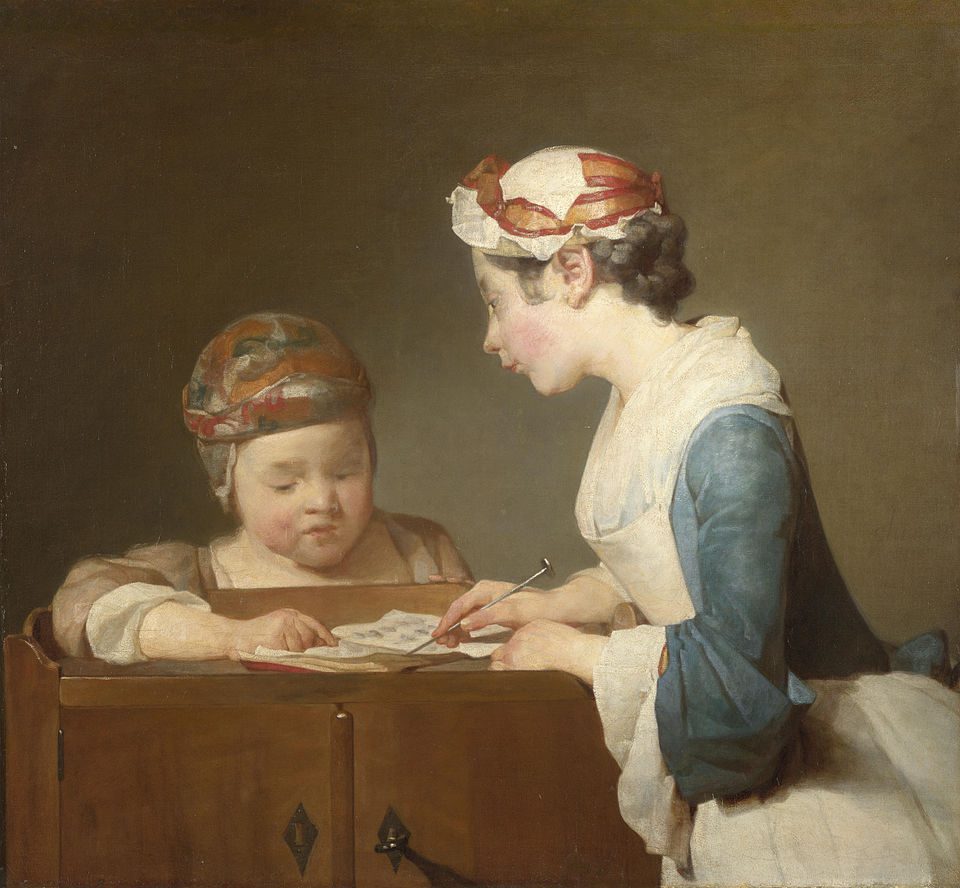
In an era dominated by grandeur and aristocratic indulgence, Jean-Siméon Chardin’s The Young Schoolmistress (painted between 1735 and 1740) offers a tender counterpoint. This oil painting, modest in scale and subdued in tone, presents a deeply moral domestic scene: a young woman guiding a small child through the basics of reading. At first glance, it may seem unremarkable—but its quiet power lies in what it represents. Chardin captured not just a moment of instruction, but a worldview rooted in duty, order, and the transmission of virtue across generations.
Set against the extravagance of early 18th-century France, Chardin’s domestic paintings pushed against prevailing artistic norms. The dominant aesthetic of the time—epitomized by the Rococo movement—thrived on mythological fantasies, erotic nudes, and theatrical allegory. Artists like François Boucher and Jean-Honoré Fragonard catered to the whims of a nobility removed from the realities of everyday life. Chardin, by contrast, painted the world as it was—particularly the humble domestic sphere of the French middle class.
Chardin’s work resonated not only because of its visual restraint but because it affirmed traditional moral values. In The Young Schoolmistress, the act of teaching is elevated to a sacred duty. The seated woman holds a book with care, leaning toward her young pupil with an expression of calm authority. In this simple arrangement, Chardin communicates something profound about civilization: that it begins at the family hearth, with one generation patiently shaping the next.
This painting is not simply a portrait of two figures—it is a statement about the moral structure of society. By focusing on education, particularly female-led instruction within the home, Chardin defends the essential virtues of discipline, modesty, and maternal responsibility. His brush does not flatter or exaggerate—it clarifies and uplifts the beauty of ordinary life lived with intention and faith.
Who Was Jean-Siméon Chardin?
Jean-Siméon Chardin was born in Paris on November 2, 1699. He came from a family of craftsmen—his father, Jean Chardin, was a master cabinetmaker who supplied luxury goods to wealthy clients. From a young age, Chardin was surrounded by the tools of traditional French craftsmanship, which likely instilled in him a sense of discipline and reverence for skill. Though little is known about his early training, records show that he studied under Pierre-Jacques Cazes and later with Noël-Nicolas Coypel, both members of the prestigious Académie Royale.
Chardin became a full member of the Académie Royale in 1728, after submitting The Ray and The Buffet, two still life works of exceptional realism. Unlike most members, who specialized in grand historical themes, Chardin was accepted for his mastery of genre scenes and still lifes—subjects often considered beneath academic dignity. Yet his technical brilliance and compositional restraint won admiration, even among critics who typically favored mythological spectacle. He would go on to exhibit at the Salon—the official art exhibition of the Académie—regularly between 1737 and 1757.
By the mid-18th century, Chardin had gained the respect of both his peers and the monarchy. In 1752, he was granted an apartment in the Louvre, and in 1755, he was appointed “Premier peintre du roi” (First Painter to the King) under Louis XV. Despite his royal patronage, Chardin maintained his artistic independence, continuing to focus on the everyday lives of ordinary people rather than courtly elites. His works stood out in a sea of artificiality, offering moral clarity and emotional resonance in an age that often valued spectacle over substance.
Chardin died in Paris on December 6, 1779. Though he was somewhat overshadowed by flashier contemporaries during his lifetime, his legacy endured. He has been praised by later generations of realists and modernists alike, including Paul Cézanne, Henri Matisse, and even Édouard Manet, who regarded Chardin as a foundational figure in the history of French painting. Today, Chardin is rightly celebrated not only for his technical skill but for his steadfast commitment to painting the quiet dignity of everyday life.
Biographical Overview:
- Born: November 2, 1699, Paris, France
- Died: December 6, 1779, Paris, France
- Education: Studied under Pierre-Jacques Cazes and Noël-Nicolas Coypel
- Membership: Admitted to Académie Royale in 1728
- Famous Works: The Ray, Saying Grace, The Governess, The Soap Bubble, The Young Schoolmistress
A Moral Message in Brushstrokes
The Young Schoolmistress reflects Chardin’s desire to present life not as fantasy, but as a series of moral responsibilities. The painting shows a young woman—likely a governess or elder sister—teaching a young girl to read. The girl’s posture is attentive, slightly slouched in concentration, while the instructor leans in with gentle firmness. There is no excessive motion, no dramatic gesture. This is not an imagined myth, but a scene recognizable to any viewer acquainted with the rhythms of family life.
What Chardin accomplishes through this understated composition is a visual sermon on discipline and virtue. The act of learning to read is not treated as a neutral educational activity—it becomes a rite of passage, a sacred trust between the older and younger generations. At a time when French elites were losing interest in moral clarity, distracted by luxury and indulgence, Chardin redirected attention to the home as the cornerstone of moral society.
The painting implicitly honors the woman’s role as guardian of culture and tradition. She does not merely pass on information; she forms the character of the next generation. In contrast to the flighty, coquettish women in Boucher’s and Fragonard’s works, Chardin’s schoolmistress is steady, serious, and morally grounded. There is no frivolity here—only purpose, patience, and piety.
This visual narrative would have struck a chord with middle-class patrons in 18th-century France, many of whom were seeking stability in an increasingly unstable world. The rise of salons and Enlightenment thought was undermining traditional institutions. Yet Chardin’s work stood as a bulwark against this tide—a reminder that true civilization begins with reverence for family and the dutiful transmission of timeless values.
Visual Composition and Symbolism
Chardin’s visual choices in The Young Schoolmistress are deliberate and calculated. The composition is vertically centered, with both figures enclosed in a subtle triangle that guides the viewer’s eye toward the book they share. The restrained color palette—dominated by earthy browns, muted blues, and soft whites—serves to underscore the seriousness of the moment. Light enters from an implied window, softly illuminating the girl’s face and the pages of the book. Nothing distracts from the intimate act of learning.
One of Chardin’s strengths as a painter was his ability to elevate the commonplace through careful observation. The textures in this painting—the grain of the wooden chair, the folds of the garments, the worn surface of the book—are rendered with precision and care. They suggest not wealth or prestige but longevity and use, reinforcing the idea that virtue is often found in the well-worn habits of daily life.
Symbolically, the book in the center is more than a teaching aid—it represents the transmission of civilization itself. In Christian and classical traditions, books symbolize wisdom, order, and divine truth. Chardin’s inclusion of the book, cradled between the hands of two generations, reflects an older worldview where knowledge is sacred and generational continuity is paramount.
Moreover, the positioning of the figures emphasizes hierarchy and reverence. The girl looks up; the woman looks down—but not with disdain. Her expression is serious but kind, suggesting responsibility, not superiority. The entire scene is one of mutual respect, founded on clearly defined roles. In this way, Chardin communicates a vision of society rooted in duty and natural order—not radical egalitarianism, but earned trust and inherited wisdom.
Comparing Chardin to His Rococo Peers
To fully appreciate Chardin’s contribution, it’s essential to understand the artistic landscape he worked within. The Rococo style, which flourished in France from roughly 1720 to 1770, emphasized opulence, eroticism, and mythological playfulness. Artists like François Boucher painted frothy, pastel-colored fantasies of goddesses lounging in silk or aristocrats frolicking in garden parties. Jean-Honoré Fragonard followed suit with works like The Swing (1767), a notorious depiction of flirtation and leisure.
In contrast, Chardin painted domestic life—children at play, women cooking, quiet mealtimes. His scenes were grounded, not fanciful; his subjects were middle-class or working families, not nobles. He did not appeal to fleeting whims but to deeper, enduring values. His brush avoided excess. Where Rococo artists delighted in the theatrical, Chardin’s work felt as sincere as a father’s blessing.
This stylistic and moral divergence was not without cost. Chardin was sometimes dismissed by critics who found his themes too humble, his compositions too still. Yet he also won praise for precisely those qualities. Denis Diderot, one of the Enlightenment’s leading art critics (despite his later philosophical contradictions), once wrote that Chardin’s paintings “make you want to be virtuous.”
Chardin did not merely ignore fashion—he defied it, standing apart as a voice of moral sanity. In a France increasingly drunk on decadence, Chardin offered sobriety and truth. His legacy reminds us that while art can entertain, its highest calling is to edify.
The Role of Women and Education
In The Young Schoolmistress, Chardin does more than simply depict a classroom scene—he communicates a cultural ideal. The woman in the painting, presumably an older sister, governess, or young mother, represents the heart of the moral household. Unlike the Rococo portrayals of women as objects of vanity or flirtation, Chardin presents her as a figure of purpose. She educates, instructs, and shapes the young mind beside her. This depiction honors the traditional role of women as moral instructors and caretakers of civilization within the domestic sphere.
During the 18th century, formal education in France was not universally accessible, especially for young girls. Most early learning took place in the home. Mothers, older sisters, and governesses were often responsible for teaching children how to read and pray, using tools like catechisms or simple moral readers. In portraying this act of instruction, Chardin aligns himself with a long-standing belief: that the home is the first school and that women are its first teachers. This belief was rooted in centuries of Christian tradition and was reinforced by classical and Enlightenment thinkers alike.
Chardin’s focus on a female teacher with a female pupil is significant. It underscores the idea that women were not only central to moral instruction but were also instrumental in the preservation of culture. The quiet authority of the schoolmistress in this painting affirms that dignity comes not from power or status, but from duty and care. In contrast to contemporary French salons—where women often played roles as hostesses or socialites—Chardin returns women to their essential place: the home, where life is nurtured and virtue is passed down.
This emphasis on maternal and sisterly responsibility reflects a worldview centered on continuity and structure. Rather than pursuing revolutionary change, Chardin’s work supports generational transmission. A culture that forgets the value of tradition, Chardin seems to say, loses its very soul. The painting reminds viewers that the most important lessons in life are taught not by the state or elite institutions, but by those closest to us—in the quiet, unassuming space of the family home.
Realism as a Moral Compass
Chardin’s approach to realism was never about photographic accuracy or technical exhibitionism. Rather, his realism served a deeper purpose: to affirm moral truths and elevate the ordinary into something noble. He did not romanticize poverty nor gloss over hardship. Instead, he offered scenes of real life, infused with grace and order. His work calls to mind a Latin phrase often quoted in classical education: ars est celare artem—“true art hides its art.” In The Young Schoolmistress, technique serves truth, not the other way around.
Unlike his more theatrical contemporaries, Chardin focused on the tactile, the familiar, and the quiet. The schoolmistress and child are painted without ornament or fantasy. Their garments are simple but carefully observed. The table, the book, the stool—all feel lived in, handled, and real. These elements are not merely props but carriers of meaning. They represent the material foundation of a moral life: hard work, stability, and discipline.
This form of realism also resonates with the values of the Enlightenment, though Chardin steered clear of the era’s more radical philosophies. While some Enlightenment thinkers sought to overturn tradition in favor of abstract reason or utopian ideals, Chardin’s work demonstrates a different application of rationality—one that reinforces order, continuity, and familial structure. He painted the world as it ought to be, not by reinventing it, but by honoring what had always been good, true, and beautiful.
This ethical form of realism laid the groundwork for later movements, particularly 19th-century Realism, which would further reject academic idealism. Artists such as Jean-Baptiste-Camille Corot and Gustave Courbet admired Chardin’s clarity and grounded subject matter. But unlike Courbet, who occasionally veered into political territory, Chardin remained rooted in timeless values. His realism pointed not to ideology but to enduring moral principles—a choice that has given his work a lasting legacy.
The Legacy of The Young Schoolmistress
Chardin’s The Young Schoolmistress may not have garnered the lavish praise that other contemporary works enjoyed in its day, but its influence has proven more enduring. The painting’s quiet moral force has spoken across centuries, especially to those who value tradition, family, and the dignity of work. It has served as an example for generations of artists who sought to paint not illusions, but truths.
One notable admirer was Édouard Manet, who reportedly kept a reproduction of Chardin’s work in his studio for inspiration. Although Manet’s own style was more modern and often more provocative, he appreciated Chardin’s integrity and calm restraint. Likewise, the great Post-Impressionist Paul Cézanne once said, “Chardin is the greatest of us all.” That kind of praise from artists pushing forward into abstraction shows that Chardin’s commitment to substance over style had a far-reaching impact.
Chardin’s emphasis on the domestic sphere—so often dismissed in the academic art hierarchy—was later revived by American and Northern European artists in the 19th and 20th centuries. His ability to find transcendence in the routine served as a model for artists grappling with modernity’s upheavals. At times of social change, economic uncertainty, or political instability, Chardin’s paintings provided a visual anchor.
What makes The Young Schoolmistress particularly potent is its unwavering focus on the foundational act of education. In a single scene, Chardin reminds viewers that culture is not maintained by slogans or institutions, but by individuals passing on wisdom, one generation to the next. That message, grounded in traditional values and reinforced by humble realism, gives the painting its lasting relevance.
Where to See the Painting Today
The Young Schoolmistress is housed in the National Gallery in London, where it remains a quiet treasure among the museum’s larger and more ostentatious works. Visitors often discover it tucked within the 18th-century European galleries, surrounded by works of greater size but not greater substance. The painting has been part of the National Gallery’s collection since the 19th century, and it is publicly displayed alongside other works of the French school.
The National Gallery’s curatorial notes emphasize the painting’s focus on “virtue and instruction”—themes that have earned it a special place in the museum’s broader educational mission. The painting, an oil on canvas measuring approximately 37 by 45 centimeters, may be modest in size, but it commands attention through its intimacy and moral clarity. Unlike many paintings from its era, it does not demand to be noticed—it invites contemplation.
Digital versions of The Young Schoolmistress are available through the National Gallery’s online collection as well as Wikimedia Commons, where high-resolution public domain images can be freely downloaded. These digital resources are often used by educators, art students, and cultural commentators interested in traditional moral themes in visual art.
The painting’s current accessibility ensures that Chardin’s message continues to reach new audiences. Whether viewed in person under museum lighting or studied in a classroom presentation, The Young Schoolmistress continues to fulfill its original purpose: to uphold virtue, encourage reflection, and remind us that even the smallest acts of instruction can shape the soul of a civilization.
Quick Facts:
- Title: The Young Schoolmistress
- Artist: Jean-Siméon Chardin
- Date: c. 1735–1740
- Medium: Oil on canvas
- Location: National Gallery, London
Final Thoughts on Art and Virtue
In a world increasingly obsessed with spectacle, speed, and novelty, Chardin’s The Young Schoolmistress stands as a gentle but firm rebuke. It does not shock or dazzle. It instructs. Its power lies in its simplicity and its unwavering commitment to truth. The painting tells us that virtue begins at home, that education is sacred, and that beauty need not be loud to be profound.
Chardin’s art calls us back to a different set of values—ones centered not on indulgence, but on order, responsibility, and moral clarity. The young teacher in his painting is not just passing on knowledge; she is embodying a vision of society where each person has a role and every task carries purpose. This is not mere nostalgia—it is a roadmap for rebuilding culture from the ground up.
Art like this resists corruption because it affirms what is permanent. Chardin painted in an age of decadence, yet he chose themes of modesty and strength. He reminds us that true refinement lies not in material wealth or superficial charm, but in service, faith, and family.
The Young Schoolmistress endures not because it is loud, but because it is right. In its quiet way, it upholds what is good. And in our time—as in Chardin’s—it is this quiet goodness that may prove to be the most powerful force of all.
Key Takeaways
- Jean-Siméon Chardin rejected Rococo excess in favor of moral, domestic realism.
- The Young Schoolmistress depicts a young woman teaching a child, symbolizing generational virtue.
- Chardin emphasized the moral role of women in education within the home.
- The painting stands as a cultural defense of order, tradition, and responsibility.
- Now housed in the National Gallery in London, it continues to inspire through its quiet dignity.
Frequently Asked Questions
- Where is The Young Schoolmistress displayed today?
The painting is located at the National Gallery in London. - What is the main theme of Chardin’s painting?
The painting highlights virtue, responsibility, and the moral role of education in the home. - How did Chardin differ from other artists of his time?
Unlike Rococo artists, Chardin focused on realism and domestic life rather than fantasy and indulgence. - What style is The Young Schoolmistress painted in?
The painting is a realist genre scene, characterized by muted tones and moral clarity. - Why is this painting still relevant today?
It reinforces timeless values of tradition, discipline, and the importance of family and education.