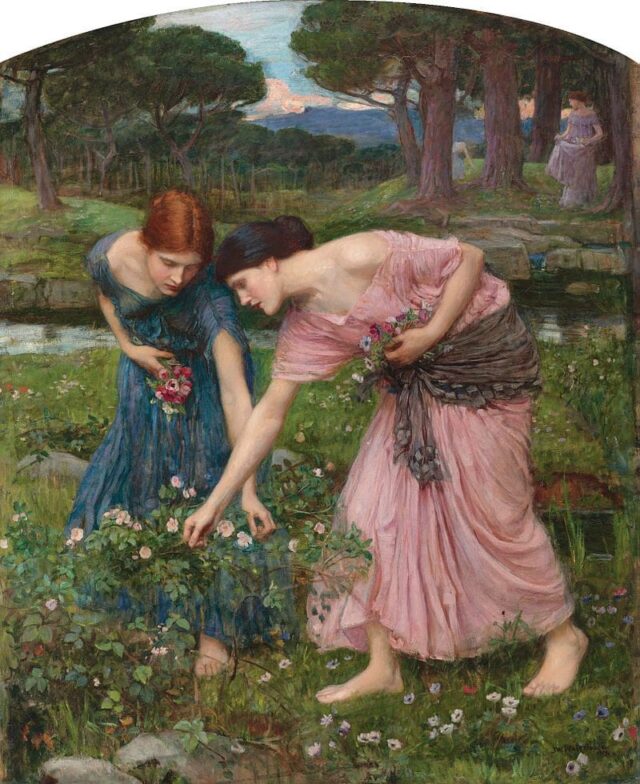
John William Waterhouse painted beautiful women, doomed lovers, sorceresses, flowers, mirrors, water, and enough flowing fabric to supply a small costume department.
But the beauty can disguise how carefully his pictures are engineered. Waterhouse inherited ideas from the Pre-Raphaelites, combined them with academic painting, and repeatedly chose stories at the exact moment when desire was about to become dangerous.
Here are nine secrets hiding inside his paintings.
1. He Usually Painted the Moment Before Trouble
Waterhouse rarely needed to show the disaster itself. He preferred the dangerous pause before it.
In The Lady of Shalott of 1888, the heroine has already left her tower and is drifting toward Camelot, but her fate has not yet arrived. In Hylas and the Nymphs, Hylas leans toward the beautiful water nymphs just before they lure him to his disappearance.
That timing gives the viewer an advantage over the character: we sense what is coming while they are still moving toward it.
When illustrating a dramatic story, test the moment immediately before the climax; anticipation can hold attention longer than showing the consequence itself.
2. Beauty Is Often the Trap
Waterhouse’s paintings are beautiful, but beauty frequently signals danger.
The nymphs in Hylas and the Nymphs are irresistible precisely because they don’t look threatening. Circe is elegant and commanding. Sirens attract before they destroy. Even the natural world—flowers, water, reeds, gardens—can feel seductive while something ominous develops underneath.
That contradiction gives Waterhouse’s prettiness tension. If everything beautiful were also safe, the pictures would become decorative very quickly.
If your work is becoming too sweet, don’t automatically make it uglier; introduce one detail that makes the beauty psychologically uncertain.
3. He Used Hands to Tell the Story
Look at the hands.
Waterhouse frequently gives them important narrative work. They clutch chains, hold bowls, gather flowers, touch water, grip a boat, weave, reach, or hover just before contact. Because faces can remain relatively controlled, the hands often reveal what the figure is actually doing or feeling.
This is particularly useful in figurative art because hands can connect the character to the surrounding world. A gaze tells us where someone is looking; a hand tells us what they are about to change.
When drawing a figure, decide what the hands are doing before treating them as anatomical details to be solved at the end.
4. He Made Water Do More Than Look Pretty
Waterhouse certainly had an appropriate surname.
Water appears repeatedly in his work: rivers, pools, fountains, marshy edges, and reflective surfaces. But it isn’t merely scenery. In The Lady of Shalott, water carries the heroine toward her fate. In Hylas and the Nymphs, it hides the world into which Hylas is being drawn.
Water is useful because it can simultaneously reveal and conceal. Its surface reflects light while its depth remains unknowable.
When using a recurring element such as water, fire, windows, or flowers, give it a job in the story instead of allowing it to remain background decoration.
5. He Let the Viewer Become the Person Being Seduced
In Circe Offering the Cup to Ulysses, Circe faces outward and extends the cup toward us. Ulysses can be seen reflected in the mirror behind her.
That arrangement does something clever: the viewer occupies roughly the position of the person being confronted by Circe. We aren’t simply watching an ancient myth from a safe distance. Waterhouse pulls us into its psychological geometry.
The same idea can work without mythology. A direct gaze, reaching hand, open doorway, or object extended toward the picture plane can implicate whoever is looking.
Instead of always arranging a scene for the viewer to observe, try composing one in which the viewer seems to occupy a specific place inside the action.
6. He Borrowed From the Pre-Raphaelites Without Simply Being One
Waterhouse is routinely associated with the Pre-Raphaelites, and understandably so. He painted literary subjects, medievalizing scenes, intense color, detailed nature, and beautiful women—the territory strongly associated with artists such as Rossetti, Millais, and Hunt.
But Waterhouse was born in 1849, a year after the Pre-Raphaelite Brotherhood was founded. He belonged to a later generation and trained at the Royal Academy Schools. His work combines Pre-Raphaelite interests with a looser, more painterly academic approach.
That mixture is part of what makes him interesting: he inherited a visual language without becoming its photocopy.
When borrowing from a style you admire, identify two or three principles worth keeping and let the rest collide with techniques that already belong to you.
7. Flowers Are Often Evidence
Waterhouse filled paintings with flowers, but they aren’t always harmless decoration.
In Ophelia and The Lady of Shalott, vegetation helps connect literary characters to their environments and reinforces the emotional atmosphere. In Hylas and the Nymphs, water lilies make the pool extraordinarily inviting while also helping conceal its depth and danger.
This is one reason his detail doesn’t always feel random. A plant can establish season, place, mood, symbolism, or even guide the eye through the composition.
Before adding a beautiful detail, ask what second job it can perform—directing attention, establishing place, revealing character, or quietly changing the meaning of the scene.
8. His Women Often Have More Power Than the Men
Waterhouse is famous for paintings of women, but many of these figures aren’t passive beauties waiting to be admired.
Circe commands. The nymphs overwhelm Hylas. Sirens lure sailors. Medea prepares magic. Even when Waterhouse depicts vulnerable figures such as Ophelia or the Lady of Shalott, he often concentrates intensely on their interior psychological moment rather than turning them into incidental characters in someone else’s adventure.
There is a complicated Victorian fascination with the dangerous or supernatural woman underneath many of these subjects, so they shouldn’t automatically be read as modern images of female empowerment. Still, Waterhouse repeatedly understood that the person with the most visual beauty could also possess the most narrative power.
When designing a scene, don’t assume the largest, loudest, or most physically dominant character should control it; give visual authority to the person who actually changes what happens.
9. He Repeated Subjects Instead of Hunting Constantly for New Ones
Waterhouse returned to certain characters and ideas throughout his career. He painted multiple versions of Ophelia and repeatedly revisited women from mythology, poetry, and legend.
Most famously, he painted The Lady of Shalott more than once, approaching Tennyson’s character at different moments rather than treating the first successful painting as the final word.
That’s a useful counterargument to the pressure artists feel to constantly invent new subjects. A subject can contain several pictures if you change the moment, viewpoint, emotional temperature, scale, or composition.
When you’ve made a successful piece, don’t immediately abandon the subject in search of originality; ask what happens five minutes earlier, five minutes later, or from the other side of the scene.
Waterhouse’s secret wasn’t simply that he could paint beautiful mythological women. Plenty of Victorian painters could do that.
His stronger skill was turning beauty into suspense. A flower leads somewhere. A hand is about to act. Water hides something. A mirror reveals someone. A beautiful stranger may be dangerous.
That’s why his best paintings still hold attention after their Victorian storytelling has become unfamiliar: he understood that a beautiful image becomes much harder to forget when the viewer suspects something is about to happen.