Wellington’s art history did not begin with paint on canvas or bronze on plinth. It began with the shaping of surfaces—wood, flax, stone, and skin—within a cultural world that did not separate beauty from purpose. Long before the city bore its colonial name, Te Whanganui-a-Tara was already dense with symbolic form. The land itself, with its steep ridges and sweeping harbour, was read and marked as a living structure, folded into a system of belief, memory, and authority. Māori visual traditions in this region were not decorative; they were declarative, functional, and woven tightly into daily life.
Carving, pattern, and meaning in Māori art of the Wellington region
The people of Te Whanganui-a-Tara—principally of Ngāti Toa, Te Āti Awa, Ngāti Raukawa, and earlier iwi—brought with them a set of artistic practices deeply rooted in whakapapa, or genealogical connection. Carving (whakairo) served not only to embellish buildings or weapons, but to locate them within ancestral and cosmological orders. In the Wellington region, whare whakairo (carved meeting houses) carried unique regional styles: elongated forms, sharply defined mouths, and angular surface patterns reflecting the rugged southern terrain. Tukutuku panels—geometric latticework patterns—were used not only to decorate but to communicate affiliations and events.
The carved figures inside a wharenui were not symbolic in the abstract sense; they were regarded as literal presences, ancestors held in wood, embodying protection, memory, and mana. Their forms—spiraled eyes, notched limbs, incised torsos—were part of a visual language understood by those who moved among them. Tools were simple: stone adzes, later steel chisels. But the complexity of the patterning, especially the fine rauru (spiral scrolls) and pakati (dog-tooth notching), reveals an aesthetic sophistication embedded in a non-Western canon.
Even smaller objects—waka huia (treasure containers), pare (lintel carvings), mere (short weapons)—bore ornamentation that linked them to status and lineage. These items were not museum pieces. They were used, worn, carried, and passed on—art not as display, but as part of life.
Place-based symbolism: landforms, pā sites, and seasonal aesthetics
The harbour was never neutral. Every hill and inlet in Te Whanganui-a-Tara had a name, a story, a function. Aesthetic choices in visual culture reflected this close reading of the land. Pā sites—fortified settlements—were often positioned on steep ridges, their placement reinforcing ideas of strength, visibility, and possession. Their designs balanced form with function: terraced earthworks, palisades, carved gateways. Even the earth itself could be shaped with aesthetic intent, visible from great distances and deeply connected to the assertion of identity.
Seasonal change affected visual life as well. Summer gatherings brought textiles, adornment, and performance into alignment with specific times of year. Women’s weaving—through cloaks (kākahu), belts, and headbands—relied on geometric patterning and symbolic material, such as feathers from rare birds or dyed muka (flax fiber). These choices were not only decorative, but strategic: they displayed status, iwi affiliation, and resource access. Wellington’s variable climate, with its persistent wind and salt air, also influenced material choices. Durability mattered.
The natural world appeared not as background but as participant. Birds, fish, stars, and plants entered into carved and woven forms as active presences. Ruru (morepork owls), tuna (eels), and whetū (stars) were part of the same pattern logic as ancestors and warriors. The aesthetic world was complete and continuous.
Continuity and adaptation in visual storytelling
Though the arrival of Europeans in the 19th century disrupted many of these patterns—both socially and materially—the visual systems did not vanish. Instead, they adapted. Carvers began incorporating new tools and sometimes new materials. Christian imagery occasionally appeared in wharenui alongside ancestral figures, not as submission, but as integration. New patronage systems—missionaries, collectors, tourists—also changed the context in which Māori art was produced. Some carvers began making works for sale or trade, while still preserving traditional methods and narratives in parallel.
One notable feature of Wellington’s art history is the continuity of certain forms even under stress. Whakairo remained central to marae culture throughout the region, and weaving retained its role as both daily craft and ceremonial marker. Oral narratives continued to guide aesthetic choices. And the visibility of Māori visual systems persisted, even when sidelined by colonial taste.
In modern times, many of the pre-colonial patterns and practices have been reasserted—sometimes through restoration, sometimes through innovation. But it’s critical to recognize that the original forms were not “lost” so much as deliberately marginalized by official institutions. The visual traditions of Te Whanganui-a-Tara endured in households, in gatherings, and in memory, long before they re-entered the walls of national museums or urban galleries.
Wellington’s art history begins, then, not with canvas or sculpture, but with carving knives, flax strips, and the spoken word made visible in pattern. These early visual cultures still shape the city’s self-understanding, even as their meanings have shifted. The land itself remains part of the composition—an ancient frame for a city still trying to read itself clearly.
Drawing the Colony: Early European Depictions of Wellington
When European ships arrived in Te Whanganui-a-Tara in the early 19th century, they brought more than men and materials. They brought eyes trained by European conventions—of survey, of property, of aesthetics. These newcomers began drawing the land almost immediately. They made sketches, painted watercolours, and annotated maps. These were not idle artworks. They were documents of ambition, designed to transform land into commodity, territory into colony. Wellington’s early art was thus inseparable from questions of ownership, vision, and settlement.
Naval sketchbooks, survey drawings, and landscape painting
Among the earliest images of the Wellington region are those produced by naval officers and surveyors. Men like Captain Edward Main Chaffers and William Mein Smith were not artists in the academic sense, but their drawings possess a sharpness and clarity shaped by navigational need. Headlands, reefs, and coastal contours were marked with precision. These works recorded what could be claimed, charted, and built upon.
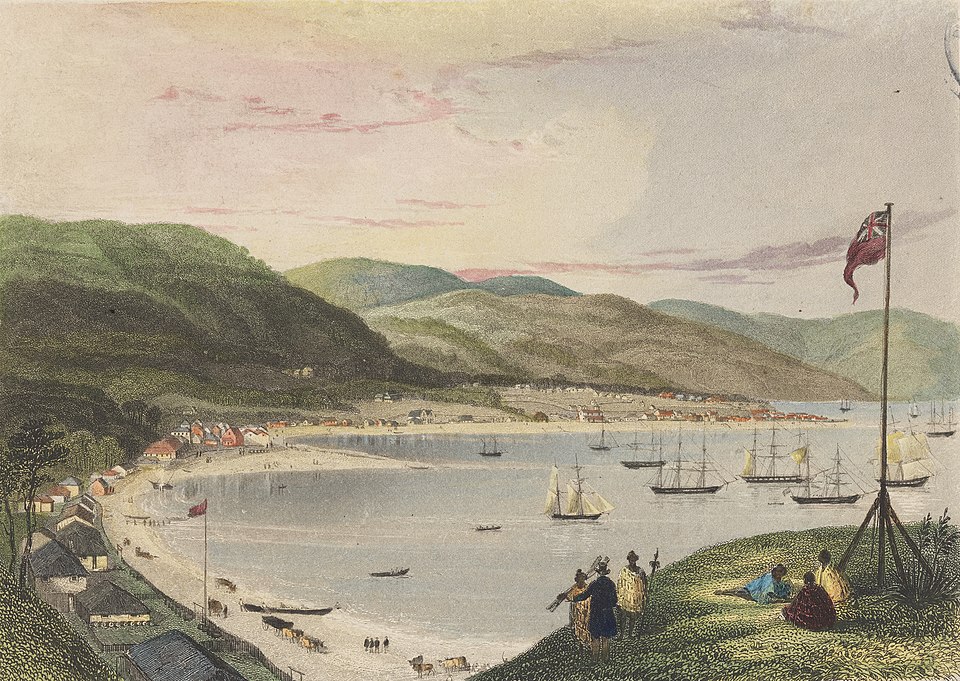
Yet even in their pragmatism, these sketches often carried aesthetic sensibilities. The horizon line was carefully placed; clouds and water were shaded for drama. In some works, especially those meant for publication or official report, we begin to see the blending of cartographic and pictorial values. A painting like Charles Heaphy’s Port Nicholson from the hills above Pitone (c. 1841) offers not just a view, but a claim: it frames Wellington Harbour as inviting, orderly, and undeveloped—a site of possibility waiting to be shaped.
Heaphy, officially employed by the New Zealand Company, played a dual role. His job was both to survey and to persuade. His images were used in promotional materials sent back to England, designed to attract settlers. These paintings smoothed over difficulty: rugged terrain is softened, Māori presence is distant or absent, and the weather is idealized. These choices were not accidental. They were visual salesmanship.
Charles Heaphy, the New Zealand Company, and visual documentation
Heaphy remains the central figure in early colonial imagery of Wellington. Trained as a draftsman, he arrived in New Zealand at age 20 and quickly became the Company’s most reliable artist. His watercolours combined fine observational skill with the promotional optimism that Edward Gibbon Wakefield’s colonization schemes required. Heaphy’s scenes of Lambton Harbour, Thorndon flats, and the surrounding hills frequently featured organized rows of tents or tidy cabins, even before such order existed.
One of his most reproduced works, Wellington, New Zealand—1841, shows the harbor from above, with European structures neatly nestled into the coastal bend. In the far distance, a few Māori figures are included—dwarfed by scale, separated by space. The effect is deliberate: Heaphy renders Māori as peripheral, already overtaken by the inevitability of British order. This kind of pictorial framing allowed settlers to imagine themselves not as invaders, but as improvers of an empty, underutilized landscape.
Yet despite their biases, these works offer valuable detail. Vegetation, ridge lines, tide levels, and early street plans are captured with care. They document the transformation of a raw settlement into a proto-city. Some of Heaphy’s later works, including interior views of pā or portraits of Māori individuals, show greater complexity. But his primary legacy remains tied to the colonial eye—to the image as an instrument of planning and persuasion.
Settler interpretations of terrain, architecture, and local inhabitants
As Wellington developed through the 1840s and 1850s, more amateur artists emerged—settlers with training or curiosity who sketched the land around them. Their work often borrowed from the English picturesque: gently undulating hills, central perspectives, softened light. But the New Zealand terrain resisted easy translation. The hills were too steep, the bush too tangled, the weather too changeable. Many images show an uneasy compromise between ideal and reality: vertical cliffs forced into diagonal compositions, unruly trees made to behave like English oaks.
Architecture, too, became a subject of visual documentation. Early sketches of government buildings, port facilities, and private dwellings tell a story of adaptation—wooden houses raised on stilts, cottages wedged into gullies, roads barely distinguishable from muddy tracks. These works rarely idealized their subjects. Instead, they often conveyed a sense of frontier fragility. Wellington, in its early decades, looked more like a temporary camp than a capital.
Māori subjects continued to appear, though usually filtered through European conventions. Portraits were made in the style of ethnographic studies, emphasizing costume and tattoo. Scenes of everyday life were often stiffly composed, focusing on difference rather than understanding. Few early artists attempted to capture the worldview behind the forms they depicted. Even sympathetic images were filtered through a colonial framework.
Still, some records stand out for their observational power. The anonymous artist of the Edward Jerningham Wakefield Sketchbook (1840s) included dynamic, detailed scenes of waka on the harbor, dense bush near Kaiwharawhara, and complex pā structures on coastal ridges. These fragments, created without clear agenda, offer a glimpse of a world in motion—neither idealized nor condemned, but seen with genuine interest.
As the 19th century progressed, artistic attention began to shift. Photography arrived. Formal art education spread. New Zealand-born artists emerged. But these early images of Wellington, drawn hastily in damp notebooks or painted for English investors, remained the visual foundation of the colony. They helped to shape how the land was seen, and therefore how it was used.
The act of drawing a place, especially at the moment of its claimed transformation, is never neutral. The earliest artworks of Wellington were tools of vision and control—art in the service of mapping, selling, and building. Yet within them, unintentionally, they also captured the awkwardness, the contingency, and the uncertainty of a city being imagined into existence.
Institutions and Authority: Museums, Collections, and Official Taste
By the late 19th century, Wellington was no longer a frontier town but a functioning colonial capital. Its streets were paved, its government housed in permanent buildings, and its status formalized. With that status came the imperative to define culture—and to control its display. The creation of museums, galleries, and official collections in Wellington was not simply about preservation. It was about power, interpretation, and national image. Through these institutions, the city began to shape how New Zealand saw itself, and what it chose to value.
The Colonial Museum and the development of a national visual archive
The origin of New Zealand’s national art and museum system can be traced to 1865, when the Colonial Museum was established in Wellington under the leadership of Dr. James Hector. Though initially focused on geology and natural history, the museum quickly expanded its ambitions. Its collections grew to include Māori artifacts, ethnographic material, and visual documentation of the landscape. These early assemblages were framed less by aesthetic criteria than by classification. The museum’s purpose was to order the world for administrative understanding.
Objects were displayed in vitrines, arranged by type, and labeled in English. Māori taonga were not presented as living cultural items but as relics of a receding past. This framing suited the political atmosphere of the time, which saw Māori culture as something to be recorded, categorized, and absorbed into colonial memory. The museum’s display practices mirrored the structure of empire: taxonomic, impersonal, and confident in its own authority.
At the same time, the museum began accumulating paintings, photographs, and drawings—mostly by European artists—documenting the land and its transformation. These images reinforced the narrative of progress: swamps drained, bush cleared, roads built, towns established. The idea of art as national record took precedence over art as expression. The institution’s taste leaned toward the illustrative and didactic.
Though modest in size, the Colonial Museum formed the seed of something larger. It established the precedent for a central cultural repository in Wellington, one whose authority derived not from popularity, but from proximity to power. Over time, its collections would grow into something more deliberate—and more contested.
The founding of the National Art Gallery and its early acquisitions
In 1936, Wellington’s ambitions took a decisive step with the establishment of the National Art Gallery, located in the new Dominion Museum building on Buckle Street. This formalized the capital’s role as cultural centre. The Gallery was born not out of popular demand, but bureaucratic initiative. It was a state-sanctioned space, built with the belief that a young nation needed not only governance but cultural definition.
Its early acquisitions reflected a narrow view of art’s purpose. Paintings by European masters (or minor figures with European training) were prioritized, alongside conservative landscapes by local artists. John Gully’s watercolours, with their romantic depictions of New Zealand’s terrain, were typical of the taste: familiar, inoffensive, and easily framed as national pride. Māori art was largely absent, or sequestered in the adjacent ethnographic wing.
Curatorship in the Gallery’s early years was cautious. Exhibitions followed traditional formats, favoring historical painting and academic realism. The role of modernism was barely acknowledged. Local artists who deviated from established norms often found themselves ignored or delayed in recognition. Wellington’s position as capital, ironically, made it more conservative than cities like Auckland or Dunedin, where private galleries and eccentric collectors had more freedom.
Yet the institution also laid groundwork for permanence. Unlike ephemeral exhibitions or commercial ventures, the Gallery built a collection. Works were catalogued, stored, and re-shown. Gradually, a visual memory of the country was being assembled. In its own restrained way, the Gallery shaped taste—what was hung, what was bought, what was taught.
Government influence on cultural priorities through exhibition
What was displayed in Wellington mattered because it was seen as official. When works were exhibited at the National Art Gallery, they were not simply paintings on a wall; they were statements of national tone. Successive governments—especially from the 1950s onward—used cultural institutions as part of their broader image-making strategies. Exhibitions marked centenaries, diplomatic anniversaries, or public events. Art became part of civic ceremony.
This often led to tension. Some artists found themselves included only when their work aligned with acceptable themes: pastoral beauty, colonial nostalgia, or technical skill. Others—those whose work challenged established narratives or aesthetics—were quietly passed over. The line between curatorial judgment and ideological convenience was rarely acknowledged but often present.
Even architectural choices reinforced hierarchy. The Dominion Museum building, with its neoclassical façade and solemn symmetry, broadcast a sense of order and legitimacy. Visitors entered through marble halls into galleries modeled on European precedent. There was little room for ambiguity or dissent. The institutions of culture mirrored the institutions of government: structured, formal, self-assured.
Still, cracks eventually began to show. In the later decades of the 20th century, artists and critics began challenging the authority of state-led taste. Independent galleries emerged, and debates about national identity spilled into exhibition policy. But throughout this period, Wellington remained the centre of institutional power. The capital’s museums and galleries may not have shaped the country’s most daring art, but they shaped its canon.
The art institutions of Wellington were never neutral vaults of national creativity. They were built with intention—selective, strategic, and tied to state identity. Their walls carried not just paintings, but priorities. And even as tastes changed and politics shifted, the influence of those early choices still lingers in what hangs in frames, what remains in storage, and what is still left out.
Art and Architecture in a Government Town
Wellington is not a large city, but it is a symbolic one. As the capital of New Zealand, it holds a disproportionate concentration of decision-making power, public monuments, and architectural ambition. These characteristics have deeply influenced its visual culture. More than just a backdrop for politics, the city has functioned as a physical expression of national identity—sometimes stiff with formality, sometimes unexpectedly bold, and often caught between pragmatism and aspiration. The built environment and its embedded art tell a story of a place continually trying to look like a capital, while also accommodating the unpredictable terrain and the realities of scale.
Civic buildings and state-funded embellishment
The effort to project authority through architecture began in earnest in the early 20th century, as Wellington moved beyond its provincial beginnings. Government buildings were no longer simply practical structures—they were designed to represent the stability and seriousness of a nation. The former Government Buildings on Lambton Quay, built in 1876 and constructed entirely of native timber, adopted the style of a Renaissance stone palace. It was a calculated illusion: permanence and elegance imposed upon impermanence and fragility.
In the 1930s and 40s, the Dominion Museum, National Art Gallery, and National War Memorial were all housed together in a vast neoclassical complex on Mount Cook, which loomed over the city like a stone declaration. The museum’s carved panels, colonnaded portico, and heavy symmetry made little attempt to speak to the local environment. It borrowed its authority from European capitals and translated it into Antipodean grandeur.
Alongside these civic monuments, government departments quietly commissioned art for interiors—murals, mosaics, friezes, and reliefs. These works often followed public themes: industry, unity, agriculture, war. Their style was subdued, leaning toward social realism or formal abstraction. Rarely did they challenge the viewer. They were intended to reassure, to reflect competence and harmony within the state.
Three examples of this state-backed visual culture in architecture:
- John Drawbridge’s mural for the Beehive’s banquet hall, an abstract rendering of New Zealand landscapes and light, large in scale but non-confrontational in tone.
- Len Lye’s designs for government posters in the 1930s, promoting national branding through streamlined modernist graphics.
- James Turkington’s mosaic work in post offices and government buildings, using classical motifs in functional civic spaces.
This was a version of art made legible to bureaucracy—stylized, safe, and in service of the building.
The tensions of identity in a small but symbolic capital
Wellington’s status as capital has often created a paradox. The city houses the major national institutions—the National Library, the national museum, the film archive, the Parliament—but it is physically constrained, both by geography and population. Its hills and harbor limit urban expansion. Its weather discourages street life. Its public spaces, particularly in the second half of the 20th century, were often built more for display than for use.
This gave Wellington an odd cultural posture. It had to look the part of a capital, while functioning like a provincial town. The result was a series of aesthetic compromises. Monuments stood isolated in windswept plazas. Grand buildings faced empty courtyards. Sculptures, meant to evoke permanence or pride, often felt untethered from daily life. There was ambition, but it floated above the footpath.
Artists responded in mixed ways. Some found inspiration in the contrast—between formality and informality, between state symbolism and private disaffection. Others resisted entirely, turning to ephemeral or oppositional modes. The city’s architectural authority, instead of silencing dissent, helped define it.
In residential architecture, Wellington displayed more character. The city’s wooden villas, zigzagging up steep streets, became icons of domestic life. They were often brightly painted, modest in scale, and visually expressive. Unlike the civic buildings, they grew organically. Their decoration was personal. This divide—between public uniformity and private individuality—became one of the capital’s most enduring visual dynamics.
Urban form, harbor views, and visual hierarchy
Topography defines Wellington. Its hills, ridges, and sharp coastal edges impose a vertical logic on the city’s layout. This physical constraint has also shaped its visual culture. Views matter. Sightlines are prized. The city is composed not just of buildings but of perspectives—harbor glimpses between houses, government blocks seen from hilltops, monuments silhouetted against grey skies.
This verticality has aesthetic consequences. Large public art projects are rare and difficult. The wind discourages sculpture. The terrain limits open space. Instead, much of Wellington’s visual identity is embedded in smaller interventions—murals down alleyways, carved panels on façades, tiled steps, stencil work, and signage. The city rewards those who look closely and navigate irregularly.
In some ways, this has made Wellington more visually interesting than larger cities. It has no single aesthetic centre. Its public art is dispersed, often encountered by accident. The Beehive, with its circular Brutalist form, remains the most debated architectural gesture in the city: admired for its confidence, disliked for its scale, and yet undeniably memorable.
The city’s visual hierarchy is complex:
- At the top are national symbols—Parliament, memorials, museums.
- In the middle are civic buildings, universities, and infrastructure.
- At street level is an informal, improvised, and often playful visual world—signwriters, muralists, shopfront designers, students.
This layering creates visual tension, but also richness. It’s a city where institutional gravity and everyday creativity coexist, if uneasily. It’s a place where the view from the hill never quite matches the feeling on the street.
Wellington’s built form has never fully resolved the question of whether it is a government town that hosts art, or an art city that happens to house government. Its architecture carries both impulses—control and expression—and the result is a civic aesthetic that is sometimes stiff, sometimes strange, and often surprisingly alive.
Private Circles, Public Silence: Artists in Mid-Century Wellington
In the mid-20th century, Wellington had the infrastructure of a cultural capital—national galleries, government support, a concentration of civil servants—but it lacked a confident public art scene. For many local artists, the city was a place of opportunity and constraint in equal measure. It provided jobs, commissions, and institutional presence. But it offered little warmth to those working outside approved conventions. In this era, Wellington’s art world functioned more as a series of private networks than as a coherent public culture. Behind closed doors, important work was being made—but outside those circles, much of it went unnoticed.
The role of collectors and private galleries
Throughout the 1940s and 50s, most visual art in Wellington was shown in a handful of venues, none of them especially adventurous. The National Art Gallery continued to favour historical works, established names, and polite modernism. More challenging art found refuge in private spaces—modest commercial galleries, university exhibitions, or the homes of collectors. It was in these quieter venues that much of the capital’s cultural substance resided.
One such space was the Helen Hitchings Gallery, opened in 1949 on Bond Street. Though short-lived—closing in 1951—it was a landmark in New Zealand art history. Hitchings created a domestic environment where furniture, ceramics, textiles, and paintings were shown together, inviting visitors to imagine modern art as part of everyday life. The gallery championed contemporary artists such as Toss Woollaston, Rita Angus, and Douglas MacDiarmid, giving them visibility at a time when institutional support was minimal. Hitchings’s clientele included civil servants, architects, and a few open-minded collectors—an educated but cautious audience.
Private collectors played a crucial role in this ecosystem. Many of them worked in government, academia, or publishing. They bought modestly but with conviction. Their purchases often circulated within small networks, reinforcing a closed but committed scene. Wellington’s art world in this period functioned less like a marketplace and more like a club—membership informal but not accidental.
Three characteristics defined the collecting culture of mid-century Wellington:
- Intimacy: most exhibitions occurred in small rooms, attended by familiar faces.
- Discretion: challenging work was supported quietly, without public declarations.
- Persistence: artists often showed the same work multiple times, waiting for recognition to catch up.
While Auckland developed a more confident commercial gallery scene, Wellington’s strength lay in its depth—low visibility, but high seriousness.
Wellington artists and the challenge of national visibility
The isolation of the Wellington scene was not just cultural but geographical. Artists working in the capital found themselves overshadowed by their counterparts in Christchurch and Auckland, where more experimental movements were taking hold. Rita Angus, though based for a time in Wellington, often showed in Christchurch. McCahon, though he exhibited in the capital, never made it his base. Wellington’s own painters—such as Evelyn Page, E. Mervyn Taylor, and Cedric Savage—struggled to establish national profiles despite strong technical skill.
This wasn’t a question of talent but of tone. Wellington’s cultural institutions tended to favour balance and reason over provocation. Artists whose work veered too far into abstraction, symbolism, or psychological intensity often found themselves politely sidelined. Even Angus, now considered one of the greats of New Zealand painting, was viewed during her lifetime as “difficult”—her portraits too severe, her style too singular.
E. Mervyn Taylor, one of the most prolific illustrators and wood engravers of the period, embodied both the opportunity and the limits of Wellington. His work appeared in official publications, on postage stamps, and in educational books. He also made deeply personal prints and murals rooted in Māori and European visual traditions. Despite his public reach, Taylor never gained the institutional status of his peers in other cities. His quiet symbolism and refusal to conform made him both valuable and peripheral.
Many Wellington artists of the time supported themselves through teaching or commercial illustration. Some found work in state broadcasting, publishing, or the education system. These jobs offered stability but often diluted their artistic ambition. The city’s pragmatic atmosphere discouraged risk.
What developed was a kind of split: artists who exhibited within official structures adapted their work to conservative expectations, while those who worked outside did so in semi-obscurity. The National Art Gallery occasionally attempted to reconcile these worlds, but rarely with conviction.
The capital’s cool reception to modernism
If modernism arrived in Wellington, it did so slowly—and without celebration. Abstraction, expressionism, surrealism, and other European movements had little early traction in the city’s galleries. The few modernist exhibitions that did occur were usually framed with caution, hedged by explanation or academic commentary. Modernism was treated not as a living movement but as a foreign curiosity, to be assessed rather than embraced.
This conservatism was not merely aesthetic—it was cultural. Wellington’s status as the administrative centre of New Zealand fostered a bureaucratic mindset. Visual clarity, narrative legibility, and technical control were preferred. Art was expected to behave. Radical form was often mistaken for incompetence, and emotional intensity for lack of discipline.
The exception to this rule came from artists who operated at the margins. Some drew influence from European émigrés. Others looked to pre-Christian myth, local geology, or personal memory for their visual language. But they remained largely on the outskirts of public recognition until much later.
This hesitance had lasting consequences. While Auckland cultivated a more internationalist and confident art scene in the second half of the 20th century, Wellington remained guarded, structured by its official duties. The visual culture of the capital did not lack intelligence—it lacked friction. Where art needed to jostle against the world, Wellington often padded the impact.
And yet, within those constraints, important work was done. The city’s artists created pieces of extraordinary depth, though often seen only by small audiences. Their silence was not absence. It was the background hum of a city thinking slowly, carefully, and—at times—brilliantly beneath its formal exterior.
McCahon, Abstraction, and the Rise of the Intellectual Painter
By the mid-20th century, the dominance of landscape realism and tidy illustrative styles in Wellington had begun to weaken—slowly, and not without resistance. The arrival of abstraction, symbolism, and more openly conceptual approaches marked a shift not just in technique, but in temperament. Art was no longer expected to simply reflect the world; it was allowed to wrestle with it. The figure who most embodied this transition—both its promise and its discomfort—was Colin McCahon. Though based in Auckland for most of his working life, McCahon’s relationship with Wellington was complex, significant, and revealing.
Colin McCahon’s exhibitions and influence in Wellington
McCahon exhibited in Wellington intermittently from the 1940s onward. His early shows were met with cautious interest at best, open hostility at worst. His 1947 exhibition at the Wellington Public Library—a humble setting, far from the National Art Gallery—was a bold departure from the visual norms of the time. His spiritual landscapes, with their dark outlines and blocky forms, confounded local viewers. Letters to the editor described the work as “childish” and “bewildering.” It was clear the city wasn’t ready.
And yet, McCahon’s work kept returning. His association with figures like Ron O’Reilly, a forward-thinking librarian and later arts advocate, helped create inroads for him in Wellington’s cultural circles. The National Art Gallery began to take notice. Curator Melvin Day, himself a painter of considerable ability, was one of the first within the institution to recognize McCahon’s seriousness. Still, support was halting. His works entered public collections slowly and without fanfare.
One key moment came in 1968 with the exhibition Colin McCahon: A Survey at the National Art Gallery. It presented three decades of work—biblical series, landscape abstractions, text paintings—and gave Wellington its first sustained encounter with the painter’s full ambition. The public response was mixed. Some critics hailed the work’s gravity and emotional charge. Others dismissed it as self-important and inaccessible.
What McCahon introduced to the capital was not just a new style, but a new mode of address. His paintings did not seek approval. They demanded engagement. They quoted scripture, invoked mortality, questioned belief. For a city used to tidy harbour scenes and heroic portraits, it was a jolt.
Abstraction, religious themes, and philosophical painting
While McCahon was the most visible figure, he was not alone in pushing Wellington toward a more conceptual art culture. Artists such as Gordon Walters, Milan Mrkusich, and later, Don Peebles brought geometric abstraction and minimalist sensibility into the conversation. These painters drew on international movements but localized their formal inquiries to New Zealand’s specific tensions: isolation, light, and the vertical pull of land and sky.
In Wellington, this language of abstraction often ran parallel to more metaphysical concerns. Painters and sculptors began to engage with ideas of belief, transcendence, and silence—not in didactic terms, but as embedded structures within the work. McCahon’s use of biblical texts, for instance, was not evangelical. It was anxious, pleading, searching. His black-and-white paintings of the late 1960s—Victory Over Death 2, Practical Religion, Gate III—offered visual sermons for a secular, fractured nation.
These works resonated awkwardly in a city built on institutional rationality. Wellington’s government buildings had little appetite for religious doubt rendered in stark modernist forms. And yet, precisely because of their difficulty, these paintings lingered. They asked questions the capital preferred not to face: What do we believe? What do we ignore? Where is permanence found in a culture built on paperwork and pavement?
A particularly illustrative moment came with McCahon’s Gate III, commissioned for the Victoria University campus in 1970. The painting, massive and uncompromising, was installed in a space rarely used for art. Its stark words—“I AM”—loomed over students and staff alike. Reactions ranged from admiration to confusion to outright contempt. But the work remained. It could not be easily moved, literally or intellectually. In this way, McCahon became not just a painter of images, but a disruptor of space.
National versus regional aesthetics in a centralizing art scene
McCahon’s growing stature as New Zealand’s foremost painter also exposed deeper fractures in the country’s cultural geography. His presence in Wellington exhibitions highlighted the gap between Auckland’s increasingly confident art world—experimental, outward-facing—and the capital’s more restrained atmosphere. Wellington artists struggled to define their own voice against this backdrop.
Some resisted entirely. Don Peebles, based in Wellington for much of his life, pursued a rigorous abstraction rooted in material process. His relief works and constructed canvases, especially those from the 1970s onward, moved away from gesture and toward architecture. Peebles never chased national fame, but his formal intelligence gave Wellington a quieter, more analytic branch of abstraction. He taught at the Wellington Polytechnic School of Design, influencing generations of students through example rather than posture.
Others, like M. T. Woollaston, maintained a more lyrical, landscape-rooted style, but with increasing abstraction and emotional charge. Woollaston’s works, often shown in Wellington even when he lived elsewhere, offered a more fluid, painterly counterpoint to McCahon’s rigidity. These regional differences were not just stylistic—they reflected different temperaments, different kinds of attention.
Wellington’s version of abstraction was never fashionable, but it was durable. It tended to avoid bravado. It was quiet, searching, and deeply formal. In time, it shaped a school of painters and sculptors who found freedom within limits—who saw in McCahon not a blueprint, but a challenge.
What emerged in this period was a new kind of seriousness in the city’s art: not institutional seriousness (which had always existed), but philosophical weight. Painters began to use form to think—not just to decorate or document. This shift did not create a booming art market, nor did it generate celebrity. But it changed the expectations of what painting could do in the capital.
Wellington’s embrace of abstraction and intellectual painting was never total, but it was lasting. It made the city a site of reflection as much as production. And it helped anchor the idea that art in the capital could be not only decorative or dutiful, but difficult—and worth the difficulty.
Government Patronage and Postwar Optimism
In the decades following World War II, New Zealand’s government undertook a period of concentrated nation-building. Wellington, as the seat of state power, became the focal point of this effort. The postwar years saw a flurry of infrastructure projects, housing schemes, and public institutions—all underpinned by a belief in collective progress. Art was enlisted into this vision, not as ornament but as an instrument of national unity and civic morale. In this moment of planned optimism, government patronage shaped much of what was seen, funded, and remembered in the visual culture of the capital.
The state’s role in commissioning murals, mosaics, and sculpture
The Public Works Department, the Ministry of Works, and various state-owned enterprises began commissioning artists to embellish government buildings and public facilities. These weren’t gallery pieces—they were integrated into walls, foyers, stairwells, and courtyards. The works were large in scale, public in function, and almost always site-specific. Though the budgets were modest, the symbolic value was high.
Many of these commissions were executed by artists with strong connections to Wellington. Mervyn Taylor, best known for his wood engravings, created a series of murals for post offices and schools across the country, several of which were located in or near the capital. His mosaic for the Petone Post Office—now lost—depicted Māori mythology with a modernist sensibility, marrying narrative clarity with formal restraint. Taylor believed that art in public buildings should be accessible, didactic, and grounded in local identity.
Other examples include:
- John Drawbridge, who produced large-scale abstract murals for government interiors, including the New Zealand Embassy in Washington, D.C., and the Beehive in Wellington. His work softened international modernism with regional sensitivity.
- James Turkington, who created figurative panels and stylized reliefs, often focused on themes of labour, communication, and national industry.
- Eileen Mayo, who worked on textile and poster design for state services, and whose precision and elegance extended into the visual education of the public.
These commissions created a dispersed but coherent visual language: civic art that affirmed public order, celebrated the natural environment, and humanized bureaucratic spaces. While rarely radical, these works were often intelligent, formally refined, and quietly ambitious.
Public art in post offices, schools, and civic buildings
Perhaps the most distinctive feature of this era was the integration of art into the everyday. Post offices in small suburbs, school assembly halls, hospital corridors—these became unlikely but effective venues for artistic display. Wellington led the way in embedding art into public space not as afterthought, but as principle.
This approach stemmed in part from New Zealand’s egalitarian ethos. Rather than centralizing all cultural display in elite institutions, the government saw value in spreading it widely, often through applied arts. Tilework, stained glass, murals, and textiles became the primary media—not just because they were durable, but because they could live in spaces used daily by thousands.
This strategy also reflected the city’s physical form. With few large public squares or boulevards, Wellington’s art had to occupy walls rather than plinths, foyers rather than piazzas. The city’s architecture—modernist, pragmatic, and relatively unornamented—offered a clean slate for visual intervention. Artists were not decorating historic monuments. They were contributing to a new civic vocabulary.
The public response was largely positive, if subdued. These works rarely provoked controversy. They blended into the experience of statehood. A child walking into a school built in the 1950s might encounter a carved lintel, a painted panel, or a mosaic floor—without being told it was art at all. This quiet ubiquity gave art a foundational presence in the visual memory of the capital.
And yet, over time, many of these works faded from view. Buildings were demolished, redeveloped, or “refreshed.” Murals were painted over, mosaics removed, and reliefs plastered beneath new drywall. In recent years, efforts have been made to rediscover and restore some of these pieces, but many are lost permanently. Their disappearance reflects changing attitudes—not just toward public art, but toward public space itself.
Artistic responses to bureaucracy, growth, and public life
Not all artists embraced the optimism of the postwar state. As government expanded its reach into housing, health, and education, a more ambivalent tone crept into the work of some Wellington-based artists. Bureaucracy, once seen as a symbol of stability, began to appear as a source of alienation. The city’s uniform concrete buildings and standardized interiors invited both participation and critique.
Some painters and printmakers began to address the emotional costs of state modernism. The feeling of being processed, filed, or overlooked found visual form in subdued colour palettes, rigid grids, and isolated figures. Government patronage created jobs and commissions, but it also defined limits. Artists who chafed against these boundaries often had to work outside the system, or within its margins.
Yet others found creative freedom within the very structure of public service. John Drawbridge, for example, worked for the Government Printing Office for years, producing postage stamps, design material, and exhibition catalogues. He used the position not as a compromise, but as a base for disciplined experimentation. His later murals, while abstract, retain the calm precision of a designer who understood how images operate in institutional space.
Wellington’s postwar art culture was not defined by rebellion but by modulation—by artists navigating between personal vision and public utility. The result was a body of work that reflected the rhythms of state life: its optimism, its formalism, its blind spots. These artworks didn’t shout. They worked quietly, embedded in the walls of the city.
For a time, it seemed possible that New Zealand might develop a truly public art tradition—not one limited to monuments or gallery pieces, but one integrated into the surfaces of life. Wellington was the test case for that idea. It succeeded, modestly, and then slipped from view—not because the work failed, but because the culture that supported it changed.
Art and Print in the Age of Rebellion (1970s–1980s)
In the 1970s and 80s, Wellington’s visual culture changed tempo. The formality of mid-century state commissions gave way to something sharper, faster, and more urgent. A new generation of artists, designers, and collectives began working outside of institutions—not with oil and canvas, but with ink, photocopiers, silk screens, and street walls. Their output was not made to last; it was made to strike. Political posters, protest graphics, and street installations flooded the capital, speaking directly to the moment. What emerged was not just a new visual language, but a new function for art: art as event, argument, and agitation.
The rise of poster design, screenprinting, and graphic collectives
The defining medium of this period was the screenprint. Cheap, fast, and easily multiplied, screenprinting allowed artists and activists to create bold images in large runs—posters, banners, t-shirts, flyers. These works were not gallery pieces. They were distributed in cafés, record shops, campuses, union halls, and telephone poles. Their purpose was to be seen and acted upon, not collected or admired.
At the centre of this shift was the Wellington Media Collective, founded in 1978. Composed of artists, designers, printers, and activists, the Collective produced visual material for trade unions, political campaigns, health initiatives, and protest movements. Their work spanned a wide aesthetic range—from stark agitprop to richly layered compositions—but their ethic was consistent: clarity, urgency, and social use.
Their posters addressed a range of topics:
- Housing and rent: graphics calling out property speculation and unlivable conditions in inner-city flats.
- Racial tensions and policing: visual responses to the Dawn Raids and other state actions.
- Global solidarity: posters in support of liberation movements in Southern Africa, Southeast Asia, and Latin America.
Though explicitly political, the Media Collective’s work also shaped Wellington’s aesthetic landscape. Its distinctive use of bold typography, block colour, and photographic layering influenced everything from music flyers to student zines. Many of the group’s members, including designers like Barry Thomas and Catherine Bagnall, would go on to have substantial careers in visual culture, but their formative years were spent producing anonymous, urgent work under pressure.
The screenprint became the dominant form not because of institutional rejection, but because it matched the city’s conditions: small budgets, fast timelines, and a growing appetite for dissent.
Independent galleries and ephemeral exhibitions
Alongside street graphics, a new scene of artist-run and independent galleries began to emerge. Spaces like 69 Cuba Street, Victoria University’s Student Union building, and later the Cuba Street Art Gallery provided alternatives to the cautious programming of the National Art Gallery. These were often short-term venues—borrowed rooms, upstairs studios, old shops—run by artists for artists. Their shows were rough, fast-changing, and sometimes barely documented.
Ephemerality was not a flaw; it was the point. These spaces allowed for experimentation without consequence. Performance art, installation, conceptual gestures—all could be tested here without needing to pass through bureaucratic approval. The result was a surge in creative risk, much of it untraceable except in memory and photograph.
This atmosphere allowed for artists like Andrew Drummond, Vivian Lynn, and Jacqueline Fraser to begin pushing into more conceptual territory. Their work—combining sculpture, body art, and spatial installation—challenged the very notion of what constituted an artwork. Often grounded in material transformation or physical process, these pieces rarely lasted, but they deepened the city’s visual conversation.
A micro-narrative worth recalling: in 1981, artist Barry Thomas and a group of collaborators planted a crop of corn on an empty lot at the intersection of Manners and Cuba Streets. The guerrilla installation, known as The Vacancy, lasted several months and became both a media spectacle and a public gathering space. It was art as gesture, protest, and joke—a living rebuke to the city’s slow development and bureaucratic logic.
Wellington’s built environment, with its gaps, weathered corners, and half-used spaces, lent itself perfectly to this mode. Art no longer required formal settings; it could happen anywhere a wall, window, or floor could be borrowed.
Pop culture, satire, and visual commentary in Wellington streets
Not all of the era’s visual culture was politically driven. Much of it was playful, surreal, or satirical. The growth of student culture, underground music, and fringe theatre brought with it a flood of gig posters, album covers, and comic zines. Bands like The Front Lawn, The Spines, and The Body Electric collaborated with artists to create visually distinctive promotional material—part graphic design, part performance.
Satirical publications such as Salient (Victoria University’s student magazine) featured original artwork that mixed critique with absurdism. Artists like Tom Scott and Trace Hodgson honed their skills in these venues, producing sharp political cartoons that circulated far beyond campus.
This irreverent visual commentary spilled into public space. Hand-drawn signs appeared on power boxes. Stencils marked pavement cracks. Lamp-posts carried pasted paper columns of poetry and graffiti. The boundary between artist and citizen blurred.
Three recurring motifs from Wellington’s street visuals of the 1980s:
- Parody of state power: including mock government seals and bureaucratic jargon turned inside out.
- Mutated New Zealand icons: the fern, the kiwi, and the Treaty of Waitangi, all twisted into satirical symbols.
- Handwritten slogans and collage text, often layered into existing advertising as silent interventions.
This visual culture—messy, critical, ephemeral—remade the capital’s surfaces. It did not seek permanence. Its goal was impact.
The mainstream institutions of Wellington were slow to respond. The National Art Gallery rarely showed poster art or street-based work during this period. But the energy of the scene was undeniable. Even the most conservative curators began to recognize that the city’s visual life was happening beyond the museum walls—in print rooms, on photocopiers, and across the weather-beaten façades of inner-city streets.
This moment of creative rebellion was short-lived. By the early 1990s, rising rents, changing government priorities, and the corporatization of culture would begin to alter the landscape again. But for a time, Wellington’s art was immediate, public, and alive with argument.
Teaching the City: Art Education and Its Institutional Impact
Wellington’s cultural identity has often been shaped less by commerce than by pedagogy. While cities like Auckland and Christchurch developed robust private gallery scenes, the capital built much of its artistic infrastructure around education. From the mid-20th century onward, Wellington became a magnet for students in art, design, film, theatre, and architecture. These disciplines weren’t confined to classrooms—they spilled into the streets, the studios, and the city’s visual rhythm. Over time, the city itself began to behave like a workshop: a site for experiment, critique, and making.
The relocation of art schools to central Wellington
The most significant institutional shift came with the consolidation and relocation of art and design education into the city centre. What had previously been spread across various teacher training colleges and satellite campuses began to coalesce around the Wellington Polytechnic School of Design, which later merged into Massey University. By the early 2000s, the art school sat squarely in the city’s heart, visible from Civic Square, walking distance from Te Papa, and surrounded by working studios and galleries.
This central location mattered. Students were no longer cloistered in peripheral suburbs or teaching campuses—they were embedded in the city’s daily flow. Their presence—carrying portfolios on buses, mounting posters on utility boxes, crowding gallery openings—became part of the fabric of Wellington life. The overlap between student work, emerging artist projects, and professional practice narrowed. It became possible to graduate, exhibit, and collaborate without ever leaving the capital’s core.
Toi Whakaari, the national drama school, and the New Zealand School of Dance added further intensity. Students in performance and design disciplines often worked together across institutions, producing collaborative exhibitions, installations, and experimental theatre. The barrier between formal education and public art dissolved.
This proximity created a culture of immediacy:
- Student exhibitions were often indistinguishable in quality and ambition from professional shows.
- Campus critiques spilled into café conversations, city walls, and fringe festivals.
- Emerging artists had rapid access to mentors, institutions, and funding bodies.
Art school in Wellington was not just a phase—it was a location.
Massey University, Toi Whakaari, and training in visual disciplines
Massey’s College of Creative Arts, which absorbed the former Polytechnic School of Design, placed strong emphasis on interdisciplinary training. Graphic design, industrial design, photography, sculpture, and fine arts were taught not in silos but as overlapping practices. This model reflected the city itself—a place where disciplines rubbed shoulders in tight quarters, where a muralist might also be a typographer, a filmmaker, or a printmaker.
The facilities, particularly in the post-merger years, were substantial: print labs, fabrication workshops, digital suites, and open studios. But just as influential were the staff. Practicing artists—among them Don Peebles, Simon Morris, and Saskia Leek—taught not as detached academics but as working professionals. Their presence created a pragmatic seriousness in the programme. Critique wasn’t abstract; it was grounded in the actual expectations of the city’s cultural institutions.
Toi Whakaari offered a different kind of training—performance, set design, costuming, voice. But its influence on Wellington’s visual culture was palpable. Theatre designers spilled into installation art. Lighting designers moved into gallery curation. Costume students collaborated with fashion shows, music videos, and community parades. The result was a fluid, multidisciplinary scene with a shared sense of making.
The convergence of these institutions—along with Victoria University’s architecture and film departments—turned central Wellington into an education-based cultural economy. Not just in terms of jobs or enrolments, but in terms of atmosphere. The city began to absorb the habits of critique, experimentation, and reflection.
Cross-pollination between education, performance, and fine arts
The legacy of this educational density is evident in the kind of art that has emerged from Wellington since the 1990s: hybrid, layered, and performative. Installations that borrow from theatre design. Videos that play with narrative. Print work that echoes sculptural logic. Education did not narrow practice—it expanded it, especially when institutions were porous.
Exhibitions often grew out of classes. Pop-up shows were mounted in stairwells, basements, abandoned retail spaces. Tutors exhibited alongside students. Visiting artists critiqued portfolios one week and curated shows the next. There was little formal hierarchy. What mattered was whether the work held up—visually, conceptually, and in conversation with the city.
A micro-narrative: in 2003, a group of recent Massey graduates took over a disused hallway near Courtenay Place. They called the space “Enjoy.” The gallery quickly gained a reputation for sharp curation, responsive programming, and a willingness to show work that didn’t fit commercial or institutional molds. “Enjoy” became a touchstone of post-art-school professionalism: artist-run but serious, modest in resources but rigorous in thought. Many of its founders went on to become curators, educators, and exhibiting artists of national standing.
Such projects demonstrate how Wellington’s educational institutions didn’t just train students—they trained the city itself. The presence of so many young makers pushed established institutions to adapt. Te Papa, City Gallery, and even the council began to respond to a public that expected risk, wit, and a degree of experimentation.
At the same time, the reliance on education created its own constraints. As student numbers grew and the cost of living in Wellington rose, the line between training and underemployment blurred. Many graduates stayed in the city, but without adequate studio space or income, their production stalled. The energy of art education could not always be sustained into mature practice.
Still, the legacy of this educational ferment remains central to Wellington’s artistic personality. The city became a place where learning and making were not separate stages, but part of a continuous process—where critique was not confined to class, and where the street often became the final site of assessment.
Wellington didn’t just teach artists. It taught itself how to see.
Te Papa and the New National Image
When Te Papa Tongarewa opened on Wellington’s waterfront in 1998, it did more than replace the old Dominion Museum—it rewrote the script for how a nation might present its culture. Designed to be interactive, accessible, and bicultural, Te Papa was a radical departure from traditional museum models. Its architecture was bold, its curatorial voice informal, and its priorities reorganized. For the capital city, the opening of Te Papa marked a decisive shift in visual authority—from solemn display to sensory engagement, from canonical order to narrative experimentation. The building itself became a symbol of a new cultural politics, and the art within it sparked praise, resistance, and ongoing debate.
The founding of Te Papa Tongarewa and its architectural message
Te Papa was born from merger and ambition. The National Museum and National Art Gallery—previously housed together in the monumental structure at Buckle Street—were combined into a single institution, governed by a new philosophy. No longer would art be housed apart from historical or scientific collections. Everything would be placed side by side, under the principle of “stories of New Zealand.”
Architecturally, the building—designed by Jasmax under principal architect Ivan Mercep—rejected classical symmetry and institutional gravitas. Instead, it offered curves, overlapping planes, and a mix of materials that referenced tectonic shifts and cultural convergence. Concrete met native timber; the exterior façade suggested both landform and industrial site. The design was not universally admired. Critics called it awkward, busy, even cartoonish. But it clearly broke with the past.
The interior reflected the same ethos: open spaces, minimal thresholds, layered signage, interactive exhibits. Visitors could move from natural history to contemporary art without formal transition. The result was a cultural experience that prioritized movement, discovery, and accessibility over reverence.
For Wellington, this architectural stance had symbolic weight. The capital was no longer simply the seat of government—it was positioning itself as the engine of cultural innovation. Te Papa declared that national identity was not a fixed portrait on a wall, but a conversation unfolding in real time.
Exhibition design, collection policy, and public engagement
Te Papa’s curatorial approach was shaped by several priorities: bicultural partnership, interactivity, and cross-disciplinary thinking. These goals radically altered how art was presented. Gone were the long white halls of European painting. Instead, artworks were embedded in thematic displays, often surrounded by objects, audio, and text drawn from other fields—history, science, sociology.
Early exhibitions such as Parade and Art Now reflected this shift. Instead of chronological narratives, they offered thematic clusters: identity, landscape, conflict, belonging. McCahon’s paintings might hang next to contemporary sculpture, photographic documentation, or political posters. The effect was destabilizing but often productive.
Māori art was treated not as ethnography but as living cultural practice. The inclusion of wharenui, marae protocol, and iwi consultation altered the rhythm of exhibition design. Artists were often invited to co-curate or to respond directly to the museum’s collections. For example:
- Michael Parekōwhai’s installations, which layered classical form with Māori symbolism and satire.
- Robyn Kahukiwa’s paintings, which addressed identity and matriarchy in a museum space historically dominated by male colonial voices.
- Shane Cotton’s hybrid visual language, which translated historical references into floating, otherworldly compositions.
Not all responses were positive. Some critics accused Te Papa of diluting visual seriousness in favour of narrative entertainment. Others objected to the spatial and thematic mixing, claiming it undermined the autonomy of art. The museum’s commitment to accessibility—through interactive displays, child-friendly spaces, and colloquial wall text—was interpreted by some as anti-intellectual.
But whatever the criticisms, Te Papa succeeded in doing something few national institutions have managed: it brought large, diverse audiences into sustained contact with art. School groups, tourists, elderly visitors, families—all encountered painting, sculpture, and design in the midst of their larger exploration of national culture.
The museum’s policy of active collecting also gave Wellington a new role as keeper of contemporary art. Acquisitions included bold, difficult works: Lisa Reihana’s digital video installations; Peter Robinson’s conceptual sculptures; Yuki Kihara’s photographic investigations of identity. Te Papa did not shy away from art that asked hard questions, though it sometimes softened their impact through careful contextual framing.
Reactions to the museum’s approach from artists and critics
From the outset, Te Papa has provoked strong opinion. For many artists, it represented an opportunity: national exposure, interdisciplinary collaboration, and access to a wide public. But for others, it introduced new constraints. The museum’s size, political visibility, and public expectations created a kind of cultural pressure. Artworks were no longer judged solely on their formal or conceptual strength—they had to carry narrative weight, serve bicultural balance, and function within a visitor-driven model.
Some artists opted out altogether. Others worked around the system, choosing to exhibit in independent spaces or international venues. For younger artists especially, the scale and symbolism of Te Papa could feel overwhelming. They admired its ambition but distrusted its bureaucracy.
Curators, too, found themselves caught between innovation and compromise. Balancing scholarly depth with broad appeal is a perennial tension in public museums, but at Te Papa the stakes were higher. It had to speak to a nation, not just a scene.
That said, many of the museum’s most successful exhibitions came from embracing this complexity. Toi Te Papa, the long-running art gallery within the museum, developed a strong reputation for well-researched shows that combined visual impact with curatorial intelligence. The team brought national treasures out of storage, commissioned new work, and maintained relationships with artists over time. They proved that even within a politically cautious environment, serious art could be made visible—and understood.
For Wellington, Te Papa did more than showcase art. It changed the city’s cultural metabolism. It attracted international exhibitions, hosted biennials, and offered residencies. It became a hub around which other institutions—City Gallery, The Dowse, even private spaces—could orient and compete.
And perhaps most importantly, it made art public in a different way. Not by hanging it higher, but by bringing it closer.
New Generations: Independent Spaces and Artist-Led Initiatives
As Te Papa redefined the institutional landscape, a different kind of cultural infrastructure was taking root in Wellington—informal, adaptable, and determinedly independent. From the late 1990s onward, a network of artist-run spaces, temporary galleries, and project-based collectives began shaping a parallel art world, one not reliant on state funding or national status. These spaces didn’t reject institutions outright, but they didn’t wait for their permission either. Their emergence marked a generational shift in how art was made, shown, and talked about in the capital: more immediate, more critical, and often more intimate.
The rise of project spaces, pop-up galleries, and studio cooperatives
Wellington’s compact scale, walkable streets, and network of cheap commercial properties (at least until the mid-2000s) made it fertile ground for short-term exhibition spaces. These weren’t traditional galleries—they were converted shopfronts, basement rooms, and shared studios. They allowed young artists to mount their first shows without financial backing, gallery representation, or long-term leases.
One of the most influential was Enjoy, founded in 2000 on Cuba Street. Run by a rotating collective of artists and curators, Enjoy quickly gained national recognition for its rigorous programming and support of experimental practices. It focused on installation, performance, process-based work, and conceptual practices that didn’t fit easily into commercial settings. Its ethos was simple: artists needed space to take risks. Its shows were often spare, challenging, and unapologetically provisional.
Around the same time, other spaces like Room 103, Bunk, and The Engine Room (based at Massey University) helped establish a rhythm of independent programming across the city. Some were ephemeral, open only for months. Others lasted years, adapting their models to suit shifting needs and available resources. Most were run by artists, not administrators—people who knew the urgency of showing work while it was still alive.
These projects shared certain characteristics:
- No commercial imperative: they weren’t designed to sell work, but to show it.
- Process over polish: unfinished, in-progress, or improvised installations were common.
- Community-driven logic: openings doubled as social events, critiques were public, and decisions were made collectively.
Wellington’s geography—its proximity, its lack of sprawl—supported this. Artists and viewers could visit multiple shows in a single evening. There was no need to choose between independence and visibility; the two could coexist.
Creative precarity and the economics of space in a small city
While these spaces thrived on energy and collaboration, they also existed in conditions of financial precarity. Rent increases, gentrification, and tightened arts funding in the 2010s put pressure on even the most resilient initiatives. Wellington’s reputation as a creative capital began to strain against its housing market and cost of living. Artists who had once been able to live cheaply near the centre found themselves pushed outward—or out altogether.
Many responded by making the city itself their material. Public space, disused buildings, and urban infrastructure became sites for unofficial installations, projection works, and performance events. One-off festivals—such as the Performance Arcade on the waterfront—provided temporary visibility for artists otherwise working in obscurity. Others turned to cross-subsidisation: teaching, freelance design, or digital work sustained studio practices that had no immediate economic return.
This reality created a dual tone in Wellington’s independent scene: vibrant but anxious, collaborative but stretched. Many artists learned to produce on short timelines with minimal resources. The lack of a formal market encouraged innovation, but also limited long-term sustainability.
Still, the visual impact of these years was substantial. The capital’s artistic identity became less about major shows at national institutions and more about the rhythm of openings in borrowed rooms, the shared language of installation aesthetics, and the quiet influence of collectives who never sought official sanction.
Artist-run culture versus institutional dominance
The relationship between independent artists and public institutions remained uneven. While some projects—especially those that gained media attention—were later picked up by Te Papa or City Gallery, most remained outside the orbit of state support. This distance could be productive. It allowed for experimentation free of bureaucratic constraint. But it also meant that much of the city’s most vital work existed without long-term preservation or critical documentation.
At times, tensions surfaced. Artists who mounted ambitious projects with little to no funding watched as institutional exhibitions echoed their ideas with significantly more resources. Some felt that the national art discourse still favoured Auckland, treating Wellington’s independent work as a footnote. Others challenged the model entirely, arguing that no single institution could represent the diversity of the city’s practice.
And yet, even in critique, Wellington’s artists continued to participate. Many alternated between independent and institutional settings. A show at Enjoy might lead to a residency at The Dowse. A project in a garage might be picked up for a festival commission. The city’s scale, once again, made these transitions possible.
A brief scene worth remembering: in 2014, the artist-run space Meanwhile hosted a 48-hour exhibition cycle, rotating shows every two days for a month. The pace was unsustainable, but exhilarating. The result was a snapshot of a restless, generous, and wildly inventive scene that knew it could not last but chose to be present anyway.
By the 2020s, many of these artists had moved into teaching, curation, or institution-building themselves. The energy of their early projects filtered into more formal roles, reshaping the city’s cultural landscape from within. What began as resistance became influence.
Wellington’s independent art spaces did not operate in the shadow of the national museum—they operated on their own axis. Their legacy lies not in monuments, but in methods: provisional, agile, and deeply attuned to the city’s tempo.
Wellington Now: A City of Scale, Intimacy, and Creative Density
Wellington’s art scene today is shaped less by grand statements than by a kind of accumulated tension—between institutional gravity and informal vitality, between a compact geography and a sprawling creative impulse. For a city of its size, the density of artistic activity remains remarkable. Walk a few blocks in any direction from Civic Square and you pass design studios, artist-run spaces, university buildings, theatre companies, independent bookshops, performance venues, and at least a few ongoing or defunct galleries repurposed into something else. It is a place where the boundaries between disciplines—and between work, life, and art—remain porous. That intimacy defines both the city’s strengths and its limits.
The constraints and freedoms of a compact urban environment
Wellington’s small size has always been a double-edged condition. On one hand, it enables friction. Artists from different disciplines cross paths constantly. Openings, rehearsals, and readings rarely compete with one another for attention; often they overlap. In this way, the city fosters collaboration by geography alone.
But that scale also imposes constraints. Real estate pressure has pushed many artists to abandon central studios. A one-bedroom flat in Mount Cook now costs more than a shared gallery space did twenty years ago. Storage is rare. Rehearsal space is unreliable. Many of the city’s young artists split their time between creative work and gig economy survival. The energy remains, but it now operates on narrower margins.
In response, the city has adapted:
- Shared studio spaces, such as those on Ghuznee Street and in Newtown, offer flexible rentals.
- Temporary installations pop up in foyers, stairwells, car parks, or even on building scaffolds.
- Social media and event platforms have replaced traditional promotion, allowing last-minute shows to attract full crowds with minimal expense.
This economy of space has also shaped the nature of the work. Wellington’s art tends to be small-scale, nimble, and site-responsive. Grand, immersive installations are rare. Instead, the best of the city’s current work is attentive: it engages the particularities of time, place, and material in subtle ways that reward close looking.
Artists often treat the city itself as a medium—its weather, signage, topography, and noise woven into the rhythm of the work. The gust that knocks over a sculpture mid-show isn’t a failure; it’s Wellington behaving as expected.
Ongoing influence of weather, topography, and local materials
Few cities impose themselves as insistently as Wellington. Its steep streets, wind corridors, salt air, and moody light inform not just the logistics of exhibition-making but the tone of the work itself. There’s a quality of attention—weather-aware, materially sensitive—that runs through the city’s strongest art.
Painters often return to its light: the compressed contrast of harbour glare, the grey veils that settle over hills, the sudden shifts from clarity to mist. Sculptors favour materials that can take a battering—steel, concrete, salvaged wood. Photographers and filmmakers tend to work in situ rather than studio, capturing the uncontainable background of the place.
Even in graphic and digital work, a local visual language persists: the typography of hand-painted signs, the visual rhythm of cliffside houses, the texture of wet brick and corrugated iron. These aren’t romantic gestures. They’re acknowledgements of where the work happens—and what it must endure.
Wellington’s topography has also protected its centre from some forms of overdevelopment. The hills make large-scale retail expansion difficult. The harbour limits sprawl. As a result, the inner city remains relatively human in scale. Artists can still walk between venues. The physical proximity keeps scenes connected—and criticism honest. In a small place, everyone eventually sees everything.
This embeddedness allows for a rare kind of feedback loop: work is made, seen, discussed, and reabsorbed quickly. An artist who experiments with spatial layout in a stairwell might see their idea echoed in a theatre set a month later. Influence in Wellington is visible in real time.
How Wellington’s geography continues to shape its visual culture
The terrain of the city does more than constrain or inspire—it actually determines the city’s aesthetic logic. The forced verticality of housing, the tightness of streets, the framing of views from unexpected angles—all of these structure how images are made and how space is used.
Public art must contend with this. There are few large civic squares; works must embed themselves in walls, corners, ledges. Successful public sculpture in Wellington doesn’t dominate—it perches, leans, or weathers. Phil Dadson’s Akau Tangi, with its wind-activated poles, succeeds because it gives the weather a voice. Joe Sheehan’s lightbox installations succeed because they seem to pulse within the city’s nocturnal rhythm.
Even gallery space itself is often shaped by architecture not designed for art. A number of exhibitions have unfolded in former warehouses, offices, or repurposed retail spaces. Rather than fight this, artists use it. They let the building shape the show. Site-specificity is not an ideology here—it’s a necessity.
The city’s geography has also created a curious humility. While artists in larger cities may produce work for prestige or market, Wellington’s artists more often produce for dialogue—with their peers, their neighbours, their streets. It is not a place that rewards posturing. It rewards thought, wit, craft, and endurance.
In this way, Wellington’s visual culture continues to be defined not by size or spectacle, but by density of thinking: compressed, layered, and weatherproof. Its smallness is not a limitation. It’s a condition that demands responsiveness—a kind of art that lives close to the ground, in tune with the uneven, wind-bitten city it inhabits.
The result is a visual scene that feels lived-in. It may not announce itself with grandeur, but it stays with you—in the way a stencil clings to a drainpipe, or a projection flickers across a closing shutter, or a print, once noticed, becomes impossible to forget.