Walk up to a modern stadium today and you might hesitate for a moment, asking yourself: am I at the home of a major sports team, or is this a sprawling office complex? Too often, new stadiums and arenas look like warehouses or corporate headquarters rather than monuments to civic pride. The shell is clean, the glass panels reflect light, but the building doesn’t stir the soul.
This is not a trivial complaint. From ancient amphitheaters to medieval cathedrals, public gathering places have always been built with symbolic weight. They were meant to be noticed, admired, and remembered. A stadium that looks like a warehouse may host the game, but it fails to inspire. By contrast, a stadium that achieves sculptural quality can stand alongside museums and monuments as a defining piece of architecture for its city.
In this article, we’ll tour the current state of stadium design. We’ll look at the bland boxes that miss the mark, the sculptural wonders that succeed, the borderline middle cases, the mixed experiences where inside and outside don’t align, the renovations that either saved or ruined a venue, and the hopeful projects that might point the way forward.
The New Warehouse Look
The warehouse look is a distinctly modern problem. These are not the brutalist concrete bowls of the 1970s, already infamous in their own right. Instead, these are recent stadiums that look sleek but sterile, more at home in a business park than at the heart of a city. They are the architectural equivalent of background noise — functional, forgettable, and devoid of artistry.
- MetLife Stadium (2010, East Rutherford) – For nearly $2 billion, fans expected a centerpiece. Instead, they got a gray monolith often compared to a corporate office park. Its scale is undeniable, but its personality is nonexistent.
- Paycom Center (2002, Oklahoma City) – A newer NBA arena that looks like a convention center. It serves its function but offers no visual drama.
- Spectrum Center (2005, Charlotte) – Boxy and indistinct, it could easily pass for a municipal office complex.
- Capital One Arena (1997, Washington, D.C.) – Perfectly fine inside, but its exterior blends into the surrounding streetscape like any other downtown building.
- FedEx Forum (2004, Memphis) – Brickwork softens the edges, but the overall impression is still a large, uninspired civic hall.
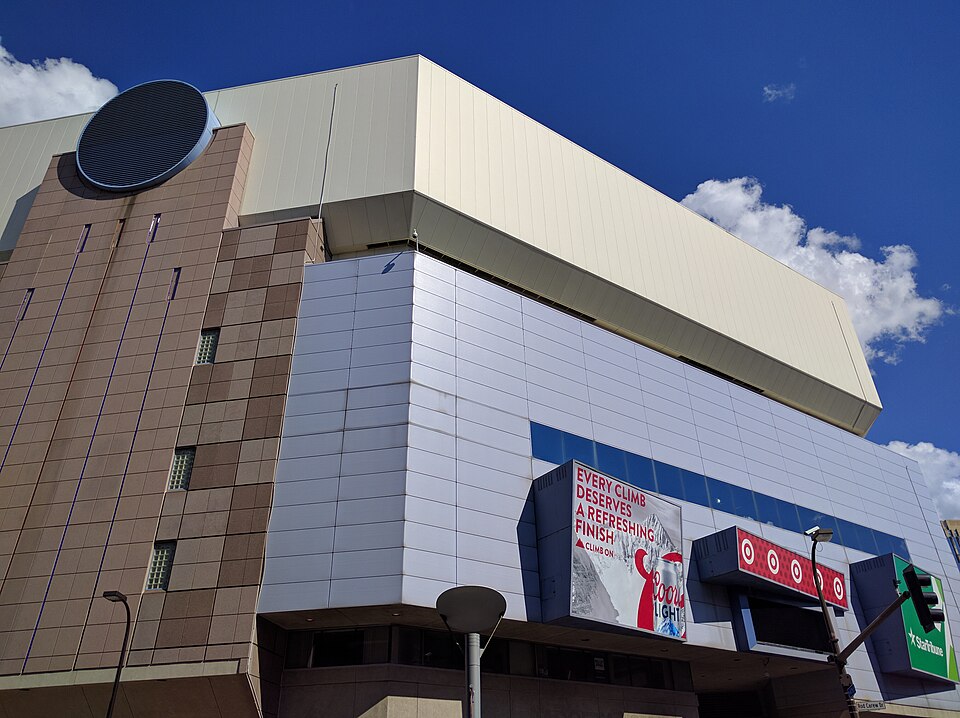
- Target Center (renovated 2017, Minneapolis) – Despite a facelift, its exterior remains flat and utilitarian, lacking sculptural ambition.
What unites these buildings is a refusal to take risks. They are safe, symmetrical, and efficient, but they fail the test of identity. A visitor leaving the game remembers the contest inside, not the building itself. In the long sweep of history, they may be remembered as serviceable but soulless.
Sculptural Centerpieces That Get It Right
The opposite of blandness is sculpture. A stadium with sculptural quality is not just a container for events but a statement in itself. These are buildings that look alive, that interact with light, that demand to be photographed and shared. They embody the same ambition that led the Romans to build the Colosseum and Gothic architects to raise cathedrals.
- Tottenham Hotspur Stadium (2019, London) – Sleek and steep, it curves around the pitch like a modern amphitheater. Its glassy skin gleams at night, making it a landmark in the city.
- SoFi Stadium (2020, Inglewood) – The vast canopy, flowing and translucent, looks almost organic. From the air it resembles a modern sculpture as much as a stadium.
- Mercedes-Benz Stadium (2017, Atlanta) – The retractable oculus roof is both futuristic and symbolic. The angular exterior gives it the presence of a monumental sculpture.
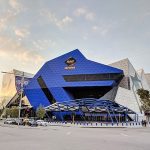
- Allegiant Stadium (2020, Las Vegas) – Its black exterior, smooth and reflective, earned it the “Death Star” nickname. Bold and unapologetic, it looks futuristic and menacing in a way that excites fans.
- U.S. Bank Stadium (2016, Minneapolis) – A crystalline shell of glass and steel, it reflects both the northern sky and the city skyline.
- Al Janoub Stadium (2019, Qatar) – Designed by Zaha Hadid, its curving rooflines evoke the sails of traditional dhow boats, linking modern design with cultural heritage.
- Allianz Parque (2014, São Paulo) – Contemporary and dynamic, it is praised for acoustics, atmosphere, and bold exterior design.
- Chase Center (2019, San Francisco) – Its curves and bayfront placement make it as much a waterfront sculpture as an arena.
These are the stadiums that show what’s possible when architecture embraces artistry. They are expensive, yes, but they earn back their cost in cultural capital, tourism, and civic pride. They prove that stadiums can still be modern cathedrals.
Borderline Cases
Between bland boxes and sculptural wonders are the borderline cases — buildings that function well but fall short of landmark status.
- Prudential Center (2007, Newark) – A solid hockey and basketball arena with excellent sightlines inside, but outside it looks more like a civic complex. Respectable, but not sculptural.
- Chase Field (1998 with updates, Phoenix) – Practical in the desert with its retractable roof, but the heavy box form lacks grace.
- Golden 1 Center (2016, Sacramento) – Praised for sustainability and technology, but architecturally restrained.
- Little Caesars Arena (2017, Detroit) – Works as a multi-use venue, yet its exterior resembles a generic shopping mall.
These arenas highlight the tension in modern design. They are competent, even pleasant inside, but they don’t rise to the level of artistry. They sit in a gray zone — neither offensive nor inspiring.
Split Personalities: Outside vs. Inside
Some stadiums present a split personality, looking bold from one angle but disappointing from another.
Nice Outside, Disappointing Inside:
- London Stadium (2012) – Striking from afar, but inside the stands are far from the pitch, and atmosphere suffers.
- Levi’s Stadium (2014, 49ers) – Its modern look masks an interior plagued by harsh sun exposure and a lack of intimacy.
- FedEx Forum (2004, Memphis) – Attractive brick exterior, but inside it struggles to generate energy.
Bland Outside, Good Inside:
- Madison Square Garden (New York) – A beige cylinder outside, but legendary atmosphere inside.
- Target Center (Minneapolis) – Still dull on the outside, but the renovation improved the experience inside.
- MetLife Stadium (New Jersey) – Widely mocked outside, but once inside the seats and amenities work fine.
Divisive Cases:
- AT&T Stadium (2009, Dallas) – Some admire its scale and technology, others see it as a soulless megamall.
- SoFi Stadium (2020, Los Angeles) – A sculptural marvel to architects, but some fans find the atmosphere too impersonal.
These cases remind us that stadiums must succeed both as architecture and as lived experience. When the two don’t align, the building feels incomplete.
Renovations: Helped and Hurt
Renovations test whether a city values its heritage or discards it. Some modernizations preserve identity, while others erase it.
Improved by Renovations:
- Lambeau Field (Green Bay) – Updated repeatedly without losing character, a model of sensitive modernization.
- Madison Square Garden (New York) – Interiors refreshed in 2011–2013 while history remained intact.
- Target Center (Minneapolis) – Amenities improved even if the exterior remained bland.
- Soldier Field (Chicago) – Functionally better after 2003.
Made Worse:
- Soldier Field (Chicago) – The same renovation that improved function destroyed its classical beauty, costing landmark status.
- Oakland Coliseum (1995) – The “Mount Davis” expansion ruined baseball sightlines.
- London Stadium (London) – Retrofitting for football never solved atmosphere problems.
- Candlestick Park (San Francisco) – Decades of tweaks made it uglier without solving wind and cold.
These examples show that modernization must be careful. Fans accept change when it improves experience, but not when it destroys identity.
Hopeful Projects
There are reasons to be hopeful. Some planned stadiums suggest a shift back toward boldness and civic pride.
- EverBank Stadium (Jacksonville, 2028 target) – Marketed as the “Stadium of the Future,” its sweeping canopy will shade every seat, lowering temperatures in the Florida heat. Its flexible capacity and downtown entertainment district could make it a true centerpiece.
- New Nissan Stadium (Nashville, 2027 target) – A domed stadium designed to be both functional and iconic.
- New Commanders Stadium (Washington, D.C., 2030 target) – Planned with a translucent roof and broader redevelopment of the RFK site.
If executed well, these could redefine the standard for stadiums in the coming decades.
Closing Reflection
Stadiums are not just functional halls. They are stages where people gather, celebrate, and remember. A good stadium should look like a city’s signature, a sculpture on the skyline. The sculptural ones inspire, the bland ones fade into the background, and the borderline cases hover without ever making their mark.
From the “Death Star” in Las Vegas to Zaha Hadid’s sails in Qatar, from the crystalline glass of Minneapolis to the hopeful canopy of Jacksonville, we see both the failures and the triumphs of our time. The lesson is simple: stadiums deserve to be wonders, not warehouses.