Scattered across the parched plains of southern Peru, the Nazca Lines are one of the world’s greatest archaeological enigmas. These vast drawings, or geoglyphs, span hundreds of square miles in the Nazca Desert, located about 250 miles south of Lima. From ground level, the lines appear as simple furrows in the reddish-brown earth. But from above, the desert suddenly transforms into a canvas for colossal hummingbirds, spiraling monkeys, and arrow-straight lines that stretch for miles.
These lines were virtually invisible to the wider world until aircraft began flying over the area in the 20th century. The sheer size and precision of the geoglyphs raised countless questions: Who made them? Why were they made? How could such exact patterns be created without a bird’s-eye view? Despite many theories, none have definitively solved the mystery.
In 1994, UNESCO declared the Nazca Lines a World Heritage Site, describing them as “the most outstanding group of geoglyphs anywhere in the world.” They’ve been preserved largely thanks to the region’s dry climate and lack of wind. Yet as modern tourism and development encroach, these ancient lines are now in greater need of protection than ever before.
The lines’ mystique lies not only in their monumental scale but also in their resilience. Etched into a fragile desert crust over 1,500 years ago, they have endured wind, sun, and neglect. They remain a compelling reminder of the spiritual and intellectual ambition of an ancient civilization that flourished long before the rise of modern nations.
The Nazca Civilization – Builders of the Impossible
The creators of these awe-inspiring geoglyphs were the Nazca people, a sophisticated pre-Incan culture that thrived from approximately 100 BC to AD 800. Centered in the arid valleys of southern Peru, the Nazca developed a society that was both artistically rich and technically adept. They built elaborate underground aqueducts, called puquios, that still function today, bringing water to some of the most bone-dry land on Earth.
Nazca pottery is considered among the most intricate of any ancient American civilization, often featuring highly stylized human and animal figures painted in vibrant colors. These motifs match many of the figures found in the Nazca Lines, providing a vital clue to the lines’ cultural and religious significance. The Nazca also excelled in textile production, using alpaca and cotton fibers dyed with natural pigments. Some scholars believe their weaving skills, which required detailed planning and symmetry, parallel the geometric precision of the lines.
The society was likely organized into small chiefdoms rather than a centralized empire like the later Inca. Religious practices played a dominant role in Nazca life, and much of their energy seems to have been devoted to pleasing or communicating with deities—especially those related to water and fertility. This religious emphasis is evident in both their burial practices and the spiritual motifs in their art.
Living in an environment where rainfall was scarce and survival depended on precise knowledge of nature, the Nazca developed a culture uniquely adapted to its challenges. Their ability to manipulate the land with such lasting impact speaks to a disciplined, orderly worldview—one that valued continuity, reverence, and perhaps cosmic alignment. The Nazca Lines, far from being random scratches in the dirt, are thought to reflect this disciplined mindset.
What Are the Nazca Lines? Size, Shape, and Scope
The Nazca Lines consist of over 800 straight lines, 300 geometric figures, and more than 70 biomorphic designs—figures that resemble animals, plants, and humans. These drawings stretch across 190 square miles of desert, and many span hundreds of feet. Some of the longest straight lines run for more than 9 miles across the desert floor, undisturbed by the shifting sands of time.
These geoglyphs were created by removing the top layer of iron-oxide-coated pebbles to reveal the pale-colored earth beneath. The lack of rain and wind in the Nazca Desert has preserved these shallow grooves remarkably well. Despite their size, the lines are shallow—only about 4 to 6 inches deep. Still, the contrast in color between the surface and the exposed soil below makes them stand out vividly from the air.
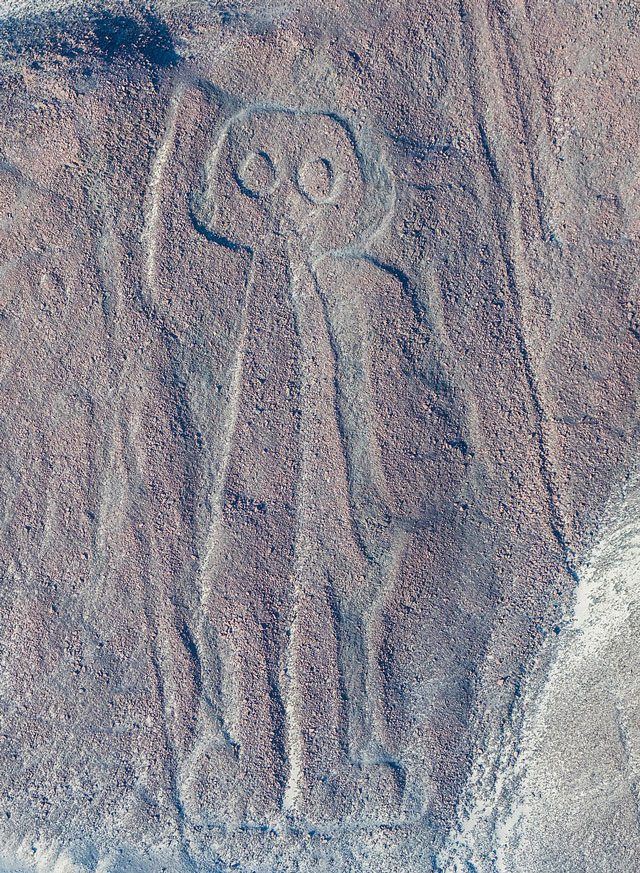
Some of the most recognizable figures have become iconic. The hummingbird measures roughly 300 feet in length, while the spider is about 150 feet long. The monkey, with its coiled tail, spans over 300 feet. Other significant figures include the condor, which has a wingspan of over 400 feet, and the so-called “astronaut,” a humanlike figure with large eyes and an arm raised toward the sky.
- Famous Nazca Figures:
- The Hummingbird: ~300 feet long, precise symmetry
- The Spider: includes details of reproductive anatomy
- The Monkey: known for its spiral tail and dynamic stance
- The Astronaut: humanoid form with large, circular eyes
- The Condor: wingspan over 400 feet, symbol of strength
While the straight lines dominate numerically, it’s the animal and plant forms that continue to capture the public imagination. Each is drawn in a single continuous line, suggesting not only artistic skill but also sophisticated planning. Whether these designs served practical, ceremonial, or symbolic purposes is still debated, but there is no doubt that their scale and intricacy were intentional.
How Were the Nazca Lines Constructed Without Flight?
One of the greatest marvels of the Nazca Lines is their creation without the aid of aerial tools. The figures and lines are most visible from the sky, yet the Nazca had no means of flight. How then were they able to design, plan, and execute these enormous patterns with such precision? Archaeological evidence points to surprisingly effective low-tech methods.
Researchers believe the Nazca used a system of wooden stakes, ropes, and simple surveying tools. Stakes have been found at the ends of many lines, supporting the theory that the ancient builders laid out these shapes on the ground much like modern engineers use grid systems. By using a basic coordinate technique, they could map large-scale designs on flat terrain, stepping off distances and measuring angles.
Experimental archaeology has shown that even complex figures like the hummingbird or spider can be recreated using these basic tools. In the 1980s, a team led by Joe Nickell successfully reproduced several Nazca figures using nothing more than string, a broom, and a few assistants. These practical experiments prove that a society with discipline, organization, and clear purpose could produce the lines with pre-industrial technology.
Furthermore, there is no evidence that the Nazca required a bird’s-eye view to plan the figures. The designs could have been created at ground level with a detailed small-scale drawing as a guide. The surrounding low hills may have provided enough elevation for project leaders to oversee progress, acting as ancient observation posts. What the Nazca lacked in machines, they made up for in patience and precision.
Theories Behind the Purpose of the Nazca Lines
The Nazca Lines are not merely a technical feat—they likely held deep cultural, religious, or astronomical meaning. One of the most enduring theories is that they served ritual or spiritual purposes. The Nazca people may have walked the lines during religious processions, invoking the favor of their gods. Some believe the lines were created as offerings, a kind of sacred art etched into the earth to be seen by deities watching from above.
Another leading theory suggests that the lines had astronomical functions. Paul Kosok, an American historian who studied the lines in the 1940s, observed that some lines aligned with the solstice sunrises and sunsets. He famously referred to the lines as “the largest astronomy book in the world.” Maria Reiche, who dedicated her life to studying and preserving the lines, expanded on this theory, cataloging dozens of astronomical alignments.
Other researchers argue the lines were connected to water sources. In a region where rainfall is rare, water would have been a divine gift. Some lines appear to radiate from ancient aqueducts or lead toward subterranean springs. The animal figures—such as the frog, spider, and whale—may symbolize fertility or rain-bringing creatures in Nazca mythology.
- Top Theories on Nazca Line Purposes:
- Spiritual processional paths for religious ceremonies
- Celestial alignments marking solstices and seasonal cycles
- Indicators of underground water sources and ritual water worship
- Tribal symbols or territorial boundary markers
- Artistic expressions or mythological storytelling in visual form
Despite decades of research, no single theory fully explains all the geoglyphs. What’s likely is that the Nazca Lines served multiple purposes over time. As with many ancient cultures, the sacred and the practical were often intertwined. Religious beliefs may have guided agricultural practices, and celestial observations could have informed ceremonial calendars.
The Aerial Discovery – How the World Took Notice
Although the local populations had always been aware of the strange lines on the desert floor, it wasn’t until the early 20th century that the rest of the world took notice. In 1927, Peruvian archaeologist Toribio Mejía Xesspe stumbled upon the geoglyphs while hiking through the foothills. He observed the lines from a nearby hill and correctly assumed that they were ancient constructions, although their full scale remained unknown at the time.
The turning point came in the 1930s when commercial airlines began flying over southern Peru. From the air, pilots and passengers were stunned to see vast drawings of animals and lines covering the desert. This aerial view revealed that the lines were far more complex and organized than they appeared from the ground. The discovery quickly drew the attention of international scholars and adventurers alike.
In 1941, American historian Paul Kosok began systematically studying the lines. On June 22 of that year, he witnessed a sunset that aligned perfectly with one of the longest lines. This led him to propose an astronomical theory for their function. Kosok’s excitement was shared by Maria Reiche, a German mathematician and translator who joined his efforts and later became the foremost advocate for the lines’ preservation.
Reiche spent over 40 years studying, mapping, and protecting the Nazca Lines. She meticulously recorded over 70 geoglyphs and tirelessly campaigned to raise awareness of their cultural value. Known in Peru as “The Lady of the Lines,” she lived in a modest hut near the site and even swept the lines clean by hand. Her life’s work helped secure UNESCO World Heritage status in 1994 and prevented further damage to the fragile desert canvas.
Preservation Challenges – A Battle Against Time and Tourism
Despite their remote location, the Nazca Lines are increasingly under threat from modern activities. The desert’s natural dryness has preserved the lines for over a millennium, but human interference now poses a far greater danger. Tourism, though economically beneficial to the region, has led to increased foot traffic, pollution, and occasional disregard for preservation boundaries.
In December 2014, international attention turned to the site when Greenpeace activists trespassed on the protected area to place a large banner near the hummingbird geoglyph. Their actions left permanent footprints and caused significant damage to the delicate surface. The Peruvian government condemned the act, and criminal charges were pursued. This incident served as a wake-up call to the global community about the importance of protecting ancient heritage.
Unauthorized vehicle access has also been a problem. In 2018, a truck driver illegally entered the site, leaving deep tire marks across several lines. Although there was no intent to vandalize, the damage was irreparable. These events prompted the Peruvian Ministry of Culture to increase security measures, including the use of surveillance drones and stricter zoning enforcement.
Efforts to preserve the lines have included education campaigns aimed at both tourists and locals. Modern drone technology now allows for better monitoring of the site, while satellite imagery has helped archaeologists identify previously unknown geoglyphs. Still, preservation requires constant vigilance, clear legal protections, and responsible tourism practices that respect the cultural legacy of the Nazca people.
Misinterpretations and Alien Conspiracies
Among the more sensational theories surrounding the Nazca Lines is the claim that they were created or influenced by extraterrestrials. These ideas gained popularity in the 1960s and 1970s, particularly with the publication of Erich von Däniken’s book Chariots of the Gods? In it, von Däniken proposed that ancient astronauts visited Earth and guided early civilizations, pointing to the Nazca Lines as alleged landing strips.
There is no credible evidence to support such claims. The lines, while impressive, do not require alien technology to explain their construction. As noted earlier, simple tools and ground-level planning could have easily produced the figures. No unusual materials, foreign artifacts, or technological anomalies have ever been found at the site that would suggest non-human involvement.
These speculative theories often do a disservice to the remarkable accomplishments of ancient peoples. Attributing their ingenuity to extraterrestrials undermines the creativity, dedication, and intelligence of cultures like the Nazca. Instead of honoring human achievement, such ideas reduce it to something beyond comprehension, which it clearly is not when examined closely and respectfully.
Scholars and cultural advocates have repeatedly urged the public to focus on verifiable facts and to appreciate the lines for what they are: the extraordinary work of an ancient human society. Far from being evidence of otherworldly visitors, the Nazca Lines stand as a monument to the capabilities of man guided by faith, purpose, and communal will.
Spiritual Symbolism or Celestial Calendar?
Many of the Nazca Line figures are mirrored in other aspects of Nazca culture, particularly in pottery and textiles. The spider, monkey, and hummingbird are not arbitrary choices—they appear in religious art and may have had sacred significance. Scholars believe these animals were not only symbolic but also associated with myths, natural cycles, or the heavens.
The spider, for example, is often linked to rain and fertility. Some interpretations suggest that certain species of spider only appear before seasonal rains, making them a natural symbol for life-giving water. The hummingbird, agile and swift, might have represented a messenger between humans and divine beings. Its importance is reflected in how carefully it was rendered in the lines.
Similarly, the monkey could be tied to the lush Amazon Basin, east of the Nazca Desert. Its coiled tail and animated posture suggest a connection to abundance or playfulness—qualities perhaps prayed for in a harsh desert life. The condor, with its powerful wingspan and command of the skies, was likely a symbol of strength, freedom, or divine watchfulness.
While Maria Reiche believed the lines served primarily as a celestial calendar, not all scholars agree. Some designs align with astronomical events, but others do not. This discrepancy suggests that the geoglyphs may have had multiple layers of meaning—some related to the heavens, others to the earth, and still others to the spiritual lives of the people who made them. The truth may lie in the intersection of all three.
Conclusion – Legacy of the Lines in Modern Thought
The Nazca Lines remain one of the world’s most remarkable testaments to ancient ingenuity. Their scale, precision, and endurance have turned the arid Nazca Desert into an open-air museum of human devotion and imagination. Whether they were used for worship, water rituals, or stargazing, the lines reflect a civilization deeply rooted in purpose and spiritual order.
They also challenge modern assumptions about ancient peoples. Too often, technological advancement is seen as the sole measure of a society’s sophistication. Yet the Nazca, without writing systems or metal tools, achieved a feat that continues to baffle observers. Their work demonstrates that discipline, faith, and unity can accomplish far more than gadgets or machines alone.
In our age of instant information and disposable culture, the lines offer a message of permanence and perspective. They encourage us to consider not only how ancient people lived but what they believed was worth preserving for eternity. These geoglyphs were not carved in stone, yet they have lasted for nearly two millennia—a tribute to the durability of conviction.
As threats to the site grow in the 21st century, so does our responsibility to protect it. Preserving the Nazca Lines isn’t just about saving a collection of drawings—it’s about honoring the heritage, courage, and vision of a people who etched their story into the earth so that future generations might read it from the sky.
Key Takeaways
- The Nazca Lines are massive geoglyphs created by the Nazca civilization between 100 BC and AD 800.
- They include over 800 lines and 70 animal and plant figures, visible only from the air.
- The lines were made using simple tools and ground-level surveying, not advanced or aerial technology.
- Theories about their purpose include religious rituals, astronomical calendars, and water-related symbolism.
- Modern threats such as tourism and vandalism demand ongoing preservation efforts.
FAQs
- Who made the Nazca Lines?
The Nazca Lines were created by the Nazca people, a pre-Incan civilization in southern Peru. - How old are the Nazca Lines?
Most geoglyphs date from around 100 BC to AD 800, with some possibly created even earlier. - Can the Nazca Lines be seen from the ground?
While parts can be seen from nearby hills, their full shapes are only visible from the air. - What do the animal figures represent?
Many figures are believed to hold religious or symbolic meanings, such as rain, fertility, or celestial beings. - Are the Nazca Lines protected today?
Yes, they are a UNESCO World Heritage Site and are monitored by the Peruvian government using drones and protective laws.