The Zodiac Killer remains one of the most chilling unsolved cases in American history. Active between 1968 and 1974, this unidentified murderer terrorized Northern California with a string of cryptic letters, strange symbols, and ciphers mailed to major newspapers. His enigmatic messages and eerie symbolism didn’t just paralyze a region with fear—they also left a deep, lasting imprint on the world of art. Decades later, artists continue to mine his cryptic codework, mysterious identity, and iconic imagery for creative inspiration.
From true crime fans to gallery professionals, the aesthetic of the Zodiac Killer’s messages has crossed into multiple creative disciplines. His handwritten letters, crosshair insignia, and unbroken ciphers have appeared in visual art, music, fashion, and design. This symbolic language of fear has captured the imagination of those who see in it a reflection of chaos, anonymity, and the allure of the unsolved. This article explores how the sinister signs of the Zodiac Killer transformed from police evidence into visual and cultural motifs.
We’ll look at how his codes and symbols evolved into something almost mythic. Along the way, we’ll trace how artists have responded to this darkness, often using it to confront themes of violence, obsession, and society’s morbid curiosity with killers. Whether in paintings, graphic novels, or movie scenes, the Zodiac Killer’s cryptograms have become a haunting language all their own.
Origins of a Cipher-Killer: Symbols and Obsession
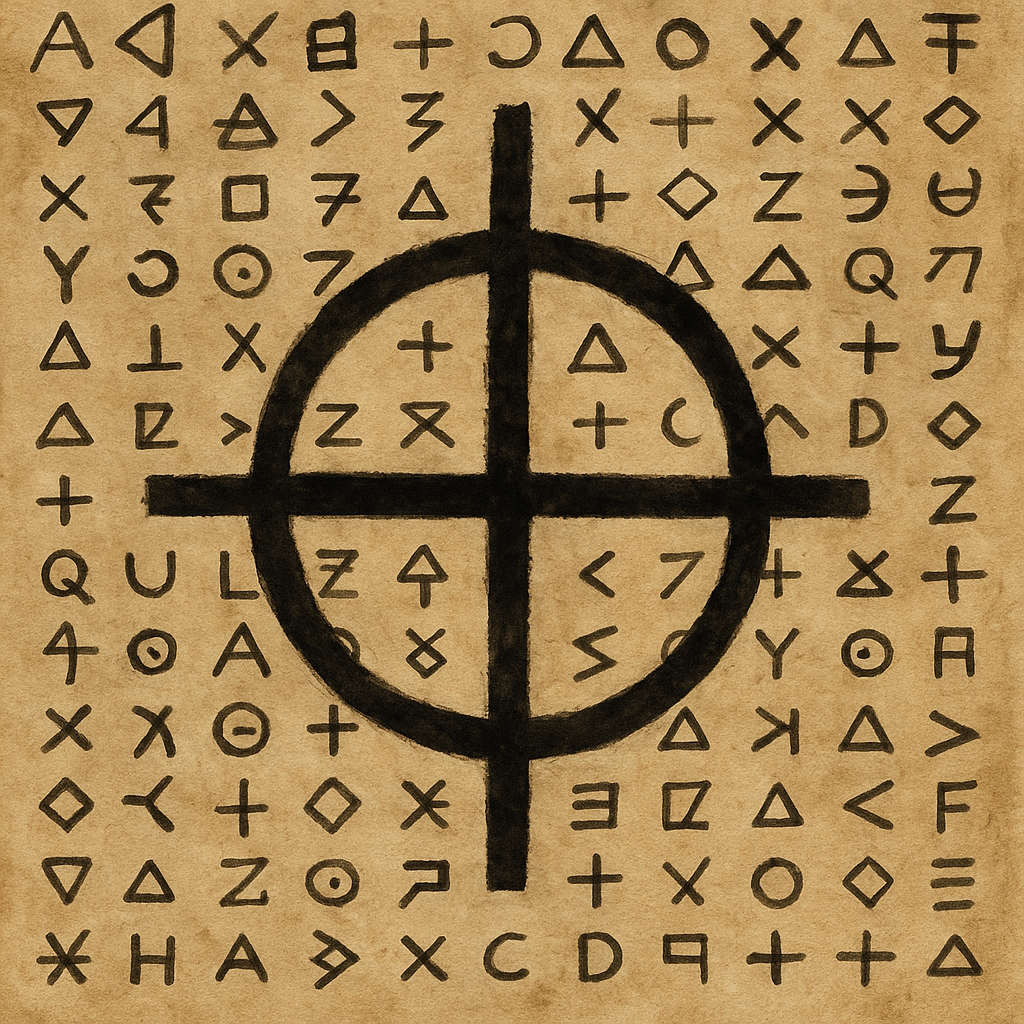
The Zodiac Killer first struck in December 1968 with the brutal murders of teenagers Betty Lou Jensen and David Faraday in Vallejo, California. Over the next few years, he claimed responsibility for at least five confirmed killings, though he hinted at 37 or more in his taunting letters to the press. These letters often included cryptograms—carefully constructed sequences of symbols that masked hidden messages—and demanded to be published or else more people would die. He signed many of them with a now-infamous symbol: a circle with a cross through it, resembling a gun sight or crosshair.
The Zodiac’s first major cipher, a 408-character message, arrived at newspapers on August 1, 1969, sent in three parts to the San Francisco Chronicle, the San Francisco Examiner, and the Vallejo Times-Herald. A schoolteacher named Donald Harden and his wife Betty managed to crack it within a week, revealing a chilling statement about killing being “more fun than hunting wild game.” But other ciphers, like the 340-character Z340 sent in November 1969, remained unsolved until 2020, when a team of amateur codebreakers finally cracked it. These puzzles weren’t just twisted games—they were part of the killer’s identity.
The Crosshair Circle – A Sinister Brand
The circle-and-cross logo quickly became the Zodiac’s signature. He used it to sign letters and even carved it into a victim’s car door after an attack in 1969 at Lake Berryessa. This mark, simple yet ominous, transformed from a cipher’s anchor into a terrifying brand. Over time, its minimalism and menace became a visual shorthand for evil in both pop culture and underground art circles.
Though the Zodiac’s identity remains unknown, several suspects have been publicly named. Arthur Leigh Allen, born in 1933 and died in 1992, remains one of the most infamous. He was questioned multiple times, but no conclusive evidence tied him to the crimes. As the years passed and the case remained open, the mystery surrounding his symbols grew, morphing into a dark mythology. Artists began seeing not just horror, but narrative potential in the Zodiac’s coded messages and cryptic iconography.
The Art of Fear: How Visual Artists Reacted
Visual artists have long been drawn to the emotional power of true crime, and the Zodiac Killer’s cryptic legacy offers fertile ground. His letters and symbols have appeared in gallery installations, street murals, and digital works exploring themes of paranoia, communication, and surveillance. California-based artists, in particular, have returned to the Zodiac narrative repeatedly, compelled by its unresolved status and cultural weight. The geography of terror—San Francisco, Vallejo, Lake Berryessa—has become both historical site and artistic metaphor.
Contemporary conceptual artist Trevor Paglen, born in 1974, has not referenced the Zodiac Killer directly, but his work on secrecy, coded language, and surveillance echoes similar themes. In a broader sense, artists inspired by the Zodiac often aim to show how language can be weaponized. Whether through handmade replicas of the letters or recreations of the ciphers in embroidery or mixed media, many pieces focus less on glorification and more on unease. The aestheticized fear the Zodiac inspired becomes a way for artists to engage with the unknown.
From Canvas to Conspiracy
Some artists go even further, using Zodiac themes to critique how media sensationalizes serial killers. Brooklyn-based multimedia creator Esmé Thompson’s 2016 exhibition “Ciphered Flesh” featured text-based oil paintings of cipher-like fragments meant to evoke both threat and miscommunication. Others, like Los Angeles street artist Retna, have experimented with cryptic alphabets that visually recall the Zodiac’s own glyphs—though without explicit connection. The result is an emerging visual subgenre of cryptic symbolism in modern art.
This influence also extends into typographic design, with some artists recreating the Zodiac’s distinctive block letters and grammar errors in their own work. By mimicking the original handwriting, these works blur the line between evidence and interpretation. Whether as political commentary or pure aesthetic exploration, these pieces show how deep the Zodiac’s hold remains on creative minds. His codes aren’t just unsolved—they’re symbols that invite endless reinterpretation.
Cinema’s Obsession: Zodiac in Film and Design
No discussion of Zodiac symbolism in art would be complete without exploring his impact on film. The most famous cinematic treatment is David Fincher’s Zodiac, released in 2007, which dramatizes the real-life investigation with a near-obsessive commitment to detail. The film draws heavily from the 1986 book Zodiac by Robert Graysmith, who worked at the San Francisco Chronicle during the killings. Visually, the movie presents a cold, muted palette with vintage typography and deliberate pacing—an aesthetic that has since influenced a new wave of crime dramas.
Fincher, born in 1962, worked closely with production designer Donald Graham Burt and costume designer Casey Storm to recreate the late 1960s and early 1970s California with unsettling accuracy. Newspapers were reproduced down to the font and paper stock, and the Zodiac’s cryptic letters were replicated using forensic images. This attention to visual detail gave the film a documentary-like weight. As a result, the Zodiac Killer’s symbols entered a new visual canon—one that has been echoed in both TV and independent cinema since.
Fincher’s “Zodiac” and a New Visual Language
Films like Se7en (also by Fincher), Prisoners (2013), and True Detective (2014) owe a stylistic debt to Zodiac, particularly in how they use symbols, space, and silence to evoke dread. The use of cryptic notes, coded language, and obsessive detectives in those projects all reflect back on the Zodiac’s legacy. In costume and graphic design, the Zodiac Killer has become a template for the unknowable antagonist—cold, methodical, and hidden behind a system of signs.
Even outside of film, his influence has seeped into advertising and title design. The bold, blocky style of his handwritten letters has been echoed in thriller posters and book covers. Brands avoid naming him directly, but the visual style—scratchy ink, ambiguous marks, and circular motifs—is unmistakable. This unintentional branding speaks volumes about how the symbols of a killer have taken on lives of their own.
Music and the Macabre: Sonic Symbolism
The Zodiac Killer’s reach extends beyond visual art into the world of music, particularly in genres fascinated by darkness and rebellion. Bands like Macabre, a death metal group formed in Illinois in 1985, have included Zodiac-inspired lyrics in songs like “Zodiac” from their 2000 album Dahmer. These tracks often retell the killings or quote lines from the cryptic letters. The mix of horror, history, and artistry creates a grim but undeniable draw for audiences.
More subtle references can be found in bands that use the Zodiac name or include his symbols in album art. Zodiac Mindwarp and the Love Reaction, a British hard rock band formed in 1985, took a name that flirts with danger and mystery. Underground acts, especially in industrial and experimental music, often layer cryptographic elements into their soundscapes. Reversed speech, Morse code, and distorted vocal samples are used to mirror the themes of secrecy and menace tied to the Zodiac’s communications.
Lyrics and Liner Notes from the Crypt
In the 2010s, several musicians in California’s underground scenes began using fragments of the Zodiac’s unsolved 340-character cipher in their album liner notes. These nods, while subtle, serve as a form of encoded commentary—emulating the killer’s love of mystery. Some artists use lyrics that mirror the tone of the Zodiac’s letters: mocking, cold, and chillingly calm. The aura of the unsolved amplifies the mystique.
Stage performances by some of these artists even adopt Zodiac’s symbology. The crosshair logo has appeared in lighting setups, backdrops, or T-shirts worn by fans. While not always intentional, the overlap between true crime and counterculture runs deep. Music, especially when combined with visual spectacle, becomes a fitting medium for exploring the Zodiac’s disturbing legacy.
True Crime Fandom and DIY Art
The rise of internet marketplaces and fan-driven platforms has made Zodiac-inspired artwork more accessible than ever. On Etsy, Redbubble, and other print-on-demand sites, you can find posters, stickers, T-shirts, and even cross-stitch kits bearing the Zodiac’s cryptograms. Some creators painstakingly recreate the 408-character cipher in stylized typography, while others turn the killer’s logo into pop-art patterns. This DIY aesthetic often reflects a mix of fascination and dark humor, depending on the artist’s intent.
Among tattoo artists, the Zodiac symbol has found surprising popularity. Requests for the crosshair emblem, dates of the killings, or even stylized recreations of the handwritten letters have been reported by West Coast tattoo shops. These designs raise difficult ethical questions about whether it’s appropriate to permanently wear the iconography of a serial killer. For many, it’s less about glorification and more about connecting with the mystery or expressing a fascination with the macabre.
Etsy Prints to Tattoo Flash
Not all true crime art is created with the same level of care or thoughtfulness. While some creators use Zodiac references to explore deeper themes, others treat it as just another spooky trend. Items like Zodiac-themed enamel pins or phone cases sometimes reduce the terror of the crimes to simple aesthetics. This raises a broader debate about whether commerce has diluted the seriousness of the case.
Still, true crime fandom remains a strong force in the creative economy. Podcasts, forums, and social media groups dedicated to the Zodiac case often share or promote this fan art. The continued relevance of the symbols—over fifty years after the killings—shows just how deeply they’ve embedded themselves in popular culture. The mystery continues to drive creativity, for better or worse.
Graphic Novels and Comic Interpretations
Comic books and graphic novels have long explored the intersection of crime, mystery, and visual storytelling. While few mainstream comics directly depict the Zodiac Killer, his influence is felt in countless works featuring cryptic killers and unsolved mysteries. The visual style of Zodiac letters—jagged handwriting, repetitive symbols, and coded language—has inspired artists crafting gritty detective stories and psychological thrillers. In this way, comics provide a unique medium to mirror the layered complexity of the Zodiac’s persona.
One of the most notable examples is From Hell, Alan Moore and Eddie Campbell’s 1999 graphic novel about Jack the Ripper. Though it focuses on a different killer in a different century, the storytelling method—filled with documents, theories, and cryptic illustrations—reflects a similar obsession with decoding violence. Some newer independent comics include Zodiac-like figures who leave clues and riddles, blurring fiction with real-world fear. The hand-lettering, fragmented panel layouts, and redacted dialogue often mimic the Zodiac’s unsettling writing style.
Panels of Paranoia
The 2014 graphic novel The Black Dahlia, adapted by Matz and Miles Hyman from James Ellroy’s novel, also reflects this tone. While focused on another Los Angeles crime, the visual mood—high-contrast shadows, eerie silences, and urban sprawl—closely resembles the atmosphere around Zodiac-inspired stories. Artists use deliberate pacing in panels to simulate the slow, creeping anxiety of an unsolved case. Typography plays a key role, too: hand-drawn fonts often replicate the uneven, threatening feel of the Zodiac’s notes.
A small group of indie comic artists have also created direct adaptations of the Zodiac story. These comics, often self-published or distributed online, typically retell events from the killer’s perspective or that of investigators. Though controversial, they show how graphic storytelling can engage with true crime as both history and myth. In these works, the symbols themselves become a character—driving the story forward as a force of unknown meaning.
The Ethical Line: When Inspiration Turns Exploitation
As the Zodiac Killer becomes more myth than man, a critical question emerges: when does artistic inspiration become exploitation? While art often wrestles with difficult subjects, using the name, symbols, or voice of a real killer carries real-world consequences. Some critics argue that turning Zodiac imagery into décor or fashion trivializes real suffering. Others believe confronting evil through art can be a legitimate act of cultural processing or resistance. This debate has become louder as the true crime genre becomes more commercial.
Many art galleries now issue content warnings for true crime-themed exhibitions, especially those involving real victims. In 2020, an art show in Los Angeles featuring re-creations of the Zodiac’s letters sparked backlash for allegedly glamorizing his crimes. On the other hand, some artists defend such work as social critique, arguing that media and police glorified the Zodiac long before artists got involved. The line between commemoration and commodification remains difficult to navigate.
Art or Appropriation?
The broader cultural trend of turning killers into characters—seen with Charles Manson, Jeffrey Dahmer, and the Zodiac—shows how easy it is for symbolism to overshadow reality. Artists who use these themes without acknowledging victims risk distorting history into spectacle. Yet art has long been used to process horror, from Goya’s The Disasters of War to post-9/11 installations. The question isn’t whether horror should be depicted, but how, and why.
Some scholars have suggested a code of ethics for true crime art: name the victims, cite facts accurately, and avoid glorifying perpetrators. Such guidelines offer a path forward for artists interested in exploring the Zodiac’s mystique without erasing the pain behind it. When used with care, symbols like the Zodiac’s crosshair can serve as a mirror to society’s darkest fascinations—not a celebration of them. The meaning lies not just in the symbol, but in how and why it is used.
Conclusion – Symbolism Beyond the Cipher
The Zodiac Killer’s crimes left behind more than terror; they left behind a visual language that continues to echo through art. His cryptic letters, haunting symbols, and eerie detachment have become a source of fascination not just for investigators, but for creatives seeking to understand the psychology of fear. Over the decades, his imagery has appeared across film, music, graphic novels, and fine art.
This enduring influence reveals how powerful symbols can transcend their original context. For some, the Zodiac represents the perfect mystery—a blank slate of unknowns. For others, he embodies a warning about the seductive power of anonymity and spectacle. What remains clear is that his iconography has far outlived his crimes.
Artists continue to wrestle with these questions, using the Zodiac’s symbols to explore obsession, danger, and our society’s complicated relationship with violence. As long as the case remains unsolved, the imagery surrounding it will remain an unsettling part of our cultural landscape—forever inviting interpretation, but never offering closure.
Key Takeaways
- The Zodiac Killer used cryptograms and a crosshair symbol as part of a chilling communication campaign from 1968–1974.
- His symbols and ciphers have become iconic in visual art, music, comics, and true crime fan culture.
- David Fincher’s Zodiac (2007) significantly shaped how modern media visually represents unsolved crimes.
- Artists using Zodiac imagery walk a fine ethical line between commentary and glorification.
- The killer’s unresolved identity continues to inspire interpretations across multiple art forms.
Frequently Asked Questions
- Who was the Zodiac Killer, and when was he active?
The Zodiac Killer was an unidentified serial killer active in Northern California between 1968 and 1974. - What is the significance of the Zodiac’s symbol?
The crosshair-like circle symbol served as his signature and has become a lasting icon of true crime. - How has the Zodiac Killer influenced visual art?
His cryptograms and symbolism have inspired paintings, digital works, and installations exploring themes of fear and code. - What role did film play in popularizing his imagery?
David Fincher’s Zodiac (2007) brought his aesthetic to a wider audience, influencing crime cinema and design. - Is it ethical to use serial killer symbols in art?
The ethics are debated; many argue for responsible use that respects victims and avoids glorification.