In the heart of the New Jersey Pine Barrens, where twisted pines sway in the Atlantic breeze and sand paths stretch into deep woods, a legend has taken root for nearly three centuries. The story of the Jersey Devil is as much a part of the landscape as the trees themselves—an eerie creature said to flap through the sky on leathery wings, scream into the night, and vanish without a trace. For generations, it has fueled campfire stories, newspaper headlines, and even statewide panic, but perhaps its most enduring legacy is the inspiration it has given to artists. From colonial etchings to modern digital prints, the Jersey Devil has captured the American imagination in ways few other regional legends have.
This article traces the journey of the Jersey Devil not only as a figure of folklore but as a dynamic force in American art. Artists across time—folk carvers, pulp illustrators, fine painters, tattoo designers—have all wrestled with the image of the Devil. What does it look like? What does it mean? Is it a monster, a symbol, a mythic guardian? In each rendering, the answers shift. Through this article, we explore how the Devil’s form has evolved and why it remains so visually powerful.
The Jersey Devil was never just a story. Its influence runs through New Jersey’s culture and visual identity like veins through granite. Schools have studied it, sports teams have adopted it, and muralists have painted it high on urban walls. The Devil is not only alive in myth but thriving in paint, ink, sculpture, and digital pixels. The sheer range of artistic responses—from fearsome to playful, realistic to abstract—reveals just how deeply embedded this creature is in the American psyche.
And it all began with one dramatic moment, one woman, and one cursed birth in 1735. That night, a child was born—or so the legend goes—that would haunt the Northeast forever. Whether you believe the tale or not, one thing is certain: the Jersey Devil has taken flight in our culture. And nowhere is that more visible than in the art it has inspired.
A Monster is Born — The Origins of the Jersey Devil
The earliest story of the Jersey Devil traces back to 1735 in Leeds Point, a remote area in what is now Atlantic County, New Jersey. According to the legend, a woman known as Mother Leeds, already a mother of twelve, declared during a difficult pregnancy, “Let this one be the devil!” Her thirteenth child was born on a stormy night and quickly transformed—sprouting wings, claws, and hooves—before escaping through the chimney into the woods. The story spread quickly among the pine settlers and became embedded in local tradition. Even without proof, the chilling imagery stuck.
This wasn’t just idle gossip. The Leeds family was a real and controversial presence in colonial New Jersey. Daniel Leeds (1651–1720), an English Quaker who emigrated to Burlington in 1677, became entangled in political and religious disputes. He published The American Almanack, filled with astrological symbols and occult references, which led the Quaker community to denounce him as a heretic. His son, Titan Leeds, later continued the publication and famously feuded with Benjamin Franklin. The Leeds family’s reputation as strange and oppositional gave weight to the devilish myth.
Even more intriguing, the Leeds family crest bore the image of a wyvern—a bat-winged, dragon-like creature with clawed feet and a barbed tail. Many scholars believe this image influenced how the Jersey Devil would later be depicted. The transition from political scapegoat to literal monster was not accidental. Colonial fear of rebellion, mysticism, and anything that diverged from Puritanical norms often manifested in folklore and visual imagery. The Devil, in this case, may have been more symbol than beast.
Early sketches and etchings from the 18th and 19th centuries often depicted the Devil with unmistakable wyvern features: wings, horns, and a hunched back. These crude images were passed down through families, etched into barn walls, and even printed in religious tracts as moral warnings. In this early period, the Jersey Devil wasn’t just a curiosity—it was a symbol of disorder, a specter of sin born from perceived rebellion and supernatural punishment.
Panic in the Press — 1909 Sightings and Illustrated Media
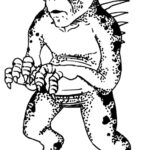
In January 1909, the legend of the Jersey Devil exploded into national headlines when over 1,000 reported sightings occurred in a single week across southern New Jersey and eastern Pennsylvania. Schools closed, factories shuttered, and search parties roamed the pine woods with rifles. The newspapers of the time, including the Philadelphia Inquirer, Camden Post, and Trenton Times, published breathless accounts of encounters with a winged creature. It was described as having a horse’s head, bat wings, cloven hooves, and a forked tail. The visual accounts varied but shared key monstrous traits.
Crucially, artists and illustrators working for these papers had to give form to the chaos. Lacking photographs, newspapers ran drawings based on witness descriptions, which played a huge role in cementing the Devil’s appearance in the public imagination. One of the most famous images from 1909 shows the Devil with a goat-like head, bird legs, dragon wings, and a twisted expression of rage. These illustrations appeared alongside headlines like “Devil Seen in Delanco” and “Terror Strikes Haddon Heights.” Art and panic fed each other.
These early media renderings weren’t just entertainment. They served to “authenticate” the myth through repetition and visibility. The more often the Devil was drawn and printed, the more real he became to the public. Children clipped pictures from the paper and carried them to school. Entrepreneurs printed the sketches on postcards and souvenirs. A creature that had lingered in shadow for nearly 200 years had now been given a face—and that face was terrifying.
The hysteria of 1909 produced a second wave of Jersey Devil art. Amateur artists and curious readers submitted their own sketches to newspapers and local museums. Many of these drawings—preserved today in local collections like the Burlington County Historical Society—are crude but earnest attempts to depict what they believed they saw. This outpouring of illustrated fear marked a turning point: the Devil was no longer just folklore. He had entered the visual record of American culture, winged and howling in ink.
Pine Barrens Folk Art and Regional Symbolism
Among the tall, dense pines and white sand roads of the Barrens, the Jersey Devil has long been a subject of handmade art—folk paintings, carvings, and stitched textiles that reflect the character and resilience of the local people. Unlike the sinister images from newspapers, these folk renditions often show the Devil as a mischievous guardian of the woods, not just a monster. These depictions are more personal, often created by artists with deep roots in the region. The Devil, in these cases, becomes a symbol of survival in a hard, wild land.
A notable example comes from “Old Joe” Thompson, a carver in Tabernacle, NJ, who during the 1940s created a series of Devil sculptures from twisted pine branches. With curled horns and contorted postures, each sculpture was different—no two Devils were alike. Old Joe’s work became known at county fairs and was often sold at roadside stalls. Though considered “outsider art,” his pieces now reside in private collections and regional museums. They reflect a vision of the Devil born not from fear, but familiarity.
Quilt-makers and folk painters also added the Devil to their visual vocabulary. A 1976 Bicentennial quilt, displayed at the Batsto Village Historic Site, features a panel of the Devil soaring over a cranberry bog, flanked by pinecones and turkeys. It was made by three local women who said they grew up with the story and wanted to include “the most local thing there is.” Here, the Devil is stylized but friendly, a folkloric neighbor rather than a beast.
Hand-painted signs across the Pine Barrens have also used the Devil to draw in tourists. Some say “Welcome to Devil Country” or “Pine Barrens—Home of the Jersey Devil,” often accompanied by bright, cartoonish artwork. These signs are usually created by regional artists and blend humor with pride. They’re not meant to scare—they’re meant to celebrate a legend that locals have embraced as their own. In this form, the Devil becomes cultural shorthand for place, history, and grit.
The Devil Goes Pop — Cryptid Art in Comics, Toys, and Posters
As America entered the postwar era, monsters moved out of the woods and into popular culture. The Jersey Devil, once a whispered legend of the Pine Barrens, found a new life in the pages of comic books, pulp horror magazines, and children’s toys. Artists began to reinterpret the creature through the lens of pop culture’s growing fascination with the weird and the monstrous. These visual reinventions of the Devil brought him into households far beyond New Jersey, changing not only how he was seen, but also who he was seen by.
One of the earliest comic appearances was in the 1953 horror comic Cryptic Shadows, which featured a short story titled “Beast of the Barrens.” The Devil, illustrated with glowing eyes and massive wings, terrorizes a group of loggers until a trapper banishes it with fire. The panels were dramatic, using heavy shadows and expressive faces, following the visual language of other popular horror figures like vampires and werewolves. Though the artist remains uncredited, the cover image became a cult classic among collectors. It marked a turning point in how the Devil was drawn—not as folklore, but as spectacle.
In the 1970s and 1980s, America’s monster craze was in full swing. The Jersey Devil appeared in trading card sets like Monsters of the USA (1978), alongside Bigfoot, the Mothman, and the Chupacabra. These cards showed colorful, over-the-top versions of the Devil, with spiked tails and comic-book style captions. Board games like Cryptid Hunt and Mystery of the Pine Barrens also used stylized images of the Devil, often rendered with exaggerated wings and glowing hooves. These depictions leaned into fantasy, distancing the Devil from his dark folklore origins and reframing him as a fun, collectible oddity.
Poster art and novelty merchandise followed. Independent horror films like The Leeds Curse (1984) and Barrens Rising (1987) used garish poster illustrations to sell their low-budget scares. These posters usually showed the Devil silhouetted against a red moon, wings outstretched, with lettering that mimicked the dripping blood fonts of the era. T-shirts, stickers, and lunchboxes followed, often sold at roadside shops along the Garden State Parkway. These pieces may not have carried artistic prestige, but they were saturated with visual creativity and energy.
By the late 1980s, the Jersey Devil had fully transitioned into pop culture. He no longer existed solely in whispers or regional art; he had action figures, fan clubs, and Saturday morning cartoon parodies. This shift was driven in large part by the visual reimagining of the creature by illustrators, toy designers, and movie artists. Through their work, the Devil took on a new identity—less forest demon and more marketable monster.
Contemporary Artists Reimagining the Jersey Devil
In recent years, a new generation of artists has returned to the Jersey Devil, not to exploit its legend for quick thrills, but to reinterpret its meaning with depth, mood, and symbolic nuance. Contemporary artists often view the Devil not just as a monster, but as a lens through which to explore nature, fear, and local identity. Their works span media from printmaking and oil painting to digital design and installation art. Many of these artists draw on the creature’s older imagery while adding layers of modern emotion, texture, and storytelling.
One such artist is Ryan Case, whose stylized woodcut-style prints of the Jersey Devil are among the most visually striking of the past decade. His series “Cryptid Kin” (2017–2020) features the Devil lurking among gnarled trees and flickering lanterns. With a limited color palette—usually black, red, and cream—Case’s work recalls 19th-century horror prints and frontier storytelling. His Devils are fierce, but also oddly noble, embodying a spirit of independence and wilderness. Case was born in 1984 and studied at the Pennsylvania Academy of Fine Arts before moving to rural New Jersey, where the creature became his muse.
Another notable contemporary interpreter is Jared T. Williams, a printmaker known for bold, minimalist linocuts. Williams’ Jersey Devil series, begun in 2016, strips the creature down to primal shapes—wings, antlers, eyes—set against moonlit backdrops. His focus is on psychological impact: Williams often exhibits his Devil prints alongside soundscapes of forest ambiance and recorded folklore. Born in 1979, Williams studied folklore at the University of Vermont before turning to visual arts full-time in 2008. He calls the Devil “America’s most poetic cryptid.”
Women artists have also reclaimed the Jersey Devil through softer, eerie lenses. Brett Manning, whose dreamy, surrealist illustrations have gained popularity on platforms like Etsy, often depicts the Devil as a liminal figure—half-spirit, half-creature, with antlers like tree branches. Her 2022 piece “Barrens Queen” reimagines the Devil as a winged forest matriarch, embodying both terror and protection. Similarly, Heather Rutz, a painter born in 1991 and educated at Montclair State University, uses oils and pastels to portray the Devil hidden in fog, barely visible among pines. Her art leans into atmosphere and absence, evoking the feeling of being watched by something you can’t quite see.
What unites these contemporary works is their emotional depth. Rather than focusing on shock or novelty, today’s artists are exploring what the Jersey Devil means. Is it a metaphor for loneliness, for American wildness, for ancient guilt? Is it a symbol of New Jersey’s strange pride in its dark woods and weirder legends? These questions are asked not with words, but with brushstrokes and lines—keeping the Devil not just alive, but evolving.
Tattoos, Murals, and Cryptid Street Culture
The Jersey Devil has made its mark not only in galleries and digital spaces but quite literally on skin and concrete. In the world of tattoo art, it has become an enduring motif—blending traditional monster imagery with regional pride. Artists across New Jersey and beyond have designed custom flash sheets featuring the Devil in styles ranging from bold Americana to fine-line blackwork. For many who choose to wear the Devil, it is a statement of identity, mystery, or connection to their home in the Garden State.
Tattoo artists often highlight the creature’s most iconic features: cloven hooves, bat-like wings, and sharp horns. Some designs draw from the classic 1909 newspaper sketches, while others lean into more recent minimalist or surrealist interpretations. The Devil is frequently inked in flight or perched among pine trees, usually in black, red, and gray palettes. One well-known example comes from Tattoo Asylum in Trenton, where artist Eric Donnell began incorporating the Jersey Devil into flash art as early as 2003. His pieces have been featured in regional tattoo expos and magazines.
The creature has also climbed out of tattoo shops and onto the walls of New Jersey’s cities and towns. Murals depicting the Jersey Devil can be found in Asbury Park, Atlantic City, and even in Camden, often painted by local artists as tributes to state folklore. These works vary in tone: some present the Devil as a comic-like character, while others portray him as a mysterious forest guardian. A mural in Vineland, completed in 2021 by a group of high school artists, shows the Devil mid-flight above a field of pine trees with the words “Our Legend Lives.” These large-scale pieces serve as public affirmations of a story that has become part of regional heritage.
In street culture and graffiti, the Devil’s form becomes even more abstract. Stenciled silhouettes, often spray-painted onto back alleys or abandoned buildings, use minimal lines to evoke wings, horns, and eyes. Sometimes just the name “Jersey Devil” scrawled in bold, angular letters carries the message. Cryptid enthusiasts have embraced this DIY street style, incorporating the Devil into zines, stickers, and pop-up exhibits. These informal, unfiltered artworks represent a living, breathing folklore—an urban echo of a backwoods myth. The Devil, in this sense, is not just a subject of art; he is part of the visual language of cultural rebellion.
What the Jersey Devil Means in Art Today
In the modern art world, the Jersey Devil continues to evolve—not as a flat caricature, but as a complex symbol tied to nature, myth, and identity. Artists now approach the Devil as more than a creature; they see it as a representation of ideas. Its image can suggest the rawness of wilderness, the eeriness of isolation, and the tension between civilization and the untamed. These themes resonate especially in an age when society often feels distant from the natural world.
The Devil’s dual identity as both terror and guardian makes it uniquely powerful in artistic terms. Its hooves, wings, and shriek may frighten—but they also protect. Many artists have drawn connections between the Devil and traditional American archetypes: the lonesome cowboy, the wild woodsman, the spiritual outsider. In this way, the Devil becomes part of the American Gothic tradition—a symbol not of evil, but of confrontation with the unknown. This reframing allows artists to treat the Devil as a metaphor, not just a monster.
There is also a growing interest in the Jersey Devil as a symbol of local pride and cultural preservation. New Jersey, often overlooked or ridiculed in broader American culture, has embraced the Devil as its own brand of folklore—one that is weird, defiant, and unforgettable. Art reflecting this theme often blends traditional folk elements—like quilts or carving—with contemporary forms such as screen printing and digital collage. The Devil stands not just for mystery, but for identity and rootedness.
Ultimately, what the Jersey Devil means in art today is layered and evolving. It is a shapeshifter in every sense: appearing in fine art galleries, tattoo studios, street murals, and Etsy shops. It is an emblem of fear and fascination, a creature both ancient and ever-new. For artists, the Devil remains a challenge and a muse—a symbol that refuses to die because it refuses to be understood. And perhaps that, above all, is why it continues to be drawn, carved, painted, and imagined.
Key Takeaways
- The Jersey Devil legend began in 1735 with the Leeds family and has deep colonial roots.
- Early 1909 newspaper sketches helped define the creature’s iconic visual form.
- Folk art in the Pine Barrens depicts the Devil as both monster and local guardian.
- Contemporary artists reinterpret the Devil through digital, surrealist, and symbolic lenses.
- The Devil remains a symbol of American wilderness, folklore, and cultural identity.
Frequently Asked Questions
- Is the Jersey Devil a real historical creature?
While rooted in legend, there’s no verified scientific evidence for its existence. - Who was Daniel Leeds and how is he connected to the legend?
Daniel Leeds (1651–1720) was an almanac publisher whose controversial work led to rumors that helped fuel the Devil myth. - What does the Jersey Devil look like in most artwork?
It’s often depicted with bat wings, hooved feet, horns, a forked tail, and a horse- or goat-like head. - Why is the Jersey Devil a popular tattoo design?
It symbolizes mystery, rebellion, and regional pride for many tattoo enthusiasts, especially in New Jersey. - Where can I see Jersey Devil art in person?
Murals exist in places like Asbury Park and Camden, and folk art is on display in museums like Batsto Village and the Burlington County Historical Society.