Sweden is often imagined from the outside as quiet and composed, its cultural exports defined by cool minimalism, functional design, and emotionally restrained pop. It’s a nation associated more with serenity than spectacle, more with order than upheaval. Yet, the visual history of Sweden tells a far more complex story—one that reveals deep currents of mysticism, resistance, idealism, and experimentation. To understand Swedish art history is to travel across not just stylistic evolutions, but across shifting ideas of identity, nature, power, and what it means to be modern on the edge of a continent.
What makes Sweden’s artistic journey particularly compelling is how it has moved between the margins and the center—culturally, geographically, and politically. For centuries, Sweden stood on the periphery of European power. Yet its artists were never disconnected from broader dialogues. The ebb and flow of outside influence—from German Gothic forms to French Rococo finesse to modernist abstraction—was constantly filtered through a Nordic lens: rooted in long winters, vast forests, and local myths. As such, Swedish art often carries a distinct tone—a clarity of form mixed with emotional undercurrents, a reverence for nature that merges with an awareness of human transience.
The prehistory of Swedish art stretches deep into the Bronze Age, where stone carvings at places like Tanum form one of the oldest visual languages in northern Europe. These carvings are not merely decorative; they are cosmologies in granite, encoded with rituals and beliefs, mapping out the spiritual geography of early communities. From there, the Viking era emerges, defined by fierce ornamentation, interlaced animal motifs, and a visual grammar of both prestige and power—carved into wood, metal, and stone.
With the Christianization of Sweden in the 11th century, a profound shift occurred in the purpose and production of art. Churches became sites of painted narrative, of iconography, of imported Gothic techniques that fused with local traditions. Sweden’s isolation meant that these styles often arrived late—but when they did, they took on uniquely regional forms. Medieval frescoes in Uppland, for instance, merge theological storytelling with almost folkloric whimsy, unselfconsciously mixing high doctrine with earthy humor.
By the early modern period, Sweden’s political ambitions began to reshape its visual identity. The 17th century saw the rise of a Swedish empire, and with it a new focus on courtly grandeur, allegory, and the assertion of royal authority through the arts. Yet this was not merely mimicry of continental courts; Swedish painters, architects, and designers began to develop an idiom that reflected a northern version of baroque splendor—less flamboyant, more austere, but no less symbolic.
What complicates Sweden’s art history—and makes it so worthy of close study—is its persistent tension between looking outward and looking inward. The 18th and 19th centuries saw Sweden embrace Enlightenment ideals and Romantic introspection in almost equal measure. The age of Carl Larsson and Karin Larsson, for instance, encapsulated this duality. Their work, grounded in the domestic and the everyday, became a kind of artistic nationalism—not of flags or battles, but of light-filled interiors and handwoven textiles. It was an aesthetic vision of Sweden as humane, harmonious, and culturally self-possessed.
Yet this pastoral image was always in dialogue with other currents. The modernist explosion of the early 20th century brought abstraction, spiritualism, and radical experimentation to Swedish shores. Artists like Hilma af Klint were producing revolutionary work that would only be fully recognized decades later. Her paintings—vibrant, symbolic, and deeply esoteric—were not merely early examples of abstraction. They were attempts to map the invisible, to make spiritual truths visual. That such work came from Sweden is no accident. There has long been, in Swedish art, a desire to find structure in the intangible, to shape the ineffable with calm precision.
As the 20th century progressed, Sweden’s welfare state and cultural infrastructure played a defining role in shaping its art scene. Institutions like Moderna Museet did more than collect and exhibit—they provided a platform for experimentation, internationalism, and state-supported cultural inquiry. This infrastructure allowed Swedish artists to take risks, to push the boundaries of what art could be, often fusing aesthetics with political critique, environmental consciousness, or technological innovation.
Today, Sweden’s art scene is a complex ecosystem. It is home to globally recognized artists, avant-garde collectives, and a growing reckoning with histories of exclusion—particularly regarding Sámi cultural expression and the legacy of settler colonialism in the north. The conversation is expanding, as artists and curators challenge the narratives once upheld by national institutions. The future of Swedish art, like its past, remains defined by its ability to hold opposites in balance: nature and industry, tradition and innovation, the local and the global.
In tracing the art history of Sweden, we are not just cataloging styles or listing famous names. We are looking at how a society has seen itself over time—its myths, its ideologies, its fears, and its dreams. We are watching how a landscape becomes a metaphor, how a country on the edge of Europe becomes central to some of its most radical artistic visions. And above all, we are following the thread of a visual culture that, in its restraint and clarity, reveals layers of depth that continue to surprise.
2: Prehistoric and Viking Art: The Foundations of Form
Long before the rise of kingdoms, churches, or academies, the land we now call Sweden was home to a visual culture carved directly into its stone and soil. Prehistoric and Viking-era art in Sweden represents not only the earliest expressions of form and symbolism in the region but also a worldview grounded in cycles of nature, cosmology, and communal memory. This era, spanning thousands of years, forms the bedrock of Swedish art history—not as primitive prologue, but as a distinct and highly developed set of visual languages, each embedded in the landscapes and lives of its makers.
Bronze Age Carvings and the Birth of Narrative
Among the most iconic sites of prehistoric art in Sweden are the rock carvings (hällristningar) found at Tanum in Bohuslän, now a UNESCO World Heritage Site. These images, chipped and scratched into granite outcrops between 1800 and 500 BCE, represent a symbolic system far removed from modern naturalism, yet rich with meaning. They depict boats, warriors, animals, and geometric patterns—forms that speak to the daily lives, rituals, and cosmologies of Bronze Age communities.
The prevalence of boats in these carvings has sparked much scholarly debate. Some interpret them as literal depictions of seafaring life—an unsurprising focus for a coastal people dependent on maritime trade and fishing. Others see them as metaphors for the journey to the afterlife, or vehicles of the sun god’s passage across the sky. The carvings’ repetition and placement—often near water sources or on sloping stone faces exposed to the elements—suggest a ritual function, a kind of dialogue between people, place, and the divine.
These early images were not made to be seen as art in the modern sense, but they are unquestionably visual statements. They reflect a communal effort to mark, narrate, and sanctify the environment. The figures are often stylized and abstract, emphasizing outlines and motion over individual detail. This abstraction may be read as aesthetic choice, symbolic compression, or both—a mode of distilling meaning into form.
What is striking is how these carvings avoid the kind of hierarchical compositions seen in later art. Rather than telling a single, linear story, they present clusters of activity: a boat here, a figure raising an axe there, concentric circles nearby. The viewer is invited not to “read” them as a sequence but to dwell within them, to piece together patterns and associations. This nonlinear spatial logic—intuitive, iterative—will resurface later in Scandinavian visual culture, from medieval decorative arts to modernist painting.
The Iron Age and the Rise of Ornament
Moving into the Iron Age (c. 500 BCE–800 CE), Swedish material culture became increasingly elaborate. Metalwork, particularly in bronze and iron, flourished. Jewelry, weapons, and ceremonial objects were decorated with spirals, animal forms, and intricate knotwork—motifs that would become central to the later Viking aesthetic. These were not purely decorative elements. They were loaded with symbolism, with references to fertility, protection, power, and myth.
Burial sites from this period also provide clues to the role of art in society. Grave goods often included highly worked fibulae (brooches), pendants, and weapons—objects that served both as status symbols and as carriers of meaning in the afterlife. These artifacts suggest a belief system where beauty and power were intertwined, where to adorn the body or weapon was to participate in a larger cosmological order.
Viking Art: Myth, Power, and the Fluid Line
The Viking Age (c. 800–1050 CE) represents a cultural flowering across Scandinavia, and Sweden was no exception. Though perhaps better known for their ships and raids, the Norse also created some of the most distinct and influential visual styles of the early medieval world. In Sweden, the fusion of local tradition with cross-cultural influences—Celtic, Slavic, Byzantine—produced an aesthetic that was both dynamic and deeply symbolic.
One of the most defining features of Viking art is its linear complexity. The so-called “animal styles”—gripping beasts, serpents, dragons—are arranged in flowing, interlaced compositions that seem almost alive. These forms, often carved into wood or cast in metal, animate everything from longship prows to belt buckles. The Urnes style, named after the stave church in Norway but found in Sweden as well, epitomizes this elegance: elongated, ribbon-like creatures twine through symmetrical frames, evoking a sense of both control and wildness.
Runestones, unique to the Norse world, are a particularly Swedish contribution. More than a thousand runestones have been found in Sweden, far more than in Norway or Denmark. These carved memorials combine writing—using the runic alphabet—with intricate ornamentation. They often commemorate the dead, honor familial ties, or boast of travels and achievements. Yet they do more than inform; they perform. Their size, placement (often near roads or on ancestral land), and visual impact make them public declarations of lineage, memory, and identity.
What’s notable about Viking art is how little it conforms to classical ideals of realism. These are not images trying to capture the world “as it is.” Instead, they function as metaphors—as networks of signs. A dragon isn’t just a creature; it’s a boundary marker, a guardian, a symbol of strength or chaos. The recursive, intertwining patterns mirror the Norse cosmology, with its nine interconnected worlds and ever-looming apocalypse.
Transmission and Transformation
While much Viking-era art was utilitarian or ceremonial, its influence extended into more narrative and architectural forms. Wood carving, in particular, flourished. Churches and halls were adorned with sculptural panels and doorways featuring scenes from mythology and battle—many now lost, but glimpsed through surviving fragments and sketches.
By the end of the Viking period, Christianity had begun to take root in Sweden, and with it came new visual codes. Yet the transition was not abrupt. Many early Christian objects—crosses, reliquaries, and church decorations—retain the sinuous forms and symbolic registers of Viking art. This continuity reveals the adaptability of local traditions and the capacity of Swedish artists to synthesize new influences without abandoning their own visual heritage.
This early era of Swedish art is not a preface—it is a foundation. In it, we find a recurring attention to nature, to abstraction, to the spiritual embedded in the everyday. These are themes that will return again and again in Swedish visual culture, resurfacing in unexpected ways across centuries. From the granite faces of Tanum to the whispering lines of a runestone, the earliest art of Sweden still speaks—if not in words, then in rhythms of form, memory, and place.
3: Medieval Sweden: Faith, Frescoes, and Folklore
When Christianity arrived in Sweden, it brought with it not only a new cosmology but also a new visual order. Over the course of several centuries, from roughly the 11th to the 15th, Sweden underwent a profound transformation in its material and spiritual culture. The old gods and mythologies of the Viking age gradually gave way to the iconography of saints, crucifixes, and the Virgin Mary. But this transformation was not one of simple replacement. Instead, Swedish medieval art is marked by an extraordinary process of synthesis—where older symbolic languages mingled with imported styles to produce a distinctive visual idiom.
A Country Slowly Christianized
Unlike parts of continental Europe where Christianization occurred through swift conquest or top-down imposition, Sweden’s conversion was a slow, uneven process. Christianity began to take hold in the 11th century but did not fully supplant Norse beliefs until well into the 12th or even 13th century, especially in the north and interior regions. This gradual shift allowed for a certain visual hybridity. Early Christian art in Sweden often bore traces of the pre-Christian past, whether in stylistic echoes of Viking ornamentation or in the placement of sacred sites near older ritual locations.
This transitional period produced a fascinating mix of artifacts: stone crosses that resemble runestones in shape and decoration; wooden church fittings that retain dragon-like beasts as part of their design; and liturgical objects where Christian and Norse symbols exist in tension or even harmony. These works do not suggest a violent rupture but a period of negotiation—art as a tool for acclimatization and persuasion.
The Rise of the Church and the Painted Word
As Christianity took deeper root, the church became the dominant patron of the visual arts. Across the Swedish countryside, stone churches were erected—modest in scale but rich in decoration. Inside these churches, a uniquely Swedish contribution to medieval European art emerged: the wall fresco cycle.
From the 12th through the 15th centuries, churches across Sweden were covered in painted narratives. Executed in lime-based pigments on plaster, these frescoes were not mere decoration but a form of storytelling for a largely illiterate population. They illustrated biblical scenes, legends of the saints, moral allegories, and apocalyptic visions. The goal was not aesthetic pleasure, but didactic clarity. These were visual sermons, rendered in color and form.
Among the most famous examples are the churches of Uppland and Gotland. The frescoes in Täby Church, just outside Stockholm, are attributed to Albertus Pictor, the most celebrated medieval painter in Sweden. His work, active around the late 15th century, is characterized by its vivid detail, expressive figures, and occasional humor. In Täby, one finds not only scenes from scripture but also more whimsical motifs: a man playing chess with Death—a striking early version of the theme that Ingmar Bergman would later immortalize in The Seventh Seal.
Albertus Pictor’s frescoes, along with those of his contemporaries, often reflect a fascinating blend of the sacred and the everyday. Biblical figures wear local medieval clothing; devils are grotesque but oddly familiar; angels might hover above landscapes that resemble the Swedish countryside. This localization of the sacred reveals a medieval worldview in which divine history was not far removed from the daily life of the viewer—it unfolded in spaces that felt recognizably human.
Sculpture, Symbolism, and the Sacred Object
In addition to frescoes, the medieval period saw a flourishing of sculpture, particularly in wood. Altarpieces, crucifixes, and statues of saints were often elaborately carved and polychromed. These works were not static icons but active participants in worship—kissed, touched, carried in processions. The artistry involved was remarkable, even in small parish churches: Christ figures with flowing hair and anatomically sensitive wounds; Virgins with serene faces and richly patterned robes.
A particularly Swedish form is the triumphal crucifix, a large wooden sculpture of Christ suspended above the nave. These figures, often dating from the 13th to 14th centuries, vary in expression from serene to agonized, and their style evolves from Romanesque stiffness to Gothic emotionality. They reflect not just evolving theological emphases (from the triumphant Christ to the suffering one) but also changing aesthetic sensibilities.
Artisans were often anonymous, but regional workshops developed distinct styles. The work of the so-called “Gotland School,” for example, is noted for its elegance and delicacy, with gracefully draped robes and emotive facial expressions. Gotland itself—strategically located in the Baltic Sea—was a cultural crossroads, and its churches are rich with sculpture and imported influences.
Manuscripts and Portable Art
Although less plentiful than in wealthier parts of Europe, Sweden also produced and preserved illuminated manuscripts, liturgical books, and ecclesiastical textiles. These portable forms of art offer further insight into the fusion of Northern restraint with religious intensity. The colors tend toward the muted, the ornamentation often geometric rather than florid—but the craftsmanship is meticulous, and the symbolism clear.
Church treasures such as chalices, reliquaries, and embroidered vestments also reflect the intersection of local resources (Swedish silver, wool, linen) with international styles. Some pieces were imported, others produced in monastic workshops. The international Gothic style, with its flowing lines and courtly elegance, made its way to Sweden, often in more modest or rustic adaptations.
Folkloric Survival and Vernacular Expression
Importantly, not all visual culture in medieval Sweden was ecclesiastical. In rural contexts, folk art traditions persisted, often blending with religious motifs. Painted wooden chests, weaving patterns, and household objects carried symbolic designs—sun wheels, trees of life, protective markings—that echoed pre-Christian beliefs or served apotropaic functions. These motifs would survive well into the early modern period and play a key role in Sweden’s later national romantic revival.
The visual language of folklore—less concerned with perspective or anatomical accuracy, more focused on symbolism and repetition—formed an undercurrent in Swedish art. Even as the Church became the dominant cultural force, these older ways of seeing and decorating endured. They lived in domestic spaces, in seasonal festivals, and in the ornamentation of daily life.
The medieval period in Sweden is often overshadowed by flashier developments in Italian or French art history. But it is precisely in its modesty, its blend of the sacred and the local, that Swedish medieval art finds its voice. It speaks in the quiet hues of church frescoes, in the rhythmic carvings of wooden saints, in the runes that linger beside crucifixes. It tells the story of a people in transition—not just between religions, but between oral culture and visual pedagogy, between ritual and narrative, between the divine and the everyday.
The legacy of this era would ripple forward into Sweden’s artistic consciousness for centuries to come. Even as the Renaissance and Reformation would soon bring new upheavals, the frescoed walls and carved altars of medieval Sweden remained as testaments to a uniquely northern vision of the sacred—a vision rooted in place, community, and enduring forms.
4: The Vasa Era and Renaissance Influence
The 16th century in Sweden marked a seismic shift—not just in politics and religion, but in how the visual arts were created, consumed, and understood. This period, often framed by the rise of the Vasa dynasty, is characterized by both rupture and adaptation. It was a time when Swedish art began to move decisively out of the medieval and into the early modern, absorbing elements of the European Renaissance while simultaneously developing its own visual grammar. At the center of this transformation stood Gustav Vasa, the monarch who not only reshaped the Swedish state but also set the stage for a redefinition of royal and religious iconography.
Gustav Vasa: The Art of Authority
Gustav Vasa’s rise to power in the 1520s, following Sweden’s break from the Kalmar Union and its independence from Denmark, established a new political order. But it also demanded new forms of visual legitimacy. In a country where monarchic image-making had previously played a relatively minor role, Gustav Vasa understood the need to construct and project royal authority—visually, spatially, and symbolically.
Portraiture became one of the primary tools in this campaign. Early depictions of Gustav Vasa, such as the now-iconic painting by Jakob Binck, show the king not in the medieval guise of a holy ruler but as a stern, calculating statesman in contemporary armor. These portraits were modeled on German prototypes—especially those of the Protestant Reformation and the Habsburg court—but tailored to Swedish sensibilities. They emphasized strength, order, and national unity. The artistic style was sober rather than opulent, restrained yet forceful—qualities that would become hallmarks of Swedish court art in the 16th century.
These portraits weren’t just for decoration; they were instruments of propaganda, copied and distributed to affirm the monarch’s presence across the realm. In this way, art became a key part of the emerging Swedish state apparatus.
The Renaissance Arrives—Slowly
Despite these courtly developments, Sweden’s encounter with Renaissance art was delayed and fragmentary compared to southern and western Europe. The Italian Renaissance, with its emphasis on linear perspective, classical revivalism, and humanist ideals, had been shaping continental art for over a century by the time Sweden began to feel its influence. Geography, climate, language, and economic limitations all played a role in slowing its full adoption.
But Renaissance ideas did arrive—primarily via Germany and the Low Countries, through trade, diplomacy, and religious reform. Many of the artists working in Sweden during this time were foreign-born or trained abroad. German painters, in particular, brought with them techniques in oil painting, printmaking, and perspectival composition that had transformed northern European art.
Woodcut prints by artists like Albrecht Dürer circulated widely and had a lasting impact on Swedish visual culture. Their clarity of line and moral gravity resonated in a country grappling with both the Reformation and a newly centralized state.
Church Art in the Age of the Reformation
One of the defining features of the Vasa era was the Swedish Reformation. In breaking with Rome, Gustav Vasa instituted a Lutheran state church. This transformation had profound consequences for religious art.
Iconoclasm was never as widespread in Sweden as it was in parts of Germany or England, but the theological emphasis shifted dramatically. Elaborate altarpieces, saints’ relics, and Marian imagery fell out of favor, replaced by a focus on scripture, the Word, and didactic imagery. Churches were stripped of some of their medieval splendor; wall paintings were whitewashed, and sculptural programs reduced.
Yet this did not result in a total suppression of visual culture. Instead, it led to a new set of aesthetics aligned with Lutheran values: clarity, moderation, and the centrality of the pulpit. Painted pulpits, lecterns, and pews often replaced statuary as focal points. The visual emphasis moved from the miraculous to the moral, from spectacle to instruction.
Swedish church painters adapted to these new conditions. They created panel paintings and modest murals that illustrated biblical narratives with clarity and conviction. In some cases, older frescoes were preserved or quietly reinterpreted. The religious art of this period is neither as sumptuous as the Gothic nor as refined as the Italian Renaissance, but it is deeply rooted in the social fabric—a visual theology for a new Protestant order.
Architecture and the Civic Imagination
Another major arena of transformation was architecture. The Vasa era witnessed the growth of secular and state-sponsored architecture. Castles, town halls, and manor houses were renovated or newly built in styles influenced by Renaissance design—though always with a regional twist.
Gripsholm Castle is a notable example. Originally a medieval fortress, it was rebuilt by Gustav Vasa into a Renaissance-style residence. While it retained elements of medieval architecture, it incorporated Italianate features like symmetrical façades, arcaded courtyards, and ornamental towers. Gripsholm signaled a new kind of power—a power not just of arms but of cultivated taste.
Architecture during this period also reflected the emergence of a Swedish civic identity. Town planning began to adopt Renaissance principles of order and rationality, though often adapted to the Swedish context of wooden construction and harsh winters. The spatial imagination of Sweden was changing—more structured, more monumental, more visibly aligned with the ideals of control and governance.
Tapestries, Textiles, and Courtly Culture
While oil painting and architecture were still developing in Sweden, textile arts flourished during the Vasa era. Tapestries, often imported from Flanders or woven locally in court workshops, were prized for their decorative and symbolic value. They served not only to insulate the cold stone interiors of castles but also to tell allegorical stories and commemorate military victories.
These works reveal a sophisticated understanding of visual storytelling. They draw from classical myths, Christian allegories, and heraldic symbolism. In them, we see the blending of personal ambition with state ideology—a fabric woven with both political power and aesthetic purpose.
Court culture under the Vasas also nurtured smaller-scale decorative arts: engraved silver, ceremonial armor, bookbinding, and furniture design. These items were not peripheral to the visual arts; they were central expressions of status, taste, and identity.
Seeds of a Swedish Renaissance
While the Vasa era didn’t produce a Leonardo or a Michelangelo, it laid crucial foundations for a Swedish visual culture that was increasingly European in its orientation but regionally grounded in its sensibility. The imported techniques of perspective and oil glazing, the emphasis on portraiture and spatial order, the shift from ecclesiastical to royal patronage—all of these developments marked Sweden’s passage into the early modern.
Just as importantly, the era introduced the idea that visual culture could serve as a political tool, a moral guide, and a vehicle for national identity. These themes would echo across the coming centuries, particularly in the grand allegorical paintings of the 17th century and the neoclassical dreams of the 18th.
The Vasa period was not a full-fledged Renaissance in the Italian sense. But it was a crucible—a moment when old forms were reimagined, when power and belief found new visual expressions, and when Sweden began to emerge as a player, however cautious, on the European cultural stage.
5: Baroque and the Swedish Empire: Art as Power
By the mid-17th century, Sweden had transformed from a relatively peripheral northern kingdom into a major European power. Through a combination of military conquest, dynastic ambition, and administrative centralization, Sweden entered what historians call the Stormaktstiden—the “Age of Greatness.” This period, roughly 1611 to 1718, marked the zenith of Swedish imperial expansion, stretching its influence across the Baltic and deep into central Europe. But this ascent was not just territorial; it was visual. Art became a key instrument of statecraft, used to glorify monarchs, legitimize conquest, and cultivate an image of Swedish sophistication. It was during this age that Sweden fully entered the Baroque, adopting and adapting the style’s visual language of grandeur, drama, and order.
The Politics of Baroque Aesthetics
The Baroque—born in Rome and shaped by Catholic triumphalism—may seem like an odd fit for Lutheran Sweden. The Counter-Reformation exuberance, the theatrical lighting, the divine ecstasy—it all appears out of sync with Sweden’s Protestant restraint. Yet Sweden made the Baroque its own, channeling its dramatic aesthetics into the language of power, discipline, and dynastic pride.
For Sweden, Baroque art was not about spiritual intensity but about political visibility. It was used to convey strength, legitimacy, and cultivated authority. Where the Catholic Baroque aimed to overwhelm with divine presence, the Swedish Baroque sought to impress with imperial control. And nowhere was this more evident than in portraiture, architecture, and public ceremony.
The Royal Image: Monumentality and Majesty
One of the key figures of this period was Queen Christina (r. 1632–1654), whose reign—marked by both military victories and intense intellectual ambition—helped place Sweden on the European cultural map. Christina was an art collector, patron, and self-fashioner. Her portraits depict her not as a demure female ruler but as a philosopher-queen, often in armor or Romanesque robes, aligning herself with classical and masculine tropes of power.
These portraits were crafted by artists like Sébastien Bourdon and David Beck, imported or trained abroad, and reflect a distinctly European visual idiom. Christina’s own abdication and conversion to Catholicism in 1654 would be a dramatic rupture, but her reign set the tone for a visual culture that saw monarchy as performance—an idea that would only grow under the kings who followed.
Perhaps the most prominent court painter of the age was David Klöcker Ehrenstrahl (1628–1698), often dubbed the “father of Swedish painting.” German-born but Swedish by naturalization, Ehrenstrahl served as the official court painter to King Karl XI. His large-scale allegorical works, mythological tableaux, and regal portraits elevated Swedish painting to a level of technical and conceptual ambition it had not previously known.
Ehrenstrahl’s work combined rich color, calculated composition, and classical references to create a visual language of Swedish greatness. His series of paintings in Drottningholm Palace—blending allegory with dynastic history—is a prime example of how the Baroque idiom was nationalized. In Ehrenstrahl’s hands, Sweden was not a cold periphery, but a radiant empire with divine favor.
Architecture: Order, Grandeur, and the City as Stage
Swedish Baroque architecture followed suit. Influenced by the developments in France and the Netherlands, it embraced symmetry, monumentality, and the staging of power. Cities such as Stockholm were reshaped to reflect the ideals of absolutist governance. Palaces, churches, and civic buildings became visual anchors in an expanding urban imagination.
The rebuilding of Stockholm Palace after the fire of 1697 was one of the grandest undertakings of the era. Architect Nicodemus Tessin the Younger, trained in France and Italy, was charged with designing the new royal residence. His plans were deeply informed by Versailles and the principles of Louis XIV’s architectural statecraft—centralized layout, axial symmetry, and a controlled interplay between interior and exterior spaces.
Drottningholm Palace, the official royal residence outside Stockholm, also reflects these ideals. Its gardens, stage sets, and interiors functioned not just as luxurious domestic space but as a setting for court rituals, diplomatic performance, and symbolic order. The Baroque garden, in particular, became a metaphor for the state: nature domesticated, shaped into geometry, disciplined into elegance.
Church architecture also evolved. Lutheran though it was, Sweden still built houses of worship with high domes, sweeping façades, and elaborate altarpieces. These were less about saints and sacraments and more about civic pride and moral order—an assertion of national identity rather than theological ecstasy.
Tapestries, Triumphs, and Visual Propaganda
Beyond paintings and buildings, the Baroque period in Sweden saw an explosion in courtly visual culture—tapestries, triumphal arches, coins, prints, and ceremonial pageantry all contributed to an image of sovereign control. After major victories, such as at Breitenfeld or Narva, the Swedish crown commissioned allegorical engravings and published illustrated pamphlets. These artifacts disseminated the idea of Swedish supremacy far beyond the battlefield.
Art was not just for the court. Urban centers increasingly featured public sculptures, triumphal gates, and decorative schemes intended to elevate civic morale and reinforce loyalty to the crown. The city itself became a theater of authority—its plazas, avenues, and façades all orchestrated to communicate stability and splendor.
The Baroque’s emphasis on spectacle and scale proved well-suited to an empire asserting itself on the European stage. Even if Sweden lacked the vast wealth of Spain or France, it invested heavily in symbolic capital. Art became a way to project permanence in the face of geopolitical volatility.
Patronage and the Emerging Elite
While royal and state patronage dominated, a new class of aristocratic patrons emerged, commissioning works for private estates, chapels, and libraries. These nobles, often military leaders enriched through campaigns abroad, used art to establish lineage and legacy. Portraiture boomed, with images of Swedish officers, noblewomen, and scholars adorning manor houses from Uppsala to Skåne.
This proliferation helped cultivate an artistic infrastructure that would support future generations. Workshops, apprenticeships, and guilds matured. Artists increasingly traveled abroad to study, especially in Paris and Amsterdam, bringing back techniques and materials. Art was no longer a foreign import but a professional field with Swedish practitioners and institutions.
Theatricality, Temporality, and the End of an Era
One of the core insights of Baroque aesthetics is its awareness of time—its interest in the fleeting, the dramatic, the moment of transformation. In Sweden, this sensibility manifested not only in the movement and gesture of painting and sculpture, but also in the ceremonial life of the court.
Masques, ballets, and royal processions were staged with elaborate sets and costumes. These ephemeral artworks—more performance than object—reflected a culture increasingly attuned to the theatrical dimensions of power. The use of allegory, costume, and stagecraft offered a shared visual language that crossed boundaries of class and education.
But as Sweden’s imperial fortunes began to wane—culminating in the disastrous Great Northern War (1700–1721)—this theatricality took on a different tone. The last decades of the Stormaktstiden were marked by overreach and exhaustion. The art of the period reflects this tension: an outward show of magnificence masking internal strain.
The Swedish Baroque was not an echo of Rome or Versailles—it was a tailored adaptation, filtered through Lutheran austerity, geographic distance, and political ambition. It taught Sweden how to see itself as a modern state, a European empire, and a visual culture in its own right. And while the age of greatness would end, the artistic legacies of this period—its institutions, its techniques, its grand visual metaphors—would shape Swedish art for generations to come.
6: 18th Century Rococo and Enlightenment: Sweden’s “French Phase”
As the 18th century dawned, Sweden emerged from the long and bruising Great Northern War with a diminished empire but a growing appetite for refinement, civility, and cultural transformation. The brutal pragmatism and symbolic might of the Baroque gave way to something lighter, more intimate, and more cosmopolitan: the Rococo. This was not simply a stylistic change, but a reflection of deeper currents—the waning of absolutist power, the rise of Enlightenment ideals, and a renewed focus on individualism, sociability, and sensuous pleasure. Sweden’s so-called “French Phase” saw its elite turn their eyes southward to Paris, embracing a world of salons, decorative elegance, and intellectual discourse.
Yet this period was not merely one of imitation. Sweden digested and reinterpreted foreign influences in ways that made the Rococo uniquely Nordic. Its art became more inward-looking, concerned with the domestic, the personal, and the idealized pastoral. It found new centers of patronage and creativity beyond the royal court, even as the monarchy—especially under King Gustav III—would stage a final grand flourish of Enlightened despotism through visual culture.
From Absolutism to Aristocratic Culture
The early 18th century in Sweden was defined politically by the Age of Liberty (1719–1772), a period of parliamentary rule following the death of King Karl XII. Though this shift limited the power of the monarchy, it created a new arena for cultural life to flourish: the aristocracy. Swedish nobles, many of whom had traveled to France, Germany, and Italy during their education or diplomatic service, returned with a taste for continental sophistication.
They built country estates with French-style gardens, filled their townhouses with chinoiserie and gilded paneling, and began to commission artworks not of kings and battles, but of leisure, family, and allegory. The aesthetics of l’art de vivre—the art of living well—took root in Sweden, and with it came a new visual focus on intimacy, pleasure, and ornament.
Rococo, with its pastel palette, sinuous lines, and emphasis on decorative grace, was the perfect language for this world. And Swedish artists and craftsmen proved adept at translating its motifs into a local idiom—less ornate than Versailles, more reserved, but no less refined.
Carl Gustaf Pilo and the Swedish-French Portrait
At the heart of this new art world was portraiture. The shift from grand historical scenes to the portrayal of individuals reflected both Enlightenment values and a growing cult of personality among Sweden’s elite. The most prominent figure in this development was Carl Gustaf Pilo (1711–1793), a painter who spent much of his career at the Danish court but left an indelible mark on Swedish portraiture.
Pilo’s portraits combined the flair of French Rococo with the gravitas of Northern realism. His subjects—courtiers, scholars, royals—are often caught in poised but psychologically rich moments. He mastered the depiction of luxurious fabrics, powdered wigs, and genteel poses, but imbued his work with a quiet depth. These were not just social masks; they were characters shaped by enlightenment, ambition, and private sensibility.
Another key portraitist of the era was Alexander Roslin (1718–1793), a Swede who found great success in Paris. His work exemplified the full flowering of Rococo elegance. His portraits of aristocratic women, in particular, are studies in surface and sheen—satin dresses, lace, pearls, and powdered skin—but they also suggest the social intelligence and wit of their sitters. His famed Portrait of the Lady with the Veil (1768) is both an exquisite fashion piece and a subtle play of concealment and self-presentation.
That Swedish painters like Roslin could compete and thrive in the Parisian art world speaks to the era’s cosmopolitanism. It also highlights how Swedish identity during this period was formed in dialogue with, not in opposition to, the wider European scene.
The Gustavian Style: Neoclassicism with a Nordic Touch
While Rococo dominated the first half of the century, it was eventually supplanted—or rather refined—by Neoclassicism, particularly under the reign of Gustav III (r. 1771–1792). Gustav, often called “the theater king,” was a deeply cultured monarch, obsessed with classical antiquity, the Enlightenment, and the visual arts. He saw art as a tool of national elevation, moral instruction, and political theater.
Gustav’s court style—now referred to as Gustavian—combined the clean lines and balanced proportions of French Neoclassicism with Swedish restraint. Interiors featured pale color schemes, light woods, and Greco-Roman motifs reinterpreted with local materials and craftsmanship. This was an aesthetic of balance and civility, far removed from the heavy ornamentation of earlier baroque designs.
The Gustavian era also saw the revitalization of Swedish architecture. Architects like Jean Eric Rehn and Carl Fredrik Adelcrantz designed public buildings, theaters, and palaces in a refined classical language. The Royal Opera House in Stockholm, the Haga Pavilion, and the palace renovations at Gripsholm all reflect this turn toward architectural order and Enlightenment ideals.
This was art as enlightenment, in both senses of the word: rational and illuminated, intellectual and physically luminous.
Art Institutions and Enlightenment Ideals
Gustav III was instrumental in institutionalizing the arts in Sweden. In 1773, he founded the Royal Swedish Opera, followed by the Royal Swedish Academy of Arts in 1773 and the Royal Swedish Academy of Music in 1771. These institutions provided formal training, patronage, and national prestige for Swedish artists and musicians, and they positioned the arts as essential to civic and moral development.
The Academy of Arts promoted history painting, classical study, and academic standards, but it also opened pathways for a broader range of artists—though not yet women—to enter professional artistic life. It connected Sweden to the wider European network of academies, salons, and exhibitions, allowing its artists to be both national voices and transnational participants.
Gustav’s own collection and his travels to Italy and France infused these institutions with a strong sense of art as cultural diplomacy. He saw the visual arts not merely as decorative, but as instruments of soft power. His reign, while short-lived, left a lasting impact on Swedish visual culture and set the stage for its development into the 19th century.
Private Interiors, Domestic Life, and the Miniature World
Beyond court and academy, the 18th century saw a turn inward—a fascination with domestic space and the everyday rituals of elite life. Swedish Rococo painting and decorative arts often center on the home, the garden, the salon. Small-scale works—miniature portraits, engraved furniture, porcelain figurines—became increasingly popular, reflecting a culture in which taste was demonstrated not just through grandeur, but through subtle refinement.
Swedish interiors from this period—now preserved in museums like Skokloster Castle or the Hallwyl Museum—are testimonies to a cultivated life. Panel paintings, tapestries, and hand-painted wallpapers speak of a society that valued decorum, harmony, and intellectual leisure.
Women played a significant role as patrons, curators of domestic space, and in some cases as artists and designers. Though formal access to academies was limited, women shaped the aesthetics of salons, commissioned portraits, and participated in the artistic life of the court and city.
The Enlightenment’s Ambivalence
Yet the Enlightenment brought with it contradictions. Its embrace of reason, order, and universal ideals often coexisted with rigid class divisions and imperial ambitions. In the Swedish colonies—most notably on the Caribbean island of Saint Barthélemy—visual culture served not only to ornament but to justify domination. Portraits of colonial governors, maps, and architectural drawings from this period reveal how art was deployed to rationalize expansion, even as the metropole basked in its image of enlightened benevolence.
At the same time, Enlightenment art began to probe the complexities of feeling, psychology, and social identity. As the century drew to a close, the seeds of Romanticism were already visible in the literature and painting of the period—a growing interest in subjectivity, nature, and emotional truth that would define the next era.
Sweden’s “French Phase” was not just a period of stylistic borrowing—it was a moment of cultural self-fashioning. In its salons, academies, and gardens, Sweden imagined itself as both enlightened and elegant, rooted in national tradition but open to the world. The art of this era reflects a society negotiating the demands of modernity with the pleasures of the private world—a society caught, beautifully, between empire and introspection.
7: Romanticism and National Romanticism
As the 19th century unfolded, Sweden entered a period of cultural introspection. The Enlightenment ideals of reason, balance, and universalism, so prominent in the previous century, began to give way to something more emotional, more subjective, and more rooted in the particular. This was the age of Romanticism, a cultural movement that swept across Europe but found especially fertile ground in Sweden’s vast landscapes, folkloric traditions, and growing sense of national identity. Swedish artists, writers, and thinkers began to turn inward—not in retreat, but in search of something uniquely Swedish.
The Romantic period in Sweden was not a carbon copy of its continental counterparts. While German and British Romantics often leaned heavily into Gothic revivalism or dark mysticism, Sweden’s Romanticism often took the form of quiet reverence: for the forest, the peasant, the folk tale, and the sublime stillness of nature. From this emerged National Romanticism, a movement that would, by the late 19th century, forge an aesthetic vision that celebrated the country’s history, landscape, and imagined rural purity. Art became a mirror of the nation’s soul.
Romanticism Takes Root: The Forest, the Soul, the Sublime
Swedish Romanticism began to flourish in the early decades of the 19th century, partly inspired by the writings of German philosophers like Johann Gottlieb Fichte and poets such as Novalis, but also as a reaction to the rapid changes sweeping Europe—industrialization, urbanization, and political upheaval.
In painting, this shift can be seen in the works of Marcus Larsson (1825–1864), one of the few Swedish artists whose canvases captured the turbulent emotionality associated with Romantic landscapes. His dramatic seascapes and storm-filled skies reflect a vision of nature as sublime and overwhelming, echoing the Nordic climate’s theatrical extremes. Larsson’s Waterfall in Småland and View of Kolbäcksån reveal a deep concern with atmosphere and emotional intensity—nature not as backdrop, but as protagonist.
Larsson had studied in Düsseldorf, part of a larger trend among Swedish artists to travel abroad and bring home stylistic influences. The Düsseldorf School’s emphasis on narrative, drama, and landscape had a profound effect on Swedish Romantic painters, who translated these techniques into their own rugged terrain and mythic themes.
The Rise of the Folk: August Malmström and the Mythic Imagination
Romanticism in Sweden was also deeply entangled with the rediscovery—or reinvention—of folk culture. Artists, composers, and writers sought to capture the oral traditions, costumes, and customs of rural Sweden, which they believed held the key to the nation’s authentic identity. This was part of a broader European trend, but in Sweden it was particularly potent, given the country’s sparsely populated countryside and long oral tradition.
August Malmström (1829–1901) was a central figure in this folkloric turn. His painting Grindslanten (The Toll Coin), depicting a group of children quarreling over a coin on a country road, became one of the most beloved images in Swedish art. On the surface, it’s a simple rural vignette. But it reflects Romanticism’s deeper concern with childhood innocence, the moral life of the peasantry, and the timeless rhythm of rural life.
Malmström was also a skilled illustrator and academic, contributing to the Swedish Legends and Folk Tales collections that were integral to the era’s myth-making. His illustrations of Norse myths and fairy tales, with their brooding forests, heroic figures, and enchanted settings, helped codify a national visual language rooted in memory and fantasy.
Carl Fredrik Hill: The Romantic Rebel
While much Romantic art in Sweden embraced national themes and emotional clarity, some figures delved into more personal and psychological territory. Carl Fredrik Hill (1849–1911) was one such artist—tragic, visionary, and largely unrecognized in his own time.
Trained at the Royal Swedish Academy of Arts and later in Paris, Hill began as a landscape painter influenced by the Barbizon School. His early works, such as River Landscape at Fontenay-aux-Roses, show a lyrical realism and sensitivity to light. But Hill’s life took a dramatic turn in the 1870s when he suffered a severe mental breakdown, diagnosed at the time as schizophrenia. He returned to Sweden, where he lived the rest of his life under care, producing hundreds of drawings, many on scraps of paper or in the margins of old books.
These later works—pencil sketches of strange creatures, phantasmagoric figures, and haunting faces—are now considered some of the most emotionally powerful works in Swedish Romantic art. Though outside the mainstream of National Romanticism, Hill’s vision offers a raw counterpoint: Romanticism not as national ideal, but as personal crisis.
The National Romantic Turn: Painting the Nation into Being
By the late 19th century, Romanticism in Sweden had begun to evolve into something more programmatic. What had started as an emotional and spiritual movement began to align with emerging nationalist ideologies. This gave rise to National Romanticism, a style that sought to celebrate Swedishness through idealized depictions of the landscape, the peasant, and the historical past.
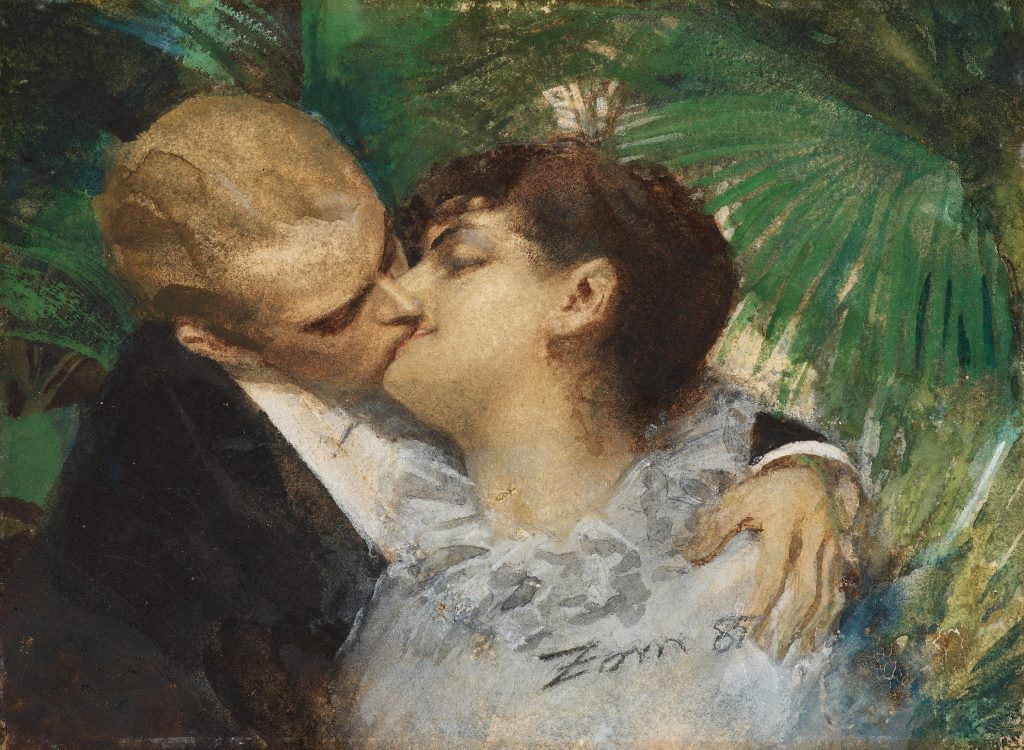
Painters like Anders Zorn, Carl Larsson, and Bruno Liljefors exemplify this turn. Their work, though varied in subject and technique, shared a common goal: to render Sweden visible to itself. They didn’t simply depict the countryside—they mythologized it. They didn’t just illustrate peasant life—they stylized it into a vision of cultural continuity and moral simplicity.
Carl Larsson in particular became the visual poet of Swedish domestic life. His watercolor series Ett Hem (A Home), published in 1899, portrayed the artist’s family life at Lilla Hyttnäs in Dalarna. These images—sunlit rooms, patterned textiles, playing children—became iconic. They helped define what a “Swedish home” looked like and felt like, intertwining personal narrative with national ideal.
Larsson’s work was not naïve. It was carefully composed, deeply influenced by Arts & Crafts aesthetics and the idea of gesamtkunstwerk—the total work of art. His wife, Karin Larsson, though often relegated to the background, was instrumental in designing their home’s textiles, furniture, and interiors. Together, they crafted an aesthetic that was modern, rural, egalitarian, and deeply Swedish.
The Pastoral as Politics
National Romantic art was not politically neutral. While it offered a comforting image of continuity and cohesion, it also simplified and excluded. Sami visual culture, urban life, class tensions, and the complexities of a modernizing society were often ignored or sanitized. The peasant became a symbol, not a subject; the forest a backdrop, not a contested space.
At the same time, National Romanticism played an important role in cultural preservation. Artists and ethnographers documented folk costumes, traditional architecture, and oral histories that might otherwise have vanished in the wake of industrialization and migration. In this sense, the movement was both nostalgic and archival—a romanticization, but also a recognition of loss.
Toward a New Century
As the 20th century approached, National Romanticism would evolve further into architecture, literature, and music. The visual motifs of this period—red-painted cottages, birch trees, lace curtains, and wildflowers—would become so deeply embedded in the Swedish imagination that they would outlive their original contexts.
Romanticism, in both its emotional and national forms, left a profound imprint on Swedish art. It shaped not only what was painted, but how Sweden thought of itself—as a land of natural beauty, quiet strength, and cultural purity. Even as modernism approached with its stark lines and abstract forms, the soft shadows of Romanticism would linger in the corners of Swedish visual culture, offering nostalgia, rootedness, and emotional resonance.
8: The Carl Larsson Phenomenon and the Arts & Crafts Ethos
In the late 19th and early 20th centuries, few artists in Sweden—or arguably anywhere in Europe—managed to fuse personal vision, national identity, and everyday life as completely as Carl Larsson. His images of domestic harmony and folk-inflected interiors became a cultural phenomenon, shaping not only Swedish art but the way Sweden saw itself. But Carl Larsson was not working alone. His art was both a product of and a contributor to the Arts & Crafts movement, a transnational ethos that sought to reunite beauty with usefulness, and art with life.
This section explores Larsson’s significance not just as a beloved watercolorist but as the embodiment of a broader cultural moment—where home, design, and national identity were being reimagined through aesthetics.
A Swedish Home: Lilla Hyttnäs as Living Canvas
Carl Larsson’s fame rests largely on a series of illustrated books, beginning with Ett Hem (A Home, 1899), in which he depicted scenes from his family life in the artist’s colony of Sundborn, Dalarna. The images show his wife Karin, their children, pets, furniture, gardens, and holiday rituals—all bathed in soft light and composed with exquisite care. But what might seem, at first glance, like sentimental domesticity is in fact a deliberate and radical artistic statement.
Lilla Hyttnäs, their home in Sundborn, was a living experiment in design. Every wall, curtain, piece of furniture, and mural was an expression of a total aesthetic vision. Rather than the heavy, dark furnishings of bourgeois Europe, the Larssons’ home was filled with light-painted walls, natural wood, handwoven textiles, and whimsical, child-friendly details. It was informal yet refined, rustic yet modern.
The home was not just depicted in art—it was the art. And it was a collaboration.
Karin Larsson: The Designer in the Frame
While Carl was the public figure, it was Karin Larsson (née Bergöö) who designed much of the home’s interior—a fact that has only recently begun to receive full recognition. Trained as an artist herself and a student at the Swedish Academy of Arts, Karin stepped away from professional painting after marriage, but her creativity exploded in another direction: design.
She crafted furniture, embroidered linens, and wove tapestries that combined traditional Swedish motifs with a forward-thinking aesthetic sensibility. Her textiles feature bold geometric patterns, simplified florals, and colors that reflect the Nordic seasons—elements that anticipate modern Scandinavian design by decades. The couple’s aesthetic partnership was a quiet revolution, making the domestic space the site of artistic innovation.
It is telling that in many of Carl’s paintings, Karin appears not simply as a subject, but as a kind of presiding spirit—at work, in motion, immersed in the very environment she helped create.
The Arts & Crafts Spirit in Sweden
The Larssons’ vision was part of a broader reaction against industrialization and mass production—a reaction that took different forms across Europe. In Britain, it was the William Morris-led Arts & Crafts movement; in Austria, the Secessionists; in Finland, the National Romantic architects. In Sweden, the ethos was deeply tied to national identity.
Swedish Arts & Crafts, known locally as slöjd when referring to folk crafts, was not just about handmade goods—it was a moral and cultural stance. It valorized simplicity, honesty of materials, local traditions, and the dignity of labor. The Larssons, through their lifestyle and art, gave this ethos a new visual vocabulary: cheerful interiors, artisanal craftsmanship, and a reverence for the everyday.
Designers and artists such as Carl Malmsten, Elsa Gullberg, and the Handarbetets Vänner (Friends of Handicraft) organization would carry these ideas forward into the 20th century. But it was the Larssons who gave the movement its most beloved images.
Painting the Modern Family
Carl Larsson’s watercolor style was light, detailed, and narrative-driven. His compositions often frame intimate moments: children at play, Christmas dinners, gardening, sewing. But rather than idealizing these scenes in a rigid or saccharine way, he gave them movement and specificity. His children are not cherubs; they’re fidgeting, absorbed, alive. His interiors are not static backdrops but dynamic spaces that reflect the personalities within them.
In doing so, Larsson helped redefine how the Swedish family was imagined. His art aligned with contemporary ideas about child-rearing, domestic equality, and the moral value of a beautiful, ordered home. These were not aristocratic visions—they were middle-class dreams, rendered with the polish of fine art but rooted in real life.
In a time of industrial expansion and urbanization, the Larsson household became a symbolic refuge: a place where art and nature, work and leisure, male and female creativity could coexist. It was a vision of modernity that looked not toward machines or cities, but toward intimacy and craft.
Reception and Legacy
Carl Larsson’s work was immensely popular during his lifetime. Ett Hem and its follow-ups (Larssons, Åt Solsidan, Spadarvet) were bestsellers, and his images circulated widely in prints and calendars. Yet his critical reception was more complicated. Some in the avant-garde dismissed his work as decorative or nostalgic, particularly as modernism gained steam.
But the longer view reveals Larsson not as an obstacle to modernism, but as a precursor. His work’s focus on design, everyday aesthetics, and functional beauty anticipated the principles that would define Scandinavian modernism after World War II. The soft minimalism of IKEA, the clean lines of Swedish furniture, and the contemporary emphasis on light, space, and livability all have roots in the Larsson household.
Today, Lilla Hyttnäs is a museum visited by tens of thousands annually—a site not just of artistic heritage, but of national self-recognition. In Carl and Karin’s shared project, many Swedes see an image of who they were—and who they still aspire to be.
The Carl Larsson phenomenon was not just about one artist’s success. It was a cultural shift: the elevation of the home to a site of art, the merging of masculine and feminine creativity, the belief that national identity could be expressed not through grand gestures, but through a well-lit room, a handwoven curtain, and the laughter of children. In this vision, Sweden found not only an aesthetic, but a philosophy of living.
9: Modernism Comes North – Hilma af Klint and Beyond
By the dawn of the 20th century, the ground beneath European art was shifting. In Paris, Vienna, and Berlin, the certainties of realism and narrative began to unravel, giving rise to abstraction, expressionism, and radical redefinitions of what art could be. Sweden, geographically on the cultural periphery, might have seemed insulated from these shocks. But far from lagging behind, Sweden was developing its own avant-garde currents—distinct, mystical, and often ahead of their time. At the center of this awakening was a figure now considered one of the true pioneers of modernist abstraction: Hilma af Klint.
Her work, long hidden from public view, has become a key to understanding how spiritualism, science, and formal innovation converged in early 20th-century Swedish art. But she was not alone. Modernism in Sweden arrived in waves, carried by a generation of artists who studied abroad, read widely, and returned home to reshape their visual world. It was an era of synthesis, resistance, and wild experimentation.
Hilma af Klint: The Mystic of Abstraction
When Hilma af Klint (1862–1944) first began painting her large, non-representational works in 1906, she predated Wassily Kandinsky’s first abstractions by several years. Yet for much of the 20th century, her name was absent from the art historical canon. Only in recent decades has her contribution been fully recognized—and it has rewritten the story of modernism.
Af Klint was trained at the Royal Academy of Fine Arts in Stockholm and worked in the academic tradition of portraiture and naturalistic studies. But her true artistic calling lay elsewhere. Deeply influenced by spiritualist movements such as Theosophy, Anthroposophy, and the teachings of Rudolf Steiner, af Klint believed that her art was guided by higher, non-physical forces. She was part of a group called De Fem (The Five), a circle of women who practiced séances and automatic drawing, laying the foundations for what we now recognize as spiritually informed abstraction.
Her Paintings for the Temple—a massive series of over 190 works—are filled with biomorphic forms, spirals, diagrams, and symbolic color systems. Many resemble scientific illustrations or cosmological charts. Yet they are also emotionally resonant and deeply intuitive. These works were not intended for public exhibition during her lifetime; af Klint believed the world was not yet ready for their meaning. She instructed that they not be shown until at least 20 years after her death.
When they finally were, they stunned the art world. Not only had she anticipated abstraction, but she had done so with a conceptual rigor and spiritual ambition that challenged traditional narratives of male-dominated innovation. Her work speaks to a specifically Swedish intersection of rational mysticism—a culture steeped in both scientific curiosity and folk spiritualism.
The “Men of 1909” and Early Modernism
While af Klint worked in relative obscurity, another group of artists was publicly challenging Swedish artistic norms. The exhibition held in 1909 at the newly formed Kunstnärsförbundet (Artists’ Association) featured artists who had returned from studies in Paris and Berlin, bringing with them bold colors, distorted forms, and the expressive freedom of post-impressionism and fauvism.
This group—sometimes referred to as the 1909 generation—included artists like Isaac Grünewald, Sigrid Hjertén, Gösta Sandels, and Leander Engström. Inspired by Matisse, Cézanne, and Van Gogh, they shocked conservative audiences and critics with their aggressive palettes and emotional brushwork. Their art was less about the Swedish landscape and more about inner feeling, city life, and psychological intensity.
Sigrid Hjertén, in particular, deserves attention. A former student of Matisse and the wife of Grünewald, her work was often overshadowed during her lifetime but has since been recognized for its raw emotional power. Her portraits and interior scenes blend bold colors with a dreamlike dislocation—tensions that mirrored her own struggles with mental illness and gendered marginalization within the art world.
These artists paved the way for modernist expression in Sweden. They connected Sweden to broader European currents, but always with a regional inflection—drawing on Nordic light, social dynamics, and a certain emotional restraint that tempered the Parisian wildness.
Gösta Adrian-Nilsson (GAN) and the Machine Aesthetic
Among the most radical early modernists in Sweden was Gösta Adrian-Nilsson, known as GAN. A gay man navigating a socially conservative society, GAN found in art a way to encode desire, identity, and utopian longing. After studying in Berlin and being exposed to German Expressionism, Futurism, and Cubism, GAN returned to Sweden with a visual vocabulary unlike anything previously seen in the country.
His paintings from the 1910s and ’20s feature fragmented bodies, machine forms, and geometric abstraction. He was fascinated by movement—of trains, ships, and muscular men. These weren’t merely formal experiments; they were charged with erotic and symbolic meaning. GAN’s vision of modernity was both mechanized and mythic, blending technology with pagan imagery, abstraction with allegory.
Though his work was largely ignored in his time, GAN is now seen as a foundational figure in Swedish modernism—an artist who brought queer desire and avant-garde innovation into dialogue with the national art scene.
Functional Modernism and the Seeds of Swedish Design
Parallel to these more experimental figures, a different strand of modernism was beginning to take root—one focused on design, clarity, and function. This would blossom in the 1930s, but its origins lie in the early 20th-century embrace of simplified form and useful beauty.
Artists and designers such as Elsa Gullberg, Gregory Paulsson, and the Swedish Society of Craft and Design (Svenska Slöjdföreningen) began promoting the idea that art should serve society. This aligned with broader European movements like the Bauhaus and De Stijl, but in Sweden it took on a particularly democratic ethos—art and design not for the elite, but for everyone.
This early phase of functionalism, which we will explore more fully in the next section, was deeply informed by modernist values: honesty of materials, formal reduction, and integration of aesthetics into everyday life. It marked a shift from subjective expression to social purpose.
The Spiritual, the Scientific, and the Nordic Mind
One of the most intriguing aspects of early Swedish modernism is its spiritual-scientific tone. Unlike the more overtly political or industrialist strands of modernism in other countries, Sweden’s early modernists were often concerned with unseen forces: emotion, electricity, the subconscious, mysticism, cosmic energy.
This is not coincidental. Sweden, in the late 19th and early 20th centuries, was a hotbed of spiritualist societies, alternative science, and psychological research. Figures like Emanuel Swedenborg, though from an earlier era, continued to influence the national imagination. The boundary between science and spirituality was porous—and art navigated that space with unusual fluency.
Hilma af Klint is the clearest example of this synthesis, but it permeates much of early Swedish modernism: GAN’s mythical machines, Hjertén’s emotional atmospheres, the stylized order of design reformers. The result is a form of modernism that feels less aggressive than its European counterparts—more contemplative, symbolic, and holistic.
Sweden’s journey into modernism was never about wholesale rejection of the past. Instead, it was a process of transformation: of tradition into abstraction, of mysticism into geometry, of the private self into a public form. Figures like Hilma af Klint, GAN, and Hjertén helped expand the language of art beyond representation and nationalism, introducing new modes of seeing that were as intellectual as they were emotional.
10: Swedish Functionalism and Design as Art
By the 1930s, Sweden was undergoing a cultural metamorphosis. The fervent experimentation of early modernism, with its mystical abstraction and expressionist intensity, began to coalesce into a vision of art that was not just for the gallery but for the world—structured, purposeful, democratic. This was the age of Swedish Functionalism, a movement that reshaped not only how Swedes made furniture and built houses, but how they conceived of beauty, utility, and society itself. In Sweden, more than in perhaps any other country, design became a civic virtue, and aesthetics became policy.
This transformation was not a retreat from modernism, but its practical realization. Swedish Functionalism retained the utopian core of the avant-garde while shedding its esoteric edges. It merged Bauhaus principles with a Nordic sensibility: soft light, natural materials, clean lines, and a profound respect for human need. The result was an aesthetic revolution that blurred the boundaries between art, design, architecture, and everyday life.
The 1930 Stockholm Exhibition: A Manifesto in Built Form
The defining moment of Swedish Functionalism arrived in 1930 with the Stockholm Exhibition (Stockholmsutställningen)—an international showcase of modern architecture and design organized by the Swedish Society of Craft and Design (Svenska Slöjdföreningen) and led by architect Gunnar Asplund.
This exhibition was no mere art show. It was a statement of intent, a national-scale argument for modernist living. Visitors encountered light-filled pavilions, flat roofs, sans-serif typography, open-plan kitchens, tubular steel furniture, and modular housing. It was Sweden’s Bauhaus moment—but with less austerity and more warmth.
The exhibition was not only visually striking but politically significant. It promoted the idea that good design was a social right, not a luxury. Function, affordability, hygiene, and comfort were foregrounded. It wasn’t about elite taste—it was about shaping a better life for all Swedes. This democratic spirit would define Swedish modernism in the decades to come.
From Architecture to Ideology
The leading architects of the Functionalist movement—Gunnar Asplund, Sven Markelius, Uno Åhrén, Sigurd Lewerentz—were not just designing buildings. They were shaping a worldview.
Their structures emphasized clarity and rationality: long horizontal lines, flat surfaces, absence of ornamentation. But they also embedded these ideals in social infrastructure—libraries, schools, hospitals, and affordable housing. The home became the central focus of Functionalist design—not just as a shelter, but as a tool for equality.
The Folkhemmet (“People’s Home”) became the guiding metaphor of the Swedish welfare state, and Functionalist design was its visual language. From the layout of public housing to the standardization of fittings and fixtures, art and design were enlisted in the project of social democracy.
The Art of Furniture: Everyday Modernism
Nowhere was this ideology more clearly realized than in furniture and interior design. The 1930s and ’40s saw the rise of designers who brought Functionalism into the domestic sphere with elegance and economy.
Figures like Bruno Mathsson, Carl Malmsten, and later Yngve Ekström created chairs, tables, and beds that exemplified the “less is more” ethos—but with a distinctly Swedish touch. Birch wood, bent lamination, ergonomic curves, and a soft palette distinguished Swedish design from the harder-edged modernism of Central Europe.
Bruno Mathsson’s “Pernilla” chair, with its undulating frame and webbed seat, became an icon of comfort-conscious modernism. Mathsson’s designs weren’t cold or mechanical; they were organic, sensuous, human.
Carl Malmsten, often positioned as a more traditional counterpoint to Functionalism, nevertheless played a critical role in shaping Swedish design. He emphasized craftsmanship, natural materials, and national heritage, bridging the Arts & Crafts tradition with modern utility. His work reminded Swedes that modernism need not erase the past—it could evolve from it.
The Democratization of Taste: IKEA and the Cultural Export
While IKEA wasn’t founded until 1943 and wouldn’t become a cultural juggernaut until decades later, its DNA is rooted in Swedish Functionalism. IKEA absorbed and mass-produced the ideals pioneered by the architects and designers of the 1930s: affordability, simplicity, adaptability, and style.
The “flat-pack” revolution—furniture that could be shipped and assembled by the consumer—was not just a logistical innovation. It was an ideological one. It reflected a belief in empowered consumers, pragmatic beauty, and universal access to good design. This egalitarianism is deeply Swedish and deeply modernist.
IKEA also exported Swedish aesthetics to the world: blond wood, white space, modular forms, and unpretentious charm. The world came to associate these traits with Scandinavian calm, rationality, and balance. Swedish Functionalism became not just a style, but a global brand of modernity.
Art or Design? Redrawing the Lines
As Functionalism matured, it challenged the very distinction between fine art and applied art. Should a beautifully designed chair be considered sculpture? Is a perfectly composed kitchen less worthy of critical attention than a canvas in a museum?
Sweden answered these questions not with manifestos but with practice. Museums such as the Nationalmuseum and the Röhsska Museum of Design and Craft began collecting furniture, textiles, and ceramics alongside paintings and prints. Schools like Konstfack (University of Arts, Crafts and Design) trained generations of artists who worked across disciplines, moving easily between product design, illustration, and spatial art.
Textile designers like Astrid Sampe and Stig Lindberg brought color and playfulness to Functionalism without sacrificing its core values. Swedish ceramics—especially from the Gustavsberg and Rörstrand factories—achieved international acclaim for their fusion of form, function, and whimsical elegance.
This erasure of the line between art and design didn’t diminish either field—it expanded the cultural imagination. It allowed the idea that art could be useful and that usefulness could be beautiful.
Critiques and Contradictions
Of course, Functionalism was not without its critics. Some saw it as sterile, overly rational, or alienating in its quest for universality. Others worried about the erasure of regional identity in favor of international modernism.
Within Sweden, there were debates about whether Functionalism served the people or imposed a particular aesthetic vision upon them. Designers like Carl Malmsten pushed back against standardization, advocating for the handmade, the irregular, and the culturally rooted.
Yet even these critiques occurred within a shared ethical framework—that design matters, that it affects how people live and feel, and that it carries moral weight.
Legacy and Lasting Influence
Swedish Functionalism didn’t fade with the arrival of postmodernism. Its legacy is woven into the very fabric of Swedish life: in the housing blocks of the Miljonprogrammet (Million Program), in the public libraries of every municipality, in the globally recognized simplicity of IKEA and H&M storefronts.
More than that, it left a cultural ethos: that beauty should be democratic, that design can shape society, and that art is not only for contemplation but for daily life.
Even today, as sustainability and social equity become ever more urgent, the ideals of Swedish Functionalism feel remarkably current. Its blend of humility, clarity, and care remains a model for what art and design can be when they work not for markets or egos, but for people.
11: Postwar Swedish Art – Between Existentialism and Experimentation
In the aftermath of World War II, Sweden found itself in a complex position—geopolitically neutral yet deeply implicated in the ideological fault lines of the Cold War era. The trauma of global conflict did not strike Sweden with the same physical devastation as elsewhere in Europe, but it left its mark nonetheless, particularly in the realm of art. Swedish artists emerged into a world shadowed by nuclear anxiety, ideological polarization, and existential doubt. Yet it was also a world electrified by new technologies, media, and modes of expression.
From the 1940s through the 1970s, Swedish art became more varied, more conceptual, and more psychologically charged. While some artists continued to refine the aesthetic legacies of functionalism and modernist form, others broke entirely with tradition, exploring abstraction, materiality, and language itself. Swedish postwar art would not coalesce into a single movement—it splintered, refracted, and radicalized.
What united these divergent practices was a deep sense of inquiry: into the self, into society, and into the very nature of art.
Concrete Art and the Search for Order
One of the defining early movements of Swedish postwar art was Concrete Art—an international tendency that rejected illusion and symbolism in favor of pure form, color, and spatial relations. It found an especially fertile home in Sweden, where its disciplined clarity resonated with modernist ideals.
Artists like Olle Bærtling, Lars Erik Falk, and Karl Axel Pehrson created geometric compositions that were rigorously non-representational. Bærtling, in particular, became known for his angular, color-saturated works, often built around the concept of “open form”—a visual language designed to suggest dynamism and infinite extension beyond the frame. For Bærtling, abstraction was not an escape from the world but a universal language that could transcend politics and geography.
The Concrete Art movement, while non-narrative, was deeply utopian. It believed in the power of pure visual logic to foster clarity and harmony in a postwar society riven by ideology. Its austerity was not coldness, but a moral stance—a belief that beauty could be impersonal, rational, and egalitarian.
Existential Figuration: The Human Condition on Canvas
While Concrete Art pursued universality through abstraction, another current in Swedish art turned inward, grappling with subjectivity, mortality, and the fractured self. This existential figuration drew on Expressionism, Surrealism, and literature to explore the psychological consequences of modern life.
Evert Lundquist, for example, painted emotionally charged, often somber figures and interiors that seemed to radiate introspection and loneliness. His thick brushwork and subdued palette conveyed a world of muted intensity—haunted by memory, faith, and doubt.
In the work of Erland Cullberg, whose expressive figures teeter between abstraction and madness, we see the postwar subject not as a rational agent but as a tormented, searching being. Cullberg’s personal struggles with mental illness informed his art, and his raw canvases are acts of both personal exorcism and philosophical inquiry.
Even Anders Österlin and Max Walter Svanberg, associated with Surrealist and Fantastic Realist modes, infused their work with existential unease. Their dreamlike imagery often conceals darker undercurrents—sexual anxiety, isolation, and absurdity.
Swedish postwar figuration is not monumental. It does not seek to glorify or soothe. Instead, it turns the canvas into a mirror for vulnerability, ambiguity, and the fragility of meaning itself.
Conceptualism and Institutional Critique
By the 1960s and ’70s, Swedish artists—like their counterparts abroad—began to question not just how to make art, but what art is, who it is for, and where it belongs. The rise of conceptual art in Sweden marked a decisive break from object-centered aesthetics toward process, language, and critique.
Öyvind Fahlström, one of the most internationally recognized Swedish artists of the period, operated at the nexus of pop, politics, and play. His work encompassed painting, performance, installation, and media, often infused with biting social commentary. Works like World Bank (1971) and his “variable paintings”—modular compositions with movable parts—reflected a world in flux, shaped by capital, war, and ideology.
Fahlström’s political art did not deliver slogans; it offered systems—dense, game-like environments where meaning was unstable and participation was required. He connected Swedish art to global networks, from Fluxus to anti-imperialist movements, and proved that conceptualism could be both rigorous and exuberant.
Meanwhile, artists like Barbro Bäckström, Marie-Louise Ekman, and Kjartan Slettemark challenged the very structures of the art world. Slettemark, in particular, used performance and persona (most famously his “Nixon-Viking” hybrid identity) to expose the absurdities of political and artistic authority. His work blurred the lines between satire, protest, and personal mythology.
Feminist Voices and Body Politics
The postwar period also witnessed the emergence of feminist and body-centered art, particularly in the 1970s. Women artists in Sweden began to confront the patriarchal structures of both society and the art world, using performance, video, and installation to reclaim the body as a site of agency.
Monica Sjöö, though working primarily in the UK, was Swedish-born and infused her work with goddess imagery, eco-feminist spirituality, and radical politics. Her controversial painting God Giving Birth (1968) epitomizes the bold reclamation of maternal imagery and feminist myth-making that was unfolding globally.
In a different register, Marie-Louise Ekman (formerly De Geer Bergenstråhle) created paintings and films that satirized domestic life, gender roles, and bourgeois norms with a dry, almost cartoonish wit. Her work, though deceptively light in tone, delivered sharp critiques of conformity and repression.
These artists did not seek inclusion in the existing art canon—they questioned the canon itself. They used humor, vulnerability, and transgression to expand the field of what art could do and whom it could serve.
Institutions and the Public Sphere
This era also saw the growing role of Moderna Museet as a central player in Sweden’s cultural life. Under directors like Pontus Hultén, the museum became internationally known for its daring programming and its embrace of contemporary art in all forms—installations, happenings, video, and beyond.
Hultén’s legendary exhibitions, including Movement in Art (1961) and collaborations with Marcel Duchamp, Jean Tinguely, and Niki de Saint Phalle, positioned Stockholm as a serious node in the global art network. Moderna Museet was not just a repository—it was a laboratory, a place where Swedish and international artists could interact, experiment, and provoke.
At the same time, Sweden’s expansive public art programs—enabled by state funding and social democratic ideals—allowed for an unprecedented integration of art into civic life. Murals, sculptures, and installations populated libraries, schools, and subway stations, reflecting a belief in art as a public good.
This democratization, however, raised new questions: Could state-supported art still be critical? Was institutional support a form of soft censorship, or a platform for genuine engagement? Swedish artists of the postwar period navigated these tensions with increasing sophistication.
Postwar Swedish art was not monolithic. It encompassed spiritual abstraction and bodily transgression, political critique and formal austerity, private torment and public play. But it was united by a sense of urgency—a belief that art could respond to the anxieties of the age, not with easy answers, but with new forms of questioning.
12: The Rise of the Contemporary – Institutional Power and the Periphery
As the 20th century gave way to the 21st, Swedish art underwent another transformation—less a rupture than an acceleration. The legacy of modernism, functionalism, and postwar experimentation remained embedded in the country’s artistic infrastructure, but the questions driving contemporary art had changed. In an era marked by globalization, migration, digitalization, and climate crisis, Swedish artists began to engage with new themes and formats, and often with a critical eye toward the institutions that shaped them.
The Swedish contemporary art scene became simultaneously more global in its reach and more reflexive in its scope—looking outward to international dialogues and inward to interrogate power, identity, and the cultural narratives produced at home. Institutions like Moderna Museet, Kulturhuset, and Konsthall C continued to dominate the landscape, but a growing number of independent initiatives, artist-run spaces, and biennales emerged from the margins. In this new terrain, the periphery was no longer passive—it was productive, subversive, and increasingly central to the story.
The Institutional Landscape: Moderna Museet and Beyond
At the heart of Swedish contemporary art remains Moderna Museet, Stockholm’s flagship museum of modern and contemporary art. Since the 1990s, the museum has played a dual role: maintaining its world-class collection (Picasso, Duchamp, af Klint) while also functioning as a laboratory for contemporary curatorial experimentation.
Under the leadership of directors like Lars Nittve and Daniel Birnbaum, Moderna Museet expanded its global outlook, hosting exhibitions that placed Swedish artists in dialogue with international movements and staging retrospectives that helped canonize previously overlooked figures like Hilma af Klint and Öyvind Fahlström. The museum’s emphasis on conceptualism, feminism, and installation art aligned with broader European and North American trends, but always with a Nordic lens.
At the same time, new institutions and initiatives pushed the boundaries of institutional critique. Spaces like Tensta Konsthall, located in a multicultural suburb of Stockholm, emerged as critical sites for exploring migration, race, and postcolonial identity. Founded in 1998, Tensta deliberately positioned itself at the intersection of art and social practice, asking what it means to make and show art in a context far removed from the elite center.
These alternative spaces, often run collectively or with rotating leadership, questioned the authority of the “white cube,” experimenting with participatory art, educational formats, and collaborations with local communities. The result was not just new art—but a rethinking of what art institutions could be.
The Conceptual Turn: Language, Identity, and Systems
Conceptualism remained a dominant force in contemporary Swedish art, but its emphasis shifted. Where earlier conceptual art focused on abstraction and process, contemporary artists increasingly turned toward language, identity, and political systems.
Annika Eriksson, for example, has created video installations and social experiments that explore collective behavior, subcultures, and everyday rituals. Her work often blurs the line between documentary and performance, inviting viewers into ambiguous social spaces—offices, parks, city streets—where the ordinary becomes strange and revealing.
Goldin+Senneby, a collaborative duo working since 2004, take conceptualism into the realm of finance, legal infrastructure, and digital networks. Their project The Nordenskiöld Model (2007–2010), for instance, explored algorithmic trading and economic speculation through a fictionalized corporate structure. Their work exemplifies a new strand of Swedish conceptualism: critical, recursive, and deeply enmeshed in real-world systems.
Other artists, such as Lisa Tan, use text, photography, and video to probe language, longing, and diasporic identity. Tan’s practice merges poetic restraint with academic rigor, reflecting the contemporary art world’s porous boundary between visual art, philosophy, and literature.
These artists and others demonstrate that Swedish conceptual art has matured into a multi-disciplinary and theory-rich practice, one that engages not only with aesthetic questions but with epistemology, power, and place.
Performance and the Grotesque: The Body Resurfaces
While conceptual rigor has remained central, contemporary Swedish art also saw the return of the body—not in the classical or expressionist sense, but as a site of excess, mutation, and grotesque play.
Nathalie Djurberg, often working with collaborator Hans Berg, creates stop-motion clay animations that are at once childlike and disturbing. Her characters—animalistic, deformed, libidinal—act out scenes of violence, sexuality, and power struggle in surreal dreamscapes. Paired with Berg’s hypnotic soundscapes, her work challenges viewers to confront taboo desires and social repression, framed in deceptively playful materials.
Djurberg’s work typifies a Swedish tradition of emotional ambivalence—combining formal control with psychological rupture. It also illustrates how performance, even in animated form, has become a dominant strategy for artists exploring gender, trauma, and social dysfunction.
Elsewhere, artists like Martina Hoogland Ivanow use photography and film to render the body in soft focus, dissolving form into mood. Her work exists in the liminal spaces between figure and atmosphere, sleep and consciousness—part of a broader turn in Swedish art toward the subliminal and affective.
Migration, Memory, and the Decentered Nation
Sweden’s changing demographics and self-image have also shaped its art. Once seen (and promoted) as a homogeneous welfare state, Sweden is now a multicultural, multilingual, and contested society. Artists working today often foreground questions of belonging, borders, and historical memory.
Rana Begum, Mohamed Bourouissa, and Éva Mag are among those whose work challenges Swedish notions of cultural purity and national identity. Others, such as Ingela Ihrman, take a more symbolic approach—using costumes, performance, and invented rituals to explore alienation, metamorphosis, and care.
Meanwhile, a younger generation of artists has used documentary, digital media, and installation to address migration, climate, and settler histories. These include Lina Selander, whose films explore the failures of political ideology and historical vision, and Fatima Moallim, whose drawings and performances often focus on diaspora, family, and displacement.
What links many of these artists is a critique of the center—not only in terms of geography, but in terms of assumed universality. Swedish art has become polycentric, multilingual, and cross-temporal. The idea of a single national style or school no longer holds.
Biennales, Residencies, and the Global Circuit
Swedish artists today participate in an increasingly global art ecosystem. They show at Venice, Berlin, Istanbul, and São Paulo, and participate in residencies and fellowships around the world. This has had a double effect: exposing Swedish artists to new audiences, and bringing international voices into Swedish discourse.
The Gothenburg International Biennial for Contemporary Art (GIBCA), founded in 2001, has become a major platform for exploring art in relation to migration, decolonization, and the politics of memory. It has often been more radical than Stockholm-based institutions, and has made a point of foregrounding curators and artists from underrepresented contexts.
This global integration has expanded the range of Swedish contemporary art—but it has also raised new tensions about access, funding, and cultural translation. As art becomes more professionalized and internationalized, questions persist: Who gets to speak? For whom? And in what language?
Contemporary Swedish art is not a singular movement—it’s a field of tensions, dialogues, and contradictions. It is shaped by powerful institutions but often resists them. It is rooted in history but oriented toward emerging futures. It embraces conceptualism, but also emotion, ritual, and critique. Most importantly, it reflects a culture constantly negotiating its position in the world—between North and South, past and future, center and periphery.
13: Sámi Visual Culture and the Struggle for Recognition
To tell the full story of Swedish art without centering Sámi visual culture would be to perpetuate the very marginalization that Sámi artists have worked for generations to resist. The Sámi people—who live across Sápmi, a region that spans northern Sweden, Norway, Finland, and the Kola Peninsula—possess a rich, complex, and evolving visual tradition. Their cultural expressions have long predated modern state borders, but since the 19th century especially, Sámi artists have had to assert their identities and practices against the erasures of settler colonialism, cultural assimilation, and state-sponsored invisibility.
This section explores Sámi visual culture not as an adjunct to Swedish art history, but as a parallel and intersecting tradition—one that has continually negotiated between preservation and innovation, resistance and resurgence. From traditional materials and symbolic forms to contemporary conceptual art, Sámi visual language reveals a deep connection to land, cosmology, memory, and sovereignty.
Duodji: Craft as Cosmology
At the heart of traditional Sámi visual culture lies duodji, a term that encompasses functional craftwork—tools, clothing, and ornamentation—created with skill, care, and spiritual significance. Duodji is not merely decorative; it is an embodied knowledge system, passed through generations and inseparable from daily life and environmental stewardship.
Items such as gákti (traditional clothing), kuksa (wooden drinking cups), and intricately patterned belts and knives are made using local materials—reindeer antler, birch, root, and dyed wool. The colors and designs of gákti vary by region and family, carrying with them codes of identity, lineage, and geography. The patterns on woven bands or beaded trims are not arbitrary—they speak, they mark belonging, they encode cosmological balance.
In the context of Swedish art history, duodji challenges the Western binary between “art” and “craft.” It insists that utility and beauty, ritual and technique, are not separate spheres. For many Sámi artists working today, referencing or continuing duodji is both an artistic and political act—an assertion of cultural continuity in the face of assimilationist policies that sought to sever these traditions.
The Legacy of Cultural Suppression
From the 19th century through much of the 20th, Sámi people in Sweden endured forced assimilation, language suppression, religious persecution, and systematic dispossession of land. Residential schooling, bans on traditional beliefs (including shamanic practices), and racist pseudoscience (including skull measurement and ethnographic “collecting” of Sámi remains) all served to marginalize Sámi culture in the name of national progress.
This history shaped the visibility—or more precisely, invisibility—of Sámi art within Sweden’s national cultural institutions. Sámi objects were relegated to ethnographic museums rather than art galleries. Sámi voices were excluded from the national narrative of artistic development. This exclusion has had lasting effects.
Yet even under these conditions, Sámi visual culture persisted. It adapted, morphed, and, by the late 20th century, began to speak back—not only to its own traditions, but to the structures that sought to silence them.
The Contemporary Turn: Resistance as Form
Since the 1970s, Sámi artists have increasingly engaged contemporary art languages—installation, video, performance, conceptualism—not to abandon tradition, but to expand the toolkit of resistance. These artists are not “modernizing” Sámi art; they are reframing it on their own terms.
Britta Marakatt-Labba is perhaps the most recognized Sámi visual artist in Sweden. Her embroidered narrative works, such as the monumental Historjá (2003–2007), tell Sámi history through textile storytelling. Using thread as a drawing medium, she depicts scenes of everyday life, protest, displacement, and myth. Historjá, which spans 24 meters, chronicles over a thousand years of Sámi history—including colonial violence and contemporary political struggles—with delicacy and quiet power. Marakatt-Labba’s work has been exhibited globally and was a highlight of the 2017 Documenta 14 exhibition in Kassel and Athens.
Her use of embroidery—traditionally coded as women’s work and craft—reclaims a space of cultural memory and transforms it into an epic historical archive. Her practice embodies a central theme in Sámi contemporary art: continuity as resistance.
New Voices, New Media
A younger generation of Sámi artists has embraced new media and interdisciplinary practices to explore issues of identity, ecology, and decolonization.
Anders Sunna, a painter and installation artist from Kieksiäisvaara in Swedish Sápmi, uses bold, confrontational imagery to critique the Swedish government’s policies toward the Sámi—especially around reindeer herding rights, land use, and bureaucratic control. His paintings are often layered with archival documents, propaganda aesthetics, and graphic symbolism. They are politically charged, emotionally raw, and unapologetically direct.
Joar Nango, an architect and visual artist, blends installation, sculpture, and social practice to examine Indigenous architecture and knowledge systems. His work challenges Western conceptions of space, dwelling, and sustainability, often using found materials and referencing nomadic traditions. Nango represented the Sámi Pavilion at the 2022 Venice Biennale, a landmark moment for Sámi visibility on the global art stage.
Pauliina Feodoroff, though based in Finnish Sápmi, exemplifies the growing transnational nature of Sámi art. Her ecological theater and land-based practices focus on Sámi land rights, environmental justice, and Indigenous caretaking. Feodoroff’s work points toward a central idea in contemporary Sámi art: that art is not separate from land, and land is not a metaphor—it is a legal, spiritual, and material reality.
The Sámi Pavilion: A Turning Point
The 2022 Venice Biennale marked a historic shift. For the first time, the Nordic Pavilion—traditionally representing Sweden, Norway, and Finland—was transformed into the Sámi Pavilion, curated entirely by and for Sámi artists. Featuring the work of Marakatt-Labba, Nango, and Feodoroff, the pavilion offered not a national showcase but a territorial statement: Sápmi is not a fringe, not a minority, but a sovereign cultural geography.
This moment represented a long-overdue recognition of Sámi art as a central force in the Nordic cultural landscape. It also reframed the very idea of national representation at global art forums, suggesting that nation-states are not the only units of culture, and that Indigenous (or stateless) nations have their own visual languages, institutions, and sovereignties.
Decolonization and the Future of Sámi Art
Contemporary Sámi visual culture is not a style or school—it is a political and cultural assertion. It exists in relationship to a land that is both sacred and contested. It draws on ancestral forms while refusing to be confined by the expectations of authenticity. It is deeply local, yet increasingly global in its reach and alliances.
Efforts toward decolonizing museums, repatriating Sámi remains and objects, and integrating Sámi voices into national arts funding bodies remain ongoing. Artists are at the forefront of these movements, not just as makers of images, but as cultural workers, activists, and historians.
As Sámi art gains greater recognition, the challenge is not simply inclusion—but transformation: of institutions, narratives, and the very assumptions about what constitutes art, who gets to make it, and where it belongs.
14: Conclusion – Art in the Age of Climate, Technology, and Migration
Sweden today stands at the confluence of accelerating global forces—climate change, digital transformation, migration, geopolitical uncertainty—and the nation’s art reflects this complexity with increasing urgency and nuance. From prehistoric rock carvings to 21st-century algorithmic critiques, the history of Swedish art reveals a continuous negotiation between place and possibility, tradition and rupture, isolation and exchange. In this final chapter, we consider how the major threads of this history—spiritual abstraction, democratic design, political critique, and ecological consciousness—are converging in a contemporary art scene marked not by stylistic unity, but by multiplicity, hybridity, and reckoning.
If art once served the crown or the church, and later the modern state or the avant-garde, it now operates in a fractured landscape where institutions coexist with collectives, craft with code, archives with living traditions. Swedish artists today are responding not only to aesthetic questions but to planetary crises, algorithmic logic, and the deep social legacies of colonialism and capitalism. They are imagining art not as a stable object, but as a method, a platform, a disruption.
Climate Aesthetics and Ecological Art
Climate change has become one of the defining issues of our time, and Swedish artists are grappling with its material and metaphysical implications in a variety of ways. Building on long-standing traditions of landscape painting, environmental design, and ecological philosophy, a growing number of artists are producing work that challenges extractive logics and reimagines human-nature relationships.
Ingela Ihrman, for instance, creates immersive installations and performances that reference the natural world in strange and poignant ways. In works like The Giant Otter Giving Birth or The Passion Flower, she uses sculpture, costume, and narrative to embody species other than the human—queering biology, disrupting anthropocentric views, and invoking forms of symbiosis and empathy.
Other artists, such as Åsa Sonjasdotter, engage in agro-cultural practices, using soil, seeds, and farming knowledge as both medium and metaphor. Her work addresses monoculture, loss of biodiversity, and Indigenous agricultural histories through acts of care and replanting, transforming the artist’s role into that of gardener, archivist, and healer.
This turn toward ecological art does not reject technology or abstraction—it reorients them. It asks not just what we depict, but how we live, and whether the very structures of art-making are sustainable.
Digital Worlds, Virtual Selves
Swedish art has long been influenced by rational systems and innovative technologies—from functionalist design to conceptual frameworks. In the 21st century, these tendencies have merged with digital media, virtual environments, and algorithmic aesthetics.
Artists like Jon Rafman and Simon Denny (though not Swedish, yet often shown in Sweden) have influenced a younger generation grappling with surveillance capitalism, AI, and networked identity. Swedish-based artists have responded with works that use machine learning, data visualization, and game engines not simply to embrace new tools, but to interrogate them.
Jonas Lund, for example, creates artworks that are self-governing or responsive to viewer input, often critiquing the art market, social media metrics, and the very gamification of creativity. His work speaks to a contemporary condition where attention, quantification, and algorithmic influence dominate cultural production.
Others, like Emil Holmer, use painting and digital layering to explore the visual logic of screen culture, collapsing the handmade and the computational into dense, glitch-like compositions.
This techno-critical strand of Swedish contemporary art continues the nation’s long interest in systems thinking—but now applies it to systems that think back.
Migration, Diaspora, and the Recomposition of “Swedishness”
In the 21st century, Sweden’s population has become increasingly diverse, due to both labor migration and refugee resettlement. This demographic shift has forced a national reckoning with identity, memory, and belonging, and artists have often led the way in framing these conversations.
Fatima Moallim, whose drawing-based practice incorporates performance and storytelling, foregrounds diasporic memory and embodied dislocation. Her figures, often rendered in minimalist lines on stark backgrounds, evoke longing, presence, and ancestral memory—without relying on literal representation.
Other artists, such as Roxy Farhat, work in video, installation, and pop aesthetics to critique cultural tokenism, gender stereotypes, and neoliberal inclusion politics. Her work is deliberately messy, satirical, and intersectional—channeling the spirit of post-punk feminism and remix culture.
This strand of Swedish art is not merely about adding more voices—it’s about reshaping the conversation, challenging the nation’s self-image, and insisting on more complex genealogies of Swedish modernity.
Institutions Under Pressure
Art institutions in Sweden today face mounting pressure to diversify their programming, decolonize their collections, and redefine their social roles. Movements like Black Lives Matter, #MeToo, and Indigenous sovereignty campaigns have reshaped curatorial priorities and funding policies.
At the same time, artists and collectives are creating alternative infrastructures: temporary museums, mobile platforms, and horizontal networks. Spaces like Konsthall C, Botkyrka Konsthall, and Malmö Konsthall are hosting critical dialogues around gentrification, language justice, and climate migration—often in collaboration with local communities.
The art school system, too, has evolved. Institutions like Konstfack and the Royal Institute of Art are increasingly foregrounding critical theory, social practice, and decolonial pedagogy, training artists not just in technique, but in institutional awareness and world-making.
This moment is not without contradictions. As public funding becomes more precarious, and as cultural policy is increasingly politicized, the tension between freedom and accountability, autonomy and service, grows sharper.
Continuities, Afterlives, and the Long Arc
Looking across the arc of Swedish art history—from Tanum’s Bronze Age carvings to Af Klint’s spirals, from Larsson’s luminous interiors to GAN’s utopian machines, from Fahlström’s political games to Djurberg’s animated grotesques—one sees not a linear progression, but a spiraling constellation.
Certain themes recur:
- A fascination with nature, not just as scenery but as system and spirit.
- A tension between order and rupture, restraint and rebellion.
- A persistent interest in design as ideology—how objects and spaces shape the self.
- A quiet, often understated form of radicalism, dressed in minimalism or wit.
- And a growing recognition that Sweden is not a monolith, but a contested and evolving cultural territory.
If art once served the sovereign or the state, it now serves a more elusive and expansive goal: to imagine forms of life, relation, and repair in the face of uncertainty.
Swedish art, in its fullest sense, is not a closed canon but a living process. It includes the Sámi carver and the suburban muralist, the textile collective and the digital provocateur. It is as much a garden as a gallery—rooted in place, open to the weather, dependent on cycles, and alive with unseen labor.
This is not the end of Swedish art history. It is only the beginning of seeing it whole.