Before Rome was Rome, it was a land of shifting identities, ancient languages, and vibrant cultural exchanges. The story of Roman art doesn’t begin with marble busts or imperial forums—it begins with tombs carved into hillsides, with painted dancers and terracotta sarcophagi. It begins with the Etruscans.
The Etruscans: Art in a Forgotten Civilization
By the time the traditional date for Rome’s founding rolled around—753 BCE—Etruscan civilization was already thriving. Centered in what is now Tuscany, northern Lazio, and parts of Umbria, the Etruscans built city-states like Tarquinia, Cerveteri, and Veii, each with distinct artistic traditions. Though much of their literature has vanished, their art survives in abundance, particularly in funerary contexts.
Etruscan tombs were not just resting places for the dead; they were statements of cultural identity, belief, and continuity. The Tomb of the Leopards in Tarquinia (ca. 480–470 BCE) is one of the most vivid examples: its walls are covered in colorful frescoes showing banquets, musicians, dancers, and mythical creatures. Life and death coexisted in these images, not as opposites but as phases in an ongoing cycle.
Their approach to sculpture was equally distinctive. The Etruscans favored terracotta over marble or bronze (though they did work in those materials too), a preference that gave their art a more expressive, dynamic quality. The Sarcophagus of the Spouses from Cerveteri (late 6th century BCE) shows a reclining couple at a banquet, tenderly engaging with one another. The woman is shown in a position of prominence—rare in contemporary Greek art—which hints at a more balanced gender dynamic in Etruscan society.
These artworks emphasize an important idea: Etruscan art was not merely derivative of Greek models, as 19th-century historians once claimed. While the Etruscans did borrow stylistic elements from Greece, especially through trade and colonization, they synthesized these with their own beliefs, rituals, and aesthetic preferences.
Early Italic Art: Beyond the Etruscans
While the Etruscans dominated central Italy, other Italic peoples—the Latins, Sabines, Samnites, and others—also contributed to the early artistic landscape. Much of their art is harder to reconstruct, owing to less favorable preservation and a smaller archaeological footprint. Yet in places like Praeneste (modern Palestrina), we find artifacts such as the famous Ficoroni Cista (late 4th century BCE), a bronze container engraved with detailed mythological scenes. Likely made by Etruscan artisans for Latin patrons, it shows the permeability of cultural lines in ancient Italy.
These interactions weren’t just artistic—they were deeply political and religious. Shared visual motifs, such as the use of the sphinx or the depiction of banquets, suggest a common symbolic language across different Italic cultures. Art was not isolated in temples or elite homes; it was part of the public sphere, intimately tied to rites of passage, warfare, and diplomacy.
The Greek Connection and Hybrid Aesthetics
The proximity of Magna Graecia—the Greek colonies in southern Italy—added another layer of complexity. From the 8th century BCE onward, Greek ceramic styles, myths, and sculptural techniques made their way northward. But again, the Italic peoples didn’t simply copy: they transformed.
Take the Capitoline Wolf, the bronze she-wolf that, according to legend, nursed Romulus and Remus. Long thought to be Etruscan (5th century BCE), its dating has been contested, but its symbolic power remains. The twins were likely added in the Renaissance, yet the sculpture itself—powerful, lean, and stylized—has become a cornerstone of Rome’s mythic origin story.
The Etruscan Influence on Roman Identity
As Rome rose from a small kingdom into a republic, then empire, it didn’t erase its Etruscan inheritance—it absorbed it. The Romans adopted the arch and vault, both innovations rooted in Etruscan engineering. They retained Etruscan religious rituals, such as augury and haruspicy (interpreting omens from the flight of birds or animal entrails). Even the Roman triumph, that great military procession, has precedents in Etruscan ceremony.
Visually, early Roman portraiture echoes the veristic tendencies seen in late Etruscan busts, emphasizing individuality, age, and wisdom over idealized beauty. Etruscan tomb paintings, with their sense of movement and narrative, foreshadow the murals that would later adorn Roman villas.
A Legacy Buried but Not Forgotten
Despite their profound influence, the Etruscans would eventually fade from historical memory. By the 1st century BCE, their language was nearly extinct, and their cities had been absorbed into the Roman orbit. Yet their art survived, often buried in necropolises or repurposed in Roman buildings. It wasn’t until the 19th century that a full-scale reevaluation began, revealing just how foundational the Etruscans had been—not only to Rome but to the story of Western art.
Today, visitors to the Villa Giulia in Rome, or the Museo Nazionale di Tarquinia, can encounter the expressive, lively world of Etruscan art up close. In those wide-eyed painted faces and terracotta figures, we see the earliest echoes of Rome—not as marble and empire, but as a living, breathing culture in dialogue with its neighbors, ancestors, and the afterlife.
Republican Rome: Realism, Portraiture, and Civic Identity
By the 6th century BCE, the Etruscan kings had left their mark on the nascent city of Rome—but their rule was coming to an end. In 509 BCE, Rome expelled its last king and established the res publica, the Republic. With this political transformation came an artistic revolution. The art of the Roman Republic wasn’t just different in style; it represented an entirely new way of thinking about the self, the state, and the purpose of art in public life.
The Ethos of the Republic
Republican Rome was a society obsessed with civic duty and ancestral virtue. In contrast to the godlike idealism of Greek sculpture, Roman art began to reflect mos maiorum—the customs of the ancestors, the values of discipline, austerity, and service to the Republic. This ethos translated visually into a style that would come to define Republican portraiture: verism.
Verism, from the Latin verus (true), is the term used to describe the hyper-realistic style of Roman portraiture that flourished from the 2nd century BCE onward. Instead of youth and perfection, Roman busts proudly displayed age, wrinkles, and imperfections. Deep creases, sunken eyes, thinning hair—all were badges of honor, signs of a life spent in service to the state. These were not portraits meant to flatter; they were meant to remind viewers of gravitas, virtus, and dignitas—the core values of Roman public life.
Imagines and the Cult of the Ancestors
In patrician households, these portraits were not confined to art galleries; they were part of the fabric of political life. Wealthy Roman families maintained imagines, ancestral masks or busts displayed in the atrium of the home. During funerals, actors would don these masks and process through the streets, physically embodying the lineage and authority of the deceased. It was an art form rooted not in aesthetics, but in lineage and memory. Art functioned here as a performative extension of political capital.
This deeply ancestral mode of representation also shaped how Romans saw time: as a continuum of responsibility, where each generation stood as both a product of the past and a steward of the future. Busts of stern-faced consuls, generals, and senators communicated more than just personal likeness—they projected a whole system of values into the public realm.
Sculpture Beyond the Bust
Though portrait busts are the most emblematic artistic form of the Republic, the sculptural tradition extended further. Triumphal reliefs, honorific statues, and commemorative altars filled public spaces, often commissioned by victorious generals or ambitious politicians. One striking example is the Altar of Domitius Ahenobarbus (late 2nd century BCE), now partially preserved in the Louvre and Glyptothek in Munich. Its relief panels show both mythological and civic scenes—including one of the earliest surviving representations of a Roman census. The figures are rendered with a realism that foreshadows the mature Republican style, blending the narrative clarity of Greek reliefs with a distinctly Roman concern for order and historical record.
Architecture and Urban Art
The Republican period also saw the transformation of Rome’s urban fabric. Temples, basilicas, and forums multiplied, many of them funded by magistrates eager to leave their mark on the city. The use of opus incertum (a form of irregular stone masonry) and the early experimentation with concrete began to distinguish Roman architecture from its Greek predecessors.
Public spaces such as the Forum Romanum became venues for political and judicial life—and they were decorated accordingly. Every architectural project was an act of civic propaganda. The Temple of Portunus (ca. 120–80 BCE), with its blend of Greek columns and Etruscan-style podium, is a perfect symbol of this hybrid architectural language. It’s Roman not because it invents new forms, but because it adapts and combines others to suit its civic purposes.
The Influence of Hellenism
Despite their austere values, Roman elites were deeply drawn to Greek art. After the conquest of Greece in the 2nd century BCE, a flood of Greek artworks entered Roman homes, villas, and libraries. Statues by Polykleitos, Lysippos, and Praxiteles were shipped to Rome—or copied in vast numbers by Roman artisans.
This Hellenistic influx sparked a tension in Roman culture: between traditional Roman simplicity and the seductive beauty of Greek aesthetics. Cicero, in his writings, often complained about the moral dangers of Greek luxury. Yet he, like many senators, decorated his villa with Greek statues and commissioned copies of famous Greek works. Art in the Republic thus becomes a site of ideological negotiation. Even the most virtuous Roman might be tempted by the idealized nude of an Aphrodite, even while celebrating the wrinkled bust of his grandfather.
Frescoes and Domestic Art
The domestic sphere of Republican Rome also bore traces of artistic ambition. In towns like Pompeii, Herculaneum, and Boscoreale, villas were decorated with elaborate frescoes. Though most extant examples come from the later Republican period and early Empire, their development began during this time.
These wall paintings, often arranged in architectural trompe-l’œil styles, gave otherwise plain Roman homes the illusion of grandeur. Columns, landscapes, and mythological scenes adorned the walls—not merely as decoration, but as statements of cultural literacy and elite status. The First Style (or “Incrustation Style”), which mimicked marble slabs, is the earliest of these traditions and reflects the Republican taste for grandeur through illusion rather than material opulence.
Toward the End of the Republic: Art as Political Weapon
As the Republic entered its final century, art became increasingly entangled with propaganda. Julius Caesar, for example, minted coins with his own portrait—an audacious act that broke with Republican tradition and signaled a shift toward personal cult. Sculpture and architecture were now used to elevate individual authority, not just civic ideals.
This trend culminated with Augustus, who would straddle the end of the Republic and the dawn of the Empire. But even before him, we can trace the roots of imperial imagery in the late Republic’s increasingly monumental artistic language. Pompey the Great, Caesar’s rival, built the first permanent theater in Rome—ostensibly to celebrate Venus Victrix, but clearly designed to showcase his own power and generosity.
The art of Republican Rome tells a story of a society in flux—a culture that looked backward to its ancestors even as it absorbed the influence of the Greek world and began to visualize new forms of power. In its wrinkled visages and austere temples, we see the scaffolding of an empire being built—not in gold, but in granite conviction.
Imperial Grandeur: Augustus to Late Antiquity
If the Republic was about restraint and realism, the Roman Empire was about scale, symbolism, and spectacle. With Augustus’s rise to power in 27 BCE, Rome entered a period of unprecedented expansion—and so did its art. Public works exploded in ambition and reach, artistic styles grew increasingly idealized, and emperors used visual culture to shape how they were seen both by their subjects and by posterity.
Art became political language, civic religion, and architectural engineering all at once. The Roman world—from Britain to Syria—became a stage upon which imperial identity was projected, stone by stone and statue by statue.
Augustus and the Birth of Imperial Iconography
Octavian, later Augustus, was a master of visual narrative. He understood that the legacy of Julius Caesar had to be managed carefully—emulating his power without repeating his mistakes. His public image had to signal stability, piety, and continuity, even as he was reshaping the Republic into a monarchy in all but name.
The Ara Pacis Augustae (Altar of Augustan Peace), completed in 9 BCE, stands as one of the most important pieces of Augustan propaganda. Though an altar, it is essentially a marble manifesto. The outer frieze shows a detailed procession of senators, priests, and members of the imperial family, walking in solemn unity. Unlike earlier Republican reliefs, which emphasized civic structure, the Ara Pacis introduces a mythic and dynastic dimension—Augustus appears not just as a political figure, but as a divine link in Rome’s eternal destiny.
Similarly, the Augustus of Prima Porta, a marble statue found in Livia’s villa, shows the emperor in a contrapposto pose reminiscent of the Doryphoros by Polykleitos. But where the Greek original celebrates youthful athleticism, Augustus’s version is packed with symbolism. His cuirass is covered in reliefs showing Roman deities and foreign submission. Cupid at his feet links him to Venus. He is youthful, godlike, eternal—not the aging ruler he actually was at the time. The message: the emperor is more than a man; he is the embodiment of Rome itself.
Architecture as Imperial Manifestation
The emperors did not just change how art looked—they changed where and how it was experienced. Augustus famously claimed to have found Rome a city of brick and left it a city of marble, and his successors took that ambition even further.
The Pantheon, rebuilt by Hadrian around 126 CE (on an earlier foundation by Agrippa), is one of the most extraordinary architectural achievements of the ancient world. With its massive concrete dome, oculus, and perfectly proportioned geometry, it created a sacred space unlike anything that had existed before—a microcosm of the universe under the gaze of the gods, or perhaps under the dominion of the emperor himself.
Other emperors contributed their own grand statements:
- Trajan’s Forum and Column (113 CE) glorified the conquest of Dacia with an extraordinary spiraling frieze that winds over 600 feet—more narrative than monument, more film strip than sculpture.
- Nero’s Domus Aurea, a sprawling palace built after the Great Fire of Rome in 64 CE, was so opulent that it shocked the Roman people and helped precipitate his downfall. Its art, however, especially the intricate frescoes and grotteschi, would influence Renaissance artists like Raphael and Michelangelo.
- The Baths of Caracalla and Diocletian, vast pleasure complexes adorned with sculpture and mosaic, reflected the shift toward mass public entertainment and the architecture of empire as spectacle.
Imperial Portraiture: The God-Emperor in Marble
Where Republican portraits emphasized age and service, imperial portraits reintroduced idealism. From Augustus onward, emperors were shown as eternally youthful, divinely endorsed, and often semi-nude in heroic poses. Even when emperors aged—or were infamous—their portraits often adhered to this visual formula.
There were exceptions. The portrait of Vespasian, a military man who rose to power after the chaos of Nero’s reign, returned to a kind of no-nonsense realism, perhaps to distinguish himself from the theatrical excess of his predecessor. Similarly, busts of Hadrian show a philosophical, bearded man in the Greek style, signaling his intellectualism and cosmopolitan outlook.
These portraits were not confined to Rome. Sculptures of emperors were shipped across the empire, installed in forums, baths, and temples from North Africa to Britannia. The emperor’s image was omnipresent, both reassuring and commanding.
Provincial Art and Cultural Integration
Imperial Rome wasn’t just about exporting a single aesthetic. It absorbed and adapted the artistic traditions of its provinces, creating a rich tapestry of local styles under a unifying imperial frame.
In places like Palmyra (modern Syria), funerary reliefs depict local aristocrats in Eastern dress, using Greco-Roman sculptural techniques. In Roman Britain, mosaics incorporate both Celtic patterns and Roman mythological scenes. Art served both to Romanize and to localize the imperial experience. It allowed subjects to see themselves as both part of Rome and true to their heritage.
This is a crucial point: the Roman Empire succeeded not by homogenizing its culture, but by creating a shared language of art, architecture, and ritual that could be adapted to different contexts.
The Crisis of the Third Century and Artistic Transformation
By the 3rd century CE, the empire was in crisis—plagued by invasions, inflation, and internal strife. Art responded with radical changes. Portraits of emperors like Philip the Arab or Gallienus show a move away from calm classicism toward angular features, deeper carving, and a sense of psychological tension.
The monumental style of the Tetrarchs (ca. 300 CE)—a porphyry sculpture group showing four nearly identical co-rulers—abandons individuality entirely. Gone are the personalized expressions; instead, we get squat figures embracing in militarized unity. It’s a style that speaks to anxiety, to a world more concerned with authority than with grace.
Constantine and the Christian Turn
No transformation was more profound than that inaugurated by Constantine the Great. After defeating Maxentius at the Battle of the Milvian Bridge in 312 CE, Constantine embraced Christianity—and changed the trajectory of Western art forever.
His colossal statue in the Basilica of Maxentius (the surviving fragments show a massive head, hand, and limbs) presents a new kind of ruler: part god, part philosopher-king, part eschatological symbol. With Constantine, Roman art takes a decisive step toward abstraction and the spiritualized imagery that would define the Byzantine and medieval periods.
The Arch of Constantine, erected to celebrate his victory, is a fascinating collage of earlier imperial art—reused reliefs from Trajan, Hadrian, and Marcus Aurelius are patched together with new work. The result is both a homage and a break, a visual declaration that the old gods and the old order had been surpassed.
From Augustus’s serene marble gaze to Constantine’s towering presence, imperial Rome used art as a force of cultural engineering. It forged identity across an empire, made politics tangible, and turned rulers into legends carved in stone. Even as the Western Empire declined, its artistic vocabulary—monumental scale, narrative relief, architectural mastery—would echo across the centuries in Christian basilicas, Islamic palaces, and Renaissance masterpieces.
Early Christian Art and the Transformation of Rome
When Constantine the Great legalized Christianity with the Edict of Milan in 313 CE, he didn’t just change the empire’s religious landscape—he initiated one of the most profound aesthetic revolutions in the history of Western art. Art in Rome was no longer about gods, emperors, or civic triumph; it now turned inward, spiritual, focused on the afterlife and divine truth. The visual culture of Rome shifted from the tangible power of the imperial state to the invisible mysteries of Christian faith.
And yet, early Christian art didn’t arrive ex nihilo. It evolved from existing Roman visual traditions, reconfiguring familiar motifs into a new symbolic language that would shape the art of Europe for the next thousand years.
The Catacombs: A Subterranean World of Symbol
Long before Christianity gained legal status, it had already begun to develop its own visual culture—often underground, both literally and metaphorically. The catacombs of Rome, sprawling networks of subterranean burial chambers dug into soft tufa rock, were not simply tombs; they were spaces of ritual, memory, and quiet resistance.
Decorated with frescoes, carvings, and inscriptions, catacomb art offers a fascinating glimpse into the early Christian imagination. The art is neither grand nor technically refined, but it is rich in symbolism. Here, the faithful painted shepherds, fish, anchors, and orants (figures with upraised hands in prayer)—imagery often drawn from existing Roman art but repurposed with Christian meanings.
- The Good Shepherd, for instance, was a familiar pagan motif representing philanthropy or the god Hermes Kriophoros. In the catacombs, it became Christ caring for his flock, a symbol of divine protection and resurrection.
- The fish (ichthys) served as a covert acronym for Iēsous Christos, Theou Yios, Sōtēr—“Jesus Christ, Son of God, Savior.”
- The orant, with arms uplifted, drew from Roman funerary imagery of piety but came to represent the soul in prayer or the figure of the Church itself.
These early works were not about aesthetics or individual identity; they were communal, coded, and centered on salvation. There was no tradition of depicting the historical Jesus with a fixed likeness—he could appear youthful, beardless, even indistinct—because the purpose was spiritual, not representational.
Transition and Transformation: Pagan Forms, Christian Functions
When Constantine began supporting Christianity, he ushered in not just freedom of worship but monumental Christian architecture. Yet because Christianity had long avoided public buildings and figural worship, it had no grand architectural style of its own. So what did Rome do? It borrowed from its own pagan past.
Interestingly, the model for the Christian church was not the pagan temple, but the Roman basilica—a civic hall used for law courts and public gatherings. Temples, with their focus on a small inner sanctuary and exterior processions, were unsuitable for communal worship. Basilicas, with their spacious interiors, aisles, and apse, were ideal for gathering large congregations and focusing attention on an altar or bishop.
The result was a new kind of sacred space: longitudinal, inward, and symbolic. The Old St. Peter’s Basilica, begun under Constantine in the 320s CE over the site believed to be the apostle’s tomb, was one of the first major Christian basilicas. It set the template for countless churches to follow: a nave, side aisles, a transept, and an apse, often adorned with mosaics and marble.
Other major Constantinian foundations included:
- San Giovanni in Laterano (St. John Lateran), Rome’s first official cathedral.
- San Paolo fuori le Mura (St. Paul Outside the Walls), marking the burial place of the apostle Paul.
- Santa Costanza, a central-plan mausoleum with extraordinary early Christian mosaics.
Mosaics: From Narrative to Revelation
Where classical art sought to depict the world in all its sensual detail, Christian art moved toward abstraction, symbolism, and transcendence. Nowhere is this clearer than in mosaic.
In early Christian churches, mosaics replaced sculpture as the primary medium of expression. Glass tesserae shimmered with gold and lapis, transforming walls and apses into visions of heaven. Perspective and naturalism were deliberately downplayed. The goal was not to replicate reality, but to reveal divine truth.
A key example is the apse mosaic at Santa Pudenziana (ca. 390 CE), one of the oldest surviving Christian apses in Rome. Christ is depicted enthroned among apostles, resembling a classical philosopher-king. The figures still show volume and drapery, but they are placed in a stylized, symmetrical composition, with gold and architectural motifs behind them. Heaven, here, is rendered as eternal order and divine wisdom.
Later mosaics at Santa Maria Maggiore (5th century) move even further from realism, replacing narrative depth with frontal, iconic images. Here we begin to see the seeds of the Byzantine style, where symbolism, hierarchy, and celestial abstraction take precedence over earthly realism.
Christian Iconography Emerges
By the 4th and 5th centuries, a coherent Christian iconographic program began to develop. Christ is increasingly shown with a beard, regal bearing, and divine authority. The Virgin Mary appears more frequently, especially in scenes like the Annunciation, Nativity, and Madonna and Child.
Biblical narratives—Daniel in the lion’s den, Jonah and the whale, the Three Hebrews in the fiery furnace—were favored for their typological connections to resurrection and salvation. These stories were not just historical events but allegories of Christ’s triumph over death.
Christian art was also used to claim and reinterpret space. Pagan motifs such as the vine, the phoenix, or the zodiac were Christianized and deployed to fill the symbolic universe of the Church. Rome, once the capital of an empire of many gods, was being remade into the New Jerusalem, the spiritual heart of a new era.
The Fall of Rome and the Rise of the Christian Imagination
As the Western Roman Empire crumbled in the 5th century, Rome’s artistic production slowed but did not stop. The papacy assumed increasing authority, becoming both spiritual and political leader of the city. Even as the city fell into decline, its Christian monuments stood as beacons of continuity.
Art in this period reflects both resilience and transformation. The grandeur of imperial art was not abandoned, but reinterpreted. The Church adopted the visual vocabulary of the empire—thrones, crowns, triumphal arches—to express the sovereignty of Christ and the authority of the Church.
The transformation of art in Christian Rome was not an act of rejection but of reinterpretation. Early Christian artists took the forms of Rome—the fresco, the basilica, the mosaic, even the image of the shepherd—and filled them with new, eternal meaning. The result was a visual language of hope, salvation, and divine mystery that would endure for centuries.
In the catacombs and churches of Rome, we see a world turning—from empire to faith, from power to spirit—and in its art, we glimpse the birth of the medieval world.
Medieval Rome: Between Ruins and Revival
In the popular imagination, the fall of the Western Roman Empire in 476 CE marked the end of Roman civilization. But in reality, Rome continued to function—politically diminished, yes, but spiritually ascendant. While cities like Ravenna, Constantinople, and Aachen rose in influence, Rome retained its unique position as the seat of the papacy and the symbolic heart of Christian Europe.
During the early and high Middle Ages (roughly 5th to 13th centuries), Roman art did not vanish. It adapted, hybridized, and often subtly flourished within a landscape of crumbling temples, repurposed basilicas, and rising bell towers. The result is a visual culture that bridges antiquity and modernity, pagan grandeur and Christian humility.
Rome in Ruins, Rome Reimagined
By the 6th century, Rome’s population had plummeted from over a million in the imperial era to perhaps 20,000. The aqueducts dried up, the Senate faded into irrelevance, and great civic buildings fell into disuse. But those same structures provided building material—and inspiration—for a new kind of art.
Churches were often built directly into or atop ancient ruins. The Church of San Clemente, for example, sits above a 4th-century basilica and a 1st-century Mithraeum. This layering of sacred spaces became a defining characteristic of medieval Rome: the physical city mirrored the spiritual idea that Christianity fulfilled and transformed the pagan world, not simply replaced it.
Marble columns were salvaged from old temples, floors re-laid with broken stones, and ancient sarcophagi repurposed for saints. This practice—often referred to as spolia—was not mere recycling; it was a conscious act of cultural memory, embedding the Christian present within the architectural bones of imperial Rome.
The Papacy as Patron and Preserver
Throughout the early medieval period, the popes played a central role in shaping Roman art. While their resources were modest compared to the imperial past, they directed what funds they had toward preserving and re-sanctifying the city’s sacred spaces.
Pope Gregory the Great (r. 590–604), a pivotal figure in Church history, also played a part in fostering art and music (the “Gregorian chant” tradition is named for him, though it evolved later). He emphasized the didactic function of imagery—art was a tool for instructing the faithful, particularly the illiterate.
A significant moment came with the Carolingian Renaissance in the 8th and 9th centuries. When Charlemagne was crowned Emperor of the Romans in St. Peter’s Basilica in 800 CE, it symbolized the fusion of Frankish power and Roman Christian authority. Roman artists and architects were called north, and in turn, Rome saw a brief revival of monumental decoration under papal patronage. Frescoes in churches like Santa Prassede and Santa Maria in Domnica showcase this renewed energy, with golden apses, hierarchical compositions, and strong Byzantine influence.
Byzantine Influence and the Iconographic Turn
Following the Gothic Wars and the brief Byzantine reconquest of Italy under Justinian, Roman art in the 6th–8th centuries absorbed strong Eastern influences. This was particularly visible in mosaics: gold backgrounds, frontal figures, and the rigid serenity of divine iconography.
One of the most stunning examples is the apse mosaic of Santa Prassede (9th century), commissioned by Pope Paschal I. Christ, flanked by saints, floats against a shimmering gold backdrop, set within a celestial vision that flattens space and emphasizes spiritual clarity over narrative realism.
This shift from narrative Roman frescoes to iconic Byzantine mosaics reveals how Rome, though no longer politically central, remained a crossroad for artistic exchange—blending Western, Eastern, classical, and Christian traditions into new hybrids.
Cosmatesque Art: Geometry and Devotion
By the 12th century, Rome experienced a quiet yet significant artistic renaissance under a group of workshops collectively referred to as the Cosmati, a family of artisan-architects active for several generations. Their work focused on decorative marble inlay—opus sectile—used to adorn church floors, altars, cloisters, and pulpits.
Cosmatesque designs are striking: geometric patterns using porphyry, serpentine, and re-used Roman marbles. They are both mathematically intricate and spiritually symbolic, reflecting a medieval fascination with cosmic order and divine harmony.
You can still walk across Cosmati floors in churches like:
- San Clemente
- Santa Maria in Cosmedin
- San Giovanni in Laterano
These are not just floors—they are theological diagrams in stone, connecting the Roman tradition of mosaic craft with a distinctly medieval cosmology.
Fresco Cycles and the Return of Narrative
Though mosaics remained prominent in apses, frescoes made a strong comeback in the Roman churches of the 11th–13th centuries, especially with the growing influence of monastic orders. These paintings began to reintroduce narrative, emotion, and even elements of classical modeling.
At San Clemente, beneath the later basilica, a stunning 11th-century apse mosaic presents the Crucifixion as a Tree of Life—blending Old Testament typology with rich Christian symbolism. The stylized vine scrolls, teeming with birds and figures, reflect both Byzantine influence and a renewed interest in storytelling and metaphor.
Medieval Rome as a Pilgrimage City
Throughout the medieval period, Rome was one of the major pilgrimage destinations in Europe—alongside Santiago de Compostela and Jerusalem. Art served not just the resident faithful, but also transient pilgrims seeking spiritual enlightenment and physical relics.
This function is visible in the grandeur of San Giovanni in Laterano (the cathedral of Rome) and Santa Maria Maggiore, both of which underwent repeated renovations to accommodate the crowds and project the city’s status as the spiritual capital of the West.
Medieval guidebooks—such as the Mirabilia Urbis Romae (“Marvels of the City of Rome”)—directed pilgrims to the tombs of martyrs, mosaics, and miracle-working images, creating an urban pilgrimage network that doubled as a spiritual and artistic map.
Toward the Gothic and the Trecento
As the 13th century progressed, the influence of the Gothic style—especially from France—began to enter Roman art. Though Rome never fully embraced Gothic architecture as northern Europe did, you can see Gothic elements in structures like the Cloister of San Paolo fuori le Mura and the rose windows of Santa Maria in Aracoeli.
At the same time, artists like Pietro Cavallini began to break from the strict iconography of earlier mosaics, introducing volume, emotion, and naturalistic detail. His Last Judgment fresco in Santa Cecilia in Trastevere (1293) is one of the great precursors to the Renaissance in Rome—a bridge from medieval symbolism to Renaissance humanism.
Medieval Rome was not a city in decline—it was a city in transformation. Amid invasions, schisms, and political fragmentation, it preserved the artistic languages of antiquity and the East, reinterpreting them through the lens of Christian theology and monastic devotion.
The city’s medieval art, though less famous than its ancient or Renaissance splendors, tells a crucial story: how Rome survived itself. How it kept building, painting, carving—even as it changed beyond recognition.
The Romanesque and the Gothic: Fragmented Flourishes
By the time the rest of Europe was raising cathedrals with pointed arches, flying buttresses, and luminous stained glass, Rome was still firmly rooted in its ancient architectural bones. The city was neither isolated nor stagnant—it was simply different. Rome’s path through the Romanesque and Gothic periods was a fragmented one, shaped by political turmoil, papal ambitions, and its enduring relationship with its own ruins.
Between roughly the 10th and 14th centuries, Roman art and architecture participated in the wider evolution of medieval style, but always in dialogue with the city’s unique past. Here, a pointed arch might spring from an ancient column; a medieval fresco might be layered over a pagan wall. Rome’s artistic identity in this period was defined not by revolution, but by hybridization.
Romanesque Rome: Continuity Through Craft
The Romanesque period in Rome—roughly the 10th to 12th centuries—is defined not so much by massive cathedrals, as in northern Europe, but by a steady campaign of church building, restoration, and embellishment. Popes, local aristocratic families, and monastic orders commissioned new works that balanced spiritual ideals with Rome’s ever-present classical inheritance.
Key characteristics of Romanesque art in Rome included:
- Thick masonry walls and semicircular arches
- Campanili (bell towers), often built next to churches rather than as integrated structures
- Cosmatesque decoration, including intricate inlaid floors, ambones, and cloisters
- Re-used ancient Roman materials (spolia) in columns, capitals, and facades
One of the great masterpieces of this era is the Cloister of San Giovanni in Laterano, built by the Vassalletto family in the 13th century. Its elegant, twisted columns and polychrome stone inlay are quintessentially Roman: medieval in construction, ancient in material, and timeless in effect. The cloister served as a contemplative space, a blend of intellectual geometry and sensory beauty.
Ambones and Pulpits: Liturgical Art with Monumental Form
While the great stone tympana and barrel vaults of Romanesque France are largely absent from Rome, the city instead developed a tradition of intricate, sculptural liturgical furniture. Ambones (raised pulpits used for reading scripture) became central focal points within Roman churches.
One of the most spectacular examples is the ambone at San Lorenzo fuori le Mura, crafted by the Cosmati in the 13th century. Perched on columns above a marble platform, it blends geometry, allegory, and craftsmanship. Lions crouch beneath the structure—a common Romanesque symbol of protection and vigilance. These ambones are not just functional; they are sermons in stone.
The Gothic Comes to Rome (Slowly)
Gothic architecture arrived late and never fully took root in Rome. This was due in part to the city’s conservative artistic traditions and its abundance of usable ancient materials, which limited the need for radical structural innovation. Instead of cathedrals that soared, Rome built churches that gestured gently toward the Gothic while maintaining their Romanesque DNA.
For example:
- Santa Maria sopra Minerva is the only true Gothic church in Rome, built by the Dominicans in the 13th century. Its pointed arches and ribbed vaults reflect northern styles, yet its location atop an ancient Roman temple of Minerva is classic Roman layering.
- Santa Cecilia in Trastevere and Santa Maria in Aracoeli show Gothic decorative elements—rose windows, pointed arches—but their spatial plans remain closer to early Christian or Romanesque structures.
In these churches, the Gothic is not a structural revolution, but an ornamental vocabulary: a flourish, a detail, an accent to the enduring Roman form.
Fresco Cycles: Narrative and Naturalism Return
In painting, however, the Gothic period in Rome saw significant innovation. Artists began to re-engage with naturalistic representation, narrative depth, and emotional expressiveness—trends that would culminate in the Renaissance but took root in the 13th century.
Pietro Cavallini is a key figure here. His Last Judgment fresco (ca. 1293) in the west wall of Santa Cecilia in Trastevere is often considered the finest medieval painting in Rome. Cavallini combines Byzantine compositional order with a remarkable sense of mass, shadow, and naturalism. Christ appears as a commanding judge, yet the figures below react with individualized gestures and expressions.
In the apse mosaic of the same church, Cavallini similarly fuses older, golden abstraction with emergent interest in anatomical modeling and spatial cohesion. These frescoes signal a turn—Rome was beginning to reawaken to the visual realism of classical antiquity, but through the lens of Christian narrative.
Monastic Patronage and Urban Renewal
As powerful families like the Frangipane and Orsini vied for control of the city alongside the papacy, monastic orders played a vital role in maintaining and renewing Rome’s artistic landscape. Benedictines, Dominicans, and Franciscans all invested in building and decorating churches that could serve both theological missions and growing urban congregations.
The Franciscans at Santa Maria in Aracoeli and the Dominicans at Santa Sabina brought with them not just new devotional practices, but also new aesthetic sensibilities—humility, clarity, and narrative engagement. These spiritual and artistic currents prepared the way for the didactic realism of Giotto and his Roman followers.
The Jubilee of 1300: Rome as Pilgrimage Epicenter
Pope Boniface VIII’s proclamation of the First Jubilee Year in 1300 brought a massive influx of pilgrims to Rome. It was a spiritual and economic event—and a moment of self-promotion for the papacy. Rome cleaned up its churches, restored its relics, and presented itself as the spiritual capital of Christendom.
This event helped catalyze new commissions and the expansion of infrastructure (such as roads, bridges, and hostels). Artists were called to Rome to create works that would impress, instruct, and move the faithful. This reinvestment in the city’s spiritual image planted the seeds of the full-blown Renaissance that would follow in the next century.
The Romanesque and Gothic in Rome are not defined by cathedrals or stylistic purity—they are defined by adaptability, subtle reinvention, and a deep awareness of place. Rome absorbed what it needed, reinterpreted what it borrowed, and remained anchored in the visual logic of its past.
In this period of fragmented flourishes, the city did not simply preserve ancient forms; it laid the groundwork for the rebirth of classical ideas in Christian form. The Roman Middle Ages were not a lull, but a crucible—quiet, complex, and essential.
The Renaissance in Rome: Papal Patronage and Artistic Revolution
By the dawn of the 15th century, Rome was a city scarred by schisms, invasions, and centuries of decay. Its once-mighty temples and basilicas had crumbled, its population had dwindled, and its grandeur seemed a memory. But within a few decades, Rome would be utterly transformed. Under the vision—and wallets—of a succession of Renaissance popes, the city became a laboratory for artistic brilliance. Michelangelo, Raphael, Bramante, and others would converge here, forging a new visual language that redefined art, architecture, and the very image of power.
The Renaissance in Rome was not merely a revival of classical form—it was an assertion of papal supremacy through art. It was beauty in the service of authority, and faith rendered in fresco, marble, and monumental design.
The Early Renaissance in Rome: Laying the Foundations
While the artistic Renaissance had begun in Florence in the early 1400s, it took longer to take hold in Rome. The papacy had been relocated to Avignon during the 14th century’s Babylonian Captivity, and the Great Schism fractured the Church’s unity until the early 15th century. Only with the return of a stable papal court to Rome could serious artistic patronage resume.
Pope Nicholas V (r. 1447–1455) was among the first to envision a grand revival of the city. He ordered the restoration of St. Peter’s Basilica and the Vatican Palace, and invited artists such as Fra Angelico to decorate the Niccoline Chapel. These works, though small in scale, were conceptually ambitious—they blended classical illusionism with Christian symbolism and laid the intellectual groundwork for what was to come.
Pope Julius II: The Warrior Pope and Artistic Commander
The real explosion of the High Renaissance in Rome begins with Pope Julius II (r. 1503–1513), one of the most forceful personalities ever to hold the papal throne. Ambitious, cultured, and politically astute, Julius understood that art could project not only divine authority but also temporal power. He wanted to make Rome the center of Christian civilization—and to do it, he needed artists of the highest caliber.
One of his most audacious moves was commissioning Donato Bramante to design a new St. Peter’s Basilica. The plan was nothing less than to replace the original Constantinian structure with a church worthy of the Renaissance—and of the papal office. Bramante’s initial centralized plan, inspired by classical temples and early Christian martyria, was radical in scale and ambition. Though it would be altered over the next century, the groundwork was laid: Rome would be reshaped.
But Julius’s greatest cultural legacy was in his hiring of Michelangelo and Raphael, two titans who would come to define the Roman Renaissance.
Michelangelo and the Sistine Ceiling: Theology in Motion
In 1508, Michelangelo—already famed as a sculptor for his Pietà and David—was reluctantly persuaded by Julius to paint the ceiling of the Sistine Chapel. What began as a commission for simple geometric decoration turned into one of the most ambitious narrative cycles ever created.
Over four years (1508–1512), Michelangelo transformed the ceiling into a vast cosmological vision: from the Creation of the World to the Fall of Man to the ancestors of Christ. The figures—massive, muscular, and dynamically posed—broke with Gothic stylization and redefined how the human body could be depicted. These were not static saints—they were divine athletes, wrestling with fate, time, and God.
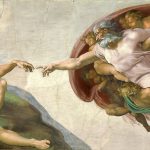
The Creation of Adam, with its nearly-touching fingers, has become one of the most iconic images in Western art, encapsulating not only Renaissance theology but also human potential. Michelangelo’s figures are not only beautiful—they are metaphysical statements.
Raphael and the Vatican Stanze: Humanism in Harmony
While Michelangelo labored on the Sistine ceiling, Raphael was at work just down the hall, in the papal apartments. His frescoes in the Stanze di Raffaello (1509–1517), especially the School of Athens, represent the intellectual heart of the Renaissance.
In the School of Athens, Raphael created a pantheon of ancient philosophers—Plato, Aristotle, Socrates, Pythagoras—set within an imagined classical basilica. The painting is more than homage; it is a declaration that classical knowledge and Christian wisdom are not at odds, but part of a divine continuum. The figures are arranged in harmonious symmetry, each pose considered, each gesture meaningful.
Elsewhere in the rooms, Raphael explores themes of theology, law, poetry, and history—creating a holistic vision of the ideal Christian state, one rooted in humanist inquiry and visual order.
The Vatican Becomes an Artistic Engine
Under Julius and his successors—Leo X, Clement VII, Paul III—the Vatican became not only a religious center but the most powerful art workshop in Europe. Architects, sculptors, fresco painters, and mosaicists were employed to build a new Rome atop the old one.
St. Peter’s Basilica became a palimpsest of Renaissance ideals. Bramante’s design gave way to Michelangelo’s dome, Antonio da Sangallo’s structural work, and later Carlo Maderno’s façade in the early Baroque. What had started as a Renaissance temple of proportion and centralization became a dynamic hybrid—testament to a century of evolving vision.
Tombs, Altars, and the Art of Commemoration
The Renaissance popes were deeply invested in their legacy—not just spiritually, but visually. Funerary art reached new heights, blending sculptural elegance with narrative drama.
Michelangelo’s Moses, part of the unfinished tomb of Julius II in San Pietro in Vincoli, is a masterpiece of psychological intensity. The figure, grasping the tablets of the law, radiates fury, wisdom, and divine tension. Though the original tomb was scaled back, the sculpture endures as a monument to papal ambition and artistic transcendence.
Classical Revival and Antiquarianism
Rome’s Renaissance was not just about new art—it was also about rediscovery. Humanists like Poggio Bracciolini and artists like Raphael took inspiration from Rome’s ruins, studying ancient sculptures, inscriptions, and architecture with unprecedented care.
Raphael was even appointed Prefect of Antiquities by the pope, tasked with preserving Rome’s classical heritage. His architectural drawings and letters reveal an early concept of art conservation, concerned with preserving the ancient past even as the city was being remade.
Antiquarianism fed directly into the visual arts. Sculptors mimicked ancient poses; painters quoted mythological scenes; architects drew on Vitruvian ideals. The Renaissance in Rome was not just a rebirth—it was an integration, a synthesis of the Christian and the classical.
The Renaissance transformed Rome from a ruined medieval capital into a city of eternal promise—a center of intellectual, spiritual, and artistic power. In the process, it also transformed art itself. Human anatomy, perspective, architecture, narrative, and symbolism were all redefined in its studios and chapels.
But even more than technique, it was vision that flourished in Renaissance Rome—the idea that beauty, truth, and divine authority could all be expressed through line, color, and stone.
The Baroque Explosion: Counter-Reformation and Spectacle
By the early 17th century, Rome had once again become the epicenter of European art—but the mood had shifted. The calm rationality of the Renaissance gave way to passion, movement, and a heightened sense of drama. This transformation was no accident. It was the artistic arm of the Counter-Reformation, the Catholic Church’s response to the Protestant Reformation.
As Protestant reformers stripped churches of imagery and ritual, the Catholic Church doubled down on visual splendor. Rome, as the seat of the papacy, became the testing ground for a new kind of art—an art that moved people, overwhelmed them, and brought them back to the faith through sheer sensory power.
The Baroque was born in Rome, and it changed everything.
The Council of Trent and the Mission of Art
The roots of the Baroque are theological. The Council of Trent (1545–1563), in its final sessions, laid out guidelines for religious art: it had to be clear, didactic, emotionally engaging, and above all faithful to Church doctrine. Art was no longer a celebration of human potential as in the Renaissance—it was now a weapon of persuasion and spiritual warfare.
Artists were called upon not to decorate, but to convert. They had to depict saints and martyrs not as distant ideals, but as emotionally real, sensually immediate, and spiritually powerful. Rome responded with art that was immersive, often overwhelming, and designed to reach the heart as much as the mind.
Caravaggio: Light, Flesh, and Divine Grit
Few artists embodied the Roman Baroque like Michelangelo Merisi da Caravaggio. Active in Rome from the 1590s until his exile in 1606, Caravaggio introduced a radical new realism and an unparalleled mastery of chiaroscuro—the use of stark light and dark to create drama.
His works were shocking in their immediacy. In the Calling of Saint Matthew (San Luigi dei Francesi), Christ steps into a Roman tavern, dressed like a barefoot wanderer, and silently points to a stunned tax collector. The lighting is theatrical, the figures are ordinary men with dirty feet and weathered faces, and the divine breaks into the mundane with terrifying intimacy.
Caravaggio’s saints don’t glow—they bleed, sweat, flinch, and pray in shadows. His Martyrdom of Saint Matthew or Conversion of Saint Paul are more like cinematic freeze-frames than classical compositions. In these works, the sacred is not abstract—it’s visceral.
His realism scandalized some, but his influence was immediate and vast. Artists across Europe, including Rembrandt, Rubens, and Velázquez, absorbed his lessons. In Rome, his presence remains immortal in paint, flickering between candlelight and blood.
Bernini: Sculptor of Heaven on Earth
If Caravaggio was the painter of Baroque intensity, Gian Lorenzo Bernini (1598–1680) was its sculptural and architectural master. In Bernini, the Baroque found its greatest orchestrator—a man who could design buildings, carve marble, direct stage sets, and conceive of churches as total works of art.
His Ecstasy of Saint Teresa (1647–1652), in the Cornaro Chapel of Santa Maria della Vittoria, epitomizes Baroque theatricality. The sculpture depicts the moment Saint Teresa of Ávila described being pierced by a seraph’s golden arrow—an ecstatic vision blending divine love and corporeal rapture. Teresa swoons, her robe rippling like liquid marble, while the angel smiles in serene authority. Above them, golden rays descend from a hidden window; to the sides, sculpted members of the Cornaro family watch the scene from their faux theatre boxes. It is sculpture, light, architecture, and stagecraft in a single, seamless whole.
Elsewhere, Bernini’s Baldacchino (1624–1633), a colossal bronze canopy over the high altar of St. Peter’s Basilica, marries architecture and sculpture with papal grandeur. The twisting Solomonic columns—drawn from the Old Testament Temple—are both ancient and baroque, linking Peter’s tomb below to the heavens above. Behind it, his Cathedra Petri (Chair of Saint Peter) sets an ancient wooden throne in a blazing cloud of angels and light.
Bernini didn’t just create works—he created experiences.
Architecture and Urban Vision: The Baroque City Emerges
Baroque Rome wasn’t just a collection of churches and chapels—it was a complete urban reimagining. Popes like Urban VIII, Innocent X, and Alexander VII turned the city into a stage for ritual processions, pilgrimage, and visual spectacle.
Architects such as Francesco Borromini (a brilliant rival to Bernini) redefined space and geometry:
- His San Carlo alle Quattro Fontane is a marvel of concave and convex forms, an undulating façade that seems to breathe.
- Sant’Ivo alla Sapienza, with its corkscrew dome and luminous white interior, is a study in sacred geometry—mystical, spatially daring, and deeply rational.
These churches were not only places of worship—they were architectural sermons, designed to elevate and mystify. In their curves and symmetry, they embodied the Baroque ideal: a fusion of emotion, intellect, and form.
Baroque urbanism also gave us the great piazzas and fountains of Rome:
- Piazza Navona, shaped by the ancient Stadium of Domitian, was transformed into a theatrical civic space, anchored by Bernini’s Fountain of the Four Rivers (1651), where river gods represent the known continents of the world.
- The Trevi Fountain, though completed in the 18th century, carries forward this Baroque vision: water, stone, myth, and movement, all staged for public delight.
Church Interiors: The Gilded Theaters of Faith
Walking into a Baroque church in Rome—Il Gesù, Sant’Ignazio, San Carlo ai Catinari—is like entering another realm. Ceilings dissolve into frescoes, where saints rise into heaven amid clouds and angels. Columns and entablatures blend into sculpted stucco. Gold glitters across altars. The senses are flooded.
The ceiling fresco by Andrea Pozzo in Sant’Ignazio (1685–1694) is among the most astonishing illusions in Rome. Painted on a flat ceiling, it opens upward into a vast dome of saints and heavenly architecture. It is trompe-l’œil at its most sublime—a metaphor for the soul’s ascent, and a demonstration of optical genius.
This art was designed to persuade and to awe. It was experiential theology—faith made visible through illusion, immersion, and wonder.
The Baroque in Rome was not just a style—it was a strategy. It responded to the anxieties of its time with visions of overwhelming glory. It reached beyond reason to stir the heart, converting viewers not through argument, but through awe.
From Caravaggio’s brutal intimacy to Bernini’s divine choreography, the Baroque created a world where heaven touched earth—and Rome once again became the stage upon which Western art turned.
Neoclassicism and the Grand Tour
By the mid-18th century, the dramatic shadows and spiritual ecstasies of the Baroque were beginning to fade. In their place came clarity, order, and intellectual cool. The Neoclassical movement, which emerged in Rome and quickly swept across Europe, was not merely an aesthetic reaction—it was a philosophical shift. Art turned back to antiquity not with medieval reverence or Renaissance curiosity, but with Enlightenment rigor.
At the center of this new visual order stood Rome: still strewn with ruins, still haunted by empire, and now teeming with sketchbooks, chisel-wielding sculptors, and aristocrats hungry for education and prestige. The Baroque had made Rome a spectacle; Neoclassicism made it a syllabus.
The Grand Tour: Pilgrimage of the Cultured Elite
From the 17th to the early 19th century, it became fashionable—almost mandatory—for young European noblemen (especially British) to embark on the Grand Tour: a journey through France and Italy intended to complete their classical education. And no stop was more important than Rome.
Here, the sons of dukes and barons studied ancient sculpture, commissioned portraits, copied ruins, and collected antiquities. Rome’s ruins became not just objects of admiration, but tools of self-fashioning. To have seen the Colosseum by moonlight, or debated Vitruvian proportion in the Roman Forum, was to prove one’s intellectual and moral refinement.
Rome’s role in this tradition was both romantic and instructive: a city of fallen grandeur, offering both cautionary tales and aesthetic ideals. It was here that Enlightenment ideals of symmetry, stoicism, and civic virtue found their visual expression in art.
Piranesi: Etching the Sublime Decay
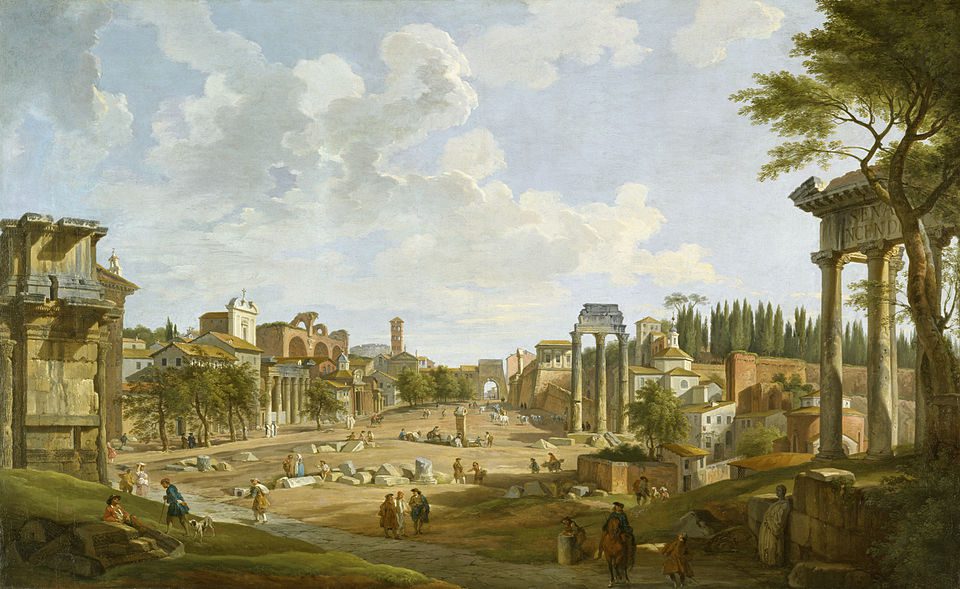
No artist captured this spirit—and Rome’s ruinous allure—better than Giovanni Battista Piranesi (1720–1778). His etchings of ancient Roman architecture, especially the Vedute di Roma (Views of Rome), presented the city not as a static museum, but as a living, breathing ruin. Crumbling arches loomed above tiny figures; broken columns cast long shadows; vegetation crawled across shattered pediments.
Piranesi’s work was both archaeological and poetic. He exaggerated scale, dramatized light, and often fantasized about the structures he depicted. Yet his engravings were wildly popular, influencing not only Grand Tourists but architects, writers, and even Romantic poets. Goethe, upon seeing Rome for the first time, wrote that “all I had read, all I had learned, had become real.”
His series Carceri d’Invenzione (Imaginary Prisons), though not strictly about Rome, captured the Neoclassical fascination with space, structure, and psychological depth—foreshadowing Romanticism and even modern architectural theory.
Canova: Sculpting the Ideal
In sculpture, the defining figure of Neoclassicism was Antonio Canova (1757–1822). Based in Rome for much of his career, Canova was hailed as the new Phidias—the ancient Greek sculptor of the Parthenon.
Canova’s marble figures, such as the Psyche Revived by Cupid’s Kiss or The Three Graces, are paragons of grace, balance, and idealized beauty. They reflect not the turbulent emotion of Baroque sculpture, but a return to Apollonian calm. Muscles are taut but smooth, poses are poised rather than explosive, and drapery clings with studied elegance.
Canova also sculpted funerary monuments—most famously the tomb of Pope Clement XIV in the Church of the Santi Apostoli—which demonstrate how Neoclassicism could infuse Christian subjects with pagan serenity. His monumental statue of Napoleon (as Mars the Peacemaker) similarly revealed how ancient forms could serve modern emperors.
Canova’s studio became a key destination on the Grand Tour. His sculptures were exported across Europe, his style copied, and his aesthetic treated as the embodiment of Enlightenment values: reason, restraint, and beauty.
The Rediscovery of Antiquity: Excavations and Scholarship
The 18th century also marked a dramatic increase in archaeological activity in and around Rome. The rediscovery of Herculaneum (1738) and Pompeii (1748) ignited Europe’s obsession with classical ruins. In Rome itself, systematic excavations of the Roman Forum, Palatine Hill, and Pantheon transformed buried stones into living heritage.
Scholars like Johann Joachim Winckelmann, often called the father of art history, based themselves in Rome and produced groundbreaking studies on ancient Greek and Roman art. His book History of the Art of Antiquity (1764) championed the idea that Greek art—especially in its “noble simplicity and quiet grandeur”—was the highest artistic achievement. For Winckelmann, Rome was the bridge to that greatness.
He argued that the study of ancient art was not only a matter of aesthetics but of moral and intellectual uplift. In his eyes, art had the power to ennoble the soul—and Rome, filled with ruins and statues, was the greatest school.
Neoclassical Architecture in Rome: Rebuilding with Antiquity
While Renaissance and Baroque architects had long drawn inspiration from antiquity, Neoclassical architecture sought to emulate it more faithfully, with cleaner lines and greater archaeological precision.
- The Museo Pio-Clementino, founded in the Vatican in the late 18th century, became both a repository of ancient sculpture and a temple to Neoclassical design, with galleries modeled on Roman baths and basilicas.
- Public monuments and villas—like the Villa Albani, designed by Carlo Marchionni—fused antique fragments with new constructions, creating idealized spaces of harmony and proportion.
Even religious architecture was touched by Neoclassicism. Though few new churches were built entirely in the style, altars, chapels, and tombs increasingly adopted ancient motifs: Corinthian capitals, triglyph friezes, and clean, white marble surfaces.
A New Kind of Patron: Nationalism and Empire
As the Grand Tour matured and Rome’s reputation spread, the patrons of Neoclassical art shifted. It was no longer just aristocrats commissioning busts and sketchbooks. Napoleon Bonaparte, for instance, saw ancient Rome as a model for his own ambitions and filled the Louvre with sculptures looted from Italy. His empire drew visual and symbolic strength from Roman iconography: laurel wreaths, eagles, triumphal arches.
Meanwhile, young democracies like the United States looked to Rome for architectural and artistic models. The U.S. Capitol and the neoclassical monuments of Washington, D.C., were directly inspired by Roman temples and Roman ideals of republican virtue.
Thus, Neoclassical Rome shaped not only art history but the iconography of modern statehood.
In Neoclassicism, Rome reasserted its authority—not through papal power or religious ecstasy, but through timeless ideals of balance, clarity, and rational beauty. The city once ruled by emperors and adorned by popes became the intellectual crucible of Enlightenment Europe.
Where once artists sculpted saints and martyrs, now they carved muses and heroes. Where Baroque ceilings exploded with clouds and angels, Neoclassical salons whispered in measured tones about harmony, democracy, and virtue.
And always, Rome remained the classroom. Its stones taught taste, its ruins taught humility, and its art pointed forward by looking back.
Rome in the 19th Century: Risorgimento and Artistic Identity
In the 19th century, Rome stood at the crossroads of ancient memory and modern ambition. As the city transitioned from papal stronghold to the capital of a unified Italy, art in Rome found itself entangled in a sweeping ideological shift. Gone were the aristocratic commissions of the Grand Tour era; now artists were engaged with nationalism, archaeology, historical consciousness, and the urgent project of constructing a new Italian identity.
This was an age of revolution and romanticism, excavation and education—a time when artists didn’t just depict Rome, they helped define what Rome meant in a modern nation.
The Risorgimento: Nationalism and the Birth of Italy
The Risorgimento (literally, “resurgence”) was the political and cultural movement that led to the unification of Italy in the mid-19th century. For centuries, Italy had been a patchwork of kingdoms, duchies, and foreign-ruled territories. Rome remained under papal control, isolated and symbolic, ruled more as a theocratic principality than a modern city.
But by the 1840s–1870s, nationalist leaders like Giuseppe Garibaldi, Giuseppe Mazzini, and Camillo Cavour pushed for a united Italy—with Rome envisioned as its historical and symbolic capital. Artists played a key role in this movement, creating paintings, sculptures, and monuments that celebrated Italy’s ancient glories, medieval heroes, and revolutionary martyrs.
Historical painting—previously a vehicle for aristocratic nostalgia—now became a call to action. Scenes of Roman republicanism, imperial defiance, and Renaissance humanism were deployed as visual arguments for Italian unity.
Artistic Themes of the Era: Memory, Struggle, and Myth
In this charged atmosphere, Rome’s history wasn’t merely admired—it was mobilized. Artists mined Roman antiquity for symbols of civic virtue and resistance, casting ancient heroes like Brutus, Cincinnatus, or Horatius at the Bridge in a new light.
Meanwhile, Romantic painters—influenced by Delacroix, Géricault, and the German Nazarenes—infused their works with emotional intensity and nationalist sentiment. Roman ruins became more than picturesque backdrops; they were metaphors for lost greatness and national rebirth.
One emblematic work of the era is Francesco Hayez’s The Kiss (1859), which, though painted in Milan, became a symbol of Italian unification. Hayez’s oeuvre is full of Roman subjects rendered with Romantic flair, such as The Sicilian Vespers or The Last Moments of Doge Marin Faliero. Even when not set in Rome, these works drew on Roman themes of betrayal, loyalty, and sacrifice.
The Fall of Papal Rome and the 1870 Turning Point
The climax of this artistic and political moment came in 1870, when Rome was annexed into the Kingdom of Italy and declared its capital. The Pope lost his temporal power, retreating into the Vatican and refusing to recognize the new state—a standoff that would last until the Lateran Treaty of 1929.
This event electrified artists. Some celebrated it with patriotic fervor; others mourned the end of papal Rome. Painters depicted Garibaldi’s troops marching through the Porta Pia, while sculptors and architects rushed to design monuments that would reflect the glory of the newly unified nation.
Rome’s urban landscape began to shift. The Victor Emmanuel II Monument (also known as the Altare della Patria, or Altar of the Fatherland), designed by Giuseppe Sacconi, was begun in 1885 to honor Italy’s first king and unify its people through monumental Neoclassicism. Though not completed until 1935, it symbolized this 19th-century impulse to assert a modern Rome that still bore the grandeur of Caesar’s city.
Archaeology and the Scientific Study of the Past
Parallel to political revolution was a quieter—but equally transformative—movement: the rise of modern archaeology. Throughout the 19th century, the Roman Forum, Palatine Hill, and other ancient sites were systematically excavated and studied with increasing academic rigor.
Scholars like Rodolfo Lanciani worked to document and preserve ancient Rome, transforming the discipline of archaeology from amateur excavation into scientific inquiry. His Forma Urbis Romae, a massive marble map of ancient Rome reconstructed from fragments, remains a landmark of archaeological scholarship.
This surge in archaeology influenced both artists and urban planners. Painters and illustrators became increasingly concerned with historical accuracy in depicting Roman scenes, and public discourse turned toward questions of conservation, heritage, and urban identity.
The Academy and the Classical Legacy
Rome also remained a global magnet for artists. The French Academy at the Villa Medici, the British School at Rome, and the Accademia di San Luca continued to train painters and sculptors in classical techniques.
But the curriculum was evolving. Where once the goal had been to imitate the ancients, now artists sought to interpret them through contemporary lenses—nationalist, romantic, or even critical. This change mirrored broader cultural debates about the role of tradition in modern life.
Rome’s identity as a museum-city became both an asset and a burden. While it offered endless inspiration, some artists began to rebel against the weight of history, foreshadowing the modernist breaks of the 20th century.
Photography and the Changing Gaze
The invention of photography in the 19th century also changed how Rome was viewed and recorded. Photographers like Gioacchino Altobelli and James Anderson documented Roman ruins, monuments, and daily life with unprecedented fidelity.
These images, circulated through albums and prints, allowed Rome’s art and architecture to be studied worldwide. Photography became both a tool of preservation and a medium for new aesthetic exploration. Some artists began to use photographs in their composition process, while others treated them as artworks in their own right.
Rome was no longer just a place to visit—it was a place to archive, catalog, and analyze.
The 19th century in Rome was a time of profound transition. The city moved from papal dominion to national capital, from Romantic longing to archaeological realism. Artists were not mere observers of these changes—they were active participants, shaping how Italy understood its past and imagined its future.
Rome’s artistic identity expanded to include not only the eternal grandeur of antiquity, but also the turbulence of revolution, the labor of excavation, and the fragile hope of unity. The Eternal City had reinvented itself once again—not through conquest or religion, but through politics, scholarship, and the visual language of nationhood.
Modernism and the Roman Avant-Garde
At the turn of the 20th century, Rome was no longer just the spiritual heart of the Catholic Church or the symbolic capital of a unified Italy—it was a city in search of a new cultural voice. The artistic landscape reflected this uncertainty. Trapped between the weight of its imperial and religious heritage and the tidal forces of modernity sweeping through Europe, Rome’s artists began to reinvent themselves, often in rebellion against the very past that defined the city.
Modernism in Rome arrived neither in a single movement nor with unified goals. Instead, it emerged through tensions—between past and future, nationalism and experimentation, monumentalism and personal expression. What emerged was a uniquely Roman avant-garde, rooted in contradiction and rich with invention.
Futurism: Speed, Violence, and the Rejection of the Past
Rome’s first true modernist rupture came with Futurism, a movement founded by Filippo Tommaso Marinetti in 1909. Though more associated with Milan and Turin, Futurism’s ideological heart was Roman. Marinetti’s Futurist Manifesto famously declared a desire to “destroy museums, libraries, and academies”—a direct challenge to Rome’s static identity as a “cemetery of antiquities.”
Futurist artists like Giacomo Balla, Umberto Boccioni, and Gino Severini celebrated motion, machinery, urban energy, and war. Balla, who lived and worked in Rome, created dynamic abstract works like Velocity of an Automobile and Street Light that fractured light and form in vibrant explosions of color.
Ironically, even as they rejected Rome’s past, the Futurists operated in its shadow. Their declarations were made in Italian, in piazzas surrounded by baroque fountains and imperial ruins. This friction—between radical aesthetics and historical surroundings—was part of what gave Roman modernism its distinctive charge.
The Scuola Romana: Expressionism in a City of Stone
In the 1920s and ’30s, another group emerged in reaction to both academic conservatism and Futurist dogma: the Scuola Romana (Roman School), also known as the Via Cavour Group. These painters and sculptors—Mario Mafai, Antonietta Raphaël, Scipione (Gino Bonichi), and Corrado Cagli among them—were deeply influenced by German Expressionism, early Italian Renaissance art, and the emotional weight of Roman space.
The Scuola Romana was introspective, mystical, and often melancholic. Their works depicted ruins, dreamscapes, still lifes, and haunted figures rendered in moody palettes and distorted forms. Rather than reject Rome’s past, they internalized it. The city’s decay became a metaphor for spiritual anxiety and political disillusionment.
Scipione’s canvases, for instance, evoke Rome as a fever dream—a spectral city where saints, skeletons, and ruined facades float through stormy color fields. This was modernism not of speed and violence, but of memory, myth, and existential dread.
Art Under Fascism: Monumentality and Myth
During the Fascist regime of Benito Mussolini (1922–1943), Rome underwent another radical transformation—this time through architecture and propaganda. Mussolini sought to reimagine the city as the capital of a new Roman Empire, using art and urban planning to craft a visual narrative of continuity between ancient glory and fascist modernity.
- The EUR district (Esposizione Universale Roma), planned for the 1942 World’s Fair (never held due to WWII), was the most ambitious project. Its rationalist architecture—most famously the Palazzo della Civiltà Italiana, or “Square Colosseum”—evoked classical forms through modern materials and geometries. It was Rome reinvented as imperial stage set.
- Monumental sculpture returned to the city in grand form: athletic figures, military parades, and mythic allegories that blended Art Deco stylization with classical ideals.
- Painters like Giorgio de Chirico, though not ideologically aligned with fascism, were embraced by the regime for their ambiguous classical dreamscapes, which lent themselves to nationalist reinterpretation.
Art under fascism was marked by contradiction. It promoted a sanitized version of the Roman past even as it suppressed the avant-garde. Many artists—especially those who were Jewish, leftist, or experimental—were censored or exiled.
The Post-War Reckoning and Artistic Renewal
The fall of Mussolini and the devastation of World War II left Rome scarred, physically and spiritually. In the postwar years, a new generation of artists sought to process trauma, rebuild meaning, and reconnect with international art movements.
One key figure was Alberto Burri, a former army doctor who turned to abstract painting. His works—made from burned wood, sacking, plastic, and industrial waste—rejected traditional canvas and spoke to the wounds of war. Burri’s Sacchi (Sacks) and Combustioni (Combustions) are raw, tactile, and hauntingly powerful.
Rome also became home to Cinecittà Studios, a booming center for Italian cinema, which fostered cross-pollination between film and visual art. Directors like Fellini, Pasolini, and Antonioni collaborated with painters and designers, creating a new, hybrid modernism that drew as much from performance and fashion as from traditional painting or sculpture.
Modernist Architecture and Urban Tension
In the 1950s and ’60s, Rome faced a new identity crisis: how to be a modern capital in a city full of sacred ruins. Architects experimented with materials and forms that tried to strike a balance between innovation and preservation.
- The Palazzetto dello Sport, designed for the 1960 Rome Olympics by Pier Luigi Nervi, fused engineering brilliance with classical symmetry.
- Brutalist and rationalist architecture made cautious appearances, but never dominated; Rome’s ancient fabric resisted domination.
The tension between conservation and modernization defined urban planning debates for decades. Each new building, subway line, or plaza risked disturbing archaeological layers—turning every construction site into a negotiation between past and present.
Rome’s modernism was never linear, never clean. It lurched between avant-garde defiance, fascist co-option, existential introspection, and postwar abstraction. It wrestled constantly with the city’s ghosts—with Caesar and Caravaggio never far from the canvas or the construction site.
Unlike the clean lines of Paris or the utopian grids of modernist America, Rome’s modernity was messy, archaeological, and haunted. Its artists didn’t just make work—they made arguments, negotiating with a past that was too heavy to ignore and too rich to reject.
Contemporary Art in the Eternal City
Rome, unlike most global capitals, does not erase its past to make room for the new—it layers it. In the 21st century, the city has become a paradoxical playground for contemporary artists: an open-air museum and a site of ongoing reinvention. Here, the Pantheon and the MAXXI coexist. Marble saints watch over video installations. A wall tagged with street art may butt up against a Renaissance cloister.
The result is a deeply textured, sometimes chaotic, often exhilarating scene where contemporary art doesn’t just exist in Rome—it responds to it.
The Museums of Now: MAXXI and MACRO
The most visible institutional symbols of Rome’s commitment to contemporary art are its two major museums: MAXXI and MACRO.
- MAXXI (Museo Nazionale delle Arti del XXI Secolo) opened in 2010 in the Flaminio district. Designed by the late architect Zaha Hadid, the building itself is a sculptural experience: fluid, curving lines and layered corridors that seem to echo the movement of Rome’s streets and aqueducts. It was Rome’s first major national museum dedicated entirely to 21st-century art, and its presence marked a turning point in the city’s cultural policy. MAXXI’s collection spans international and Italian artists—William Kentridge, Mona Hatoum, Michelangelo Pistoletto, and Francesco Vezzoli, among many others. It also houses cutting-edge architecture exhibits and fosters cross-disciplinary experimentation.
- MACRO (Museo d’Arte Contemporanea di Roma), founded in the early 2000s and spread across multiple sites, takes a more decentralized approach. Housed in repurposed industrial buildings—including a former Peroni beer factory—MACRO embraces Rome’s post-industrial edge. It often showcases emerging artists and site-specific installations, and fosters a dialogue between urban space and creative intervention.
These museums represent a significant shift: from preservation to production, from looking back to engaging forward.
Art in the Streets: Rome’s Urban Canvas
Beyond the institutions, contemporary art in Rome flourishes where it always has—in the streets.
Neighborhoods like Pigneto, San Lorenzo, and Tor Marancia have become centers of street art and muralism. Here, artists transform facades and alleyways into vivid canvases, often addressing social issues, political commentary, or simply the surreal beauty of Roman life.
- The Big City Life project in Tor Marancia brought internationally renowned street artists—like Seth, Jaz, and Case Maclaim—to decorate the walls of public housing blocks. The murals, which range from poetic portraits to mythic reinterpretations, reflect both global trends and deeply local narratives.
- In San Lorenzo, long a haven for students, punks, and political activists, walls are filled with anarchist graffiti, stencil art, and ephemeral wheatpaste posters. This is art that changes daily, art that responds to the news cycle, gentrification, and protest culture.
Rome’s street art scene is inherently dialogic—it speaks back to its environment. A spray-painted Venus might wink from behind a dumpster. A Roman wolf might be tagged with LGBTQ+ slogans. In this city, even a stencil can feel like a philosophical argument.
Rewriting the Past: Contemporary Artists and Historical Sites
In Rome, contemporary artists are constantly in conversation with antiquity—not out of obligation, but out of creative provocation. Many projects and exhibitions intentionally use historic spaces as stages for new work.
- William Kentridge’s Triumphs and Laments (2016) is a powerful example. This massive frieze, stretching 500 meters along the Tiber River near Ponte Sisto, was created by power-washing soot from the embankment walls to reveal a procession of shadow-like figures. The work depicts scenes of Roman triumphs alongside tragedies—refugees, assassinations, deportations—creating a counternarrative to Rome’s official grandeur. It is temporary, political, and hauntingly beautiful.
- Jenny Holzer, Anish Kapoor, and Giuseppe Penone have all participated in site-specific installations within Rome’s ancient or sacred spaces—recontextualizing history through light, scale, or material.
These interventions do more than decorate; they complicate. They force viewers to ask: Whose history is this? What’s missing from the marble?
Rome’s Contemporary Art Scene: A Snapshot
While it may lack the commercial heft of Paris, London, or Berlin, Rome’s contemporary art scene is vibrant, grassroots, and increasingly international.
- Galleries such as Galleria Lorcan O’Neill, Monitor, and T293 show rising and mid-career artists working in a range of media—from video and sculpture to performance and conceptual art.
- Artist-run spaces and collectives—like Spazio In Situ, Fondazione Volume!, and Centrale Montemartini—blur the line between gallery, studio, and research lab.
- Rome also plays host to Rome Art Week (RAW), an annual open-studio event that invites the public into artists’ creative processes across the city.
Rome’s artists today work across disciplines—fine art, film, architecture, design—and often use the city itself as raw material. Whether exploring themes of migration, ecology, digital identity, or historical revisionism, their work speaks to both the specificity of place and the expansiveness of global contemporary discourse.
Time as Medium: Living in a Palimpsest
In many ways, time itself is Rome’s defining medium. Few cities offer contemporary artists such a charged relationship to the past—not as something to escape, but as something to engage, subvert, or honor.
Rome’s contemporary art is temporal, adaptive, and paradoxical. It can be sleek and digital or earthy and hand-made. It may live in a cube of glass or under a Roman arch. But it is never neutral.
To make contemporary art in Rome is to choose to coexist with the past. And that choice—far from being a constraint—has become one of the city’s most dynamic, generative forces.
Rome today is not only a city of ruins and relics. It is a city of living creativity, where artists reinterpret myth, question identity, and challenge history—sometimes with reverence, sometimes with rebellion.
In the shimmering mosaics of a digital projection or the ghostly outline of a riverbank mural, we see a Rome that is not frozen in time, but forever becoming. The Eternal City endures not because it resists change, but because it absorbs it—and reimagines itself with every generation.