In the spring of 1891, peat cutters working in a bog in northern Denmark uncovered one of the most mysterious treasures of the ancient world. Beneath layers of dark peat lay fragments of a massive silver vessel decorated with striking scenes of warriors, gods, animals, and ritual ceremonies. Once carefully reconstructed, the artifact revealed itself as the Gundestrup Cauldron, the largest known silver vessel from Iron Age Europe. Today it is widely regarded as one of the most remarkable archaeological discoveries ever made in Scandinavia.
The cauldron immediately captured the attention of historians and archaeologists. Its images seemed deeply tied to Celtic religion, yet the craftsmanship resembled metalwork traditions from southeastern Europe. The vessel was discovered in Denmark, but its style hinted at connections that stretched across the continent. Scholars soon realized they were looking at evidence of cultural exchange on a grand scale during the late Iron Age.
The artifact is generally dated to the second or first century BC based on stylistic comparison and archaeological analysis. The vessel is made of high-purity silver plates that were hammered into elaborate relief scenes using a technique known as repoussé. After discovery, specialists carefully restored the fragments and assembled the vessel into the shape we see today.
Since the late nineteenth century, the Gundestrup Cauldron has been studied by archaeologists, historians, and art scholars across Europe. It now resides in the National Museum of Denmark in Copenhagen, where it remains one of the museum’s most important artifacts. More than a century after its discovery, the cauldron still raises fascinating questions about religion, craftsmanship, and long-distance cultural contact in the ancient world.
Discovery of the Gundestrup Cauldron
The 1891 Peat Bog Discovery
The Gundestrup Cauldron was discovered on May 28, 1891, in a peat bog known as Rævemose, near the village of Gundestrup in Himmerland, northern Jutland, Denmark. Two peat cutters, working with spades to harvest peat for fuel, noticed pieces of hammered silver emerging from the wet soil. The fragments were flattened and bent, and at first they looked like scrap metal rather than an ancient treasure.
Word of the find quickly spread in the surrounding community. More fragments were recovered from the bog, revealing that the pieces belonged to a large vessel that had been dismantled before burial. Local authorities soon contacted the National Museum of Denmark, which arranged for the fragments to be transported to Copenhagen for examination.
Archaeologists studying the find realized that the cauldron had not simply been lost in the bog. The plates had been deliberately separated and placed into the peat. This method of deposition closely resembles other ritual offerings discovered in northern European bogs. From the Bronze Age through the Iron Age, many valuable objects were intentionally deposited in wetlands as offerings to supernatural forces.
By the end of 1891, researchers had recovered nearly all of the silver plates belonging to the vessel. Although the cauldron had been heavily compressed by centuries of peat pressure, the scenes carved into the metal remained astonishingly clear. The discovery immediately became one of the most important archaeological finds in Danish history.
Reconstruction of the Silver Vessel
When the fragments arrived in Copenhagen in 1892, conservators faced a difficult challenge. The vessel had been flattened and bent by centuries in the bog. Each plate had to be carefully cleaned, stabilized, and reshaped before the object could be reconstructed.
The cauldron was eventually determined to consist of thirteen silver plates that formed the structure of the vessel. These plates included the following components:
- One circular base plate
- Five interior panels
- Seven exterior panels
Each plate was decorated with detailed scenes hammered from the reverse side of the metal. The images were created using repoussé techniques, with additional details added by chasing and engraving on the front surface.
The plates were originally held together by a rim and by separate silver fittings that are now partly missing. Because the rim pieces were not found in the bog, many scholars believe the vessel may once have been slightly taller than the reconstructed version seen today.
After careful restoration work during the 1890s, museum experts assembled the plates into a large bowl-shaped vessel. The finished reconstruction revealed a cauldron approximately 42 centimeters (16.5 inches) high and about 69 centimeters (27 inches) in diameter. The structure was both impressive and unusual, suggesting that it was designed for ceremonial rather than everyday use.
Artistic Design and Craftsmanship
Materials and Construction
The Gundestrup Cauldron
Artist: Unknown craftsman or workshop
Date: 2nd–1st century BC
Medium: Hammered silver with gilded details
Dimensions: Height approximately 42 cm; diameter approximately 69 cm
Current Location: National Museum of Denmark, Copenhagen
The cauldron is composed of nearly pure silver, a remarkable choice of material for such a large object. Silver was extremely valuable during the Iron Age, and objects made from it were usually reserved for elites or for sacred purposes. The sheer amount of metal used in the vessel indicates that its creators had access to significant wealth and resources.
The images were produced using the repoussé method. In this technique, a sheet of metal is hammered from the back to raise the design outward on the front. Once the basic shapes were formed, the craftsman refined the details using engraving tools and punches. This approach allowed the artist to create dramatic depth and lifelike figures.
Several elements of the images were highlighted with gilding, meaning a thin layer of gold was applied to selected areas of the silver. This would have created striking visual contrasts when the cauldron caught the light. Gold highlights appear on torcs, animal features, and decorative borders.
The plates were not cast as a single piece but were assembled from separate sections. This method required both artistic skill and careful engineering. Small rivets and fittings once held the vessel together. The combination of complex imagery and precise metalworking demonstrates a high level of craftsmanship rarely seen in Iron Age artifacts.
Thracian Metalworking Influence
Although the imagery on the cauldron appears closely related to Celtic mythology, the techniques used to create it strongly resemble metalwork traditions from southeastern Europe. Many scholars have compared the vessel to silver objects produced by Thracian craftsmen, who were active in regions that are now part of Bulgaria, Romania, and northern Greece.
Thracian metalworkers were famous during the first millennium BC for their elaborate silver vessels decorated with mythological scenes. Surviving examples from Thracian tombs show similar repoussé techniques, as well as comparable ways of depicting animals and human figures.
In particular, the Gundestrup Cauldron shares stylistic similarities with silver vessels discovered in Thracian burial sites dating from the third and second centuries BC. These objects often feature bold animal forms, richly ornamented borders, and complex narrative imagery.
Because of these similarities, many archaeologists believe the cauldron may have been produced in a Thracian workshop and later transported northward. Trade routes during the Iron Age connected southeastern Europe with the Celtic territories of central and western Europe. It is therefore possible that the vessel was commissioned by a Celtic patron but crafted by Thracian artisans.
This theory helps explain the unusual blend of cultural elements found on the cauldron. The imagery reflects Celtic religious ideas, while the craftsmanship reflects southeastern European metalworking traditions. The object may represent a rare collaboration between cultures that were connected through trade and migration across ancient Europe.
Mythological Scenes on the Silver Panels
The Horned Deity Panel
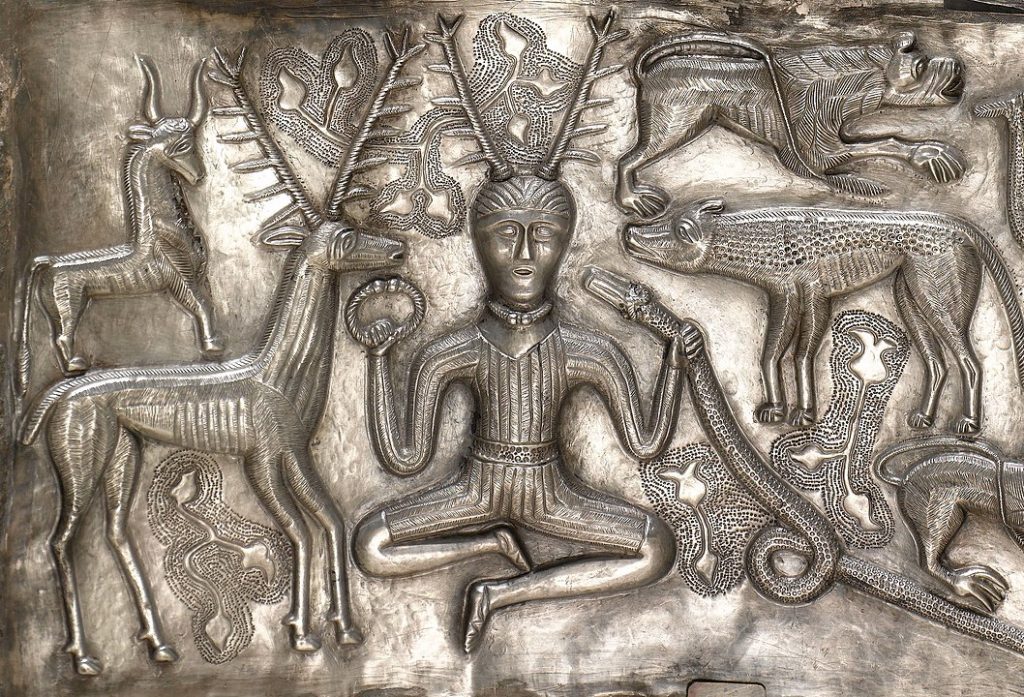
One of the most famous images on the Gundestrup Cauldron appears on one of the interior plates. The scene depicts a seated figure with large antlers extending from his head. The figure sits cross-legged and holds two objects: a torc, which is a rigid metal neck ring associated with Celtic elites, and a long serpent with a ram-like head.
Surrounding the horned figure are several animals, including a stag, a wolf-like creature, and other wild beasts. The arrangement of these animals suggests that the figure is a master of the natural world. His calm posture and commanding presence reinforce the idea that he represents a powerful supernatural being.
Many scholars believe this figure represents a deity commonly known as Cernunnos, a horned god associated with nature, animals, and fertility in Celtic religion. The name Cernunnos comes from a Latin inscription found on a monument in Paris dating to the first century AD. Although the name itself does not appear on the cauldron, the imagery closely resembles later representations of the same deity.
The horned god motif appears in several Celtic artifacts from the Iron Age. The Gundestrup image remains the most detailed and dramatic example known. Because of its rich symbolism, the panel has become one of the most widely studied images in Celtic art.
Warrior Processions and Ritual Scenes
Several other panels on the cauldron depict scenes that appear to show ritual activities or mythological narratives. One interior plate shows a line of warriors marching across the surface of the vessel. These figures carry spears and shields and wear helmets typical of Iron Age warriors.
Above the warriors appears a much larger figure who holds a human body upside down over a cauldron. This scene has often been interpreted as a ritual immersion or sacrifice. Some scholars believe the image may represent a mythological ceremony in which warriors are symbolically reborn through immersion in a sacred vessel.
The exterior plates of the cauldron also contain striking scenes filled with animals and supernatural beings. Among the creatures depicted are lions, bulls, and fantastical beasts. Some animals, such as elephants, would have been unfamiliar in northern Europe. Their presence suggests that the artists were drawing on stories or artistic traditions that traveled long distances.
Common imagery appearing across the panels includes:
- Armed warriors carrying spears and shields
- Powerful animals such as bulls and lions
- Deities interacting with animals
- Ritual or ceremonial scenes involving large vessels
Together, these images create a complex visual narrative that likely held deep religious meaning for the people who used the cauldron. Although the exact stories remain uncertain, the scenes clearly reflect a mythological worldview filled with gods, heroes, and sacred rituals.
The Mystery of Its Cultural Origin
Celtic Symbolism and Religious Meaning
Many of the symbols depicted on the Gundestrup Cauldron are strongly associated with Celtic culture during the late Iron Age. The torc worn by several figures was a well-known sign of status among Celtic warriors and nobles. Archaeological discoveries across France, Germany, and Britain have revealed numerous examples of these neck rings.
Animal imagery was also central to Celtic belief systems. Stags, bulls, and other powerful creatures often appear in Celtic art as symbols of strength, fertility, or divine authority. The presence of these animals on the cauldron reinforces the interpretation that the vessel was connected to religious practices.
The horned god image fits within a broader pattern seen in Celtic art from the La Tène cultural period, which flourished between roughly 450 BC and the Roman conquest of Gaul in the first century BC. La Tène art frequently features stylized animals, elaborate curves, and symbolic figures linked to mythology.
Because of these connections, many historians believe the cauldron reflects Celtic religious traditions even if it was not produced within Celtic territory. The imagery appears to represent stories or beliefs that would have been recognizable to Celtic audiences.
The cauldron itself may have been used during ceremonial gatherings or sacred feasts. In many ancient cultures, large vessels were associated with communal rituals, including offerings to gods or shared meals during religious festivals.
Why Was It Buried in a Bog?
One of the greatest mysteries surrounding the Gundestrup Cauldron is why such a valuable object was placed in a bog. The vessel was not simply discarded. It was intentionally dismantled and carefully deposited in the wet ground.
Across northern Europe, archaeologists have discovered numerous objects that were deliberately placed in bogs during the Bronze and Iron Ages. These deposits include weapons, jewelry, tools, and even human remains. Scholars widely interpret these finds as ritual offerings to supernatural forces.
Bogs were often viewed as sacred places where the natural world intersected with the spiritual realm. Waterlogged landscapes seemed mysterious and powerful to ancient communities. Depositing valuable objects in these environments may have been seen as a way of communicating with divine beings.
The dismantling of the cauldron before deposition suggests that the act itself was ceremonial. Breaking apart an object could symbolize its transfer from the human world to the realm of the gods. Once placed in the bog, the vessel would no longer belong to the living.
The exact date when the cauldron was deposited remains uncertain, but many scholars believe the offering may have occurred during the first century BC. Whatever the reason, the bog preserved the silver plates for nearly two thousand years until they were uncovered by peat cutters in 1891.
Conclusion
The Gundestrup Cauldron remains one of the most extraordinary artifacts from ancient Europe. Discovered in a Danish peat bog in 1891, the vessel provides a rare glimpse into the religious imagination of the Iron Age. Its detailed silver panels depict gods, warriors, animals, and ceremonial scenes that hint at complex mythological traditions.
The object’s craftsmanship suggests connections with metalworking traditions in southeastern Europe, particularly among Thracian artisans. At the same time, the imagery reflects symbols widely associated with Celtic culture. This combination reveals that ancient Europe was far more interconnected than many people once believed.
The cauldron’s deliberate burial in a bog adds another layer of mystery. The act appears to have been a ritual offering, demonstrating the importance of sacred landscapes in Iron Age belief systems. By placing such a valuable object into the earth, ancient people may have been honoring powerful forces they believed controlled the natural world.
Today the Gundestrup Cauldron stands as one of the most important treasures in the National Museum of Denmark. Its images continue to inspire research and debate among historians and archaeologists. More than two thousand years after it was created, the vessel still speaks to the imagination, reminding us that ancient art can preserve stories long after the cultures that created them have vanished.