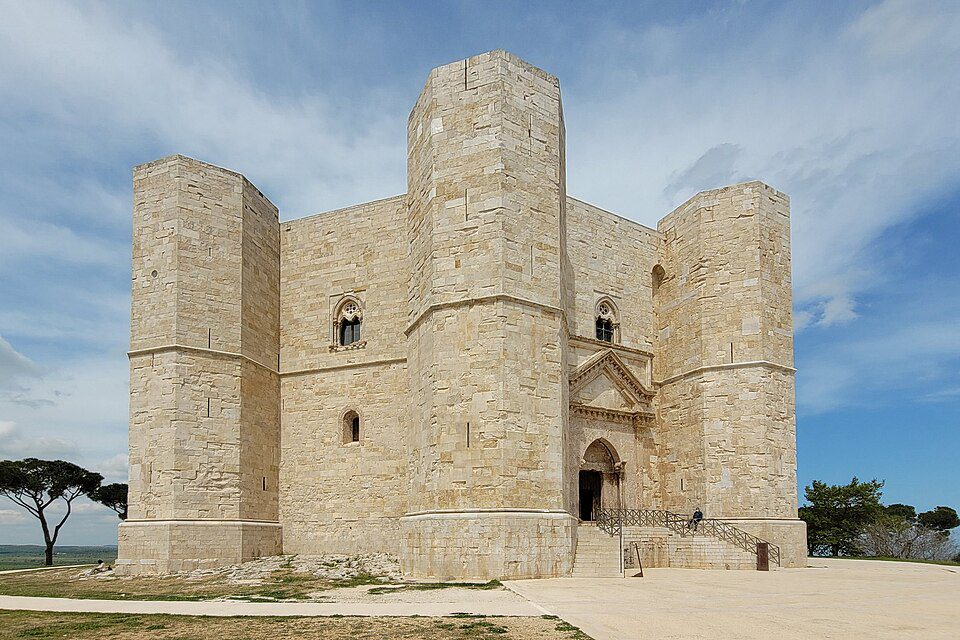
Rising from the rugged landscape of Apulia, southern Italy, like a massive geometric crown, Castel del Monte is one of the most enigmatic buildings in medieval Europe. Commissioned by Holy Roman Emperor Frederick II around 1240, it is a perfect octagonal fortress, remarkably symmetrical, sparsely decorated, and utterly unique in medieval architecture. Often called the “Stone Crown of Apulia,” it’s more than a castle — it’s a riddle carved in limestone.
Unlike typical medieval castles, Castel del Monte lacks standard military defenses: no moat, no drawbridge, no curtain wall, and no significant signs of military use. Instead, it features mathematical precision, classical influence, and astronomical symbolism that seem to defy conventional categorization.
Perched on a hill in the Murge plateau, the structure dominates the surrounding landscape, visible from miles away. It has fascinated historians, architects, and esoteric theorists for centuries. Is it a fortress? A palace? An imperial retreat? Or was it intended as an intellectual statement about harmony, reason, and imperial order?
Declared a UNESCO World Heritage Site in 1996, Castel del Monte draws visitors from around the world — not just for its beauty, but for its sense of mystery. Its precise octagonal layout, its blend of classical, Islamic, and Gothic elements, and its unresolved purpose make it one of the most studied and debated buildings of the Middle Ages.
Historical Background: Frederick II’s Vision
To understand Castel del Monte, one must understand its creator. Frederick II of Hohenstaufen (1194–1250) was no ordinary medieval monarch. Known as the Stupor Mundi (“Wonder of the World”), he was king of Sicily, king of Germany, and Holy Roman Emperor. Fluent in six languages, deeply curious, and often called “the first modern ruler,” Frederick was a patron of science, law, poetry, and philosophy.
Educated in Palermo, a cosmopolitan hub under Norman and Arab influence, Frederick was exposed to Islamic mathematics, Greek philosophy, and Roman legal systems. He surrounded himself with scholars from Christian, Muslim, and Jewish backgrounds — and saw architecture as a way to reflect intellectual and imperial ideals.
Castel del Monte was commissioned around 1239–1240, likely as part of a wider plan to consolidate power in southern Italy. Unlike Frederick’s other castles, such as Castel Maniace or Castello Ursino, Castel del Monte had no apparent strategic purpose. It wasn’t near a port, crossroads, or border. It was placed alone on a hill, as if to make a statement more than defend territory.
No records exist to explain its function, and Frederick died before it was finished. The building was later used as a prison and fell into disrepair before 20th-century restoration. Still, its original intent remains unclear, giving rise to countless theories — each grounded in the building’s precise architectural language.
Octagonal Perfection: Design and Geometry
The most immediately striking feature of Castel del Monte is its octagonal layout — a shape rarely used in castle design, yet here employed with obsessive regularity. The central structure is a perfect regular octagon, with eight towers, also octagonal, positioned at each corner. The result is a form that is mathematically pure, symbolically rich, and architecturally unique.
Key geometric features include:
- A central courtyard, also octagonal
- Eight main rooms on each floor, arranged symmetrically
- Precise axial alignment of doorways and windows
- Consistent proportional relationships throughout the structure
The octagon itself has symbolic meaning across cultures:
- In Christian architecture, it represents resurrection and eternity (e.g., octagonal baptistries)
- In Islamic geometry, it symbolizes order and the transition between the earthly square and the heavenly circle
- In classical design, it represents balance and harmony
Whether Frederick intended these meanings or simply admired the form is unknown — but the perfection of the plan suggests deliberate philosophical intent.
The castle measures about 56 meters in diameter, with towers approximately 24 meters high. Each tower has three floors, while the main structure has two principal levels. No defensive ditch or rampart surrounds it — the power it projects is intellectual, not military.
Even the building’s orientation is precise: each wall faces a cardinal or intercardinal direction. During solstices and equinoxes, sunlight enters the rooms and courtyard in geometrically significant patterns, leading some to suggest an astronomical function or symbolic alignment.
Materials and Construction Techniques
Castel del Monte was constructed primarily from local limestone, giving it its pale golden hue. This stone was quarried nearby, reducing the need for long-distance transport and allowing for tight-fitting joints with minimal mortar. The precision of the masonry is one of the most impressive technical features of the building.
Other materials used include:
- Coral breccia marble: Used decoratively for columns and pilasters, providing a reddish contrast to the limestone
- White marble: Especially in the interior capitals, cornices, and window surrounds
- Gray-green stone (perhaps serpentine): Found in door frames and some flooring elements
The use of multiple colored stones may have had symbolic or aesthetic purposes, echoing classical Roman, Islamic, and Byzantine architectural palettes — all of which Frederick admired.
Interior floors were originally paved with polychrome marble, though most of this has been lost. Ceilings are made with cross-ribbed vaults in the Gothic style, and spiral staircases inside the towers are corbelled from the wall — another engineering achievement for the time.
Despite its geometric precision, the castle was built without the use of standardized architectural drawings. Master masons and builders would have used proportional measuring rods and geometric principles, reflecting both ancient Roman techniques and Islamic craftsmanship.
The overall effect is one of intellectual clarity — a structure that feels purpose-built for thought, not battle.
A Castle Unlike Any Other: Form Without Function?
One of the most enduring mysteries of Castel del Monte is its ambiguous purpose. Unlike typical medieval castles, it lacks the standard features of a military fortress. There are no moats, portcullises, arrow slits, or fortified outer walls. Its entrances are elegant, not defensive. Its towers contain staircases, not battlements.
This has led many scholars to conclude that the building was not designed for warfare, but for symbolic, ceremonial, or intellectual use. Some theories include:
- A hunting lodge for Frederick’s leisure in the Apulian countryside (though no stables or service quarters exist)
- A scientific or astronomical observatory, given its geometric alignment and solar orientation
- A temple of reason, expressing the emperor’s devotion to mathematics and classical ideals
- A statement of imperial power, where form replaced function as a demonstration of cultural supremacy
Others have speculated even further:
- Was it an esoteric structure, linked to the Knights Templar or Hermetic philosophy?
- Was it inspired by the Dome of the Rock, which Frederick would have seen during the Sixth Crusade (1228–1229)?
- Was it a secular monastery of learning, intended for quiet study and elite discourse?
None of these theories are definitively proven — and perhaps that’s the point. Castel del Monte defies categorization because it was likely meant to. It projects imperial abstraction, not feudal necessity. It’s a building that elevates architecture from utility to expression.
Even the double-floor plan, with identical rooms stacked vertically, adds to the sense of conceptual clarity — or redundancy, depending on interpretation. There are no grand halls, throne rooms, or chapels. Everything is measured, mirrored, and minimal.
In an age of functional castles and spiritual cathedrals, Castel del Monte is something else entirely: a statement in stone, built not to house armies or saints, but to provoke thought and wonder.
Stylistic Synthesis: Classical, Islamic, and Gothic Elements
Though often labeled “medieval,” Castel del Monte is not bound to a single stylistic tradition. Instead, it represents a fusion of influences — a physical manifestation of Frederick II’s multicultural court and wide-ranging interests.
Classical (Roman) Influence:
- The perfection of the octagon, a form used in Roman baptistries and villas
- Use of Corinthian columns and triangular pediments in interior spaces
- A commitment to symmetry and axial design, reminiscent of Roman urban planning
Islamic Influence:
- Possible inspiration from the octagonal Dome of the Rock in Jerusalem
- Use of geometric abstraction and light as a design element
- Parallels with Islamic palace architecture in Sicily, especially in the Zisa Palace in Palermo
Gothic Influence:
- Ribbed vaults in the ceilings, an early Gothic structural element
- Use of ogival (pointed) arches in windows and portals
- Sculptural details in capitals and cornices reflecting northern European craftsmanship
This stylistic blend is not accidental. Frederick’s court was one of the most cosmopolitan in Europe. His kingdom of Sicily had absorbed Norman, Arab, and Byzantine influences, and he personally corresponded with Islamic scholars, Jewish astronomers, and Latin theologians. Castel del Monte reflects that synthesis — not through decoration, but through structure and form.
Even the building’s sparseness speaks volumes. There is little religious imagery, no overt Christian symbolism, and no heraldic clutter. Instead, the language is one of pure form, light, and logic — rare for the time, and deeply modern in its restraint.
Astronomy, Solstices, and Symbolic Alignment
Much has been made of the castle’s astronomical orientation. Scholars and architects have noted how the building interacts with the sun’s position during solstices and equinoxes. These alignments suggest the structure was more than a mere residence — it may have functioned as a kind of solar calendar or cosmic diagram.
Observed alignments include:
- On the winter solstice, sunlight enters the main portal and illuminates specific interior corners
- During the equinoxes, sunlight streams into the central courtyard through symmetrical windows
- Some windows are placed to cast rays of light on specific walls only during certain times of the year
While we can’t be certain Frederick designed these features intentionally, they echo known Islamic and classical practices, where buildings were oriented to celestial events. In Islamic architecture especially, qibla walls, muqarnas, and domes often incorporate solar or lunar geometry.
The octagon itself may reflect cosmological concepts:
- It mediates between the square (earth) and the circle (heaven)
- In Christian numerology, it symbolizes renewal and eternity (e.g., eight-day cycles)
- In Islamic mysticism, it represents the harmonious order of creation
Whether the castle was meant to mark time, align with celestial bodies, or simply echo cosmic order remains a matter of debate. But the consistency of proportion and orientation is undeniable — and suggests that Castel del Monte was conceived as a cosmic structure, not just a terrestrial one.
Interior Spaces and Spatial Philosophy
Walking through Castel del Monte reveals an experience that is deliberately disorienting yet harmonized. The interior consists of eight trapezoidal rooms on each of the two main floors, symmetrically arranged around a central octagonal courtyard. There are no grand halls, no chapels, no kitchens or latrines — at least none that survive visibly — adding to the mystery of its intended function.
Each room on the ground and upper floors is nearly identical in size and shape, with minimal ornamentation. The only differences lie in the arrangement of windows and the staircases in the towers. This repetitive geometry reinforces the building’s sense of abstract order rather than practical hierarchy. There is no throne room, no audience chamber — nowhere for power to reside except in the stone itself.
Interior elements of note:
- Pointed Gothic windows with elegant stone tracery on the upper floor
- Vaulted ceilings in most rooms with ribbed designs — rare for a non-ecclesiastical building at the time
- Fireplaces and chimneys in some rooms, indicating potential for habitation or seasonal use
- Spiral staircases inside six of the eight towers, connecting floors without disrupting the rooms
The central courtyard, open to the sky, was likely intended as the building’s primary light source and a symbolic core. Its symmetry, octagonal plan, and axial relationships suggest more than just an aesthetic gesture — they suggest a cosmological center, a void around which the world is ordered.
No religious iconography appears in the preserved structure — an oddity for a 13th-century ruler’s residence. This has led many scholars to propose that the palace was an intellectual retreat, inspired by Neoplatonic ideals where architecture was meant to reflect divine harmony.
Rather than emphasize control or faith, the interior of Castel del Monte emphasizes clarity, balance, and contemplation — making it perhaps the most philosophical building of the Middle Ages.
Preservation, UNESCO Status, and Modern Legacy
Despite centuries of neglect, looting, and misuse, Castel del Monte remains remarkably intact. After Frederick’s death in 1250, the building passed through various hands and was used over time as:
- A prison during the 18th and 19th centuries
- A shelter for shepherds and livestock
- A stone quarry, with many of its decorative elements removed and reused elsewhere
Serious preservation began in the late 19th century, with architectural surveys and partial restoration. By the 1920s and 1930s, Italian authorities had taken full control, and by the mid-20th century, efforts were underway to restore the structure’s geometry and integrity.
In 1996, Castel del Monte was inscribed as a UNESCO World Heritage Site, recognized for its:
- “Perfect fusion of cultural elements from Classical antiquity, the Islamic world, and northern Europe”
- “Innovative architectural design based on mathematical and astronomical principles”
- “Exceptional testimony to the cultural complexity of 13th-century southern Italy”
Today, Castel del Monte is administered by the Italian Ministry of Culture, with visitor access regulated to preserve the structure. The interior is mostly bare — intentional, to highlight the architecture itself — though exhibitions and interpretive materials help explain the castle’s context and theories.
Tourism is steady but not overwhelming, making it a peaceful destination for those interested in medieval architecture, imperial history, or geometric design. It remains one of the most distinct and intellectually charged buildings in Europe — often overlooked, but never forgotten by those who visit.
Its legacy also lives on symbolically: the octagonal plan of Castel del Monte appears on the Italian one-cent euro coin, and it is studied in architecture schools as a model of conceptual clarity and formal discipline.
Key Takeaways
- Castel del Monte was commissioned by Frederick II in the 1240s and features an octagonal plan with eight octagonal towers.
- It blends classical symmetry, Islamic geometry, and Gothic structure, reflecting Frederick’s multicultural court.
- The building likely served a symbolic, intellectual, or ceremonial purpose — not military defense.
- Its astronomical alignments, proportional harmony, and minimal ornamentation set it apart from all other medieval castles.
- Designated a UNESCO World Heritage Site in 1996, it remains a preserved and mysterious marvel of medieval architecture.
FAQs
- Who built Castel del Monte?
It was built by order of Frederick II, Holy Roman Emperor, around 1240 in southern Italy. - Why is it octagonal?
The octagon symbolized harmony, balance, and transition between earth and heaven — and reflected Frederick’s interest in mathematics and cosmology. - Was it ever used in battle?
No — Castel del Monte shows no evidence of significant military use. It lacks typical defenses like moats or arrow slits. - Is there any religious symbolism inside?
No overt Christian or Islamic iconography survives. The building is notable for its abstraction and philosophical intent. - Can you visit Castel del Monte today?
Yes — it is open to the public and managed by the Italian government, with regular access and historical exhibits.