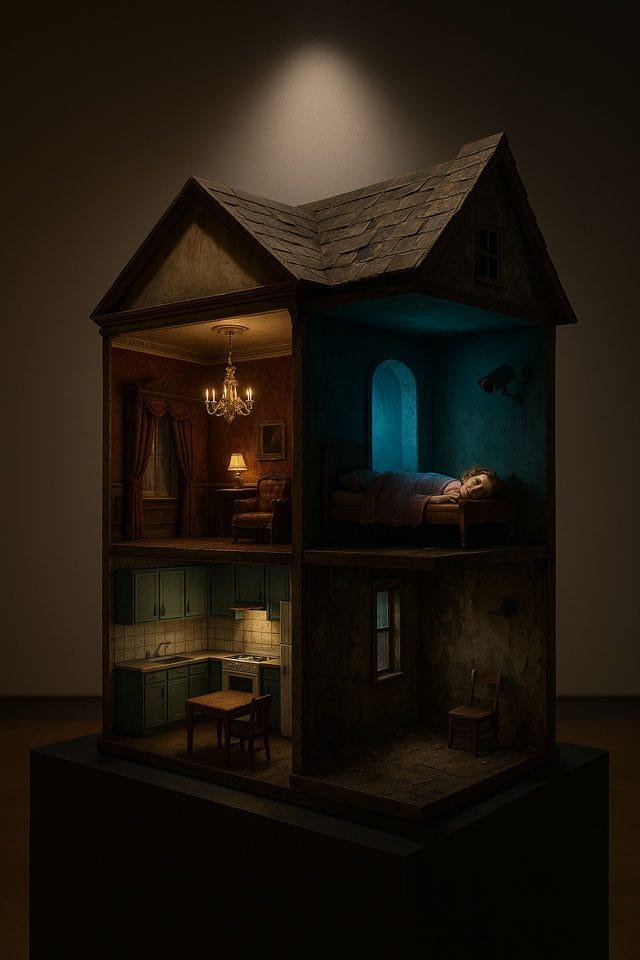
At first glance, a dollhouse might seem like a child’s toy—an object of play, imagination, and nostalgia. But look closer, and you’ll find something far more complex. The dollhouse is a meticulously crafted miniature world that reflects and critiques the one we live in. It’s a symbol of domestic life, a vessel of memory, and a potent artistic medium. Across centuries and continents, dollhouses have evolved from aristocratic showpieces to feminist statements, surrealist provocations, and even political commentaries. Whether displayed in a nursery or a museum, the dollhouse speaks volumes—if you know how to listen.
From the ornate “baby houses” of 17th-century Europe to the eerie installations of contemporary artists, dollhouses have always served dual purposes: to comfort and to disturb. They capture ideals of home and order while also exposing the pressures and confines of domestic space. In their silence and stillness, they evoke both innocence and unease. Artists and collectors alike are drawn to these tiny realms, not just for their aesthetic charm but for the questions they raise about gender, identity, class, and control.
The miniature scale of a dollhouse invites intense observation. Every chair, rug, window, and staircase becomes significant. In a world that often overlooks the domestic sphere, the dollhouse insists on its importance. It allows us to manipulate our surroundings, to perfect and critique them. And in doing so, it holds a mirror to the culture that created it. That’s what makes the dollhouse more than a toy—it becomes a canvas, a theater, a battleground for ideas.
This article explores the dollhouse as art, tracing its historical roots and following its transformation into a serious form of creative and cultural expression. We’ll examine its role in feminist critique, surrealist experimentation, and political storytelling. We’ll look at artists who’ve used the dollhouse to disturb, to memorialize, and to question. Along the way, we’ll discover how this small object—often overlooked—contains entire worlds.
A Brief History of the Dollhouse
Though many associate dollhouses with Victorian nurseries and childhood play, their origins stretch back to Renaissance Europe. The earliest known examples weren’t toys at all—they were “cabinet houses,” sometimes called “baby houses,” built for wealthy adults in the 16th and 17th centuries. These were not for little girls to play with; they were detailed, glass-fronted cases showcasing idealized interiors. Rich in craftsmanship and filled with miniature luxury items, these houses demonstrated taste, wealth, and domestic virtue. In a time when the home was seen as a reflection of one’s moral standing, the baby house acted almost like a sermon in wood and silk.
By the 18th century, dollhouses began to shift from aristocratic showpieces to educational tools. They were still expensive and rare, but now they were increasingly seen as a way to teach young girls about homemaking. A miniature home could model proper domestic arrangement and reinforce expectations about gender roles. Furniture was arranged just so; dolls were placed in their designated roles—mother, father, child, servant. These lessons weren’t subtle. They were embedded in every miniature broom, stove, and cradle. Even as these dollhouses grew smaller and more accessible, their underlying message remained the same: this is what a proper home looks like.
The Victorian era marked the height of the dollhouse’s popularity. As the middle class grew and industrial manufacturing improved, mass-produced dollhouses became widespread. They were marketed as essential toys for young girls, often emphasizing moral development and domestic education. At the same time, the houses themselves grew more realistic, modeled after the architecture of the day. Parlor rooms featured tiny oil paintings and velvet armchairs. Kitchens had copper pots and tiled floors. The detail was staggering. But beneath that charm lay a reinforcement of rigid ideals—order, control, and prescribed gender roles.
By the 20th century, dollhouses became both more commercialized and more democratized. Companies like Germany’s Märklin and America’s Strombecker and Rich Toys began producing affordable dollhouses for the general public. Plastic eventually replaced wood. Play replaced instruction. But even in mass-market form, the dollhouse retained its symbolic power. It still modeled domestic life. It still told girls what to expect from womanhood. And by the mid-century, artists and critics began to push back—reimagining the dollhouse not just as a site of training, but as a space for rebellion.
The Dollhouse as Artistic Medium
In the hands of contemporary artists, the dollhouse transforms from nostalgic relic to provocative artwork. Far from the realm of childhood play, these miniature structures become sites of emotional resonance, political critique, and aesthetic experimentation. Through sculpture, installation, photography, and multimedia, artists reimagine the dollhouse as a serious artistic medium—one that plays with perception, scale, and cultural assumptions.
Laurie Simmons is a prime example of this transformation. Her photographic series in the late 1970s and early 1980s featured plastic dolls posed within manufactured dollhouse interiors. At first glance, the scenes seem playful. But a closer look reveals a deeper commentary on gender roles and domestic performance. Simmons’ work critiques how femininity is staged—literally and symbolically—within confined, artificial spaces. Her use of shallow depth of field, artificial lighting, and pastel tones evokes both nostalgia and suffocation. The women in her photographs are posed like mannequins, unable to escape the roles assigned to them. The dollhouse, in Simmons’ work, becomes a metaphor for societal expectations—a boxed-in stage where identities are performed, not lived.
Other artists push the medium further by building full-scale installations. Canadian artist Heather Benning’s The Dollhouse (2007) is a haunting example. She transformed an abandoned prairie farmhouse into a life-sized dollhouse by removing one entire wall and installing pastel-painted, mid-century furnishings inside. Visitors viewed the interior like a diorama, frozen in time. The effect was eerie: a perfectly preserved domestic space, exposed and decaying. Benning’s work comments on rural abandonment, memory, and the idealization of home. It evokes a sense of stillness that is both beautiful and tragic—a house once full of life now stands as a monument to what was.
Mona Hatoum, a Palestinian-born artist known for her politically charged installations, uses the language of the dollhouse to explore themes of surveillance, displacement, and control. In works like Homebound (2000), Hatoum presents a skeletal domestic scene made of steel furniture, wired with electric current. Buzzing and glowing with menace, the installation critiques the illusion of safety within the home. While not a literal dollhouse, it draws from the same miniature impulse: to present domestic space as something legible, ordered, and symbolic. But in Hatoum’s hands, that order becomes threatening. The wires restrict, the furniture looms, and the viewer is reminded that “home” can be as much a prison as a refuge.
Even traditional dollhouses have been repurposed by modern artists to tell more abstract or disturbing stories. Some embed video screens within the rooms, others distort proportions or inject surreal elements—floating beds, melting floors, or infinite hallways. These disruptions challenge the viewer’s expectations. The dollhouse becomes an uncanny object: familiar yet strange. It invites you in, only to unnerve you. That tension—between the real and the artificial, the comforting and the unsettling—is what makes the dollhouse such a potent artistic tool. It’s not just the miniature scale that draws us in—it’s the way it reflects and distorts our world.
Domestic Space, Power, and Gender
The dollhouse may appear to be an innocent, charming object, but it carries centuries of encoded meaning—particularly when it comes to gender. At its core, the dollhouse is a model of domestic life, and for much of history, the domestic sphere was seen as a woman’s rightful place. Artists and scholars have long recognized how this tiny home reflects larger dynamics of control, societal expectation, and gendered labor. Far from being a neutral toy, the dollhouse often serves as a tightly controlled environment where roles are assigned, movements are restricted, and freedom is only an illusion.
Feminist artists and thinkers have explored the dollhouse as a symbol of female confinement. Just as real women were expected to manage the home, the dollhouse invites young girls to rehearse these duties in miniature. Every tiny broom, sink, or baby crib becomes part of a domestic script. The user—typically a girl—is trained to internalize these responsibilities, to see the home not just as a space, but as a purpose. This implicit instruction has not gone unnoticed. Scholars like Susan Stewart, in her foundational work On Longing, point out that the miniature invites control but also enforces boundaries. It reflects a world where power is invisible but ever-present.
In artistic interpretations, this dynamic becomes more pronounced. Dollhouses created or modified by feminist artists often subvert traditional ideals. In some pieces, domestic interiors are vandalized—furniture overturned, wallpaper torn, dolls dismembered. These visual disruptions are not just shocking—they’re statements of rebellion. The “perfect home” is being dismantled, reimagined, and, at times, destroyed. Artists like Miriam Schapiro, a pioneer of feminist art, incorporated dollhouse-like imagery in her collages and installations, reclaiming the domestic not as a site of submission, but of creative power. She turned the tools of homemaking—fabric, patterns, even wallpaper—into high art, pushing back against the idea that domesticity was inherently lesser.
The dollhouse also functions as a tool of control—not just for the user, but over the figures within. Dolls are placed in fixed positions. Rooms are curated, not lived in. This curated stillness mirrors the way traditional female roles have often been idealized—neatly arranged, static, and picturesque. But what happens when we resist that control? Some contemporary works allow dolls to “escape” their settings. Others distort the architecture itself—walls bow outward, staircases lead nowhere, doors don’t open. These architectural anomalies challenge the assumption that the home is a place of order. Instead, they expose its contradictions. The dollhouse isn’t just a place of safety—it’s also a mechanism of surveillance, performance, and entrapment.
Perhaps the most powerful aspect of the dollhouse in feminist art is its dual nature. It is both tool and critique, both stage and battlefield. It holds the power to train, to critique, and to liberate—all within the same frame. When artists engage with dollhouses, they aren’t just crafting miniatures. They’re confronting the very architecture of womanhood—how it’s built, who controls it, and what it means to tear it down and start again.
Psychological Dimensions and Surrealism
There’s something undeniably eerie about a dollhouse. The stillness, the silence, the miniature scale—it all creates a sense of disquiet, as though something is off. This unsettling quality has fascinated artists and psychologists alike. It’s not just about scale; it’s about what the dollhouse represents. A home, after all, is supposed to be safe, familiar, and alive. When it’s rendered in miniature and stripped of motion or sound, it can feel lifeless, haunted, or worse—controlled. This tension between familiarity and unease is central to the concept of the uncanny, a psychological term popularized by Sigmund Freud that artists have used to great effect.
Freud’s 1919 essay “The Uncanny” defines the term as something both familiar and alien at once. A dollhouse fits that definition perfectly. It’s recognizable—we see the armchair, the kitchen, the bedroom—but it’s also sterile, unmoving, and frozen in time. The comfort of home becomes a ghost story. In this way, the dollhouse becomes a natural vehicle for surrealist art. The Surrealists, who were deeply influenced by Freud’s theories, were drawn to the hidden, repressed, and irrational. They viewed the home not just as a physical space, but as a psychological landscape—one shaped by memory, desire, and anxiety.
Artists working in this vein have used dollhouses to explore the darker corners of the mind. In the mid-20th century, Frances Glessner Lee created an extraordinary series of miniature crime scene models known as the Nutshell Studies of Unexplained Death. Though built to train police investigators, these tiny, meticulously crafted scenes resemble dollhouses gone wrong. Each one shows a room where a violent death has occurred—bloodstains, upturned furniture, and subtle clues lie frozen in place. Glessner Lee’s work is a study in psychological detail. It demands careful observation and asks viewers to reconstruct a narrative. But more than that, it turns domestic space into a site of mystery and trauma. What should be comforting becomes unsettling.
Contemporary surrealists continue this tradition by blending dreamlike elements into dollhouse forms. Rooms might stretch impossibly long, or be lit from within by flickering, unnatural light. Some artists incorporate mirrors, trapdoors, or optical illusions to disorient the viewer. Others take a more nostalgic approach, using dollhouses to explore personal memory or childhood trauma. The idea is the same: the home is not always a sanctuary. Sometimes, it’s where our deepest fears reside. The miniature scale only amplifies this, drawing viewers in close, asking them to look harder, think deeper.
Surrealist and psychological dollhouse art isn’t just about unease—it’s about revelation. By making the familiar strange, these works help us see our inner lives more clearly. They show that homes can hold secrets, that innocence can mask fear, and that even the smallest objects can carry enormous emotional weight. The dollhouse, then, becomes a kind of dreamscape—where walls can whisper, shadows tell stories, and nothing is quite what it seems.
Contemporary Art and the Miniature Aesthetic
In today’s art world, the miniature has made a bold comeback. Whether in physical form or digital space, dollhouse-inspired aesthetics are being embraced by a new generation of artists who blend nostalgia, hyper-realism, and storytelling. This renewed interest reflects both a longing for tactility in an increasingly digital world and a fascination with small-scale narratives that feel intimate, controlled, and meticulously curated. The miniature isn’t just cute—it’s compelling. And in the hands of contemporary creators, it becomes a powerful form of visual poetry.
Hyper-realistic miniature sculptures have become especially popular in the 21st century. Artists like Tatsuya Tanaka and Thomas Doyle craft tiny, detailed worlds that speak volumes through scale. Tanaka, known for his “Miniature Calendar” project, creates scenes of daily life using everyday objects—turning broccoli into trees or loaves of bread into beds. Doyle, meanwhile, constructs suburban homes mid-crisis: a roof caving in, a tornado ripping through a backyard. These works echo the dollhouse’s ability to compress drama into a confined space. They invite us to peer closer, to imagine the lives unfolding within each small window, hallway, or collapsed ceiling.
The resurgence of craft culture, fueled by platforms like Instagram and Etsy, has also contributed to the miniature boom. Crafters and hobbyists build elaborate dollhouses that rival professional installations, often blurring the line between DIY and fine art. These creations are shared widely online, creating a global community of miniature makers. While many of these dollhouses follow traditional patterns—Victorian parlors, rustic farmhouses—others break the mold. Some creators design haunted dollhouses, apocalyptic ruins, or fantasy realms. This creative diversity echoes a broader trend in contemporary art: the breaking down of barriers between “high” and “low” forms of expression.
Digital media has added another layer to the miniature aesthetic. Virtual dollhouse games like The Sims allow users to design and decorate entire homes, complete with characters, wardrobes, and storylines. These simulations have become a kind of interactive art form—blending architecture, interior design, and digital storytelling. Artists and gamers alike use The Sims to build surreal, political, or emotionally charged narratives. Museums, too, are beginning to embrace virtual miniatures. Institutions like the V&A Museum and the Museum of the History of Science have digitized dollhouse collections, allowing users to explore historical interiors with unprecedented access. In the digital realm, the dollhouse is not only preserved—it’s reimagined.
What unites all these modern interpretations is a deep appreciation for scale and detail. In a fast-paced, oversized world, the miniature offers a chance to slow down and look closely. It rewards patience and invites reflection. More than that, it taps into something primal: our desire to create order, tell stories, and play with perspective. Whether built by hand or rendered on screen, the contemporary dollhouse reminds us that art doesn’t have to be massive to make a massive impact.
Collectors, Museums, and the High Art Divide
Despite their artistic merit and cultural resonance, dollhouses have long occupied an uneasy space between fine art and folk craft. Are they toys? Decorative objects? Social documents? Or are they—like paintings and sculptures—worthy of museum walls and scholarly attention? This debate has followed the dollhouse for decades. Yet today, more museums and collectors are recognizing the power of these miniature homes, not just as charming curiosities, but as significant works of art and cultural memory.
Some of the world’s most breathtaking dollhouses are found in museum collections. One of the most famous is Queen Mary’s Dolls’ House, built in the early 1920s for the British monarch. Designed by architect Sir Edwin Lutyens and filled with contributions from over 1,500 artists and craftsmen, the dollhouse is a masterpiece of Edwardian elegance. It features working plumbing, electric lighting, and a wine cellar stocked with real vintages. But it’s more than just a marvel of craftsmanship—it’s a time capsule of a particular social class, steeped in royal imagery and idealized British life. Today, it resides at Windsor Castle, drawing visitors from around the world.
In the United States, the Thorne Miniature Rooms at the Art Institute of Chicago are a prime example of dollhouses elevated to high art. Created by Narcissa Niblack Thorne in the 1930s and ’40s, these meticulously crafted interiors represent various periods of American and European history in exacting detail. Each room—encased behind glass—is a lesson in design, architecture, and lifestyle. What makes the Thorne rooms so striking is their accuracy. They are not imagined spaces, but scholarly recreations, complete with authentic materials and historically appropriate décor. Visitors are invited not just to marvel at their beauty, but to consider the cultural values they preserve.
Still, the dollhouse faces resistance from some corners of the art world. Its association with childhood and femininity has long marginalized it. High art has traditionally favored the monumental—the towering canvas, the colossal sculpture. The dollhouse, by contrast, is intimate, delicate, and domestic. As a result, it has often been dismissed as “women’s work,” “craft,” or “kitsch.” This is the same bias that once relegated quilting, embroidery, and ceramics to the sidelines. Yet as feminist and outsider art gain prominence, the boundaries are shifting. Museums and galleries are beginning to reconsider what counts as serious art—and who gets to decide.
Collectors, too, are playing a role in this reevaluation. Private collections of dollhouses and miniatures are being donated to institutions or showcased in dedicated exhibitions. These collectors treat dollhouses not as toys but as cultural artifacts—each one a tiny world with its own story. Some focus on historical accuracy; others seek out rare or avant-garde designs. As interest grows, so does the market. Antique dollhouses, especially those with fine craftsmanship or unique provenance, can fetch tens of thousands of dollars at auction. It’s no longer unusual to see a dollhouse displayed under glass with the same reverence given to a painting or sculpture.
In bridging the divide between art and artifact, the dollhouse challenges the very hierarchy of the art world. It raises questions about value, labor, and meaning. Who decides what is worthy of a museum? What makes something “art”? And why have small, domestic, often female-created works been overlooked for so long? As more institutions answer these questions with open eyes and open doors, the dollhouse continues to rise—not just as a collector’s prize, but as a legitimate form of artistic expression.
DIY, Folk Tradition, and Political Commentary
While grand museum collections and artist installations often steal the spotlight, some of the most compelling dollhouses come from unexpected places: kitchens, prisons, garages, and community centers. These DIY and folk creations may not carry price tags or gallery labels, but they are no less powerful. In fact, they often speak more directly to the lived experiences of ordinary people—especially those on the margins. These dollhouses become vessels of memory, identity, protest, and deeply personal storytelling.
In many working-class communities, dollhouses were never bought—they were built. Parents, grandparents, or neighbors cobbled them together from scraps of wood, wallpaper samples, and found objects. These homemade miniatures often reflected not a fantasy, but the maker’s real surroundings. Instead of Victorian parlors, they featured linoleum kitchens, dusty attics, or porches with broken steps. These houses were deeply rooted in place and class, offering a window into lives rarely represented in traditional art. What began as toys often became time capsules—recording a family’s style, values, and even hardships through humble materials and improvised design.
Folk artists and outsider creators have taken this idea further, using dollhouses as storytelling devices to explore complex personal and cultural narratives. In some cases, they memorialize lost loved ones. In others, they serve as therapy for trauma. These structures might be adorned with handwritten notes, religious icons, or found photos. They might follow no architectural logic at all, growing sideways or upward in chaotic layers. But every room, every object, holds meaning. These works challenge the neatness of commercial dollhouses. They are not about ideal homes—they are about real ones, broken ones, reimagined ones.
Dollhouses have also emerged as unexpected tools for political commentary. Artists and activists have used them to critique war, racism, poverty, and surveillance. For example, miniature border detention centers or bombed-out homes have been built to highlight the human cost of conflict. One particularly haunting example is by artist Abigail Goldman, a former crime analyst, who constructs graphic “Die-O-Ramas”—violent scenes in pristine suburban settings, critiquing the illusion of American normalcy. Another example is found in community art projects where refugees build miniature homes to represent the ones they’ve lost. These dollhouses bear scars—charred walls, broken windows—but they also tell stories of resilience and hope.
Even within prison walls, inmates have constructed dollhouses out of toothpaste caps, matchsticks, and cardboard. These creations, often made without access to tools or materials, reflect both a desire for beauty and an escape from confinement. Some are sent to loved ones as gifts. Others are kept as symbols of imagined freedom. Whether or not they’re labeled “art,” they contain all the hallmarks of it: craftsmanship, vision, narrative, and emotional truth.
In these DIY and folk forms, the dollhouse sheds all pretense. It’s no longer about status or perfection. It’s about voice—about making something meaningful with what you have, where you are. Whether political, personal, or both, these small homes speak loudly. They remind us that art doesn’t need a spotlight to matter. Sometimes, it lives quietly on a shelf, waiting to be seen.
Key Takeaways
- The dollhouse has evolved from aristocratic curiosity to a respected medium in contemporary art, blending history, memory, and aesthetics in powerful ways.
- Feminist and psychological interpretations reveal the dollhouse as more than a toy—it reflects confinement, control, and societal expectations, especially around gender and domesticity.
- Surrealist and political artists use the miniature format to provoke emotion and challenge norms, transforming cozy interiors into scenes of mystery, trauma, or resistance.
- Modern creators—from museum curators to DIY folk artists—are reclaiming the dollhouse as a tool for storytelling, using it to explore identity, trauma, and social injustice.
- Across media and cultures, the dollhouse remains a potent symbol of imagination, order, rebellion, and introspection, transcending its small size with massive expressive power.
FAQs
- Why are dollhouses considered creepy in art?
Their stillness, miniature realism, and domestic settings often evoke the uncanny—a psychological unease rooted in familiarity turned strange. - Can a dollhouse really be considered fine art?
Yes. Artists like Laurie Simmons and museums like the Art Institute of Chicago treat dollhouses as legitimate art forms with complex aesthetic and cultural value. - What’s the difference between a toy dollhouse and an art dollhouse?
While toys are meant for play, art dollhouses often serve as commentary, memorials, or installations designed to provoke thought and emotion. - How have feminist artists used dollhouses?
They’ve used them to critique gender roles, domestic expectations, and the confinement of women in traditionally “feminine” spaces. - Are there modern digital equivalents to dollhouses?
Yes. Games like The Sims and virtual museum exhibitions offer interactive miniature environments with artistic and narrative depth.