Long before the rise of modern Europe, nestled in the rugged Carpathian Mountains and the fertile plains of the Danube, lived a people known as the Dacians. Their territory, Dacia, covered much of what is now Romania and parts of surrounding regions. To the ancient world, the Dacians were both fierce and enigmatic—a tribal society bound by strong warrior traditions, deep spirituality, and an aesthetic vision that has only recently begun to receive the recognition it deserves. While their political history often focuses on their clashes with the Roman Empire, the Dacians’ cultural and artistic identity runs far deeper.
The Dacians shared roots with the broader Thracian peoples, yet they forged a distinct identity. With their mountain fortresses, spiritual sanctuaries, and stunning goldwork, the Dacians held their own amidst powerful neighbors like the Greeks, Scythians, and later, the Romans. They had complex interactions with these groups: at times trading and exchanging ideas, at others fiercely defending their independence. These interactions enriched their material culture and left traces in their art, which drew from outside influence while maintaining its native soul.
Society in Dacia was stratified but closely knit. At the top stood the noble warrior class, followed by the priesthood—a powerful and sometimes mystical caste that mediated between the Dacians and their gods. Commoners formed the bulk of the population, working the land, crafting goods, and supporting the social elite. This societal structure played a significant role in shaping Dacian art. The elite sponsored sophisticated gold and silver work, while the common folk produced more rustic but no less meaningful forms like ceramics and textiles.
Despite their rich cultural tapestry, Dacian art has often been misrepresented—or worse, ignored—by mainstream historical narratives. Much of what we know about the Dacians comes from Roman sources, which were biased at best and propagandistic at worst. Coupled with centuries of neglect under various regimes, Dacian artistic achievements were left buried—both literally and figuratively. But thanks to modern archaeology and a renewed cultural interest in Eastern Europe’s indigenous traditions, the art of the Dacians is stepping into the light once again.
The Foundations of Dacian Aesthetic Style
At the heart of Dacian art lies a rugged originality—one that was deeply connected to the land, nature, and spiritual beliefs of its people. Before Greek and Roman contact intensified, Dacian artistic traditions had already developed distinctive patterns and styles. They leaned into geometric abstraction, bold symbolic imagery, and a tactile craftsmanship that reflected both utility and reverence. Art was not a luxury in Dacia; it was a medium through which the divine, the natural, and the communal intersected.
The symbolism found in Dacian art is rich and multilayered. The wolf, for example, held enormous significance—it was not only a tribal totem but a fierce guardian spirit. The Dacian Draco, a dragon-headed standard with a wolf-like body, was both a military and spiritual emblem. Serpents, another recurring motif, represented rebirth and eternity, often depicted coiled or in mid-motion. The sun, circles, and spirals symbolized time, cycles of life, and divine order. These symbols weren’t chosen at random—they reflected core beliefs that governed Dacian cosmology and ritual practice.
Material culture also played a defining role in shaping the Dacian aesthetic. Wood was abundant and widely used, though much has been lost to time. Stone carvings survive, often in the form of religious stelae or architectural elements. But it was metal—especially gold and silver—that became the primary canvas for Dacian artisans. These materials weren’t merely decorative; they were sacred. The belief that metal connected the earthly to the divine made its use in art both spiritual and political.
What truly sets Dacian art apart is how it captured a worldview that was simultaneously mystical and martial. Their works weren’t just beautiful—they were purposeful. From the placement of ceremonial objects in sanctuaries to the designs on warrior armor, everything had meaning. Even in simplicity, Dacian art conveyed depth. In a time before mass production and artistic abstraction, the Dacians created a visual language that was precise, symbolic, and enduring.
Dacian Gold and Silver Work
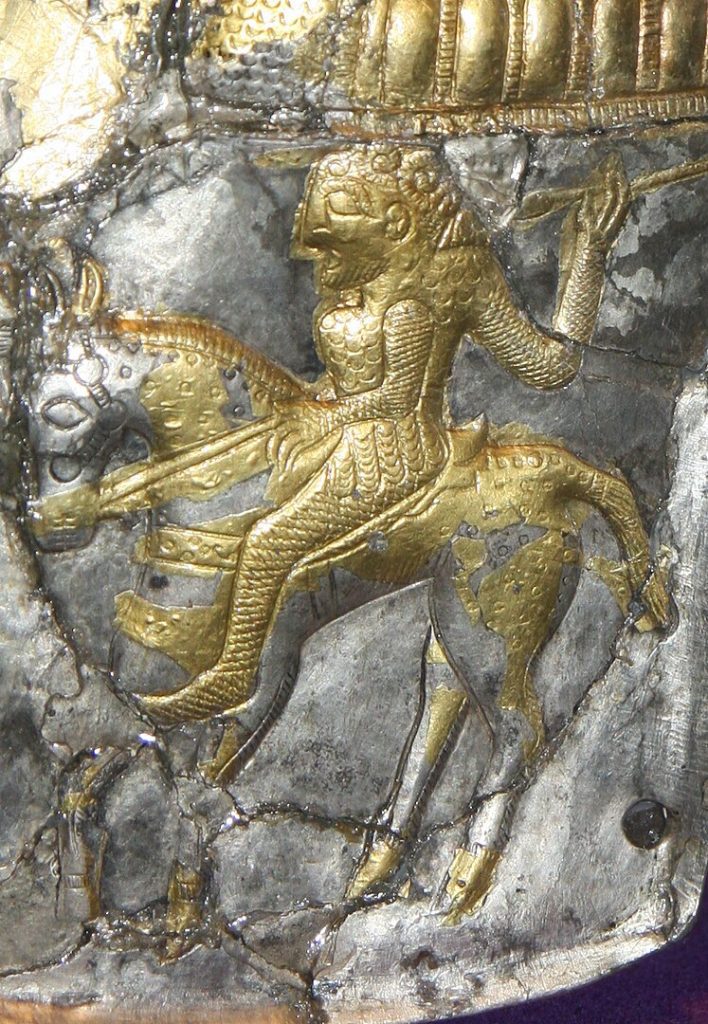
Among the most celebrated achievements of Dacian artistry is their mastery of gold and silver. These metals were not just materials—they were sacred vessels of power, identity, and divine communication. The Dacians extracted gold from the Apuseni Mountains and shaped it into objects of breathtaking complexity and elegance. Jewelry, ceremonial items, weaponry, and religious artifacts all bore intricate patterns and powerful symbols, revealing the Dacians’ exceptional skill and spiritual worldview.
One of the most stunning examples of Dacian metalwork comes from the hoards found at Sarmizegetusa Regia, the ancient Dacian capital. These treasures include gold bracelets shaped like serpents, crescent-shaped ornaments, and delicately crafted necklaces. Another notable find is the Pietroasele Treasure—although partly of Gothic origin, it includes elements with unmistakable Dacian design traits. These objects are not just beautiful—they tell stories, represent clans, and serve as connections to divine forces.
Techniques used by Dacian goldsmiths were advanced for their time. Filigree, granulation, repoussé, and casting were all employed with stunning precision. Many pieces show symmetry and balance that hint at a strong understanding of mathematics and design. Spirals, double-helix patterns, animal heads, and cosmic symbols abound in their work. Goldsmiths likely held a revered place in society, their work commissioned by nobles and priests alike for both public display and private ritual.
When compared to Greek or Celtic metalwork, Dacian craftsmanship holds its own in terms of artistry and meaning. While Greek goldwork leaned toward realism and harmony, Dacian gold was more symbolic and abstract—more raw and expressive. It evoked emotion rather than symmetry, power rather than polish. The use of animal imagery, divine patterns, and tribal motifs reveals a culture that saw metal not just as a resource, but as a medium of sacred communication. This art wasn’t meant to dazzle strangers—it was meant to speak to the gods.
Pottery, Ceramics, and Everyday Art
While gold and silver captured the elite imagination, the heartbeat of Dacian artistic life thrived in the humble medium of pottery. Ceramics were a vital part of daily living, used for storage, cooking, rituals, and trade. Yet even the most utilitarian Dacian pottery reveals a surprising level of artistic care. From carefully balanced forms to incised decorations, the ceramic arts tell us volumes about the values and aesthetics of the common people.
Dacian pottery is often categorized into two broad types: coarseware and fineware. Coarseware included large storage jars and cooking vessels, typically undecorated but sturdy. Fineware, however, showed off a higher level of craftsmanship. It featured burnished surfaces, geometric patterns, and sometimes stylized animal forms. Spirals, meanders, and sun motifs frequently appeared, suggesting that even everyday items were imbued with spiritual or symbolic meaning.
The materials used in Dacian pottery were mostly locally sourced—clay from riverbeds or valleys, mixed with organic temper. Techniques included hand-building and wheel-throwing, with firing done in basic kilns. Despite these humble conditions, the level of symmetry and detail in their work is remarkable. What’s more, pottery styles varied slightly from region to region, offering insight into the diversity within Dacian cultural zones.
Beyond its domestic function, pottery played a role in trade and cultural exchange. Dacian ceramics have been found in Greek colonies along the Black Sea and even in Roman provinces, indicating vibrant commercial links. Some vessels include foreign influences in form or decoration, a testament to the Dacians’ openness to outside ideas while still maintaining their unique identity. In this way, pottery becomes a lens through which we can view the convergence of cultures on Dacian soil.
Dacian Architecture and Monumental Design
If there’s one aspect of Dacian culture that mirrors their deep connection to both nature and the divine, it’s their architecture. Far from the marble temples of Rome or the symmetry of Greek city-states, Dacian monumental design was rugged, organic, and spiritually aligned with the landscape. Nowhere is this more evident than in the incredible stone fortresses of the Orăștie Mountains—fortified sanctuaries that speak to the fusion of engineering and sacred intention.
These fortresses, including Sarmizegetusa Regia, Blidaru, Piatra Roșie, and Costești, were more than military installations. Built with massive limestone blocks in the distinctive murus dacicus (Dacian wall) technique, they also housed sacred spaces, ceremonial platforms, and watchtowers. The sheer scale and layout reflect a culture highly organized in terms of labor, planning, and spiritual observance. These structures weren’t just meant to defend; they were meant to elevate the Dacians closer to the divine.
One of the most fascinating architectural elements of these fortresses is the sacred circular sanctuary at Sarmizegetusa. Made of andesite columns arranged in concentric circles, this structure aligns with solar cycles, hinting at an advanced understanding of astronomy and religious ritual. Scholars have likened it to Stonehenge or other ancient observatories, suggesting that Dacian priests used it to mark time and conduct seasonal rites. Its design, devoid of excessive ornamentation, still conveys power, purpose, and cosmic alignment.
Natural materials dominated Dacian building practices. Stone and timber were locally sourced and skillfully manipulated. Even residential structures showed an awareness of proportion, climate adaptation, and community layout. Dacian settlements, both fortified and rural, integrated into the surrounding landscape rather than imposing upon it. This design philosophy reveals a culture that viewed the land not just as territory, but as sacred inheritance.
Religious and Funerary Art
Religion permeated every layer of Dacian life, and their art reflected this reverence in deeply symbolic ways. Unlike the gods of Olympus, Dacian spirituality revolved around Zalmoxis—a possibly deified man or prophet who promised immortality and unity with the divine. Artistic expression of these beliefs is found most vividly in their burial practices, grave goods, and sacred totems, which blend symbolism, mysticism, and ancestral worship.
Dacian burial mounds, or tumuli, often contained goods that accompanied the dead into the afterlife. These included weapons, jewelry, pottery, and sometimes animal offerings. The placement and design of these objects were far from random—they reflected status, spiritual readiness, and tribal identity. Items placed with warriors often bore symbolic animal motifs, while women’s graves revealed adornments of ceremonial significance. The funerary art of the Dacians thus served as a narrative of both life and afterlife.
Priests in Dacian society were not mere ceremonial figures; they held real political and cultural influence. Their role in crafting religious art—either directly or through commissioning—cannot be overstated. Wooden idols, stone stelae, and sanctuary carvings likely functioned as ritual aids, spiritual intermediaries, or representations of Zalmoxis himself. Unfortunately, much of this wooden religious art has not survived, but what remains in stone suggests a focus on abstraction, symbolism, and spiritual intimacy.
Stelae often featured concentric circles, serpent patterns, and stylized human forms—some with outstretched arms in poses of invocation. These were not sculptures made for admiration, but for function. They were meant to guide, protect, or signal spiritual energy. The blending of earthly materials with transcendent themes shows how Dacian artists understood their work: not as a product for display, but as a bridge between the seen and unseen.
Roman Accounts and Trajan’s Column: Artistic Glimpse or Propaganda?
When Emperor Trajan launched his campaigns against Dacia in the early 2nd century AD, he not only sought military victory but a legacy. That legacy lives most vividly in Trajan’s Column in Rome—a towering monument covered in intricate reliefs that chronicle the Dacian Wars. While visually striking and historically significant, the column offers a lens that’s both informative and deeply biased. The Dacians appear noble, defiant, and strangely familiar—yet always cast as the “other.”
The reliefs show Dacians with distinctive long hair, bearded faces, and flowing garments. They carry curved swords (falx) and unique shields, details that have helped archaeologists reconstruct aspects of Dacian material culture. But these images must be taken with caution. The column served Roman propaganda first, truth second. It emphasized Roman valor and conquest, casting the Dacians as worthy adversaries, but ultimately defeated pagans needing Roman order and civilization.
Despite this slanted portrayal, Trajan’s Column has become a key source of information for reconstructing Dacian dress, weapons, and even social structure. Certain reliefs show Dacian women pleading or resisting, hinting at the societal roles beyond the battlefield. Others depict Dacian architecture—wooden fortifications, elevated temples, and mountain strongholds. Ironically, in attempting to glorify Rome, the column has immortalized the very people they sought to erase.
Beyond the column, Roman statuary and coins also featured Dacian themes. The captured Dacian warrior became a common motif in Roman sculpture—shown bound, muscular, and proud. While these images were created to celebrate Roman superiority, they inadvertently validated the strength and distinctiveness of the Dacians. Today, modern scholars and artists are reinterpreting these depictions, reclaiming the Dacian identity from the shadows of imperial propaganda.
Dacian Influence on Later Romanian Folk Art
Long after the Roman conquest of Dacia and the subsequent waves of migration, echoes of Dacian art lived on. The mountains, valleys, and villages of Romania kept silent watch over patterns, symbols, and rituals passed down from ancient times. Though centuries removed from their origin, many elements of Romanian folk art today bear a striking resemblance to Dacian motifs—suggesting a powerful cultural continuity that defied foreign rule and modern upheaval.
One of the most enduring examples is textile art. Romanian traditional embroidery often includes spiral patterns, tree-of-life motifs, sun wheels, and animal figures—particularly wolves and serpents. These aren’t mere decorative flourishes; they serve protective, symbolic, and identity-bearing roles within the culture. The “hora” (circle dance), another deep-rooted folk tradition, mimics solar and cosmic cycles also seen in Dacian sanctuaries and ceramics.
Wood carving in rural Romania, particularly in Maramureș, reveals similar links. The iconic wooden gates and crosses feature intricate rosettes, zigzags, and intertwined serpents—all motifs with ancient precedents. These carved symbols weren’t just artistic—they were talismans meant to guard homes, honor ancestors, and signal tribal belonging. It’s difficult to believe these striking similarities are coincidental. More likely, they’re quiet testimonies to the Dacian spirit embedded in the Romanian soul.
Even Romania’s national consciousness has embraced Dacian heritage as a cornerstone of identity. In the 19th and 20th centuries, artists and writers began exploring their country’s ancient past, rediscovering and reinterpreting Dacian symbolism. The Dacian Draco, once a forgotten battle standard, became a national emblem. Statues of Dacian warriors—strong, proud, unbending—now grace parks and museums, representing continuity between ancient roots and modern pride.
This resurgence wasn’t just patriotic—it was a spiritual revival. In reclaiming Dacian art and symbolism, Romanians were reconnecting with something older than conquest or empire: a worldview shaped by the land, faith, and communal memory. In this way, Dacian art continues not only in form, but in the values, hopes, and aesthetic sensibilities of a people still very much alive.
Modern Rediscovery and Preservation of Dacian Art
The modern rediscovery of Dacian art has been a slow but passionate journey. For much of history, Dacia’s material culture was overshadowed by Greco-Roman narratives, viewed as primitive or irrelevant. But over the last century, especially with the rise of Romanian archaeology and nationalist scholarship, Dacian art has been pulled out from the shadows and given the spotlight it deserves.
Key archaeological digs—particularly in the Orăștie Mountains—have unearthed sacred sanctuaries, fortresses, and countless treasures that have revolutionized our understanding of Dacian life. Museums like the National Museum of Romanian History in Bucharest and the Dacian and Roman Civilization Museum in Deva now house many of these finds. These exhibits give the public direct access to serpent bracelets, ornate fibulae, engraved pottery, and sculptural fragments that once belonged to a lost world.
But preserving Dacian art isn’t just about protecting artifacts in display cases. It’s also about telling the story behind them. Too often, ancient cultures are stripped of context and reduced to aesthetic objects. To fully appreciate Dacian art, we must preserve its spiritual, political, and communal meanings. That’s why scholars, local historians, and educators play such a vital role in transmitting not just the objects, but the worldview they represent.
There have been political dimensions to this rediscovery as well. Various Romanian governments—especially during the Ceaușescu era—used Dacian heritage to forge a nationalistic narrative. While this politicization sometimes led to distortion, it also resulted in large-scale preservation efforts, cultural festivals, and historical education campaigns. Today, the focus has shifted toward academic rigor and cultural appreciation, with international partnerships working to recognize Dacian sites as UNESCO World Heritage landmarks.
Despite these gains, challenges remain. Looting, underfunded excavations, and limited access to international research networks hinder progress. Yet there’s hope. Each unearthed bracelet, every reconstructed sanctuary, and each newly translated inscription brings us closer to reviving a civilization whose artistic genius still whispers through the forests of Romania.
Key Takeaways
- The Dacians were a proud and artistic people whose legacy has long been overlooked due to Roman conquest and historical bias.
- Dacian art is rich in symbolism, featuring wolves, serpents, spirals, and solar imagery that reflect their spiritual beliefs.
- Their mastery of gold and silverwork—particularly the bracelets and ceremonial pieces—demonstrates an advanced and sacred use of metallurgy.
- Everyday art forms like pottery and woodwork also carried deep symbolic meaning and cultural significance.
- Modern Romania preserves and celebrates Dacian artistic influence through folk traditions, archaeology, and cultural identity.
FAQS
- What materials did the Dacians use in their art?
Primarily gold, silver, wood, stone, and clay—each with both practical and symbolic importance. - Is Dacian art influenced by other cultures?
Yes, especially by Greek, Celtic, and Scythian neighbors, though the Dacians maintained a distinctive visual style. - What is the Dacian Draco, and why is it important?
A wolf-headed dragon standard used in battle, symbolizing strength, protection, and spiritual power. - Where can I see Dacian art today?
Museums in Romania, particularly in Bucharest, Deva, and Alba Iulia, showcase many surviving artifacts. - How does Dacian art influence modern Romanian culture?
Through motifs in folk art, national symbols, and a revived sense of heritage and identity.