The first art in the place that would one day become Tel Aviv was made long before the word “city” had any meaning, when the Mediterranean shoreline was both a larder and a horizon. To walk the beach in those millennia was to find shells of improbable colors, flint nodules with a glassy edge, and bones weathered into unexpected shapes. People living here in the Stone Age did not build monuments, but they left behind objects that blend function, ornament, and mystery in ways that defy modern categories.
The shoreline as a gallery of survival
Archaeologists working along the central coast of today’s Israel have found small but telling traces of artistry: beads drilled from shells, sometimes rubbed to a chalky polish by years of wear; fragments of ochre, ground down for pigment; and flint tools whose careful shaping suggests more than simple utility. Sites such as Nahal Sorek and the dunes north of Jaffa have yielded evidence that the prehistoric inhabitants treated color, texture, and form as part of their daily life. A bone awl might have a carved spiral. A fishing weight might be smoothed to a pleasing oval. In a world where every possession had to be carried, such choices mattered.
These finds also speak to exchange. The sea provided not just food, but materials—shells that may have been traded inland, pigments from distant deposits brought here along coastal routes. The shoreline was a marketplace before there were coins, a gallery before there were walls.
Archaeological voices
The key to reconstructing this deep past lies in sites like Tel Qasile, which, though better known for its later Iron Age layers, has yielded earlier prehistoric levels beneath. From them emerge bits of human intent—scratched patterns on a pottery shard, deliberate flaking on a piece of stone to create a leaf-like silhouette. These are modest works by any modern standard, but in context they are profound: signs of an aesthetic sensibility in a time when survival was always close to the surface of thought.
Occasionally, discoveries upend assumptions. In 2012, a small figurine of an animal carved from limestone was found in coastal sands near Jaffa, dated to several thousand years before agriculture reached the region. Its head is oversized, its body stylized, its purpose unknown. Was it a charm for a successful hunt? A child’s toy? An emblem of clan identity? Whatever its role, it reminds us that the earliest “art” here was not created for gallery walls, but for lives in motion.
Stone, bone, and firelight
In the absence of permanent structures, much prehistoric creativity was ephemeral. Patterns traced in the sand at the end of a fishing day. Arrangements of shells on a flat rock. Decorative cuts in the handle of a spear that would eventually wear away. Night gatherings around a fire may have brought a different kind of art—storytelling, gesture, perhaps body painting with pigments that left no trace in the soil.
The environment encouraged portability and improvisation. Three elements in particular shaped this early artistic vocabulary:
- Marine abundance — shells, fishbones, and driftwood offered ready materials.
- Open light — the seashore’s reflective brightness influenced the choice of pale stones and shiny surfaces.
- Constant movement — seasonal patterns of fishing and foraging meant art often had to be carried or left to the elements.
This was a world where art was not yet a separate sphere of life. It was embedded in tools, in clothing, in gestures that vanished with the tide. And yet, when we hold a drilled shell bead from six thousand years ago, its hole smoothed by fingertips, we touch the same impulse that would later build temples, pave streets in colored stone, and paint the walls of Tel Aviv apartments: the desire to shape beauty from what is at hand.
Bronze Age Portals: Jaffa’s Artistic Roots
By the early Bronze Age, the sandy ridge south of where Tel Aviv now stands had become more than a fishing outpost. The fortified port of Jaffa was an opening to the wider Mediterranean, and with the ships came not only grain and copper, but new ways of seeing and making. Art here no longer clung solely to the intimate scale of shell beads and carved bone. It began to appear in stone blocks, imported vessels, and public ritual spaces.
Maritime exchange
The harbor’s natural anchorage was its greatest asset, but the true wealth lay in its role as a cultural conduit. Excavations in Jaffa have yielded painted pottery in shapes and colors characteristic of Cyprus, alongside fragments of alabaster containers from Egypt. Some jars bear incised marks that scholars believe were trade notations, while others carry decorative bands and zigzags that served no commercial purpose at all—embellishment for its own sake. These were the portable ambassadors of far-off styles, carried ashore by merchants, sailors, and emissaries.
In the warehouses and courtyards near the waterline, artisans absorbed these influences. Clay figures show Egyptian proportions in their stance but are molded from local reddish earth. A small bronze axehead, likely ceremonial, bears a shape familiar from Anatolia but is engraved with geometric symbols more common in Levantine art. This mixing of forms was not accidental; it was the visual expression of a port city constantly negotiating its identity.
Imported styles
Egyptian hegemony over parts of Canaan during the Late Bronze Age left clear artistic fingerprints. Relief fragments from Jaffa’s gates include lotus motifs, a favorite of Egyptian temple decoration, and hieroglyphic cartouches naming pharaohs who reigned far to the south. These weren’t simply trophies; they were statements of power carved in imported stone.
But alongside the symbols of imperial authority ran a more subtle stream of local adaptation. Cypriot bichrome ware—white slip with painted black and red patterns—was prized here, yet local potters imitated it with their own materials, producing pieces that at first glance look imported but bear the telltale mineral signature of the coastal clay. This was a city learning to speak in multiple artistic dialects at once.
Symbolic authority
In the Bronze Age, art and governance were inseparable. The massive city gate at Jaffa, reconstructed from archaeological remains, was more than a defensive structure. Its decorated doorways and carved lintels announced the city’s role as a node in the great imperial web stretching from the Nile to the Euphrates. Within the administrative quarter, clay tablets in cuneiform recorded trade agreements, land grants, and even disputes—many sealed with cylinder impressions that are miniature works of art in themselves.
One remarkable tablet fragment depicts a pair of stylized bulls flanking a palm tree, an image with both Mesopotamian and local connotations. Such motifs likely served as official emblems, reinforcing a shared civic identity in a place where sailors from Tyre, envoys from Memphis, and traders from the Aegean might all walk the same streets.
In Jaffa’s Bronze Age, art was neither purely local nor wholly foreign—it was the art of a place built to receive, reinterpret, and project. That sensibility, born in the port’s narrow lanes, would echo in Tel Aviv’s later openness to new ideas and styles from across the world.
Classical Echoes: Hellenistic and Roman Jaffa
By the time Alexander’s armies swept down the coast in the late 4th century BC, Jaffa was already old. Yet Hellenistic rule, and later the dominance of Rome, brought a different visual vocabulary—stone carved into human likeness, civic spaces adorned with myth, and an emphasis on public display that transformed the port’s appearance.
The sculpted citizen
Hellenistic culture prized the human figure as both artistic subject and civic ideal. Fragments of marble statuary found in Jaffa—torso sections, draped garments, even an isolated hand—point to a once-flourishing sculptural program. Most were likely imported as finished works, their fine-grained marble not native to the Levant. These statues served as both decoration and political messaging, embodying the virtues of leadership, strength, and civic pride.
One particularly evocative fragment, now in the Israel Museum, shows the lower legs of a standing figure, the left slightly forward, a hallmark of Greek contrapposto. Even reduced to shins and sandals, the posture suggests movement and vitality. For Jaffa’s inhabitants, accustomed to earlier symbolic or stylized art, these realistic bodies must have been startling in their lifelike presence.
Mosaics of myth
If sculpture brought human form into three dimensions, mosaics spread a rich visual layer underfoot. Excavations in the vicinity of Jaffa’s ancient streets have uncovered tessellated floors depicting scenes from Greek mythology—Dionysus among vines, a leaping dolphin framed in geometric borders, Eros with a bow. These weren’t simply decorative flourishes; they were cultural signifiers, aligning the port with the cosmopolitan Hellenistic world and later with the Roman Empire’s vast network.
Roman tastes refined and expanded the mosaic tradition. Villas and public buildings adopted intricate polychrome designs, sometimes combining local stone with imported glass tesserae. The blending of mythological imagery with motifs drawn from the sea—fish, shells, tridents—created a thematic link between Jaffa’s maritime identity and the universal language of classical art.
Theatres and colonnades
Public space became the prime stage for art under Roman influence. While no fully intact Roman theatre survives in Jaffa, architectural fragments—column drums, Corinthian capitals, carved friezes—suggest the presence of colonnaded streets and formal gathering spaces modeled on those in Caesarea and other coastal cities. These structures were both functional and symbolic, providing settings for political assemblies, market days, and festival performances that reinforced civic cohesion.
One inscription fragment in Greek, likely once mounted on a public building, praises a local benefactor for funding a portico. Such dedications were themselves works of art, their careful lettering and balanced proportions meant to be read and admired. Even the street layout hinted at an aesthetic agenda: colonnaded avenues guiding the eye toward monumental gates, public fountains framed in sculpted niches, and open plazas that gave visual order to the bustling port.
In the Hellenistic and Roman centuries, Jaffa’s art shifted from the portable and the ornamental toward the monumental and civic. The city’s walls and public spaces became carriers of cultural identity, embedding classical aesthetics into the daily life of a port that had seen countless styles wash ashore.
Byzantine Light: Sacred Mosaics and Church Art
When the Byzantine Empire absorbed the Levant in the 4th century AD, Jaffa’s art began to shimmer—literally. The Christianization of the port brought churches, pilgrimage hostels, and a new visual vocabulary steeped in both imperial grandeur and local craftsmanship. Tesserae replaced paving stones, painted saints supplanted marble heroes, and light itself became a medium.
A city in tesserae
Byzantine mosaics were not just decoration; they were theology underfoot. In and around Jaffa, archaeologists have uncovered church floors alive with symbolic imagery: vines curling into endless knots, peacocks with fanned tails, and baskets of bread flanked by fish—a direct allusion to the Gospel miracles. These motifs were rendered in glass and stone tesserae, their colors made more intense by the Mediterranean sun filtering through clerestory windows.
One remarkable example, found near the site of a 5th-century church, depicts a crisscross of floral scrolls enclosing medallions with stylized birds. The workmanship reveals the hand of artisans trained in the imperial workshops of Constantinople but adapted to local materials. Sea-green glass, for instance, was likely manufactured nearby, blending imperial design with coastal resourcefulness.
Imported pigments, local hands
Wall painting also flourished in the Byzantine era, though far less survives than the resilient mosaic floors. Fragments of plaster bearing deep reds and lapis blues suggest a palette enriched by imported pigments. Coptic and Syrian influences filtered in through the movement of monks, merchants, and pilgrims, giving local church interiors a layered style: the grandeur of the imperial center tempered by regional preferences for geometric framing and restrained figural scenes.
These churches were built not only as places of worship but as waypoints for travelers to Jerusalem. Pilgrims from as far as Gaul and Armenia passed through Jaffa, leaving offerings and commissioning small devotional works—painted icons on wood, silver reliquary boxes, carved crosses in ivory. Many of these objects combined Western stylistic traits with Eastern manufacturing techniques, reinforcing the port’s long tradition of hybrid artistry.
Pilgrimage and relic display
The Byzantine fascination with relics shaped Jaffa’s visual culture. Churches developed elaborate display niches for bones of saints, fragments of the True Cross, or vials of holy oil. These spaces were themselves works of art: arched frames inlaid with glass, carved lintels bearing crosses entwined with vines, and bronze lamps suspended by chains patterned with tiny stamped crosses.
Some of the most striking finds from Byzantine Jaffa are oil lamps cast with Christian symbols—chi-rho monograms, crosses, and doves—that served both a devotional and a practical function. In the half-light of evening services, their flicker would have set gold tesserae and painted halos aglow, transforming architecture into a luminous extension of the liturgy.
Byzantine Jaffa was a place where faith, art, and seafaring converged. The port’s mosaics and sacred furnishings not only reflected the city’s religious identity but also signaled its connection to the great Christian centers of the Mediterranean. Light and color became the means by which the city announced its place in the spiritual geography of the empire.
Early Islamic and Crusader Shifts
The 7th century brought a profound change to Jaffa’s artistic language. The arrival of Arab rule introduced new aesthetics—geometry, calligraphy, and vegetal ornament—while retaining some of the building traditions inherited from the Byzantines. Later, in the 12th century, the Crusaders would reclaim and refashion the city, overlaying their own visual culture atop the Islamic foundations. These centuries were less about erasing the past than about layering one style over another, sometimes in direct conversation, sometimes in deliberate contrast.
Geometry and script
Under the Umayyads and Abbasids, Jaffa’s art shifted toward abstraction and inscription. The prohibition on figural imagery in religious contexts encouraged artisans to explore the full possibilities of line, proportion, and repetition. Mosque walls and prayer niches were adorned with plaster carvings of interlocking stars, stylized foliage, and angular Kufic script. The use of epigraphy transformed the very walls into carriers of meaning, with Qur’anic verses arranged in balanced panels, the letters themselves an art form.
Small finds from the period—ceramic bowls with painted arabesques, glass weights stamped with inscriptions—show that this emphasis on pattern extended into domestic life. Even simple utilitarian objects became canvases for visual refinement. The city’s role as a port meant exposure to North African, Egyptian, and Syrian influences, each leaving subtle marks on local motifs.
Mosque art and fortified beauty
Jaffa’s coastal location made it a target for raids, so its fortifications were repeatedly expanded and reinforced. Yet even military architecture bore artistic touches. Carved stone lintels over gatehouses bore vegetal designs; arrow slits were framed in alternating stone colors for a subtle decorative effect. The Great Mosque, though reconstructed many times, retained the essential features introduced during this period: a square prayer hall, a prominent mihrab, and a minaret rising above the skyline. Inside, plaster ornamentation caught the shifting light, softening the building’s mass with intricate surface play.
The use of glazed tiles—deep blues, turquoise, and greens—appears in surviving fragments, suggesting that even in a defensive-minded port, color and sheen remained central to architectural design. These tiles, often imported from Egypt or Syria, were prized both for their beauty and for the technical mastery they represented.
Cross-cultural layering
The Crusader conquest in the late 11th century transformed the city yet again. Churches rose on or near the sites of earlier mosques; fortifications were rebuilt with pointed arches and ribbed vaults in the European style. Yet the Crusaders often retained and reworked Islamic decorative elements. In some chapels, carved panels bearing Quranic inscriptions were turned inward or incorporated into walls as spolia, their original messages hidden but their patterns still visible.
One surviving example of this blending is a carved limestone doorway whose geometric border is unmistakably Islamic in origin, yet whose tympanum contains a cross-shaped relief added by Crusader masons. Such works embody the pragmatic reality of medieval Jaffa: a city too valuable to be left in ruins, too contested to keep a single artistic identity for long.
By the end of the Crusader period, Jaffa had become a palimpsest of Islamic and European forms. The city’s streets, buildings, and everyday objects bore the marks of both worlds, each reshaping the other in a visual dialogue born of conflict, commerce, and coexistence.
Ottoman Jaffa: Port Artistry and Urban Ornament
When the Ottomans consolidated control over Jaffa in the early 16th century, they inherited a port in varying states of ruin and revival. Over the following centuries, the city’s architecture, decorative arts, and urban layout took on the visual language of Ottoman civic and domestic life—ornamented woodwork, glazed tiles, and urban spaces shaped for both trade and social exchange.
Wooden balconies and carved doors
Domestic architecture in Ottoman Jaffa often carried its artistry in the details. Projecting wooden balconies, or mashrabiyas, shaded streets below while allowing airflow and privacy inside. Their latticework, carved from cedar or local hardwoods, created intricate patterns that shifted with the sun. Doors, too, were crafted as works of art. Heavy planks bound in iron might be inset with small panels carved in floral motifs or geometric grids, sometimes painted in deep reds or ochres.
The wealthier merchant houses displayed stone window surrounds with modest but precise carving—spirals, palmettes, or stylized tulips. These flourishes spoke to a shared Ottoman visual vocabulary while allowing for local variation in proportion and pattern. Even the hinges and locks on such buildings often bore engraved designs, a quiet assertion that beauty belonged in everyday function.
Ceramic tradeware
Jaffa’s role as a port ensured a constant flow of ceramic goods. Blue-and-white Iznik tiles from Anatolia, with their curling saz leaves and carnations, appeared in the homes of prosperous traders. These might frame a niche in a reception room or line the interior of a fountain. Cheaper but no less visually striking Syrian underglaze-painted wares—often in cobalt and black—circulated widely.
Local potters responded with their own adaptations, using imported designs as templates but substituting available clays and pigments. The result was a lively secondary market of ceramics that bore Ottoman stylistic traits but carried a distinctly coastal Levantine sensibility. The interplay between imported refinement and local ingenuity mirrored Jaffa’s broader cultural life.
Festive processions
Public art in Ottoman Jaffa often came alive in motion. Religious and civic processions, whether marking a holiday, the arrival of an official, or a victory at sea, transformed the streets into moving galleries. Banners painted with calligraphic blessings, silk hangings embroidered with gold thread, and musicians carrying inlaid drums and flutes created a sensory spectacle.
Such processions might pass under temporary wooden arches decorated with flowers and colored cloth—an ephemeral architecture that dissolved as quickly as it appeared. In these moments, art was not fixed in stone but woven into the life of the city, its patterns and colors remembered as much for their social meaning as for their physical form.
By the end of the Ottoman period, Jaffa had established itself as both a practical working port and a place where visual culture infused daily life. Its architecture carried the vocabulary of the empire but adapted it to local materials and climate. Decorative arts traveled in and out with the tides, leaving traces that would still be visible when a new neighbor to the north—Tel Aviv—was founded in the early 20th century.
The Birth of Tel Aviv: Bauhaus Meets the Levant
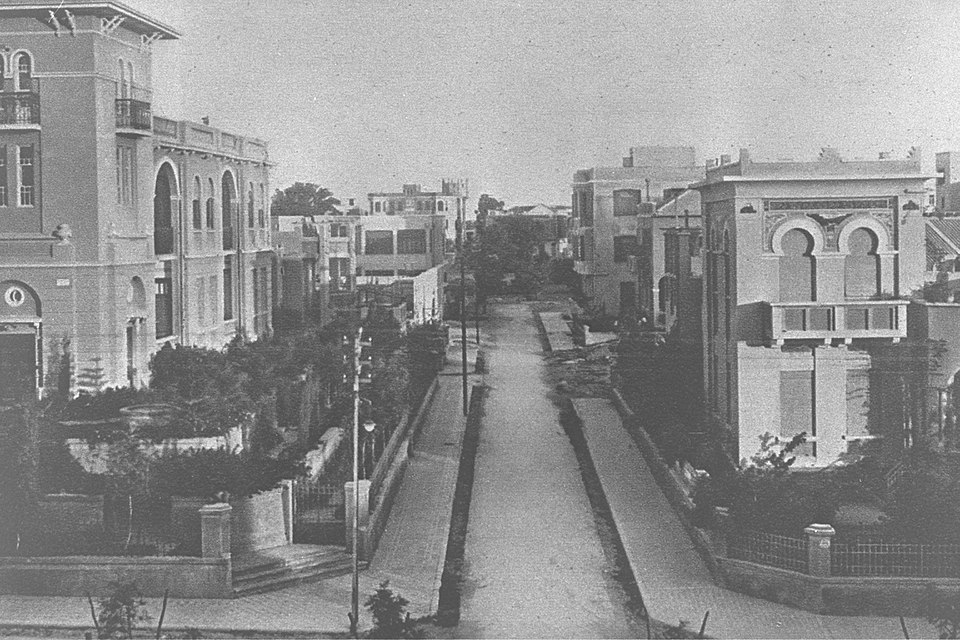
When Tel Aviv was founded in 1909 on sand dunes just north of Jaffa, its first streets were a modest grid of single-story houses with pitched roofs. Within two decades, however, the city would become an architectural laboratory. Waves of architects trained in Europe—many in the Bauhaus school and other modernist circles—arrived, bringing with them a vision of functional beauty that they reshaped for the Levant’s light, heat, and sea air.
White City beginnings
The White City, now recognized by UNESCO, was not a single project but the cumulative work of hundreds of architects who embraced the principles of the International Style: simplicity, clean lines, and the honest expression of function. Yet in Tel Aviv, these ideas were adapted to local needs. Buildings were painted white or light beige not merely for visual purity but to reflect the sun. Windows were enlarged and often shaded by horizontal concrete fins. Balconies curved like ship prows caught sea breezes, doubling as both social space and passive cooling system.
Among the key figures in this transformation was Arieh Sharon, a Bauhaus graduate who blended modernist discipline with a sensitivity to local climate and lifestyle. His apartment blocks emphasized communal spaces—shared stairwells, accessible rooftops—that mirrored the social ethos of the city’s founders.
Stucco, shade, and sea air
The materials of Tel Aviv’s early modernism tell their own story. Concrete and stucco, relatively new to the region, allowed for sweeping curves and cantilevered balconies that would have been costly or impossible in stone. Flat roofs became common, serving as informal gathering places for families and neighbors. These rooftops, often ringed by low parapets, were functional terraces where laundry dried, children played, and evening breezes offered relief from summer heat.
Shade was treated as an architectural art. Deep-set windows, brise-soleil, and recessed entrances created cool pockets even on sweltering days. The overall effect was a city whose form followed function without losing grace—modernism with a Mediterranean accent.
Urban planning as art
In 1925, Scottish biologist and urban planner Patrick Geddes proposed a master plan for Tel Aviv that would influence its growth for decades. Geddes envisioned wide, tree-lined boulevards intersecting with smaller residential streets, each neighborhood anchored by a public garden. This plan not only improved airflow and shade but also created visual rhythms: the alternating bands of greenery and whitewashed buildings, the sudden opening of a street into a plaza.
The Geddes plan, though altered over time, set the stage for an urban fabric where architecture and public space worked together as a coherent composition. In this sense, Tel Aviv’s early years were not just about constructing buildings but about crafting an entire aesthetic environment—one that would eventually stand as one of the largest ensembles of modernist architecture in the world.
By the mid-1930s, Tel Aviv was no longer the sleepy outpost beside Jaffa. It had become a symbol of modern living, its streets lined with buildings that embodied the optimism of their time while quietly acknowledging the realities of life on a hot, sun-bleached shore.
Street Murals and Socialist Modernism
By the 1930s and 1940s, Tel Aviv’s modernist architecture was no longer the sole expression of its visual culture. On walls, in public buildings, and in civic spaces, a distinct graphic language emerged—rooted in socialist ideals, infused with a sense of collective purpose, and expressed through murals, posters, and large-scale decorative panels.
Collective imagery
The labor movement, a driving force in the city’s early decades, saw art as a tool for education and unity. Workers’ halls, cooperative offices, and public meeting spaces often featured wall paintings depicting agricultural labor, construction, and scenes of community life. Figures were rendered in a robust, simplified style—strong hands, upright postures, and faces turned toward a shared horizon. These images, while stylistically modern, drew on the monumental clarity of older propaganda traditions.
In some cases, entire walls became visual manifestos. One surviving mural from the 1940s shows men and women harvesting grain against the backdrop of a rising sun, a motif that could be read both as an emblem of national revival and as an affirmation of daily work. The interplay between symbolic abstraction and literal storytelling kept these works accessible without being artistically static.
Workshops and kibbutz influence
The artistic style that flourished in Tel Aviv was closely linked to the workshop culture of the kibbutzim. Many urban artists trained or taught in collective studios where the ethos emphasized collaboration over individual fame. Decorative ceramic panels, for instance, were often designed by one artist, glazed by another, and installed by a team of builders.
This process carried a strong ideological undertone: the finished work was a product of many hands, just as the society it depicted was meant to be. Themes were often pastoral—fields, orchards, flocks—serving as urban reminders of agricultural ideals. Even in the heart of Tel Aviv, the imagery of the land remained central, tying the city to the broader social and economic project of the time.
Ceramic murals in schools and public buildings
From the late 1940s into the 1950s, ceramic tile murals became a fixture in public architecture. Schools, post offices, and municipal buildings featured panels that combined folk motifs with modernist abstraction. Stylized olive branches, geometric suns, and schematic human figures formed patterns that were as much decorative as narrative.
Three qualities made these murals distinctive in the Tel Aviv context:
- Durability — fired ceramic withstood sun, rain, and salt air.
- Visibility — murals were placed in courtyards, entrances, and stairwells, making art part of daily routines.
- Symbolism — recurring motifs reinforced civic ideals of labor, community, and progress.
By mid-century, Tel Aviv’s walls told a collective story. Architecture provided the stage, but the murals, panels, and graphic works animated it with color, symbolism, and a constant reminder that art here was meant to be lived with, not just looked at.
Post-War Cosmopolitanism: Galleries and New Movements
In the years after World War II, Tel Aviv’s art scene shed its strictly ideological skin and began to open toward a more diverse, cosmopolitan vocabulary. The influx of émigré artists and the return of locals who had studied abroad introduced styles and techniques far removed from the collectivist murals of the 1930s and 1940s. Galleries proliferated, and the city developed the infrastructure to sustain a market for art as both cultural expression and private possession.
The Dizengoff Circle effect
At the heart of this transformation was the area around Dizengoff Circle. Its cafés, bookshops, and small galleries became meeting points for artists, writers, and collectors. Spaces like the Chemerinsky Gallery and later the Gordon Gallery gave emerging painters and sculptors a platform to experiment with abstraction, surrealism, and modern figurative work.
Dizengoff was more than an address—it was a microclimate for cultural exchange. Conversations in its cafés often led directly to collaborations, exhibitions, and cross-disciplinary projects. The proximity of critics, patrons, and practitioners meant that artistic ideas could travel from sketchbook to wall in a matter of weeks.
Émigré painters and sculptors
Among the most influential forces in this new phase were artists who had fled war-torn Europe. They brought with them the sensibilities of Paris, Berlin, and Vienna, tempered by the trauma of displacement. Some pursued pure abstraction, seeking in geometry a universal language beyond politics. Others embraced expressive figuration, drawing on memory and personal mythology.
Notable émigrés introduced printmaking techniques, experimental use of color, and an openness to nontraditional media. Sculptors began working in welded metal, carving abstract forms that engaged the surrounding space rather than depicting familiar subjects. The stylistic range broadened dramatically, signaling Tel Aviv’s arrival as a city conversant with global trends.
From realism to abstraction
By the 1950s and 1960s, the local art conversation had shifted toward questions of form, color, and process. Realist depictions of labor and landscape gave way to lyrical abstraction, gestural painting, and experiments with texture. The “New Horizons” group, founded in 1948, championed a style of modernism rooted in European abstraction but seeking an identity that reflected the light, heat, and colors of the Middle East.
Galleries became testing grounds for these ideas. Exhibitions were not simply displays but arguments—about what Israeli art could be, about whether the European canon should be adapted or challenged, about the place of local environment in the definition of modernism.
By the close of the 1960s, Tel Aviv’s art world had established itself as outward-looking and self-confident, capable of both absorbing international influences and generating distinctive local movements. The city’s galleries were no longer fringe institutions; they were engines of cultural identity, setting the stage for the more radical experiments to come.
The 1960s–70s: Brutalism, Conceptual Art, and Public Debate
The late 1960s and 1970s marked a turbulent yet fertile period in Tel Aviv’s visual culture. Architecture grew heavier, art more experimental, and the public sphere became a contested arena where aesthetics, politics, and social change converged. The optimism of earlier decades gave way to a more questioning spirit, visible in concrete façades, provocative performances, and the first significant clashes over public art.
Concrete monuments
In the built environment, Brutalism emerged as the dominant civic style. Public buildings, cultural centers, and university structures were erected in raw concrete, their mass and texture making no concessions to decorative charm. The Tel Aviv Museum of Art’s original building on King Saul Avenue, opened in 1971, embodied this sensibility: angular, fortress-like, and unapologetically modern.
These structures projected a certain ideological confidence—they were meant to be honest, functional, and durable. Yet the public response was mixed. Some praised their clarity and strength; others saw them as austere and alienating. The debates over these buildings mirrored broader cultural questions about modernization, identity, and the city’s relationship to its own climate and human scale.
Art as provocation
In the same years, Tel Aviv’s artists began to push beyond the canvas and the frame. Performance art, installations, and ephemeral works entered the city’s galleries and even its streets. Exhibitions included sand-filled rooms, interactive environments, and staged actions that blurred the line between art and political protest.
One memorable event involved an artist leading a live goat into a gallery, its movements altering a grid of flour on the floor. The piece was both a commentary on rural-urban tension and an invitation to consider the unpredictability of real life within the controlled space of art. Works like this provoked discussion about the role of the artist—not just as a maker of objects but as a catalyst for experience and thought.
Graffiti emerges
While official art pushed boundaries indoors, the city’s walls began to host their own uncommissioned experiments. Early graffiti in Tel Aviv of the 1970s was less about elaborate street murals and more about quick, urgent markings—political slogans, satirical drawings, cryptic symbols. Many were painted over within days, but the idea of the wall as a democratic canvas had taken root.
By the end of the decade, Tel Aviv had become a place where art could no longer be neatly confined to museums or civic commissions. The heavy permanence of Brutalist buildings coexisted with works that lasted only as long as a gallery run, or until the next coat of paint on a back alley wall. This tension—between permanence and ephemerality, official sanction and spontaneous expression—would become a defining feature of the city’s artistic landscape in the decades to follow.
Port Revival: Jaffa’s Artistic Rebirth
By the late 20th century, Jaffa’s once-bustling port had fallen quiet. Commercial shipping had shifted elsewhere, leaving behind warehouses, rusting cranes, and derelict piers. But in the 1990s and early 2000s, a deliberate revitalization transformed the area into one of Tel Aviv’s most distinctive cultural districts—a place where contemporary art, historic architecture, and maritime atmosphere converged.
Warehouse galleries
The unused industrial spaces of the port proved ideal for artists seeking large, flexible studios. The thick stone walls of Ottoman-era warehouses, once used for grain and citrus storage, were retrofitted with whitewashed interiors and track lighting. The contrast between the raw exterior and the clean, controlled gallery space became part of the experience.
Notable galleries took root here, curating exhibitions that often responded directly to the surrounding environment—installations incorporating saltwater corrosion, photography series documenting the changing waterfront, sculpture that engaged with the port’s nautical past. Visitors could move from one exhibition to another within minutes, the sea always in view, giving the art a connection to place that downtown spaces could not replicate.
Craft revival
Alongside the contemporary galleries, Jaffa’s revival sparked a renewed interest in traditional crafts. Ceramicists, glassblowers, and textile designers set up workshops in restored buildings, often combining ancient techniques with modern aesthetics. Hand-thrown pottery might carry minimalist glazes in soft greys; woven fabrics might feature patterns derived from local historical motifs but executed in bold, unexpected colors.
These craftspeople turned the port into a destination for both tourists and Tel Aviv residents, offering objects that were functional, beautiful, and rooted in the city’s layered history. The sound of a potter’s wheel or the glow of a glass furnace became part of the sensory experience of walking through the district.
Intercultural collaborations
Jaffa’s population has long been mixed, and the port’s artistic revival provided new opportunities for collaboration between Arab and Jewish artists. Joint exhibitions explored themes of shared space, memory, and the sea as both a boundary and a link. Projects ranged from co-created mosaics installed on public walls to photography series documenting family life across different communities.
These collaborations, while sometimes politically charged, often focused on the quieter aspects of coexistence—parallel rituals, overlapping landscapes, common visual languages. The result was a body of work that resisted simple narratives and instead embraced the complexity of the port’s identity.
By the time the 2010s arrived, the Jaffa port had fully reestablished itself as a cultural anchor, balancing the commercial realities of tourism with a genuine commitment to artistic production. The salty air, the historic stone, and the constant movement of light over the water remained the backdrop against which a new generation of Tel Aviv artists worked, exhibited, and reimagined what a port city’s art could be.
Global Contemporary Tel Aviv
By the early 21st century, Tel Aviv had positioned itself as an active participant in the global art network. Its galleries exhibited artists who showed in London, New York, and Berlin; its art fairs attracted collectors from across Europe and North America; and its street culture developed in parallel with digital media. The city’s art scene became a layered ecosystem—commercial, experimental, and grassroots all at once.
The art fair circuit
Art fairs played a central role in projecting Tel Aviv’s creative identity internationally. Events like Fresh Paint brought together established galleries, independent project spaces, and emerging artists under one roof, offering a condensed snapshot of the city’s visual culture. These fairs were as much about networking and sales as they were about exposure, allowing Tel Aviv artists to forge connections with curators and institutions abroad.
The economic side of the art fair phenomenon was impossible to ignore. Works created with the global collector in mind often leaned toward large, visually striking formats—sculptures, multi-panel paintings, or immersive installations designed to photograph well and travel easily. Yet many artists managed to balance market demands with personal vision, producing work that resonated both locally and internationally.
Digital and street art
Parallel to the gallery and fair circuit, a vigorous street art scene developed, often blending analog and digital methods. Murals by artists such as Dede and Know Hope combined hand-painted imagery with QR codes or social media tie-ins, turning walls into interactive narratives. Graffiti styles ranged from politically charged slogans to surreal visual poetry, each adding another voice to the city’s visual conversation.
Digital media also reshaped how Tel Aviv’s art was seen and shared. Instagram accounts dedicated to documenting street works created an unofficial archive of pieces that might last only days before being painted over. This constant turnover kept the city’s streets visually dynamic, blurring the line between permanent and ephemeral art.
Marina to markets
Public space remained a key site for artistic experimentation. The marina area hosted outdoor sculpture exhibitions, while food markets became canvases for colorful murals and light installations during festivals. Pop-up shows appeared in unconventional spaces—abandoned shops, beachside warehouses, even private apartments—drawing in audiences who might not visit formal galleries.
This multiplicity of venues and approaches reflected Tel Aviv’s role as both a local cultural hub and a city with an eye firmly fixed on the global stage. The same artist might paint a wall in Florentin, install a piece in a Jaffa warehouse, and show a series in a Berlin gallery, all within the same year.
By the 2020s, Tel Aviv’s art scene had embraced its own contradictions: it was cosmopolitan yet deeply tied to place, commercially savvy yet committed to experimentation, a city where high-rise glass towers and crumbling stucco walls could both serve as backdrops for contemporary creativity.
The City as a Museum Without Walls
In Tel Aviv, art is not confined to the interiors of museums or the pages of catalogues—it spills into parks, streets, and seaside promenades. Over the decades, the city has cultivated a tradition of integrating sculpture, murals, and site-specific installations into its everyday spaces, creating a living gallery that evolves with the seasons and the skyline.
Permanent street installations
Public sculpture occupies traffic circles, beachfront walkways, and garden courtyards. Some are commemorative, like the 1970s bronze memorials to fallen soldiers, their abstract forms evoking both loss and endurance. Others are playful or enigmatic, like Yaacov Agam’s kinetic sculptures that shift appearance as the viewer moves past.
The beachfront offers one of the city’s most visible open-air collections. Large-scale works in steel or stone punctuate the promenade, framed by the horizon line of the Mediterranean. These pieces are not hidden away; they become landmarks, meeting points, and parts of daily life for joggers, cyclists, and beachgoers.
Memory and memorials
Tel Aviv’s commemorative art is notable for its stylistic range. Some memorials follow the modernist preference for abstraction, inviting interpretation rather than dictating emotion. Others use figuration to directly depict moments or individuals from history.
One striking example is the memorial in Rabin Square, a raw geometric form that functions as both sculpture and architectural space. Visitors can walk beneath its sloping planes, the act of movement becoming part of the memorial experience. Such works often aim to balance remembrance with the city’s constant forward motion, embedding memory in the public realm without freezing it in time.
Ephemeral beauty
While some works are designed to last for generations, others are meant to be temporary. Art festivals and cultural events regularly commission installations that exist only for days or weeks. Light projections on Bauhaus façades, textile canopies strung over pedestrian streets, or floating sculptures anchored just offshore transform familiar spaces into something briefly extraordinary.
These short-lived interventions carry a particular charm. Their impermanence encourages engagement—they must be seen now, because they will not be here tomorrow. In a city where construction cranes are as common as palm trees, the temporary nature of much public art mirrors the shifting, adaptable spirit of Tel Aviv itself.
By embracing both permanence and ephemerality, the city has effectively turned itself into a museum without walls. Here, the boundaries between formal exhibition and daily environment dissolve, and art becomes part of the same rhythm as traffic lights, ocean tides, and evening café chatter.
Future Horizons
Tel Aviv’s art history, from prehistoric beads to kinetic sculpture, suggests a city that thrives on adaptation. As the 21st century unfolds, the forces shaping its next chapter—climate change, urban redevelopment, shifting demographics—are already prompting artists and architects to rethink what it means to make art here.
Climate-conscious design
Rising temperatures and the pressure for sustainable development are influencing both architecture and public art. Shading, passive cooling systems, and the use of recycled or locally sourced materials are no longer just technical considerations—they’re becoming part of the city’s visual identity. Green walls, solar-integrated sculptures, and water-efficient landscaping blur the line between environmental infrastructure and aesthetic statement.
Some recent projects explicitly integrate climate themes into their artistic language. Sculptures powered by solar panels, installations that track wind patterns, or pavilions that collect rainwater all act as functional environmental tools while contributing to the public realm as works of design.
Reinterpreting heritage
The pressure to build upward in a rapidly growing city has made preservation an urgent cultural question. Tel Aviv’s Bauhaus buildings, Ottoman stone houses, and early modernist public works face constant threats from real estate development. This tension is inspiring a new wave of adaptive reuse projects that combine conservation with creative transformation.
Artists are turning vacant historic structures into temporary studios, galleries, and performance spaces, using their limited lifespan as a catalyst for site-specific works. These projects often highlight the building’s layered history—exposing old stone walls inside sleek glass additions, or projecting archival images onto their façades at night.
Tel Aviv as a Mediterranean art capital
The city’s position on the Mediterranean has always made it a point of exchange, but in the coming years, increased connectivity with regional and European art networks could place Tel Aviv more firmly in the orbit of cities like Barcelona, Marseille, and Athens. This would mean both opportunities and tensions: greater exposure and funding, but also pressure to cater to global tastes.
Tel Aviv’s challenge—and perhaps its greatest strength—will be to maintain the specific textures of its local art scene: the interplay between high-gloss galleries and unpolished street works, the juxtaposition of centuries-old stone with cutting-edge installations, the constant dialogue between permanence and change.
If its past is any guide, the city’s future art will continue to emerge from this dynamic balance, shaped as much by the salt air and shifting light as by the forces of the market or the global art world. Tel Aviv’s horizon—literal and cultural—will remain open.