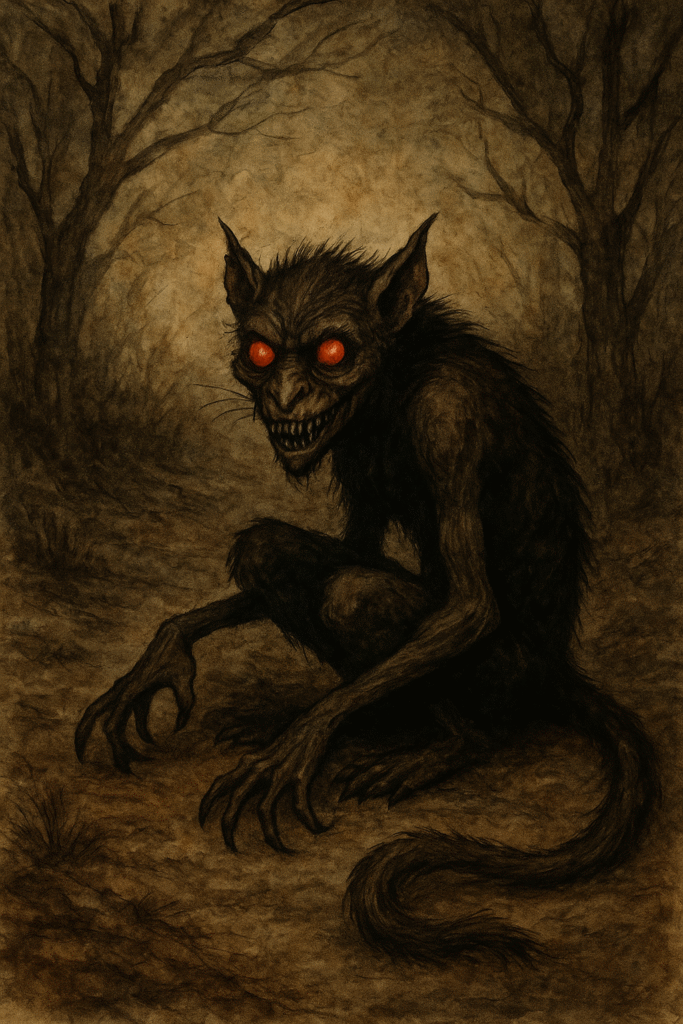
Tailypo is one of the most chilling folktales to emerge from the American South, especially the Appalachian region. It’s a story passed down orally for generations, with variants appearing across Southeastern Ohio, West Virginia, Kentucky, and the Carolinas. While there’s no definitive record of its first telling, most scholars believe the story gained popularity in the 19th century, when rural isolation made oral storytelling the main form of family entertainment. As it spread across hills and hollers, the tale took on local flavors but retained its core horror elements.
The name “Tailypo” has multiple spellings, including “Taily-Po,” “Tailipoe,” and “Taileypo,” which reflects its deep roots in the oral tradition. Without a fixed written form, storytellers adapted it to their voice, accent, and regional dialect. Some early folklorists recorded versions in the 20th century, though exact publication dates and collectors vary by region and source. What’s certain is that Tailypo endured, echoing through cabins, classrooms, and campfires alike.
Appalachian Roots and Oral Storytelling
Tailypo isn’t just a story — it’s part of Southern heritage. Families told it during storms or chilly nights, using it to spook children and teach respect for nature. It blends survival themes with supernatural horror, all set in remote, wooded locations that mirror the isolation many rural families lived in before electricity and modern roads. This raw setting heightened the tale’s impact and ensured its longevity in Southern culture.
Storytellers often tailored the tale’s ending to the audience. In some, the creature reclaims its tail and vanishes; in others, it devours the man and leaves only whispers behind. These versions reflect regional values — from cautionary to terrifying. The story’s flexibility, tone, and tension make it one of the South’s most persistent and emotionally resonant folk legends.
The Classic Story Structure and Variations
The core of the Tailypo story is deceptively simple: a hermit, a cabin, a strange creature, and a missing tail. Typically, the man is hungry, isolated, and accompanied by three loyal hunting dogs. One night, he encounters a strange animal — part cat, part rodent, part shadow — and cuts off its tail, which he cooks and eats. Later, the creature returns, chanting in a rasping voice, “Tailypo, Tailypo, give me back my Tailypo,” a phrase that builds dread with each repetition.
As the creature stalks the cabin night after night, the man’s dogs disappear one by one. The tension increases until, in the final scene, the creature confronts the man in the dark. Depending on the version, it takes back its tail, or exacts a violent revenge. Children hearing this in darkened rooms often scream or grab their blankets, drawn in by the story’s rhythm and escalation.
Versions Across the South
There are numerous regional variations of Tailypo that show how storytelling adapts to culture. In African-American communities, for example, the tale sometimes includes a spiritual dimension or moral about fairness. Other versions remove the tail-eating scene altogether, softening the horror for younger audiences. Some replace the man with a boy, shifting the story into more of a coming-of-age lesson.
Despite the differences, the themes stay consistent: greed, isolation, and consequences. The man takes what isn’t his, disregards warnings, and pays a supernatural price. As a result, the story teaches respect — for nature, for the unknown, and for humility in the face of desperation. It’s a uniquely Southern mixture of folklore and moral lesson wrapped in an unforgettable nightmare.
Tailypo in Published Literature and Education
Though Tailypo began as a spoken tale, it eventually found a home in print. One of the most well-known published versions is Tailypo: A Ghost Story, written by Joanna C. Galdone and illustrated by her father Paul Galdone in 1984. The book remains widely circulated in elementary schools and libraries across the United States. With evocative illustrations and simple, rhythmic prose, it captures the eerie tone while making it accessible to children.
The book’s success brought Tailypo to national attention and sparked renewed interest in Southern folktales. Teachers began using it to teach narrative structure, suspense, and regional culture. It became a favorite for October classroom reading, particularly around Halloween. Children were taught not just to enjoy the suspense, but to recognize cultural storytelling patterns and oral tradition.
From Oral Story to Children’s Book
Despite its popularity, the book has also drawn criticism from some educators and parents for its scary themes. In some school districts, teachers reported complaints that the story frightened young children or introduced “dark” ideas into the classroom. However, defenders argue that fairy tales and folklore have always included fear as a teaching tool. Tailypo, like the Grimms’ tales, doesn’t shy away from consequences.
The Galdones’ version continues to be reprinted and recommended in teacher guides and library lists today. Its combination of minimalist text, dark illustrations, and emotional rhythm makes it effective as both literature and oral performance. For many American children in the 1980s and 1990s, this was their first exposure to genuine Southern folklore in a classroom setting. The book’s staying power proves the story’s relevance and emotional grip.
Cultural Symbolism and Psychological Themes
Beyond fright and entertainment, Tailypo reflects deep cultural fears — especially those rooted in survival, nature, and justice. The forest is more than a setting; it’s a character, embodying the unknown and the uncontrollable. The hermit represents the self-reliant frontiersman, cut off from society and facing consequences from violating natural law. The Tailypo creature is vengeance personified, returning what was taken by force.
Psychologists and folklorists alike have noted the tale’s deeper meanings. The creature’s demand for the return of its tail could symbolize unresolved guilt or the cost of selfishness. The man’s solitude heightens his vulnerability, making the story as much about emotional breakdown as supernatural revenge. Tailypo becomes a metaphor for the past catching up with those who think they can escape it.
Fear, Isolation, and Retribution
The tale also reflects traditional Southern fears of poverty, hunger, and divine punishment. The man eats something unnatural because of starvation — a real concern in historical Appalachia, especially during the Great Depression. His fate echoes religious parables where wrong choices lead to judgment. The rhythmic chant of the creature mimics the Biblical refrain of “justice will find you,” but wrapped in folklore.
In times of crisis — from war to pandemics — the Tailypo story sees revivals. Its themes are timeless: making do, breaking rules, and facing consequences. It can be read as a warning against hubris or a reflection on nature’s unbending laws. That’s what gives Tailypo its durability — it’s not just about a monster, but about fear itself, in forms both real and imagined.
Tailypo in Storytelling Performance and Theater
Tailypo is one of the most performed ghost stories in Southern oral tradition. Skilled storytellers bring it to life with dramatic pauses, voice changes, and darkened rooms. One of the best-known performers was Kathryn Tucker Windham (1918–2011), an Alabama author and folklorist. She recounted the story in her famous 13 Alabama Ghosts and Jeffrey series and during public storytelling festivals in the 1980s and 1990s.
Windham’s performances were masterclasses in Southern folklore — blending humor, fright, and rhythm in perfect balance. She inspired generations of Southern oral historians and brought tales like Tailypo to wider audiences through NPR appearances and school visits. Her legacy helped legitimize storytelling as both an art form and educational tool. Children and adults alike were drawn into the tale’s repetitive structure and emotional escalation.
Campfire Dramas and Community Events
Tailypo remains a staple at Halloween storytelling events throughout the South. From church basements to outdoor festivals, it’s performed with sound effects, costumes, and lighting. Children memorize it and recite it in school competitions, while drama classes adapt it for stage plays. The structure — three dogs, three nights, rising tension — makes it easy to adapt and hard to forget.
In the age of social media, some teachers record classroom performances of the tale to share online. Its oral roots translate well to video, making it one of the few truly “performable” American ghost stories. Whether whispered in the dark or shouted on stage, Tailypo still captures hearts and chills spines. It’s a reminder that sometimes the simplest stories are the most powerful.
Visual and Artistic Interpretations of Tailypo
Though Tailypo is primarily known as a spoken and written story, it has also inspired a range of visual artworks. Paul Galdone’s 1984 illustrations remain the most iconic — his depiction of the creature as a catlike, sinewy shadow set the visual standard for decades. The limited palette and grainy texture of his art emphasize the claustrophobia of the hermit’s cabin and the haunting nature of the Tailypo itself.
Since then, artists have reinterpreted the creature in many forms. Some see it as a monstrous raccoon, others as a glowing-eyed ghost or a stitched-together hybrid. Folk artists in the South have created Tailypo sculptures from wood, masks from bark and leather, and even storytelling quilts depicting the creature’s progression from shadow to avenger. These pieces are displayed at regional heritage centers and art fairs.
From Illustration to Digital Art
Tailypo has also entered digital art circles, with concept artists sharing their versions on platforms like ArtStation and Reddit. Here, the creature is often imagined in horror-fantasy style, with glowing red eyes, twisted limbs, and ragged fur. Some artists place the story in post-apocalyptic or modern settings, reinterpreting Tailypo as a symbol of ecological collapse or urban loneliness.
Art educators use Tailypo to explore Southern Gothic themes in middle and high school classes. The visual contrasts — rural vs. monstrous, natural vs. uncanny — offer students a chance to interpret a single narrative across multiple media. As with other folktales, Tailypo’s horror invites creativity, giving rise to everything from children’s cartoons to surrealist paintings. The tale lives not just in words, but in brushstrokes and pixels.
Modern Legacy and Revival in Pop Culture
In recent years, Tailypo has seen a quiet resurgence in online and pop culture spaces. Podcasts like Lore and Scary Stories Told in the Dark have featured the tale in episodes, often adapted for modern listeners. The eerie repetition and simple plot make it ideal for audio storytelling. YouTube creators also animate versions, giving the story a visual life that spreads across age groups.
On TikTok and Instagram, storytellers perform live readings or post spooky monologues set to moody music. In October, the hashtags #Tailypo and #SouthernFolklore trend across horror fandoms. While some simplify the tale for jump-scare appeal, others preserve the story’s psychological depth and Southern character. Tailypo is no longer just a regional myth; it’s a cultural export with growing digital presence.
Creepy Podcasts and Social Media
Tailypo is often grouped with other American monsters like the Mothman, Jersey Devil, or Wendigo. But unlike those cryptids, it has a fixed narrative and moral arc. That makes it more accessible for teaching and adaptation. It’s not just a creature, it’s a story — and that makes all the difference.
The enduring appeal lies in its fear of the unknown. What lurks in the woods? What happens when we take what we shouldn’t? Tailypo doesn’t offer clean answers. It offers a whispered warning: what you do in the dark may come back to find you.
Key Takeaways
- Tailypo is a Southern folktale with deep Appalachian roots.
- The story reflects themes of guilt, isolation, and retribution.
- It gained wider attention through Paul and Joanna Galdone’s 1984 children’s book.
- Artists and educators use it in theater, illustration, and folk art.
- The tale continues to spread through podcasts, performances, and online media.
FAQs
- What is the Tailypo story about?
A hermit cuts off a strange creature’s tail, eats it, and is later stalked by the creature demanding its tail back. - Where did Tailypo originate?
The tale comes from the Appalachian region and broader Southern United States, likely in the 1800s. - Who illustrated the most famous version of the story?
Paul Galdone illustrated Tailypo: A Ghost Story in 1984, with text by Joanna C. Galdone. - Is Tailypo still told today?
Yes, it’s featured in school readings, podcasts, social media, and storytelling events across the country. - What does the story symbolize?
Tailypo often represents guilt, natural revenge, or fear of isolation and survival.