Bordeaux has long stood as a city where material grandeur and mercantile ambition converged. Built upon a bed of luminous white limestone and nestled on a crescent of the Garonne River, its urban fabric speaks in architectural rhythms shaped not only by aesthetic vision but by the quiet, ceaseless churn of commerce. As France’s great Atlantic port and gateway to the wine-rich lands of Aquitaine, Bordeaux emerged over centuries not merely as a place of trade but as a crucible of cultural accumulation—absorbing, refining, and projecting a visual identity marked by cosmopolitanism, civic pride, and intellectual ambition.
The art history of Bordeaux is a story with many tributaries. It begins with classical foundations—Roman Burdigala—where mosaics and temples echoed imperial grandeur. It evolves through centuries of ecclesiastical dominion, where the carved tympanums of Gothic cathedrals and the illuminated manuscripts of cloisters testified to a theological imagination made material. In the Enlightenment age, it crystallized into neoclassical clarity, where urban planning became itself a form of civic artwork and architecture became rhetoric in stone. And in the modern era, it fractured, diversified, and reconfigured itself through abstraction, experimentation, and a newly democratized visual culture, responsive not only to national movements but to global flows of influence.
What distinguishes Bordeaux in the panorama of French art history is not flamboyant innovation or revolutionary rupture—traits more commonly associated with Paris—but a particular form of cultivated synthesis. The city’s art evolved less through radical rejection of precedent and more through absorption, translation, and adaptation. Its wealth—drawn from wine, colonial commerce, and maritime exchange—created a substrate upon which patronage and institutional support could thrive. Yet this wealth also came with contradictions. Bordeaux’s prosperity was intertwined with systems of exploitation, most notably in the triangular trade of the 18th century, and this legacy has quietly haunted its visual culture, shaping not only what was depicted but also what was left out.
From a distance, Bordeaux appears visually coherent—its famed honey-colored façades and regularized streets present a harmonious aesthetic. Yet this apparent unity conceals a deeper and more turbulent history of artistic transformations. Its medieval churches, often embedded within modern urban surroundings, reveal traces of an earlier sacred geography. The grand civic squares of the 18th century, such as the Place de la Bourse, express Enlightenment ideals that were as much political as artistic. And the 20th-century interventions—both architectural and conceptual—illustrate the city’s uneasy negotiation with modernism, with globalism, and with its own past.
Importantly, Bordeaux was never an artistic backwater. While not a generator of avant-garde movements, it functioned as a node in the broader network of European artistic exchange. Italian engravings found their way here in the Renaissance; Flemish painting circulated through port traders; Enlightenment prints spread from Paris and London to salons along the Garonne. Artists trained in Paris often returned to Bordeaux with new ideas, and local patrons—especially in the 18th and 19th centuries—were eager to anchor these innovations in the service of civic dignity and familial commemoration. Bordeaux’s art history is thus not simply regional or provincial, but transregional—defined as much by what entered its harbors as by what was created within its ateliers.
The city’s artistic identity has also been shaped by its institutions. The Musée des Beaux-Arts, founded during the fervor of the Revolutionary period, remains a touchstone, housing works from Titian to Delacroix. The CAPC musée d’art contemporain, occupying a 19th-century warehouse, signals Bordeaux’s more recent investment in contemporary art. These are not merely repositories but active players in shaping visual discourse. Alongside them stand smaller galleries, ephemeral street art installations, and an increasingly international scene of artists responding to urban space, history, and social change.
To write the art history of Bordeaux, then, is not merely to document a succession of styles or figures. It is to read a palimpsest—where every new stroke, every architectural intervention, every institutional shift overlays and dialogues with what came before. It is to understand the city not as a static container of artworks but as an evolving organism, where stones, stories, and images continually reshape each other. In Bordeaux, art has always been a negotiation between tradition and ambition, between place and passage, between the rooted and the itinerant. It is this dialectic—between the luminous permanence of limestone and the ceaseless movement of river and sea—that defines its artistic soul.
Roman Burdigala and the Classical Foundations
The origins of Bordeaux as an artistic and urban entity trace back to antiquity, when the settlement known as Burdigala emerged as a provincial jewel of the Roman Empire. Situated strategically on the western reaches of the Via Domitia and accessible by river, Burdigala flourished from the 1st century BC into late antiquity as a Gallo-Roman city, marked by architectural ambition, cultural hybridity, and an enduring relationship between civic form and aesthetic expression. Though little survives intact of its Roman grandeur, what remains—through archaeological fragments, substructural remains, and documentary echoes—provides a foundation upon which the later city was materially and symbolically constructed.
Roman Burdigala was not merely a distant outpost; it was a provincial capital of real consequence. In the 3rd century AD, under Emperor Gallienus, the city reached the height of its political significance as the capital of Aquitania Secunda, a status reflected in its built environment. The amphitheatre—known today as the Palais Gallien—was one of the most prominent structures, and though its ruins are partial, they suggest a colosseum capable of accommodating thousands. Its elliptical shape and travertine-clad arches spoke the imperial language of spectacle and control, while also embedding Roman cultural values into the daily life of the local population.
The city’s forum, temples, baths, and aqueducts followed the same logic. These were not merely functional; they were aesthetic assertions of order, hierarchy, and civilization. The use of symmetry, monumental scale, and classical proportions introduced a visual grammar that would echo centuries later in Bordeaux’s neoclassical planning. Indeed, the architectural vocabulary of ancient Rome—columns, pediments, arches—would return in the 18th century not as foreign imports, but as latent memories activated by Enlightenment ideals of antiquity.
One of the most remarkable legacies of Roman Burdigala is the figure of Ausonius (c. 310–395 AD), a poet, rhetorician, and teacher of rhetoric to the future emperor Gratian. Ausonius’s writings provide not only literary elegance but documentary insight into the city’s cultural milieu. In his poem Mosella, though centered on the Moselle River, he evokes the grandeur and cultivated life of the Gallo-Roman world, to which Bordeaux belonged. His texts suggest a city where eloquence, learning, and artistic patronage coexisted with imperial power. Ausonius himself was a collector of art, as evidenced by his references to engraved gems and crafted objets. His aesthetic sensibility, shaped in part by Bordeaux’s intellectual climate, stands as one of the earliest articulations of the city’s enduring artistic personality—cultured, erudite, cosmopolitan.
What remains of Roman visual culture in Bordeaux today is fragmentary but instructive. Excavations have uncovered mosaics featuring geometric motifs and Dionysian imagery, suggesting not only technical sophistication but thematic interests that would persist—Bacchus reappears in later iconography tied to the region’s wine identity. Funerary stelae and sarcophagi, often inscribed in Latin and adorned with classical motifs, indicate a population invested in the aesthetics of memory and commemoration. These early visual expressions—set in limestone and marble—reveal how the desire to be remembered was never divorced from the desire to be seen beautifully.
Material culture from the Roman period also suggests the intersection of local and imported forms. Pottery styles reveal both Gallic continuity and Roman innovation; jewelry recovered from gravesites displays hybrid motifs, mixing native Celtic symbols with Mediterranean forms. This fusion—a hallmark of Roman provincial culture—also defines Bordeaux’s later artistic identity: a capacity for absorbing external influence and rearticulating it in locally meaningful terms.
Moreover, the spatial logic of Roman Bordeaux persisted even after its decline. The alignment of medieval streets, the placement of ecclesiastical sites, and the underpinnings of later urban expansion followed patterns first laid down by Roman surveyors. In this way, the aesthetic and functional imagination of the Roman city became, however invisibly, the scaffolding for all subsequent artistic development. Even where ruins vanished, their logic endured.
It is essential, however, not to romanticize Roman Burdigala as a seamless precursor to later artistic grandeur. The city suffered invasions, fires, and economic decline. By the 5th century, it had become a diminished outpost in a fragmenting empire, its monumental architecture gradually repurposed, pillaged, or buried. Yet in these ruins lay a strange potency: the aura of a lost order, which Renaissance and Enlightenment minds would later seek to resurrect, often quite literally, by unearthing classical fragments and reinterpreting them in their own terms.
In the Renaissance, scholars and antiquarians in Bordeaux would rediscover Ausonius, read Roman inscriptions with fresh eyes, and study the remaining architectural fragments not merely as curiosities but as blueprints for civic renewal. The Roman legacy became not just historical but aspirational—an idea of cultural legitimacy that could be reborn through visual form. When Ange-Jacques Gabriel’s neoclassical facades lined the Place de la Bourse in the 18th century, they did so not as foreign imports but as echoes of Burdigala’s long-vanished colonnades.
Thus, the classical foundations of Bordeaux are not merely archaeological facts but aesthetic continuities. Roman Burdigala may have fallen into ruin, but its ideals—proportion, monumentality, visual order—became the undercurrent of a much longer artistic story. In this way, the stones of antiquity did not die; they were buried, remembered, and ultimately re-spoken in the language of later centuries, forming the bedrock—literal and conceptual—of Bordeaux’s artistic identity.
Gothic Aspirations: Sacred Art in Medieval Bordeaux
If the Roman foundations of Bordeaux established a civic and aesthetic order grounded in imperial monumentality, the medieval period saw a transmutation of that legacy into the spiritual realm. Between the 11th and 15th centuries, Bordeaux emerged not as a political capital but as a sacred city: a site of pilgrimage, ecclesiastical authority, and liturgical spectacle. Its artistic production during these centuries was dominated by the Gothic, yet always refracted through regional particularities and economic conditions that rendered its religious art both ambitious and idiosyncratic. While not the equal of Chartres or Reims in sheer scale, Bordeaux’s Gothic art—particularly its architecture and sculpture—reveals a complex interplay between devotional function, material symbolism, and civic representation.
At the heart of this transformation stood the Cathédrale Saint-André, the city’s most commanding medieval monument. Consecrated in 1096 in the presence of Pope Urban II, the cathedral began in the Romanesque style but evolved over several centuries into a high Gothic edifice, its verticality and skeletal stonework expressing a theological aspiration toward the divine. The twin spires, pointed arches, and intricately ribbed vaults are not merely stylistic imports from northern France; they represent Bordeaux’s integration into broader ecclesiastical and architectural currents, while also revealing the city’s rising spiritual ambitions in an age of crusades, relic cults, and trans-European pilgrimage.
The cathedral’s sculptural program reflects this dual ambition of theological instruction and civic pride. Tympanums, capitals, and portal sculptures—though many have suffered erosion or were replaced in later restorations—once offered vivid depictions of Last Judgments, martyrdoms, and Christological narratives. These were not abstract metaphysical musings; they were immediate, didactic images meant to impress upon both clergy and laity the weight of salvation history. The sculptors, often anonymous, worked within established iconographic conventions but imbued their figures with regional character: angular drapery folds, expressive faces, and a restrained but palpable emotional realism.
The Porte Royale, one of the cathedral’s most significant sculptural ensembles, reveals not only theological depth but also a worldly sophistication. It echoes stylistic elements from Chartres and Paris while maintaining a certain provincial austerity—a sobriety in execution that may reflect the tastes or resources of local patrons. Unlike the flamboyant profusion seen in the flamboyant Gothic of the Loire, Bordeaux’s Gothic idiom is more measured, more contemplative, and often more architectural than figurative in its decorative emphasis.
Beyond Saint-André, other churches contributed to the city’s sacred topography and artistic evolution. The Basilica of Saint-Seurin, whose origins date to the early Christian period, underwent major Gothic modifications, particularly in its crypt and ambulatory chapels. The Basilica of Saint-Michel, begun in the 14th century, represents a later flowering of Gothic style in Bordeaux, notable for its monumental bell tower—the flèche, rising over 100 meters and detached from the main structure—a peculiarity that visually distinguishes the city’s skyline to this day. Its stained glass, much of it destroyed during the Wars of Religion and restored only partially, once cast vibrant chromatic light across liturgical space, transforming stone into a medium of divine revelation.
Indeed, stained glass was one of the most important vehicles of visual theology in medieval Bordeaux. While little of the original glazing survives, what remains—and what has been reconstructed—speaks to a sophisticated iconographic program. Scenes from the life of Christ, the Virgin Mary, and local saints such as Seurin and Michel were not only narrative but symbolic, organized to reinforce theological lessons and liturgical cycles. The intense blues and reds, typical of Gothic glazing, found resonance in the city’s otherwise pale architectural palette, producing a contrast that heightened the sense of sacred drama.
Yet sacred art in Bordeaux was not confined to monumental architecture. Manuscript illumination flourished in the city’s monastic and ecclesiastical centers. Though Bordeaux was not a major center of manuscript production like Tours or Paris, several surviving missals and breviaries bear witness to a localized school of illumination. These works, often made for use in the liturgy of the cathedral or nearby abbeys, display a decorative elegance marked by vegetal borders, historiated initials, and miniature scenes infused with Gothic expressivity. The Bordeaux manuscripts reveal both the influence of Parisian models and a certain regional restraint—less flamboyant, more attuned to the meditative pace of clerical reading.
The medieval period also saw the rise of reliquary art, tied intimately to the cult of saints and the city’s place on the pilgrimage route to Santiago de Compostela. Pilgrims passing through Bordeaux brought with them not only prayers but visual culture—badges, manuscripts, portable altarpieces—which mingled with local forms. Reliquaries, often crafted in gold, silver, and enamel, were among the most prized objects of sacred art. These were not merely containers but expressions of devotion, civic identity, and artistic virtuosity. Their elaborate forms—miniature cathedrals, chasses, or anthropomorphic busts—blurred the line between sculpture and architecture, emphasizing the embodied nature of sanctity.
Economically, the Gothic period in Bordeaux was marked by a gradual increase in mercantile activity, particularly through its port. This growing prosperity helped fund church construction and decoration, but it also introduced new tensions between ecclesiastical authority and emerging civic institutions. Guilds, some of which took patronage roles in decorating chapels or commissioning altar pieces, began to assert their presence in the visual life of the city. While records are fragmentary, it is clear that the line between sacred art and civic expression was porous: chapels were adorned not only with saints but with the coats of arms of merchants, the insignia of professional associations, and inscriptions attesting to individual piety and public generosity.
As the medieval period waned and the Renaissance approached, Bordeaux’s sacred art began to lose its hegemony. Yet its Gothic heritage endured—not only in surviving structures and objects but in the city’s collective memory. The verticality of its towers, the rhythm of its nave arcades, the metaphysical aura of its stained glass: all contributed to a visual culture in which spiritual aspiration was embedded in the very stone of the city.
In Bordeaux, the Gothic was never a mere style. It was a theology of space, a vision of the cosmos made visible through proportion, light, and iconography. It expressed not only the ecclesiastical order of the medieval world but also the city’s emergent sense of identity—a place where stone reached upward, and where art served not just beauty, but salvation.
Renaissance Echoes in a Port City
The Renaissance reached Bordeaux not with the sudden thunderclap of revolution but with the slow wash of tide. It arrived by sea, through ships laden with manuscripts, engravings, and the subtler freight of ideas. Bordeaux, long a conduit of commerce between the French hinterlands and the Atlantic world, became in the 15th and 16th centuries a quietly receptive matrix for the artistic humanism taking root in Italy and spreading across the European continent. Yet here, in this city of stone quays and ecclesiastical silhouettes, the Renaissance unfolded not as a dominant rupture with the medieval world but as a palimpsest—layered, hesitant, and shaped by mercantile pragmatism as much as by philosophical idealism.
By the mid-15th century, Bordeaux was under the sway of the French crown, having passed from English control in the wake of the Hundred Years’ War. This political reorientation coincided with a gradual increase in urban and economic stability, allowing for a modest flourishing of civic culture. While the grand Florentine or Roman models of Renaissance art had no direct counterparts in Bordeaux, the city nonetheless began to absorb elements of classical revivalism, particularly in its architecture and urban embellishment. The Hôtel de Ville (City Hall), noble residences, and ecclesiastical annexes began to display the lexicon of the new style: pilasters, entablatures, rusticated stonework, and proportional geometries that looked back to Vitruvius as interpreted through the lens of Alberti and Serlio.
One of the most significant examples of early Renaissance architecture in Bordeaux is the Palais de l’Ombrière, the former seat of the Parliament of Bordeaux. Though much altered and ultimately demolished in the 19th century, it embodied the cautious insertion of Renaissance aesthetics into a still largely Gothic urban texture. Elsewhere, in surviving hôtels particuliers built for the bourgeois elite, one finds a hybridization of styles: dormer windows and ribbed vaults coexist with rounded arches and classical mouldings. This was a visual language still negotiating its own grammar, adapting foreign ideals to local materials and conventions.
Indeed, the materiality of Bordeaux played a crucial role in the city’s reception of Renaissance aesthetics. The pale, easily carved limestone that defined its architectural identity lent itself to ornamentation but also imposed certain limits. There was no Carrara marble, no bronze casting workshops to rival those of Florence or Padua. Instead, Bordeaux’s artisans developed a vernacular Renaissance: one that relied on surface refinement, subtle spatial modulation, and the borrowing of motifs via prints and pattern books. Engravings by Marcantonio Raimondi, illustrations from Serlio’s architectural treatises, and copies of antique statuary filtered into the city through merchants, booksellers, and ecclesiastical patrons.
This diffusion of visual knowledge was facilitated in large part by the rise of humanist circles in Bordeaux’s educational institutions. The University of Bordeaux, founded in 1441, became a modest yet significant center for legal and theological study, where the Latin classics were revived and emulated. Humanist scholars, some of whom had studied in Italy, returned to Bordeaux with a renewed sense of the civic value of classical learning. They brought with them not only texts but a sensibility—one that valorized proportion, balance, and the moral utility of beauty.
Among the most emblematic figures of this intellectual milieu was Étienne de La Boétie, whose friendship with Michel de Montaigne (whose estate lay not far from Bordeaux) stands as a monument to Renaissance individuality and skeptical inquiry. While neither man was a visual artist, their literary and philosophical ethos shaped the broader cultural atmosphere in which artistic patronage occurred. In Bordeaux, the Renaissance was less a matter of grand commissions than of cultivated refinement—an appreciation for ornament, antiquity, and intellectual elegance expressed through modest means.
Religious institutions, too, participated in this slow transformation. Church interiors began to incorporate Renaissance elements: altarpieces framed by classical columns, baptismal fonts adorned with grotesques and putti, frescoes that echoed Italian chiaroscuro techniques. Yet the Gothic structure of these buildings remained largely intact. The shift was not one of destruction but of accretion—like a new melody played over an old ground bass. The Flamboyant Gothic of the late Middle Ages merged with the linear precision of Renaissance ornamentation, producing a hybrid style that could be seen in sacristies, choir stalls, and rood screens.
Painting in Renaissance Bordeaux, by contrast, remained relatively conservative. There were no native masters of the calibre of Clouet or Fouquet, and few large-scale commissions survive. The extant works suggest a provincial school oriented toward devotional subjects, rendered in tempera and oil, with compositions often derived from Netherlandish models. Given Bordeaux’s trading ties with the Low Countries, this influence is unsurprising. Panels depicting the Virgin and Child, the Passion, and various saints exhibit a Northern realism in their textures and faces, often paired with archaic spatial treatments that lagged behind Italian developments.
Yet in miniature and manuscript, the Renaissance left more refined traces. Illuminated books produced in Bordeaux during this period show the gradual infiltration of classical motifs, naturalistic foliage, and architectural framing devices that move beyond the constraints of the Gothic page. The art of the book, long a clerical preserve, began to reflect secular tastes and humanist content. Heraldic manuscripts, legal codices, and civic records adopted Renaissance visual tropes, indicating a broader diffusion of the style across different strata of society.
The port of Bordeaux—always the city’s vital organ—also served as a conduit for artistic materials and objects. Italian maiolica, Iberian tapestries, and Flemish paintings found their way into private collections. While the documentation of these collections is sparse, inventories from noble estates occasionally record paintings “à la manière d’Italie,” suggesting that art collecting, though limited, was not unknown. Such acquisitions were less about aesthetic speculation and more about cultural capital: to possess a painting in the Italian manner was to declare oneself part of a larger, civilized world.
Thus, the Renaissance in Bordeaux did not manifest as a rebirth in the grand, Michelangelesque sense. It was more atmospheric than monumental—an accrual of tendencies, ornaments, ideas. It reshaped the city slowly, almost imperceptibly, layering its aesthetic grammar onto pre-existing structures and habits. It was a Renaissance of emulation rather than innovation, of measured ambition rather than heroic transformation.
But in this very restraint lies a certain beauty. Bordeaux’s Renaissance was not diluted; it was translated. And in that translation—through the medium of limestone, the rhythms of trade, and the quiet confidence of civic life—the city began to shape the contours of the artistic identity that would define it in the coming centuries: not flamboyant, not central, but deeply, resolutely cultivated.
Baroque Flourish and Bourbon Patronage
By the dawn of the 17th century, Bordeaux had matured into a city of visible ambition and latent anxiety. It was now firmly within the orbit of the French crown, integrated into the administrative apparatus of the Bourbon monarchy. The tensions of the previous century—religious conflict, dynastic instability, and civic unrest—had not extinguished the city’s aspirations; rather, they had reshaped them. In this context, the Baroque emerged in Bordeaux not as a vehicle of unbridled theatricality, as in Rome or Madrid, but as a calculated projection of power, order, and spiritual persuasion. The Baroque in Bordeaux was filtered through the imperatives of monarchy, orthodoxy, and civic control, and its visual language reflected this ideological ballast. It was a Baroque of discipline, not of delirium.
The aesthetic vocabulary of the Baroque—dynamic movement, dramatic chiaroscuro, architectural grandeur, emotional expressivity—was imported to Bordeaux gradually, largely through ecclesiastical commissions and aristocratic patronage. Unlike in Paris, where royal largesse could sponsor experimental allegories and vast decorative cycles, Bordeaux’s artistic life was more decentralized, more rooted in the pragmatic concerns of religious institutions and magistrates seeking to manifest both piety and authority. Yet within these constraints, the Baroque found fertile soil. It gave visual form to the Counter-Reformation’s rhetorical and didactic demands, and it offered a means by which the Bourbon monarchy could anchor its ideological presence in a province still marked by the memory of Huguenot resistance.
One of the most significant manifestations of Baroque sensibility in Bordeaux was architectural. The Jesuits, ever the spearhead of Catholic revivalism, were instrumental in shaping the city’s sacred landscape. Their church, the Église Saint-Paul-Saint-François-Xavier, consecrated in 1649, stands as a testament to the Counter-Reformation’s spatial theology. The façade, while modest by Roman standards, incorporates classical orders, volutes, and broken pediments arranged in a vertical emphasis that draws the eye heavenward—a quintessential Baroque maneuver. Inside, the nave is flanked by lateral chapels, and the altar is elevated, designed to emphasize sacramental visibility and Eucharistic centrality. Here, architecture was catechesis in stone: a spatial homily on the glory of the Church triumphant.
Elsewhere in the city, the influence of Baroque planning can be traced in civic structures and urban developments. The Hôtel de Ville underwent renovations during this period, incorporating more assertively classical lines and sculptural ornamentation. Private residences of the parlementaire class—the magistrates of the local high court—displayed increasingly elaborate façades, often adorned with pilasters, carved cartouches, and elaborate keystones. These visual flourishes were not mere decoration; they were assertions of social rank and ideological alignment with royal authority. The Bourbon Baroque in Bordeaux was a language of hierarchy made visible.
Sculpture and decorative arts during this period also reflected the dual imperatives of religious persuasion and aristocratic display. Church interiors were furnished with altarpieces, pulpit canopies, confessionals, and tabernacles carved in richly veined wood and sometimes gilded in gold leaf. While few of these survive in their original form, records indicate the presence of sculptors capable of considerable virtuosity. These artisans, often working anonymously or under ecclesiastical direction, contributed to a sensory environment designed to overwhelm the rational faculties and draw the faithful into a state of devotional receptivity. Angels in mid-flight, clouds breaking open above the altar, and twisted Solomonic columns all performed a visual metaphysics: the presence of God made not abstract but dazzlingly immanent.
Painting, too, was increasingly shaped by Baroque tenets. Local artists and imported canvases, many from Paris or even Italy via the port, brought to Bordeaux a heightened sense of movement, drama, and emotional resonance. The Passion of Christ, the martyrdoms of saints, and Marian iconography were rendered with a pathos that aimed to penetrate the viewer’s heart. One notable work of the period is a canvas by the French Baroque painter Jean André, active in the late 17th century, whose Assumption of the Virgin—once housed in a now-lost chapel—reportedly employed bold coloration and a swirling composition that lifted the Virgin from the earth in a vortex of heavenly light.
Alongside these developments in religious art was the cultivation of secular portraiture. The growing bourgeoisie and the legal nobility sought to inscribe their likenesses within the visual record of civic life. Portraits from the period, though fewer in number than in Parisian collections, reveal a sober elegance: sitters posed with ledgers, books, or legal robes; expressions carefully composed to suggest both intellectual gravity and social refinement. The Baroque ethos of identity—rooted in theatrical presentation and symbolic embellishment—manifested here in subtler form. The theatricality was inward, contained within the measured decorum of French classicism.
The influence of the Bourbon monarchy was everywhere implicit in this visual culture. The fleur-de-lis appeared in architectural ornament and liturgical textiles; dedications to Louis XIII and Louis XIV proliferated in inscriptions, paintings, and sculptural cartouches. These were not mere tokens of loyalty but assertions of political theology: the King, like the Church, ruled by divine right, and art served as the mediator of that doctrine. Even urban space became a medium of Bourbon ideology. Plans were drawn up for more regularized streets, public squares, and axial alignments that expressed the absolutist desire for visual and civic order.
Yet the Baroque in Bordeaux was never wholly absorbed into state or church propaganda. It also served as a platform for regional identity. Local saints such as Seurin, Martial, and Amand were honored in altarpieces and processional banners. Pilgrimage continued to be a vital force in the city’s religious and artistic life, and many of the Baroque commissions were funded not by royal agents but by confraternities, merchant guilds, and parish communities. These patrons brought their own tastes and priorities, often favoring devotional intimacy over theatrical spectacle. In their hands, the Baroque became not an instrument of power but a mode of consolation and continuity.
By the end of the 17th century, Bordeaux had been thoroughly inscribed within the visual and ideological contours of the Bourbon regime. Yet this inscription was never total. The Baroque in Bordeaux retained a local accent—a tempering of grandeur with restraint, of emotion with clarity. It reflected a city balancing its commercial energies, its spiritual devotions, and its political allegiances in a visual idiom that was both expressive and controlled. The flourish of the Baroque, filtered through Bordeaux’s limestone façades and Atlantic skies, became not a break from the past but a richly ornamented bridge to the classical ambitions of the Enlightenment to come.
Enlightenment Aesthetics and Urban Grandeur
The 18th century was Bordeaux’s golden age. Never before, and arguably never since, did the city express such clarity of vision, confidence in its identity, and coherence in its urban and artistic fabric. The Enlightenment was not merely a set of philosophical doctrines or political ideas in Bordeaux; it was a comprehensive aesthetic. It reshaped the city not only in mind but in stone, translating the rational principles of the age into avenues, façades, civic spaces, and visual order. It was during this century that Bordeaux was transformed from a medieval stronghold into a classical city—a model of urban beauty and symmetry that seemed to embody the ideals of proportion, reason, and enlightened governance. Here, architecture and the visual arts ceased to be secondary ornaments and became the primary expressions of political ambition, civic pride, and philosophical clarity.
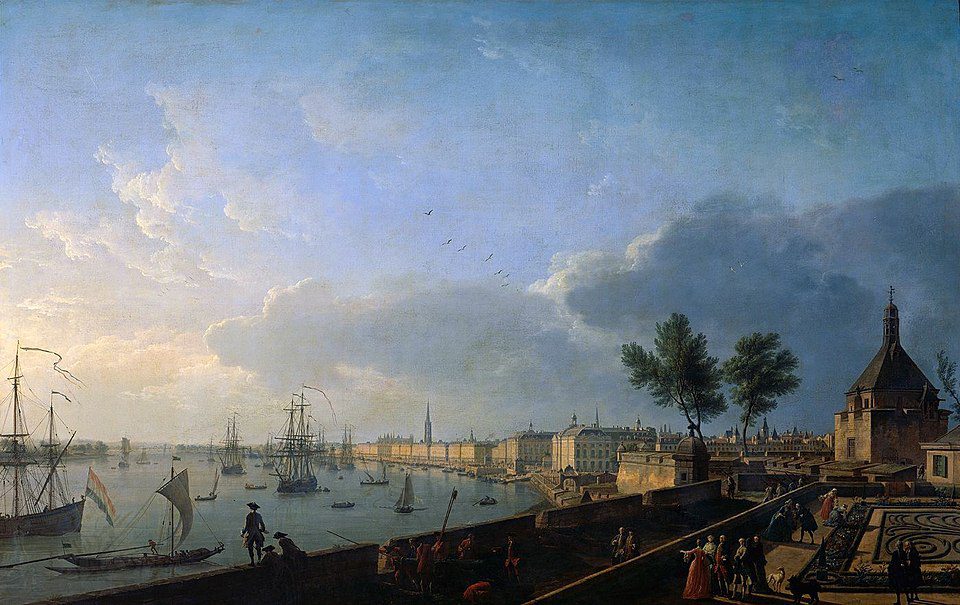
At the center of this transformation was architecture, and at the center of architectural achievement stood Ange-Jacques Gabriel, First Architect to the King, whose work in Bordeaux remains one of the finest examples of Enlightenment urban design in provincial France. Commissioned in the 1730s by the intendant Claude Boucher, Gabriel designed the Place Royale—now the Place de la Bourse—a semicircular ensemble of classical buildings that faced the Garonne River like a stage set open to the world. This space, anchored by a central pavilion and flanked by matching wings, embodied the Enlightenment ideal of urban order: geometrically pure, open to natural light, and framed by a harmonious rhythm of pilasters, cornices, and balustrades. It was also deeply symbolic. The river, long the artery of commerce, was now bordered by architecture that projected reason, control, and dignity—a stone declaration that Bordeaux had entered the modern age.
The aesthetics of this period were governed by the principles of neoclassicism, but not in the austere, heroic mode found later in revolutionary Paris. In Bordeaux, classical revival was tempered by sensuality and regional warmth. The golden limestone of the region gave neoclassical forms a glow that softened their rationality. The emphasis on symmetry and axiality was always balanced by attention to light, perspective, and public use. The Enlightenment in Bordeaux was not an ideology imposed; it was a way of shaping space to elevate the citizen, organize the city, and make beauty an instrument of governance.
This ambition extended beyond major squares and into the very infrastructure of the city. Quays were regularized, streets widened, and façades brought into aesthetic harmony through building codes that prescribed a uniform architectural language. What had once been a haphazard medieval port became an urban composition whose components spoke in a single, legible style. The continuity of cornices, the spacing of windows, the modulation of rooflines—all were regulated not simply for appearance but for civic virtue. Order in stone was a metaphor for order in society.
The visual arts were increasingly institutionalized in this context. In 1801, just after the close of the Enlightenment period, the Musée des Beaux-Arts de Bordeaux was founded, but its roots lie in the cultural infrastructure developed during the 18th century. Earlier, private salons, academies, and connoisseur circles had begun to play a role in cultivating artistic taste. The drawing school established in the mid-century reflected a new social role for art: not merely a religious or aristocratic possession, but an instrument of moral and civic formation. Art education was increasingly seen as part of a wider pedagogical project—training the eye and refining the mind.
Painting and sculpture in Enlightenment Bordeaux aligned closely with these values. Portraiture flourished, particularly among the magistrature and the merchant elite. Sitters were often depicted in their professional or civic roles, surrounded by symbols of legal authority, scientific inquiry, or mercantile success. The theatrical flourishes of the Baroque receded, replaced by the calm rationality of neoclassical composition. In portraits by artists such as Joseph André Cellony and Jean-Baptiste Greuze (whose works circulated in Bordeaux and influenced local painters), we find a new mode of subjectivity: poised, thoughtful, morally legible.
Public sculpture also came into its own. Fountains, allegorical statues, and monuments to civic benefactors began to populate the reorganized cityscape. These were not mere decorations but statements of civic ideology. A fountain adorned with nymphs and tritons became a meditation on abundance and harmony; an allegorical figure of Justice on a courthouse façade became a visual embodiment of Enlightenment legality. Sculpture was integrated into the architecture itself, merging ornament with structure, beauty with function.
Perhaps no better symbol of Bordeaux’s Enlightenment culture exists than the Grand Théâtre, designed by Victor Louis and completed in 1780. With its twelve Corinthian columns and balanced proportions, the theater was both a civic monument and a temple to the arts. Inside, its blue and gold decor and carefully tiered balconies demonstrated the intersection of aesthetics and social hierarchy. The theater was a place where the senses were refined, the intellect stimulated, and the civic body assembled. It was, in the Enlightenment imagination, not simply entertainment, but an institution of public virtue.
Yet for all its clarity and grandeur, the Enlightenment city of Bordeaux was not without its contradictions. Its prosperity was underwritten by the Atlantic slave trade and the triangular commerce that brought sugar, coffee, and exotic goods into its port. Many of the very merchants who funded civic beautification did so with profits derived from human bondage. The visual culture of the period largely elided this reality. In paintings, engravings, and urban design, the labor and suffering that sustained Bordeaux’s prosperity remained invisible or relegated to marginal iconography—exoticized Africans in allegorical roles, ships in harbor scenes rendered with aesthetic detachment.
This moral dissonance complicates the Enlightenment aesthetics of Bordeaux. The ideals of order, beauty, and civic virtue were made possible, in part, by a system of violence and exploitation that remained largely unacknowledged in the city’s official iconography. The clarity of stone masked the opacity of conscience.
Nonetheless, the aesthetic achievements of this period remain enduring. The 18th century gave Bordeaux the form by which it is still most commonly recognized today: a city of measured grandeur, of luminous stone façades, of classical rhythm adapted to Atlantic light. The Enlightenment did not merely build the city—it defined its self-image, its relationship to history, and its aspirations for the future. It left an imprint not only on architecture but on the very concept of urbanity: the idea that a city could be both beautiful and rational, a work of art in itself.
Wine, Trade, and the Colonial Gaze in 18th-Century Art
If the 18th century endowed Bordeaux with a coherent visual grammar of Enlightenment symmetry and classical elegance, it did so atop an economy deeply entangled with the Atlantic world—a world of wine and sugar, of mahogany and molasses, of maritime risk and colonial exploitation. Bordeaux’s rise as a cultural and artistic capital in the Age of Reason was materially sustained by its prominence in what historians now term the triangular trade. The city became, alongside Nantes and La Rochelle, one of the key French nodes in transatlantic commerce. And while its architecture and civic institutions projected an image of rationality, order, and virtue, the visual culture of the period reveals more complex undercurrents: a subtle but persistent colonial gaze, an aestheticization of exoticism, and an effort to render the sources of Bordeaux’s wealth both palatable and picturesque.
The Bordeaux wine trade, of course, was the city’s primary economic engine, and its significance was reflected in art. Paintings commissioned by négociants and landed proprietors often included subtle indicators of viticultural prosperity—vineyards rendered in miniature in the background of portraits, barrels and ledgers in still-life compositions, and ships docked along the Garonne with sails poised for export. The representation of wine as a signifier of cultivation, prosperity, and regional identity found its way into engravings, decorative arts, and even architectural ornamentation. Bacchus, long a symbolic figure in the region since Roman times, reappeared in allegorical sculpture, tapestries, and fireplace mantels, transformed from a pagan god into a benign patron of commerce and conviviality.
Yet this seemingly bucolic visual vocabulary masked more unsettling economic realities. Bordeaux’s prosperity in the 18th century was not only due to the export of wine but also to its participation in the colonial economy—particularly through its role in outfitting ships bound for West Africa, importing goods from the Caribbean, and financing voyages that trafficked in human lives. The city’s elite merchants and shipowners invested heavily in slavery, directly or indirectly, and reaped the profits through a diverse portfolio of colonial commodities. Sugar, coffee, indigo, cotton, and tobacco flooded the port, feeding the tastes and luxuries of the Enlightenment bourgeoisie and providing the material substrate for the city’s artistic patronage.
Despite this centrality, the institution of slavery and the colonial system remained curiously underrepresented in the official art of Bordeaux. Portraits of merchants and magistrates from the period are filled with the iconography of refinement—books, globes, quills, and classical busts—but rarely acknowledge the colonial economies that underwrote their status. When slavery does appear, it is most often in allegorical or decorative guise. In gilt consoles and porcelain services, one might find a black pageboy, exotically dressed, attending to a white aristocrat; in engravings, one sees figures of “Moorish” servants or African slaves included as markers of global reach and luxurious living. These images functioned not as documents but as aesthetic symbols—flattening the reality of colonial violence into decorative motif.
This exoticization found more overt expression in the decorative arts, particularly in furniture, tapestries, and ceramics. The taste for “chinoiserie” and “turquerie” was mirrored by a growing appetite for images and objects that invoked Africa and the Caribbean. Mahogany, imported from the West Indies, became the preferred wood for high-end furnishings. Upholstery patterns included palm fronds, parrots, and elephants—iconography that transformed the colonial periphery into a visual playground for metropolitan fantasy. The colonial gaze in Bordeaux’s art was rarely frontal; it was oblique, coded, and ambient, operating through surfaces rather than statements.
There were, however, exceptions that disrupted this decorum. Certain maritime paintings, commissioned to commemorate voyages or merchant successes, depicted African ports or Caribbean landscapes with a documentary impulse. In these works, the presence of enslaved laborers or colonial plantations was sometimes registered—though more often as a background element than a subject in its own right. The artistic conventions of the time made it difficult to represent suffering or violence directly, particularly when the patrons of such works were complicit in those systems. As a result, the aesthetic rendering of colonial scenes was often sanitized, embedded in the conventions of maritime genre painting or topographical engraving.
Perhaps the most telling absence is found in Bordeaux’s public monuments. Throughout the 18th century, statues and inscriptions proliferated to honor civic leaders, magistrates, and benefactors. Yet no monument acknowledged the slave trade, nor the labor of colonial subjects. The architecture and public sculpture of Enlightenment Bordeaux remained resolutely classical, eschewing any visual reference to the global systems of extraction and oppression upon which its economy depended. This was not mere oversight—it was an aesthetic strategy, a visual silence designed to uphold the city’s self-image as rational, civilized, and humane.
Nonetheless, traces of the colonial system insinuated themselves into the city’s artistic materiality. Mahogany was used in the framing of mirrors and paintings; Caribbean sugar sweetened the tea served in porcelain cups decorated with African or Oriental motifs; wealth generated by slaving ventures was funneled into the construction of theaters, salons, and hôtels particuliers whose walls were hung with neoclassical canvases. Art and exploitation were not separate spheres—they were intimately entangled, part of the same cultural economy.
The legacy of this entanglement is still being unearthed. In recent years, historians and curators have begun to trace the provenance of Bordeaux’s 18th-century artworks, identifying links between specific patrons, collections, and colonial fortunes. Some paintings once considered merely decorative have been recontextualized as documents of imperial ideology. This reassessment does not diminish the artistic achievements of the period—it deepens them, adding layers of ethical complexity and historical texture.
For all its elegance, the art of Enlightenment Bordeaux bore the imprint of empire. Its portraits, furnishings, and urban designs were the visual expressions of a city situated at the crossroads of commerce, cultivation, and colonization. The colonial gaze was not always direct, nor always conscious, but it was pervasive. It shaped what was seen, what was valued, and what was omitted. It rendered the periphery visible as fantasy, and the center invisible as agent. And in doing so, it left behind a body of art that is both beautiful and compromised—a mirror of its time, and a challenge to our own.
Revolution and Romanticism: Bordeaux’s 19th Century
The 19th century began for Bordeaux not in tranquility, but in upheaval. The city that had flourished under Enlightenment rationality now found itself reeling from the political storms unleashed by the French Revolution and Napoleonic wars. The ancien régime, whose wealth had underwritten Bordeaux’s classical elegance, was swept aside; the merchant-aristocracy found itself disempowered or redefined. Yet if the Revolution dismantled certain structures, it also gave rise to new ones—both materially and ideologically. For the arts, this century was one of reorientation, in which old certainties gave way to new anxieties, and visual culture responded by embracing emotion, history, and subjectivity with a fervor that marked the city’s entry into Romantic modernity.
The effects of the Revolution on the visual arts in Bordeaux were immediate and profound. Ecclesiastical property was seized, churches were closed or repurposed, and sacred artworks were removed, damaged, or lost. The cathedral of Saint-André, like many across France, was stripped of its liturgical richness and subjected to a program of republican iconoclasm. Religious painting and sculpture entered a period of decline, not due to aesthetic failure, but to the dismantling of its institutional support. Many artists found themselves without patrons, workshops disbanded, and commissions evaporated. Yet even in this period of loss, there were gains of a different kind: the secularization of art opened the path for new genres, new themes, and new modes of expression.
Chief among these was historical painting, which flourished in Bordeaux during the Napoleonic and Restoration periods. The revolution had not only created martyrs and heroes, it had inaugurated a new relation to time—a heightened awareness of history as a stage of dramatic transformation. Artists such as Jean-Paul Alaux (1788–1858), a native of Bordeaux and a key figure in local Romanticism, began to depict landscapes and historical events with a new emphasis on mood, atmosphere, and moral resonance. Alaux’s topographical views of Bordeaux are more than civic documentation; they are poetic evocations of a city in transition, caught between the grandeur of its Enlightenment architecture and the ambiguities of post-revolutionary identity.
Romanticism in Bordeaux expressed itself most vividly in painting and print. While Paris was the epicenter of Romantic art in France, the movement’s themes—nature, ruins, historical nostalgia, the solitary figure—found fertile ground in the southwest. The surrounding Gironde countryside, with its ruins, vineyards, and Atlantic mists, became a source of aesthetic reverie. Landscape painting in particular underwent a transformation: what had once served as a mere backdrop for classical or religious scenes now became an autonomous genre, suffused with feeling and national memory.
The rise of Romantic portraiture also marked a shift in the conception of subjectivity. No longer content with the static, idealized forms of Enlightenment nobility, Bordeaux artists turned toward more intimate, psychologically charged depictions. Sitters were portrayed not merely as types—magistrates, matrons, functionaries—but as individuals bearing emotional depth, melancholy, ambition, or introspection. The technique followed suit: softer contours, atmospheric lighting, and an emphasis on the eyes as mirrors of the soul. These portraits aligned with broader Romantic preoccupations with the self, interiority, and authenticity.
Sculpture during this period moved along similar lines. Monumental sculpture became increasingly invested in public commemoration, yet often with Romantic pathos. Statues erected to honor generals, mayors, or civic figures often employed a neoclassical vocabulary but infused it with expressive gestures and dynamic drapery. War memorials, especially those erected after the Napoleonic campaigns, blended stoicism with mourning, reflecting the paradoxes of glory and loss.
Perhaps the most important institutional development of the 19th century in Bordeaux was the redefinition of its museums and schools. The Musée des Beaux-Arts, officially established in 1801 but expanded and reorganized in the ensuing decades, became a central venue for artistic education and public engagement. Its collection grew through revolutionary confiscations, state deposits, and private donations, offering the Bordeaux public access to masterworks previously reserved for elite eyes. Paintings by Rubens, Titian, and Delacroix—acquired through state channels—helped shape local aesthetic sensibilities and set benchmarks for technical excellence.
The École Municipale de Dessin, founded earlier in the century and expanded during the Restoration, became the training ground for a generation of artists who blended academic rigor with Romantic intuition. The curriculum, like that of the École des Beaux-Arts in Paris, emphasized classical drawing, anatomy, and perspective, but students also absorbed the new ethos of artistic individuality and expressive freedom. Some pupils went on to study in Paris, others remained in Bordeaux, contributing to an increasingly sophisticated local art scene.
The Romantic century in Bordeaux was not isolated from the wider political convulsions of France. The revolutions of 1830 and 1848, the Second Empire, and the Commune in Paris all had reverberations in provincial life. Public commissions in Bordeaux often reflected changing regimes: busts of Napoleon were replaced or recontextualized; allegories of Liberty and Justice took on different valences depending on the political winds. Art became a site of ideological contestation, yet in Bordeaux this was often expressed through symbolism rather than confrontation. The city’s artists preferred allusion to agitation, tone to rhetoric.
Photography arrived in Bordeaux in the mid-19th century and quickly became a medium of both documentation and artistic inquiry. Early daguerreotypes captured the city’s quays, façades, and inhabitants with a stark realism that painting could rarely match. Photographic studios flourished, and portraiture—now democratized—entered a new phase. The tension between painted and photographed representation became a critical issue in the latter half of the century, as artists grappled with the question of what painting could still do that photography could not.
Toward the end of the century, the influence of Symbolism and early Impressionism began to percolate through Bordeaux’s art world. Though the city never became a hub for these movements, local artists engaged with their themes and techniques. Landscape painting grew looser in touch, more attuned to the play of light and shadow. Urban scenes depicted with plein air spontaneity began to replace the more composed civic views of earlier decades. A new sensitivity to color, temporality, and sensation emerged—foreshadowing the transformations of the 20th century.
Yet throughout, Bordeaux remained faithful to its sense of refinement, balance, and discretion. Its Romanticism was seldom flamboyant, but it was deeply felt. It honored the past without succumbing to nostalgia, and embraced emotion without descending into sentimentality. It was a Romanticism rooted not in revolutionary fervor, but in the quiet drama of memory, landscape, and moral introspection.
In the 19th century, Bordeaux became a city that remembered itself—not only through monuments and museums, but through the very texture of its visual culture. It painted its past, sculpted its ideals, and, through Romantic eyes, saw itself anew.
Institutionalizing Art: Museums, Academies, and the Public Sphere
In the 19th century, Bordeaux underwent a crucial transformation—not merely in its artistic production, but in the infrastructure through which art was produced, displayed, and judged. If the preceding century had endowed the city with architectural grandeur and aesthetic coherence, the new century tasked it with institutional maturity. Art no longer existed as a private affair between patron and artist, or solely within the confines of ecclesiastical and aristocratic spaces. It entered the public sphere: codified, exhibited, regulated, and debated. In Bordeaux, this shift was neither abrupt nor totalizing, but it marked the slow and permanent consolidation of artistic life into a set of civic institutions that shaped the city’s cultural identity well into the 20th century.
Foremost among these institutions was the Musée des Beaux-Arts de Bordeaux. Founded in 1801 under the Consulate—a product of the revolutionary reorganization of cultural life—it was initially installed within the walls of the former Archiepiscopal Palace, part of the city’s broader secularization of religious spaces. Its foundation was both practical and ideological: practical, in its mission to conserve artworks seized from émigré nobles and suppressed religious houses; ideological, in its embodiment of the revolutionary belief that art should be accessible to all citizens, not just the elite. The museum became a civic temple, where moral and aesthetic education were conjoined, and where the principles of the Enlightenment continued under new political banners.
As the 19th century progressed, the museum’s collection expanded through state deposits, private bequests, and targeted acquisitions. Paintings by Rubens, Van Dyck, Titian, and Correggio arrived not through the accidents of taste but as part of a national strategy to distribute masterpieces beyond Paris. This decentralization was both a gesture of republican equality and a practical solution to overcrowded Parisian museums. Bordeaux thus found itself in possession of a collection remarkable not for its volume, but for its breadth and quality. The presence of these works exerted a formative influence on generations of local artists, who studied them not as relics of the past but as models for emulation and, increasingly, critical departure.
The museum also played a crucial role in forming public taste. Its curatorial decisions, its modes of display, and its pedagogical mission all reflected and shaped contemporary ideas about what art should be. The early 19th-century emphasis on classical history painting gave way, over time, to the inclusion of landscapes, portraits, and genre scenes, reflecting the diversification of both artistic production and audience expectations. Exhibitions were not static; they changed, responded to new acquisitions, and followed ideological currents. The museum became a living institution, where aesthetics, education, and politics intersected.
Complementing the museum was the École Municipale de Dessin, the city’s principal academy of fine arts. Founded during the Revolution and consolidated in the early 19th century, it operated initially under a strict academic regime, modeled on the Parisian École des Beaux-Arts. Students were trained in drawing from the antique, anatomical studies, perspective, and compositional design—skills considered essential for any aspiring painter, sculptor, or architect. The curriculum was rigorous, and the pedagogy authoritative. Yet the school was more than a training ground; it was a filter through which aesthetic values were transmitted and contested.
The academy’s faculty included artists trained in Paris who brought with them a mixture of academic orthodoxy and Romantic innovation. Over the course of the century, the school began to adapt to new currents—allowing for more freedom of expression, integrating landscape and still life into its curriculum, and acknowledging the validity of new media such as lithography and photography. Competitions and prizes encouraged emulation, but also fostered rivalry, dissent, and the development of artistic individuality. In this way, the École Municipale functioned not merely as a conservatory of tradition, but as an incubator of modernity.
These institutions were part of a larger ecosystem of art societies, salons, and critical discourse that made Bordeaux an active participant in the national conversation on art. The Société des Amis des Arts, founded in the mid-19th century, organized exhibitions that brought together local, national, and sometimes international artists. These salons, held in municipal spaces or within the museum itself, allowed artists to show their work, reach new audiences, and sell directly to collectors. They were judged by committees composed of academics, critics, and civic figures, and thus served both artistic and social functions: they made aesthetic judgment a matter of public deliberation.
In the press, local art criticism began to emerge as a genre in its own right. Newspapers covered openings, reviewed exhibitions, and debated artistic trends. Though the tone was often didactic or conservative, it nonetheless opened a space for public engagement with art that had previously been the preserve of elite connoisseurship. Critics commented not only on technical execution, but on subject matter, symbolism, and national relevance—revealing the extent to which art had become entangled with questions of identity, morality, and political sensibility.
Monuments and public sculpture also became key elements of institutionalized artistic life. Statues of civic leaders, revolutionary heroes, and literary figures were commissioned by municipal authorities and installed in public squares, parks, and along the quays. These works were selected by committees, funded through public subscription or state subsidies, and unveiled with great ceremony. They functioned as embodiments of collective memory and political consensus, often coded with allegorical significance. The statue of Montaigne, erected near the Lycée bearing his name, was not merely a tribute to a local intellectual hero—it was a statement about the values Bordeaux wished to claim as its own: skepticism, erudition, and republican dignity.
Notably, these public commissions were often executed by artists trained in Bordeaux’s own institutions, indicating the maturity of the city’s artistic infrastructure. Sculpture workshops flourished, and the technical mastery required for large-scale bronze casting and architectural ornamentation became part of the local artisan economy. This integration of high art with applied arts—of monument with métier—further reinforced the civic character of Bordeaux’s visual culture.
By the end of the 19th century, the institutional landscape of art in Bordeaux had become deeply embedded in the fabric of the city. Museums, academies, and public monuments were not separate from everyday life; they were part of the civic experience. They mediated between artist and audience, tradition and innovation, private expression and public meaning. They made art a visible, structured, and—crucially—debated part of Bordeaux’s identity.
This institutionalization did not suppress creativity; it gave it a framework. It did not eliminate dissent; it made dissent legible. The academy could be rejected, but only after one had passed through its gates. The museum could be critiqued, but only by those who had learned its language. In this sense, 19th-century Bordeaux achieved what few provincial cities managed: the creation of a stable, self-reproducing artistic culture that was both rooted in tradition and open to transformation.
Modernism Along the Garonne: 20th-Century Transitions
As the 20th century dawned, Bordeaux stood poised between the weight of tradition and the urgency of transformation. Its limestone façades, classically ordered avenues, and institutional respectability gave it the appearance of cultural permanence. Yet beneath this stony elegance, new forces were at work—social, technological, and aesthetic. The visual culture of Bordeaux in the 20th century became a negotiation between the desire to preserve a harmonious civic identity and the need to respond to the fragmented, often violent energies of modernity. It was a century marked by disruption, reinvention, and—in the realm of art—a complex and often uneasy dialogue between provincial fidelity and cosmopolitan innovation.
The early decades of the century were still shaped by the lingering dominance of academic art, but cracks were appearing. Local artists, trained at the École des Beaux-Arts de Bordeaux or in Paris, began to assimilate and reinterpret the formal experiments of Impressionism, Symbolism, and Art Nouveau. Landscapes became looser, more gestural; color was no longer merely descriptive but expressive. The Atlantic light, long a subject of classical realism, now became a medium of painterly exploration. Exhibitions organized by the Société des Amis des Arts began to reflect a cautious openness to stylistic deviation, even as conservative critics bemoaned the erosion of pictorial discipline.
One of the most influential figures in this transitional period was André Lhote (1885–1962), born in Bordeaux and educated at the local fine arts school before moving to Paris. Lhote’s work, informed by Cubism yet resistant to its most austere formulations, exemplifies the way Bordeaux’s artistic temperament tempered modernist innovation with classical structure. His paintings combined geometric abstraction with figural clarity, often returning to the landscape and the human form as loci of visual harmony. Lhote’s legacy in Bordeaux was not merely artistic but pedagogical: he returned frequently to the city, lecturing, exhibiting, and shaping generations of younger artists who saw in him a model of modernism that neither rejected nor deified tradition.
The interwar years brought both opportunity and constraint. The municipal art institutions maintained their commitment to classical education, but students increasingly looked to Paris for models of radical experimentation. Surrealism, Dada, and Constructivism reached Bordeaux more slowly than elsewhere, but they were not absent. Small exhibitions, private salons, and avant-garde journals circulated in artistic circles, fostering a quiet ferment. Some artists engaged with abstraction, others with new forms of figuration that reflected the psychological dislocations of the First World War. Yet the public sphere remained largely inhospitable to overtly experimental work; commissions continued to favor commemorative statuary, historical tableaux, and decorous landscapes.
The experience of the Second World War, and especially the German occupation of Bordeaux from 1940 to 1944, cast a long shadow over its cultural life. The city’s role as a regional administrative center under Vichy governance created a climate of surveillance and constraint. Artists were subject to censorship, and public commissions were tightly controlled. Yet there were undercurrents of resistance. Some artists turned inward, creating allegorical or symbolic works that masked dissent beneath mythological or religious surfaces. Others simply withdrew, waiting for the ideological storm to pass.
In the postwar decades, Bordeaux entered a new phase of artistic development. The trauma of war and the reconstruction of civic identity created space for experimentation. The founding of the Maison de la Culture in the 1960s marked a shift in cultural policy toward accessibility and innovation. The École des Beaux-Arts revised its curriculum to reflect contemporary trends, incorporating abstract painting, conceptual practices, and new media into its program. The museum, too, adapted—acquiring works by 20th-century artists, mounting exhibitions on modern movements, and rethinking its role as a custodian not only of the past but of living artistic discourse.
Throughout the 1950s and 1960s, modernist architecture began to alter the visual identity of the city. While the historic center remained largely untouched, new housing projects, cultural venues, and administrative buildings introduced concrete, steel, and glass into Bordeaux’s material lexicon. These structures, often informed by the principles of Le Corbusier and the International Style, met with mixed reactions. Some welcomed the clarity and efficiency of modernist design; others decried its rupture with the city’s traditional visual harmony. In either case, modernism had arrived—not as a revolution, but as an encroachment, fragmenting the unity of Bordeaux’s inherited image.
The rise of abstraction in the 1950s and 1960s found limited but notable expression in Bordeaux. Artists such as Claude Bellegarde, Gérard Fromanger, and Henri Cueco—though not all native to the city—exhibited there and influenced younger painters exploring gesture, materiality, and non-representational form. Informel and lyrical abstraction offered Bordeaux’s artists a means of expressing postwar disorientation and subjective intensity. Yet these movements remained marginal in terms of public visibility. The city’s artistic institutions, while gradually modernizing, retained a cautious posture, eager to incorporate the new but reluctant to abandon the familiar.
Photography and printmaking gained momentum during this period, particularly through the work of regional collectives and independent ateliers. Street photography captured the evolving textures of urban life: markets, protests, workers, children. These images, often disseminated through local journals and exhibitions, expanded the definition of artistic production beyond painting and sculpture, aligning it with reportage, ethnography, and social critique.
By the late 20th century, conceptual and installation art began to assert a presence in Bordeaux’s artistic scene, especially with the founding of the CAPC (Centre d’Arts Plastiques Contemporains) in 1973. Housed in a converted warehouse, the CAPC became one of France’s most important centers for contemporary art, hosting exhibitions by Daniel Buren, Christian Boltanski, and Joseph Beuys. It represented a decisive rupture with the past—not only in terms of aesthetics, but in institutional orientation. The CAPC eschewed the museum’s static temporality in favor of the dynamic, the ephemeral, the interrogative. It brought Bordeaux into the international conversation on contemporary art, challenging its provincial image and expanding its cultural horizon.
Still, this modernism was not total. Bordeaux’s visual culture in the 20th century remained layered and ambivalent. It did not dissolve into abstraction, nor surrender to conceptualism. It retained a stubborn attachment to the figural, the architectural, the civic. Even in its most experimental forms, Bordeaux’s modernism bore the imprint of its history—filtered through limestone, shadowed by empire, shaped by the river that carried both wine and war. The city did not become a Parisian satellite, nor did it turn wholly inward. It moved, with its characteristic restraint, through the storms of modernity, adapting without disavowing, changing without erasing.
Modernism in Bordeaux was less a revolution than a negotiation—a slow, uneven dialogue between past and present, center and periphery, order and rupture. It asked not what art could destroy, but what it could carry forward. And in doing so, it preserved something rare: the ability to modernize without abandoning the depth and dignity of cultural memory.
Contemporary Bordeaux: From Street Art to Installations
In the early 21st century, Bordeaux has experienced a remarkable reawakening—not just in its urban infrastructure or global visibility, but in its artistic imagination. What was once a stately, self-contained city, celebrated for its neoclassical façades and genteel cultural institutions, has become a site of ongoing visual experimentation. Its contemporary art scene, though not defined by any single movement or school, is increasingly characterized by heterogeneity, spatial engagement, and a critical dialogue with the city’s own historic identity. Street art, installation, video, and performance now stand alongside traditional forms in a landscape where artistic practice is no longer confined to galleries and museums, but spills out into public space, industrial ruins, and the very fabric of the city itself.
This transformation owes much to the broader political and economic resurgence of Bordeaux in the 2000s. Under the mayoralty of Alain Juppé, the city underwent a vast urban renewal, including the redevelopment of the quays, the installation of a modern tramway system, and the restoration of its 18th-century architecture. These changes made Bordeaux more attractive to tourists, investors, and young creatives alike. Yet urban beautification was only one part of the story. In parallel, a new generation of artists and curators sought to reclaim the city not merely as a picturesque backdrop but as a space for critical engagement, spatial intervention, and ephemeral art practices.
The CAPC musée d’art contemporain—already a pioneering institution in the 1970s—became central to this reorientation. Housed in the former Entrepôt Lainé, a colonial-era warehouse, the CAPC has continued to redefine what a contemporary museum can be. Its vast, industrial spaces provide a canvas for large-scale installations, immersive environments, and multidisciplinary works that challenge conventional museum norms. Artists such as Annette Messager, Pierre Huyghe, and Mona Hatoum have exhibited there, bringing with them practices rooted in feminism, postcolonial critique, and political abstraction. The building itself, with its vaulted brickwork and freighted history, becomes part of the artwork—its spatial memory activated by contemporary forms.
Beyond the CAPC, Bordeaux’s art scene has diversified through independent galleries, artist-run spaces, and temporary interventions. The Frac Nouvelle-Aquitaine MÉCA, opened in 2019 in a monumental concrete structure by architect Bjarke Ingels, has become a new institutional anchor. Designed as a gateway between Bordeaux’s historic center and its post-industrial south, the MÉCA embodies the city’s contemporary ambition: a bold, outward-facing cultural infrastructure rooted in experimentation and regional dialogue. Inside, its exhibitions emphasize emerging artists, multimedia work, and transdisciplinary collaboration, marking a departure from the hierarchies of traditional painting and sculpture.
Yet some of the most dynamic visual expressions in Bordeaux today emerge not from institutions, but from the street. Graffiti, muralism, and ephemeral public art have become integral to the city’s contemporary aesthetic. This phenomenon is not merely decorative. It reflects a deeper shift in how space, visibility, and authorship are negotiated in the urban environment. The Darwin Ecosystème—a converted military barracks turned eco-cultural compound—has become a key hub for such practices. Its walls are layered with murals, tags, and paste-ups, forming an ever-evolving visual palimpsest that blurs the line between sanctioned and unsanctioned art. Artists such as Zarb, Alber, and Lousk have created large-scale works that fuse text, image, and gesture into critical commentaries on ecology, identity, and urban life.
This street-level creativity finds echoes in Bordeaux’s growing engagement with performance and participatory art. Site-specific installations in abandoned spaces—factories, disused train stations, derelict housing complexes—challenge the conventional boundaries of exhibition and audience. Collectives like Zébra3 and Fabrique Pola have embraced this ethos, producing works that inhabit and react to marginal spaces, bringing together artists, architects, and citizens in projects that are as much social experiment as aesthetic proposition. These practices often foreground process over product, experience over object, and community over commodification.
Technology, too, has altered the scope of Bordeaux’s visual art. Video projection, interactive sculpture, and digital mapping have become increasingly visible in public installations and festival contexts. Events like the Bordeaux Fête le Vin and the Bordeaux Fête du Fleuve now include large-scale audiovisual projections on historic buildings, blending tradition and innovation in real time. These spectacles, though popular, also raise questions about the commodification of heritage and the aesthetics of consumption—questions that some artists address head-on through subversive counter-events or critical appropriations.
What distinguishes contemporary art in Bordeaux is its dialogical nature: it speaks to the past without being trapped by it, and it engages the present without assuming its transparency. The city’s history—its mercantile wealth, its classical architecture, its complicity in the slave trade—has become a subject of renewed artistic scrutiny. Artists have staged interventions that address these absences directly, whether through installations that reference the silenced histories of the quays or performances that evoke the lives erased by official memorialization. In this way, the visual culture of contemporary Bordeaux functions not just as adornment, but as excavation.
Yet it would be misleading to describe the city’s art scene as uniformly critical or politically charged. Much of it remains focused on formal inquiry, material experimentation, or personal expression. Painters such as Florence Nérisson, mixed-media artists like Nicolas Milhé, and photographers like Nicolas Lux continue to explore the aesthetic possibilities of their respective mediums, often drawing on the unique qualities of Bordeaux’s light, landscape, and architecture. Their work affirms that contemporary art in Bordeaux is not simply reactive; it is also affirmative, rooted in pleasure, sensation, and craft.
What emerges, then, is a city in plural: historic yet porous, dignified yet dynamic. Bordeaux no longer imagines itself as the provincial outpost of Parisian modernism, nor as a fixed monument to 18th-century symmetry. Instead, it has embraced an aesthetic identity defined by multiplicity, experimentation, and spatial friction. From monumental installations in concrete galleries to spontaneous graffiti on alley walls, from interactive projections to contemplative paintings, contemporary art in Bordeaux is less a style than a condition—a state of perpetual negotiation between surface and depth, legacy and reinvention.
It is a visual culture both in motion and in dialogue, shaped by artists who are as attentive to the city’s scars as to its surfaces. And in this, Bordeaux has become not simply a place to exhibit art, but a site where the very meaning of art—its audience, its space, its temporality—is continuously being reimagined.
The Architecture of Art: Spaces as Statements
Throughout Bordeaux’s long history, architecture has done more than house its art—it has articulated it. The city’s built environment is not merely the backdrop against which visual culture has unfolded; it is an artistic medium in itself, a slow and deliberate composition in stone, rhythm, and space. From Roman amphitheaters to Gothic spires, from Enlightenment symmetry to industrial warehouses now reclaimed for cultural use, Bordeaux’s architecture constitutes both a record of its aesthetic ambitions and an active participant in its artistic life. In the contemporary era, this relationship between space and artistic meaning has intensified. The architecture of art—its institutions, venues, and interventions—has become a critical element of how Bordeaux understands and projects its cultural identity.
Few cities in Europe can boast the architectural coherence of Bordeaux’s 18th-century center. The limestone façades, strict building lines, and disciplined proportions of this urban ensemble have made it, since its inscription as a UNESCO World Heritage Site in 2007, a globally recognized emblem of classical urbanity. But this very regularity presents a paradox. How can a city so defined by historical fixity also serve as a site for contemporary artistic flux? The answer, in Bordeaux’s case, lies in the strategic redefinition of space—not through erasure or rupture, but through reinterpretation.
The transformation of the Entrepôt Lainé into the CAPC musée d’art contemporain in the 1970s was the seminal moment in this reorientation. The building, once a warehouse for colonial goods—sugar, coffee, cocoa—was reimagined as a container for the most experimental and challenging forms of postwar art. This architectural conversion was more than adaptive reuse; it was a conscious confrontation with the city’s material past. The very walls that once stored the products of empire now housed installations critiquing its legacies. The vast scale of the warehouse allowed for immersive works impossible in traditional museum settings, while its preserved industrial features—brick arches, cast-iron columns—offered a raw materiality that many artists found provocatively resonant.
This approach to space—as palimpsest, as critical site, as medium—has since informed numerous projects across Bordeaux. The Darwin Ecosystème, occupying the former Niel military barracks on the Right Bank, exemplifies this ethos. A hybrid space combining co-working, eco-businesses, restaurants, and artist studios, Darwin is a self-declared “urban laboratory” where architectural restoration meets cultural experimentation. Its graffiti-covered walls, open-plan structures, and intermittent exhibitions have made it not only a symbol of Bordeaux’s creative energy, but a statement about how space can be reclaimed from authority and reanimated by community. Here, architecture is not finished form but evolving process—a platform for social and aesthetic encounter.
The MÉCA (Maison de l’Économie Créative et de la Culture en Nouvelle-Aquitaine), designed by Bjarke Ingels and inaugurated in 2019, marks another architectural turn. In contrast to the industrial texture of CAPC and Darwin, the MÉCA is a purpose-built monument of contemporary design: a massive, sculptural void framed in concrete, bisected by a public walkway that invites traversal as much as contemplation. Housing the regional Frac (contemporary art collection), as well as agencies for literature and cinema, the MÉCA is conceived as both cultural machine and civic icon. It literalizes the idea that architecture can frame not only art, but the conditions of its production, dissemination, and reception. The building’s very form—its openness, its non-linear interior volumes—challenges conventional museum typologies, aligning itself with the shifting definitions of art in the 21st century.
Smaller-scale architectural projects also play a significant role in Bordeaux’s cultural ecology. Former wine storehouses have been converted into galleries; 19th-century apartment salons host exhibitions of contemporary photography; even the public spaces between buildings—plazas, stairwells, quays—have been co-opted for site-specific works. The ephemeral and the monumental cohabit. Architecture in Bordeaux is no longer merely about containment; it is about activation. Spaces speak not only through design, but through use—through the kinds of encounters they permit or provoke.
This attention to space also extends to how the city memorializes itself. Bordeaux’s history, long sanitized through classical stone and Enlightenment narrative, has become the subject of architectural interventions that challenge its self-image. The Mémorial de l’Abolition de l’Esclavage, installed along the quays, is a minimalist gesture—an installation of names, dates, and silence—rather than a heroic monument. It asks the viewer to walk, to read, to confront absence. Its architecture is the antithesis of classical grandeur: it is refusal, subtraction, humility. And in that, it becomes one of the most powerful artistic spaces in the city.
The Bordeaux tram system, inaugurated in 2003, offers another instance of architectural-artistic synthesis. Designed not simply for transport, but as a thread binding the city’s disparate neighborhoods, the tram has been accompanied by public art installations and station designs that reflect local history and artistic vision. This integration of function and form reinforces the city’s belief that art should be part of daily life—not an event, but an atmosphere.
In Bordeaux today, architecture continues to evolve as a statement of values—about inclusion, sustainability, memory, and imagination. The city’s approach avoids the extremes of demolition or museification. Instead, it enacts a method of architectural continuity: building upon the old, adapting with precision, inserting the new where it can resonate rather than dominate. This sensitivity to context has become an aesthetic principle in its own right.
Ultimately, the architecture of art in Bordeaux is not defined by style, but by dialogue. It asks how space and vision co-create meaning. It recognizes that buildings are not mute containers, but active agents in the cultural field. They reflect decisions about visibility, authority, history, and participation. They carry memory as much as they project ambition.
In Bordeaux, to walk through the city is to move through layers of aesthetic time—to see Roman masonry echoed in neoclassical stone, to find a video installation in a wine cellar, to stumble upon a mural beneath the arches of a Napoleonic bridge. The architecture of art is everywhere, not as spectacle, but as structure—quietly shaping how the city sees itself, and how it invites others to see.
Bordeaux and the Peripheral Imagination
Bordeaux, despite its long-standing grandeur and cultural prestige, has always occupied an ambiguous position within the French artistic imagination. It is a city of scale and wealth, of international reputation—particularly through its wine trade—yet it has remained, from the perspective of Paris, provincial. Not provincial in the pejorative sense of cultural backwardness, but as something other: geographically distant, structurally marginal, and aesthetically autonomous. This condition of peripherality has long shaped Bordeaux’s self-understanding and its cultural production. It is neither center nor counterpoint, neither avant-garde hub nor nostalgic outpost. Instead, it embodies what might be called the peripheral imagination: a way of seeing, making, and situating art that draws its strength from distance rather than proximity.
In France, the gravitational pull of Paris has been both centripetal and suffocating. The centralization of institutions, critical discourse, and market attention around the capital has historically relegated other cities to the role of secondary contributors or regional variants. Bordeaux has resisted this status in its own subtle ways. Rather than position itself as a provincial imitation of Parisian taste, it has developed a cultural identity that privileges moderation, synthesis, and an acute sensitivity to place. Its art history, as we have seen, is not one of radical ruptures but of persistent recalibrations—absorbing external influences and naturalizing them within local idioms.
This resistance to centrality has manifested in multiple ways. Artists born or trained in Bordeaux have often chosen to leave, seeking recognition in the capital or abroad. Figures like André Lhote and Odilon Redon (the latter born in nearby Saint-Médard-en-Jalles) became associated with broader movements only after departing the region. Their careers exemplify the dilemma of the peripheral artist: the need to migrate in order to be seen, yet carrying with them a sensibility shaped by regional light, tempo, and landscape.
But Bordeaux has also been a place of return. Lhote, for example, regularly re-engaged with the city through exhibitions and pedagogy, maintaining a dialogue between the center and the periphery. More recently, contemporary artists based in Bordeaux—such as Nicolas Milhé or Myriam Mihindou—have resisted the pull of Paris altogether, choosing instead to cultivate practices grounded in local histories, public engagement, and the slow rhythms of regional production. Their work does not eschew the global; rather, it refracts it through the specifics of place. Bordeaux becomes not an escape from modernity, but a lens through which to apprehend it differently.
This peripheral condition also fosters a certain freedom—less bound by fashion, less exposed to the churn of institutional validation. The slower pace of the city, its smaller and more interwoven cultural networks, create a context where long-term projects, experimental methods, and interdisciplinary collaborations can thrive. Artist-run spaces, residencies, and collectives operate with fewer resources but greater autonomy. The constraints of marginality become, paradoxically, enablers of artistic risk.
Yet this autonomy is double-edged. Bordeaux’s relative distance from the mechanisms of national prestige can result in a lack of visibility, underrepresentation in major surveys, and a diminished presence in critical literature. Artists working in the city often struggle for inclusion in the circuits of Paris-based galleries, state commissions, and international biennials. This exclusion is not merely logistical but epistemic: a blindness to the periphery as a site of innovation, not merely reflection.
To counter this, Bordeaux has developed its own institutional and curatorial strategies. The CAPC, from its inception, positioned itself as both international and local, bringing world-renowned artists to its industrial halls while supporting regional production. The MÉCA, by consolidating regional art, cinema, and literature under one architectural gesture, asserts the value of decentralized creativity. These institutions are not simply satellites; they are nodes in an alternative network, one that values multiplicity over hierarchy.
Moreover, Bordeaux’s identity as a port city offers a metaphorical counterweight to its peripherality. The port is a threshold space—a site of exchange, arrival, departure, and reorientation. Historically, Bordeaux connected France not to Paris but to the Atlantic, to Africa, the Americas, and beyond. Its art, too, has always borne the traces of this maritime openness: Flemish painting in the Renaissance, exoticist décor in the 18th century, postcolonial critique in the 21st. The city’s artistic imagination is thus defined less by its relation to the center than by its relation to elsewhere.
In recent years, this orientation has taken on renewed urgency. As debates over decentralization, heritage, and cultural equity intensify in France, Bordeaux has emerged as a case study in regional dynamism. Its ability to balance historical continuity with contemporary experimentation, to honor its architectural identity while fostering new forms of expression, suggests a model of cultural life not bound by metropolitan validation. The peripheral imagination becomes a strategy, not a handicap—a way of thinking and making that draws strength from lateral vision.
This strategy also implicates how Bordeaux remembers and represents itself. The city’s visual culture increasingly foregrounds its own peripherality—through exhibitions that reflect on memory and migration, public art that reclaims marginal spaces, and practices that embrace slowness, opacity, and ambiguity. Artists in Bordeaux do not aspire to become the next center; they explore what it means to create without one.
And in this, they echo the city itself. Bordeaux is a city that has never quite fit the molds imposed upon it—too rich to be minor, too distant to be central, too classical to be avant-garde, too porous to be insular. Its art reflects this tension, and this freedom. It is the art of a city on the margins, where the edges are not boundaries, but frontiers.
Conclusion: Memory, Material, and Maritime Light
Bordeaux, for all its stone and symmetry, is a city shaped by motion. Its visual history flows not as a straight line but as a river—meandering, tidal, at times obscured by sediment, at others revealed in startling clarity. The art of Bordeaux does not announce itself in grand manifestos or singular revolutions. Rather, it speaks in layers: Roman fragments beneath Gothic vaults; Baroque pulpits within Enlightenment geometries; conceptual installations in colonial warehouses. It is a city that accumulates rather than discards, whose artistic identity is less an edifice than a palimpsest. And in that accumulation—in its material continuity and its atmospheric inflections—it offers a singular example of how art can be at once enduring and elusive, grounded and fluid.
One cannot understand Bordeaux’s art without considering its material: the limestone that gives the city its honeyed luminosity. This stone, quarried locally and used continuously since antiquity, is more than a construction material—it is an aesthetic substance. It absorbs light differently than Parisian sandstone or Provençal ochre. It reflects the Garonne’s glint and holds the memory of centuries in its weathered pores. Architecture in Bordeaux is never simply structural; it is visual culture made permanent. The façades of the 18th-century quays, the colonnades of the Grand Théâtre, the arcades that shade its squares—all speak in a tonal register of continuity, of proportion, of restraint. And yet they are never inert. Light, as it changes hour by hour, season by season, animates these forms anew, making the city itself an optical instrument.
But the material history of Bordeaux is not composed solely of limestone. It includes the mahogany of colonial furniture, the pigments of imported canvases, the iron of railway viaducts, the neon of contemporary installations. It includes the ships that brought art, ideas, and goods from the Americas and Africa, and those that took artists away. The city’s art has always been entangled with movement—not just physical movement across seas and borders, but conceptual movement between epochs, ideologies, and aesthetic regimes. Bordeaux’s museums and monuments preserve this motion even in stillness: a Delacroix canvas next to a video installation; a classical bust across from a sculptural critique of empire. These juxtapositions do not resolve into a single narrative. They form, instead, a kind of resonance chamber where past and present echo against each other.
Memory, in Bordeaux, is not static. It is contentious, curated, and constantly renegotiated. The city’s reluctance to fully memorialize its role in the slave trade, for instance, has become a focal point for contemporary artists and critics alike. Yet even in its silences, Bordeaux reveals its histories. The warehouses along the quays, the inscriptions on porticos, the exotic motifs in 18th-century décor—all bear traces of what was gained and what was erased. Today’s visual culture increasingly refuses those erasures, bringing them to the surface not through confrontation alone, but through artistic acts of revelation: installations that invoke absence, performances that animate forgotten sites, murals that insert the marginalized into public space.
This emphasis on memory is not backward-looking. Rather, it is the condition for a future-oriented art—a visual culture that draws its vitality from historical consciousness without being trapped by it. In Bordeaux, tradition is not a cage but a material to be reshaped. Artists working here engage with history not as burden but as resource: a vocabulary from which to invent, distort, echo, or overturn. Whether working in paint, stone, text, or light, they participate in a dialogue with the city itself, whose forms and fissures offer endless points of entry.
What distinguishes Bordeaux in the broader landscape of art history is not innovation in the Parisian sense, nor resistance in the avant-garde mode. It is a kind of cultivated responsiveness: an ability to absorb external influences and transmute them into local terms without reducing their complexity. It is a city that has never sought to define French art, but has instead offered one of its most refined—and quietly enduring—variants. Its art is Atlantic in orientation, neoclassical in posture, and postmodern in awareness. It is provincial only to the extent that it refuses to imitate; peripheral only in its refusal to centralize.
And always, there is the light. The maritime light of Bordeaux—muted, shimmering, never static—has served as the silent partner of all its visual culture. It softens limestone, dramatizes shadow, sharpens color, and renders even the most rigid architectural geometry subtly animate. Artists have returned to this light again and again, not as a subject in itself, but as a condition of perception. It is what allows the city to be seen, and what makes seeing it an aesthetic act.
In the end, Bordeaux’s art is inseparable from its place. It is not a school or a style, but a sustained relation between form, history, and atmosphere. It is the art of a city that does not clamor for attention, but repays it richly. A city that carries its past with grace, confronts it with intelligence, and continues—quietly, patiently—to imagine itself anew through the visual.